Don Bluth:
In the late 70s, a Disney-trained animator named Don
Bluth was an animator for Disney's Robin Hood (1973), The
Many Adventures of Winnie the Pooh (1977), The
Rescuers (1977), The Fox and the Hound (1981), and the
live-action-plus-animation fantasy Pete's
Dragon (1977). Bluth broke
away and formed Don Bluth Productions with a group of disgruntled
animators.
His first notable non-Disney work was the animation
sequence of Xanadu (1980). His first independent feature-length
animation was The Secret of N.I.M.H. (1982), and his first
big hit was the Spielberg-co-produced animation An American Tail
(1986),
starring coincidentally, a Russian mouse character named Fievel.
At the time of its release, it was the highest-grossing animated
feature film. The followup film, also Spielberg co-produced
(without Bluth), was An American Tail: Fievel Goes West (1991), with
James Stewart (in his last film before his death in 1997) as the voice of
sheriff Wylie Burp.
Other notable Bluth films included the Lucas/Spielberg
production The Land Before
Time (1988), All Dogs Go to Heaven (1989), Rock-A-Doodle (1992), Thumbelina (1994), The Pebble and the Penguin (1995), Anastasia (1997),
and Titan
A.E. (2000).
[Note: In 1983, Bluth was also noted for the development
of the first laserdisc animated video-arcade games with Cinematronics,
including Dragon's Liar and Space Ace. These titles
fused the state of the art in arcade game technology and traditional
cell animation.]
Disney's Animation Renaissance from the 1960s into
the 70s:
In the 60s through the 70s, Disney also released a
second-tier of animated feature films, including:
Walt Disney Animation Studio Feature Films
(1937-present)
Decade of the 1960s and 1970s
|
| No. |
Title Screen |
Title (Year) |
Notables |
|
17
|
|
One Hundred and One Dalmatians (1961)
|
- based on the novel The Hundred and One
Dalmatians (1956) by Dodie Smith
- a delightful animation that used inexpensive
animation techniques (including Xerography) to keep production
costs low
- it was the second Disney feature-length
animated film to be set unambiguously in contemporary times,
after Lady and the Tramp (1955)
- released as a remake - a live-action feature
film 101 Dalmatians (1996), starring Glenn Close as
Cruella deVille, followed by its sequel 102 Dalmatians (2000)
|
|
18
|
|
The Sword in the Stone (1963)
|
- based upon T.H. White's UK novel The Sword
in the Stone (1938) - about the King Arthur legend
- the last animated Disney film to be released before the death
of Walt Disney
|
|
19
|
|
The Jungle Book (1967)
|
- based upon English author Rudyard Kipling's late 19th century
writings in The Jungle Book
- an Academy Award nominee: Best Original Song
(The Bare Necessities)
- often considered the most original animated
Disney film in the 1960s
- released as a live-action remake in 1994, an
animated sequel The Jungle Book 2 (2003), and a live-action/CGI
feature film: The Jungle Book (2016)
|
|
20
|
|
The AristoCats (1970)
|
- the last film personally approved by Walt Disney himself
- the main character: J. Thomas O'Malley, an alley
cat who aided an abandoned high-society cat named Duchess and
her three kittens to combat greedy English butler Edgar and
return them to 1910 Paris
|
|
21
|
|
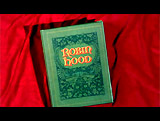
Robin Hood (1973)
|
- based on the classic British legend
- used anthropomorphic furry animals to represent
the human characters (Robin Hood - a fox, Maid Marian - a female
fox, Little John - a bear, Friar Tuck - a badger, etc.)
- an Academy Award nominee: Best Original Song
(Love)
|
|
22
|
|
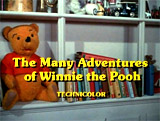
The Many Adventures of Winnie the Pooh (1977)
|
- based upon the 'Pooh' storybooks by British author A.A. Milne
- basically a compilation film, composed of three
previous featurettes: Winnie
the Pooh and the Honey Tree (1966), Winnie the Pooh
and the Blustery Day (1968),
and Winnie the Pooh and Tigger Too (1974) with an added
fourth short -- Winnie the Pooh and a Day for Eeyore
- directly followed by the sequel Winnie the
Pooh (2011)
|
|
23
|
|
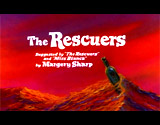
The Rescuers (1977)
|
- based upon the series of children's books (beginning
in 1959) of the same name by author Margery Sharp, about two
mice: Miss Bianca (voice of Eva Gabor) and Bernard (Bob Newhart),
who traveled around the world to "R
- E - S - C - U - E" cute human children
- the first Disney animated feature to
have a sequel released: The Rescuers Down Under (1990)
|
In the 1960s decade, Walt Disney Studios also re-emerged
as a triumphant box-office moneymaker and producer of a variety of
expensive-to-produce, animated and likable, wholesome live-action
family features, including Mary Poppins (1964), a delightful
musical fantasy combining animation and live-action sequences (winning
the Best Special Effects Oscar), and featuring Best Actress-winning
Julie Andrews in her screen debut as an energetic, eccentric nanny
with magical powers in Edwardian London; also with Dick Van Dyke,
and the songs "Supercalifragilisticexpialidocious" and
the Oscar-winning "Chim-Chim Cher-ee." Bedknobs and
Broomsticks (1971), a combination of live-action and animation,
was a feature similar to Mary Poppins (1964).
Disney's Animations in the 80s:
Throughout most of the 1980s, Disney struggled, and
continued to release fairly mediocre animations (except for The
Little Mermaid (1989)), including the following:
Walt Disney Animation Studio Feature Films
(1937-present)
Decade of the 1980s
|
| No. |
Title Screen |
Title (Year) |
Notables |
|
24
|
|
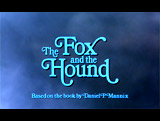
The Fox and the Hound (1981)
|
- based on the novel by Daniel P. Mannix
- tagline: "A Story of Two Friends Who Didn't
Know They Were Supposed to Be Enemies" - orphaned young
red fox Tod and hound puppy dog Cooper
- the first major effort by the "new generation" of
Disney artists
- to date, the most expensive animated
film ($12 million) ever produced
- the 14th highest-grossing (domestic) film of
1981, with $39.9 million revenue
- with a direct-to-video sequel, The Fox and the
Hound 2 (2006)
|
|
25
|
|
The Black Cauldron (1985)
|
- this dark animation was based on the mid-1960s
Welsh mythological novels The
Chronicles of Prydain by
Lloyd Alexander; it told about Taran, a young apprentice pigkeeper
who aspired to be a warrior; the Black Cauldron could unlock
an army of invincible, undead warriors able to conquer the
world
- the first Disney animated film to be recorded
in Dolby Stereo, and to receive a PG rating
- the first Disney animated film to feature CGI (computer-generated
imagery)
- a costly-to-produce feature, setting a new record
of $44 million, and a major box-office failure - the 42nd highest-grossing
(domestic) film of 1985, with only $21.3 million
|
|
26
|
|
The Great Mouse Detective (1986)
|
- based upon Eve Titus' childrens books, Basil
of Baker Street, and Sherlock Holmes tales
- the characters: mice and rats
in Victorian London; Basil was a "great mouse detective" hired
to find kidnapped toymaker and mechanical genius Hiram Flaversham,
while combating his arch-enemy Professor Ratigan (Vincent
Price)
- the 38th highest-grossing (domestic) film of
1986, with only $25.3 million
|
|
27
|
|
Oliver & Company (1988)
|
- based upon Charles Dickens' classic 1838 novel,
Oliver Twist, although a retelling with talking animals,
including Oliver as an unwanted homeless kitten and dogs in
Fagin's gang, led by a mongrel named Dodger (as in the Artful
Dodger)
- the setting was modern-day NYC, not London
- the 17th highest-grossing (domestic) film of
1988, with $53.3 million
- the first Disney film to experiment with the
CAPS (Computer Animation Production System) animation system
- digital ink and paint to reduce costs, in its creation of
New York traffic
- the first Disney animated film to include advertised,
brand-name or commercial products (some with logos)
- this film was considered the last film
of Disney's "pre-Renaissance" era
|
|
28
|
|
The Little Mermaid (1989)
|
- based upon Danish author Hans Christian Andersen's
tale of the same name - about a mermaid Princess Ariel who
wished to be human after falling in love with human Prince
Eric
- due to the film's overwhelming success, it was
considered the first film in a
"Disney Renaissance"
- the 13th highest-grossing (domestic) film of
1989, at $84.4 million and $211.3 million (worldwide)
- a two-time Academy Award winner: Best Song
(Under the Sea), Best Score, and another nominee
for Best Song (Kiss the Girl)
- with numerous spin-offs and sequels
|
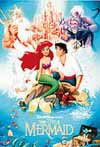 Disney
Studios returned to the quality of its heyday of animation from the
30s and 40s with advanced, more mature animations in the late 80s
and into the 1990s, including the tale of the headstrong young mermaid
Ariel in The Little Mermaid (1989).
The popular and highly successful film won two Oscars (Best Score
and Best Song: "Under
the Sea") - Disney's first Oscar nominations since 1977, and
earned $84 million (domestic) and $211 million (worldwide) at the
box-office. The film recharged Disney, and insured the revival of
animated films, with increasingly stronger hits for the studio in
the early 1990s. Disney
Studios returned to the quality of its heyday of animation from the
30s and 40s with advanced, more mature animations in the late 80s
and into the 1990s, including the tale of the headstrong young mermaid
Ariel in The Little Mermaid (1989).
The popular and highly successful film won two Oscars (Best Score
and Best Song: "Under
the Sea") - Disney's first Oscar nominations since 1977, and
earned $84 million (domestic) and $211 million (worldwide) at the
box-office. The film recharged Disney, and insured the revival of
animated films, with increasingly stronger hits for the studio in
the early 1990s.
Disney's
TRON:
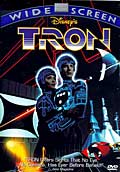 Although not a classic animated film, Disney's TRON (1982),
the studio's first PG-rated film and the first feature
film to imaginatively attempt to represent a computer-generated 'cyberspace'
world, was the first live action film with over 20 minutes
of computer animation. It told about gladatorial-style combat between
two individuals within a computer's virtual reality world, including
a race on light bikes. [The fictional cyberpunk book (the first of
the cyberpunk literary genre) credited with coining the word 'cyberspace'
(referring to the Internet) was William Gibson's Neuromancer in
1984. The book also referred to cyberspace as the Matrix. One
of Gibson's short stories was later turned into the film Johnny
Mnemonic (1995) with Keanu Reeves.] Although not a classic animated film, Disney's TRON (1982),
the studio's first PG-rated film and the first feature
film to imaginatively attempt to represent a computer-generated 'cyberspace'
world, was the first live action film with over 20 minutes
of computer animation. It told about gladatorial-style combat between
two individuals within a computer's virtual reality world, including
a race on light bikes. [The fictional cyberpunk book (the first of
the cyberpunk literary genre) credited with coining the word 'cyberspace'
(referring to the Internet) was William Gibson's Neuromancer in
1984. The book also referred to cyberspace as the Matrix. One
of Gibson's short stories was later turned into the film Johnny
Mnemonic (1995) with Keanu Reeves.]
It was also the first film to popularize the
idea of a computer or network in which one could experience virtual
reality, and the first film to use the term 'hack' (the root
of 'hacker' or 'hacking'), and to refer to the cyberuniverse as the
'matrix'. [Landmark composer Wendy (nee Walter) Carlos (who had collaborated
earlier with Stanley Kubrick on A
Clockwork Orange (1971) and The Shining (1980) -
among others) provided a unique synthesized/orchestral score to accompany
the pioneering, on-screen animation.]
It was disqualified for a Best
Visual Effects award because the old-fashioned Academy believed that
it "cheated"
by using a computer. (In fact, the film used a laborious, frame-by-frame process
to produce its computer animation.) The concept of using computers to craft
environments, rather than drawing them by hand, was considered inauthentic
- until Cameron's computer-animated The Abyss (1989) won the
Best Visual Effects Oscar.
A New Era of Disney Animation: The 1990s
Disney continued its string of major hits into the
1990s: (also see chart below)
- Beauty and the Beast (1991), an
updated version with a strong heroine, Belle and a Beast (a mix
of buffalo, lion, and gorilla), was nominated for a well-deserved
Best Picture Academy Award (the first nomination for Best
Picture ever received for a full-length animated feature), and
the theme song "Beauty
and the Beast" won the Best Original Song Oscar (from its
six Oscar nominations). It also had tremendous box-office: $146
million (domestic), $219 million (domestic lifetime), and $425
million (worldwide).
- Aladdin (1992), a film that moved beyond
the traditional fairy tale, used computer-generated imagery, and
was designed for a more adult audience - it marked a significant
change in Disney's output. It received a phenomenal five Oscar
nominations (and won two for Best Original Song, "A Whole
New World," and Best Score). At the time of its release, it
was criticized for its negative, 'Americanized' representation
of Arabs and non-western cultures. The film featured improvisational
comic Robin Williams as the vocal for Aladdin's blue Genie. Its
box-office was $217 million (domestic) and $504 million (worldwide).
- The Lion King (1994),
the first Disney film based upon an in-house original story,
rather than upon a well-known children's narrative, although its
complex and advanced story-line was derived from elements of Shakespeare's Hamlet,
classical mythology, various hero-quest tales, and African folk
tales. It was also Disney's first film to totally disregard
human characters, although it received criticism for racial stereotyping
(the voices of the evil hyenas were voiced by minority-ethnic performers).
The wildebeest stampede scene integrated 3-D computer animation
with traditional animation techniques. After setting a box-office
record (of over $312.9 million (domestic), $422.8 million (domestic
lifetime), and $968.5 million (worldwide) at the box-office as
the most commercially-successful animated film to date), it also
won two Academy Awards from its four music-related nominations. The
Lion King spurred a boom in animation production and merchandising,
and other animation production studios besides Disney entered the
picture.
[Note: Some Disney critics firmly believed that The
Lion King was blatantly derived from Kimba the White Lion. Kimba was
originally known as Jungle Emperor (Jungle Taitei) when
it was serialized as a comic from 1950 to 1954, and it later became
Japan's first color animated TV series in 1965. Fifty-two
episodes were released in 1966 in English under the title Kimba
The White Lion from Tezuka Productions. Disney supporters claimed
that the similarities were only coincidences.]
- Disney's Pocahontas
(1995), a hand-drawn animation, was the studio's 33rd
feature-length animated movie and the first to be based on actual
events and people.
- Disney also released two hand-drawn animations in
the next two years, the dark and ambitious The Hunchback of
Notre Dame (1996) based upon the Victor Hugo novel, and Hercules
(1997) about
the mythological strong man.
- Disney's hand-drawn animated Chinese folk tale Mulan
(1998) was the studio's 36th feature-length animated film.
- The coming of the end of the decade was marked by
Disney's Tarzan
(1999),
the first full-length, hand-drawn animated feature about Edgar
Rice Burrough's King of the Jungle.
Walt Disney Animation Studio Feature Films
(1937-present)
The Decade of the 1990s
|
| No. |
Title Screen |
Title (Year) |
Notables |
|
29
|
|
The Rescuers Down Under (1990)
|
- a sequel to The Rescuers (1977) - Disney's
first animated theatrical feature film sequel; the studio's next
two sequels were Fantasia 2000
(1999) and Winnie the Pooh (2011)
- set in Australia's Outback ("Down Under"),
and the third Disney film to feature anthropomorphic mice as
the main characters; Bob Newhart and Eva Gabor reprised their
roles as Bernard and Miss Bianca
- the least successful film released during the
Disney Renaissance (from 1989 to 1999), and the only one during
the time period to be a non-musical film; with only $28 million
(domestic) revenue
- a pioneering film - the first to be 100%
created digitally without the use of a camera; all of the coloring,
many effects, and the final film printing was done digitally
(it was Disney's first film produced entirely using the CAPS
animation-coloring system), saving the company both time (6
mos.) and money
- its theatrical release at the time was accompanied by the animated featurette The
Prince and the Pauper, based on the story by Mark Twain and starring
Mickey Mouse and friends
|
|
30
|
|
Beauty and the Beast (1991)
|
- based upon Jeanne-Marie Le Prince de Beaumont's
1756 French fairy tale of the same name, and paying homage
to Jean Cocteau's La Belle et La Bete (1946, Fr.)
- the first animated film to be nominated
for Best Picture before a special category for Best Animated
Feature Film was created in 2009
- the third highest-grossing (domestic) film of
1991, and the best film of Disney's "Renaissance" period
- with 6 Oscar nominations, it was a two-time
Academy Award winner: Best Original Score, Best Original Song
(Beauty and the Beast), also nominations for two other
Best Original Songs (Belle and Be Our Guest),
Best Sound and Best Picture
- it was the first animated film to be nominated for an Academy
Award for Best Picture
- the first Disney animated film to be adapted
into a Broadway musical in 1994
- followed by a live-action remake Beauty and
the Beast (2017)
|
|
31
|
|
Aladdin (1992)
|
- based upon the familiar Arabian fairy tale ("Aladdin
and the Wonderful Lamp") and
Antoine Galland's French interpretation The Thousand and One
Nights in the early 18th century
- the story was about the developing romance,
in the fictional city of Agrabah in Arabia - between street
urchin Aladdin and rebellious
Princess Jasmine; other characters included evil vizier
Jafar, a magic lamp, magic carpet, and a huge blue genie
(Robin Williams)
- the highest grossing (domestic and worldwide)
film of 1992, at $217 million, and $504 million (worldwide)
- with 5 Oscar nominations, it was a two-time
Academy Award winner: Best Original Song (A Whole New World),
Best Score, also nominations for Best Sound, Best Sound Editing,
and another for Best Original Song (Friend Like Me)
|
|
32
|
|
The Lion King (1994)
|
- the first Disney film based upon an in-house
original story, rather than upon a well-known children's narrative,
although with similarities to Shakespeare's play Hamlet
- about a lion cub named Simba, his father Musafa
(ruler of the Pride Lands), and the treachery of his uncle
Scar and romance with Nala
- the second highest-grossing (domestic) film
of the year 1994, at $312.9 million, and the highest-grossing
(worldwide) film of the year with $968.5 million - one of the
most financially successful of Disney's films
- with 4 Oscar nominations, it was a two-time
Academy Award winner: Best Original Score, Best Original Song
(Can You Feel the Love Tonight), and two other Best Song
nominations for Circle of Life and Hakuna
Matata
- a large series of sequels, spin-offs, series,
and a Broadway musical (in 1997) followed
|
|
33
|
|
Pocahontas (1995)
|
- based upon the life and legend of Native American
Algonquin Pocahontas (1595–1617), the daughter of Chief
Powhatan, and rewritten by Englishman John Smith
- the first animated Disney movie with an
inter-racial romance
- the 4th highest-grossing (domestic) film of
1995 at $141.6 million, but with only $346 million (worldwide)
- considered a poor performing film when compared to its predecessor
The Lion King (1994), and criticized for its modified historical
story
- a two-time Academy Award winner (for its 2 nominations):
Best Original Musical Score, Best Original Song (Colors
of the Wind)
- followed by a direct-to-video sequel, Pocahontas
II: Journey to a New World (1998)
|
|
34
|
|
The Hunchback of Notre Dame (1996)
|
- based upon the novel by French author Victor
Hugo, and similar to the earlier film The Hunchback of Notre
Dame (1939), about an unlikely friendship that developed
between deformed Notre Dame bellringer Quasimodo and gypsy
girl Esmeralda
- one-time Academy Award nominee: Best Musical
Score
- the 15th highest-grossing (domestic) film of
1996, at $100.1 million and $325.3 million (worldwide) - but
its production budget was $100 million!
- some attributed its box-office failings to adult-oriented
topics in a family film, including lust, racism, and religious
bigotry, although it was surprisingly rated G
- although backgrounds and crowd scenes were CGI,
all of the character animations were hand-drawn
- a sequel was only direct-to-video: The Hunchback
of Notre Dame II (2002)
|
|
35
|
|
Hercules (1997)
|
- adapted from the Greek myth of Heracles (the
son of Zeus), a Roman hero and god known as Hercules - a strong
man
- the 17th highest-grossing (domestic) film of
1997, with $99.1 million in revenue, and only $252.7 million
(worldwide), and a production budget of $85 million
- a one-time Academy Award-nominee: Best Original
Song (Go the Distance)
- the 8th film in the so-called "Disney Renaissance"
- the first Disney animated film with a positive
portrayal of African-American women
- followed by a direct-to-video TV prequel Hercules:
Zero to Hero (1999)
|
|
36
|
|
Mulan (1998)
|
- based on the ancient Chinese folk legend of
an historical warrior female named Hula Mulan; in the feature
film, the title character was Fa Mulan (who assumed the male
name Fa Ping) to be trained militarily and to fight against
invading Huns
- the 13th highest-grossing (domestic) film of
1998, at $120.6 million, and $304.3 million (worldwide)
- one-time Academy Award nominee: Best Original Musical Score
- a sequel followed: Mulan II (2004)
|
|
37
|
|
Tarzan (1999)
|
- based upon Edgar Rice Burroughs' character
in 1912 novel Tarzan of the Apes, starring two main characters:
the heroic Tarzan (Tony Goldwyn) and Jane (Minnie Driver), and
two animal friends - a female gorilla (Rosie
O'Donnell) and a neurotic elephant (Wayne Knight)
- the last film of the so-called "Disney Renaissance"
- the 6th highest-grossing (domestic) film of 1999, at $171 million,
and $448.2 million (worldwide)
- with a production budget of $130 million, it
was the most expensive animated film ever made at the time
- Academy Award winning Best Original Song (You'll
Be In My Heart)
|
|
38
|
|
Fantasia 2000 (1999)
|
- the sequel to Fantasia (1940)
- composed of eight animated segments tied to
classical music (performed by the Chicago Symphony Orchestra),
one of which was The
Sorcerer's Apprentice from the original film
- the other seven segments, introduced by celebrities,
were: Beethoven's abstract Symphony
No. 5, Respighi's Pines of Rome (about flying
humpback whales), Gershwin's jazzy rendition of Rhapsody
in Blue, Shostakovich's Piano Concerto No. 2 in F
Major (the
telling of Hans Christian Andersen's story The Steadfast
Tin Soldier), Saint-Saëns' The
Carnival of the Animals - Finale (a flamingo with a yo-yo),
Elgar's Pomp and Circumstance (the story of Noah's
Ark with Donald Duck), and Stravinsky's
Firebird Suite
- premiered in mid-December 1999, with its IMAX
release in the year 2000 - it was a milestone -- the first
animated feature-length film to be released in the format
- with a production budget of $80-85 million,
and only $60 million (domestic), and $90.8 million (worldwide);
it was the 50th highest-grossing (domestic) film of the year
2000
|
Other Exceptional Animations:
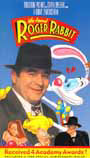 Another
exceptional film (a coordinated effort released by Disney (Touchstone),
produced by Steven Spielberg's Amblin, live-action directed by Robert
Zemeckis, and animated by Richard Williams) was the Oscar-winning Who
Framed Roger Rabbit (1988), a remarkable blend of animated
imagery and live-action human characters. It was filmed as a tribute
to the entire pantheon of cartoon characters from Disney, Warner
Bros., and MGM, and other studios in the 1940s. Its animation was
revolutionary in a number of ways: Another
exceptional film (a coordinated effort released by Disney (Touchstone),
produced by Steven Spielberg's Amblin, live-action directed by Robert
Zemeckis, and animated by Richard Williams) was the Oscar-winning Who
Framed Roger Rabbit (1988), a remarkable blend of animated
imagery and live-action human characters. It was filmed as a tribute
to the entire pantheon of cartoon characters from Disney, Warner
Bros., and MGM, and other studios in the 1940s. Its animation was
revolutionary in a number of ways:
- it used light and shadows
in new ways to produce remarkably realistic, 3-D effects
- it
extensively panned and moved the camera to reduce a static look,
and
- it had the car'toon' characters interact flawlessly
with real-world objects and flesh-and-blood people as much as possible
Warner Bros.' Space Jam (1996) also featured Looney
Tunes characters within a live-action film with basketball superstar Michael
Jordan. Other films that used the same techniques to mix live-action and animation
were: The Adventures of Rocky and Bullwinkle (2000) and Joe Dante's Looney Tunes: Back in Action (2003).
Japanimation or Anime:
One of the reasons for the popular emergence of Japanese animation was the successful animated Japanese-TV series Astro Boy (1963). The Western release of director Katsuhiro Otomo's cult favorite
epic animated adventure Akira (1988), based on the science-fiction comic book (manga)
series - a post-apocalyptic, cyberpunk tale set in Neo-Tokyo, also contributed to the spread of Japanese anime (or "Japanimation") worldwide.
Excellent
examples of feature length, science-fiction Japanese anime were directed by auteur animator and founder of the famed Ghibli Studios Hayao
Miyazaki -- known as the "Japanese Walt Disney." His humanistic-oriented
animations -- painstakingly detailed traditional cel animation during an era
of CGI films -- were generally filled with magical and/or mythical settings,
rich and fantastic characters (usually a young heroine), imaginative and visual
renderings, fairy-tale motifs and plots with moral lessons, tales of the struggle
between the strong and the weak, and environmental concerns. His films were
actually bought for American distribution by Disney Studio, and include the
following:
|
Filmography: Examples of Hayao Miyazaki's Japanese Anime Films
|
| Title |
Notable |
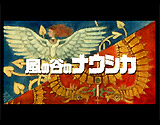
Nausicaä of the Valley of the Wind (1984, Jp.)
(aka Kaze
no tani no Naushika, or Warriors of the Wind)
|
- this was Miyazaki's second feature (after Lupin
the Third: The Castle of Cagliostro (1979, Jp.) that
was released
in 1979 in Japan,
but not theatrically-released to US audiences until 1991)
- Nausicaa's success directly led to the
formation of Studio Ghibli for his next anime film
- it was the first Miyazaki film to have a North
American release, but it was retitled as Warriors of the
Wind (1985) in
a poorly-edited and excised version; eventually, an approved,
uncut and uncensored English version was finally produced in
2006 by Ghibli's longtime partner Disney and approved by Miyazaki
himself
- it was a post-nuclear or post-apocalyptic, anti-war
tale, set in the protected Valley of the Wind
- it was based on the comic book (manga)
Miyazaki had created years earlier, about the struggle of a
peace-seeking warrior princess to keep two opposing kingdoms
from destroying the planet
|
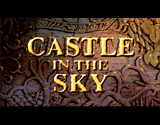
Castle in the Sky (1986, Jp.)
(aka Laputa: Castle in the Sky)
|
- the very first film animated and released by
Studio Ghibli, newly-formed to produce the film
- it was a fantasy action-adventure anime,
inspired by one chapter of
Gulliver's Travels
- in the plotline, two young orphaned children
(Pazu and Sheeta) searched for a floating city in the sky (with
the fabled castle Laputa) as they battled sky pirates (led
by matriarch Dola) and evil government
forces
|
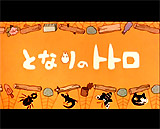
My Neighbor Totoro (1988, Jp.)
(aka Tonari no Totoro)
|
- this was Studio Ghibli's second feature film
and the fourth animated feature directed by Hayao Miyazaki
- it has been considered the definitive Miyazaki
film
- the film's title character in the forest
of post-war Japan was a friendly wood spirit known as Tortoro,
seen by two sisters (young Mei and older Satsuki)
- Tortoro
became the mascot for Studio Ghibli
|
Grave of the Fireflies (1988, Jp.)
(aka Hotaru no Haka)
|
- released theatrically as one-half of a double
feature; the other half was the more light-hearted My Neighbor
Totoro (also
1988)
- the powerful and poignant tearjerking tale
was based on Akiyuki Nosaka's semi-autobiographical novel of
the same name
- it told about two orphaned Japanese siblings
during the waning days of World War II: a teen-aged boy (Seita)
and his 4 year-old sister (Setsuko), who reunited after death
and as ghosts looked back at the last few months of their
short lives in the city of Kobe (the motif of fireflies symbolized
the shortness of life, and the souls of the dead)
- at the time, it was the only Ghibli film
not personally directed by Miyazaki - instead, it was written
and directed by Isao Takahata for Studio Ghibli
- animation historian Ernest Rister felt it was
comparable to Spielberg's Schindler's
List (1993), and film critic Roger Ebert considered
it one of the greatest (anti-) war films ever made
|
Kiki's Delivery Service (1989, Jp.) (aka Majo no Takkyûbin)
|
- in the plot, newly-turned 13 year-old witch
Kiki ventured to a southern, ocean-side port city
of Koriko where she used her flying broom as a 'delivery service'
for a baker, and then went into business independently; the
plot was an excuse to examine her coming-of-age, and her trials
and tribulations as an adolescent
- nine years after the film was released, Disney
(in partnership with Studio Ghibli) dubbed it with English-speaking
celebrity voices and additional music for a US release in
1998
|
Porco Rosso (1992, Fr./Jp.)
(aka The Crimson Pig,
or Kurenai No Buta)
|
- the anime's main character was mercenary pilot
Porco Rosso (the "Red Pig"), a renowned Italian fighter pilot
and veteran of WWI, who had been transformed into an anthromorphic
pig, flew in a crimson seaplane and battled "air pirates" during
the Roaring 20s in the Adriatic Sea off the East Coast of Italy;
the pirates fought back by hiring American aviator Donald Curtis,
while Porco was aided by a teenaged sidekick named Fio - a
young mechanic with a crush on Porco
- Miyasaki's anime paid homage to the early days
of aviation, Italy and cinema
|
Whisper of the Heart (1995, Jp.)
|
- it was the first theatrical Studio Ghibli film
to be directed by someone other than Miyazaki or Isao Takahata
- the film's tale was a romantic drama set in
Tokyo, written by Hayao Miyazaki, about the relationship between
book-loving 14-year-old junior high school student Shizuku
Tsukishima, and fellow student Seiji Amasawa, an apprenticed
violin maker
- in the plot, Shizuku created a fantasy
story with four characters: (1) herself as the
female protagonist, (2) a male hero named the Baron, (3)
Baron's lost love Louise, and (4) a cat known as "Moon" or "Muta" that
she followed from the train to an antique shop owned by Nishi,
Seiji's grand-father; in the shop was a cat statuette garbed
in formal wear known as the "Baron"
- it was followed by the semi-sequel, The Cat
Returns (2002) - see below
|
Princess Mononoke (1997, Jp.)
|
- it was a $20 million animated
adventure-fantasy epic that opened in Japan, where it quickly
became the highest-grossing Japanese film in Japanese
history to the time
- it was originally intended to be Miyazaki's
last film, until the release of Spirited Away (2001)
- it was an extremely-intense and dark anime,
not often recommended for young children
- the story ws set in the 15th to 16th centuries
in a mining town known as Tataraba (Iron Town), during a
three-way mythic battle between the town (led and protected
by Lady Eboshi), forest gods (led by the Wolf God named Moro),
and greedy samurai war-lord Lord Asano who wished to take over
the town; the main protagonist was young prince Ashitaka
endowed with superhuman strength who pursued a relationship
with human girl San (raised by wolves)
|
Spirited Away (2001, Jp./US)
|
- it was a magical and surreal animated adventure
- one of the director's most revered, popular and honored films
- it was the Oscar winner for Best Animated Feature
Film (it was the first anime feature film to win an
Academy Award Oscar, awarded in 2002)
- at the time, it was the highest-grossing film
in Japanese history
- it bested Miyazaki's previous film as the highest-grossing
Japanese film ever made
- with an Alice-in-Wonderland like tale
of a young 10 year-old girl (shojo) named Chihiro, who
found a mysterious spirit world amusement park where she attempted
to save her parents (who were transformed into pigs) by changing
them back into humans, and then escape out of the spirit world
before losing her own identity; she was aided by human boy
Haku
|
The Cat Returns (2002, Jp.)
(aka Neko No Ongaeshi)
|
- it was a spin-off or semi-sequel of the earlier
anime film Whisper
of the Heart (1995), focusing on the minor character
- a cat figurine known as Baron that had come to life, and
it involved a journey to a Cat Kingdom
- the story was the creation of the protagonist
(a high-school student) of the earlier film - it was another
coming-of-age story about a high-school girl named Haru
who could communicate with cats
- it was the second Ghibli Studios anime not directed by Miyazaki
or Takahata
|
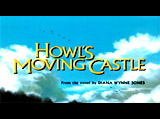
Howl's Moving Castle (2004, Jp.)
|
- an Academy Award-nominated film for Best Animated
Feature Film, but lost the Oscar to the UK's Wallace & Gromit:
The Curse of the Were-Rabbit (2005)
- it was one of the most financially-successful
Japanese films in history
- the setting was a steampunk/gaslamp fantasy
(fictional) world, where the main protagonist Sophie was transformed
by a witch's curse into a 90 year-old woman; the story was
about Sophie's quest to find the wizard Howl who could break
the cursed spell; she found Howl in his floating castle along
with Howl's young male apprentice Markl
- this anime had a very strong anti-war
message, as it followed the development of Sophie's romance
with Howl during a time of war
|
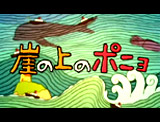
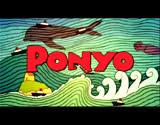
Ponyo (2008, Jp.)
(aka Gake no ue no Ponyo, or Ponyo on the Cliff By the Sea)
|
- this anime was distantly based upon
Hans Christian Andersen's 1837 tale The Little Mermaid
- its story followed the adventures and quest
of Ponyo (a goldfish) to become human
and find love with 5 year-old human boy Sosuke
- it was Ghibli Studio's first film in years
that was traditionally created -- completely hand-drawn (without
any CGI); it was also Miyazaki's eighth film that he had directed
for Ghibli
- it was the highest-grossing Miyazaki movie
in North America, at $15 million (domestic), and $201.8 million
(worldwide), until the release of co-writer Miyazaki's The
Secret World of Arrietty (2012, US release with American
dub)
- Arrietty was originally
released in 2010 in Japan as Arrietty (aka The Borrower
Arrietty); it was based on Hans Christian Andersen's
fairy tale Thumbelina; it became the highest-grossing
theatrical Studio Ghibli release in the US, with a gross of $19.2
million (domestic), and $145.6 million (worldwide)
|
Others have created equally-inventive and beautiful animations,
including:
- director Yoshiaki Kawajiri's dark, excessively-violent
and adult-oriented Wicked City (1987)
- director Isao Takahata's Only Yesterday (1991) and Pom Poko (1994)
- anime auteur Mamoru Oshii's cyber-punk, apocalyptic
animated thriller, Ghost in the Shell (1995) - one of the most expensive anime films ever made, and the first made specifically for the international
market
Satoshi Kon's Millenium Actress (2001) and
the Pokemon series
of children's films (beginning in 1999) were also notable examples
of anime.
A Boom in CGI Animation in the 90s:
Cutting edge, computer-graphics imaging (CGI) has recently
taken over the cinematic industry. A dazzling collection of state-of-the art
computer animation footage in "The Mind's Eye" video series (from
Miramar Productions) highlighted, documented, and showcased the vast array
of computer artistry, CGI and visual magic in the early to mid-90s from various
sources, with accompanying original music. The main videos in the showcase
series included:
- The Mind's Eye (1991)
- Beyond the Mind's Eye (1992), including
special effects clips from The Lawnmower Man (1992)
- The Gate to the Mind's Eye (1994)
- Odyssey into the Mind's Eye (1996)
Warner Bros' adult-oriented, dark animated adventure Batman:
Mask of the Phantasm (1993) - aka Batman: The Animated Movie, with
an opening CGI sequence, was based on the '90s Saturday morning animated television
series, and was the successor to the original comic-book hero and the two
Tim Burton feature-film versions: Batman (1989) and Batman Returns
(1992). [Mark Hamill provided the humorous voice of the Joker.] Burton
has become better known for his two ghoulishly clever stop-motion animation
films with puppetry - The Nightmare Before Christmas (1993) and Corpse
Bride (2005) (with Johnny Depp as 19th century shy bridegroom
Victor Van Dort who inadvertently married a 'corpse bride' voiced
by Helena Bonham Carter), as well as for his James and the Giant Peach (1996). |
 Animated Films