|
Entrances of All-Time 1950-1955 |

| Movie Title/Year and Film Character with Scene Description | ||||||||||||||
|
D.O.A. (1950)
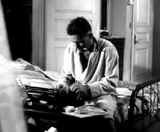
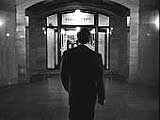
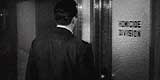
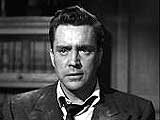
In the striking opening sequence during the credits, one of the greatest entrances of all time, an individual was followed by the camera - face unseen - as he determinedly proceeded down the long hallway into the homicide division office of a police station. He was there to seek the "man in charge" and to report a murder ("I want to report a murder") to the homicide chief. He was asked the location of the murder and when asked: "Who was murdered?" the camera finally revealed the protagonist: small-town accountant Frank Bigelow (Edmond O'Brien), his face sweaty, his tie loosened and collar disheveled, and his suit caked with dirt. Frank paused for a long minute, and answered shakily: "I was." He then related, in flashback, how he had awakened and discovered that he'd been poisoned by a "luminous toxin" called iridium and had a week to live due to the radiation poisoning - only a short time to try to untangle the events behind his imminent demise. |
|
||||||||||||
|
Rashomon (1950, Jp.)
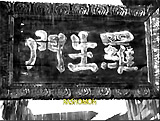
In Akira Kurosawa's landmark film in cinematic history, set in 12th century feudal Japan, a bandit Tajōmaru (Toshirō Mifune) was the first of the four main characters to testify - all of the characters told incompatible, contradictory tales of the same 'rape' and murder. The wife (Machiko Kyō) (with her face concealed under a large hat and veil) was being led on a horse by her samurai husband (Masayuki Mori) through a dense forest. The bandit/rapist watched from a concealed place. When the bandit glimpsed her bare feet and the camera panned up to partially reveal her face through the open veil, he was awestruck by the sight. He recalled:
The bandit chased after them to confront them. He lied to the husband and led him deep into the woods where he attacked him (and tied him with a rope to a pine tree). He returned to the wife who fully opened her veil to him. He told her the samurai was sick. She turned pale and looked at him with "frozen eyes." The bandit changed his feelings about her husband:
He dragged the wife back into the forest, where the wife fiercely defended herself with an expensive jewel-inlaid dagger, but then exhausted, she yielded and let herself be seduced by the bandit:
She encouraged a fight for her honor by begging:
After the samurai was released, the two men dueled to the death over the wife's honor. The bandit killed the samurai, but then the scared wife ran away. |
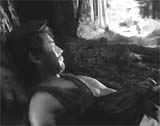 The Bandit Watched the Couple 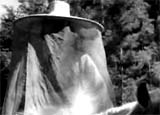 The Wife Concealed Under Veil  Wife's Face First Revealed to Bandit 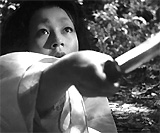 Wife's Defense with Dagger 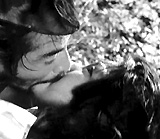 Wife Succumbing to Bandit |
||||||||||||
|
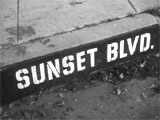
Sunset Blvd. (1950) (aka Sunset Boulevard)
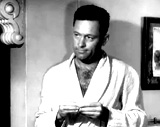
Billy Wilder's gothic masterpiece opened with a voice-over narration read cynically and crisply in a film-noirish style, by a disembodied dead man - hack screenwriter Joe Gillis (William Holden). At about 5 am in the morning, motorcycle officers, followed by police cars with sirens blaring, carrying a homicide squad, detectives and reporters, rushed down Sunset Boulevard to a mansion in Beverly Hills in the 10,000 block. There, they found a dead body floating face down in a swimming pool.
Shortly afterwards, in a flashbacked scene set six months earlier, Joe was introduced as a struggling, down-and-out, depressed, Midwestern screenwriter, who was working in his one-room apartment house. While fleeing in his car from repo men, Joe happened to have a flat tire near the driveway of a decaying mansion in the 10,000 block of Sunset Boulevard.
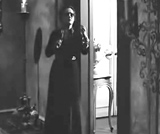
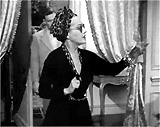
He heard a woman wearing dark glasses behind a slatted shade beckoning him: "You there! Why are you so late? Why have you kept me waiting so long?" After being summoned inside by a butler, he ventured upstairs where in the corridor, he met for the first time the wealthy, aging, reclusive Norma Desmond (Gloria Swanson), Paramount's greatest film star during the silent era ("an old time star...one of the biggest"), but now a relic forgotten for the past twenty years. She was dressed in black house pajamas, wearing sunglasses and she had a leopard-patterned scarf wrapped like a turban around her head. During their initial conversation, he recognized her, and commented about how big she was in silent pictures: "You're Norma Desmond. You used to be in silent pictures. You used to be big." She bristled back: "I am big. It's the pictures that got small." |
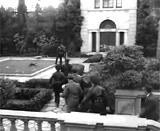 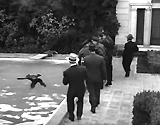 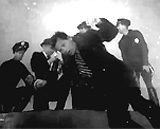 Joe Gillis (William Holden) Dead in Swimming Pool 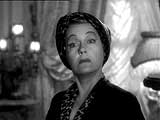 Norma: "I am big - it's the pictures that got small" 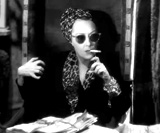 Vampish-Looking Norma Desmond |
||||||||||||

|
The Day The Earth Stood Still (1951)
After a huge flying saucer landed on the Ellipse (President's Park) in Washington, DC in 1951, a humanoid alien visitor Klaatu (Michael Rennie) emerged down a ramp. The strange visitor was followed to everyone's amazement by his imposing massively-tall menacing robot protector named Gort - who had the ability to zap (melt) weapons or tanks with the disintegration laser beam-ray behind his visor. [The film was remade in 2008 by director Scott Derrickson, starring Keanu Reeves as Klaatu.] |
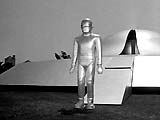 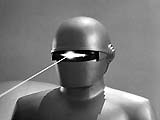
|
||||||||||||
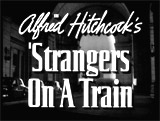
|
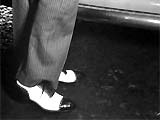
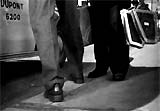
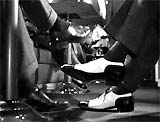
The opening sequence of Hitchcock's suspense thriller introduced the duality of the two 'strangers on a train' and a plan to "swap murders" - the two characters were:
They had a 'chance' meeting on a train enroute from Washington DC - it was a cleverly-choreographed sequence in which the two sets of the strangers' shoes were highlighted (and expressed their personalities) before they even met. |
|
||||||||||||
|
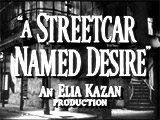
A Streetcar Named Desire (1951)
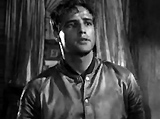
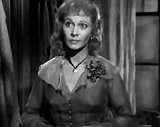
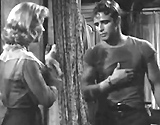
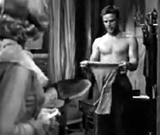
Director Elia Kazan's steamy and controversial classic, adapted from Tennessee Williams' 1947 Pulitzer Prize-winning play, opened with the arrival of fragile, repressed and delicate Southern lady Blanche du Bois (Vivien Leigh) in New Orleans. She found the location of a squalid, cramped and tawdry French Quarter one-bedroom apartment occupied by her married younger sister Stella Kowalski (Kim Hunter). But then she had to go to the local bowling alley to meet up with Stella. It was here that her brother-in-law Stanley (Marlon Brando) was bowling and causing a ruckus (seen only from a distance). Back at the apartment, Blanche became nervous about Stella's raunchy and raw husband, whom she hadn't yet met. When Blanche first came upon the brawny Stanley, he had just returned home from bowling. They stared at each other for a short while and sized each other up. Then she introduced herself: "You must be Stanley. I'm Blanche." Animalistic and exhibitionistic, he removed his bowling jacket, and then his hot, sweat-soaked, smelly and sticky T-shirt in front of her, and changed into a clean one to "make myself comfortable." She covertly snuck a peek at his massive, muscular biceps and torso. |
|
||||||||||||
|
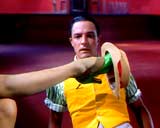
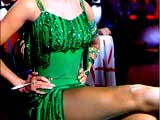
In an extraordinary scene, while Don Lockwood (Gene Kelly) was singing and dancing to a fantasy number - a 'show within a show' titled "Broadway Rhythm," a woman's long shapely leg abruptly appeared on the screen. It was dangling and balancing the straw hat from his head on an upturned foot. His eyes and the camera followed the leg up to the figure of a seductive Dancer (Cyd Charisse), a gangster's moll with a Cleopatra haircut. Wisps of cigarette smoke emanated from her mouth - while her striking leg raised almost 90 degrees, tantalizingly. He had met the girl of his dreams, a beautiful, bewitching exotic nightclub performer and city vamp, looking like vixenous silent star Louise Brooks. She was wearing a short, gloriously sexy green dress with matching green high-heels, and had a long cigarette holder in her hand. She left the table where her silver dollar-flipping, scar-faced gangster boyfriend (resembling actor George Raft in Scarface: The Shame of the Nation (1932)) sat with two mugs. She danced provocatively around him, shaking her hips and blowing cigarette smoke in his face. She removed his glasses and hat, steamed up the glasses with her breath and wiped them on her thigh, and then kicked away both his hat and glasses. She placed her long cigarette holder in his mouth. They continued dancing sensuously close together, and she began to kiss him. But she was lured away by the sight of a thick, sparkling diamond bracelet, held out by her gangster boyfriend's hand. |
  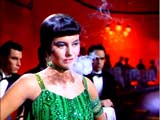 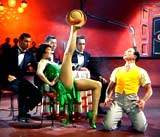
|
||||||||||||
|
Gentlemen Prefer Blondes (1953)
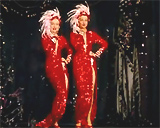
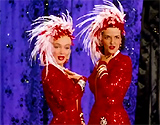
After the introductory 20th Century Fox logo, but before the opening credits, Marilyn Monroe (as Lorelei Lee) and Jane Russell (as Dorothy Shaw) burst onto the screen through black curtains, wearing sparkly red and white costumes. They were singing the opening number: "(We're Just) Two Little Girls From Little Rock"
|
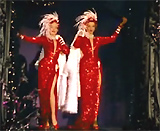  
|
||||||||||||
|
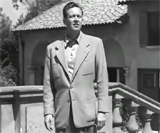
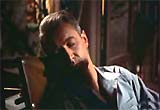
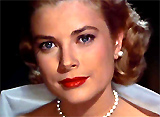
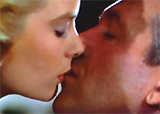
Photographer L. B. "Jeff" Jefferies (James Stewart) was dozing off in his apartment, immobilized with a cast on his broken leg. Earlier in the classic Hitchcock film, he had talked to his sharp-tongued, visiting nurse-therapist Stella (Thelma Ritter) about his girlfriend/fashion model-designer Lisa Carol Fremont (Grace Kelly). He was complaining about how she was too much of a "Park Avenue" woman - too rich, "too perfect," spoiled, sophisticated and incompatible for his lifestyle as a globe-trotting, high-risk, ultra-masculine photographer. In her famed film entrance, Lisa's shadow was first visible as it slowly rose up on Jeff's face as she approached (seen in close-up from his POV), bent over, and then lovingly kissed him - and asked: "How's your leg?" She roused and awakened him from his sleep - very stylish, elegant (with bright red lipstick and pearls), lovely, and blonde. |
|
||||||||||||
|
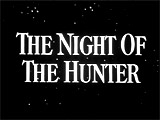
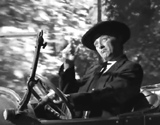
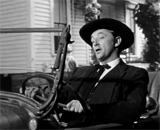
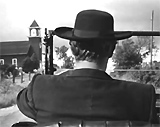
The Night of the Hunter (1955)
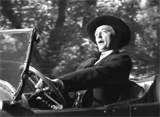
This mid-50s noir had one of the creepiest introductions in film history, in the sole directorial effort of English actor Charles Laughton. The camera tracked a Model T driven down a country road by a sinister, crazed, malevolent, black-cloaked, wide-brimmed and hatted 'Preacher' Harry Powell (Robert Mitchum), one of the 'false prophets.' He had presumably just committed another crime. In a chilling, perversely evil and memorable monologue to the Lord, the deranged killer-evangelist with borderline sanity, glanced heavenward and delivered an insane prayer, asking permission to kill another rich widow:
|
|
||||||||||||
(chronological, by film title) Introduction | 1920s-1935 | 1936-1939 | 1940-1945 | 1946-1949 | 1950-1955 | 1956-1959 | 1960-1965 | 1966-1969 1970-1975 | 1976-1979 | 1980-1985 | 1986-1989 | 1990-1995 | 1996-1999 | 2000-2005 | 2006-Present |




 Frank
Bigelow
Frank
Bigelow