|
Femmes Fatales in Classic Film Noir 1947 - 2 |
(chronological by film title) Introduction | Picture Guide | 1941 | 1944 | 1945 | 1946-1 | 1946-2 | 1947-1 | 1947-2 1948 | 1949 | 1950-1952 | 1953 | 1954-1956 | 1957-1959 |

|
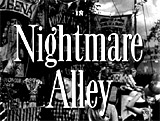
Nightmare Alley (1947)
Director Edmund Goulding's dark, bleak, fatalistic and very disturbing noir was basically the story of the rise and precipitous fall of a con-man - an overly-ambitious, cynical and fake mentalist/spirtualist or clairvoyant. The repulsive tale of decadence, doom and deception was based upon William Lindsay Gresham’s 1946 novel of the same name, with a screenplay by Jules Furthman. The film featured one of the coldest, most cunning, and calculating femmes fatales ever on film. [Note: Director Guillermo Del Toro's remake Nightmare Alley (2021) starred Bradley Cooper and Cate Blanchett in the two lead roles.] The sordid yet compelling film failed at the box-office, mostly because 20th Century Fox studio head Darryl F. Zanuck hated the film version and took it out of circulation. The film's super-charged sexuality and adultery (for its time) that caused the Production Code to order its scandalous content toned down, was reflected in its tagline:
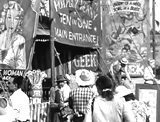
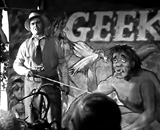
It opened in Burly, TX at one of the traveling Hoatley-Kenny Carnival's sideshows where handsome Stanton "Stan" Carlisle (Tyrone Power) was introduced - he was a roustabout drifter who had been raised in an orphanage before going to reform school. He had just joined the carnival as one of its hustlers, and was intrigued and fascinated by a performance of The Geek - one of the carnival's biggest draws. It was presented by the main carnival barker/owner Hoatley (James Flavin):
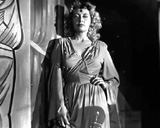
Stan watched as the Geek (George Beranger), in front of the audience (off-screen), bit off the heads of two live chickens. Next to the Geek exhibit was a fire-breather, and a Miracle Woman Zeena Krumbein (Joan Blondell), a fortune-teller whose assistant-husband Pete Krumbein (Ian Keith) was a spent, over-the-hill drunkard (a "rum-dumb" acc. to Stan). Zeena watched as Stan stood transfixed by the Geek show. Her specialty was a phony psychic mind-reading act. After the Geek act, Stan asked about becoming a Geek: "How do you get to be a Geek? Is that the only one? I mean, is a guy born that way?" He was cautioned to stop asking questions, and pondered to himself the Geek's degrading state in life: "I can't understand how anybody could get so low." (The Geek was a crazed, down-and-out alcoholic bum desperate for work, who took the job in exchange for a daily bottle of liquor.) Stan was Zeena's show announcer and told her how enthusiastic he was for his new experiences within the carny world:
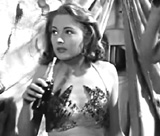
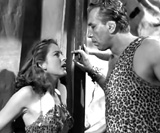
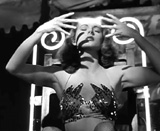
After Stan introduced Zeena and collected hand-written questions from the onlookers, a tricky back stage switch of cards (with Pete assisting in a lower cubbyhole) allowed Zeena to 'see' the questions in order to fool the audience. Another young and pretty carnival worker was Molly (Coleen Gray) - the 'Electric Girl' and girlfriend of possessive Bruno the Strongman (Mike Mazurki) with a leopard-skin loincloth. Her costume was a flimsy, flesh-colored costume with static blue fire shoots from her fingers (covering both breasts). Molly told Stan that Zeena and Pete were once big-time vaudeville headliners with another version of their mentalist act (until Pete became a bottle-hitting drunkard) - and had become stars through the development of a valuable, secret word code:
While on the road, Stan continued to be intrigued by the code, and manipulatively suggested to Zeena that she teach him the code - just in case Pete couldn't continue due to his sickly condition ("I was thinking that if Pete got sick or something, why, I could work from the audience just like he used to. No stage trap, no gypsy switch"), but Zeena at first declined by describing her intention to be steadfast and loyal to Pete, but she also admitted: ("I'm about as reliable as a two-dollar cornet"). Although Pete's dissipation and downfall to booze had brought them down to working in the low-life carnival, Zeena wasn't ready to reject Pete quite yet - until she could raise enough money to send him to rehab: "And I'm not gonna give up on him. It's the least I can do."
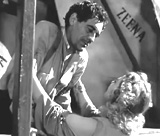
Shortly later, she acceded to Stan's shrewd request-suggestion to share the code so that they develop a new high-class touring act together: ("Let's build up a new act with it") - to fund the cost of Pete's cure. They were becoming closer and closer romantically. Although unsure, Zeena sought advice from a private reading with her tarot cards - she became alarmed when the cards portended Pete's demise and decided to reject becoming Stan's partner: ("It's all off, Stan... Everything...I can't go against the cards"). Stan was frustrated by her belief in superstitious magic: "Honest, Zeena, to see a smart girl like you fall for one of your own boob-catchers, I give up." Then, he admitted his tendency to be selfishly persistent, and didn't want to make her unhappy - and they kissed. Later, Stan bought a quart of cheap $4 dollar liquor from moonshiner Charlie (Mike Lally) in one of the carny trailers, but then accidentally handed an anxious, shaky Pete a similar-looking bottle of Zeena's wood alcohol from her prop trunk. As he drank and came out of his stupor, Pete began to describe a vision of a boy and his dog - a common vision most people had:
Pete's last words were: "Drink a little drink. Dream and drink. Drink and dream" - before he was found dead from poisoning the next morning. Stan was devastated by his role in Pete's death but told no one. A grieving Zeena was regretful that she hadn't found help for him sooner: "He was a good guy and a swell trouper. Only last night I made up my mind to put him in a cure." Soon enough, Stan had memorized the code and replaced Pete as Zeena's helper during her mentalist show - and he quickly appeared gifted with the use of memorized verbal cues. Molly described his technique to Bruno: "She and Stan are using a two-person code....Each word stands for a number. Each number stands for some object...As soon as Stan has more practice, I think they're going to quit the carnival." A rural Marshal (James Burke) threatened to close down the carnival: ("They say you've got an illegal performance going on here with cruelty to human beings and feeding live chickens"), arrest the Geek and owner Hoatley, and also Molly for "indecent exposure," but Stan put his mind-reading strategy into action.
After a demonstration of Molly's need for a thin and revealing costume during her 'electrical' act, Stan performed some sleight-of-hand tricks and used his gifted powers - known as "second sight" - to inform the Marshal that he saw jealous, malicious and "antagonistic influences" surrounding him in his hayseed town - but that he was saved by the power of a "fine woman's love." He convinced the Marshal to depart with religion-talk, and without any animosity toward the carnival: ("Repay evil with good. Love your neighbor. Do not hate your enemies. Forgive them. They just don't know what they're doing. Don't forget to err is human, to forgive - divine. Good-bye now"). Seduced and overwhelmed by his charm in saving the carnival, an exhilarated and thankful Molly kissed Stan twice, but then she worried that they were betraying Zeena. The charismatic shyster soothed her worries and explained how Zeena and he were only friends - he boldly lied to her in order to have her for himself - and she was completely convinced:
At Lem's Place in town where the two met up with the carnival troupe, Zeena greeted Stan and congratulated him for being a "born mentalist," and everyone seemed relieved, but then Stan and the younger naive Molly were suspected of having slipped away to have sex. Bruno, Zeena and the others (Bruno: "Molly, you and Stan gonna get married?") reviled Stan and persuasively forced him, helped by a choke-hold - to have a shotgun marriage to Molly. An opportunity now arose for Stan to reinvent himself with his young bride (who knew the code game) to go on the road performing together with the mentalist show. Stan appeared exhuberant:
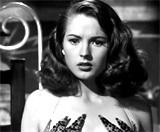
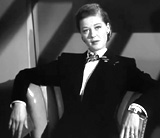
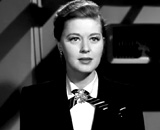
He headlined as "The Great Stanton" at an exclusive nightclub (The Spode Room) in the Chicago-area's Hotel Sherman, where he performed with Molly, and they became a solid hit. After 8 weeks, one of their show's attendees was consulting psychologist Lilith Ritter (Helen Walker) who was extremely skeptical of Stanton's question-answering charade. To outwit him, she tested him with the unanswerable trick question: "Do you think my mother will recover from her present illness?" He answered correctly that her mother was deceased. She was visibly but quietly impressed - and invited him (via a note written offscreen) to her Lakeshore Building business office. During their visit together, Stan admitted that her question wasn't "on the level" and was intended to make a "chump" out of him. He confronted her: "What's on your mind, lady? What are you up to?" - and with steely eyes, she replied: "Don't worry, Carlisle. I never make the same mistake twice." He quipped: "Me neither."
They were unexpectedly interrupted by wealthy, elderly Chicago socialite Mrs. Addie Peabody (Julia Dean), one of her regular patients. With Stan out of the office in a back room, Mrs. Peabody's therapeutic treatment session regarding her deceased daughter Carol was secretly recorded. When Stan appeared back in her dark office (immediately after the session), he noted that she was secretly recording the interview-sessions of all her wealthy, high-class patients. Sensing that she was a kindred spirit, he suggested a pecuniary, deceitful scheme to illegally use the information from her recordings to make money off her elite clientele by channeling their dead relatives: ("I wanted to get a line on you. Maybe we can do a little business after all....You don't realize what you've got here. We could set this town on its ear") - he had a "hunch" that she was going to first suggest the scheme to him, but she denied the accusation. She claimed the potentially-sensitive recordings were only for her "personal study" and were considered very "sacred" and private. She threatened him if he was ever to divulge her practice of recording patients, and then promptly threw him out:
Later following one night's performance, Zeena and Bruno visited Stan and Molly in their hotel suite and congratulated them on their continued success. Zeena referred to her tarot cards for consultation - Molly wouldn't have children in the year, but if Stan changed and tried a "new stunt" that would send him "to the top like a skyrocket," it would also end up to be a disaster just like Pete's downfall. It was confirmed when Molly turned over "THE HANGED MAN" card (Pete's card). Although Stan called Zeena's magic a "pack of gypsy cards," he believed in the portend. He ordered them out, calling them "a couple of cheap carnival freaks." During a massage rub-down after they left, Stan's memory of Pete's death was triggered by the smell of alcohol, and he freaked out. Stan rushed to phone Lilith (at her Belmont Apartments residence), and met with her into the early morning hours. Not realizing he was being recorded (as all her patients were), he described how his stomach was turned "inside out" over giving Pete a fatal bottle of wood alcohol. She diagnosed his memory as "total recall" and explained it was his guilty feelings coming out regarding his role in Pete's death:
He complimented her for helping him (services were offered free as a "professional courtesy"): "I figured that if anyone was gonna help me, it'd have to be somebody like you." Despite Zeena's warning, Stan was determined to embark upon the big-time with what he termed "the spook racket." He boasted: "I was made for it." During another show performance, Stan unethically used what he knew of Lilith's recording of her private session with Mrs. Peabody to accurately answer her question about seeing her 16 year-old dead daughter Caroline again "beyond the grave" - then, he went into a trance before he fainted. Following Stan's amazing display of spiritualist powers, there were differences of opinion - did he have true powers or was he a trickster? The normally level-headed Mrs. Peabody conferred with skeptical Ezra Grindle (Taylor Holmes), her late husband's friend, to propose supporting Stan's powers to bring "spiritual comfort" to others. Lilith conspired and teamed up with Stan by providing him with recording information about Grindle. Swayed by Stan's abilities, Grindle (who originallly wished to expose Stan's trickery) offered him $150,000 in cash for the construction of a brand-new tabernacle and a radio station (the funds would be held by Lilith), in exchange for "spiritual communion" with his lost sweetheart Dorrie from 35 years earlier. Stan explained his convincing conversations with Grindle to Lilith - and told her that they shouldn't be seen together: "We don't wanna take any chances. This thing's too big. I'm surprised a smart cookie like you... Supposing somebody saw us together and Grindle found out about it. Then where would we be?" After Lilith had acquired old photos of Grindle with Dorrie, Stan tried to persuade the gullible Molly to be in on his scheming "subterfuge" by masquerading as the 'materialization' of the ghostly spirit of Grindle's dead love. At first, she cried out: "I knew it...You never were on the level. You lied to me. Zeena was right." She threatened to walk out on him: "You've got to stop it," and told him:
Although Stan argued: "There's no difference between this and mentalism. It's just another angle of show business," she insisted: "You're not talking to one of your chumps. You're talking to your wife. You're talking to somebody who knows you red, white and blue. And you can't fool me anymore. There's only one way I can stop you from doing this thing, and that's to leave you." Nonetheless, he convinced her to remain to complete the ultimate trick:
In a secluded garden area at the Grindle's estate one evening, Stan met with Grindle to channel his dead love Dorrie. As the anguished and distraught Grindle saw Dorrie in the distance and begged for her forgiveness (had he caused her death?), Molly broke out of character, rushed forward, and revealed she was faking the illusion of Dorrie. Grindle realized he had been swindled by the charade and attacked Stan ("Fake! You crook! You dirty, sacrilegious thief!") who pushed the man onto the ground. As they drove away, Molly was instructed to pack their things at the motel and rendezvous later at the Inglewood train station, without going back to the hotel. Stan also met with Lilith and described their failed plan: ("There he was on his knees, I had all that dough right in my hand and she has to go and blow her top"). She gave him an envelope with the cash, and encouraged him to flee and not contact her ("Don't try to get in touch with me under any circumstances"). On the way to the station in a cab, Stan opened the envelope - Lilith had replaced the $150,000 with single $1 dollar bills - and realized he had also been conned. He turned the taxi around and returned to confront Lilith - via her fire escape. He grabbed her in her bed and accused her of duplicity: ("You're good. You're awful good. Just about the best I ever saw!"). In a cunning way, she treated him as one of her disturbed, delusional and mentally-unbalanced patients that she had failed to cure. She threatened that if he accused her of complicity, she would play the recording of his confession regarding Pete's death. She transferred all the guilt between them onto him:
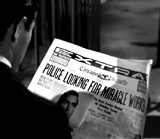
Realizing that he was had, and that Lilith was offering to have him committed or taken to the hospital, he then believed her and actually thought he was hallucinating and delusional when he heard police sirens. He fled to the train station where he admitted to Molly that Zeena's fortune for him came true: "Zeena wasn't so far off after all." He protectively gave Molly the $150 dollars, and ordered her to somehow return to the carnival in Galesburg, IL before the train pulled away without him. As he walked away, he noticed the latest Chicago Gazette newspaper headlines: "POLICE LOOKING FOR MIRACLE WORKER."
Stan's fortunes and career were destroyed - he became a vagrant hobo, living in cheap hotel rooms, drinking heavily, and telling the fortunes and mind-reading for other poor forgotten men. He admitted he was a con man after telling Pete's man and dog story: "Hey, you see how easy it is to hook 'em? Stock reading, fits anybody. Never misses." He sought work in the local carnival from the new owner McGraw (Roy Roberts), but was refused work because he was an obvious "boozer" - but then after begging, he was offered the exploitative job of Geek, in exchange for room and board - and drink: "And we'll keep you in coffee and cakes. Bottle every day. Place to sleep it off in." Stan gladly accepted: "Mister, I was made for it!" Unbeknownst to him, Molly was working in the carnival and found Stan who had "gone nuts" and was in a combative, alcoholic daze - she devotedly promised to care for him ("Everything's gonna be all right now. I'll look after you") as Zeena had done for Pete. In the unhappy yet fitting ending for Stan, McGraw provided the moral of the story:
|
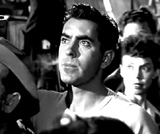 Transfixed by the Geek Show - Stanton "Stan" Carlisle (Tyrone Power) 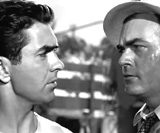 Stan Asking Owner Hoatley: "How do you get to be a Geek?" 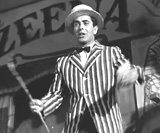 Stan - The Announcer for Zeena's Act 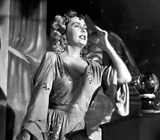 Zeena's Phony Mind-Reading Act  On the Road with Zeena - Stan Asked About Secret Code (Zeena: "I'm about as reliable as a two-dollar cornet")  Pete's Drunken Dissipated State  Zeena - Frustrated by Pete's Alcoholism 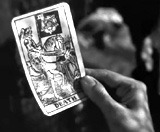 Zeena's Tarot Card Reading - Bad Fortunes Ahead (The "Death" Card) 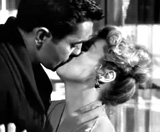 Beginnings of Stan's Romantic Relationship with Zeena 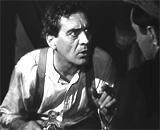 Pete's Drunken Monologue Before His Death 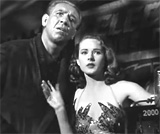 Molly's Description of Stan's Code Trickery to Bruno 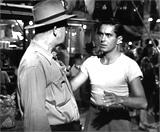 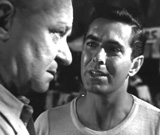 Stan's Smooth-Talking of the Marshal 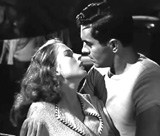   Molly Kissed and Convinced by Seductive and Charismatic Stan 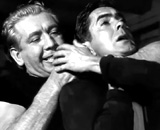 Bruno With a Choke-Hold on Stan - Forcing His Marriage to Molly 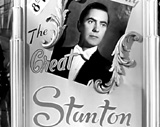 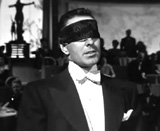 "The Great Stanton" Show in Chicago 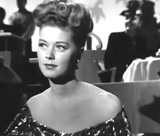 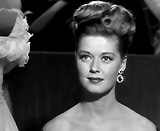 Lilith Ritter (Helen Walker) - Asking a Question at Stan's Nightclub Show 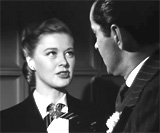 Stan's Proposed Deceitful Scheme to Lilith - Use Her Private Recordings to Bilk Her Rich Clients 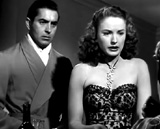 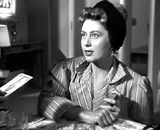 Tarot Card Prediction of Disaster (The Same as Pete's Fate) by Zeena 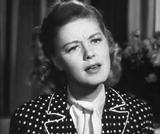 Stan's Consultation with Lilith About Pete's Death 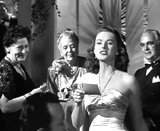 Question From Mrs. Peabody in Stan's Audience 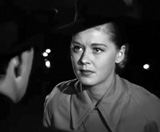 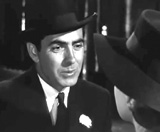 Stan Conspiring with Lilith 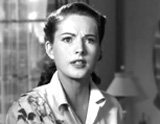 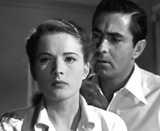 Molly's Resistance to Stan's Scheme 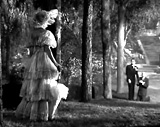 'Dorrie's' (Molly's) Spiritual Appearance to Ezra Grindle 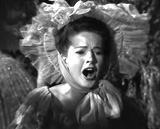 Molly Ending the Illusion 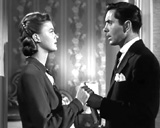 Retrieving the Cash Envelope From Lilith 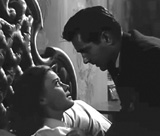 Returning to Lilith to Confront Her For Conning Him 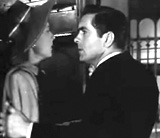 Train Station Farewell to Molly |
|||||||||||||||||||||||||||||||
|
Out of
the Past (1947) (aka Build My Gallows High)
In Jacques Tourneur's beguiling, complex, quintessential slick film noir about double-dealing, betrayal, passion and intrigue from the post WWII period - it was one of the best ever made, notable for its doom-laden flashback narrative structure and shadowy cinematography, with complex flashbacks.
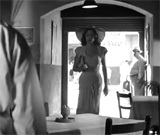
The main character with a sordid past was Jeff Bailey/Markham (Robert Mitchum) - a laconic, former, worn-out and ultimately doomed private detective; he was hiding out with a sweet, local girlfriend/fiancee Ann Miller (Virginia Huston), as the owner of a Bridgeport, California gas station, with his mute assistant Jimmy "The Kid" (Dickie Moore). Jeff was forced to meet with his former boss - the menacing, obsessed and ruthless gangster Whit Sterling (Kirk Douglas), who lived at Lake Tahoe, to work for him as a private eye. As he drove to Northern California with Ann, he explained his past life to her, seen in flashback, about how he had been commissioned earlier by Whit to travel to Acapulco to pursue Whit's treacherous girlfriend/mistress, who had stolen $40,000 and fled to Mexico. In the flashback, Jeff described his first meeting with the archetypal, icy, duplicitous, chameleon-like, dark and deadly femme fatale brunette named Kathie Moffat (Jane Greer) - the seductive female made a memorable, sultry silhouetted, almost-magical entrance into a dark Mexican cantina in Acapulco from the bright and hot hazy outdoors when she walked into his life - wearing a broad-brimmed white hat; Jeff described her remarkable appearance as she cast a sultry shadow: "And then I saw her, coming out of the sun, and I knew why Whit didn't care about that forty grand."
The self-indulgent, lethal, and erotic enchantress was the object of romantic fascination for both men - Jeff also became mesmerized and infatuated by her (seemingly so innocent), unaware at first of how he would become entangled in the dark-haired beauty's enchanting charms; he ended his pursuit of her and fell in love with her - the start of an ill-fated affair; both wanted to escape from the past, but couldn't deny its grip upon them. Their romantic interlude was highlighted on a moonlit beach (where Jeff and then the two of them were framed by an entrapping fish net); after deceiving Whit, Jeff and Kathie moved to San Francisco to live anonymously and in secret obscurity, to avoid Whit; he reflected on their pairing: "It was the bottom of the barrel and I scraped it. But I didn't care. I had her." However, when they were discovered together by Jeff's former partner, a "stupid, oily gent" named Jack Fisher (Steve Brodie) who was hired by Whit to find them, Jeff and Fisher engaged in a brutal, shadowy fist-fight that ended when Kathie coldly shot Fisher to death; Jeff turned to Kathie and wondered: "You didn't have to kill him...You didn't have to do it" - but she claimed it was necessary to prevent him from going to Whit - and then she fled the scene.
Jeff realized how murderous, double-crossing, and selfish Kathie really was, and the dangers of falling in love with her; she drove away from the murder scene and left him to dispose of the body and take the blame; he also discovered what she had left behind - her incriminating bank book with a $40,000 deposit in her account - evidence that she had lied to him about the money; he expressed his stunned reaction to Ann at the end of the flashback: "I wasn't sorry for him or sore at her. I wasn't anything." When the action returned to the present, Jeff arrived at Whit's mansion, fearing that he would again be doomed and seduced by the same charming, but wicked woman he had once loved and lost, especially after he discovered that Kathie was living with Whit again; Whit remarked: "You remember Kathie, don't you?...Kathie's back in the fold now. You're back in the fold too, Jeff"; obviously, Whit knew of their past acquaintance and their double-dealing, telling Jeff (via blackmail and extortion) that all would be forgiven if he performed one more job to help Whit avoid tax evasion charges; shortly later, Jeff sneered at Kathie with an insult: "You're like a leaf that the wind blows from one gutter to another"; Jeff had already learned the dangers of falling in love with her. There was snappy dialogue and tawdriness in the new love/hate relationship between Jeff and Kathie, when he came under Kathie's lethal, deceptive erotic spell once again during a second affair; he became involved in another complex web of intrigue, passion, betrayal, double and triple-crosses and death in San Francisco, and feared that he was going to be framed and made the 'fall-guy.' On the run for allegedly committing two murders in SF, Jeff fled back to Bridgeport, where while he was hiding in the woods, one of Whit's henchmen, Joe Stephanos (Paul Valentine) (who had been paid by Kathie to murder Jeff), attempted to kill him; as Stephanos aimed his gun at Jeff and was about to pull the trigger, Jimmie hooked the man with his fishing fly rod and pulled him off the rocky cliff to his death, saving Jeff's life. In the film's resolution, Kathie was chastised by Whit for her cool, detached double-crossing, and for sending Joe to kill Jeff without his knowledge; he slapped her and threatened to turn her in: "You dirty little phony. Go on lie some more....What a sucker you must think I am. I took you back when you came whimpering and crawling. I should have kicked your teeth in. No, I'm not going to. Not now, Kathie. We're gonna let the law push you around... You're gonna take the rap and play along. You're gonna make every exact move I tell ya. If you don't, I'll kill ya. And I'll promise you one thing. It won't be quick. I'll break you first."
Shortly later inside Whit's estate, Jeff discovered Whit's corpse on the floor - rightly deducing that Kathie had shot and killed him to prevent him from turning her in for Fisher's murder; she explained her motive to Jeff: "You can't make deals with a dead man, Jeff....I never told you I was anything but what I am. You just wanted to imagine I was. That's why I left you. Now we're back to stay....Don't you see? You've only me to make deals with now" - he gave her a laconic reply: "Build my gallows high, baby"; he was more pessimistic about their chances of succeeding because she was so corrupt: "They'll always be looking for us. They won't stop till we die"; she only wanted to link herself to him: "I don't care. Just so they find us together. If you're thinking of anyone else, don't. It wouldn't work. You're no good for anyone but me. You're no good and neither am I. That's why we deserve each other" (after which they shared a kiss). Shortly later, Jeff also decided to turn her in to the authorities, but pretended to play along with her plan to go back to Mexico to pick up their idyllic romance where they had left off; he repeated her statement back to her: "We deserve each other." Their final tragic end came in the concluding dramatic sequence of the film, when she saw a police roadblock trap and realized that Jeff had capitulated to the authorities and set her up - destined to die together for their sins, she viciously pulled out a gun and cried: "You dirty, double-crossing rat"; she shot Jeff dead in the driver's seat, firing her gun into his crotch, but then was gunned down by a barrage of police fire as their out-of-control car crashed into the roadblock. In the last scene set in Bridgeport, California at the gas station, Jeff's mute assistant Jimmy lied in his answer to Jeff's girlfriend Ann when she asked about Jeff's final moments with Kathie - in the film's final line of dialogue: "You can tell me. You knew him better than I did. Was he going away with her? I have to know. Was he going away with her?" - he nodded his head affirmatively to give Ann the impression that Jeff actually loved Kathie and was going off with her; he lied to soften the blow so that Ann could reject Jeff's memory and free herself from him (and her past) to build a new life, presumably with her patient Bridgeport admirer Jim (Richard Webb). |
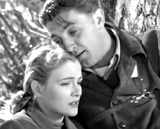 Jeff in Bridgeport, CA With Fiancee Ann Miller (Virginia Huston) 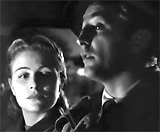 Jeff With Ann on Drive to Northern California - Beginning of Flashback 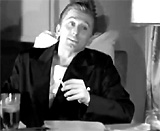 At Tahoe, Whit Sterling (Kirk Douglas) 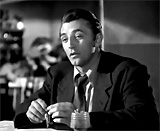 Jeff In Hot Pursuit of Kathie in Acapulco 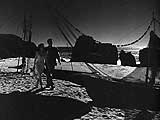 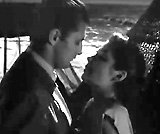 Moonlit Beach Love Scene with Entrapping Fish Nets 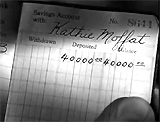 Kathie's Absconding of $40,000  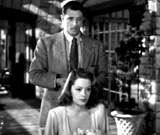 Whit to Jeff: "Kathie's back in the fold now" 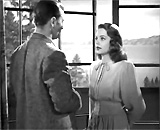 Jeff to Kathie: "You're like a leaf that the wind blows from one gutter to another" 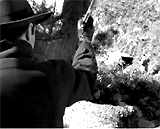 Attempted Murder of Jeff in Bridgeport by Stephanos 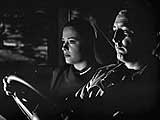 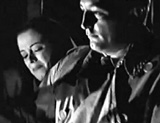 Kathie Firing into Jeff's Crotch at Roadblock: "You dirty double-crossing rat!"  Conclusion: Ann's Question to Jimmy About Jeff's Intentions with Kathie |
|||||||||||||||||||||||||||||||
|
The Paradine Case (1947)
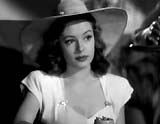
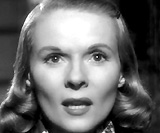
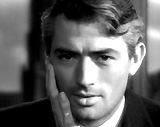
Hitchcock's film noirish, stagy courtroom drama was a very dialogue-rich and slow-moving tale. It was based upon the 1933 novel by Robert Smythe Hichens, and noted as Alfred Hitchcock's final film for producer David Selznick. The Hitchcockian tale of romantic obsession shared similarities with the director's later masterpiece Vertigo (1958) about a smitten lawyer who self-destructively fell in love with his alluring female client. It also contrasted the two clearly opposite females in the film - a married, rational, optimistic and mature blonde, and a dark-haired, elegant, foreign-born, strikingly-beautiful and sophisticated suspected murderess. The film's main character was a classic, beautiful and poisonous femme fatale, the film's title character Mrs. Maddalena Anna Paradine (Alida Valli in her first Hollywood role). She was a seductive nymphomaniacal adulteress who was responsible for the deaths of two men and the near destruction of another. In "the recent past," the attractive, exotic and glamorous Italian widow, Mrs. Paradine, was living in London. During the opening sequence, she was charged with poisoning her older, blind, retired WWI war-hero husband Colonel Richard Patrick Paradine on May 6, 1946, presumably to obtain his wealth. The Paradine family's solicitor, Sir Simon Flaquer (Charles Coburn), hired one of his colleagues - respected and distinguished barrister Anthony "Tony" Keane (Gregory Peck) to defend Mrs. Paradine. He had a reputation for not always defending the wealthy class. (Keane was married for 11 years to pretty, sympathetic, devoted and kind-hearted blonde wife Gay (Ann Todd)). In regards to the case, Keane's wife Gay offered her opinion about the female defendant: "I don't believe she did it...Well, nice people don’t go about murdering other nice people....And anyone who wasn't nice wouldn't have married that poor blind man." Tony retorted that she was delusional about nice people: "So it's your opinion that nice people never murder their husbands?" Gay was concerned that the time-consuming case would interfere with their lives. Shortly later, they spoke about how their planned anniversary trip to Switzerland (possibly changed to Italy after Tony met the Italian widow) would be affected by the trial. When visited by Keane in the foreboding and sparse H.M. (Holloway) prison while awaiting trial, the glamorous Mrs. Paradine was described as "a strange woman, with an almost mystic calm." She expressed worry that people would pre-judge her as a gold-digging female who married her helpless blind husband in order to kill him for an inheritance: ("Saying I married a helpless blind man for his money and then killed him for money"). The already-infatuated Keane immediately denied her guilt, took her side and fantasized that as a beautiful woman, she had sacrificed so much in marrying a blind man: "Weren't you his eyes?...You devoted your whole life to this splendid fellow. Freely. Gladly.... It was a sacrifice. A sublime sacrifice." Shortly later, Simon Flaquer's daughter Judy (Joan Tetzel) predicted about Tony: "Can't you just see Tony giving another one of his great performances. Riding to the rescue of beauty in distress." Later, Keane described Anna as "strangely attractive."
During his interactions with his attractive client, trial lawyer Keane soon became blinded, bewitched and obsessed by Anna himself. He learned that she had been promiscuous (a woman of easy virtue), and a victimizer of men before and during her marriage: ("It will not shock you, I assume, to learn that I am a woman, what would you say, a woman who has seen a great deal of life"), a fact that she had shared with her husband ("I kept nothing from him"). To Keane's surprise, she confessed that she had taken advantage of an older, rich, married and respected man when she was a teenager - and there were many others. A discussion ensued between Flaquer and Keane about how difficult it would be to defend Anna in a case involving a blind man committing suicide on his own. There was mention of the Colonel being possibly assisted by his mysterious but devoted 30 year-old Canadian valet André LaTour (Louis Jourdan) of many years. Flaquer stated his strong belief: "This wasn't suicide, and it wasn't assisted suicide, it was murder." Flaquer believed Mrs. Paradine was guilty. Keane felt otherwise and wanted her to plead not-guilty: "We have the very simple and very obvious fact that Mrs. Paradine is not a murderess - she's too fine a woman." Flaquer disagreed: "Indeed? I was of the impression that she'd been a woman of very low estate and rather easy virtue." The distinguished but bewitched and enraptured trial lawyer Keane unquestioningly believed Anna's innocence from the start, although she was obviously guilty. He believed he would be nobly defending her virtue: "I intend that the rest of the world shall see her as I do, as a noble, self- sacrificing human being that any man would be proud of." Overly-dedicated and lustful toward Anna himself, Keane was determined to indict Andre LaTour as Anna's scapegoat - believing he was guilty of the crime instead of Anna. He suspected that "there's something between Mrs. Paradine and that valet." Turning 'detective' in the case, Keane visited the Paradine country estate known as Hindley Hall in Cumberland (the Lake District), in order to interview LaTour and "nose around a bit." He discovered the estate was up for rent now that it was vacated. He suspected rumors circulating that LaTour might have been Anna's lover - when he learned that LaTour lived in the house, not the servant's quarters. During one late night encounter with LaTour, Keane was told that the manservant believed Anna was evil and that he despised her - to his surprise:
Upon his return to London, Keane visited Anna in prison and told her LaTour's resentful assessment of her: "LaTour hates you. You know that? He hates you most bitterly. He said, he said you're an evil woman." He then asked: "What existed between you and LaTour?" but received an unsatisfactory answer. After he became exasperated by her, she asked him to drop the case. He softened, asked for forgiveness, and then vowed to defend her: "I shall do my best to defend you." At one point, although Keane suggested dropping the case, his wife Gay continued to support her husband's work on the case. When he returned from the Lake District, she reinforced her earlier vow to be supportive: ("Do you think I-I could ever want anything bad for you?"), and urged him to find the enigmatic Anna innocent. She reasoned that she didn't want to lose her infatuated husband if Anna was executed - she knew that he would be emotionally devastated by her loss, and it would affect his future career. She told him:
She also expressed her feeling that their love wouldn't survive if he lost the case:
Mrs. Paradine was put on trial in London in the Old Bailey Courthouse, autocratically and tyranically ruled over by offensive, lecherous presiding Judge Lord Thomas Horfield (Charles Laughton). She pleaded not guilty to the charge of murdering her husband on May 6th, by administering poison in a glass of burgundy brought with his dinner into his bedroom, according to the Crown's Chief Prosecutor Sir Joseph Farrell (Leo G. Carroll). He contended that the defendant was inordinately patient:
During the trial's examination of LaTour by Keane, Keane was able to discredit or question the truthfulness of some of LaTour's testimony. It was called into question whether Mrs. Paradine invented a story or not about LaTour being discharged and told to leave the Colonel, causing a quarrel. LaTour also confessed that he had poisoned the Colonel's sick old hunting dog two years earlier (with a single dose of poison from the vet), but denied being involved in the Colonel's death. In a break during the trial, Anna was upset that Keane suspected LaTour of murder, and she defended his innocence: ("I objected when you wanted to make it appear that Andre had helped my husband kill himself. I objected even to that. And now you make him out to be a murderer...I will not have you making Andre a murderer"). Keane was shocked by her denouncement of his heroic efforts, and then privately admitted his love for his client - something that compromised his judgment and impartiality: ("I was idiot enough to fall in love with you"). And then she made a startling accusation: "You're my lawyer, not my lover." She made it clear that she didn't want him to bring down LaTour: "You are not to destroy him. If you do, I shall hate you as I've never hated a man." It was eventually revealed during further testimony that LaTour was indeed Anna's secret adulterous lover and was having a secret affair with her - possible motivation for the original murder of the husband. LaTour attempted to shift blame: "It was she who dragged us both down. I hated every moment with her, but God forgive me, I couldn't help myself!" When Keane began his defense of Anna before calling her to the stand, he again stressed the point about Anna's sacrificial marriage:
As a witness, Anna explained her reasoning for the possibility of LaTour's dismissal by the Colonel during a quarrel - he had become "too familiar" with her and was forcing himself on her sexually: ("He - he took liberties") - although she dubiously asserted that she resisted him and complained to her husband about it. Then, she further implicated herself in her husband's death (or a cover-up of LaTour's guilt), by admitting that she (not LaTour) had washed and dried the burgundy glass that contained the poison. With that bombshell admission, the case was adjourned until the next day. The strategy for Keane to condemn LaTour (and therefore save Anna) ultimately backfired. After testifying to his own guilt about the affair (but not admitting to poisoning the Colonel), LaTour (who felt tremendous pressure on the stand) killed himself. The next day, sensational news was announced in court: ("...the witness LaTour has done away with himself"). Keane immediately concluded that LaTour had killed himself because he had betrayed his master. Furious and also completely distraught and shaken over LaTour's unnecessary death, Mrs. Paradine confessed to her guilt - that she had poisoned her husband because of her lustful desire for LaTour ("The man I love is dead"). It was confirmed that the seductive Anna had succeeded in inducing LaTour to make love to her, even though it tore him up inside. She wanted to run away with him to be free and live together, but LaTour declined because of his honor. Her admission was devastating:
Although Keane tried to control her admissions of guilt and self-incrimination, she responded: "I have nothing more to say to you, Mr. Keane. I loved Andre LaTour - and you murdered him. My life is finished; it is you yourself who have finished it. My only comfort is the hatred and contempt I feel for you!" According to her, LaTour had no part in the plot to kill the Colonel - she was entirely responsible for the murder. She also hatefully chastised, denounced and contemptuously accused the disreputable Keane for his improper handling of the case, and for his part in destroying her real love, LaTour, by causing his suicide. In front of the court, a weakened and faltering Keane confessed that Anna's words rang true - he concurred that he had major shortcomings, had made errors of judgment and incompetence during her defense, and asked for forgiveness before requesting to be excused from the case in an aborted speech ("My lord, I regret that I can go on no longer"). For her crime, Mrs. Paradine was sentenced to execution (by hanging): ("The Paradine woman will be hanged after three clear Sundays").. Despairing and guilt-ridden, Keane's law practice and his marriage to Gay were nearly destroyed from the emotional pressure and stress. He ultimately reconciled with his conciliatory and supportive wife who vowed to stand by him ("I was proud of you today"). Keane felt such public shame that he considered quitting the bar. But she encouraged him to remain steadfast, strong, and committed to his work:
|
 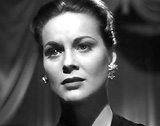 Anna Paradine (Alida Valli) - Receiving News of Her Arrest for Murder 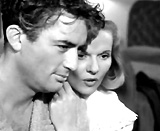 Defense Lawyer "Tony" Keane (Gregory Peck) with Wife Gay (Ann Todd) 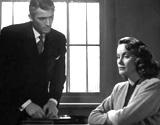 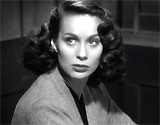 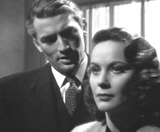 Keane Growing Closer to Mrs. Paradine 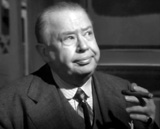 Sir Simon Flaquer (Charles Coburn) - "It was murder!" 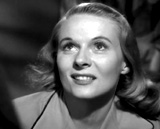 Keane's Long-Suffering Wife Gay 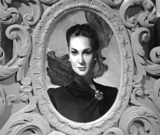 Anna's Portrait Carved into Her Bed's Headboard in the Country Estate 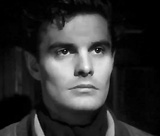 Colonel's Valet Andre LaTour (Louis Jourdan) Speaking of Anna: "She's bad, bad to the bone" 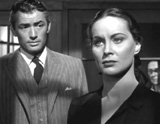 Keane to Anna: "What existed between you and LaTour?" 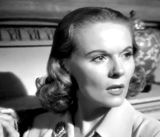 Gay to Keane: "I want very much for her to live..." 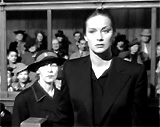 Mrs. Paradine's Entry into Courtroom Trial 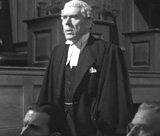 Chief Prosecutor Sir Joseph Farrell (Leo G. Carroll) 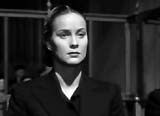 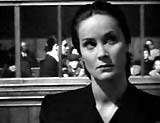 Mrs. Paradine On Trial 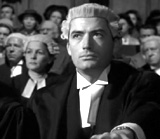 Barrister Anthony Keane 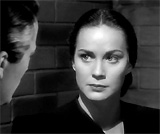 Anna Upset with Keane's Tactics Against LaTour 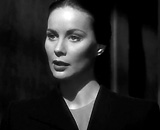 Anna (regarding LaTour): "He - he took liberties!" 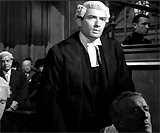 Keane: "Did he try to make love to you?" 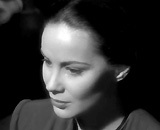 Anna's Confession: "The man I love is dead" 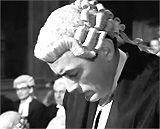 Keane Chastised by Anna for Destroying LaTour - He Confessed His Shortcomings Before the Court |
|||||||||||||||||||||||||||||||
|
The Woman on the Beach (1947)
(aka La Femme Sur La Plage (Fr.), or Desirable Woman)
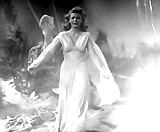
Renoir's moody, overwrought and nightmarish erotic melodrama was a psychological character study about a tormented love triangle. It was the director's final American film during wartime exile. The film, Renoir's best Hollywood work, was severely edited by RKO after a disastrous preview screening, leaving it as only a fragment of what it could have been at 71 minutes. Its main femme fatale star Joan Bennett had already just starred in two back-to-back film noirs for director Fritz Lang, The Woman in the Window (1944) and Scarlet Street (1945). This film had similar themes: lust, promiscuity, loneliness, jealousy, and damaged personalities. Shell-shocked, traumatized, unbalanced and disturbed WWII Coast Guard veteran officer Lieutenant Scott Burnett (Robert Ryan) was stationed near a desolate California coastline during recuperation from post-traumatic stress due to a maritime battle tragedy (he admitted later: "I'm not well"). The patrolman was haunted by his combat days, seeing "ghosts" and suffering nightmares of a shipwreck following a torpedo attack. He dreamt that he sank into a whirlpool, was drowned and walking on the ocean floor littered with skeletons while a glowing woman beckoned to him from afar. When he approached close to the woman, he embraced her.
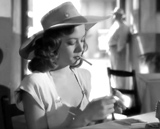
Scott was engaged to wholesome and sweet but bland local girl Eve Geddes (Nan Leslie), a blonde worker at the local shipyard, Bill Geddes' Boat Yard (Building & Repairing), where her father was a boat-builder. She resembled the blonde in his underwater dream. Their marriage was set to occur in two weeks. Meanwhile, while riding mounted on the foggy California beach, he sighted an unknown brunette who was smoking a cigarette seated next to an abandoned shipwreck ('woman on the beach'). During another ride shortly later, he met the vixenish siren again while she was collecting wood - she identified herself as Peggy Butler (Joan Bennett), the film's sexy femme fatale, with whom he was immediately smitten. He helped her bring a heavy stack of firewood to her isolated cliff-top house, where she lived and was married to older renowned blind painter Tod Butler (Charles Bickford). The callous wife Peggy was involved in an unhappy, imprisoning, and dysfunctional love-hate marriage to an excessively-jealous, troubled, surly and grumpy man. Tod had become embittered due to the loss of his career's livelihood ("I assure you a blind painter's just the same as a dead man") - he was unable to paint, but knew that the value of his paintings would increase due to his lack of continuing output ("Now that I can't paint anymore, this stuff of mine gets more valuable every day"). He had locked his paintings in a closet to keep them intact, while Peggy encouraged him to sell them so they could maintain a better lifestyle. He also expected that his wife was cheating on him and would soon eliminate him: "You think I need eyes to tell me you want to get rid of me? You murderous little sneak!" However, he still perversely encouraged visits by Scott to see Peggy, and wasn't 'blind' to their passion. During Scott's illicit affair with the slutty Peggy, she became more obsessively guilt-ridden as she snuck kisses and embraces, while vowing her hatred for Tod: ("Love him? I hate him"). At one point, she had met secretly with Scott in the beached, rotting ship's hull (while her unseeing husband approached the porthole - and they feared he sensed them there). Nonetheless, she still believed she had to stay with Tod because she had caused her husband's blindness (by cutting his optic nerve with a glass thrown at him) during a drunken brawl. She felt responsible for him and bound to him. As an aspiring upper-class socialite and a playgirl earlier in her life, however, Peggy felt confined by her meager, lowly, and isolated lifestyle, and immediately felt a strong attraction to the virile Coast Guardsman. Peggy and Scott both felt that that had lost something major in their lives and were haunted by "ghosts" ("Have you ever had everything and suddenly had nothing? Nothing but ghosts?"). He confided in her that they were very similar: "We're pretty much alike, aren't we?"
Paranoid about being found out, and suspecting that Tod's blindness was faked in order to manipulate Peggy, Scott took it upon himself to prove or test that Tod's blindness was not real: ("If I could prove to you that Tod wasn't really blind, would you leave him?"). In one extraordinary scene to disprove his disability, he led the painter along a cliffside and then abandoned him. Tod did fall to the beach below and injured himself with bad bruises, but not seriously. Afterwards, Scott confessed the truth of the cliff incident, and Tod (who was truly blind) accepted the apology. Peggy's past was revealed to Scott - she had been involved with Eve's deceased brother Bill, and admitted she was a nymphomaniacal seductress: ("Go on. Say it - I'm a tramp. You're just finding that out?"). She also suffered abuse at the hands of her wife-beating husband. When Tod discovered that his deceitful wife had hidden what he considered his masterpiece - a nude portrait of her, and that she was planning to secretly sell it (to use the profits to improve their living conditions), he was furious about letting go of his past: ("Everything I saw in life, I set down on canvas. If I let them go I lose the last connection to the past - strong and alive"). He slapped her repeatedly, as Scott listened to the abuse from outside. In another display of his madness and infatuation with Peggy, and his own potentially-homicidal or death-wish tendencies, during a fishing trip in a small boat during stormy conditions, Scott confronted Tod about his treatment of Peggy, and attempted to drown them by poking holes in the bottom of their boat to sink it. When the concerned Peggy alerted the Coast Guard to rescue them (one of the team members was Eve), the two were saved. In the ambiguous ending, after Peggy's obvious demonstration of her love for Scott, Tod attempted to free himself from Peggy, and his past life (and his paintings) by burning down his house ("I am free"). Tod reasoned that everything was a symbol of the obsession he had with his previous, sighted life.
Afterwards, Tod renounced his past behavior and gave Peggy and Scott his blessing. His plan was to head to New York to start a career as an aspiring writer. To his surprise, Peggy walked over to Tod to reconcile with him and join him to start a new and liberated life, while Scott left the beach - free to return to Eve. |
 Scott's First View of "Woman on the Beach" 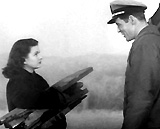 Scott's Second View of Peggy Butler (Joan Bennett) 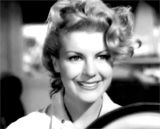 Eve Geddes (Nan Leslie) 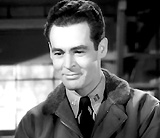 Lieut. Scott Burnett 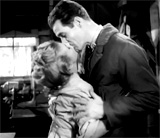 Scott and Eve - Engaged 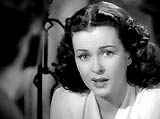 Peggy Butler (Joan Bennett) 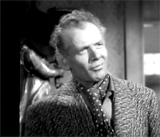 Tod Butler (Charles Bickford) 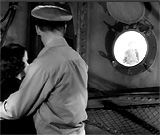 Tod Approaching Ship Porthole Where Peggy and Scott Were Having a Secret Rendezvous 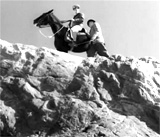 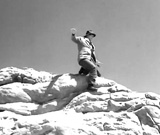 Scott Testing Tod's Blindness on Cliffside - Tod Stumbled and Fell 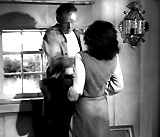 Tod Slapping Peggy For Hiding His Nude Painting of Her 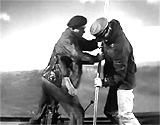 Scott's Second Attempt to Kill Tod During Fishing Trip |
|||||||||||||||||||||||||||||||