|
Film Spoilers and Surprise Endings D2 |

| |
|||||||||||||||||||||||
|
Deja Vu (2006)
Director Tony Scott's loud and noisy action thriller (with some paradoxical science-fiction elements) was an exciting murder mystery, although its implausible plot holes in the final, overly-confusing product were numerous. Its misleading trailers tauted the idea of deja vu, although the film had really nothing to do with the concept (the feeling as if you’ve been someplace or met someone, where you’ve never actually been before). Its main real-life antecedent was the Oklahoma City bombing. It centered on an investigation into a disaster that occurred on February 28, 2006 in New Orleans, LA (this was the first film shot in post-Katrina New Orleans) on the morning of Fat Tuesday. The Sen. Alvin T. Stumpf ferry carried hundreds of uniformed US Navy sailors and their families across the Mississippi River for Mardi Gras celebrations in the city. A ferry explosion at 10:50 am, presumably a deliberate domestic terrorist attack, resulted in 543 deaths of passengers and crew members. Assigned to the case was maverick ATF special agent Doug Carlin (Denzel Washington), adept at reading the details of bombed crime scenes. At the site of the disaster, he heard his own unique cellphone ring tone inside one of the black body bags.
Also mysteriously found in another body bag were the charred (30%) remains of 30 year old Claire Kuchever (Paula Patton) - it was determined that her body had washed up prior to the explosion.
Carlin speculated about bomb residue on the female victim: "The bomber came in direct contact with the victim. You solve her case, you solve this case." Did her murder have something to do with the ferry disaster, and could they track the killer through her during her last few days of life? A sophisticated, brand-new, futuristic system and multi-angle surveillance program (linked to seven orbiting satellites) labeled "Snow White," located at a top-secret government base, was used to relook at past events - it could even track through walls. Physicists explained that the privacy-busting device was limited to looking back only 4 days, 6 hours, 3 minutes, 45 seconds, and 14.5 nanoseconds. The investigators watched a satellite surveillance tape shot three days before Claire was taken from the Mississippi River - and Doug fell in love with the pretty image of the woman (a thematic plot similar to the one in Laura (1944)) after voyeuristically watching her every move, including seeing her step naked into a steamy shower. Although the physicists denied that she could detect the surveillance, Claire correctly sensed that she was being watched and wrote in her diary: "Got that weird I'm being watched feeling. It's like someone is out there..." In fact, the device allowed the physicists to view the actual past - to revisit and interact with it - revealed when Carlin shone a red laser-light into the past and Claire reacted to it (the scientists explained: "They found a way to fold space back onto itself...to create an instantaneous link between two distant points" - between the base and Claire's house, for example). The scientists also described how there were multiple planes of time, or different timelines branching out when one traveled back in time. If a new branch was created, what happened to the old one? "It might continue parallel to the new branch, but most likely, it ceases to exist."
During the early portion of the film, although it was unclear what was happening, Carlin was leaving clues from the past in the future (his fingerprints, bloody bandages, and the answering machine messages in Claire's place, the 'U Can Save Her' message on Claire's refrigerator, etc.) - maybe, as it has been speculated, during multiple trips back to the past. Doug sent a warning note back in time to himself - an "anonymous tip" to alert his 'past self' to the terror suspect's whereabouts (while surveilling the Algiers ferry dock at 4:40 am) in an attempt to prevent the bombing. The note on Carlin's desk was intercepted by Minuti, who approached the bomber at the dock and was eventually shot to death. They identified the terrorist as unrepentant and disturbed Carroll Oerstadt (Jim Caviezel), an embittered, unstable anti-social individual with a vendetta against the military after numerous enlistment rejections. He had contacted Claire about her '94 tan/red Ford Bronco SUV for sale, and ultimately kidnapped her in her home, duct-taped her mouth, murdered her (by setting her on fire with gasoline) in his own bait camp in the bayou, dumped her body in the river, and stole her SUV to use in the bombing. In the most preposterous sequence in the film, an absurd idea with a causal paradox, Carlin also went on an unauthorized time travel mission of his own to change the past. He returned back in time, as the 'future' Doug, to save his obsessive love interest Claire, stop Oerstadt and prevent the disaster ("It's time to prevent a crime before it happens"). Before his transport in the device (resembling a giant spark plug), technician Dr. Alexander Denny (Adam Goldberg) warned: "You don't have to do this." Carlin responded: "What if I already have?" [Note: It was likely that this wasn't his first mission back to the past.]
They drove away together in the happy ending, as the Beach Boys' "Don't Worry Baby" played on his radio |
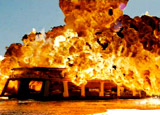 Ferry Explosion  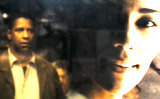 Doug and Ferry Victim Claire (Paula Patton) 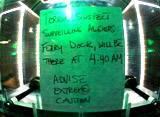 Doug's Reminder Note to Himself 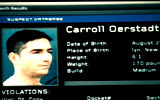 Terrorist Carroll Oerstadt (Jim Caviezel)  "Snow White"  Oerstadt at the Bayou Bait Camp 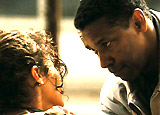 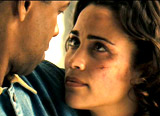 Doug With Claire 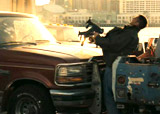 Death of Oerstadt  Claire's SUV 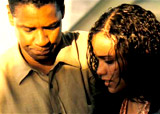 "Present Day" Doug United With Claire |
|||||||||||||||||||||
|
The Departed (2006)
Best Director-winning Martin Scorsese's viciously-violent Best Picture tale (an adaptation of Siu Fai Mak's Infernal Affairs (2002, HK)) was about reciprocally-planted 'moles' (or rats) within both the South Boston Irish-American mob and the Massachusetts State Police Department. The two moles (and a third) were:
It concluded with a bloody denouement in which almost all of the leading big-name cast members were killed (mostly by a single-gunblast to the head) - some abruptly and by complete surprise.
The film ended with a view of a real rat scurrying on the outdoor balcony railing of Sullivan's apartment against the backdrop of the gold-domed Massachusetts State House. One of the film's sub-plots was that police psychiatrist Madolyn Murray (Vera Farmiga) was dating both Costigan and Sullivan. She was living with Sullivan and secretly engaged to him. Costigan gave her an envelope - containing evidence of Sullivan's treachery. She survived, possibly carrying Sullivan's baby (or more likely, Costigan's baby). |
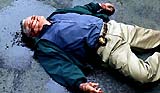 Captain Queenan (Martin Sheen) 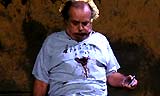 Frank Costello (Jack Nicholson) Shot by Sullivan (Matt Damon) 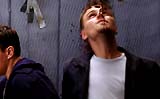 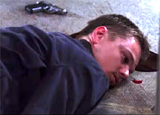 Billy Costigan (Leonardo DiCaprio) Killed by Trooper Barrigan (James Badge Dale) 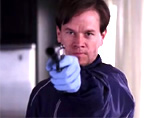 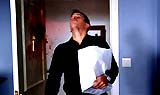 Colin Sullivan Shot to Death by Sgt. Dignam (Mark Wahlberg)  Scurrying Rat |
|||||||||||||||||||||
|
Derailed (2005, UK/US)
Swedish director Mikael Håfstrom's suspenseful psychological drama-thriller (his first American feature film) was about the effects of a derailing adulterous affair (deceit, blackmail, etc.). The crime thriller was similar to the themes of classic noirs Double Indemnity (1944) and The Postman Always Rings Twice (1946), and more recently Fatal Attraction (1987) and Unfaithful (2002). The faux-noir began with a short under-the-credits sequence of an unidentified prisoner in his Illinois State Penitentiary cell beginning to write a story into a blue notebook: "The morning it all began, began like any other morning." Then, the film flashbacked to tell its fairly predictable tale - specifically it was a long set-up about how the man in the prison cell became involved with the film's main character:
At breakfast, Charles explained to his book-report-writing daughter that storytelling suspense was about the twisting plot seducing you to read further in ways you weren't expecting - it was a clear and predictable hint about what to expect in the way of a plot twist.
On a commuter train, Charles first viewed a femme fatale's legs in shiny spiked high heels (with black stockings). He was attracted to the intriguing, flirty, smart and attractive brunette Lucinda Harris (Jennifer Aniston) who paid his fare when he found himself broke (his wife had borrowed money from his billfold). She introduced herself as an employee at Avery Price: "I'm a financial advisor. I cheat clients" - a major tip-off to her character. During their next meeting, she told him she was married, and also whispered at him: "Some people just don't know how to appreciate what they've got." Before long, his sex obsession with the woman led to their clandestine rain-soaked coupling in a $46 room at the seedy Lake Hotel, at three in the morning. She enticed: "I think I wanna f--k you" - and as they furtively got undressed to make love, Charles heard the cocking of a gun. A French-accented, menacing armed man with a devil's goatee named Philippe LaRoche (Vincent Cassel) forcefully intruded into their room, held a gun to Lucinda's head, chided Charles for cheating with the "fine piece of ass," broke Charles' nose with his gun butt and rendered him into unconsciousness as he sadistically and repeatedly raped (mostly off-screen) the fully-clothed Lucinda. [Later, Lucinda falsely claimed that she had become pregnant from the rape and had an abortion.] The next morning, the guilt-ridden adulterers mutually decided to not report the violent attack to the police, due to their surreptitious tryst. Soon after, the creepy villain LaRoche blackmailed Charles for $20,000 (which was paid from his daughter's medical savings account nest egg), and then six weeks later demanded another $100,000. Charles attempted to have office mail-room employee Winston Boyko (rap artist RZA), an ex-con, threaten LaRoche, in return for $10,000. (Charles embezzled the $10,000 from an aspirin account that he was working on, to pay Winston.) The effort failed when LaRoche shot and killed Winston in the back of the head, and took his pay-off money. The next day, Charles was forced to pay the $100,000 to LaRoche as he held Lucinda at gunpoint in her Chicago apartment. And then he was considered a suspect for Winston's murder and doggedly questioned by Detective Franklin Church (Giancarlo Esposito) from the Chicago Police Department. The film's obvious and laughable twists came next:
Another major twist occurred. Charles admitted: "I CHOSE this prison" and stabbed LaRoche to death in the abdomen with Winston's makeshift knife (shank) given to him earlier. To the authorities, however, Charles claimed that LaRoche had tried to kill him with a knife that he had manufactured in prison. Detective Church was incredulous that Charles had been able to defend himself against LaRoche who had killed Winston and three others ("You expect me to believe that you overpowered him?"). Charles replied: "I guess I got lucky." Church also threatened Charles: "You brought that shank in with you, it's pre-meditated murder. Law don't care who you kill," although the knowing detective then released Charles to return home, realizing that LaRoche deserved retribution for killing his good friend Winston. Everything was reconciled and restored to normal in the anti-climactic finale, as Amy ran to her morning school bus - after she had been successfully treated with anti-rejection medication. |
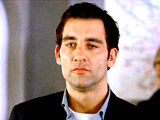 Chaz Schine (Clive Owen)   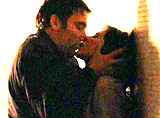 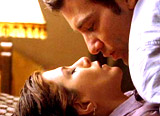 Charles "Chaz" Seduced by Lucinda Harris (Jennifer Aniston) 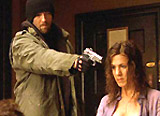 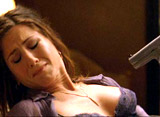 Assault by Philippe LaRoche (Vincent Cassel) on Lucinda 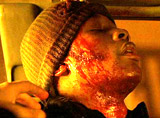 Death of Winston Boyko (RZA) 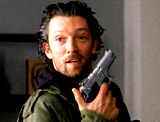 Blackmailer LaRoche 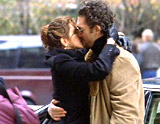 A New Target: Sam Griffin (David Morrissey) 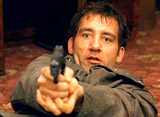 Shoot-Out 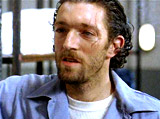 Prison Laundry Room Encounter With LaRoche 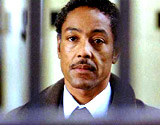 Detective Church (Giancarlo Esposito) |
|||||||||||||||||||||
|
The Descent (2005, UK)
Neil Marshall's claustrophobic horror thriller told about a group of six, extremely-athletic female spelunkers (six unknown actresses) including:
The group were trapped deep underground in the dark in an Appalachian cavern after a cave-in. They realized that they were in the wrong place - not Boreham Caverns but an unknown and unmapped section ("We're in the wrong f--kin' cave!"). Juno admitted to everyone: "It hasn't got a name. It's a new system. I wanted us all to discover it. No one's ever been down here before." The six were very concerned that there wouldn't be a way out of the chamber.
The first intimation of horror was a quick appearance of a hairless, pale creature in the distance drinking water. The horrors were revealed to be predatory, sharp-toothed, whitish, carnivorous humanoid underground beasts called "crawlers" in the thick darkness, who attacked them relentlessly in the maze-like, entrapping lair. Sarah explained:
Holly was the first to have her throat ripped out by one of the crawlers. Juno was viciously attacked, and after knifing the creature with her pick-axe, she quickly turned around fearing another creature behind her. Horrified, she realized that she had swung her pick-axe and accidentally speared Beth in the neck. Later, Beth begged to be mercy-killed by Sarah, and her head was bashed in with a large rock. After she had killed one of the younger creatures, the beast's mother (with visible breasts) attacked Sarah and together they fell into a bloody pool. To protect herself, Sarah reached for a jagged bone and stabbed the creature in the eye - killing it. Sam and Rebecca were the next two victims of the creatures - Sam had her throat ripped while attempting to climb across a rocky roof to safety, and Rebecca was cannibalized alive when her stomach was chomped. Sarah and Juno were left to battle four of the creatures and a second wave of attackers. They were successful, although there was a confrontation between the two (Sarah believed that Juno had purposely harmed Beth), and Juno was injured by Sarah's pick-axe. In the ending, the wounded Juno died (off-screen) when she was surrounded by the creatures, but Sarah survived after escaping and falling unconscious down a chute. When she awoke, she crawled up a long pile of skeletal bones into daylight, where she emerged from the ground, took a deep breath of air, and then ran hysterically through the woods to her vehicle and drove away. After she stopped by the side of the road to puke, Sarah turned and saw Juno (with a blood-streaked face) in the passenger seat - Sarah screamed - and then the trauma of the vision caused her to awaken underground, where she realized that her escape was only an hallucination. In one final vision, she imagined her tragically-killed daughter Jessica's birthday (and a candle-covered birthday cake) as she stared into her torch's flame (her daughter spoke: "Mummy?"), and the camera drew backward into the darkness as her flame began to dim. She had imagined that the flickering flames of her torch were the candles on the cake. The sounds of creatures threatening to attack were heard. The credits played atop a black and white group photo of the six cave-explorers. [In the North American release, the film ended a minute earlier, at the point where Sarah saw Juno. The UK version was considered too dark for American audiences and was modified.] |
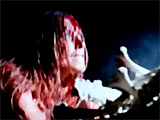 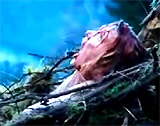 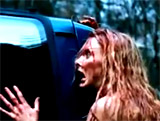 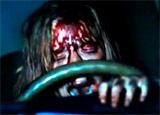 Sarah's Escape to Daylight and a Vehicle? 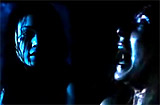 Vision of Juno in Car 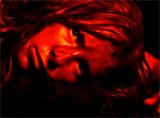 Only an Hallucination  Her Daughter Jessica's Birthday Cake 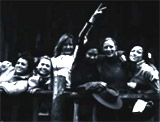 B/W Photo of Six Spelunkers |
|||||||||||||||||||||
|
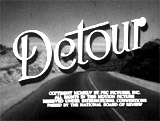
Detour (1945)
In this gritty Edgar Ulmer B-film noir told in flashback, fatalistic, self-pitying, down-and-out, NYC musician-loser Al Roberts (Tom Neal) was seated in a tawdry Reno diner where he told about recent events and imagined his pending arrest. In Arizona during his westward trek, Roberts had found himself as a hitchhiker in the car of Miami bookie Charles Haskell, Jr. (Edmund MacDonald), while he was on the way to Hollywood to meet up with his girlfriend-fiancee, aspiring nightclub singer Sue Harvey (Claudia Drake); when Haskell died from a heart attack and a blow to the head under ambiguous circumstances, Roberts feared he would be arrested for murder; he dumped Haskell's body along the side of the Arizona road and stole his identity (wallet with cash, clothes, and car). In California, he picked up vulturous and despicable femme fatale hitchhiker Vera (Ann Savage), who suspected that he had deliberately 'killed' Haskell, the man he was impersonating, since she had hitchhiked with Haskell earlier in the plot: ("You're a cheap crook and you killed him"); she blackmailed Roberts for Haskell's stolen cash - and greedily schemed with more ways to take advantage of the suspected murderer Roberts. During a vicious argument one night in their rented Hollywood hotel-apartment when Vera threatened to call the Hollywood police station and accuse him of Haskell's murder, he accidentally killed the castrating, drunken and exploitative Vera. After she had called him a "yellow stinker" and accused him of not being a "gentleman," she ordered him to open up the windows. It was a ploy - she grabbed the phone and raced into the adjoining bedroom where she locked herself in. He pulled on the long phone cord extension through the closed door, which she had inexplicably wrapped around her neck. When she ignored his promise to do anything she asked for, he began yanking on the cord and pulled it as tightly as possibly (with a close-up of his straining fists). Then, he broke down the door and saw her body lying on the bed - reflected in a mirror. This was a a second disastrous twist of fate! He knew his fate was sealed, as he spoke in voice-over:
The film ended with Roberts imagining being picked up by a patrol car in Reno, NV for the murder of Vera. |
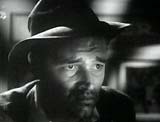 Al Roberts (Tom Neal) Explaining His Determined Fate in Flashback in a Reno, NV Diner 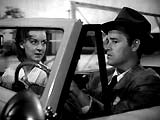 In California, Al and Hitchhiker Vera (Ann Savage) 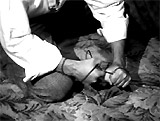 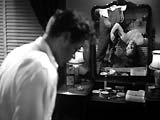 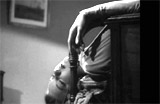 Vera's Accidental Telephone Cord Strangulation in Rented Hollywood Hotel-Apartment |
|||||||||||||||||||||
|
Devil (2010) (aka The Night Chronicles: Devil)
Director John Erick Dowdle's low-budget supernatural horror film was based upon a story by M. Night Shyamalan (scripted by Brian Nelson), the "master" of plot-twist films, although Shyamalan was often accused of cheap third-act twists. The edgy thriller was to be the first film in The Night Chronicles trilogy. Two of the film's taglines told a lot about the plot - that there would be no coincidences:
This theme was similar to many classic mystery tales (i.e., Agatha Christie's And Then There Were None, which was made into two different films with the same title in 1945 and 1974, and also as Ten Little Indians in 1965 and 1989, along with the comedy spoof Murder By Death (1976)), in which a group of people were trapped in an isolated or inescapable location, and one by one, they died off. [Note: Other films with the same premise: Hitchcock's Lifeboat (1944), Cube (2003), Open Water (2003), Buried (2010) and many others, kept a group of individuals in a confined, dangerous situation.] The plot twist often contained the same ingredient - the villain, thought to be dead, was one of the remaining survivors. The prologue's Biblical quote (inaccurately credited as Peter 5:8) set up the plot:
A gruesome and disturbing folktale ("old wives' tale") told at bedtime, titled "The Devil's Meeting," was described (in voice-over) in early sequences by a religiously fanatical, superstitious security guard Ramirez (Jacob Vargas). Its premise inspired the storyline: the Devil (El Diablo) was to take human form, hide amongst everyone, and torture and punish various damned individuals who had sinned. Other innocents would die along the way, trying to help out. The film opened with a striking, inverted helicopter shot of the city of Philadelphia's harbor and downtown, and then a suicide jump from a window on the 35th floor of a skyscraper ("paving the way for the Devil's arrival"). The end credits identified the five individuals who would soon become trapped in the same building's high-rise office elevator, stuck at the 21st floor during the suicide investigation. They were listed by their occupations or descriptions, not by their character names:
Called into the case was recovering alcoholic Detective Bowden (Chris Messina) with his loyal assistant Markowitz (Josh Peace). Bowden was still suffering from an incident five years earlier - the hit and run death of his own wife and toddler son, by someone who left the scene after writing an apology on the back of a car wash coupon. The two officers soon discovered that all five occupants had dark or criminal pasts in some way, were potentially capable of murder, or deserved to be killed. They had all done evil things, it seemed:
Therefore, according to Ramirez, it was Satan's plan:
The elevator occupants were doomed to experience vengeful punishment by Satan posing as a human. There were frequent power failures, hallucinations regarding what was happening (Ramirez saw a "face" superimposed on the elevator, and the Young Woman had a vision of everyone bloodily slaughtered). In addition, there were recriminations and shifting blame, and a rescue attempt by repair technician Dwight (Joe Cobden) in the shaft that ended with a fall to his death onto the top of the elevator. Another guard named Lustig (Matt Craven) was electrocuted. The elevator characters began dying one by one (each time when the lights went dark):
Mechanic Tony - the last survivor, repentently confessed to a revived and spiteful Jane (with pupils dilated revealing herself to be Satan), and via radio to Detective Bowden, that he was the drunk hit-and-run driver who had killed Bowden's family years earlier. On the way to the police station, Bowden reciprocated and forgave Tony for his sin. The film's moralizing final line was delivered by Ramirez (in voice-over): "If the Devil is real, then God must be real, too." |
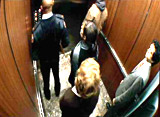 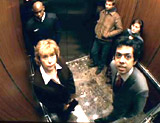 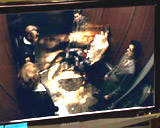 Stalled Elevator Crisis 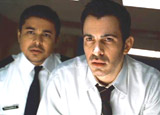 Security Guard Ramirez (Jacob Vargas) and Detective Bowden (Chris Messina) Elevator Deaths: 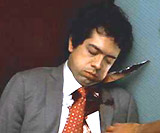 Salesman Vince (Geoffrey Arend) 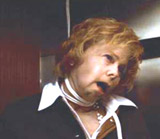 Old Woman Jane (Jenny O'Hara) 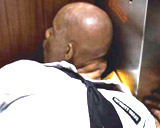 Guard Ben (Bokeem Woodbine) 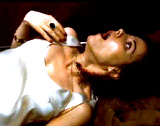 Young Woman Sarah (Bojana Novakovic) 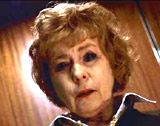 The Satan Figure  Mechanic Tony (Logan Marshall-Green) Confessing to Det. Bowden  Det. Bowden |
|||||||||||||||||||||

|
The Devil's Advocate (1997)
During a particularly difficult trial, young Florida defense attorney Kevin Lomax (Keanu Reeves) fantasized that he had sold his soul. Experiencing an elaborate daydream, he fantasized that he was about to compromise his integrity by representing his guilty client, a schoolteacher named Mr. Gettys (Chris Bauer), in a child molestation case. He was tempted to acquit the child molester by discrediting the victim during harsh cross-examination. In his fantastic daydream - his vision of the future, he went ahead in the case to acquit Gettys and maintain his perfect trial record. Afterwards, he was recruited into the corrupted service of Satanic John Milton (Al Pacino) (deliberately named to imply his "Paradise Lost") at a law firm in New York. Lomax and his wife Mary Ann (Charlize Theron) were plunged into a life of sex, money, and power after moving to the city. They came under the perversely seductive, tempting, corruptive mentoring tutelage and services of diabolical law firm head John Milton. Lomax accepted an offer of a high-paying job and the couple moved to Manhattan, where Lomax began a busy schedule of work, while Mary Ann was left at home by herself; they didn't realize that their lives had been totally altered. With Lomax away and hard at work on a high-profile murder case, Mary Ann's increasing isolation caused her distress, and she began to have flashes of demonic faces, especially during a shopping trip with other lawyers' wives. To console Mary Ann for being away from her for long periods of time, Kevin suggested that they should have children; in a very hallucinatory sequence during love-making with his wife, Kevin fantasized that he was also having sex with pretty and attractive red-headed co-worker Christabella Andreoli (Connie Nielsen).
A number of other unusual circumstances also occurred -
Afterwards, Lomax discovered Mary Ann in a local church covered by a blanket, claiming that Milton, who had earlier flirted with her, was having sex with her - and then forcefully raped her. Lomax took the side of Milton, although Mary Ann was able to prove the rape by showing cuts, bruises and scratches all over her body; fearful that Mary Ann was inflicting self-harm and injury, Kevin admitted Mary Ann to a mental institution. the film's major turning point came at Eddie Barzoon's funeral when Kevin noticed that Alexander Cullen was stroking his 14 year-old stepdaughter Alessandra Cullen's (Monica Keena) skin - and suddenly imagined Cullen as the child-molesting HS teacher Gettys who he was defending in his case in Florida; Kevin was also urgently notified by US Justice Dept. agent Mitch Weaver (Vyto Ruginis) that Milton's worldwide firm was corrupt (involved in arms brokering, chemical weapons and toxic waste, money laundering - "Milton is into everything"), and that Barzoon - now dead - was about to testify against Milton; he added that released pedophile Gettys was under arrest for another underage crime - this time a homicide of a 10 year-old girl found in the trunk of his car; immediately after, Weaver was conveniently struck and killed by a car in Lomax's view, as Milton at Barzoon's funeral service dipped his fingers into baptismal holy water causing the liquid to boil, with his hysterical laugh in curtains of flames. In the next startling scene set in the mental institution, the mentally-ill Mary Ann envisioned her case manager Pam Garrety (Debra Monk) as a demon; she barricaded herself in her room and suicidally slit her throat as Kevin tried to break into her room to prevent her from hurting herself. Kevin confronted Milton in his law office, who confessed that he had raped Mary Ann; Lomax attempted to shoot and kill Milton with gun shots, but he was invincible - due to being Satan himself; he also revealed that he was Lomax's father ("Call me Dad"); Milton reminded Kevin that everything he had done was of his own free-will choices ("Stop deluding yourself") - he was too busy and had neglected Mary Ann, causing her to be attracted to Milton and ultimately commit suicide, and he had defended the guilty teacher Gettys; Lomax reluctantly admitted that Milton was right. Milton delivered a climactic, fiery monologue in which he called God an "absentee landlord" and revealed himself as the charismatic, evil Satan himself: ("...Well, I tell ya, let me give you a little inside information about God. God likes to watch. He's a prankster. Think about it. He gives man instincts. He gives you this extraordinary gift, and then what does He do? I swear, for His own amusement, His own private cosmic gag reel, He sets the rules in opposition. It's the goof of all time. Look, but don't touch. Touch, but don't taste. Taste, don't swallow. Aha ha ha. And while you're jumpin' from one foot to the next, what is He doin'? He's laughin' His sick, f--kin' ass off. He's a tight-ass. He's a sadist. He's an absentee landlord. Worship that? Never!"). Lomax asked: "'Better to reign in Hell than serve in Heaven'", is that it?" Milton added that he was a humanist through and through, and had been on man's side (as opposed to the absent God), and had made the 20th century his own century: "Why not? I'm here on the ground with my nose in it since the whole thing began. I've nurtured every sensation man's been inspired to have. I cared about what he wanted and I never judged him. Why? Because I never rejected him. In spite of all his imperfections, I'm a fan of man! I'm a humanist. Maybe the last humanist. Who, in their right mind, Kevin, could possibly deny the twentieth century was entirely mine? All of it, Kevin! All of it. Mine. I'm peakin'. It's my time now. It's our time." As the wall sculpture mural with naked figures came to life behind him, the charismatic, evil Milton further seduced and tempted Lomax with Kevin's half-sister Christabella to have sex with her and offering him the possibility of fathering the Anti-Christ; while referring to his own 'free will' to make the choice. In response to Milton's offer of "Everything, anything...How about bliss for starters, instant bliss, bliss on tap, bliss any way you want it," Lomax began kissing the nude Christabella, but then asked "What about love?"; Milton interjected: "Overrated. Biochemically no different than eating large quantities of chocolate" and urged: ("It's time to step up and take what's yours").
Instead, Lomax voluntarily committed suicide by shooting himself in the head, citing his use of 'free will.' In reaction, Milton shrieked hysterically "No!" and due to his hot volcanic rage, he and the wall mural burst into raging flames while a naked Christabella age-withered and died, and Milton was converted into angelic form resembling Lomax
After this climactic series of events, in the first of two major plot twists, Lomax was brought back to reality, and returned to the Gettys case courtroom during a recess period; Mary Ann was still alive, and everything previously viewed was Kevin's fears of his future if he defended a known pedophile. In the Florida courtroom, Lomax announced (as part of doing "the right thing") that he would no longer represent his guilty client and cross-examine the witness - thus threatening his own disbarment. A press newsman named Larry (Neal Jones) who was covering the case summed up Lomax's decision as a future sensational media story: "A lawyer with a crisis of conscience?...It's huge!...You've gotta give me an exclusive. This is wire service. This is 60 Minutes! This is a story that needs to be told. It's you! You're a star!"
After tempting the couple to agree to a news story, the newsman morphed into Milton, the second major plot twist, as they left, gloating with a devilish grin: "Vanity - definitely my favorite sin!" He was insinuating that the Devil still had plans to intervene in the Lomax's lives. He was determined to try again. Milton dissolved into flames as The Rolling Stones' Paint It, Black played. |
 Defense Attorney Kevin Lomax (Keanu Reeves) During Harsh Questioning in Florida Courtroom  John Milton (Al Pacino) and His Rooftop Persuasion of Kevin Lomax to Join NYC Law Firm  Mary Ann's Momentary Flash of Jackie's Demonic Face 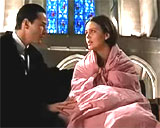  Mary Ann (Charlize Theron) in Church - After An Alleged Rape by Milton - With Bruises as Proof  Milton's Fingers Made Baptismal Water Boil at Eddie Barzoon's Church Funeral 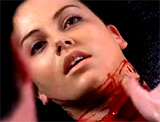 Mary's Ann's Suicide in Mental Hospital 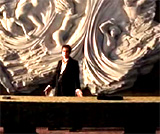 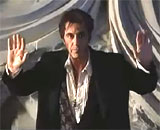 Milton In Front of Wall Sculpture Mural Confronted by Lomax with Gun  Milton's Over-the-Top Rant and Denunciation of God 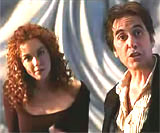   Lomax Tempted by Milton's Nude Half-Sister Christabella to Conceive the Anti-Christ 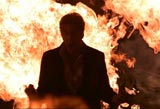 The Wall Mural and Milton Bursting into Flames 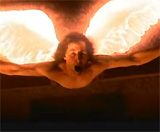 Milton Converted Into Angelic Form Resembling Lomax |
|||||||||||||||||||||
|
Les Diaboliques (1955, Fr.) (aka Diabolique, or The Devils)
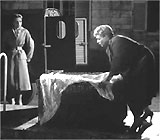
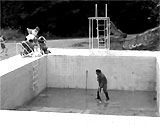
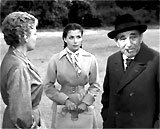
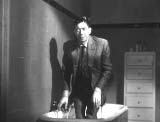
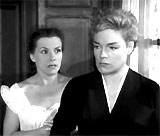
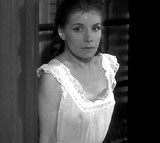
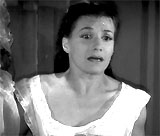
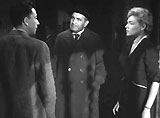
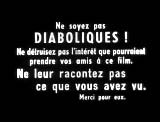
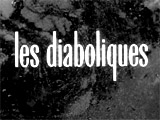
French director Henri-Georges Clouzot's intriguing, noirish psychological horror-thriller was one of the earliest films to feature a shocking plot twist in its conclusion. The Hitchcockian, Psycho-like film with the overarching themes of hate, double-cross, revenge and greed, was adapted for the screen from Pierre Boileau's and Thomas Narceja's 1952 novel Celle Qui N'était Plus (She Who Was No More). The film was remade as the R-rated erotic thriller Diabolique (1996), starring Sharon Stone, Isabelle Adjani and Chazz Palminteri. This film was one of the first to actually contain an end-credits 'anti-spoilers' director's statement (see below) that advised viewers to keep the film's ending a secret. The opening title screens were symbolically displayed above the algae-infested, fetid waters of an unkempt swimming pool. The film's setting was the run-down, all-boys Institution Delassalle Boarding School in metropolitan Paris (in the provincial town of St. Cloud), where a love triangle involved the three main characters (all heinous, evil, and greedy in their own right) in the curving plotline. The headmaster of the school was 34 year-old Michel Delassalle (Paul Meurisse) - a despicable, miserly, tyrannical and abusive schoolmaster who was cruelly mistreating his students and employees. He was also involved in a physically-abusive affair with his mistress - the brassy science schoolteacher, an icy cool-tempered, cropped blonde-haired femme fatale Nicole Horner (Simone Signoret) whom he often beat (in the opening scene, she had a black eye that was hidden by her sunglasses). The film's point-of-view or perspective was from Michel's also mistreated, downtrodden, humiliated, tormented and "delicate" wife/Headmistress-Principal Christina "CriCri" Delassalle (Véra Clouzot, director Georges Clouzot's real-life wife), a devout ex-Catholic nun originally from Caracas, Venezuela with a heart condition; Michel called his wife of eight years "a cute little ruin." The dark-haired, pig-tailed infantilized Christina was the wealthy owner of the school; Christina knew of her husband's destructive affair with Nicole, but tolerated it; one of the other teachers astutely observed: "The legal wife consoling the mistress" In an early scene in the school's dining room, the mean-spirited Michel made Christina chew and swallow stinking, rotten fish served for dinner (expired food prepared by the school's staff) in front of everyone: "Everyone is looking at you. Swallow!" During the suspenseful thriller (with a convoluted murder plot), Nicole was finally able to convince her co-battered friend Christina to join together with her to commit the perfect yet sinister murder of their equally-despised tormenter Michel. During a 3-day school vacation break that they took together to Nicole's country apartment (in the isolated village of Niort over 400 km from Paris), Christina and Nicole shared the one bed (the film's mildly-implied lesbian sub-text). They lured Michel by phoning him and having Christina announce her sudden divorce plans for a legal separation. Later that evening, after Michel arrived by train in Niort, they discussed her unhappiness in the marriage and he slapped her in anger. He was tricked by Christina into drinking alcohol spiked with a sleep sedative before they drowned him in the bathtub. Nicole held down Michel's drugged body as the horrified and more sensitive Christina stood by, but then went to the bedroom with heart pains. [Note: This was Christina's fatal mistake - she did not definitively verify that Michael was actually dead!] The females concealed Michel's bloated body in a large wicker trunk to drive it back to the school the next day, but were nearly discovered when a piece of string snapped on the wicker trunk as it was being dragged with help from Nicole's upstairs neighbor M. Herboux (Noël Roquevert) to their vehicle, and the corpse was almost detected. As the two drove back, Christina worried: "We are monsters. I don't like monsters," while Nicole replied: "If it's only him, I feel better. I'll save the grain of sand falling from the hands of providence for my morality lessons." A hitch-hiking drunken soldier (Jean Lefebvre) also made Christina anxious when he kept insisting on getting into the back of their vehicle. Later that night as the two were dumping the weighted body into the school's murky, scummy, neglected and unused swimming pool, they were almost discovered when a young boarding school student named Pascual (Jean-Pierre Bonnefous) turned on an upstairs bathroom light that illuminated the pool area.
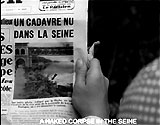
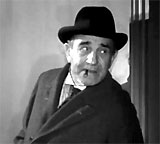
The two females thought that the death would easily be ruled a suspected drowning once the body surfaced, but it didn't appear as expected. Speculation was running rampant about the missing Michel's unforeseen absence. To force the draining of the pool, Nicole claimed that she had accidentally dropped her keys into the water. As the pool was being emptied by the school's groundskeeper-concierge Plantiveau (Jean Brochard), the distracted and anxious Christina was nervously teaching her math class nearby; when Michel's body was not found, Christina fainted in shock by the side of the pool. The two uncertain and nervous co-conspirators began to distrust each other, assign blame and make recriminating statements, while becoming guilt-ridden, fearful, and worried about the possibility of being blackmailed by someone who had discovered their secret. Christina blamed Nicole for promoting the murder: "I was insane to listen to you." Other tense, semi-supernatural and unusual situations began to occur, suggesting that something had gone terribly awry with the murder. Michel's gray, Prince of Wales suit that he was wearing when he was drowned was mysteriously delivered from the dry cleaners. A key found in the suit was identified as the door key to Room # 9 in a nearby, rarely-used, fancy Eden Hotel residential room. It had "no belongings, no bags" and no one seemed to have ever seen Michel there. Christina also found that charges for an unpaid bill two years earlier (shower repair for 80,000 francs) had recently been paid from Michel's account. Once the remains of a naked body were discovered off the school grounds in the Seine River, Christina went to the morgue to verify its identity, but the body was not Michel's. Nosy, retired police commissioner and elderly, bumbling private detective Alfred Fichet (Charles Vanel) became involved in the case when he insisted that he could help Christina and locate her missing husband: ("If you'd like, we are both going to find your husband....don't worry, I'll find him").
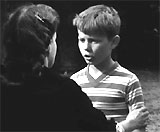
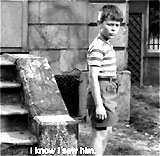
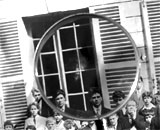
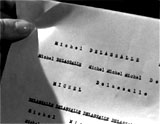
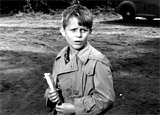
Christina and Nicole listened as a student named Moinet (Yves-Marie Maurin) claimed to have been recently reprimanded and punished by an 'unseen' Michel (and ordered to rake dead leaves) for shattering a window with his slingshot (that was promptly confiscated); teachers were known to often accuse the fanciful-minded boy of lying and being a "mythomaniac": (Nicole: "You forget that this kid is a pathological liar"), and now they doubted his account of the presence of the supposedly-dead Michel. As he walked away, the boy affirmed his sighting: "I saw him. I know I saw him." Oddly though, a photograph taken at the school seemed to show that the spectral figure of Michel was standing in the window behind the students - was Michel still alive? The fearful, unstable, paranoid and ailing Christina was suffering from nightmares; in her bedroom, she confessed everything to the private detective and told him why Michel wasn't coming back: ("You know he can't come back...because I killed him...five days ago in Niort"); he was doubtful of her story due to help she received from Michel's mistress Nicole; Christina was surprised that Alfred didn't charge her with a crime, and told her to take a strong sedative. Later that night, in the film's plot-twisting conclusion, after wandering around the school building and her apartment and getting spooked by strange noises and shadows, the trembling Christina heard the sounds of a typewriter's keys; down a long hallway and into Michel's office, she found a piece of paper in the typewriter with multiple "Michel Delassalle"'s typed on the page, with Michel's gloves nearby. As she screamed and raced away, she was lured into her bathroom, and unexpectedly found Michel's corpse in the bathtub.
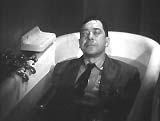
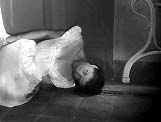
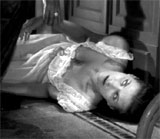
The sight caused her (and the audience) to have a fright-induced heart attack, when Michel rose zombie-like out of a bathtub with half-opened, glazed all-white eyes. Was it revenge beyond the grave? She clutched her chest in the vicinity of her heart, and her eyes rolled back as she fell against the wall behind her. She slid to the floor where she collapsed and slumped over dead.
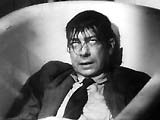
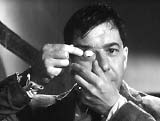
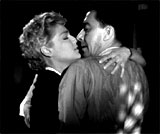
The major twist was that Michel was never killed by them - he had faked his own death - with collaborative help by Nicole - so that Christina could be induced into having a fatal heart attack. Afterwards, Michel popped the fake eye lenses from his eyes, exited the tub, and perfunctorily checked Christina's arm for a pulse. After unlocking the apartment door, Nicole rushed into his arms for embraces and kisses. Their plan was to become rich by selling the "fire-trap" school that he would inherit from his deceased wife (Michel: "Wasn't it worth it? Now, we're rich. Just by selling the school, we'll get a lot"). The film's initial conclusion was that the pair of "Diaboliques" weren't Christina and Nicole as previously assumed, but Nicole and Michel. In the denouement, the two gloating co-conspirators were immediately arrested by Alfred - who overheard them talking about their plotting, and predicted their prison term ("between 15 and 20 years in jail"). In the film's resolution the next day as the school was closing due to the scandalous news, there was another dizzying reversal regarding the fate of Christina. The confused, truth-telling or lying (?) schoolboy Moinet, the same one who had earlier broken a window, declared that Christina had just given him back his confiscated slingshot which he had used to break a second window that morning: ("She's not dead. She came back") - the film's last line as he walked away to again stand in a corner for punishment was: "I saw her. I know I saw her." (translated) The film viewer was left pondering this additional integral question: Had the retired detective Alfred and Christina devised their own scheme (off-screen) to fool both Nicole and Michel?; it was highly likely that the school-boy - who hadn't really lied the first time about Michel's continued presence - also wasn't lying this second instance when he declared that Christina was still alive. The film's unique, one of the first of its kind, end-credits 'anti-spoilers' director's statement advised viewers to keep the film's ending a secret (two translations):
|
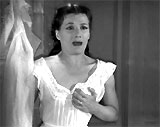
 Christina "CriCri" Delassalle (Véra Clouzot) 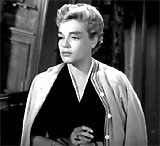 Nicole Horner (Simone Signoret) 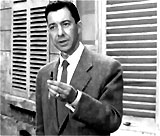 Michel Delassalle (Paul Meurisse) 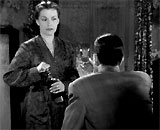 A Spiked Drink Offered by Christina to Michel 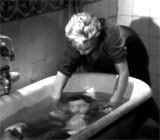 Michel's Forced 'Murder' (by Drowning) in Bathtub
|
|||||||||||||||||||||
|
In this 20th James Bond film (the fourth with Pierce Brosnan), there were two major identity shifts. The 007 agent was first up against a very crafty, rogue North Korean weapons dealer named Colonel Tan-Sun Moon (Will Yun Lee). He was Harvard educated and cynically bragged about his corruption by Western education ("majored in Western hypocrisy"). After it appeared in the opening sequence that Moon had been killed when his hovercraft plunged off a steep cliff into a waterfall, he later resurfaced in the film as an entirely different character, after having his appearance entirely altered (and his accent too). He secretly underwent painful DNA replacement gene therapy at a "strange" treatment center-clinic on Isla de Los Organos, an offshore facility (later called a "beauty parlor") near Havana, Cuba run by Dr. Alvarez (Simon Andreu). Even his father General Moon (Kenneth Tsang) was unaware of his son's survival and drastic transformation.
Moon's new character was introduced as:
It was a good-will cover for laundering African conflict diamonds, and for carving an invasion path from North Korea into South Korea, by destroying the minefield in the DMZ between the two countries - "creating a highway for our troops" and opening S. Korea up to invasion. His publicist was mysterious blonde Miranda Frost (Rosamund Pike), a fencing expert - and as it turned out in another minor plot twist, M's (Judi Dench) newest undercover MI6 agent. She had been on the Graves case for three months after volunteering, and claimed: "Graves seems to be clean" although Bond believed differently. It was at first a surprise when she revealed to Bond that she was a fellow agent, and let herself be seduced by him. Then, when she appeared to be on Bond's side and held a gun on Graves, the villain noted: "Miss Frost is not all she seems" and Bond added: "Looks can be deceptive" - but then she swiveled her gun to face it toward Bond, and was about to follow orders to kill Bond. She was the traitorous double-agent MI6 mole who had betrayed Bond's identity in Korea in the film's opening (and it was revealed that she had met the Korean General at Harvard when they were students there together). Graves smirked:
When Bond attempted to fire his gun, Miranda told how she had sabotaged it when they slept together. Graves explained how he fatally poisoned Frost's opponent in the Olympics fencing competition in order to win her loyalty:
Bond critiqued: "The coldest weapon of all." |
  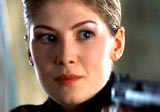 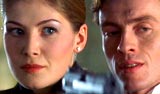 Traitorous Double Agent Miranda Frost (Rosamund Pike) with Graves |
|||||||||||||||||||||





 ATF
Agent Doug Carlin Investigated A Tragic Ferry Bombing, and Was Determined
to Save Pretty Claire Kuchever, One of The Collateral Victims Killed
by the Domestic Terrorist (Carroll Oerstadt); He Traveled Back in
Time To Save Her and Prevent the Ferry Explosion
ATF
Agent Doug Carlin Investigated A Tragic Ferry Bombing, and Was Determined
to Save Pretty Claire Kuchever, One of The Collateral Victims Killed
by the Domestic Terrorist (Carroll Oerstadt); He Traveled Back in
Time To Save Her and Prevent the Ferry Explosion