|
Film Spoilers and Surprise Endings I |

|
|
||||||||||||||||||||||||||
|
The I Inside (2003)
Director Roland Suso Richter's enigmatic psychological thriller (direct to video/DVD) was based upon screenwriter Michael Cooney's own play "Point of Death" - a title that gave away the film's entire plot twist premise. As in many similar films, such as Jacob's Ladder (1990), Soul Survivors (2001), and The Butterfly Effect (2004), events and people were thoroughly distorted and confused because the protagonist was at the point of death. The tagline was misleading:
The mind-warping film opened with a hospital patient Simon Cable (Ryan Phillippe) awakening in a hospital with little knowledge (amnesia perhaps?) of what had happened, and why he was there, etc. He was told by attending Dr. Jeremy Newman (Stephen Rea) that it was July 29, 2002 (Simon thought it was the year 2000 - he was confused - he heard a doctor say 20:00 hours!) and that he had died for two minutes from cardiac arrest following the near-fatal accident -- but he had been revived ("You're as good as new").
A major clue to everything that truly happened was the scene that played next under the credits - hospital staff failed to bring a patient back to life with a defibrillator after a car accident. Chest compressions failed and there was no pulse. A second major clue was provided by hospital orderly Travis (Stephen Graham):
A third clue was provided by a doctor:
For the remainder of the film, Simon's mind was in a confused state regarding the actual year, alarming events with his brother and wife, and his own existence. He thought he had lost two years of his life. He believed he was in a different time period and in the hospital following a different car accident. He recalled being a patient in the same St. Jude's Hospital (in Maine) in the year 2000 as the victim of a similar accident, when his older brother Peter (Robert Sean Leonard) died. The disoriented and confused Simon thought he had two missing years, from 2000 to 2002, and he struggled to put the pieces of his life together - a puzzle metaphor. Dr. Newman told him his objective:
He was also encouraged to start remembering: "The quicker that happens, the quicker you accept what really happened, the quicker you'll find you'll be able to move on." There were lots of confused pathways that he explored as he darted back and forth as a time-traveler between the two years. He was attempting to piece together the experiences of his recent past (he inaccurately thought it was a two year period between 2000 and 2002):
The true revelations of what happened came when Simon - with blood literally on his hands - admitted his guilt: "I killed him." In a loathsome act of betrayal, Simon had kissed his brother Peter's fiancee Clair in the estate's sun-room. [Clair later told Simon: "I can't help but think that we're paying for what happened."] After a slight altercation, Peter accidentally fell from the estate's top floor through a skylight below. Simon drove his seriously-injured brother to Vista Point and contemplated rolling the car over the cliff (with Peter inside), to cover up the crime. In a replay of the same event in his mind, guilt-ridden Simon had a sudden change of heart from his first inclination. He tried to change reality ("I thought I could change it"). He turned away from the Vista Point turn-off to take his brother to the hospital. Clair - who was driving back to the estate at the same time on the same narrow road - had a head-on collision with their car (due to blinding headlights), and everyone was killed. Two of the paramedics at the scene were Nurse Hathaway and Travis. Although reluctant to accept his death ("It wasn't supposed to happen like this"), Simon ultimately accepted the reality of his expiration. He remained in the afterlife with his brother Peter, who had counseled:
Simon's 'death' in his dream of the year 2000 was mirrored or paralleled with his death in 2002. The film returned to the car accident scene - also shown in the film's opening - when Simon was being treated by emergency personnel. Peter told him: "It's your choice, Simon, where you go. It's your choice." A time stamp clock showed the time of his death: 20:02. Attending hospital physician Dr. Newman [revealed as Mr. Cable - the father of the two sons] matter-of-factly delivered the news to Simon in the film's final line - with an added final sentence - "You died, Mr. Cable."
[There was no
mention of him being revived.] |
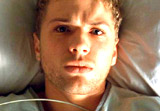 Simon Cable (Ryan Phillippe) 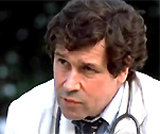 Dr. Newman (Stephen Rea) 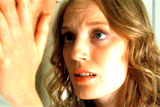 Clair (Sarah Polley), Peter's Fiancee 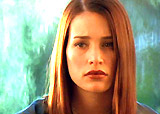 Anna (Piper Perabo), Simon's Wife  Simon Kissing Clair 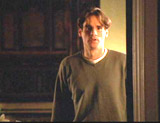 Peter (Robert Sean Leonard) Witnessing Simon Kissing Clair 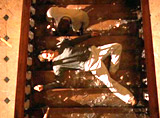 Peter's Fall Through Skylight 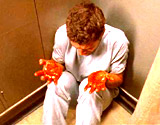 Simon With Blood on His Hands 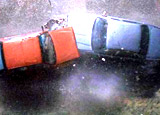 The Car Crash 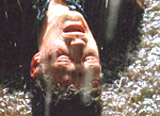 Simon's Death 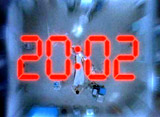 Time of Death |
||||||||||||||||||||||||
|
I Pass For Human (2004)
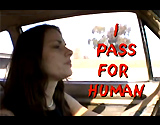
Writer/director Chris D.'s (Chris Desjardins) first feature-length film was this direct-to-DVD/video low-budget, independent horror film. The over-used plot twist in this film was also seen in Carnival of Souls (1962), Siesta (1987), Jacob's Ladder (1990), A Pure Formality (1994), The Sixth Sense (1999), The Others (2001), Soul Survivors (2001), Stay (2005), and many other films. The grim movie from the Flesh Eater punk rocker was about the LA drug scene, in which drug use (equated with undead zombies) robbed individuals of their identities and pulled them into the nightmarish world of the dead filled with ghoulish creatures. The tagline summarized the metaphoric effects:
The crude and amateurish film opened with tattooed Jane (Eleanor Whitledge), not yet an habitual drug user, worried about the condition of her heroin-addicted boyfriend Dax (Bryan Small) who was experiencing visions of old friends - all users who were OD victims:
She met with her concerned drug counselor Dr. Larraz (cult queen Mary Woronov), who urged her to break up with him. When she returned home, she found that Dax had already suffered a deadly overdose in the bathroom after shooting up. Tormented and despondent after Dax's death, Jane was having hallucinations herself. Especially when she was high, she saw phantom apparitions that weren't there. She was introduced by Dax's self-destructive, strung-out, drug-abusing half-sister Mila (Jennifer Ciesar) to Rick (Joshua Cox), who had also recently lost his sexy girlfriend Azami (Eva Scott) to drugs. Strangely, Mila reported that she had seen Azami at Dax's gravesite. Rick explained how he spied on Azami buying hard drugs and using them with her "strung out" ex-husband (John Diehl). Azami overdosed and died in her parents' (Jake and Elke Hill) home when staying there overnight with Rick. [On a side-note, just before she died, Rick had helped Azami cover up the deliberate murder (by suffocation) of her abusive, overdosed ex-husband with 4x's dosage, and the disposal of his corpse.] Rick and Jane bonded and soon, they became users together. After shooting up for the first time, Jane admitted: "I'm such a weak-willed piece of s--t." Jane said that she was seeing many undead zombies, including lost partners Dax, Azami, and blonde Samantha (Iris Berry): "I'm seeing god-damned people who aren't there...Why are we suddenly seeing ghosts? Is it the dope?" Were they ghouls, vampires, or just hallucinations? Rick and Mila, both habitual users, acquired drugs from Mila's "heroin-bar" source - brutish drug dealer Hobby (E. Shepherd Stevenson). Jane's doctor, an ex-addict herself (in med school, she was a junkie to morphine) thought there was some truth to the belief that the leeching, blood-thirsty, vampirish zombie creatures vicariously fed off the highs of living users:
Jane feared she was developing a physical addiction, but before that happened, wondered if she could enter a 30-day rehabilitation program to avoid following the path of her acquaintances ("I don't know one sane person. Everyone I know who wasn't crazy is gone"). In the week before Jane could arrange for rehab, she bought dope from Hobby, who then accused her of stealing his larger stash of dope (Mila was the culprit). At shot-gun point, he threatened to rape Jane in the back of his van, but Rick arrived and put a bullet in his head to save her. With a blood-splattered face, she fled to a nightclub, where she was followed by a haunting Samantha and Azami and saw a decomposed Dax in a bathtub. Meanwhile, with Rick's gun, Mila shot and killed a security guard after shoplifting in a convenience store. In her apartment, Jane shot up one final time, and as she prepared a bath, collapsed. At the same time, Mila over-dosed (in the company of Azami and Samantha), and guilt-ridden Rick (about covering up Azami's murder) planned to suicidally take his own life with his gun. Just before putting the gun in his mouth and killing himself, Rick spoke to the zombified ex-husband who urged him to get off the "merry-go-round" of life:
In the not very surprising twist ending (the very ubiquitous death-dream revelation), Jane (who believed she was alive) ventured to Azami's ex-husband's house, where she was surrounded by many dead junkie apparitions, including all her dead acquaintances. She was spiteful when Dax and others offered her a hit:
Azami urged: "We'd rather have you here, with us" - and attempted to bite into her neck. Then, after fleeing back to her apartment, Jane discovered that she was also dead from an overdose, lying in her own bed. |
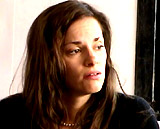 Jane (Eleanor Whitledge) 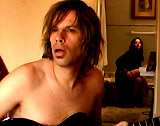 Dax (Bryan Small) 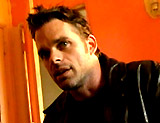 Rick (Joshua Cox) 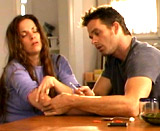 Rick & Jane Shooting Up 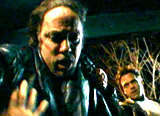 Rick Killing Threatening Drug Dealer Hobby 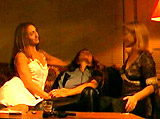 Mila's Overdose 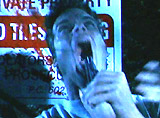 Rick's Suicidal Death 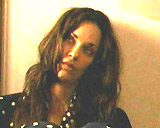 Jane's Bathroom Overdose 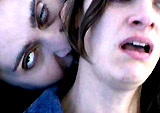 Azami's Vampire Bite on Jane's Neck  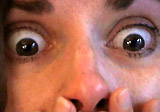 The Revelation of Jane Finding Herself Dead |
||||||||||||||||||||||||
|
Identity (2003)
Director James Mangold's psychological thriller was similar to a popular concept of many plot twisters, a combination of Fight Club (1999) and Agatha Christie's novel And Then There Were None, adapted into many film versions. In the familiar thematic plot, a group of individuals in a remote location were being killed off, one by one. In this filmed story, during a torrential rainstorm, ten strangers were trapped in a secluded motel in Nevada, owned-managed by Larry Washington. They were forced to band together when someone started killing them.
In this high-concept film with a well-constructed plot twist, each of the strangers that was being murdered, one-by-one (each victim had a room key placed on or near their body, with each room number connected to the order of the deaths), was not a real person. They were specific personalities of the 'host' Malcolm Rivers (Pruitt Taylor Vince). Malcolm was a convicted death-row inmate and serial killer, facing the death penalty and guilty of committing brutal murders in the real-world. His doctor, Dr. Malick (Alfred Molina), argued that Malcolm suffered from Multiple Personality Disorder (or Disassociative Identity Syndrome). He theorized that Malcolm was criminally insane - and that his one 'evil' homicidal personality was 'cleansing' himself of the other normal and sympathetic personalities - those were the 'individuals' at the motel. The scenario in Malcolm's head was based on elements of his real life - for example, he was abandoned in a motel as a boy. After a final clemency hearing with a court judge, it was ruled that the death penalty be overturned:
Malcolm was being taken by van with his doctor, Dr. Malick (Alfred Molina), to state psychiatric services after it was recommended that his execution be held off since it was believed that his homicidal identity had 'died.' During the drive, Malcolm had another startling vision of his last two remaining personalities: Paris and Timmy. The only one allowed in his mind to leave the motel alive was cynical ex-Las Vegas prostitute Paris, who was digging in her Florida garden when she found an orange motel door key with the number '1' on it. She turned to see seemingly innocent, mute young Timmy York who was revealed (in a quick flashback montage) to be the one murderous or guilty personality, who was responsible, directly or indirectly, for the deaths of all of the motel occupants. The boy proceeded to kill her with a garden plowing fork-rake (off-screen) after telling her:
Timmy then took control of Malcolm's personality and strangled psychiatrist Dr. Malick in the front seat of the van as the vehicle lurched to the side of the road. Timmy whispered the nursery rhyme (in voice-over) as the film ended:
|
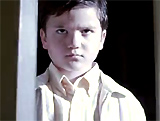 The Murderous 'Evil' Personality -- 'Timmy' York (Bret Loehr) 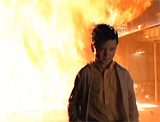 "Timmy" Blowing Up Car With Murdered Mother Ginny Inside 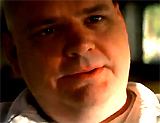 Serial Killer Malcolm Rivers With Dissociative Personality Disorder 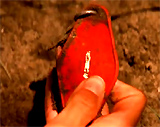 Number '1' Motel Room Key 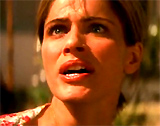 Paris Nevada (Amanda Peet) 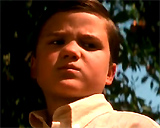 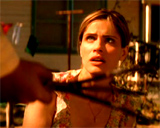 "Timmy" Threatening to Kill Paris With Her Rake 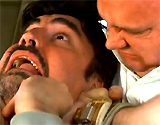 Malcolm Rivers Strangling Dr. Malick in Transport Van |
||||||||||||||||||||||||

|
The Illusionist (2006)
Writer/director Neil Burger's dazzling and glowing period melodrama (and fairy-tale romance) was loosely adapted from the story Eisenheim the Illusionist, by Steven Millhauser - about the turn-of-the-century Viennese magician/wizard. The first three quarters of the film was basically a flashback to explain events occurring before the opening scene. It was narrated (in voice-over) by the dogged and determined Chief Police Inspector Walter Uhl (Paul Giamatti) to describe why he was arresting stage performer Eisenheim (Edward Norton) (aka Eduard Abramovich). The ambitious Uhl was in obligatory allegiance to the surly, competitive, arrogant and abusive Crown Prince Leopold (Rufus Sewell) who was planning to usurp the Austrian-Hungarian throne. As childhood friends, lower-class magician Eisenheim (Aaron Johnson) had fallen in love with Sophie (Eleanor Tomlinson), the future Duchess von Teschen (Jessica Biel). After he gave her a wooden, butterfly-decorated twisting locket that when turned took the shape of a heart (with his picture inside) (and she prophetically told him: "One day we'll run away together. We'll disappear"), they were forcibly and cruelly separated and didn't see each other until 15 years later, when she was engaged to marry the Crown Prince. She was reluctantly volunteered by the Prince to participate in an on-stage demonstration in Eisenheim's illusionist theatre show. The film revealed that the charming Eisenheim and the serenely-beautiful Duchess, who was increasingly reluctant to marry, had again reignited their love for each other during a secret love-making rendezvous. When the Duchess determinedly told the drunken and jealous Prince that she wouldn't marry him and was leaving permanently, it appeared that she was murdered. Off-screen in the horse stables, she was struck across the neck with his jewel-encrusted sword, rode off slouched half-dead on a horse that wandered into the forest, and bled to death. Her lifeless body was later found in a stream. Although the Prince was suspected of the crime, his royal status prevented any serious consideration of his guilt. Eisenheim's new stage show entered the supernatural realm of the spirits. With hired Chinese, the talented illusionist was conjuring up spirits, including Sophie's spirit. When her ghostly image materialized twice on stage, Eisenheim made it appear like she was accusing Leopold of the crime. The conclusion of the opening arrest scene was then played out - Eisenheim escaped when his spirit also faded and vanished. Uhl was led to evidence in the stable linking the Prince to the murder (an emerald from the Prince's sword and Sophie's locket). When he accused Leopold of the murder, the Prince committed suicide by shooting himself in the head. The film's twist was an illusion all its own - in the concluding sequence, Uhl was given a book with Eisenheim's detailed drawings of the solution to the "ORANGE TREE" trick, signifying that Eisenheim's magic was completely illusionary. At the same time, the locket in Uhl's possession was pickpocketed by a disguised Eisenheim, who hurriedly boarded a train for the country, to cheerfully reunite with Sophie. In a spectacular and exhilarating montage, Uhl suddenly pieced together the fact that Sophie's death had been a complete and deceptive frameup to implicate Leopold:
The film's last line was Uhl's memory of Eisenheim saying: "Everything you have seen is an illusion. It's a trick," as he laughed to himself at the recollection. |
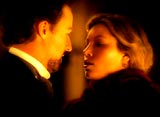 Magician Eisenheim (Edward Norton) With Sophie - The Duchess (Jessica Biel) 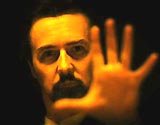 Conjuring Up Spirits - An Illusion 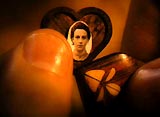 Sophie's Locket With Eisenheim's Picture Inside 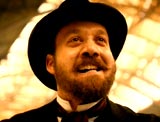 Chief Police Inspector Walter Uhl (Paul Giamatti) 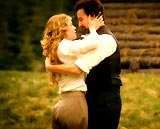 Reunited With Sophie 
|
||||||||||||||||||||||||
|
In the Company of Men (1997)
Writer/director Neil LaBute's disturbing drama (his debut film, a low-budget independent film) had as its thematic premise: "Let's hurt somebody" - a line spoken by corporate ex frat-boy Chad (Aaron Eckhart) out to seek premeditated, retributive revenge on women, after he claimed he had broken up with steady girlfriend Suzanne (Emily Cline) - and she had packed up, leaving him only a futon and his American Gigolo poster. Chad expressed his vile hatred of the fair sex:
As the handsome Chad and bespectacled business colleague/nice-guy college pal Howard (Matt Malloy) were traveling to a project in a branch office for a six-week stint, Howard described how his relationship with girlfriend Melanie fell apart (even after he gave her a ring). Misogynistic Chad thought "we ought to do something about it" - referring to how women were "getting out of balance," and cruelly proposed that they find an unattractive woman, date her, and then unceremoniously dump her during their six week stint:
In their office setting, Chad selected deaf and naive secretarial assistant temp worker Christine (Stacy Edwards), a dark-haired beauty, as their innocent, targeted female - and in week five, Chad slept with her (in his friend Howard's hotel room!). And then, in one of the film's most painful sequences, set in a restaurant and afterwards in a parked car, Howard confessed that he was genuinely falling in love with Christine (he told her: "I need you" using sign language). She was the one who replied with apology that she had two-timed him ("I've let this go too far...I shouldn't have dated both of you") and that she was in love with Chad ("I love someone else"). Howard decided to tell her (out of guilt, hurt, and jealousy) that Chad's love was a total sham and that they had planned the game together ("He doesn't like you. He loathes you. He detests you and your pathetic retard voice. That's what he calls it...You better wake up. You were used. It was a game"), but she had trouble believing him ("Chad would never do that"). He tried to force a ring upon her ("It's not a game to me anymore"), but she refused. In week six, Christine met Chad in the hotel room and asked: "Do you love me?" and then admitted that she knew about his duplicity in the game ("I know what's going on...You two were playing a game on me, right?"). Chad quickly attempted to explain his participation in a "contest" to date Christine, but then admitted he couldn't keep a "straight face" telling the excuse. When he asked how she felt, she slapped him hard across the face. He asked: "It only hurts that much?" and then promptly left the room, dumping her ("The deed's done"). He left her in the room where the emotionally-devastated Christine sobbed uncontrollably. A few weeks later, after they returned to their hometown, a sickened Howard visited Chad at about 1 am, and learned that Chad had no regrets about his actions, and that girlfriend Suzanne had NEVER left him ("She never left. She's always been right there") - the film's plot twist. He boldly and amorally declared why he had devised the game: "Because I could." It seemed that all along, the motivation of the venomous and controlling Chad was a subtle hatred of the submissive and vulnerable Howard, who was appointed ineffectual team leader (in retrospect, Chad had cleverly sabotaged Howard's work throughout the film). When Howard left the building, he vomited on the staircase. Later, Howard found Christine working as a secretary at a bank and approached her desk, shouting loudly at her: "Listen, listen, listen, Listen to me" - but she ignored him and wouldn't listen or speak to him. |
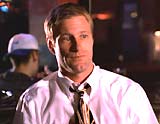 Chad (Aaron Eckhart) 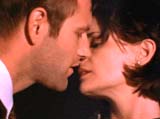 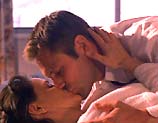 Chad With Christine (Stacy Edwards) 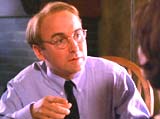 Howard (Matt Malloy)  Christine Told the Truth by Howard 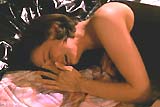 Christine Dumped 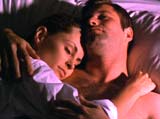 Plot Twist: Chad With Suzanne (Emily Cline) 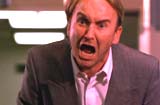 Howard: "Listen to me!" |
||||||||||||||||||||||||
|
In the Cut (2003, US/UK/Australia)
Director Jane Campion's dark feminist sex film featured the alluring tagline: "Everything you know about desire is dead wrong." It became noticed for its huge ad campaign touting clean-imaged Meg Ryan performing her first major explicit sex scenes (that were entirely realistic, dirty, and erotic) - but the film was a box-office disaster, nonetheless. The film was released in other versions - including an unrated and uncut Director's Edition with more explicit versions of the love-making and basement (oral sex) scenes. It was considered a pretentious rip-off of Richard Brooks' Looking for Mr. Goodbar (1977). It starred clean-imaged Meg Ryan as a mid-30s English writing teacher - an unattractive, sex-hungry, despairing divorcee named Francis "Frannie" Avery, who met a tough, foul-mouthed NY detective named Giovanni "James" Malloy (Mark Ruffalo).
He was investigating a homicide in her neighborhood. A severed head (with a "disarticulated" body) was discovered in the garden outside her window. He had a questionable wrist tattoo of the three of spades, matching the tattoo she had seen on the wrist of a man (smoking cigarettes) she had witnessed receiving an explicit 'blow job' in The Red Turtle pool/bar club's darkened basement, performed by a blue-fingernailed woman named Angela (Heather Litteer) - the decapitated homicide victim. When Frannie masturbated face-down on her bed, she fantasized that Malloy was watching her, and that he was the man receiving fellatio. With sexual tension building, she began a torrid, risky sexual liaison with him after he asked her on a date and suggested: "I can be whatever you want me to be...You want me to be your best friend..." - hinting his desire to have sex with her. The film was erotically shocking for Mark Ruffalo's and Meg Ryan's full-frontal nudity, and for Ryan's performance of sex acts. After sex, when she brought him a drink afterwards, she asked: "I want to know...how you did that to me?", and he described (after briefly revealing his genitals as he laid back), with a hands-on demonstration, how he first learned about stimulating a woman. This was offered as a prelude to more missionary-position intercourse. The exciting premise of the film was that the cop, a possible murderer, might kill her next, and she was mugged on the street and roughed up. She was nervous about Malloy being the killer of Angela (and others), and believed that he might be the one who had received oral sex from the murdered woman in the basement and might possibly be the serial killer who murdered other female victims that he was investigating, although he vehemently denied any wrong-doing. The serial killer also murdered and mutilated a medical student co-ed whose body parts were found in the school's laundry room, and toward the film's end, Frannie's half-sister Pauline (Jennifer Jason Leigh) who worked as a stripper/go-go girl at the Baby Doll Lounge, was also found bloodied and decapitated in her apartment's bathroom. After straddling Malloy and making love to him with one wrist handcuffed to her apartment's radiator, Frannie found her missing charm bracelet trinkets (a carriage and baby) that she had last seen at Pauline's place in the cop's coat pocket, convincing her that he was the killer ("It was you!"). His alibi was that he had found them on the street after her mugging. When Malloy's butchy, on-probation detective partner Ritchie Rodriguez (Nick Damici) drove her 'to the lighthouse' under the George Washington Bridge (coincidentally the name of a literature book that Frannie taught) to conceivably take her statement on Malloy, she saw that he had a matching three of spades tattoo - identifying him as the serial killer who had received the 'blow-job' and murdered the other women. When Rodriguez proposed marriage: "Will you marry me, Frannie?" as he dangled a wedding ring on his knife (a wedding ring was his signature at each crime scene), she shot him at close range with Malloy's .38 in the pocket of his coat that she happened to be wearing. She shot him again as he forced a kiss from her. Dazed, she then returned (drenched in blood) to Malloy where she had handcuffed him earlier, and laid down next to him in a spooning position, as the film ended. There were other red-herring characters/suspects:
|
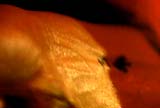 Wrist Tattoo of Killer - Three of Spades 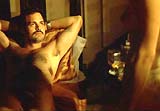 Detective Malloy With Frannie - Showing Off Himself 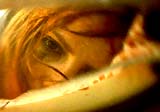 Murder of Frannie's Half-Sister Pauline (Jennifer Jason Leigh) in Bathtub 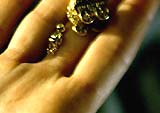 The Giveaway -- Charm Bracelets - "It was you!" 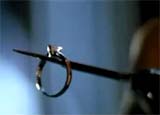 Ritchie Rodriguez Proposing Marriage to Frannie 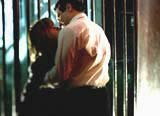 Rodriguez Shot by Frannie at Close Range 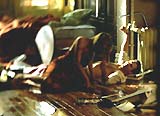 Ending: Frannie Reconciled With Detective Malloy - Spooning on the Floor With Him |
||||||||||||||||||||||||
|
In the Heat of the Night (1967)
This tense whodunit detective story, and Best Picture-winning thriller was set in the little town of Sparta, Mississippi during a hot summer. It chronicled the racial tensions between two individuals brought together for a murder case:
The film's main plot was about the murder of a prominent and wealthy industrialist from Chicago named Philip Colbert (uncredited Jack Teter) who was found beaten to death (a massive head wound) in a town alleyway. Colbert had come to Sparta from the North to build a new factory. His surviving widow Leslie (Lee Grant) insisted that Detective Tibbs stay on the case to find her husband's killer, causing ripples of racism in the small town. During the case's investigation, there were at least four suspects in the case over a two-day period, each eliminated one by one:
During a night-time altercation when all the principal characters were assembled, Tibbs was confronted by a gun-wielding mob outside the back-room abortionist's store, led by Delores' racist brother Purdy. Tibbs announced that Delores had $100 in her purse - funds that she had received for her abortion from Ralph Henshaw. When the money was discovered in her purse, Lloyd Purdy became enraged at Delores (and Henshaw): "You turned my little sister into a field slut?" He was shot and killed by Henshaw before being disarmed and held by Tibbs. After Henshaw's arrest, his confession was recorded in the Sheriff's office. He had murdered Colbert but claimed that it was an assault that all went wrong ("I didn't mean to kill him"). And in the farewell scene as Tibbs departed from the train station, he and Sheriff exchanged respectful goodbyes and shook hands - with mutual respect:
|
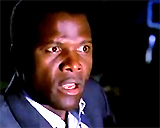 Virgil Tibbs (Sidney Poitier) 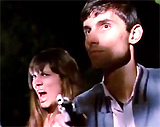 Delores with Henshaw 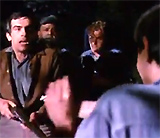 Delores' Brother Lloyd Purdy (left) Shot by Henshaw  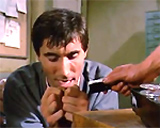 Confession of Murderer Ralph Henshaw (Anthony James) 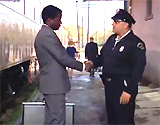 Train Station Goodbye |
||||||||||||||||||||||||
|
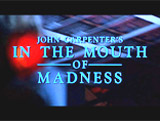
In the Mouth of Madness (1994)
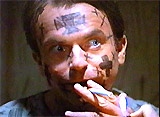
Director John Carpenter paid convoluted, warped homage to Stephen King and H. P. Lovecraft in this film that blurred the boundaries of fantasy and reality, fact and fiction, sanity and insanity, and reality and cine-reality. The film's plot, told in flashback, was about insurance fraud investigator John Trent (Sam Neill) - now a violent and delusional asylum inmate in a padded cell ("I am not insane"), who had been institutionalized after axe-murdering a reader of a popular horror novel, In the Mouth of Madness.
Trent had been hired by Arcane Publishing director Jackson Harglow (Charlton Heston) to search for the author, Sutter Cane, who had mysteriously disappeared. Trent was tasked with retrieving the manuscript for Cane's latest novel (for Arcane Publishing). Trent found himself in the small town of Hobbs End in New Hampshire that resembled a place in Cane's novel. It appeared to be a surrealistic gateway to another world of evil and madness, and Trent began to believe he was a character in the just published book (called "the new Bible"). He learned that god-like Cane's latest book was so powerful that it could change people ("I think, therefore you are!") - making them paranoid and delusional, and even turning anyone who read it into a mutant like creature. Those who didn't like to read (or didn't read the book) could be converted by watching a movie adaptation of the book. When the film ended with a slaughter at the asylum by monstrous creatures, Trent wandered out into the world that was alarmingly empty after a bloody slaughter and civilization had seemingly been destroyed by Cane's creatures. The film concluded by being folded back upon itself - Trent entered an abandoned movie theatre that was showing the latest movie adaptation of Sutter Cane's book - and slowly changed into a crazed, mutant creature that laughed maniacally as he sat down and watched himself on the silver screen. The film's open-ended conclusion let the viewer decide whether Trent was insane or whether what he experienced was actually reality. |
 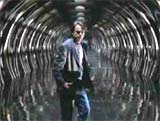 John Trent (Sam Neill) 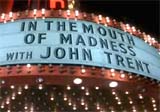 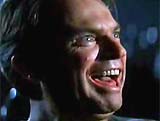 Laughing Maniacally While Watching "In the Mouth of Madness" |
||||||||||||||||||||||||
|
Inception (2010)
In Christopher Nolan's mind-bending sci-fi heist thriller, Leonardo DiCaprio played the part of Dominick "Dom" Cobb, a skilled espionage spy who performed thefts (or extractions) of corporate secrets by invading people's dreams. However, he had become an international fugitive and had ruined his own personal life. He was tasked with one final, seemingly-impossible "inception" job - this time not to steal an idea ("an inception") but to plant one. And if he succeeded in the task, his criminal record of murder of his suicidal wife Mal (Marion Cotillard) would be erased - and his family life with his children would be restored. Due to the nature of the film, it was open to interpretation that the whole film might have been the dream of either Cobb, or someone else. The film's tagline made sense after viewing:
The film opened with a scene revisited much later in the film - Cobb was lying on a beach where he was found delirious. He envisioned his children playing near him. He was taken by an armed guard to a beachside fortress where he was faced by wealthy, aged corporate executive Saito (Ken Watanabe). The Japanese businessman had been Cobb's latest employer. Saito was in "limbo" (a state he entered by dying while in a sedated dream) during his mission. He had received a lethal wound in a lower dream level while sedated (that extended over to deeper levels), requiring Cobb to liberate him - by killing him - to bring him safely back to reality. It was later revealed that this initial mission had been a test, to see whether Cobb would be capable of a much more difficult "extraction" - or "inception." Cobb had passed the test, and was readied for his next mission.
For the new "inception" mission, Saito had hired Cobb to plant an idea ('inception') in the subconscious mind of Robert Fischer (Cillian Murphy), the son and heir of dying Maurice Fischer (Pete Postlethwaite), who headed up a rival energy corporation to Saito. The idea would be that Robert Fischer - out of his own self-generated volition - would choose not to follow in his father's footsteps and would break up his corporate energy empire. (Cobb's mission was to successfully plant the seed of the idea that Maurice never wanted his son Robert to be like him.) To accomplish their objective of planting seeds within Fischer, it was necessary to enter very deeply into his subconscious, possibly to a third dream level. Going deeper into dreams exponentially turned minutes into hours, into days, and even into years. Various members of Cobb's team coordinated the effort, including:
At each stage, one member of the team who was creating the dream remained behind while the others fell asleep to travel to the next level. So-called "kicks" would propel the dreamers out of the dream and back toward reality step by step (for example: Yusuf driving the van off a bridge and hitting the water, Arthur detonating an elevator carrying the entire team to fall down the shaft and simulating free-fall, and the ice-fortress being detonated and collapsing):
In the last phase of the current "inception," Mal agreed to give up Fischer on the porch if Cobb would remain with her in Limbo. Cobb told her that he couldn't keep coming back to her because it wasn't her - "You're just a shade of my real wife...I'm sorry, you're just not good enough." She was merely his projection of her from memory ("I can't stay with her anymore because she doesn't exist"). He had continually been plagued by her. When he refused her demands, Mal shot Fischer to death in Level Three. Then, Mal stabbed Cobb, and Ariadne shot her. She died in Cobb's arms as he told her: "I have to let you go." Ariadne and Fischer fell off the building as their "kick" to get back. Cobb woke up again on the shores of Saito's beach house - the film's opening scene. For Cobb's successful efforts at inception with Fischer, Saito made a phone call to clear away Cobb's legal troubles with immigration at LAX, enter the US, be freed of his guilt, and be reunited with his children - at the film's conclusion. The film ended ambiguously, however. As Cobb tested out his top's spinning on a table top, to see whether it would topple or not (and to find out whether he was dreaming or not), the screen turned to black. What was clear was that Cobb walked away from the top in order to be with his children. |
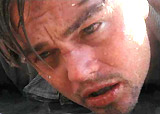 Dominick "Dom" Cobb (Leonardo DiCaprio) Awakening on Beach  Vision of Dom's Children Playing on Beach 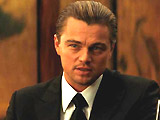 Cobb Speaking With Saito 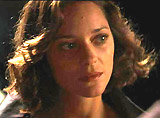 Cobb's Wife Mal (Marion Cotillard) 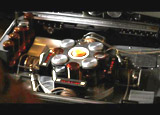 A Portable Technology Case  Saito (Ken Watanabe)  The Fischers  Robert Fischer (Cillian Murphy)  In Corporate Hotel  A "Kick" - Van Driven Off Bridge 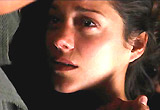 Suicidal Mal 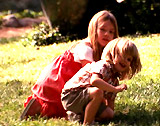 Cobb Reunited with Children 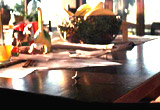 Cobb's Totem: A Spinning Top (On Table) |
||||||||||||||||||||||||

|
Indiana Jones and the Kingdom of the Crystal Skull (2008)
This fourth entry in the highly-successful franchise of Indiana Jones films was set in the year 1957. It starred an aged, 60-ish Indiana Jones (Harrison Ford). One of the side stories was that globe-trotting professor-archaeologist Indy had fathered a biker-son named Mutt Williams (Shia LaBeouf) (aka Henry Jones III) by old lover Marion Ravenwood (Karen Allen), although Mutt thought his father was treasure-hunting explorer Dr. Harold Oxley (John Hurt) already in Peru. The plot revolved around an ancient legend that an elongated crystal skull of Akator (with powerful magnetic properties) had been stolen from a Mayan temple (in the legendary and lost city of gold called El Dorado) in the Amazonian jungles of South America. According to legend, the one who found it and returned it would be rewarded with "treasure." [Note: Conquistador Francisco de Orellana also vainly searched for it in the 1540s.] In her maniacal quest for the sacred object (to be used as a cosmic mind weapon to rule the world), the lead psychic KGB operative Dr. Irina Spalko (Cate Blanchett) with a black page-boy haircut was aided by Indy's traitorous "triple agent" colleague George 'Mac' McHale (Ray Winstone) who kept Irina following close behind in Jones' journeys by dropping blinking tracking beacons. In the finale, they entered the Mayan temple's inner chamber where 13 aliens ("inter-dimensional beings") with crystal skeletons (arranged in a circle) were seated. Presumably, the alien beings had been worshipped by the Mayans, who were taught advanced technology by the extra-terrestrials. Once the retrieved crystal skull was restored onto the spinal cord of one of the aliens, Irina demanded the reward: "I want to know." The supernatural being (the collective of all 13 aliens) overloaded her skull with knowledge, burning and disintegrating her brain (and eyesockets) with flames, and her remains and those of other henchmen were sucked up into a vortex that took them into a giant spaceship above (in another dimension?). After Indy and his friends escaped from the crumbling temple, they watched from afar as the temple collapsed, the whirling, spinning flying saucer created a vortex in its ascension, and the valley floor was covered over by Amazonian waters ("Like a broom to their footprints"). Oxley summarized where the saucer went: "Not into space. Into the space between spaces." Indy also contributed this afterthought:
|
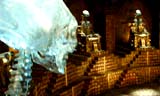 The Crystal Skulls of 13 Aliens Arranged in a Circle in Mayan Temple Chamber 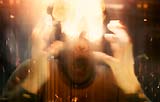 Dr. Irina Spalko (Cate Blanchett) Disintegrating After Asking: "I Want to Know" 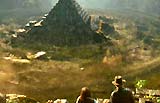  Temple Sucked Up into Vortex |
||||||||||||||||||||||||

|
Inland Empire (2006)
As with any David Lynch film, making sense of the surrealistic images, unconventional and non-linear plot, overlapping storylines, alternate worlds, hyperlinked events, and changing identities (doubling of characters as doppelgangers) can be dubious. Even the title of the film was ambiguous, not referring to a region in SoCal, but something more interior to the psyche. The film's main clue was its tagline:
This was Lynch's first entire digital video film, shot on a handheld Sony PD150 recorder. This three hour mystery-horror film was no different than most of Lynch's other works, although there were general outlines to follow about a doomed film project, adultery, and a possibility of pregnancy:
In the film's second epilogue and final scene, Nikki was back home in her living room with many characters from the film. She seemed at peace. Was everything in the film a dream of her ideal and righteous life - a "blue tomorrow"? During the cheerful end credits, Nina Simone delivered a strong rendition of "Sinnerman." |
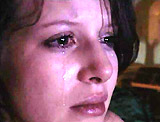 Lost Girl (Karolina Gruszka) 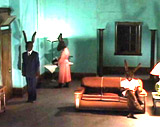 TV Sit-Com With Three Anthropomorphic Rabbits 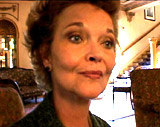 Polish neighbor lady (Grace Zabriskie) 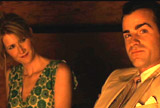 Nikki Grace as Sue Blue (Laura Dern) With Actor Devon Berk as Billy Slide (Justin Theroux) 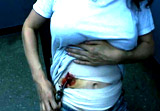 Billy's Crazed Wife Doris (Julia Ormond) With Screwdriver Stabbed in Side 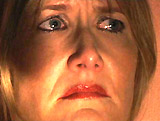 Fragmentation of Identity  (left) Prostitute Salli (Wendy Rhodes) - Before Showing Off Chest  Troupe of Prostitutes Dancing "The Loco-Motion" 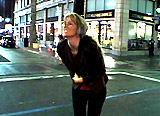 Sue Wandering the Streets of Hollywood and Stabbed in Stomach with Screwdriver 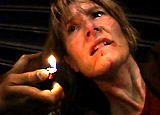 Flame of Cigarette Lighter Before Sue's Death 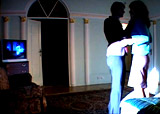 Epilogue: The Freed Lost Girl Embracing Estranged Husband |
||||||||||||||||||||||||
|
The Innocents (1961, UK)
Director Jack Clayton's scary, supernatural-psychological horror film was adapted from Henry James' novella, The Turn of the Screw. The setting was in the 19th century in Victorian England, at a gothic, bleak English country estate. A new governess, Miss Giddens (Deborah Kerr), was taking care of a young boy and girl for wealthy Bly House estate owner and bachelor, the Uncle (Michael Redgrave). The orphaned children were:
As the disquieting story progressed, the sexually-repressed Miss Giddens appeared slightly deranged (was she mad or not?), believing that the slightly mature, corrupted and strange children Miles and Flora were 'possessed' by the malignant spirits of the estate, including:
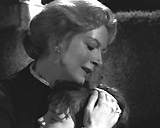
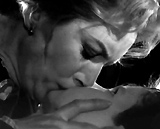
The two deceased individuals had carried on a perverse sexual relationship (in public) and were suspected of 'haunting' the estate as apparitions, often seen by Miss Giddens. The governess believed the ghostly couple possessed the bodies of the children in order to continue their relationship beyond death. The most controversial portion of the film was its adult-like, intimately passionate, unsettling on-the-lips kiss between Miss Giddens and the wise-beyond-his-years Miles after she escorted him to bed. She was horrified that Miles was keeping a pigeon with a broken neck under his pillow ("Yes, poor thing, I'll bury it tomorrow"). And then he suddenly sat up and put his arms around her neck, asking: "Kiss me Goodnight, Miss Giddens." In the film's frenzied conclusion, first in the hot and humid greenhouse, she kept urging and suspecting that the ghost of Quint was causing Miles to frighten his schoolmates with vulgar language and behavior, and was teaching him to do and say things. Behind Miles, she saw an apparition of Quint reflected in a window. But Miles denied her assertions, screamed at her, and accused her of being mad:
Then, Miles broke a window, and fled outside to the garden, Miss Giddens grabbed Miles when he stumbled to the ground. She hugged him and tried to reassure him: "Oh, it wasn't you. That voice, those words, they weren't yours." She begged him to admit that the ghost of the dead Quint existed and was present there with them, and then shook him:
He yelled back at her and ran off: "You're wrong, you're insane, you're insane...you're insane, you're insane...He's dead!" Miles collapsed to the ground at her feet after screaming out and possibly having seen the ghost that she was warning him about (the hand of one of the statuesque figures in the garden moved): "Quint! Peter Quint! Where? Where? Where? Where, you devil? Where?" She ran to Miles, cradled his body in her arms, assuring him and believing that he was finally freed from Quint:
Then, she realized he was dead ("Miles? Miles! Miles! Oh! Oh, no."). Sobbing, she leaned over and kissed him, as the film ended. |
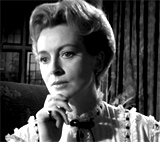 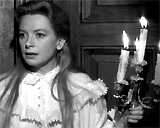 Governess Miss Giddens (Deborah Kerr) 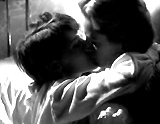  Miles: "Kiss me Goodnight, Miss Giddens" 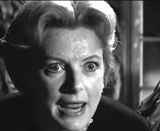 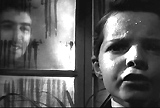 The Vision of Quint in Window 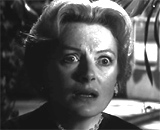 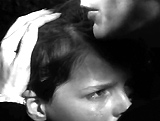 Hugging and Reassuring Miles 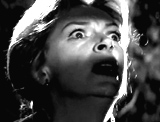 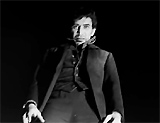 Quint - Seen by Miss Giddens in the Garden 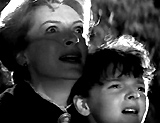 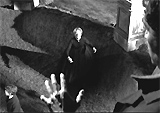 The Hand of a Garden Statue Moved |
||||||||||||||||||||||||
|
Inside Man (2006)
Director Spike Lee's R-rated film was a typical Hollywood retreaded heist-thriller flick, specifically a tense hostage drama. It reflected elements found in Serpico (1973), Dog Day Afternoon (1975), the comedy heist film Quick Change (1990), and Die Hard: With a Vengeance (1995). The film opened with cunning leader Dalton Russell (Clive Owen) and his gang committing the "perfect bank robbery" at the Manhattan Trust Bank in the Wall Street district. He broke through the fourth wall to address the audience as the film began, offering a major clue that he was speaking from a "tiny cell" rather than "in prison":
The film's action was seen - in flashback. The slogan on the side of the thieves' stolen van, for a company called Perfectly Planned Painting, provided a major clue to the plot: "We NEVER Leave Until The Job Is Done!" The robbers were cleverly dressed - with white painter's overalls or jumpsuits, white caps, and sunglasses. During the early stages of the robbery (although no money was ultimately taken!) after closing the front doors of the bank and sabotaging the security cameras, Russell and his masked gang of three ordered everyone to the floor. After herding the 50 or so hostages (bank customers and employees) downstairs, they bullied them into turning over their cellphones and then stripping down to their underwear. The robbers then forced the hostages to put on identical dark suits with hoods and white cloth face masks, and herded them in groups into several locked offices or rooms, and from time to time shuffled them around. A few of the identically-dressed hostages were released from the bank, to be mercilessly grilled and interrogated with exit interviews by the authorities. The gang members also dressed the same as the hostages to confuse the other hostages and police. Russell demanded two busses and a jumbo jet at JFK airport for the criminals' escape. The lead negotiator (and others) for the hostages were:
At the same time, ultra-rich bank chairman (of the board of directors), founder and owner Arthur Case (Christopher Plummer) revealed that he had some secrets - what he called "family heirlooms" (valuable diamonds in velvet bags, a Cartier ring, and a Nazi swastika manila envelope with documents linking him to war crimes, revealed later) hidden in his safety deposit box (# 392) in the besieged bank. Case hired sleek, high-heeled, iron-willed, and bitchy-chilly private investigator/fixer Madeleine White (Jodie Foster) (called a "magnificent c--t" by the Mayor as she bullied him for favors), to secure the box's contents. She was introduced while arranging for Bin Laden's nephew to purchase a co-op on Park Avenue (and list her client Case as a reference). Case had a dark and secretive past. To enrich himself during WWII, he had used his position working in a bank in Switzerland to do business with the Nazis during the Holocaust. He helped them betray and steal from wealthy Jews and send them to death camps. As "a short path to success," he "used his blood money to start a bank." He later admitted to Madeleine: "I sold my soul." On his behalf, fixer Madeleine entered the bank and bribed Russell with an offer for a reduced 4 year sentence, and $2 million dollars after his release, in exchange for the envelope, but he didn't accept it. Although unsuccessful in retrieving the contents of Case's deposit box, the banker gave Madeleine a generous check as hush money. Frazier's questions and the answers he received during the case were merely coincidental, but often quite revealing. For instance, when he spoke to Russell, the robber boasted that he would walk out the front door (as he did): "I'm gonna walk out of that door when I'm good and ready." Frazier also told Russell that he was "too broke" to get married (and buy an engagement ring for his girlfriend Sylvia (Cassandra Freeman)). And Frazier surmised, from another cop's comment ("You never know who's listening"), that the police command center had been bugged by the robbers, so they had heard everything. In the end, no money was stolen, the guns the robbers used were fake toys, and an execution of one hostage had been staged. The only items disturbed in the bank were the contents of the safety deposit box. All of the hostages were released (with three of the gang members joining them), while Russell stayed behind to hide. The three pretenders (all with the variation on the name Steve) were still subjected to exit interviews (seen in fast-forwarded videos), although ultimately they were all released:
The reason the 'robbery' took so long was because the robbers were creating a hiding place - a false wall - in the bank's supply room. There, they dug a hole to be used by Russell (as the titular "Inside Man") as a latrine ("now that's a good-looking s--thole" was the clue!). After staying cooped up behind a fake wall in the supply room for about a week, he emerged and walked out of the bank as a free man, to be picked up in an SUV by his fellow gang members. He had absconded with the loose diamonds in velvet bags, and the envelope from Case's safe deposit box to use as blackmail in the future. On his way out, he bumped into Frazier, who was entering the bank with a court order to open Case's safe deposit box. Frazier found that the Cartier ring had been left behind in the box with a note: "Follow the Ring." Frazier realized that the bank's chairman was implicated and linked to Nazi war crimes. The diamond ring had once belonged to a French Jewish banker and his family who were sent to concentration camps. Later that evening in his girlfriend's bedroom, Frazier found one of the loose diamonds in his pocket - and realized that the man who had bumped into him in the bank was Russell (He recalled: "I'm gonna walk out of that door when I'm good and ready"). He had been graciously provided with a wedding diamond so he could propose to his girlfriend. Sylvia was on the bed, urging him to join her for sex - with his "Big Willie and the twins":
|
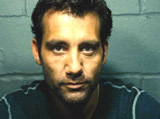 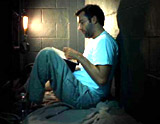 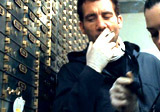 Dalton Russell (Clive Owen)   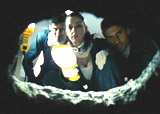 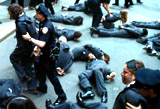 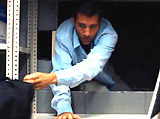 The Heist 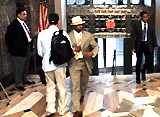 Russell Bumping Into Frazier On the Way Out of the Bank a Week Later 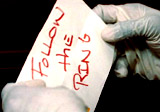 Note Left in Safe Deposit Box 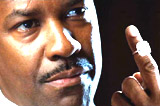 Frazier With Diamond Ring  Cartier With Loose Diamond Found in His Pocket |
||||||||||||||||||||||||
|
Insidious (2010)
Director James Wan and writer Leigh Whannell, creators of the "Saw" film franchise, created this exceptionally-suspenseful horror film. It was derived from elements of typical haunted house tales, The Exorcist (1973), The Shining (1980), Poltergeist (1982), The Cell (2000), and Paranormal Activity (2007). The supernatural flick posited the existence of an unseen shadowy world known as "The Further" (known in many such films as the "Other Side"), inhabited by creatures ready to possess the souls of humans. The film opened with a view of a creepy Old Woman (Philip Friedman) through a window, holding a candle - a major hint, and then the title screen in pulsating, blood-red lettering. A suburban family moved into a spooky old 1920s, two-story Craftsman house:
They began to experience a few strange occurrences: books falling off a shelf, scratching noises, and a creaking attic door. After Dalton went up into the attic to explore, he saw something, fell off the ladder (with a broken rung), and hit his head. Overnight as he slept, he went into an unexplained 'coma' (without brain damage, trauma, or infection). Dalton was hospitalized for three months and then returned (still unresponsive) to the house, where more inexplicable things began to happen:
Josh's strange past history was hinted at:
They promptly moved to another house, a single-story home. Soon, the supernatural events began to reoccur, e.g., the LP record playing on the phonograph changed to "Tiptoe Through the Tulips" and a figure was seen dancing in the living room, doors abruptly shut and opened, a riderless rocking horse rocked, and a laughing doll-child ran through the house. As the trailer revealed, Dalton was the one that was haunted by spirits, not the house. Josh's tense mother Lorraine Lambert (Barbara Hershey) described a horrifying nightmare and vision she had the night before about an unusual figure she saw in the corner of Dalton's bedroom ("There was something in there with him"), who was visiting and had come to take Dalton. As she told the story to the couple, she saw a red and black-faced Demon (Joseph Bishara), looking like Star Wars' Darth Maul, suddenly emerge behind Josh ("It's here!"). They found Dalton's room torn apart, and an unharmed Dalton on the floor. The couple, with Lorraine's recommendation, hired a professional group of paranormal investigators to check out the new house:
Elise's immediate discovery was that otherworldly presences, including the blood red-faced, black-bodied Demon, and other spirits or ghosts were definitely in the house to pursue Dalton's spirit. She stated: "It's not the house that's haunted. It's your son." Dalton was astral-projecting himself (his spirit had left his physical body) when he traveled into a far-off dark world known as The Further. But on one of his out-of-body journeys to the far-off spiritual world, he had traveled too far and become lost. Elise said they must get the son back before the disembodied and tortured spirits of the dead and other malevolent entities with an "insidious agenda" took over (or possessed) his physical body (an "empty vessel"). During communications during a seance session in Dalton's bedroom, the group learned that the boy was being held (with no way to escape) by the fire-faced Demon spirit (who wished to "cause pain to others"). Dalton repeatedly cried out: "Help me." The Demon possessed Dalton's body and used it to fight the group - the Long-Haired Fiend attacked Renai and licked at her. Elise grabbed the boy's hair and screamed out: "Leave this vessel," until the Demon departed. The next revelation was that Josh had experienced "night terrors" and "awful fits of pure fear" when he was eight years old. He had been terrorized, like his son, by an evil spirit - in the guise of an Old Woman (the one that opened the film). A series of photographs from his boyhood showed the Old Woman getting closer and closer to him. He was also a "gifted traveler" in his childhood with the ability to venture out of his physical body during a dream state. He had handed down astral-projection abilities to his son. It was recommended that Josh, the only one capable of rescuing Dalton's soul, rediscover his lost abilities and enter "The Further." Under hypnosis, Josh entered his two story house, where he came upon a number of tormented spirits, including the Doll Girls (Kelly Devoto and Corbett Ruck) and a Whistling Ghost Dad (Lary Crews). He retrieved Dalton from the Demon's lair (located behind a red door), where Dalton was found chained down, and the two awakened back in the 'real world' after successfully fleeing from the fork-tongued Demon and the Old Woman, who both had vanished. In the shocking conclusion, after Elise took a revealing photograph of Josh, he choked her to death (as he shouted: "You bitch!"). In Elise's camera, Renai saw a picture of the creepy Old Woman. The surprise twist was that Josh had been possessed by the spirit himself - the Old Woman. 'Josh' reappeared and put his hand on his wife's shoulder, and ominously told her: "Renai, I'm right here." After the end credits, the Old Woman blew out the candle she was holding, and the screen turned to black. |
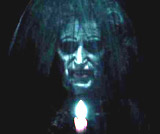 Creepy Old Woman (Philip Friedman) 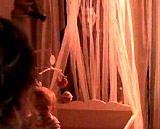 Sleepwalking 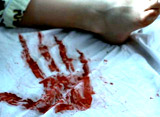 Bloody Handprint 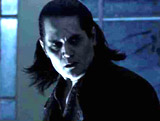 Long Haired Fiend (J. LaRose) 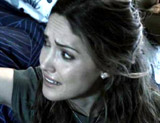 Renai (Rose Byrne) 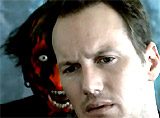 The Red and Black Lipstick-Faced Demon (Joseph Bishara) Behind Josh (Patrick Wilson)  Doll Girls  Astral Projection  A Demon Drawing 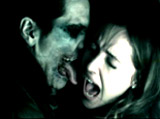 Renai Attacked by Fiend 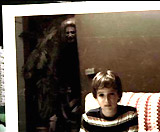 The Old Woman Terrorizing Young Josh  Various Spirits 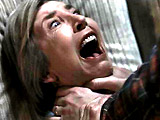 Elise Choked to Death 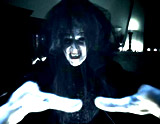 The Killer: Josh/Old Woman |
||||||||||||||||||||||||
|
Invasion of the Body Snatchers (1956)
This classic science fiction film by director Don Siegel involved the fear of a small town doctor that many of his patients, friends and relatives were experiencing fearful paranoia and delusions that their acquaintances were imposters - and were possibly being replaced by doppelgangers. The film was an effective metaphor for the fear of Communist infiltration during the Cold War 1950s. The main characters, living in the small town of Santa Mira, were eventually the only two remaining non-pod people:
In their flight from the town's pod people, the two were compelled to hide under the floorboards in a dark, deserted cave or tunnel. When Miles left the fainting Becky to discover the source of beautiful music for a few moments, Becky briefly fell asleep. After he returned to the mine, he found her fatigued and started to carry her. And then in the film's most memorable and frightening moment, he took her in his arms to kiss her, and then drew away from her unresponsive lips. In a tight closeup shot of her face, he looked into the blank, dark, expressionless and staring eyes of his fiancée, realizing with a look of utter fright, shock, and fear that she was now one of "them" - her body had been invaded and snatched by the clones. He knew instantly that this was not Becky, his sweetheart of a moment ago, but a treacherous imposter and victim. She confirmed the truth, and traitorously screamed to the pod-people searchers:
Horrified that he was now completely alone, Miles helplessly rushed in panic from the tunnel. He spoke, in voice-over:
He clambered up the hills to a busy highway, where he attempted to flag down cars, and convince passing drivers to help him and believe his story. Crazed with fear, he rushed into the onrushing traffic, nervously shouting and crying words of warning to the unheeding cars and unconvinced drivers. Miles climbed onto the back of a passing truck with the names of cities on it, horrified to find it loaded with pods to be distributed and spread throughout the nation. He dropped off, jumping back on the highway - feeling completely helpless. As a crazed prophet of doom, he looked directly into the camera, desperately trying to warn others and the audience:
In an added epilogue, the distraught and raving mad Miles was relating his fantastic nightmarish tale in a hospital. The doctors commented that he was a lunatic and as "mad as a March hare." As the doctors left the office, another accident victim from a wreck was brought in by ambulance. One of the doctors explained how there was a collision between a Greyhound bus and a truck, and how the truck driver had to be dug out from under a peculiar pile of "great big seed pods" from a truck coming out of Santa Mira. Verifying and confirming Miles' story, the police started to take control of the invading aliens by blocking highways, and the FBI and law enforcement agencies were notified of the emergency. An all-points alarm was sounded and Miles was finally vindicated and relieved that someone had finally believed him. |
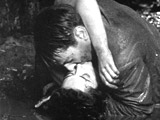 Dr. Bennell Kissing Becky in Cave 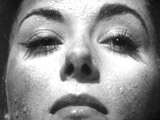 Becky's Expressionless Face 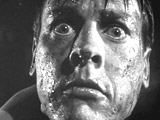 Dr. Bennell's Horror 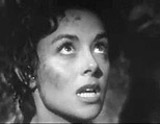 "He's in Here. Get him!" 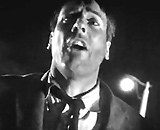 "You're Next!" |
||||||||||||||||||||||||

|
Invasion of the Body Snatchers (1978)
In the despairing, climactic ending of this horror remake by director Philip Kaufman, San Francisco health department field investigator Matthew Bennell (Donald Sutherland) had seemingly escaped being replaced by a pod likeness. After leaving work near City Hall, he was summoned by the still-human Nancy Bellicec (Veronica Cartwright) - the last to not be absorbed. Her happy greeting was that she had managed to stay awake and remain human. After she called out his name ("Matthew, Matthew"), he turned to confront her. He screamed with a piercing, accusatory howl (and the camera descended into the blackness of his open mouth) while pointing his accusatory finger at her. She also screamed, realizing that he had become a cloned pod person. |
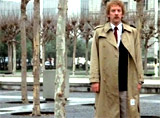 Matthew Bennell (Donald Sutherland) 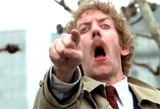 The Open Mouthed Scream 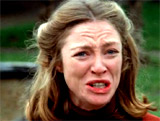 Nancy Bellicec (Veronica Cartwright) 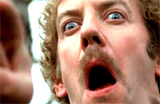
|
||||||||||||||||||||||||

|
The Island (2005)
Director Michael Bay's futuristic action-adventure thriller faced major legal problems when the producers of the low-budget independent film Parts: The Clonus Horror (1979) filed a legal suit in 2005 (settled out of court in 2006) claiming that the DreamWorks/Warner Bros. production was an unauthorized, cloned, scene-by-scene remake. It also combined elements of THX 1138 (1971), Logan's Run (1976), and Blade Runner (1982). In the story, survivors of a massive, toxic global contamination lived in a highly-controlled and monitored, self-contained and isolated utopian environment in the post-apocalyptic world of 2019. All of the residents in the remote community believed that the 'outer' world was contaminated. They were told that specially-selected individuals would be chosen:
The way to escape was by winning the Lottery - the prize being transport to "The Island" - the only remaining uncontaminated, pristine paradisiacal land area left in the world free of a pathogen. Lucky ones, such as the latest winner Starkweather Two Delta (Michael Clarke Duncan), were ecstatic about their winning future: "To go out and breathe fresh air, swim in the ocean. I can't believe I won. Call me Mr. Popular." In short, however, there was no Island. The entire operation was kept top-secret by 'godlike' sinister Dr. Merrick (Sean Bean), the unethical owner of the cloning, bio-engineering corporation, who was profiting billions of dollars by harvesting 'agnates' - human clones. Visiting, rich potential clients were promised a lifespan of 60-70 years longer than normal:
However, a lie was told to those wealthy individuals who purchased copies of themselves that the clones (or "products") were only in a "persistent vegetative state" (or not human), so any harvesting process was considered non-lethal. Lincoln Six-Echo (Ewan McGregor), who was suffering nightmares and erratic sleep cycles, was skeptical when his best friend Jordan Two-Delta (Scarlett Johansson) was the next lottery winner. After Lincoln's simple discovery of a flying winged insect from outside, seeking light in the top of a ventilation shaft in an off-limits power facility, he began to think that much of his environment and what he had been told was questionable. The moth should have been killed by the pathogen in the outside world. He caught the moth and kept it in a glass vase by his bed. And Lincoln then witnessed two examples of clone products being given to customers. He saw Starkweather make a futile and desperate attempt to escape from organ surgery for a liver transplant. Lincoln and Jordan realized that the lottery "winners" were used as surrogates for replacement or spare parts, organs, genes, and even wombs for their wealthy sponsors as insurance policies - when needed. The two fled to the 'real world' (a barren and rocky desert area near Yuma, Arizona) where they learned that they were actually clones for two sponsors:
Jordan was needed for transplant surgery, because her sponsor Sarah Jordan, was comatose after a car accident - that was why she had become a 'lottery winner.' To retrieve his two runaway 'clones,' Merrick hired mercenary Albert Laurent (Djimon Hounsou) to find and return them unharmed to the compound. During the pursuit, Lincoln tricked Laurent into killing his sponsor Tom Lincoln, which allowed Lincoln to assume Tom's identity. Tom/Lincoln (and Jordan) sought to return to the isolated facility and liberate all of the other clones, which they successfully accomplished, with help from Laurent. Tom/Lincoln fought hand-to-hand with cloning technology mastermind Merrick, who died when hanged by a harpoon cable around his neck. With the destruction of the holographic reactor chamber, the illusory holograms disappeared and natural sunlight flooded in. The white-clad 'agnates' ran from the underground bunker into the fresh desert air. Afterwards, Lincoln and Jordan kissed and soon sailed away together on the deck of a large boat (the Renovatio, meaning 'rebirth') cruising through blue waters. |
 "The Island awaits you." 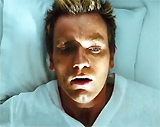 Lincoln Six-Echo (Ewan McGregor) 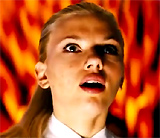 Jordan Two-Delta (Scarlett Johansson) 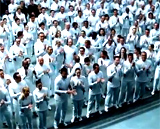 Inhabitants  The Lottery 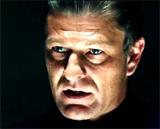 Dr. Merrick (Sean Bean) 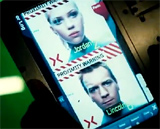 Jordan and Lincoln 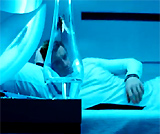 The Tell-Tale Moth  'Agnates' Freed Into the Outside World  Lincoln and Jordan Kissing 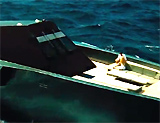 The Renovatio |
||||||||||||||||||||||||





 Hospital
Patient Simon Cable Died in a Fatal Car Accident in the Year
2002; Due to Memory Loss and His Confused State Between Life
and Death, Simon Recalled a Similar Fatal
Head-On Car Accident in the Year 2000. It Happened As a Result
of Simon's Betrayal of His Brother Peter When He Was
Having An Affair With Peter's Fiancee Clair, and All Three Died
in The Crash. Guilt-Ridden and With a Change of Heart, He Attempted
to Save His Brother - Simon Struggled to Make Sense of
Things and Change the Reality of His Death (While Efforts Were
Made to Revive Him), But He Was Not Able to Be Resuscitated
Hospital
Patient Simon Cable Died in a Fatal Car Accident in the Year
2002; Due to Memory Loss and His Confused State Between Life
and Death, Simon Recalled a Similar Fatal
Head-On Car Accident in the Year 2000. It Happened As a Result
of Simon's Betrayal of His Brother Peter When He Was
Having An Affair With Peter's Fiancee Clair, and All Three Died
in The Crash. Guilt-Ridden and With a Change of Heart, He Attempted
to Save His Brother - Simon Struggled to Make Sense of
Things and Change the Reality of His Death (While Efforts Were
Made to Revive Him), But He Was Not Able to Be Resuscitated