|
Film Spoilers and Surprise Endings L1 |

| |
|||||||||||
|
L.A. Confidential (1997)
In the surprising conclusion of this popular post-noir crime drama about police corruption, "Hollywood" narcotics detective and technical advisor for the TV police drama series Badge of Honor Sgt. Jack Vincennes (Kevin Spacey), who was receiving kickbacks for aiding in the arrest of celebrities, was shockingly shot in the chest and killed by LAPD Capt. Dudley Smith (James Cromwell) in the Captain's own kitchen, for knowing too much.
When Capt. Smith leaned over and asked: "Have you a valediction, boyo?" as Vincennes slumped to the floor, he heard the words 'Rollo Tomasi' - identifying Dudley as the mastermind. The metaphoric term denoted the corrupt police chief as the perfect example of a criminal who was able to escape punishment and literally get away with murder. Later, Smith moved Vincennes' body to Echo Park as part of his cover-up. Afterwards, when held at gunpoint by Smith after a brutal shootout in the abandoned Victory Motel (that also wounded another Officer, Wendell "Bud" White (Russell Crowe)), idealistic young cop Sgt. Edmund Exley (Guy Pearce) told Smith about the meaning of the term 'Rollo Tomasi.' (Exley had made up the name after his legendary cop-father was shot and killed by a purse-snatcher in the line of duty.) He knew that the Police Chief was a corrupt mastermind crime boss:
When the tables were turned, Exley shot LAPD Capt. Smith in the back as he walked away, with his hands in the air. The killing recalled Capt. Smith's earlier advice to Exley, that a detective should be willing to shoot a guilty man in the back for the greater good. Afterwards, Exley confessed to superiors that the Nite Owl Coffee Shop's multiple (six) murders were most likely conducted by LAPD officers Michael Breuning and William Carlisle, and a third individual, presumably Capt. Smith. Smith's motivation was to take over the city's rackets and heroin drug trade (run by Mickey Cohen (Paul Guilfoyle)) - described in Exley's account:
Ironically but true to form in the subsequent cover-up, Smith was remembered dying as a "hero," and a compromised Exley was awarded a Medal of Valor - to avoid controversy, and to prevent a stain on the reputation of the LAPD. At the ceremony, Exley was lauded:
Injured but surviving Officer White (sitting mute in the back seat) departed with Veronica Lake-look-alike prostitute Lynn Bracken (Kim Basinger), on her way home to Arizona after quitting the high-class whore business. As Lynn departed and kissed him, she told Exley (in the film's last line):
|
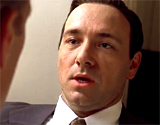 Sgt. Vincennes' Last Words: "Rollo Tomasi" 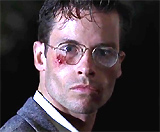 Sgt. Edmund Exley (Guy Pearce) 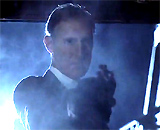 LAPD Capt. Smith (James Cromwell) Shooting Officer White (Russell Crowe) 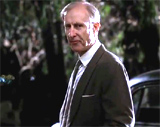 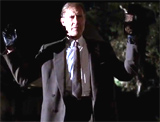 Capt. Smith Walking Away With Hands Up Before Shot in Back by Exley 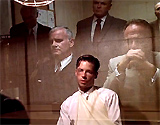 Exley's Accounting of Corrupt LAPD 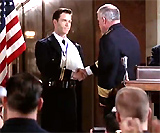 Exley's Medal of Valor Ceremony 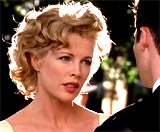 Lynn Bracken's Departure and Exley's Goodbye |
|||||||||

|
Lady in the Water (2006)
Writer/director/actor M. Night Shyamalan's fantasy thriller about the power of myth and the importance of community contained no traditional trademark "plot twist," although there was a mystery element about the roles of the many characters. It told about The Cove apartment manager in Philadelphia: stuttering Cleveland Heep (Paul Giamatti), who was hiding a tragic past (he was a doctor who had lost his family by murder). In the pool of his 5-story complex, he found pale-faced, red-haired Story, a "lady in the water" (a narf) (Bryce Dallas Howard) who was from the "Blue World." As an opening voice-over with crude animated illustrations described, she had come to the land of men to help change the world and help lead humankind out of its troubled warring state, but she also had to return to her world. A fairy tale, told by one of the tenants, a Korean mother Mrs. Choi (June Kyoto Lu), brought Story's scary predicament and life to reality. She described a bedtime story about a scared young water-nymph, actually a Madam Narf, who wanted to journey back to her home via a giant eagle known as the Great Eatlon, although her first task was to be an emissary and impart a healing message. She was to locate and then motivate serious but unpublished political writer Vick Ran (director M. Night Shyamalan) to complete his work (a book titled "The Cookbook") - an influential, important yet controversial historical book that would one day inspire a young boy to read it and later become the President of the US. But Ran knew he would be assassinated for his radical ideas. She was fearful of growling, grass-covered scrunts - beastly creatures lying flat in the grass who wanted to consume her. However, Story was being protected by a group of simians known as the Tartutic. The film's message was that there were different archetypal roles to be played by the talents of various apartment tenants to assist Story in getting home, but they needed to be matched up correctly during her departure ceremony. Heep received assistance from film critic Harry Farber (Bob Balaban), but was misled in the match-ups, and then Story was mortally wounded by the Scrunt. Eventually, Heep succeeded in identifying the four proper roles, to assist Story in returning safely to her world:
As Story was about to be rescued by the giant eagle, the Tartutic monkeys in the trees attacked the wolfish-scrunt and killed it, and she was safely taken. |
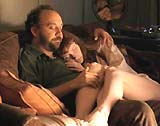 Cleveland Heep (Paul Giamatti) with Story 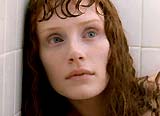 Story (Bryce Dallas Howard)  The Apartment's Pool 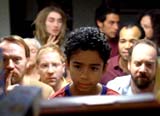 Various Apartment Tenants 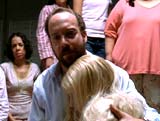 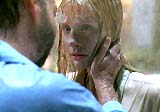 Story's Departure Ceremony |
|||||||||
|
The Last Broadcast (1998)
The Last Broadcast (1998), a cult horror "found footage" film, was notable as the first feature-length video shot and edited entirely on personal, consumer-level digital video equipment (for a reported $900) - without the use of celluloid film. It was the first feature to be theatrically-released digitally via satellite to theaters across the United States, on October 23, 1998. However, it was also criticized for its blatant similarities to The Blair Witch Project (1999), although it was actually made first. This inventive mock-documentary horror film took the approach of re-creating the events by a sleuthing documentarian, while Blair Witch favored the approach of watching unexplained recovered footage. The film's main taglines were:
In the film's forward, intrigued local documentary film-maker and reporter David Leigh (David Beard) explained (to the camera) his motivation for studying a recent series of ritualistic homicides of TV show hosts and crew, allegedly committed by one of their team members, Jim Suerd. The convicted murderer Suerd (who had died in prison after sentencing - "under mysterious causes") was thought to be troubled and emotionally-disturbed. David Leigh admitted that he was deconstructing the mystery behind the multiple murders in his mock-documentary, with cinema verite-styled shots - composed of shaky closeups, quick-cutting, and ambiguous scenes:
Leigh explained that he was reviewing all the footage and creating a documentary of the group's ill-fated trip, whose 4 members were all involved in a public access cable TV show. The first two individuals, Avkast and Wheeler, were the hosts of a local public-access cable TV show titled Fact or Fiction - an investigatory show about unsolved murders, mysteries, and the paranormal:
On December 16, 1995 at 11:57 am, Suerd made a confused and shocked pay phone call to 911 about his missing team members (he said that he had "a really bad feeling about it"). The mutilated bodies of two of them (Wheeler and Clackin) were found in the New Jersey Pine Lands, with blood in the snow and the hat of the third individual (Avkast). Leigh covered the subsequent investigation and trial of Suerd beginning in June of 1996. Suerd was accused, charged and tried as a major suspect (there was blood evidence from all three on his shirt). Suerd was found guilty (in mid-July 1996) of two counts of first-degree murder, and sentenced to two consecutive life terms. Then, in early January 1997, Suerd died in prison of questionable causes. To discover the truth about what had really happened, about a year after the murders, documentarian Leigh was re-assembling a video chronology and synopsis of the mysterious trip after gaining access to all of the available surviving footage, interviews, and police evidence - including 15 hours (22 tapes) of archival footage "badly shot" by members of the group - and then interweaving the material together. He called his work "The Last Broadcast." He mentioned that the murders had occurred in the "high-tech age" and that the dead individuals were all "children of a digital age." The excursion into the woods by the two hosts was broadcast (it was their "last broadcast") in a live show simultaneously seen/heard via the Internet's Web, TV cable and amateur ham radio. They were doing their show while searching for the legendary Jersey Devil in the area of Pine Barrens in southern New Jersey. The group of four had set out to discover the mythical Yeti-like creature - an urban legend. Jim Suerd's background was surveyed - he had a difficult childhood and both of his parents had recently passed away. He was a magician, a reclusive and "maladjusted" loner and an Internet-obsessed computer nerd. The two broadcasters, who had set up an interactive, live IRC chat (with a text-to-speech converter and computerized voice) to save their dying show and revive its popularity, received a suggestion from an unidentified caller ("D something") - to do this live show. Thus, the trip into the woods was conceived, from which only Suerd returned a few days later. Two corpses were found - but Avkast's body was never located. There were conflicting opinions during Suerd's "kangaroo court" trial (marked by media frenzy), but the prosecution's case was so strong that he was inevitably convicted, although there was only circumstantial evidence against him. Dedicated magnetic-media data retrieval expert Michelle "Shelly" Monarch (Michele Pulaski) was commissioned to work with additional footage that was delivered to documentarian Leigh's house in a brown box, comprised of a VHS videotape cassette (possibly hinted at earlier, a new tape that was loaded following the 22nd tape) with lots of loose and damaged footage mixed in with packing peanuts. David Leigh decided that the tape would not be submitted to authorities - the trial had already concluded and was "closed," especially after Jim's death. He added, ironically: "My search for the truth behind the Fact or Fiction murders has in some way become part of the story." Later, he also stated that he and many others had benefited business-wise from the event:
Over a period of a few months in early 1997, Michelle retrieved and reconstructed the data frame by frame. Her findings proved shocking and contradicted everything in the trial:
Meanwhile, in late March of 1997, David Leigh was filming himself as he conducted a re-enactment of the group's trip. On April 1, 1997, Michelle promised: "I will see the face of the killer." After 2 1/2 months work, the killer's face, although blurred in frame 232, was revealed to be David Leigh. Boldly shifting from a first-person to a third-person perspective, Leigh burst in to Michelle's studio, struggled with her and slowly smothered her with plastic sheeting. He then faced his own video camera and announced that he was going to continue staging his re-enactment of the original killings - to prove Suerd was innocent of the murders. He bundled up Michelle's body in his back of his van, and drove out to the Pine Barrens camp site. He continued videotaping himself at the woodsy site as the film concluded. |
 David Leigh (David Beard) 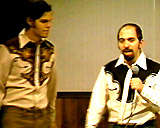 Wheeler and Avkast 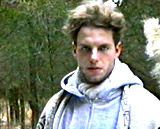 Jim Suerd (Jim Seward)  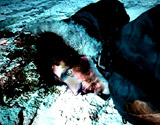 Two Dead Bodies 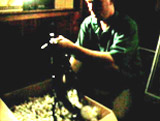 The Box with Mangled Mystery Videocassette Tape  Michelle Monarch (Michele Pulaski) 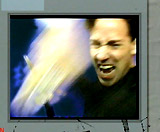 Frame 232 Revealed - David Leigh 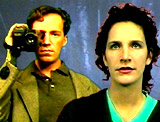 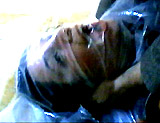 The Murder of Michelle 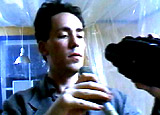 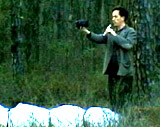 Leigh Filming Himself During a Re-Enactment of the Trip |
|||||||||
|
The Last Seduction (1994)
John Dahl's modern-day dark noir featured lethal, sexy, amoral, cold-blooded and brainy femme fatale Bridget Gregory (Linda Fiorentino), who used her sexual wiles to manipulate a dumb, love-struck boyfriend to murder her husband. [She followed in the footsteps of two other great femme fatales in film noir - Jane Greer and Barbara Stanwyck.] She first absconded with her physician husband Clay's (Bill Pullman) $700,000 of pharmaceutical-cocaine drug money, and fled from NYC to Upper State New York to the small town of Beston near Buffalo. In the local Ray's Bar after she was ignored by the bartender, she muttered: "Who's a girl gotta suck around here to get a drink?" She was approached by the local, gullible bar pickup stud Mike Swale (Peter Berg) who bragged about his manly size: "I'm hung like a horse. Think about it," and the sexpot seduced and propositioned him: "No names. Meet me outside." They went to his place to spend the night, after which she began scheming with her lawyer Frank Griffith (J. T. Walsh) to divorce her husband and abscond with the money. She took a job in a local company, Interstate Insurance, as Director of Lead Generation, claiming she was alias Wendy Kroy (an acronym for New York) and was fleeing from her abusive husband. Hiding out, she took residence at the Beston Motor Court (and soon after rented a house), and frequented Ray's Bar occasionally. She made love to Mike again (as her "designated f--k"), in an alley behind the smoky saloon while hanging on a chain-link fence and straddling him with his pants down to his ankles. When he asked, "Where do I fit in?" she coldy replied: "You're my designated f--k." Bumping and grinding later on top of him in the back of her Jeep, she admitted to her frequent sex partner: "I'm a total f--king bitch." He complained that he was being kept at arm's length like a "sex object." To keep him at bay, she stated: "F--king doesn't have to be anything more than f--king." Scheming, she tricked Clay's black private detective Harlan (Bill Nunn) (who was hired to find her and get the funds back, and had traced her to Beston) into becoming distracted by showing his large penis to her while she was driving. When he undid his seatbelt and exposed himself, she deliberately sped up and crashed the car into a utility pole, killing him by propelling him through the windshield. She took a taxi to Buffalo to the Erie County Municipal Building where she identified Mike's earlier unwitting and mistaken marriage to a trans-sexual named Trish (Serena) - and then conducted an interview with Trish. She tricked Mike into thinking she had taken a weekend trip to Miami to murder Lance Collier, a cheating and abusive husband who deserved death, to claim the widow's pay-off. She claimed: "I did it for us, Mike," and wouldn't listen to his objections: "Spare me your brain with countrified morality. The world's better off without Lance Collier" - and showed him a case of cash (her own!) as "f--king evidence." When he was astonished at her brashness, she threw the love-sick Mike out of her house. She resisted Mike's later apologies (she told him: "You have a way of making a woman feel like a one-way train ticket"), claiming that he needed to be her equal ("a relationship of equals") in order to show his commitment and interest in her. He replied: "Murder is commitment?" When Mike finally acquiesed, she cleverly convinced him into duplicating her scheme to show his love - to murder Clay (who was trumped up to be an unfaithful husband/cheater and wife beater in New York City named 'Cahill'), claiming the payout by the widow would be over three million ("You, me, three million bucks, New York City, Mike. It's reasonable"). And then to convince Mike to "pull up stakes" to leave Beston and accept her plan, she faked a letter from Trish to Mike asserting that she was returning to Beston to be with him. The murder plan (an "unpleasant chore") to stab Clay in his NYC apartment went awry when Mike turned chicken and yelled: "I can't do it, Wendy, I can't do it" - and then he saw their wedding picture. He realized that the victim was not 'Cahill' but Wendy's husband, and that he had been seduced into committing her husband's murder. Wendy entered the apartment to check on the killing, where she found both Clay and Mike had teamed up, and Mike knew of her deception ("So you were gonna have me kill your husband"). In a clever double-cross, Bridget killed her own husband by spraying Mace down his throat, after kissing him, and then calmly told her naive boyfriend: "Now we have a future." Then to complete the deception, she aggravated the 'intruder' Mike to rape her by first removing her pants and displaying old fashioned men's underwear, reinforcing Mike's fears of being homosexual. She then taunted him about Trish: "You should have told me you never slept with a man before. Must have been some wild night, you getting married so fast." She angered him over his damaged marriage:
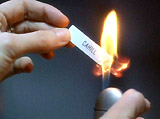
She also self-incriminated Mike by surreptitiously recording their conversation and the crime/rape confessional role-play on a 911 call, including the accusation that she repeatedly screamed out: "You killed my husband." Mike was arrested, jailed and obviously out-maneuvered and set-up for the crime, and he was destined for the electric chair. The one remaining shred of evidence, Clay's 6B NYC apartment call-button label reading "Cahill," was taken by rape-victim and widow Bridget in the final scene - she burned it as she slyly smiled in the back of a chauffeured limousine, now free to escape with the cash.
|
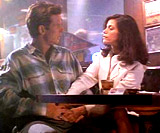 Bridget Gregory (Linda Fiorentino) Seducing Mike Swale (Peter Berg) 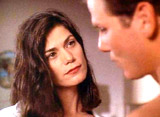 Bridget With Mike  Meeting Trans-Sexual Trish (Serena) - Mike's 'Wife'  Bridget Killing Husband Clay  Bridget Revealing She Was Wearing Men's Underwear  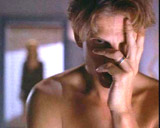 Mike Taunted and Shamed About His Marriage to Trish 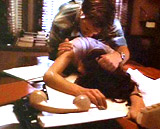 Bridget's Rape by Mike - a Set-Up |
|||||||||
|
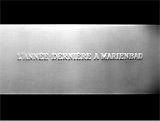
Last Year at Marienbad (1961, Fr/It.) (aka L'Année Dernière à Marienbad)
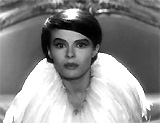
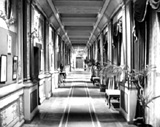
In this enigmatic, cinematically puzzling, allegorical and ambiguous New Wave film - a black and white, slow-moving, expressionistic film and fragmented tale from director Alain Resnais - it mixed time (past and present), and reality (fantasy vs. memory). It was about dreamy seduction, memory, the past and the present, the reconstruction of reality, and time. [Note: in the original screenplay by Alain Robbe-Grillet, there was an explicit forceful rape, but it was not fully pictured in the film.] Many critics have regarded the film as having a strong influence on Stanley Kubrick's The Shining (1980), David Lynch's Mulholland Dr. (2001) and Inland Empire (2006). The setting after the opening credits was revealed to be an opulent, enormous but empty European hotel or resort chateau in Marienbad (in the Czech Republic) - described during an atmospheric, deathly, ominous voice-over guided tour with lengthy tracking camera shots (slightly tilted upwards) - the camera viewed the expansive hallways and long dark corridors, mirror-lined walls, statues, high ceilings with ornate chandeliers - and outdoors, geometric gardens, often with repetitive wording. Eventually, the tour entered the hotel's theatre for a play-within-a-film being performed, and attended by the hotel guests (impassive, unmoving, and coldly-still). The guests at the hotel appeared to be either trapped or automatons, or were they ghosts or dead souls existing in purgatory (including the main characters)? In the original screenplay, characters were referred to by letters. The three main characters were involved in a traditional love triangle - an existential, non-linear dance of seduction between two 'lovers' who might not actually know each other, exist together, or even be alive:
X/Stranger endlessly attempted to convince A/Woman that they had met a year before at Marienbad and had a passionate sexual love affair. But she claimed that she didn't know him. A second man, implied to be A's authoritarian husband or lover, was M. He could have just been imagined in either A's or X's head. He often enjoyed defeating X/Stranger in a mathematical game (similar to Nim). It could be argued that the entire film was only a dream/memory (possibly of a dead man or woman), and entirely pretentious and incomprehensible. X's endless and obsessive attempts were to convince A that they had met before and had past associations (last year at Marienbad?), including having had sex at the hotel - seen in subjective imaginings (possibly his, possibly hers); the entire object of his intense, but flat and sometimes creepy, pushy questioning was to prove his delusional point, and persuade the woman of his account of the past, while she continued to protest his assertions; he told her: "You won't remember because you're afraid"; when he caressed her breasts in the garden, she responded: ("Leave me alone, please....Who are you? What's your name? You're like some phantom, waiting for me to come. Leave me"). It was also possible that she had set up their rendezvous, and X/Stranger wanted to take her away. Was he creating the past with his obsession for the female? Or was she creating a past (entirely inside her head) that didn't actually exist? Some interpreted the film as an adaptation of the tragic Greek myth about Orpheus and Eurydice.
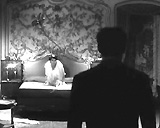
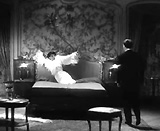
X's treatment of the details of the previous year's events at Marienbad were as if they were fictional segments of a conventional movie drama; he believed that A had previously promised to elope or run away with him when they again met, and that they had an unrealized love affair, but she claimed that she couldn't remember, made repeated attempts to rebuff and recoil from him, and became weary by his assertions -- whether X was lying, experiencing a nightmare, or only confused about A's identity was open to question. In a dance of seduction, the two unnamed 'lovers' recounted a fragmented tale of their perceived reality and unrealized (?) love affair. The puzzling film never clearly ascertained whether X's claim of a relationship was true or false. What really happened "last year"? One incomprehensible premise was that A had been murdered by M because of the alleged, talked-about affair (there was a brief sequence of M firing on A on her bed with a silencer-gun, and she fell back onto the floor, with her feet still on the bed) - and then it was possible that X had developed this fuzzy story in his imagination to assuage his guilt, by thinking of her as alive? There was also a 'rape' scene - only viewed as fragmentary and incomplete - the short bedroom scene commenced when A was started by X's advance toward her on the bed; she backed up in fear against the bed's headboard - followed by another of the over-exposed (hallucinatory), feverishly-swift tracking shots (also seen earlier), down a long corridor towards A who was standing in the middle of a room with outstretched arms; separate takes of the same camera movement, but with minor or slight changes, were frantically repeated.
By film's end, X's ambiguous allegations about what had happened were completely uncertain, although it appeared that the protagonist had gradually succeeded in readying A to leave the hotel one night for an unknown destination, as M watched them depart from a staircase. However, X's voice-over account was unreliable and described in the past tense:
|
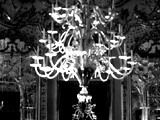 The Marienbad Hotel 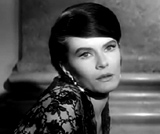 A/Woman-Lover (Delphine Seyrig) 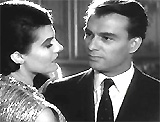 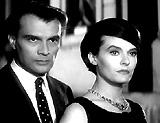 X/Stranger (Giorgio Albertazzi) With A/Woman-Lover 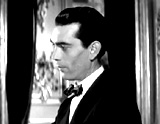 M (Sacha Pitoeff) 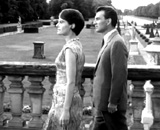 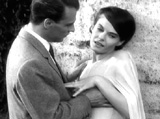 In the Garden 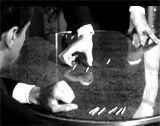 The Mathematical Game of 'Nim'  Washed-Out Tracking Shot 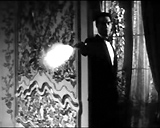 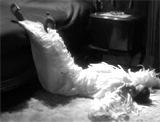 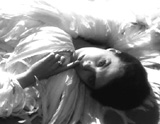 A's "Murder" by M |
|||||||||
|
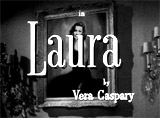
In a surprising scene, the titular Laura Hunt (Gene Tierney) suddenly walked into her own apartment - a murdered woman who mysteriously appeared over half way into the film. Investigating, mildly-obsessed New York City detective Mark McPherson (Dana Andrews), who had fallen in love with Laura's portrait in her apartment, expressed stunned shock when stirred from sleep as the "dead" Laura appeared in her own apartment - at first, he thought she was a ghost or figment of his imagination. She threatened to call the police: "What are you doing here?" - unaware of the news of her own slaying. The major plot twist was that Laura was never the murdered woman in her Upper East Side apartment - she had been out in the country (the murder victim was a young model named Diane Redfern in her negligee, in a case of mistaken identity). Laura was horrified to realize that she was caught in the middle of a murder case. In the film, celebrated, snippy gossip columnist Waldo Lydecker (Clifton Webb) functioned as Laura's Svengali-like mentor and protective confidant in a platonic relationship, when he helped her become a successful advertising executive. Womanizing, effete Southern playboy Shelby Carpenter (Vincent Price), whose marriage to Laura had been recently called off, was also a prime suspect (he confessed later to being present at the murder scene when the off-screen shooting occurred). After reappearing, Laura herself became a prime suspect in the murder case, since it was possible that Laura killed Diane Redfern out of jealousy for her association with Shelby. Another suspect was Anne Treadwell (Judith Anderson), Laura's wealthy, amoral spinster aunt who was neurotically in love with Shelby and decidedly defensive and jealous of the younger Laura, her engagement, and her possible forthcoming marriage to Carpenter. Although there were many suspects, the actual murderer was Lydecker, who in a jealous rage mistakenly shot the wrong woman (in the face) with a blast from a shotgun, thinking Diane was Laura. In the film's conclusion, Lydecker attempted to kill Laura a second time with a shotgun (hidden in the base of a grandfather clock) in a murder/suicide, rather than leave her to the "vulgar pawing of a second-rate detective" -- but she was saved in the nick of time by McPherson as Lydecker was mortally wounded in an exchange of gunfire with the police. As Waldo was dying and uttered Laura's name in his final words, she rushed to his side. The camera rested on the shot-gun-damaged clock as Lydecker's final words were delivered off-screen with a theatrical flourish:
|
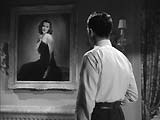 Laura's Portrait 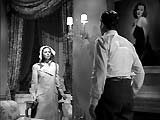 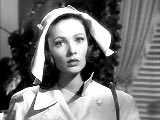 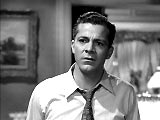 Laura's Sudden Appearance to Detective McPherson 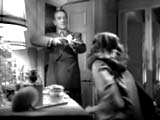 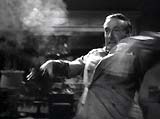 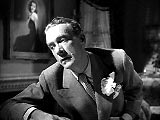
Waldo Lydecker (Clifton Webb) - Threatening Laura |
|||||||||

|
Law Abiding Citizen (2009)
Director F. Gary Gray's grisly revenge fantasy (based on a script by Kurt Wimmer, with homage to Death Wish (1974)) was released unrated after it was threatened with an NC-17 rating for its violent aspects. The set-up was slightly absurd, and its purpose was confused.
A law-abiding family man, after an atrocious murder of his family, became a crime victim - the lone survivor of his family's massacre and a man with a score to settle. He planned to conduct an elaborate personal vendetta against his family's killers - a mission which became highly irrational, uncredible, uncontrollable and implausible by film's end. The vigilante film opened in 1999 (a flashback actually) during the Philadelphia home invasion of intelligent engineer-inventor Clyde Alexander Shelton (Gerard Butler). Clyde was watching as his 10 year-old daughter Heather (Ksenia Hulayev) was making him a letter cube-beaded bracelet with the word "DADDY." Two intruders broke in:
Clyde was bound and duck-tape gagged (and stabbed in the abdomen), after which Darby told him: "You can't fight fate." He was forced to watch as his beautiful wife (Brooke Mills) was also gut-stabbed and her panties were ripped off (no rape shown), while his daughter was grabbed and taken off-screen (another scene of suggested rape and murder). Suave prosecuting lawyer Nick Rice (Jamie Foxx), a jaded and corrupt career lawyer only interested in maintaining his 96% conviction rate, believed that "some justice is better than no justice at all." Instead of taking a chance by trying the case, he made a deal for a plea bargain, in which murderer Darby cooperatively testified against his partner Ames. Darby lessened his conviction down to a three-year served sentence for third-degree murder, while Ames was sentenced to death row to be executed. Nick emphasized to a disbelieving Clyde that although it seemed unfair, it was a victory. He stressed: "We can lose. And then we'd have nothing." Clyde begged that there not be a plea-bargain with Darby: "Please don't make a deal with this man. He's a monster - " Ten years later, raging, sociopathic "tactician" Clyde, traumatized with inconsolable grief, sought ultra-vicious revenge and retribution for the slaughter of his family. He declared himself "at war" with the flawed criminal system, by first using one-man killing machine tactics which referenced the 'torture-porn' found in the Hostel and Saw films:
Planning his own surrender, masterminding Clyde lured a SWAT team to his remote home, where he had stripped himself naked (except for the beaded "DADDY" bracelet given to him by his daughter before she died). He was captured, put behind bars, denied bail and held for contempt of court, even though no evidence was found against him. He then offered specifics regarding Darby's murder as a confession:
After confessing, Clyde bargained for a 20 oz. porterhouse steak and his iPod from assistant DA Nick and his junior partner Sarah Lowell (Leslie Bibb), in exchange for more confessions about his diabolical planned scenarios:
Clyde was placed in solitary confinement. There was a reveal of how Clyde was so skilled with heavy machinery, robotic weaponry, and high-tech surveillance systems - according to CIA contact Bray (Michael Kelly). [Bray was described as "someone who does some really nasty s--t so we can live the American dream."] Bray described Clyde as:
Bray suggested an easy solution: "Walk into his cell and put a bullet in his head" - the only way to stop him. Soon, Clyde had orchestrated another death. Judge Laura Burch (Annie Corley) was killed with an exploding cell-phone next to her ear. Clyde stated that even from behind bars, the "larger picture" (of what he was doing or who was helping him) still eluded authorities. He challenged Nick to release him by 6:00 am, or otherwise, he would kill everyone - as he demonstrated.
The Mayor (Viola Davis) of the city was justly infuriated ("Get this situation under control"). Clyde promised Nick that he was going to wreak further havoc and destruction in the City of Brotherly Love:
On their way to a press conference following a mass funeral, there was a surprise assault on Rice's convoy of black city limousines by a robotic, weaponized bomb disposal unit on a trolley with a mounted .50 caliber machine gun. In the lead car, District Attorney Jonas Cantrell (Bruce McGill) was killed when the limo was struck by a projected missile bomb. The Mayor replaced the deceased DA with newly sworn-in Rice, who responded to Detective Dunnigan (Colm Meaney) about his new approach to the treatment of Clyde: "F--k his civil rights." In the 'surprise' ending and revelation, Rice discovered through records of Clyde's real estate purchases that he owned an auto-garage next to the prison. He had constructed a sophisticated tunnel from the building to his solitary confinement prison cell ("He had wanted to be transferred into solitary"). From there, with a supply of guns, disguises, explosive plastic, and other video surveillance equipment, Clyde had executed the murders himself. Clyde's final target, while impersonating a janitor, was the bombing of City Hall (with a cellphone-activated suitcase bomb filled with malglinite-napalm) where a 6th floor meeting with the Mayor and other city officials was about to take place. His plan was discovered by Rice and Dunnigan and a bomb squad expert. In the last scene, Rice confronted Clyde in his cell and refused to make a deal with the clever vigilante ("You played us real good...I don't make deals with murderers anymore, Clyde. You taught me that"). In the last line, Rice spoke to Clyde, who was prepared to trigger the suitcase bomb with the cellphone in his hand:
As Clyde pressed the send button on the phone to the bomb-attached cellphone, Rice quickly exited the cell and locked the door behind him. He repeated:
Rice had removed the suitcase bomb from City Hall and placed it under Clyde's cot, while Dunnigan had blocked the tunnel for escape. Clyde realized that he had triggered his own bomb to kill himself. He calmly accepted his fate as he sat on the cot and looked longingly at his daughter's bracelet. Thereafter, Nick was peacefully and safely restored to his family life. He was seated in an audience, beaming and proud next to his wife as they watched their daughter playing onstage during a cello concert. |
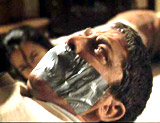 The Shelton Family's Home Invasion 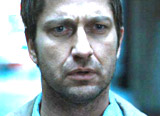 Vigilante Clyde Shelton (Gerard Butler) 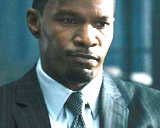 Prosecuting Lawyer Nick Rice (Jamie Foxx) 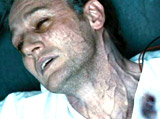 Ames's (Josh Stewart) Painful Execution 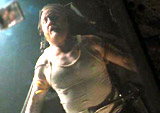 Darby's (Christian Stolte) Torture-Murder 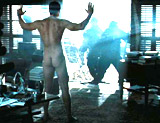 Arrest of Clyde 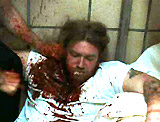 Clyde's Cellmate (Charlie Alston) Murdered 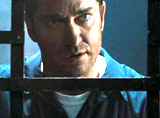 Clyde Jailed  Judge Laura Burch (Annie Corley) Also Killed 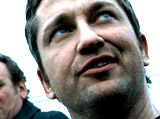 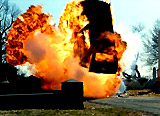 Limo-Car Attack on Ride's Convoy 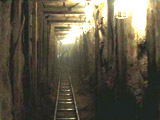 Clyde's Prison Tunnel 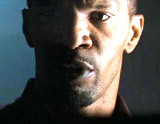 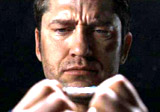 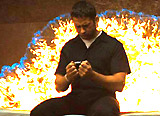 The "DADDY" Bracelet 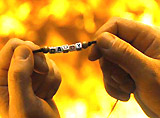 Clyde Triggered His Own Bomb Under His Bed |
|||||||||

|
Layover (2001)
This plot-twisting, complex techno-thriller (with the tagline "A Deadly Seduction"), told about microelectronics businessman Dan Morrison (David Hasselhoff) who lived in Chicago and had a troubled marriage with his wife of eight years Allayne (Sherri Alexander). Its tagline described the basic plot:
During a lay-over in San Francisco on his way to Tokyo, he met flirtatious, conniving femme fatale Vickie Dennis (Italian model Yvonne Scio) at the airport bar who came up to him and boldly propositioned him for sex - quickly consummated in an unclaimed baggage room. Soon after, she was revealed to be married to a pushy, opinionated jewel (diamond) merchant named Roy Dennis (Gregg Henry) that Dan had met earlier on his previous flight. The jealous, abusive jewel dealer suspected that Vickie was cheating on him, but didn't know that Dan had just had sex with her. At their home where Dan was lured to help Vickie, he used Roy's gun to 'kill' Roy, and found himself held at the SF police station and (falsely) charged with the murder. He realized that he had been set up:
Dan escaped from the police station and returned to the scene of the crime where he confronted Vickie, asking: "Why'd you set me up?" and she falsely blamed everything on Jack. Her plan was to have her husband killed, and then abscond with $18 million (wholesale) worth of diamonds ("You did all this just for diamonds?"). Dan was deliberately set up to take the blame for the death of the real "Roy Dennis" - who had actually been killed in his own home by Jack, using the gun with Dan's fingerprints. And then in one of the film's most surprising moments set in a getaway airport hotel room, Jack suddenly shot partner Vickie in the stomach - his plan was to pin Vickie's death on Dan and have the diamonds all to himself; but things went awry when a bloodied, still-alive Vickie stumbled out into the hotel corridor where Jack had to pursue and kill her, allowing Dan to escape. Dan followed Jack to the SF International Airport terminal and into an off-limits airplane maintenance hangar for a deadly stand-off. The film ended with Allayne, who had flown to SF, shooting Jack to death as he was poised to kill her husband - and then in another shocking twist, she admitted her involvement with Jack:
Unbelievably, she proposed fleeing with Dan and the diamonds - "You and I could walk out of here and have a great life together...What's it gonna be, Dan? You and me?" -- but he rejected her crazed plan:
He revealed that his cell-phone gadget had recorded their conversation and that the police were on their way, foiling her scheme as she was wounded in the leg by approaching cops and then handcuffed. Dan was cleared of all charges and walked off, knowing the location of the diamonds in an airport locker and luckily having the key in his possession. |
 Dan Morrison (David Hasselhoff) at Airport with Vickie (Yvonne Scio) 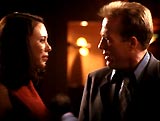 Vickie and 'Roy Dennis' (Gregg Henry) 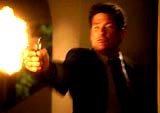 The Set Up Murder 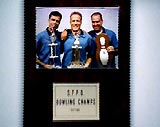 'Roy' Identified as Det. Jack Guillardo 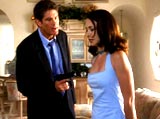 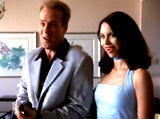 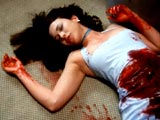 Murder of Vickie by Detective Jack Guillardo 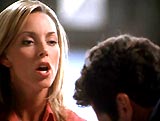 Allayne (Sherri Alexander), Dan's Scheming Wife |
|||||||||





 Corrupt
LAPD Capt. Dudley Smith Shot Sgt. Vincennes To Death, to Cover-Up
His Take-Over of LA's Organized Crime; Cop Exley Then Killed Smith
(Who Was Ironically Remembered As a "Hero"), and Exley Received
the Medal of Valor
Corrupt
LAPD Capt. Dudley Smith Shot Sgt. Vincennes To Death, to Cover-Up
His Take-Over of LA's Organized Crime; Cop Exley Then Killed Smith
(Who Was Ironically Remembered As a "Hero"), and Exley Received
the Medal of Valor