|
Film Spoilers and Surprise Endings B2 |

| |
||||||||

|
The Bedroom Window (1987)
Writer/director Curtis Hanson's Hitchcockian (Rear Window and The Man Who Knew Too Much), plot-twisting romantic thriller began with a very simple premise that became more complex and problematic as the film unfolded. Bachelor-architect Terry Lambert (Steve Guttenberg) had sex for the first time with his executive boss Collin's (Paul Shenar) sexy French wife Sylvia Wentworth (Isabelle Huppert) in his Baltimore apartment after an office party. After sex, he was in his bathroom at 2 am when she heard screams coming from outside his second story bedroom window. She witnessed a brutal mugging of a young cocktail waitress, later revealed to be Denise Connolly (Elizabeth McGovern). During the struggle, Sylvia saw the creepy serial killer face-to-face as she stood nude at the window. She told Terry the attacker was red-haired (with hair combed back into a ducktail), had pasty white skin, and was wearing a windbreaker. To hide the fact of their affair, Terry naively suggested that he would be honorable and report to investigative detectives Quirke (Carl Lumbly) and Jessup (Frederick Coffin) that he had seen the attacker, using her detailed observations as his own. During a line-up (when Terry was unable to make a positive ID) and a subsequent court hearing, 'second-hand' witness Terry was shown by shrewd defense attorney (Wallace Shawn) to be an unreliable witness (without his contact lenses, he couldn't identify a red book at a distance of 20 feet in the courtroom). But to satisfy his own curiosity and act as an amateur detective doing his own surveillance, he trailed after the released prime suspect - a red-headed shipyard welder named Carl Henderson (Brad Greenquist), the "Dumpster Killer," who had since murdered another co-ed the same night of the attack a few blocks away, and a third young woman known as the Dancing Girl ((Sara Carlson) in the credits). When Terry became a suspect himself, he attempted to have Sylvia testify to the truth, but the cold-hearted woman refused and abandoned him ("You'll have to find some other way to solve your problems"). During a ballet concert, Henderson (who had realized Sylvia's connection to Terry, and that he could be identified by her) violently stabbed Sylvia to death, making it look like Terry committed the crime. On the run, Terry went to Denise who all along had realized his dilemma (that only his female partner saw the crime), and they both devised a foolish plan to ensnare the rapist by baiting him, thereby insuring Terry's innocence. Denise would masquerade as a loose woman ("I go in and try to set the hook") in Bud's & Joe's bar-pool hall in a seedy side of town (where she seductively fingered the tip of her pool cue), and then lure him back to her apartment (after he spied her address on her ID) so he could be caught in the act. The plan partially worked, but the authorities were late in arriving in the tense conclusion, while Denise had to be saved by a desperate Terry (who frantically drove a stolen police car to her place) and apprehended the rapist. In the film's conclusion with the film's last line, Quirke told them: "That was a stupid play you made tonight. You're lucky it turned out all right. You both are." |
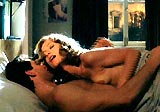 Terry Lambert (Steve Guttenberg) Having Sex With Sylvia Wentworth (Isabelle Huppert) 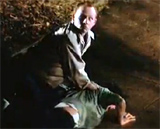 The Mugging/Rape 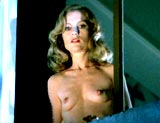 Witnessed by Sylvia at the Bedroom Window 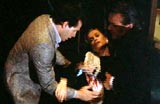 Murder of Sylvia 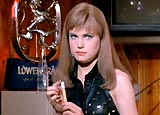 Rape Victim Denise Connolly (Elizabeth McGovern) 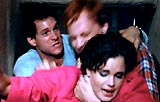 The Set-Up to Snare the Rapist 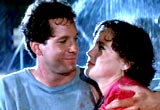 Terry With Denise |
||||||
|
Being John Malkovich (1999)
This inventive and original film by director Spike Jonze began with the discovery, by desperate puppeteer and LesterCorp file clerk Craig Schwartz (John Cusack) on the 7 1/2 floor of his NY office building (Mertin Flemmer), of a mysterious portal in the file room. It led directly into the mind of celebrity/actor John Horatio Malkovich (John Malkovich). The transport allowed him to experience the thoughts/sights of the mind of Malkovich for about 15 minutes, until being thrown out by the side of the New Jersey Turnpike. With sexy co-worker Maxine Lund (Catherine Keener), Craig decided to make a profitable nightly business out of the trip by charging $200 to customers, advertising (with the film's tagline):
Schwartz' dowdy, pet-loving wife Lotte (Cameron Diaz) had expressed an interest in being trans-sexual through surgery. After her first experience entering the portal into JM's mind, she became obsessed with it. Lotte felt natural being within a man's body (she said: "For the first time, everything just felt right"). She also described the duality of the portal:
Lotte became attracted to Maxine and they began a sexual relationship - when Lotte was 'inside' Malkovich's head and when Maxine was having sex with Malkovich. In a lustful effort to win back Maxine and have sex with her (although she was in love with Lotte when 'inside' Malkovich), Craig decided he would pretend to be Lotte while 'inside' Malkovich - and further realized that while inside Malkovich, he could 'control' the host's words like a puppeteer. A side plot concerned Schwartz' boss, Dr. Lester (Orson Bean), who described how he had used the portal and lived for years in the body/host of people like Malkovich. She discovered that Dr. Lester had an upstairs room in his home dedicated to Malkovich, with a wall covered with pictures of him. As the story jumped forward eight months, Malkovich (with Schwartz inside) had reinvented himself as a reknowned puppeteer, and was married to an 8-months pregnant Maxine (she conceived when Lotte was 'inside' Malkovich). Dr. Lester was planning to enter Malkovich's body with lots of other elderly friends on Malkovich's upcoming 44th birthday (before midnight when his vessel was most 'ripe') to extend their life spans and save themselves from imminent death. Now that Malkovich was approaching the day of his 44th birthday, Dr. Lester kidnapped Maxine and threatened to kill her if Craig didn't leave the host body, so that they could take over inside Malkovich before midnight. After Craig complied with their demands and expelled himself, the mind/body of Malkovich was taken over by Dr. Lester and his elderly cohorts. The film ended seven years later, with Malkovich (looking like Dr. Lester) married to Dr. Lester's hearing-impaired secretary Floris (Mary Kay Place). Maxine's daughter, named Emily (Kelly Teacher), was now revealed to be the new host ("the newly formed infant vessel") for the future. At the age of 44, Malkovich as the host had become too old, and the portal moved on to its next host - an unborn child (in this case, Emily). In the final scene at a swimming pool, Craig was shown to be 'trapped' in the mind/body of Emily - he had rushed back 'into' Malkovich so that Maxine could love him again, but entered after midnight on Malkovich's B-day, and therefore was stuck 'inside' Emily as the new host and unable to leave her mind -
Craig found himself powerless watching (through the eyes of an unaware Emily) as Maxine lived happily ever after with her new partner - Lotte. He kept repeating to Maxine:
|
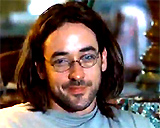 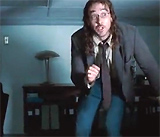 Puppeteer/File Clerk Craig Schwartz (John Cusack) and Portal on 7 1/2 Floor  Maxine Lund (Catherine Keener) 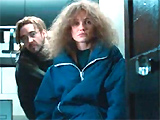 Craig's Wife Lotte (Cameron Diaz) Entering the Portal to JM 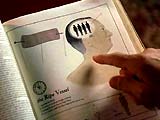 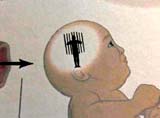 In the Mind of Someone Else  The Room Dedicated to John Malkovich  Maxine's Daughter Emily (Kelly Teacher)  Lotte (Cameron Diaz) and Maxine with Emily  Craig Schwartz Trapped in Emily's Subconscious, Looking out at Lotte and Maxine |
||||||
|
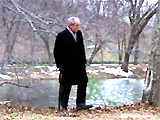
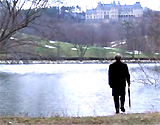
Director Hal Ashby's comedic drama was about a totally innocent idiot named Chance-Chauncey Gardiner (Peter Sellers), who was entirely sheltered, oblivious and only informed about the world through his television viewing. After being cast out onto the street, he happened to be taken in by wealthy but sickly businessman-financier Benjamin Turnbull Rand (Melvyn Douglas) and his wife Eve (Shirley MacLaine). Rand was an influential political Washington DC insider, and came to the conclusion (with others) that Chauncey was spouting deep and brilliant political insights. Once introduced to powerful politicians, including US President (Jack Warden), Chauncey was regarded as full of allegorical statements of deep wisdom, and instantly became a media celebrity. The film ended with a mystical, incongruous conclusion (accompanied by off/on-screen voices) at the memorial funeral of Rand, with one of the pallbearers discussing the protagonist's bid for the Presidency:
At that moment, totally innocent idiot Chance-Chauncey Gardiner, who had wandered away from the ceremony into a wooded area closeby, blithely stepped onto a pond and literally walked on the water. He tested the depth of the water with the length of his umbrella - and then continued walking away from the camera.
The final words of the film, delivered by the President at the funeral, were heard from a distance: "Life is a state of mind." |
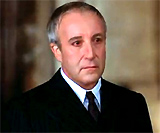 Chauncey Gardiner (Peter Sellers) 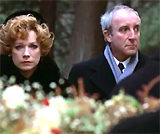 Eve (Shirley MacLaine) and Chauncey at Benjamin Rand's Funeral 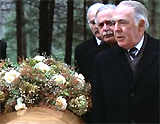 Pallbearers |
||||||

|
Beneath the Planet of the Apes (1970)
In this first sequel to the long-running series, in the final shocking concluding scene set in the post-apocalyptic year 3955 AD, telepathic, mind-controlling, subterranean-dwelling human mutants (with radiation-scarred faces) worshipped an ICBM nuclear missile - an atomic bomb (the 'Divine Bomb') - on an altar in the ruins of NYC's St. Patrick's Cathedral. Mendez (Paul Richards) revered the golden-coated bomb: "This is the instrument of my God" as he touched controls. The bomb was activated and rose up from the altar to its firing position. After Mendez was shot and killed during an arrest attempt by armed gorillas with Dr. Zaius (Maurice Evans), the bomb was ordered to be dismantled by gorilla ape leader General Ursus (James Gregory): "If we can't shoot it down, we'll pull it down." Dr. Zaius argued back about how they should carefully treat the human weapon: "You don't know what you're doing. It'll kill us all." When the missile was pulled down and slammed to the ground, the shell casing of the missile cracked open and a deadly gas was released. Astronaut Taylor (Charlton Heston) attempted to stop General Ursus from accidentally setting off the weapon, but Taylor was shot and fatally-wounded. Astronaut Brent (James Franciscus) came out into the open where he shot and killed ape commander Ursus, and continued to fire upon other gorillas until he was struck down and died. Taylor then begged orangutan Dr. Zaius to prevent a massive apocalypse: "It's doomsday. The end of the world. Help me." Zaius contemptuously refused and scoffed: "You ask me to help you! Man is evil, capable of nothing but destruction." Taylor responded with his final words: "You bloody bastard..." and died with his hand outstretched - appearing to deliberately grasp for the red triggering control switch of the Alpha-Omega bomb and set it off.
The doomsday weapon, with an ΑΩ (Alpha and Omega) symbol on its fin, detonated and destroyed the planet Earth. A blinding white light intensified until it whited out the image of Taylor's bloody fingers hanging onto and then falling off the detonator. The film closed with the following voice-over narration (uncredited Paul Frees):
The pessimistic, downbeat film ended abruptly, without traditional closing credits. |
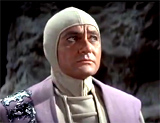 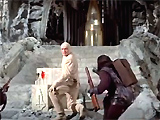  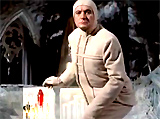 Mendez (Paul Richards) at Altar of Atomic Bomb 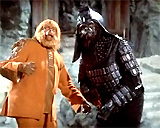 Dr. Zaius (Maurice Evans) with General Ursus (James Gregory) 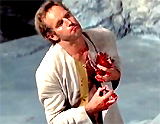 Astronaut Taylor (Charlton Heston)  Detonation of the Doomsday Weapon |
||||||
|
Beyond the Black Rainbow (2010, Can.)
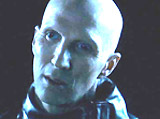
Writer/director Panos Cosmatos' feature debut film was this weird, slow-moving Canadian sci-fi thriller - a midnight movie with an incoherent, head-tripping type of dreamy plot that ended degeneratively with slasher killings. The experimental film's surreal visuals (saturated colors) and synthesizer soundtrack were appealing to certain viewers. The incomprehensible film was admittedly designed to copy-cat certain features (stark white rooms, glowing cubes and pyramids, a psychedic light trip) of Kubrick's 2001: A Space Odyssey (1968), and also the look of The Andromeda Strain (1971), THX 1138 (1971), and Dark Star (1974). The self-indulgent and portentious film also appropriated the iconography of Luis Buñuel and Kenneth Anger's works. The final credit for the film was the famous quote from The Adventures of Buckaroo Banzai: Across the 8th Dimension (1984) - "No matter where you go...There you are." The "New Age" Arboria Institute, an experimental science center (commune, laboratory, sanitorium, or detention facility?) of neuro-psychologies, was contained in a self-sustaining dome. It was the setting for the dystopian film (in the future year of 1983, during the Reagan years). The institution had been founded in 1960 by now-dying author and psychiatrist Dr. Mercurio Arboria (Scott Hylands), who was kept alive by machines and somewhere on the grounds. Arboria was designed to renew one's mind and body, to create inner contentment and peace, to harness psychic powers, and to create advanced humans (or mutants?). Dr. Arboria's protege - psychopathic, semi-sadistic, sexually-creepy, pill-popping scientist Dr. Barry Nyle (Michael Rogers) was now the lead administrator, assisted by herbologists, healers, and other New Agey personnel. Dr. Nyle was observing mute and sedated teenaged orphan Elena (Eva Allan), who was being held captive and against her will in a below-ground, claustrophobic room. During daily therapy sessions, she was interrogated with unanswerable questions. She exhibited unexplainable psychic abilities and supernatural mind powers kept in check by a glowing, floating, pyramid-like or triangular device emitting light. Dr. Nyle suppressed the psychic device momentarily, as Elena's cruel nurse Margo (Rondel Reynoldson) entered her room. When Margo crumpled up an illicit picture of Elena's dead mother (who had died during childbirth), the provoked Elena caused her head to explode - homage to The Fury (1978) and Scanners (1981). During her brief escape, Elena had a vision of a Sentionaut, a giant, seven-foot tall, motorbike-helmeted, space-suited individual. The evil-masked guard injected her neck with a syringe and she passed out. In a strange flashback sequence (in severe black and white and in slo-motion) set in 1966 at the Institute, young psychic trainee Nyle was sent on a "great journey," but had freaked out and become hysterical after ingesting a substance and being dipped in a vat of primordial dark liquid ("beyond the black rainbow"). He attacked (raped??) and then fatally wounded assistant Mrs. Anna Arboria (Sara Stockstad) shortly before Elena was born - was Elena his daughter? One of the film's major twists was that Dr. Arboria's wife was Elena's mother. The troubled Dr. Nyle murdered (or euthanized) Dr. Arboria with a fatal inoculation. The dying doctor reacted: "That's wonderful. Barry, that's so wonderful. Isn't it beautiful?" Arboria watched a video of the Hawaiian Islands as he died, reminiscent of Soylent Green (1973). Then, Nyle returned home, removed his wig to reveal his baldness, extracted his colorful contact lenses, donned a black leather body suit, and confronted his own, homely, curly-haired wife Rosemary (Marilyn Lorry). She asked: "Barry, you're not wearing your appliances." He replied: "I don't want to wear them anymore," then killed her while claiming: "I see what others cannot see... I have entered the eye of God." He crushed her eyesockets and skull with his bare hands (homage to Blade Runner (1982)) to set her free. During a second escape attempt from her quarters, Elena walked by a scary-looking, zombie-like, flesh-eating, veiny bald creature in a straitjacket. She also came upon a Sentionaut (a thin, tall, sexless creature with a baby-doll face), before stepping out of the Institute's dome and into the night. Dr. Nyle pursued her with a sharp-curved knife and a GPS locator-device, and revealed while driving that he was an advanced, bald human-mutant with green glowing eyes. He first bloodily murdered two beer-drinking pot-smokers (Gerry South and Chris Gauthier) at a campfire site. When he caught up to her, he kept repeating: "Come to me." Elena's telekinesis powers picked up Nyle's body and crushed his skull on a rock - accidentally killing him. Elena made her way across a road to a suburban group of homes (one with a flickering TV set seen through the living room window).
After the credits, the camera focused on a plastic (?) Sentionaut lying on the floor of a living room. A robotic voice was heard asking twice: "Do you read me?" |
 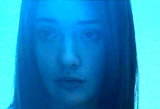  Elena 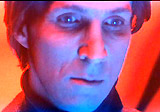 Dr. Nyle 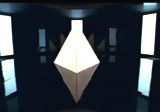 Light-Emitting Pyramid 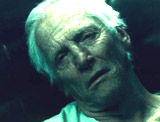 Dr. Mercurio Arboria 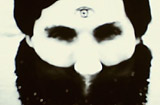 Dr. Nyle Dipping Into Primordial Liquid 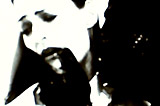 Nyle's Rape/Murder? of Mrs. Arboria  Murder of Nyle's Wife  Zombie Creature  Sentionaut |
||||||
|
The Big Clock (1948)
Director John Farrow's film noirish crime thriller was about the cover-up and suspenseful investigation into the murder of blonde mistress Pauline York (Rita Johnson). She had a final fateful encounter with her sugar-daddy - a clock-obsessed, ruthless, possibly homosexual, detestable New York Crimeways Magazine boss Earl Janoth (Charles Laughton), a powerful publishing tycoon in NYC. In a moment of extreme jealousy when visiting Pauline in her apartment, Janoth accused her of having another lover, and she snapped back that he was a "cheap imitation Napoleon." She called him "disgusting...flabby." He passionately reacted by impulsively striking her on the head with a phallic-shaped, heavy metal sundial (the murder weapon). Before entering, Janoth had noticed someone else who had just left Pauline's apartment just as he arrived, but did not see the man's face. Before killing Pauline, Janoth had pressured her to identify her other lover - and she elusively claimed that his name was "Jefferson Randolph." To cover up his crime, Janoth cleverly planned to blame the murder on this other man. Ironically, Janoth enlisted his media executive and magazine journalist and editor-in-chief, George Stroud (Ray Milland), to find the killer - "Jefferson Randolph". Stroud found himself in a difficult cat-and-mouse game. He had been witnessed accompanying Pauline during the evening by many individuals, and he was the one who had left Pauline's apartment (although not clearly identified) just before his boss Janoth, so he could be regarded as the killer. He feared his investigation would lead to only one man - himself! Stroud realized that all the clues pointed to himself as the prime suspect, so he attempted to steer the manhunt away from himself, and find information to incriminate Janoth. With additional revelations and the gathering of evidence, Stroud was able to knowingly accuse Steve Hagen (George Macready), Janoth's right-hand man, as the killer - in order to smoke out Janoth. This caused a raging Janoth to shoot Hagen (after he confessed: "Janoth killed Pauline") and then fall to his own death down the building's elevator shaft in his attempted escape.
|
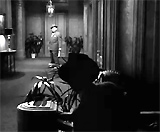 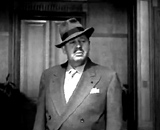 Earl Janoth (Charles Laughton) - Spotting A Silhouetted Man in Hallway 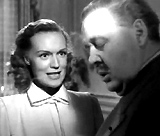 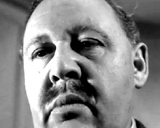 Janoth's Confrontation with Incensed Mistress Pauline (Rita Johnson) 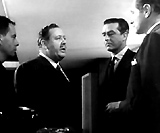 Janoth Ordering Stroud (Ray Milland) To Take Charge of Investigation |
||||||
|
The Big Empty (2003)
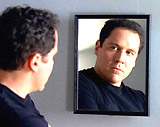
Writer/director Stephen Anderson's independent science-fiction film (also a dark comedy resembling The Coen Brothers' The Big Lebowski (1998) and David Lynch's works) was a quirky character study with an enigmatic plot. The tagline described its unusual nature: "Cowboys. Aliens. Blue suitcases and bowling balls. Strange things are happening out in the middle of nowhere." It was a straight-to-video release, completely bypassing theatres. It told about a struggling, unemployed LA actor, stage-named John Person (Jon Favreau) eager for auditions. He was almost $28,000 in credit card debt, and living across the hall from geeky Grace (Joey Lauren Adams) at Hollywood's landmark Alto Nido Apartments. He received an unusual offer from his strange, neck-braced next-door neighbor Neely (Bud Cort), a possible conspiracy theory nut-job. Neely told John that his life that had became "empty, your existence futile." After being told intimate details about his masturbation techniques by Neely, Person was persuaded to accept a "simple courier job" - to deliver a large, locked blue suitcase to a truck stop in Baker, California to an elusive person named "Cowboy" (Sean Bean), identified by a long black duster and black Stetson. He finally agreed when the $25,000 offer was negotiated upward to $28,000 to cover his debt. In Baker, he checked into Arne's Royal Hawaiian Motel managed by eccentric, pushy Elron (Jon Gries), and met various characters in town, including:
Strange occurrences focused on a dry lake bed named Devil's Crest, located outside of town - associated with conspiracy theories, and UFO and alien sightings. Blue-collar trucker Dan (Brent Briscoe) showed John an "alien claw hand" in a diner, and believed aliens were harvesting human sperm and eggs from neck incisions to start a "master race." Ruthie described how Devil's Crest was a pickup spot used by aliens:
John was told (when Grace phoned) that Neely was shot and then beheaded. John began to think that Neely's decapitated head was in a blue bowling bag delivered to him (but it only contained size 11 bowling shoes). But he was considered a prime suspect by menacing and probing FBI agent Banks (Kelsey Grammer), and also suspected of being involved in the mysterious disappearances of over 75 individuals in the area within the last six years, including three strippers from Vegas. Banks wrongly theorized that all the missing abductees were the "victims of, say, a single diabolical serial killer." There were other various symbols, including the color blue (eyes, track-sweatsuits, suitcases, the bowling ball), the number 11 (or John's motel room 111, or Banks' office clock at 11:11), a large number of identical blue suitcases (arranged in a circle) in the desert, neck band-aids, numerous references to Hawaii (Paradise?), an umbrella (with a sky design), the Cowboy and Indian characters, and locked items that couldn't be opened. The Cowboy shot Randy dead and took Grace as his hostage, to convince John to bring the many suitcases to Devil's Crest and arrange them in a circle. The entire cult film, almost like an episode of Twilight Zone, turned out to be an alien-abduction story in the 'big empty' desert area, where 15 willing victims were taken (including barefooted Ruthie now wearing size 11 shoes) by the Cowboy in an RV, to join up with the contents of the suitcases (to start life over in a "whole other world"). They thought that they were 'moving on' and escaping their "mundane ordinary lives" through "a gateway to the other side" leading to Paradise - a "better place." The Cowboy shot a flare into the sky and there was a white blast. John woke up on the desert floor three days later (with a neck bandage - indicating his sperm was stolen?), with a bunch of empty suitcases. Was he 'left behind' as Ruthie had described? As he walked back to Baker, Gracie drove up in his VW van, with the key (given to her by the Cowboy) to the one locked suitcase he was carrying - inside was his cash payment of $28,000. John's life was also transformed or renewed - the film ended with agent Banks (also with a neck bandage) declaring the Neely case closed and John presumed innocent, and hypothesizing that Ruthie (just a few weeks shy "of legal age") ran off with Randy. John paid off his debts, found work in a supporting role, and went bowling (he was wearing size 11 shoes on lane # 11, and was on a date with new-found girlfriend Grace). After two strikes in a row in the 10th frame, he had the opportunity to "get one more chance - make it count" before a new game - and his eyes turned from brown to blue. His final roll with a blue bowling ball was across the desert, as a new flare was spotted in the distance. |
 John Person (Jon Favreau) 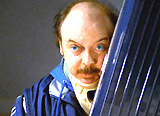 Neely (Bud Cort) With Blue Suitcase  Ruthie (Rachael Leigh Cook) 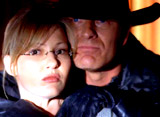 "Cowboy" (Sean Bean) With Hostage Grace (Joey Lauren Adams) 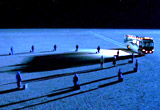 Blue Suitcases Arranged in Circle in Desert Lake Bed at Devil's Crest  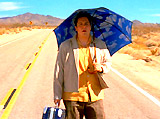 John Walking Back to Baker with Umbrella   John With Newfound Girlfriend Grace at Bowling Alley |
||||||
|
The finale to the twisted plot of this classic film noir mystery with multiple murders tied up many loose ends. Hard-boiled detective Philip Marlowe (Humphrey Bogart) had been commissioned by General Sternwood (Charles Waldron) to locate his favored, missing companion Regan - thought to possibly be in the company of Mrs. Mona Mars (Peggy Knudsen), a mobster's wife. Marlowe correctly laid out his suspicions to gambler Eddie Mars (John Ridgely) that unstable, nymphomaniac Carmen Sternwood (Martha Vickers) had killed the missing Regan, out of jealousy over an imaginary relationship that he was having with Eddie Mars' wife Mona. Carmen's loyal sister Vivian Rutledge (Lauren Bacall) chose to turn to her gambling acquaintance Mars to have him help cover up the matter and "protect" her sister Carmen from guilt - and to prevent her sick father from any further suffering. With the help of Mars' cold-blooded hired killer Canino (Bob Steele), Regan's body was hidden and the deception was set up. However, high-class blackmailer Mars also forced an overly-protective, well-intentioned Vivian to part with her gambling winnings and possibly offer sexual favors. And to keep police from learning the truth and investigating, he went even further by hiding his wife Mrs. Mars at Huck's Garage, to make it look like she had run away with Regan during their entirely conceivable affair. The uncovering of the web of secrets was followed by the murder of Mars by his own henchmen when Marlowe forced him to run outside Geiger's house (as he shouted vainly: "Don't shoot! It's me, Mars!") where his own men were laying in wait for Marlowe. Mars' death - signaled by bullet holes across the door and his collapse at the door, allowed Marlowe to protect Carmen (who was sent "away" to an institution) and Vivian by pinning the murder of Regan on Mars - and Marlowe was able to end up with Vivian. |
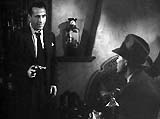 Marlowe Holding Gun on Eddie Mars (John Ridgely) 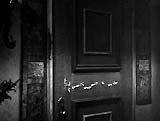 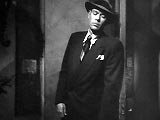 Bullets Through Door Killing Mars 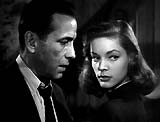 Marlowe With Vivian (Lauren Bacall) |
||||||





 The
Rapist/Killer - Carl Henderson - Was Caught, Although Barely
The
Rapist/Killer - Carl Henderson - Was Caught, Although Barely