| Ray Harryhausen's Mythological Science-Fiction/Fantasy Films
- One of the Fathers of Modern-Day Special Effects
After admiring and being inspired by the ground-breaking work
of Willis H. O'Brien in Kong Kong (1933) and the work of special-effects animator George
Pal in the 1940s, Ray Harryhausen was able to work on Mighty Joe Young
(1949), one of O'Brien's final projects (for which O'Brien won a Best
Visual Effects Oscar) although Harryhausen wasn't really credited for most
of the work.
Besides the films already mentioned in the 1950s, master
of stop-motion animation Ray Harryhausen (often teamed with long-time
producer Charles Schneer) turned to mythologically-tainted science-fiction
films (including three Sinbad films) to display his painstaking,
classic craft of special effects - animated frame-by-frame, until
the special effects revolution ushered in by Star Wars (1977) swept
through the industry. Harryhausen, who never received an Oscar
nomination, did receive the Gordon E. Sawyer Honorary Academy Award
in 1992. He created the fantastic images in 15 films between 1953
and 1981, including:
|
Harryhausen's Films
|
Descriptions
|
| The Beast From 20,000 Fathoms (1953) |
mentioned earlier |
| It Came From Beneath The Sea (1955) |
about a giant squid-octopus (with only six
arms instead of eight to save money) threatening San Francisco and the
Golden Gate Bridge |
| Earth vs. The Flying Saucers (1956) |
mentioned earlier |
| 20 Million Miles to Earth (1957) |
mentioned earlier |
| The Three Worlds of Gulliver (1959) |
adapted from Jonathan Swift's novel about
an adventurer who encountered the worlds of Lilliput, Brobdignag, and
England |
| Mysterious Island (1961) |
mentioned earlier |
| Jason and the Argonauts (1963) |
Harryhausen's best film, with screeching
harpies, a giant metal warrior (a cross between the Colossus of Rhodes
and a bronzed Talos man), a 7-headed hydra, and sword-wielding skeletons
doing battle against Jason (Todd Armstrong) |
| The First Men in the Moon (1964) |
mentioned earlier |
| One Million Years, BC (1966) |
Harryhausen's most celebrated film, with
Raquel Welch as a fur bikini-clad cavewoman, and a menagerie of prehistoric
creatures |
| The Valley of Gwangi (1969) |
about the unleashing of a giant, flesh-eating
prehistoric monster that burns to death at a church altar in the fiery
climax |
| Trog (1970) |
a horror-monster film, noted as the last
film of Joan Crawford |
|
The Sinbad Trilogy:
(1) The 7th Voyage of Sinbad (1958)
|
featuring Harryhausen's Dynamation process,
and a giant, horned Cyclops who spit-roasts a sailor |
| (2) The Golden Voyage of Sinbad (1974) |
featuring a 6-armed statue, a one-eyed centaur,
and a flying Griffin |
| (3) Sinbad and the Eye of the Tiger (1977) |
with three zomboids, a giant saber-toothed
tiger, a horned prehistoric caveman named Troglodyte (Trog for short),
three banshees, and Minoton (similar to the legendary Minotaur with a
human body and bull's head) - among other creatures |
| |
|
| Clash of the Titans (1981) |
featuring a snake-haired medusa; this was
Ray Harryhausen's swan song - his last film as Special Effects
producer |
[Pixar's Monsters, Inc. (2001) paid tribute
to Harryhausen by having Monstropolis' chic night spot restaurant
named after him. Also, the octopus behind the bar in Harryhausen's
Sushi restaurant had only six legs, another clever in-reference. Tim
Burton also paid homage to Harryhausen in his films, including Corpse
Bride (2005).]
Some 60's Sci-Fi Films:
In the 1960s, producer George Pal and director Byron Haskin
teamed again to deliver a sci-fi version of Defoe's classic novel, Robinson
Crusoe on Mars (1964), about a stranded astronaut on the planet of Mars,
with only a monkey named Mona as a companion. Another stranded astronauts
film, this time on the Moon after a retro-rocket failed to return them to
Earth (foreshadowing the Apollo 13 disaster and its telling in the
film version Apollo 13 (1995)), was director John Sturges' Marooned
(1969) - that won an Academy Award for Best Visual Effects. And director
Richard Fleischer's fanciful Fantastic Voyage (1966), from Isaac Asimov's
novel, put a medical team of shrunken explorers (Stephen Boyd and Raquel Welch)
inside a human body in a miniaturized submarine that traveled through the
blood stream, with a mission to wipe out a dangerous blood clot in the brain
of an atomic scientist, while being confronted by the body's natural defense
system. Roger Vadim's futuristic space fantasy Barbarella (1968), derived
from a comic strip, featured a sexually-emancipated 41st century space adventuress
(Jane Fonda), with a memorable striptease under the credits and John Phillip
Law as the blind angel Pygar.
Sci-Fi Flops and Turkeys:
There were also any number of dreadfully grotesque, cheesy
low-budget science-fiction flops or turkeys - now often regarded as kitsch
or cult classics, drive-in specials, or as "the most enjoyable bad films
of all time." [Many of these films would eventually end up on the satirical
TV show Mystery Science Theatre 3000.] They included some of the following:
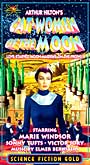 Arthur
Hilton's 3-D Cat-Women of the Moon (1953) about scantily-clad Amazons
on the lunar surface (advertised as "Love-Starved Moon Maidens on the
Prowl!") Arthur
Hilton's 3-D Cat-Women of the Moon (1953) about scantily-clad Amazons
on the lunar surface (advertised as "Love-Starved Moon Maidens on the
Prowl!")- director Phil Tucker's incredible 3-D Robot Monster
(1953) (aka Monsters from the Moon) - the sex-starved Ro-Man
monster was played by a man in a gorilla suit with a diving helmet; upon
release, this famed 'turkey' was so heavily scorned and criticized that
Tucker committed an unsuccessful suicide
- Bride of the Monster (1956), with an aged Bela Lugosi
playing a mad scientist; one of writer/producer/director Ed Wood's awful
classics
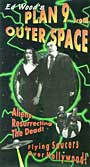
- Ed Wood Jr.'s legendary Plan 9 From Outer Space (1956),
about space aliens conquering Earth by resurrecting the dead; often considered
the worst sci-fi film ever made
- the creature feature The Mole People (1956) about
an ancient Sumerian-like, underground group of albinos located in the Middle
East during a subterranean, anthropological expedition led by John Agar
- John Sherwood's The Monolith Monsters (1957), based
on a story by Jack Arnold (who directed Creature from the Black Lagoon),
with giant, menacing black rocks formed from meteor fragments
- Arnold Laven's The Monster That
Challenged the World (1957), a classic B-movie
creature-feature about giant, prehistoric killer sea mollusks (discovered
under S. California's Salton Sea) with snapping mandibles, and with aging
western film actor Tim Holt in the male romantic lead role
 the
preposterous schlock film Attack of the 50-Ft. Woman (1958, 1993) about a gigantic woman (Allison Hayes) in a bikini the
preposterous schlock film Attack of the 50-Ft. Woman (1958, 1993) about a gigantic woman (Allison Hayes) in a bikini- Attack of the Giant Leeches (1958), a typical representation
of a cheap Roger Corman-produced film, about marauding giant leeches in
a swamp
- The Wild Women of Wongo (1958)
- The Brain from Planet Arous (1958), about a huge
floating alien brain set to take over the Earth
- Tom Graeff's alien invasion film Teenagers from Outer
Space (1959)
- Robert Hutton's The Slime People (1963), shot cheaply
in a Los Angeles butcher shop; about prehistoric monsters in deep freeze
cabinets that were awakened from hibernation by atomic testing
- Roger Corman's disturbing and grotesque sci-fi/horror film, "X" - The Man with the X-Ray Eyes (1963), with Ray Milland as Dr.
Xavier, a hubris-filled surgeon whose powers of X-ray vision became self-destructive,
causing him to tear out his rotted eyes when a tent evangelist in a revival
meeting exhorted his audience to pluck out an offending eye (from the Biblical
quote Mark 9:47)
- El Paso fertilizer salesman Hal Warren's Manos:
The Hands of Fate (1966), his sole directorial
effort (he also wrote and produced), has been mocked as one of the worst films
ever made by the Mystery Science Theater 3000 TV show (their most
popular episode ever) - it featured out-of-focus scenes, ultra-repetitive dialogue,
a badly-dubbed soundtrack, long and drawn-out scenes, and amateur actors;
its characters included a half-man, half-goat individual named Torgo and
a mysterious cult leader character named the Master [The below standard
B-grade film's notoriety even led to a short Canadian documentary titled Hotel Torgo (2004), made by Niagara College film students about the
turbulent making of the film]
- and another of the worst films ever made - the sci-fi parody Attack of the Killer Tomatoes (1980)
Time Travel Films:
A number of time travel films have been produced over the
years:
-
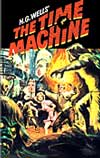 producer/director
George Pal's classic film adaptation of H. G. Wells' 1895 novel with Oscar-winning
Special Effects, The Time Machine (1960) in which a turn-of-the-century
English time traveler and inventor H.G. "George" Wells (Rod Taylor)
went to the year 802,701 (past three world wars) to find a most-unusual
world populated with peaceful Eloi and monstrous green Morlocks producer/director
George Pal's classic film adaptation of H. G. Wells' 1895 novel with Oscar-winning
Special Effects, The Time Machine (1960) in which a turn-of-the-century
English time traveler and inventor H.G. "George" Wells (Rod Taylor)
went to the year 802,701 (past three world wars) to find a most-unusual
world populated with peaceful Eloi and monstrous green Morlocks
- La Jetee (1962, Fr.), the landmark, eloquent
short French film from director Chris Marker composed entirely
of B/W still frames; set after WWIII, about a group of scientists
who attempted to send a man back in time to his life before the
war; remade as 12 Monkeys (1995) -
see below
- the fantasy-biopic Time After Time (1979), director
Nicholas Meyer's directorial debut film, in which a young H. G. Wells (portrayed
by Malcom McDowell) pursued Jack the Ripper through late 70s San Francisco
- The Final Countdown (1980), in which the USS
Nimitz, a modern-day aircraft carrier, was sent back to the Pacific
Ocean by time warp to December 6, 1941 (pre Pearl Harbor)
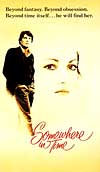 Somewhere
in Time (1980), an old-fashioned, dramatic love story conducted across
time and based upon Richard Matheson's novel Bid Time Return; aspiring
playwright/actor (Christopher Reeves) willed himself back to 1912 to a turn
of the century hotel after falling in love with the picture of an actress
(Jane Seymour) given him by an elderly woman who beckoned: "Come back
to me" Somewhere
in Time (1980), an old-fashioned, dramatic love story conducted across
time and based upon Richard Matheson's novel Bid Time Return; aspiring
playwright/actor (Christopher Reeves) willed himself back to 1912 to a turn
of the century hotel after falling in love with the picture of an actress
(Jane Seymour) given him by an elderly woman who beckoned: "Come back
to me"- Time Bandits (1981), Terry Gilliam's sci-fi fantasy
in which six renegade dwarves and a British schoolboy traveled through history
after entering a time portal
- The Terminator (1984) and Terminator 2: Judgment Day (1991), see further
below
- The Planet of the Apes series,
see further below
- Back to the Future (1985), Back to the Future
II (1989), and Back to the Future III (1990), three entertaining
and popular films in which Marty McFly traveled backwards and forwards in
time with the help of mad scientist Doc Brown (Christopher Lloyd) and a
super-adapted Delorean vehicle
- Star Trek IV: The Voyage Home (1986), in which the Enterprise crew of the 23rd century journeyed back to 1986 San Francisco
in a captured Klingon spaceship to save the Earth's humpbacked whales
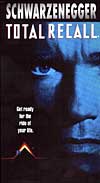 the
mega-blockbuster Total Recall (1990), from director Paul
Verhoeven and adapted from Philip Dick's short story We Can
Remember It For You Wholesale; it starred Arnold Schwarzenegger
as a 22nd century construction worker named Doug Quaid who visited
a memory-implant travel service to transport him to Mars for an
adventure trip as an agent; he discovered that he really was a
secret agent and that his entire life as Quaid was a set of artificial
implanted memories the
mega-blockbuster Total Recall (1990), from director Paul
Verhoeven and adapted from Philip Dick's short story We Can
Remember It For You Wholesale; it starred Arnold Schwarzenegger
as a 22nd century construction worker named Doug Quaid who visited
a memory-implant travel service to transport him to Mars for an
adventure trip as an agent; he discovered that he really was a
secret agent and that his entire life as Quaid was a set of artificial
implanted memories- Freejack (1992), in this time-travel chase movie
from director Geoff Murphy, a 1991 race car driver (Emilio Estevez) was
abruptly transported to the year 2009 by a 21st century bounty hunter (Mick
Jagger)
- Timecop (1994), a futuristic action film from Peter
Hyams in which Jean Claude Van Damme had the role of a special unit cop
in the Time Enforcement Division, an agency to protect against the misuse
of time travel
- 12 Monkeys (1995), director Terry Gilliam's mind-bending
story, a remake of Chris Marker's short film La Jetée/The Pier
(1962, Fr.), was set in a disease and plague-ravaged world due to biological
terrorism, forcing the human race to live in miserable conditions below
the surface of the Earth; in the year 2035, prisoner Bruce Willis was sent
back twice to the 1990s to prevent the 'Army of the 12 Monkeys' from instigating
their plot to spread a devastating plague
- Star Trek: First Contact (1996),
the 8th film in the series (that began in 1979), with interplanetary time
travel from the 24th century to the mid-21st century
- Retroactive (1997), a sci-fi thriller about repeated
attempts to change a violent act in the past, through time-travel, that
ended up even more disastrous
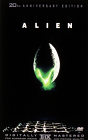 The Alien Films: The Alien Films:
Ridley Scott's effective and influential horror/sci-fi
film Alien
(1979) - the last major sci-fi film of the 70s, was
a unique combination of Spielberg's Jaws
(1975) and
Carpenter's horror film Halloween (1978).
However, it was actually based on A.E. Van Vogt's 1939 short
story "Black Destroyer," found in his 1950 collection titled "Voyage
of the Space Beagle."
Alien featured H. R. Giger's unique alien design
- a dilapidated mining space vehicle Nostromo, a deadly extra-terrestrial
life form stowaway, and a shocking and repulsive chest-bursting sequence
involving John Hurt. It appeared that the alien monster may have
arisen from the unconscious of its victims. Scott's film spawned
other renditions in the four-part series:
- writer/director James Cameron's suspenseful, tense and
non-stop action sequel Aliens (1986) about the futile nightmarish
battle between Marines and the fertile Mother of rapacious aliens
- David Fincher's Alien 3 (1992)
- Jean-Pierre Jeunet's Alien Resurrection (1997)
Paul W.S. Anderson's Alien Vs. Predator (2004),
set in 2004, crossed the Alien franchise with the Predator's
(two films in 1987 and 1990); it was the only film not to feature
Lt. Ellen Ripley (Sigourney Weaver). A second follow-up film was Alien
Vs. Predator Requiem (2007). |
 Science Fiction Films