| More Early Westerns Stars:
Early westerns provided theater owners with second features
and steady work for a countless stable of actors. During the earliest, pre-sound
period of the westerns (the teens and the 20s) and into the 30s, the elderly
William S. Hart was soon replaced by other more glamorous, swaggering, and
action-oriented western stars of the primitive B-films:
- Gilbert M. "Broncho Billy" Anderson (1881-1971) - the genre's first western film hero and star, who made about 400 "Broncho
Billy" westerns, beginning with Broncho Billy and the Baby (1910);
his last silent western role was in The Son of a Gun (1919)
- Tom Mix (1880-1940) (a prototypical western action
hero with a wholesome screen persona, fancy cowboy outfits, and
his horse Tony the Wonder Horse, a prominent star for Fox films),
he often produced and directed his own films. He was known as the
first western superstar, and first appeared as Bronco Buster in
Selig Polyscope's Ranch Life in the Great Southwest (1910),
and then in many others (for Selig and later for Fox), including The
Man From Texas (1915) and The Heart of Texas Ryan (1916),
and later in such expensive features as Fox's Riders of the
Purple Sage (1925) (from Zane Grey's 1912 melodrama of the
same name) and The
Great K & A Train Robbery (1926). Mix was an accomplished
rodeo horseman/cowboy who performed most of his own stunts
- Harry Carey, often featured as the frontiersman character
Cheyenne Harry (Carey was the lead in twenty-four John Ford silents); toward
the end of his film career, he played the lead in William Christy Cabanne's The Last Outlaw (1936), based on an original story by John Ford (who
directed a silent version in 1919)
- Hoot Gibson, who usually performed supporting roles in
the Ford-Carey western films at Universal, and became a major star in the
1920s
- Buck Jones ("The Red Rider")
- Bob Steele ("Two Fisted Hero of the West")
- Tim McCoy
- Ken Maynard
- Tim Holt
- George O'Brien
- Bill Elliott
- Charles Starrett
- Johnny Mack Brown
Westerns were among the slowest of the film genres to mature
although with the coming of sound, they achieved fuller development. From
the early 1920s, many westerns were unsophisticated, inexpensively-made, low
quality, action-packed B-pictures from Poverty Row studios (predominantly
Republic Studios), filled with familiar stock footage, often the bottom half
of a double bill in feature-length and Saturday-matinee serial formats, although
some of the early 40's westerns were A-budget films regarding social issues
(e.g., The Ox-Bow Incident (1943)).
The first feature-length color western was the Zane Grey horse opera
from Famous Players-Lasky, Wanderer of the Wasteland (1924).
The Silent Western Epic:
 Notably,
the first big-scale epic film of the silent era was also a western,
James Cruze's landmark and highly successful The Covered Wagon (1923),
an expensive effort which cost $800,000 yet brought $4 million at the box-office.
This feature-length western from Paramount was the historical drama of a wagon
train in the mid-1800s moving westward, encountering harsh environmental and
weather conditions (a river crossing and prairie fire), and of course, hostile
Indians. Hollywood was encouraged to produce many more westerns in subsequent
years. Notably,
the first big-scale epic film of the silent era was also a western,
James Cruze's landmark and highly successful The Covered Wagon (1923),
an expensive effort which cost $800,000 yet brought $4 million at the box-office.
This feature-length western from Paramount was the historical drama of a wagon
train in the mid-1800s moving westward, encountering harsh environmental and
weather conditions (a river crossing and prairie fire), and of course, hostile
Indians. Hollywood was encouraged to produce many more westerns in subsequent
years.
Its success led to another silent western tale of the
building of the American empire by the construction of the Union
and Central Pacific RRs - famed western director John Ford's silent
railroad classic epic The
Iron Horse (1924) for Fox films - his 50th film. Many of the
genre's greatest directors, such as John Ford, developed their craft
and scored their first hits with Westerns. The Iron Horse was shot almost entirely on location in the Nevada desert, and used
real-life, original props (such as Wild Bill Hickok's vest-pocket
Colt Deringer revolver). One of Paramount's last silent westerns
was director Victor Schertzinger's tale of culture clash titled Redskin
(1929) -
a good-intentioned follow-up to the earlier epic western, director
George Seitz' Zane Grey tale The Vanishing American
(1925). It was partially shot in two-strip Technicolor, with
white actor Richard Dix again in the role of college-educated Navajo
Indian Wing Foot. Although the casting was such, it was the last Hollywood
feature for two decades to take a sympathetic look into Native American
culture. After another of Ford's silent epics, Three Bad Men
(1926), it would be another
thirteen years before Ford's next western classic, Stagecoach
(1939).
Accolades for Early Westerns:
 Warner
Baxter won a Best Actor Academy Award as the Cisco Kid ("the Robin Hood
of the Old West") in Fox-Movietone's In Old Arizona (1928/9),
noted as the first sound Western produced by a major studio. [This
was the film during which co-director Raoul Walsh lost an eye.] The Best Picture
Academy Award winner in the 1930/31 ceremony was RKO's and Wesley Ruggles' Cimarron (1931), an epic tale based on Edna Ferber's tale of the Oklahoma
Land Rush of 1889, with a young Irene Dunne and Richard Dix. The big-budget,
somewhat dated film opened with a spectacular Oklahoma run sequence, requiring
thousands of extras, herds of livestock, and dozens of cameramen for its success.
[For many years, it was the only western ever to win the Best Picture honor
- until two 90s winners: Dances with Wolves (1990) and Unforgiven
(1992).] Warner
Baxter won a Best Actor Academy Award as the Cisco Kid ("the Robin Hood
of the Old West") in Fox-Movietone's In Old Arizona (1928/9),
noted as the first sound Western produced by a major studio. [This
was the film during which co-director Raoul Walsh lost an eye.] The Best Picture
Academy Award winner in the 1930/31 ceremony was RKO's and Wesley Ruggles' Cimarron (1931), an epic tale based on Edna Ferber's tale of the Oklahoma
Land Rush of 1889, with a young Irene Dunne and Richard Dix. The big-budget,
somewhat dated film opened with a spectacular Oklahoma run sequence, requiring
thousands of extras, herds of livestock, and dozens of cameramen for its success.
[For many years, it was the only western ever to win the Best Picture honor
- until two 90s winners: Dances with Wolves (1990) and Unforgiven
(1992).]
B-Movie Westerns:
Beginning in the 1930s (and lasting until the late
1940s), inexpensive, formulaic B-westerns were churned out each year
by the hundreds from the lesser studios (Columbia, Universal, and
Republic) -- mostly for kiddie audiences at matinees. Some were multiple-chapter
serials with cliffhangers or series Westerns (a succession of films
with familiar characters). Others were "horse operas" -
westerns with crooning added. They were mostly popularized by Gene
Autry and Roy Rogers (with wife/heroine Dale Evans).
30's Low-Budget 'Singing' Cowboy Films with Gene
Autry, Hopalong Cassidy, and More:
 During
this time period, shorter, light-hearted, low-budget, non-violent B-Westerns,
called singing cowboy films, highlighted the musical and singing talents
of its stars in addition to gunslinging. The first musical western that introduced
the singing cowboy to the screen was Montana Moon (1930), with an early
role for young starlet Joan Crawford. During
this time period, shorter, light-hearted, low-budget, non-violent B-Westerns,
called singing cowboy films, highlighted the musical and singing talents
of its stars in addition to gunslinging. The first musical western that introduced
the singing cowboy to the screen was Montana Moon (1930), with an early
role for young starlet Joan Crawford.
"King of the Cowboys" Gene Autry soon became
the top moneymaker of the singing cowboy stars of the mid-to-late
1930s and early 1940s, after pioneering the Singing Cowboy movie
formula with the newly-formed Republic Pictures. His debut was in
the popular film In Old Santa Fe (1934),
and his first starring western was Tumbling Tumbleweeds (1935).
Autry also headlined - in his first starring role - in Mascot's influential
science fiction/western 12-episode serial The Phantom Empire
(1935) (aka Radio Ranch).
Other
singing stars, including Tex Ritter, Bob Baker, Dick Foran, Jimmy Wakely,
"Smiley" Burnette, Eddie Dean, Rex Allen, black singing cowboy Herb
Jeffries, and Bing Crosby, often played themselves and became cultural icons,
in such forgettable films as:
- Moonlight on the Prairie (1935) and Song of the Saddle (1936) with Dick Foran
- Joseph Kane's Ride, Ranger, Ride (1936) with Gene
Autry
- Song of the Gringo (1936), featuring the screen
debut of Tex Ritter
- Rhythm of the Saddle (1938), another Gene Autry
musical western
The country-western singing group Sons of the Pioneers would often perform within the many films, making their film debut in Norman
Taurog's Rhythm on the Range (1936) (Bing Crosby's only Western!).
One of the most successful of all the singing cowboys was
William 'Hopalong Cassidy' Boyd (who appeared in almost seventy films between
1935 and 1952) - he went on to a starring role in a long-running TV series.
Hopalong ("Hoppy") Cassidy was always dressed in black (unlike most
B-western heroes).
Gene Autry's Successor: Roy Rogers
 Roy
Rogers, previously a member of the Sons of the Pioneers (when he was named
Leonard Slye) became a movie-star in the late 30s for Republic Pictures after
appearing in many bit roles. He made his starring film debut in the Republic Studios' B-western Under Western Stars (1938). Singing cowboy Roy's song in the film, Dust, was nominated as Best Original Song (written by Johnny Marvin), but the Academy Award went to Thanks for the Memory in the film The Big Broadcast of 1938). Rogers succeeded Gene Autry as 'The King of the Cowboys'
during the 1940s (and was often seen with his horse Trigger, sidekick Gabby
Hayes, and future wife Dale Evans), performing in King of the Cowboys (1943) and in director William Witney's Home in Oklahoma (1947), one of his
best films. By the late 40s and early 50s, Autry, Rogers, and Boyd had all
moved to the new entertainment medium - television. Roy
Rogers, previously a member of the Sons of the Pioneers (when he was named
Leonard Slye) became a movie-star in the late 30s for Republic Pictures after
appearing in many bit roles. He made his starring film debut in the Republic Studios' B-western Under Western Stars (1938). Singing cowboy Roy's song in the film, Dust, was nominated as Best Original Song (written by Johnny Marvin), but the Academy Award went to Thanks for the Memory in the film The Big Broadcast of 1938). Rogers succeeded Gene Autry as 'The King of the Cowboys'
during the 1940s (and was often seen with his horse Trigger, sidekick Gabby
Hayes, and future wife Dale Evans), performing in King of the Cowboys (1943) and in director William Witney's Home in Oklahoma (1947), one of his
best films. By the late 40s and early 50s, Autry, Rogers, and Boyd had all
moved to the new entertainment medium - television.
1930s Westerns Talkies and Their Stars:
In 1930s and 40s westerns, many well-known acting stars
got their start, and added another round of clean-cut, idolized
Hollywood heroes to the mix. The frontier heroes usually represented
the ideal masculine role model, never smoking, lying, drinking, swearing,
having sex, or gambling. Gary Cooper starred in an early talkie -
Paramount's first sound western by director Victor Fleming titled The
Virginian (1929), known for its famous western phrase: "When
you call me that, smile." John Wayne gained his acting experience
during the 1930s in dozens of B westerns. "John Wayne" (born
as Marion Robert and later given the nickname
"Duke" after the family dog, and the full name of Marion
Michael Morrison) was first discovered by director John Ford when
he appeared as an extra in the silent war drama Four Sons (1928).
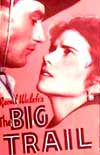 Ford
recommended Wayne to Raoul Walsh, who cast the twenty-two year-old actor in
his first starring role as a wagon train scout in the first sound-era epic western about an 1840s Missouri-to-Oregon wagon trail journey
- The Big Trail (1930), but it was not a breakthrough film for Wayne
(that wouldn't occur until his role in Ford's Stagecoach (1939) - see
below). The $2 million production was filmed in both 35mm and in an early,
revolutionary wide-screen 70 mm process called Grandeur, but proved
to be a financial disaster at the box-office. It was a remake of the classic
silent western The Covered Wagon (1923) mentioned earlier. Ford
recommended Wayne to Raoul Walsh, who cast the twenty-two year-old actor in
his first starring role as a wagon train scout in the first sound-era epic western about an 1840s Missouri-to-Oregon wagon trail journey
- The Big Trail (1930), but it was not a breakthrough film for Wayne
(that wouldn't occur until his role in Ford's Stagecoach (1939) - see
below). The $2 million production was filmed in both 35mm and in an early,
revolutionary wide-screen 70 mm process called Grandeur, but proved
to be a financial disaster at the box-office. It was a remake of the classic
silent western The Covered Wagon (1923) mentioned earlier.
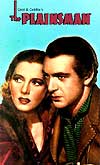 Other
stars in westerns were Wallace Beery who memorably portrayed a Mexican revolutionary
in Viva Villa! (1934), Barbara Stanwyck (in her first-ever western)
as the famous markswoman in George Stevens' fictionalized Annie Oakley
(1935) - the director's first western, and Randolph Scott in an early
large-scale version of the French and Indian War (during America's colonial
period) in the film adaptation of James Fenimore Cooper's The Last of the
Mohicans (1936). Producer/director Cecil B. De Mille's stylish but historically
imaginative The Plainsman (1937) starred Gary Cooper and Jean Arthur
as Wild Bill Hickok and Calamity Jane respectively, attracting a wider audience.
The film impressively recreated the Battle of the Little Big Horn, shot on
location in Montana with thousands of Native-Americans as extras. Two years
later, DeMille filmed a spectacular version of the building of the transcontinental
railroad, Union Pacific (1939). Other
stars in westerns were Wallace Beery who memorably portrayed a Mexican revolutionary
in Viva Villa! (1934), Barbara Stanwyck (in her first-ever western)
as the famous markswoman in George Stevens' fictionalized Annie Oakley
(1935) - the director's first western, and Randolph Scott in an early
large-scale version of the French and Indian War (during America's colonial
period) in the film adaptation of James Fenimore Cooper's The Last of the
Mohicans (1936). Producer/director Cecil B. De Mille's stylish but historically
imaginative The Plainsman (1937) starred Gary Cooper and Jean Arthur
as Wild Bill Hickok and Calamity Jane respectively, attracting a wider audience.
The film impressively recreated the Battle of the Little Big Horn, shot on
location in Montana with thousands of Native-Americans as extras. Two years
later, DeMille filmed a spectacular version of the building of the transcontinental
railroad, Union Pacific (1939).
Republic's 'Three Mesquiteers' Series: 1936-1943
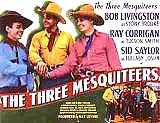 After
obtaining the rights in 1936, Republic Studios delivered
a series of Westerns adapted from William Colt MacDonald's "Three Mesquiteers"
novels (specifically Law of the 45's (1935)), about a trio of wandering
Western heroes. The successful series eventually lasted eight years and included
51 films. The original trio consisted of Tucson Smith (Ray 'Crash' Corrigan),
Stony Brooke (Bob Livingston, later replaced for awhile by Ralph Byrd), and
comic sidekick Lullaby Joslin (Sid Saylor, replaced by Max Terhune in the
second film). Future western star John Wayne portrayed Stony Brooke in eight Mesquiteer features in 1938-1939. Some of the films' titles, most of
which were 1-hour two-reelers, were: After
obtaining the rights in 1936, Republic Studios delivered
a series of Westerns adapted from William Colt MacDonald's "Three Mesquiteers"
novels (specifically Law of the 45's (1935)), about a trio of wandering
Western heroes. The successful series eventually lasted eight years and included
51 films. The original trio consisted of Tucson Smith (Ray 'Crash' Corrigan),
Stony Brooke (Bob Livingston, later replaced for awhile by Ralph Byrd), and
comic sidekick Lullaby Joslin (Sid Saylor, replaced by Max Terhune in the
second film). Future western star John Wayne portrayed Stony Brooke in eight Mesquiteer features in 1938-1939. Some of the films' titles, most of
which were 1-hour two-reelers, were:
- The Three Mesquiteers (1936) - the first in the
series
- The Three Mesquiteers: Hit the Saddle (1937)
- The Three Mesquiteers: Heroes of the Saddle (1940)
- The Three Mesquiteers: Trail Blazers (1940)
- Riders of the Rio Grande (1943) - the last in the series
A Classic Western: Stagecoach (1939)
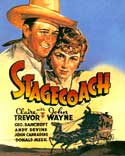 At
the end of the 1930s, director John Ford's landmark classic Stagecoach
(1939) about a stagecoach journey across Apache country
marked a turning point. He had created a new kind of western film with
standard B-picture action, epic scope, and the film
had an intelligent emphasis on character and mood. This great mythic
film transformed the western into A-film status. It was also Ford's first sound
western. It was his first western since his silent western Three
Bad Men (1926), since
Ford had avoided the genre for over a decade. The film was written
by Dudley Nichols, from the story The Stage to Lordsburg by
Ernest Haycox. At
the end of the 1930s, director John Ford's landmark classic Stagecoach
(1939) about a stagecoach journey across Apache country
marked a turning point. He had created a new kind of western film with
standard B-picture action, epic scope, and the film
had an intelligent emphasis on character and mood. This great mythic
film transformed the western into A-film status. It was also Ford's first sound
western. It was his first western since his silent western Three
Bad Men (1926), since
Ford had avoided the genre for over a decade. The film was written
by Dudley Nichols, from the story The Stage to Lordsburg by
Ernest Haycox.
With B-western stalwart John Wayne as Ringo Kid, a
vengeful but noble gunslinger, Ford helped to make him a full-fledged
charismatic, western star. John Wayne was the only truly iconic
western figure to emerge from the simplistic western plots of the
era. [Wayne also appeared in another historical western adventure
in the same year called Allegheny
Uprising (1939), and in a few Mesquiteer films (see above).]
Stagecoach had a formative and regenerative influence
on all future westerns, raising the stature of 30's B-Westerns for years to
come by concentrating on the film's characters. It was skillfully composed
of traditional action/chase sequences, the introduction of the beautiful,
sweeping expanses of Monument Valley, and polarized, intelligent dialogue
among clashing characters and personalities (a Grand Hotel-like assemblage
including a sheriff and cowardly driver, with their passengers: a drunken
doctor (a Best Supporting Actor Oscar-winning role for Thomas Mitchell), a
whiskey drummer, an unscrupulous bank executive, a prostitute with a heart
of gold, a pregnant, Eastern-bred lady and a genteel gambler). Its-crisply
edited Indian chase sequence across salt flats was thrillingly-made, and it
had a decisive quote to end it: "Saved from the blessings of civilization".
It was the first of seven films he made in the famed western Monument Valley.
Westerns in the Early 1940s:
 The
1940s and 50s were to soon become the heyday of the classic film western
- and director John Ford was considered the major craftsman of the western
genre during the sound era. However, there were others that also contributed
to the genre's success. King Vidor's great historical-adventure saga of colonial
America, Northwest Passage (1940) starred Spencer Tracy as the leader
of Roger's Rangers, battling Indians for territory - an anti-Native American
picture. The first Western shot in color in Monument Valley was David
Miller's Billy the Kid (1941). The
1940s and 50s were to soon become the heyday of the classic film western
- and director John Ford was considered the major craftsman of the western
genre during the sound era. However, there were others that also contributed
to the genre's success. King Vidor's great historical-adventure saga of colonial
America, Northwest Passage (1940) starred Spencer Tracy as the leader
of Roger's Rangers, battling Indians for territory - an anti-Native American
picture. The first Western shot in color in Monument Valley was David
Miller's Billy the Kid (1941).
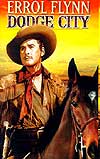
Swashbuckler star Errol Flynn starred in three Michael Curtiz-directed,
big-scale adventure westerns of the late 30s and early 40s for Warner Bros.,
displaying his athleticism and romantic appeal as a post-Civil War Texas cattleman
in Dodge City (1939) with one of the best bar-room brawls ever filmed,
and as an ex-Union officer in Virginia City (1940). In his third western,
Flynn starred as cavalry officer Jeb Stuart chasing abolitionist John Brown
(Raymond Massey) in Santa Fe Trail (1940) (with Ronald Reagan as General
George A. Custer), and then he portrayed the flamboyant General Custer in
an historically inaccurate biography from director Raoul Walsh, the romanticized They Died With Their Boots On (1941). In three of these four western
films, his romantic interest was played by Olivia de Havilland. Flynn's last
on-screen teaming with De Havilland (of their eight films together) was in
their 1941 film. |
 Westerns Films