|
(chronological by film title) Intro | Classic (1) | Classic (2) | Modern (1) | Modern (2) |
(in chronological order) |
||||||||||
| Film Title/Year/Director, Setting and Brief Description | ||||||||||
|
The Bishop's Wife (1947) Guardian angel Dudley (Cary Grant) helps a smalltown bishop realize that "loving kindness and warm hearts" is what's important in life.
This original version of this popular Christmas classic was unmatchable! The beloved romantic fantasy-comedy told about an angel named Dudley (Cary Grant) who was sent to help ambitious and distracted Episcopal Bishop Henry Brougham (David Niven).
The well-dressed, handsome, urbane guardian angel appeared in Henry's study, to advise the troubled bishop about his failing building project, after he had prayed for "guidance" regarding problems of fund-raising for the construction of a new church. Henry had become obsessed with building and funding a new cathedral, and was having difficulty raising money and receiving support from the wealthy and elderly Mrs. Hamilton (Gladys Cooper), the chair of the cathedral committee. Due to his preoccupations with the cathedral, the Bishop was most noticeably producing strains in his marriage to his lovely wife Julia (Loretta Young). The very helpful and debonair Dudley was not there to assist with the cathedral's building or fund-raising, but to show the very busy Henry what he had been neglecting in life --
According to Dudley, Julia had the incredible gift of "making heaven here on Earth." Unexpectedly, Dudley began to have romantic feelings for Julia. As time passed, Henry became increasingly annoyed with Dudley's intrusiveness and attention to Julia, and he was jealous of Julia's growing infatuation and attraction for him. All the while, Dudley kept trying to remind the Bishop about all his greater priorities in his life. On Christmas Eve, Dudley volunteered to rewrite Henry's Christmas sermon, dictating while the typewriter took down his words. When Henry finally publically announced the importance of Julia in his life to Dudley: ("Julia means more to me than my life, I'm not going to lose her"), the angel promptly announced his departure. Dudley was relieved to realize that Henry had finally straightened out his priorities - and his prayer for "guidance" (rather than for a cathedral!) had been answered. As he was summoned back to heaven after his mission was accomplished, the angel told Henry that he and everyone else would have no memory of his visit or existence ("When I'm gone, you will never know that an angel visited your house"). At St. Timothy's Church, the Bishop delivered Dudley's sermon on Christmas Eve at midnight, while Julia beamed at him from the pews.
From the street outside under a light falling snow, Dudley listened to the poignant and touching words, satisfied that his work was complete as he turned and slowly walked away - bringing the film to a heartfelt close: |
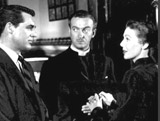 Angel Dudley (Cary Grant) with the Broughams The Scene of Henry's Christmas Sermon 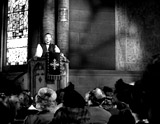 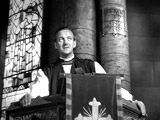 Bishop Henry Brougham 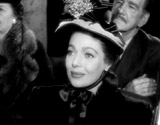 Julia (Loretta Young) 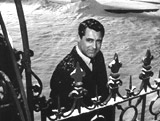 Dudley Listening From Outside |
||||||||
|
Is Kris Kringle really Santa or is he just plain crazy? The Macy's Santa must prove himself by enduring a psych evaluation, corporate competition, and even a court case. This classic shows us that "Faith is believing when common sense tells you not to."
This wonderful holiday film has long been considered a cherished family tradition, with a strong faith-affirming religious theme. In fact, the theme of the film was captured in this quote:
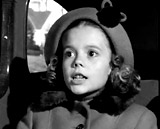
[Note: The film's plot about the identity of "Kris Kringle" paralleled and retold the last year of the life of Jesus when he was tried before Pontius Pilate.] Bearded Kris Kringle (Oscar-winning Edmund Gwenn, the only actor to win an Oscar for playing Santa Claus) was offered the job of Santa for the Macy's Department Store (on W 34th Street in NYC) by reluctant, feisty event director Doris Walker (Maureen O'Hara), when the Santa character for the Macy's Thanksgiving Day parade was reported to be drunk and unconscious. Disillusioned divorcee Doris' skeptical 6 year-old daughter Susan (Natalie Wood) didn't believe that the actual, warm-hearted, white-haired Kris Kringle was real, and pulled his beard to test him. Doris was dismayed that Santa was recommending that shoppers go elsewhere if they couldn't find toys that they wanted at Macy's. She also made the shocking discovery that Kris Kringle's employment card revealed that his address was the Brooks' Memorial Home for the Aged in Great Neck, Long Island, NY. However, Kris insisted that he really was the genuine Saint Nick: ("Well, I'm sorry to disagree with you, Mrs. Walker, but not only is there such a person, but here I am to prove it"). He explained to Doris his concern about the loss of the real meaning of Christmas:
Disbelieving cynics at Macy's and at Bellevue Hospital institutionalized him and declared him delusional and insane. In the meantime, good ol' Saint Nick created goodwill and peace between feuding store owners (of Macy's and Gimbels) and delighted customers. The white-bearded Santa, a resident of the Brooks' Memorial Home for Old People, a retirement home on Long Island, also was instrumental in assisting the romantic relationship between Doris and her attorney/neighbor Fred Gailey (John Payne), with whom he was staying. In the stirring finale and happy ending set in the NY Supreme Court on Christmas Eve, a battle between lawyers tried to determine Kris' sanity or lunacy. Susan wrote a letter to Kris Kringle to cheer him up while in court for his insanity hearing (with her mother's added postscript: "I believe in you, too"). The climax came when the Postal Service delivered many bundles of letters. 21 bags and stacks of thousands of letters addressed to Santa Claus were brought into the court, proved that Kris was Santa Claus, and caused the case to be dismissed by the judge:
Kringle eventually fulfilled Susan's Christmas wish for a beautiful dream house (for sale) with a swing in the backyard, and she was ecstatic:
The film concluded as Fred kissed Doris and proposed to her in their future home, and then both of them noticed Kris's red cane leaning against the wall by the fireplace. She doubted its ownership ("Oh no, it can't be. It must have been left here by the people that moved out"), while Fred added his own reflection about his successful defense of Kringle:
|
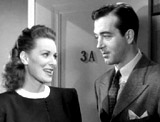 Divorcee Doris Walker (Maureen O'Hara) With Friend Fred Gailey (John Payne) 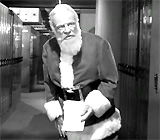 Kris Kringle (Edmund Gwenn) 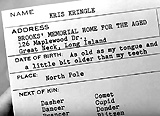 Living at Home For Aged 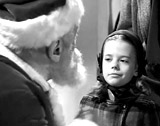 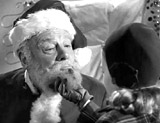 Kris Kringle with Susan (Natalie Wood) 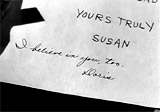 Believers in Kris 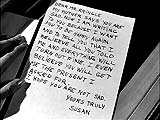 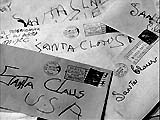 Letters to Santa |
||||||||
|
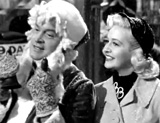
Holiday Affair (1949) A love triangle and a final kiss on New Year's Eve wrap up this romance starring Robert Mitchum and Janet Leigh.
A modest Christmas season romance developed in this sentimental b/w romantic drama by director Don Hartman, even though the circumstances weren't promising at first. It was advertised with the tagline:
Department store clerk Steve Mason (Robert Mitchum), a drifter hired during the busy Christmas season by Crowley's in New York, assisted a customer - a pretty young war widow Connie Ennis (Janet Leigh) whose husband was killed in the war. Hired secretly as a comparison shopper, she had purchased an expensive (approx. $80) model Red Rocket Express electric train set at the store allegedly for her 6 1/2 year-old son Timmy (Gordon Gebert). The boy became disappointed when he learned that the gift wasn't really intended for him but only part of her job. Steve threatened to turn her in as a professional spy from a rival store and report her to his superiors when she returned it. But he felt sorry for her that she would lose her job, and helped her by refunding her money for the purchase ("Now I write you a refund slip which I have a feeling I'm gonna live to regret") - but then he was fired as a result of the incident. An almost-broke Steve became friends with Connie and the boy, and bought the train set as a Christmas gift for Timmy. Before long, an awkward love triangle developed between Connie, Steve, and Connie's long-time suitor Carl Davis (Wendell Corey). Carl was Connie's stable admirer/boyfriend - a stuffy divorce lawyer whom she was planning to marry on New Year's Day. Meanwhile, Steve was concerned about Connie and lectured and reprimanded her for grieving over her dead husband. He advised her to let go of the past which was affecting her present love life:
Realizing that Steve was destitute, Timmy had returned his train set to Crowley's for the refund of $79.50, where he successfully pleaded his case to the store owner Mr. Crowley (Henry O'Neill). When Steve received the refund money, he claimed to Connie:
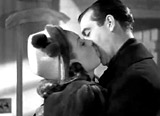
In the conclusion set on New Year's Eve, Connie decided to find love with Steve rather than Carl (who had decided to "divorce" their relationship and break up). Connie received a Western Union telegram that Steve was taking the "midnight special" - a westbound train to Balboa, California (where he planned to build sailboats with his friend). He promised: "WILL BE DRINKING TO YOU ABOARD THE MIDNIGHT SPECIAL. HAPPY NEW YEAR. STEVE." Timmy and Connie rushed through the partygoers on the moving train. She met up with Steve and embraced him between cars, as the camera pulled back. They were on one of the model train cars outside the Balboa, California station. |
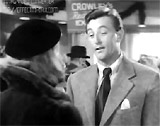 Steve Mason (Robert Mitchum) 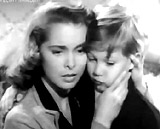 Connie (Janet Leigh) with Son Timmy  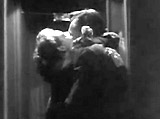 Final Embrace Between Connie and Steve on Train |
||||||||
|
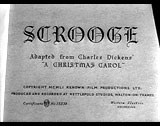
A Christmas Carol (1951) (aka Scrooge, UK) 17 minutes longer then the '38 version, this movie adds depth and more special effects -- starring Alastair Sim as Ebenezer Scrooge.
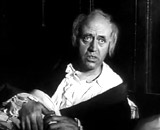
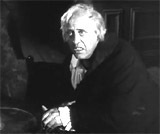
This black and white classic from director Brian Desmond Hurst has been considered the most definitive and faithful film ever made about miserly Ebenezer Scrooge. It was 17 minutes longer, at 86 minutes than the 1938 version (at 69 minutes), with more depth and some crude special effects. [Note: Director Walter R. Booth's British short, titled Scrooge, or, Marley's Ghost (1901, UK), was the first known film adaptation of the tale, although only half of the short survived.] Scrooge (or A Christmas Carol) was based on writer Charles Dickens' 1843 novella, A Christmas Carol in Prose, Being a Ghost Story of Christmas (aka A Christmas Carol). The mean, white-haired Ebenezer Scrooge, known for his trademark phrase: "Bah, humbug!" was authentically portrayed by Alastair Sim. The film opened at the London business exchange, where miserly Scrooge demonstrated his obvious distaste for the festive season and holiday:
On the outside steps, he rebuffed a debtor who asked for more time to repay a loan of twenty pounds. The wealthy Scrooge wouldn't give to charitable causes for the poor, destitute, unfortunate and needy ("l wish to be left alone"). He also refused a Christmas dinner invitation from his good-natured nephew Fred (Brian Worth).
Scrooge begrudgingly allowed his own underpaid, humble clerk Bob Cratchit (Mervyn Johns) with lame son Tiny Tim (Glyn Dearman) to have Christmas day off for a family celebration, although he called it an "inconvenience." When reminded it was only once-a-year, Scrooge replied: "That's a poor excuse for picking a man's pocket every 25th of December." As he departed and was wished a "Merry Christmas," Scrooge scoffed:
On his way home after work on Christmas Eve, Scrooge stopped in for a meal at an inn, and when he asked the waiter for more bread, he changed his mind when the waiter claimed it would be an "extra" charge. Once he returned alone to his empty mansion (with his door knocker reflecting the face of a ghost), Scrooge climbed stairs and heard ringing from unmoving bells. Suddenly, his door swung open to a ghost - his former partner Jacob Marley (Michael Hordern) who was dragging heavy chains. Marley stated: "You don't believe in me...Man of the worldly mind, do you believe in me or not?" After Scrooge cowered and admitted his belief in the suffering and tormented Marley, his former partner explained his wandering spirit:
The shackled Marley warned that Scrooge still had a chance of escaping the same fate, with the visits of three ghosts that would begin at 1 am ("Hear me! My time is nearly gone. l come tonight to warn you that you have yet a chance and hope of escaping my fate....You will be visited by three spirits...Without their visits you can not hope to shun the path l tread. Expect the first when the bell tolls One"). Marley directed Scrooge to the window, where he saw other helpless, hopeless souls and phantoms like Marley (seen with a double-exposure special effect). Then a procession of three ghosts or spirits appeared (also filmed with double-exposure) who all advised the embittered Scrooge to repent of his greedy ways, and redeem himself. Each of the ghosts showed Scrooge the parts of his life that he had forgotten or ignored, and urged him to discover and adopt the true spirit of Christmas:
With the Ghost of Christmas Past, Ebenezer Scrooge revisited his idealistic youth and saw himself (George Cole) in an earlier time. He watched as he met with his beloved sister Fan Scrooge (Carol Marsh), but later was heartbroken when he saw her die while giving birth to nephew Fred - someone Scrooge would resent, although Fan had graciously asked him to care for her orphaned boy. [Note: Scrooge was likewise resented by his father when his mother gave birth to him and died.] The segment entered a party at the Fezziwig household, where the younger Scrooge proposed to his fiancee Alice (Rona Anderson), but soon, their future marriage was not meant to be due to drastic changes in Scrooge's personality. Scrooge was apprenticed to a benevolent employer Mr. Fezziwig (Roddy Hughes), but he was lured (and corrupted) by a rival - mentor Mr. Jorkin (Jack Warner) to leave his employment. As Scrooge prospered, he manifested the first signs of tyrannical greed after Fezziwig was subsequently run out of business, and a new company emerged - the Amalgamated Mercantile Society. Alice returned her engagement ring to Scrooge, telling him that his pursuit of wealth and world-view had completely changed him: "Another idol has replaced me in your heart - a golden idol...You fear the world too much...Our promise is an old one. lt was made when we were both poor and content to be so....lf you were free today, would you choose a direless girl with, with neither wealth nor social standing? You, who now weigh everything by gain?! l bring you nothing but repentance and regret." She ended the break-up with: "May you be happy in the life you have chosen." When the company faced scandal (Jorkin was accused of both bankruptcy and embezzlement), Ebenezer and his long-time colleague - accountant/clerk, John Marley (Patrick MacNee), who were "not facing prosecution for the capital offense," offered to take over 51% of the company's shares (majority control), and in return, save the company by keeping the scandal quiet. Later, Scrooge offered no pity when notified that his co-partner Marley was dying. He remained at work until 7 pm and only then, after-hours on Christmas Eve, visited the dying Marley. He ignored Marley's last words of advice on his deathbed ("There's still time...We were wrong") - that Scrooge should save himself ("Save yourself"). Scrooge was reprimanded by the Ghost (in voice-over) for his lack of caring:
During the second visitation by the Spirit of Christmas Present, Scrooge was told to observe the hearts of people with good will:
Scrooge looked in on the happy Christmas celebrations of lowly miners, then his nephew Fred and the Cratchits. He heard Mrs. Cratchit chastise him: "Could only be on Christmas Day that l would drink the health of such a hard, stingy, unfeeling man as Mr. Scrooge." He also saw that his spurned ex-fiancee Alice was now a nurse charitably caring for the sick and poor. The Ghost of Christmas Present also presented Scrooge with a grim view of a young boy and girl at his feet, representing Ignorance and Want in the world: ("They cling to me for protection from their fetters. This boy is lgnorance. This girl is Want"). During the final visitation by the Spirit of Christmas Yet to Come (or the Future), Scrooge was most fearful of this last dark-shrouded spectre (looking like the Grim Reaper), although he still claimed:
He was shown that at the Cratchit house, Tiny Tim had died and was deeply mourned and lamented, especially by his father Bob Cratchit. By contrast, Scrooge watched three poor characters pawning off some of Scrooge's possessions the day after his death, with dealer Old Joe (Miles Malleson):
Scrooge was aghast as he saw his things pawned off and sold after his own death. He also attended his own funeral, where he heard wealthy businessmen talking about how no one would attend (unless lunch was served). At the cemetery, Scrooge pondered: "Are these the shadows of things that must be? Or are they only shadows of things that might be? l know that men's deeds foreshadow certain ends, but if the deeds be departed from, surely the ends will change! Tell me it is so with what you show me now" - and then Scrooge horrifically saw his own engraved tombstone in the cemetery. He pleaded with the Ghost: "Tell me l'm not already dead....I'm not the man I was! Why show me all this if l'm beyond all hope? Oh, pity me, Spirit, pity me! And help me!" He asked for repentance: "l'll make good the wrongs l've done my fellow man. And, l'll change!" On Christmas morning after awakening from his frightful dreams, Scrooge seemed crazed, giddy (as a drunken man) and wild-haired. He tried to reassure his screaming and hysterical maid Mrs. Dilber who fled from him down the stairs, that he was still himself: "Please, Mrs. Dilber. I am not mad. Even if I do this!" He gave her a guinea coin as a Christmas present, raised her pay from two to ten shillings a week, and gave her the day off. Feeling redeemed, Scrooge went to a window and sent a boy (with the promise of a shilling) to purchase a turkey at the local butcher's shop, to be delivered to the Cratchits' home. (The Cratchit family reacted in astonishment, thinking Scrooge had taken leave of his senses: "What would make Mr. Scrooge take such leave of his senses suddenly?") Scrooge then called on his nephew Fred at his house and asked for forgiveness for refusing to dine with him earlier. He also asked forgiveness from Fred's wife (Olga Edwardes): "Can you forgive a pig-headed old fool for having no eyes to see with, no ears to hear with - all these years?" And then he danced a lively polka with her. The next day at work, Cratchit arrived late and feared being fired as he meekly approached Scrooge in his office. However, Scrooge laughed uncontrollably as he happily raised Bob Cratchit's salary, and then he promised:
Then he added (as he mumbled and cackled to himself): "I don't deserve to be so happy! But I can't help it. I just can't help it." The narrator (Peter Bull, in voice-over) concluded the film with laudatory comments about Scrooge, as he ran to meet up with Tiny Tim - now running without crutches:
|
 Ebenezer Scrooge (Alastair Sim) 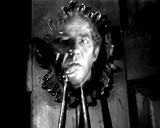 Marley's Ghost in Scrooge's Door Knocker 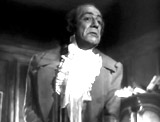 Jacob Marley (Michael Hordern)  The Ghost of Christmas Past (Michael J. Dolan)  Young Scrooge (George Cole)  Scrooge's Sister Fan (Carol Marsh)  Scrooge's Fiancee Alice (Rona Anderson)  Mr. Fezziwig (Roddy Hughes)  Mr. Jorkin (Jack Warner)  Young Marley (Patrick MacNee)  The Ghost of Christmas Present (Francis de Wolff)  Ignorance and Want  The Spirit of Christmas Yet to Come (or the Future) (C. Konarski)  (l to r: Laundress, Undertaker, Char Lady, Old Joe)  Mrs. Dilber (Kathleen Harrison) 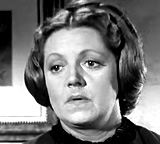 Mrs. Cratchit (Hermione Baddeley) 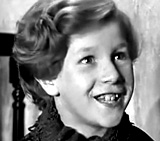 Tiny Tim (Glyn Dearman) 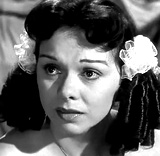 Fred's wife (Olga Edwardes) 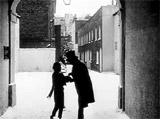
The Ending: Scrooge with Tiny Tim |
||||||||
|
The Lemon Drop Kid (1951) At Christmas time, a scam artist sets up a fake old folks' home charity for elderly 'dolls' to repay a debt to an enraged, cheated gangster.
Director Sidney Lanfield's crime comedy was based upon the Damon Runyon short story. It was a complete remake of the earlier film directed by Marshall Neilan, The Lemon Drop Kid (1934). The mostly-forgotten film instantly became a classic Christmas movie with the introduction of the now ubiquitous Christmas carol, Silver Bells. Eventually, the Yuletide song became Hope's unofficial theme song on his annual Christmas TV special. Comedian Bob Hope portrayed fast-talking scam artist Sidney Milburn, aka The Lemon Drop Kid (because he loved lemon drop candies). In the opening scene at a Florida race track, bookie Sidney's tips on winning bets for horses failed. One of the losers was Stella (Andrea King), the lady-friend of gangster Moose Moran (Fred Clark), who was promised a win of $10,000, but lost $2,000. The Kid was ordered to cough up the full $10,000 by Christmas Eve at the gangster's Long Island casino - or else. Returning to NYC, the Kid was determined to raise quick money within three weeks. He posed as a bell-ringing Salvation Army sidewalk Santa Claus with a kettle to collect donations from unsuspecting passers-by. His exploitative plan failed almost immediately when he was recognized as a con, arrested for panhandling without a license and sent to jail. Before his quick release from his cell, he was reminded by Moose's enforcer, Sam the Surgeon (Harry Bellaver), about his looming $10,000 debt to be paid back.
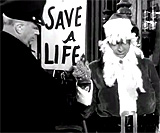
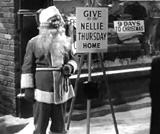
Sidney let Sam in on his new scheme. To appear more legitimate, he would set up Moose's illegal, abandoned, shut-down and empty casino as an old folks' home for elderly women (Sam: "That’s the most legal double-cross I’ve ever heard"). He vowed that collections would be directed toward a bogus fund, known as the Nellie Thursday Fund, named after one of his acquaintances, elderly neighborhood resident (Jane Darwell), who was being threatened with eviction and homelessness. His old folks' home was named the Nellie Thursday Home for Old Dolls. After the Kid successfully received a state charity license, he dressed up other crooks as Father Christmas, who were positioned to solicit donations throughout the city, with signs reading: "GIVE TO THE NELLIE THURSDAY HOME." He encouraged them:
Sidney's lovestruck girlfriend Brainey Baxter (Marilyn Maxwell), an innocent nightclub singer, was impressed that Sidney seemed to have reformed himself by his Santa fund-raising campaign. The singing of Silver Bells was accomplished by both Gloomy Willie (William Frawley), in a fractured version, and then by Sidney with Brainey, on the streets of New York in their Santa outfits:
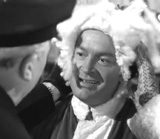
Rival New York crime boss and Charley's nightclub owner, Oxford Charlie/Charley (Lloyd Nolan), Brainey's boss, muscled in on the lucrative scam by taking over the racket, stealing $16,000 in funds already collected, and kidnapping some of the old folks, including Nellie Thursday (he took them to his Nyack, NY home north of the city). When Sidney's plan to personally profit was revealed and everyone turned against him, he was forced, by Christmas Eve, to resolve things. His main tactic was to dress up as an old spinster woman named Mrs. Herbert Beasley. After stealing the clothes off a store mannequin in a window, he took a taxi to the Nyack home - Charlie's place. There, he discovered that Charlie and Moose were about to move all of the nice old ladies back to Moose's converted NY casino. Before leaving, Sidney/Mrs. Beasley beat up Oxford Charlie, stole back the money, and fled from the premises on a bicycle conveniently borrowed from a friendly Boy Scout. Back in NYC, at Moose's casino, Sidney paid off Moose's debt of $10,000, just as Oxford Charlie arrived and wanted his money back too. Sidney joked: "You'll have to work it out. I've done my share." Suddenly, Sidney flipped a switch and the mansion was converted into a gambling casino - with well-dressed customers at betting tables. It was all a double-crossing frame-up - the two gangsters were arrested during a pre-planned police raid ("Come on, boys, this is it. This is a raid!"). Moose was charged with running a gambling joint again, and Charlie was charged with running an illegal "charity racket" and forced to give up the money collected for the charity home. In the sentimental ending, Sidney proved that he had actually turned over a new leaf - he was forced to agree with Judge Wilkinson (Stanley Andrews) that the collected charity money would indeed be used to fund the retirement home. The film's last line came after the mooing of a cow as Sidney kissed Brainey and finally vowed to marry her: "Quiet, Crosby!" |
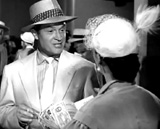 "Lemon Drop Kid" Sidney Milburn (Bob Hope) as Scam Artist at Florida Race Track 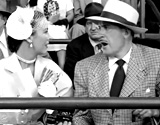 Moose Moran (Fred Clark) Angrily Learning About Switched, Losing Bet 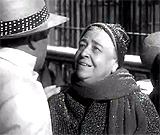 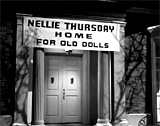 Nellie Thursday (Jane Darwell) and Bogus Old Folks' Home 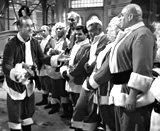 Fake Santas  Rival Gangster Oxford Charlie/Charley (Lloyd Nolan)  Sidney as Old Lady Spinster Mrs. Beasley  Sidney Splitting the Dough Between the Two Gangsters Before Their Arrest |
||||||||
|
The Holly and the Ivy (1952, UK) An emotionally-wounded family in post-war Britain that has survived the ordeal of the war now copes with personal issues and frailties (at Christmastime), heretofore shielded from the patriarchal head of the family - a recently-widowed clergyman who 'couldn't be told the truth.'
Director George More O'Ferrall's heartwarming, realistic, poignant dramatic British Christmas (Yuletide) tale was based upon English playwright Wynyard Browne's 1950 play, and adapted into a screenplay by Russian screenwriter Anatole de Grunwald. It was finally released for showing in the US in 1954 after it was banned for having too many agnostic or atheistic characters.
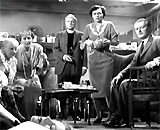
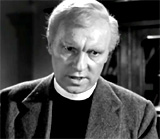
The main character was patriarchal English clergyman Reverend Martin Gregory (Ralph Richardson), a recently-widowed, elderly country vicar. In the year 1948, the parishoner called together his neglected and detached family relatives for a gathering at Christmastime in his rambling parsonage in the remote snowy village of Norfolk. The clergyman's three children were invited for the Christmas holidays - they included:
Also invited were other relatives:
There were a number of serious issues and problems in the lives of the family members, who were reluctant to discuss them with the Reverend, fearing that his religious views would interfere with the truth. It was well-known that he cared for his parishioners more than his own clan members. Stay-at-home devoted Jenny was engaged to David Paterson and was on the verge of leaving her beloved father, to move with him to Brazil. And Margaret's increasing alcoholism was proving difficult to deal with.
Following a series of confessions and revelations, the clergyman finally demonstrated sympathy and understanding and was able to reunite his family. Margaret agreed to return home and live with her father, thereby freeing Jenny to leave with David. |
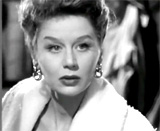
 Reverend Martin Gregory (Ralph Richardson) 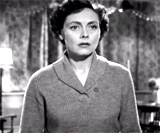 Jenny Gregory (Celia Johnson)  Jenny Greeting "Mick" with David Paterson in-between  The Two Aunts: Bridget and Lydia 
|
||||||||

|
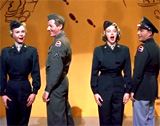
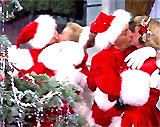
White Christmas (1954) This holiday rom-com starring Bing Crosby and Danny Kaye was the highest grossing movie of 1954. Crosby and Astaire celebrate a year's worth of holidays against a steady flow of Irving Berlin tunes.
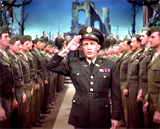
This heart-warming and sweet-natured romantic comedy musical from director Michael Curtiz was a loose remake of the earlier Holiday Inn (1942). (It had debuted "White Christmas" - also heard in this film and again performed twice by Bing Crosby). Irving Berlin's original song "Count Your Blessings (Instead of Sheep)" was the only one to receive an Oscar nomination. The title song had already won Berlin his only Academy Award in 1942. Also notable was that the film was Paramount's first VistaVision wide-screen production, and it was the highest-grossing picture of 1954. The main characters were two ex-Army GIs, buddies returning from WWII, paired or partnered with two blonde singing/dancing sisters:
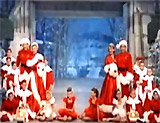
During the war, Bob and Phil had performed for their fellow troops in Europe on Christmas Eve, 1944. Now ten years later, the twosome were producing and performing very popular shows, first in nightclubs, then on the radio, and finally, they scouted new talent as producers of Broadway revues - seen on TV as The Wallace and Davis Show. A series of incidents found them traveling from Florida by train northward, in the company of the Haynes sister act (on the run from their landlord and an arrest warrant) to bring their Broadway-level Christmas show ("Playing Around") to a financially-struggling Vermont inn ski lodge. They were surprised to discover that the Vermont inn was owned by their old Army superior during WWII, Major General Thomas F. Waverly (Dean Jagger). But because it hadn't snowed since Thanksgiving, the lodge was about to go bankrupt with warm temperatures and green grass. They hoped that their show, brought from New York before its Broadway debut, would financially revive the lodge. Typical of romantic musical comedies, there were the usual romantic pursuits and misunderstandings between the couples. By Christmas Eve, after advertising the show and creating publicity on the Ed Harrison (Johnny Grant) variety show/program, the lodge was packed with customers (including a reunion with members of the 151st Division showing up to honor the retired General). After performing various numbers, including "The Old Man," and "Gee! I Wish I Was Back in the Army," the benefit show was coming to an end - when it began to snow just before the title song finale.
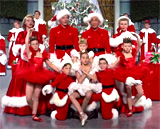
During the final number with Betty and Judy, Bob and Phil (and others) were dressed in Santa outfits. The film ended with kisses between Bob and Betty, and Phil and Judy, and the reprised singing of "White Christmas." Everything ended with a toast using the song's last line:
|
 The First Rendition of "White Christmas" 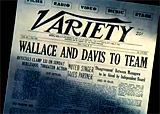 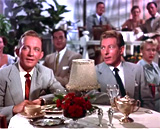 "Wallace and Davis" 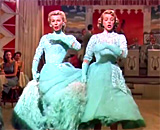 Betty and Judy 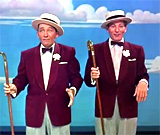 Bob and Phil 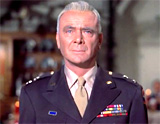 Surprise Stage Show For Gen. Waverly in His Lodge |
||||||||
|
Scrooge (1970, UK) A Technicolored British musical fantasy - a big-budget retelling of Charles Dickens' 1843 novella A Christmas Carol, with an especially harrowing sequence of Scrooge being sent to Hell before changing his ways. Director Ronald Neame teamed up with British musical composer/screenwriter Leslie Bricusse to create this mostly joyous, theatrical rendition of the familiar Victorian Christmas tale. Other previous (and future) versions of the "A Christmas Carol" story presented in film that deserve viewing also include:
In this British production with eleven cheery, rousing and spritely songs, Albert Finney starred as the title character - the miserly, stingy skinflint, Christmas-hating ("Humbug!"), ungenerous and rich London businessman Ebenezer Scrooge. He sang about his own detestable personality: "I hate people, I hate people / And I don't care if they hate me." The moneylender was visited on Christmas Eve by his formerly-deceased business partner Marley (Alec Guinness), a white-faced ghost emerging at his door, who warned of greediness and foretold that Scrooge might end up like him - in heavy burdensome chains in Hell. Scrooge was then visited by three 'ghosts' or spirits to review various aspects of his life:
In the redemptive final sequence, Scrooge awoke in bed on Christmas morning, tangled in his bedsheets - and relieved that he was not chained in Hell with Marley anymore. He vowed to reform himself and change, and merged his words into the hopeful song: "I'll Begin Again":
His first overcompensating actions were to go on a shopping spree. He purchased a turkey, toys in a toy store, and a 'Father Christmas' costume. Before arriving at the Cratchits' house, he offered toys to children in the street, then delivered the turkey and presents to Bob Cratchit's family. He promised to help find doctors and a cure for Tiny Tim, eliminated the obligations of his many debtors, doubled Cratchit's salary, and then prepared to have Christmas dinner with Fred, his wife and family/friends. |
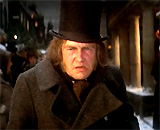 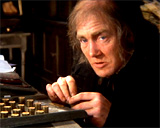 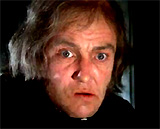 Scrooge (Albert Finney) 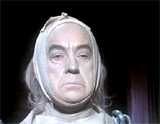 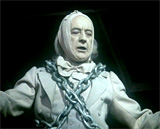 Marley (Alec Guinness) 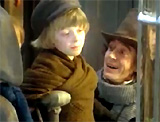 Tiny Tim (Richard Beaumont)  Scrooge With Isabel Fezziwig (Suzanne Neve)  With Marley in Hell 
Scrooge with "Father Christmas" costume |
||||||||




 An
Urban Setting, Post WWII, at Christmastime
An
Urban Setting, Post WWII, at Christmastime