|
Film Cameo Appearances Part 1 |

|
Hitchcock's first confirmed appearance was in his third major UK film, The Lodger (1927) and then in five more of his major British films, followed by 30 appearances in his US productions. (Frenzy's dual appearances were only counted once). Three recurring themes:
Most of the cameos appeared early in the film, and often there was a bit of mild humor in the appearance (weight-reduction ads, getting up from a wheelchair, having an unbeatable bridge hand, drinking champagne to lessen the supply, etc.). Note: Only once did he appear in an installment of his Alfred Hitchcock Presents (1955-1966) TV show - besides his personal introductions. The one appearance was in the 1958 episode of the third season titled A Dip in the Pool, in which he showed up on the front cover of a magazine being read by Mr. Renshaw (Philip Bourneuf).
|
|
(in reverse chronological order) Part 1 | Part 2 See all Alfred Hitchcock Title Screens See Hitchcock's MacGuffins |
||
|
|
|
(Minutes Into Film) |
 Family Plot (1976) |
With his widely-familiar but stern silhouette viewed through the frosted-glass door of the "Registrar of Births and Deaths." Hitchcock appears to be arguing with an elderly woman and accusedly jabbing and pointing his finger. | 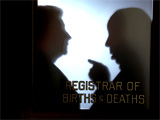 40 minutes |
 Frenzy (1972) |
Two Appearances: In
the center of a crowd, wearing a black bowler hat, facing to the left.
He is the only one not applauding the political speech-maker Sir
George (John Boxer) (delivering a speech about pollution and cleaning
up the Thames River). |
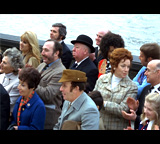 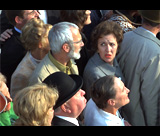 3-4 minutes |
 Topaz (1969) |
In a crowded LaGuardia International Airport scene, seated in a wheelchair as he is being pushed by a nurse under a sign with an arrow reading "United Airlines - To Planes." He miraculously stands up from the wheelchair, greets and shakes hands with a man, and walks off to the right. | 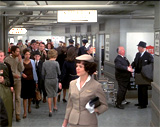 33 minutes |
 Torn Curtain (1966) |
In Copenhagen, sitting in the large Hotel d'Angleterre's ("English Hotel") lobby entrance with a blonde-haired baby in his lap (who possibly wet itself), with his back to the camera. During the brief cameo, the music changes to resemble the famous "Hitchcock theme," also known as the Funeral March of the Marionette. | 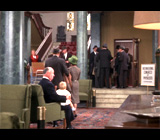 8 minutes |
 Marnie (1964) |
Entering from the left of the hotel corridor from a hotel room after Marnie Edgar (Tippi Hedren) has passed by with a bellman carrying her things. The director looks guiltily at the camera. | 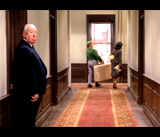 5 minutes |
 The Birds (1963) |
Leaving downtown San Francisco's Davidson's Pet Shop with two white terriers (Hitchcock's own Sealyham terriers Geoffrey and Stanley on leashes) as elegantly-dressed blonde Melanie Daniels (Tippi Hedren) enters. | 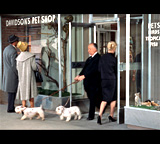 2 minutes |
 Psycho (1960) |
Wearing a large cowboy hat and discreetly viewed through Marion Crane's (Janet Leigh) realtors' office store-front window, loitering or standing on the sidewalk, as she returns to her Phoenix real estate company after a lunchtime quickie in a cheap hotel with lover Sam Loomis (John Gavin). | 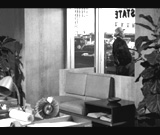 7 minutes |
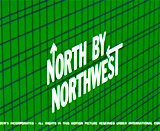 North by Northwest (1959) |
At the end of the opening title credits sequence in a bustling NYC, missing a city bus (green and yellow) that slams its door in his face, anticipating a similar scene later in the countryside near a cornfield when a bus door shuts on Roger O. Thornhill (Cary Grant). | 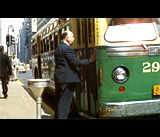 2 minutes |
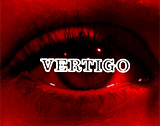 Vertigo (1958) |
In a gray suit walking (from left to right) across the street past the entrance to Gavin Elster's (Tom Helmore) Mission District shipyard and office in San Francisco, in front of columns and a newspaper rack, carrying a horn (or trumpet) case. | 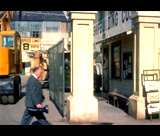 11 minutes |
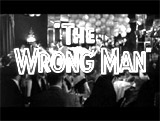 The Wrong Man (1956) |
(Narration Only - Not a True Cameo) Hitchcock (in silhouette) narrates the film's prologue and introduces the film's true story before the credits appear. Not a traditional cameo, but this was the sole time Hitchcock actually spoke in any of his feature films. | 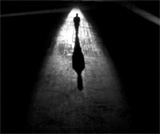 Beginning of film - 1 minute |
 The Man Who Knew Too Much (1956) |
Hitchcock was the balding man (on the left side of the frame with his back to the camera) watching a troupe of acrobats in the crowded outdoor French Moroccan (Marrakesh) marketplace next to the McKennas, just before the murder of Louis Bernard (Daniel Gelin). | 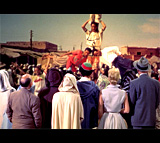 26 minutes |
 The Trouble With Harry (1955) |
On the far left of the frame, the man with a trench coat walking past a parked-by-the-side-of-the-road limousine of an old man who is looking at Sam Marlowe's (John Forsythe) outdoor stand/exhibition of artwork and paintings. | 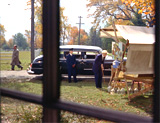 22 minutes |
 To Catch a Thief (1955) |
Staring straight ahead and sitting motionless to the left of John Robie (Cary Grant) in the rear-seat of a bus as a passenger, revealed as the camera slightly panned to the right. To Robie's right is a woman (Adele St Mauer) with a bird cage (containing two birds). | 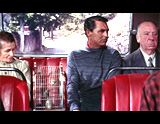 10 minutes |
 Rear Window (1954) |
Winding or repairing a clock in the songwriter's/musician's (real-life composer and vocalist Ross Bagdasarian, Jr.) apartment, across from where J. Jefferies (James Stewart) was being a voyeur. | 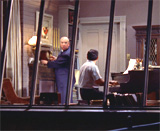 26 minutes |
 Dial M for Murder (1954) |
Hitchcock was on the left side of Tony Wendice's (Ray Milland) Cambridge class-reunion dinner photograph hung on the wall, turning back and looking up to his right, seated at a white table-clothed table. The framed photograph was taken off the wall by Tony and shown to Captain Lesgate/Charles Swann (Anthony Dawson) (Swann was blackmailed into murdering Tony's wife), who is across the table from tuxedoed Hitchcock in the photo. | 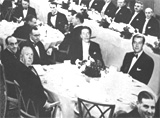 13 minutes |
 I Confess (1953) |
Strolling across or along the top of a long flight of stair-steps in Quebec, in a long-shot silhouette filmed at a distance, during/after the opening credits. | 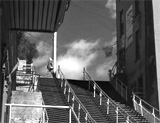 2 minutes |
 Strangers on a Train (1951) |
Struggling to board a train with a very large and awkward double bass fiddle or cello (similar in shape to Hitchcock's own rotund body), as Guy Haines (Farley Granger) gets off in his hometown of Metcalf. | 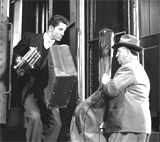 11 minutes |




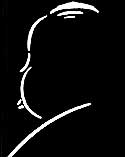
 Hitchcock's
Film Cameo Appearances:
Alfred Hitchcock made a total of 36 self-referential cameos (confirmed)
in his 52 surviving films over a 50 year period (from 1927-1976),
if one counts his off-screen narration at the start of
The Wrong Man (1956). Some films may have had two cameo appearances,
but were unconfirmed. Only one film had two confirmed cameos: Frenzy
(1972).
Hitchcock's
Film Cameo Appearances:
Alfred Hitchcock made a total of 36 self-referential cameos (confirmed)
in his 52 surviving films over a 50 year period (from 1927-1976),
if one counts his off-screen narration at the start of
The Wrong Man (1956). Some films may have had two cameo appearances,
but were unconfirmed. Only one film had two confirmed cameos: Frenzy
(1972).