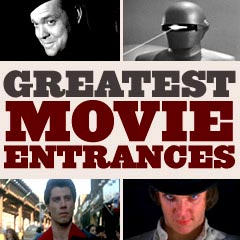
Greatest Movie Entrances of All-Time

Part 1


One of the most striking elements in any film is the sudden or memorable appearance of one of the main characters or stars. Often, film entrances are not very extraordinary, but now and again, there are some that are very spectacular and skillfully executed. Although it would be impossible to compile a list of every single memorable movie entrance ever screened, this collection moves toward that goal.

The following illustrated list in the next few web pages, in unranked chronological order, presents a solid collection of the most classic movie entrances or bows of film characters in cinematic history. These include film scenes from the silent era, the classic film period, and modern-day.

Greatest Movie Entrances of All Time
(chronological) - Part 1
Part 1 | Part 2 | Part 3 | Part 4 | Part 5

Movie Title and
Film Character
Brief Scene Description Example

Metropolis (1927)

Maria

Purchase at MoviesUnlimited

The first view of the ethereal Maria (Brigitte Helm) was the scene of showing children of workers to the upper level of Metropolis, in an attempt to have them see the life of the rich - she told them: "Look. These are your brothers" - she inadvertently attracted wealthy Freder's (Gustav Frohlich) attention. Maria's words and beauty deeply touched him, and after Maria was escorted out of the gardens, Freder clutched his breast with adoration, and for the first time saw the frivolous wastefulness of life in the upper city and the pleasure garden

Dracula (1931)

Dracula

Purchase at MoviesUnlimited

In the dark cavernous entry-room of Dracula's castle, the dwarfed figure of Renfield (Dwight Frye) stood at the bottom of the wide and long stone staircase of the castle. An ominous silence hung heavily in the air. Dracula (Bela Lugosi), elegantly dressed in a black tuxedo, slowly descended the massive staircase while holding a single candle. Rats and armadillos scurried across the dirt-covered stone floor. A giant spider web hung from the ceiling above the staircase. When Renfield turned, he was startled to find Dracula walking through the large spider web without disturbing it. Dracula glided toward him and memorably introduced himself in an immaculately delivered line (uttered with a Hungarian accent): "I am...Drac-u-la...I bid you welcome"


Frankenstein (1931)

The Monster

Purchase at MoviesUnlimited

The giant monster (Boris Karloff), kept in total darkness for a few days, had developed enough strength to shuffle forward (like a teetering toddler) and enter into the mad scientist's laboratory from the dark corridor. The first appearance and unveiling of the Monster - bringing him into the light of enlightenment - was truly memorable. The door slowly swung open, revealing a dark, lumpish silhouette in the doorway in a full figure shot. The bulky figure lurched clumsily into the room with halting steps, gradually revealing a bulky head and broad back - the Monster awkwardly moved into the room by backing in! The hulking Monster then slowly turned around, and then provided a shadowy profile in the first chilling close-up look of his blankly expressionless, tabula rasa face - a jagged surgical scar around the jaw appeared. There was also a prominent spike that gleamed into view on the side of the figure's neck. A series of camera jump cuts provided increasingly tighter close-ups of the hideous visage of the cadaverous creature. The Frankenstein Monster was a startling, grotesque, and gruesome figure, about seven feet tall with broad shoulders. The creation was more Monster than man. The monstrous face was placid, gaunt and elongated. The creature had a square-shaped head with boxy forehead, hooded eyelids over deep-set sunken eyes, neck-spikes or bolts to serve as electrical connectors on his neck, jagged surgical scars, and a matted wig. The Monster wore a dark suit and thick, heavy boots, causing him to walk with an awkward, stiff-legged, crude gait. His long arms seemed enormous because the coat sleeves were shortened

Night After Night (1932)

Maudie Triplett

Purchase at MoviesUnlimited

This early 30s film was known for its debut of the inimitable, wise-cracking sex symbol Mae West in her first talking film (in a supporting role); in her part as uncouth Maudie Triplett, West made a memorable first entrance on the screen, with what may be considered the single greatest opening bit in any film actress's career; outside of a nightclub, she was surrounded by men, waiting to be let in as the doorman Patsy (Dink Templeton) looked through the peephole and asked: "Who is it?" She replied impatiently: "The fairy princess, ya mug!"; she then swaggered into the nightclub, well-dressed and covered with jewels, where the wide-eyed cloakroom hat-check girl, overwhelmed by her, admired her diamonds: Hatcheck girl: "Goodness, what beautiful diamonds!" followed by Maudie's suggestive response: "Goodness had nothing to do with it, dearie"

Tarzan, The Ape Man (1932)

Tarzan

Purchase at MoviesUnlimited

In the first of many Tarzan films, the introduction of ape man Tarzan (Johnny Weismuller) with his famous trademark jungle call: "aaah-eee-aaah" as he swung on vines from tree to tree, followed by the first good look at the jungle man peering down at the group of white explorers from a tree perch

Duck Soup (1933)

Rufus T. Firefly

Purchase at MoviesUnlimited

The opening scene was the classic inaugural ceremony and lawn party for the conferring of the Presidency of the tin-pot republic of Freedonia to a newly-appointed leader, Rufus T. Firefly (Groucho Marx), characterized by a supportive Mrs. Teasdale (Margaret Dumont) as "a progressive, fearless fighter." At his inauguration, however, Firefly showed up late (he stood in his own military guard line), insulted everyone in sight - especially his benefactress, and sang the song "Just Wait 'Til I Get Through With It" about how he intended to abuse his power

King Kong (1933)

King Kong

Purchase at MoviesUnlimited

The brutish Kong made an extremely memorable first appearance. The mighty ape was first heard as he came angrily thrashing and stomping through the jungle, bending nearby trees. Horrible roars, growls, and sounds were heard from an indistinct shape. When he came into view, he was tremendous - a thirty-foot tall giant ape, much bigger than a gorilla. As she saw the demonic, strong Beast-lover approaching the altar, Ann Darrow (Fay Wray) struggled to free herself from chains holding her to posts. She let out shrill screams in absolute terror, just like in the practice session. Her eyes signified complete fear and helplessness. With raw sexual impulses that had been incited and aroused by a rolling-eye view of the white girl, Kong flared his teeth and snarls, beat his chest and let go mighty roars. As he came closer to leer at her, he released her from the stakes, and she slumped into a faint. Kong picked her up with his giant paw, as the natives cheered enthusiastically at Kong's acceptance of the valued sacrifice (worth six black native girls). She succumbed to the naked Beast's dark libido. Rather than devouring her, the hairy colossus carried her off into the jungle as she continued to scream

Bride of Frankenstein (1935)

The Bride

Purchase at MoviesUnlimited

The presentation of the birth of the Monster's Bride (Elsa Lanchester) was stunningly grotesque. When Pretorius (Ernest Thesiger) removed the bandages from her eyes, two uncomprehending globes stared back. Henry Frankenstein (Colin Clive) exclaimed typically: "She's alive! Alive!" The two scientists tilted the table to an upright vertical position. The Bride stiffly raised her arms and then collapsed. After the bandage-covered Bride had her wrappings removed, indicated by a dissolve, she was viewed in full, chilling splendor. The repellently-beautiful female wore a flowing white shroud (laboratory smock) and a wild, frizzled fright wig. Streaked with white from lightning charges, her hair stood straight out behind her, making her look dramatically like Queen Nefertiti. Stitches were visible beneath her jaw. Her angular movements were bird-like - her sharp-boned and angular head jerked and darted from one position to another. Appropriately, her white covering could be mistaken for a bridal gown - Pretorius announced: "The Bride of Frankenstein!"

The Adventures of Robin Hood (1938)

Robin Hood

Purchase at MoviesUnlimited

Introducing himself with a dramatic entrance, the handsome, but uninvited, devil-may-care Sir Robin of Locksley (Errol Flynn) unexpectedly burst through the gate to the great banquet hall with the body of a slain deer draped across his shoulders - well aware that killing one of the king's deer could bring execution. Robin daringly threw the deer on the table before host Prince John (Claude Rains)

Gone With the Wind (1939)

Rhett Butler

Purchase at MoviesUnlimited

As Scarlett O'Hara (Vivien Leigh) ascended the staircase of Twelve Oaks plantation during a pre-Civil War BBQ, she asked one of her girlfriends, Cathleen Calvert (Marcella Martin) to identify the "nasty dark one" [dark-haired and devilish-looking] that was standing alone at the foot of the staircase. Scarlett was told: "My dear, don't you know? That's Rhett Butler! He's from Charleston. He has the most terrible reputation." The dashing and charming Rhett Butler (Clark Gable), in his dramatic film entrance, was dressed in an elegant black suit - the roguish character exchanged a cool, challenging stare with Scarlett, attracted by her stunning beauty. She responded to his sexually attractive gaze as he undressed her with his eyes: "He looks as if - as if he knows what I look like without my shimmy"

Stagecoach (1939)

Ringo Kid

Purchase at MoviesUnlimited

Along the way after the stagecoach rounded a turn, a rifle shot was heard, and a tracking shot zoomed in (losing focus for a moment) for a large clear closeup of Ringo Kid (John Wayne in his first major western role, the role that made him famous, launching him as the most durable Western hero) from the perspective of the moving coach. The camera rapidly tracked in on his face. Ringo was twirling and re-cocking his rifle in one hand, shouting out: "Hold it!", while holding his saddle in the other hand. He was standing in the middle of the desert by the trail, stranded without a horse. Ringo was wearing a paneled, placket-front shirt with a neckerchief, and jeans with its pants legs rolled up outside of the boots

The Wizard of Oz (1939)

Miss Gulch

Wicked Witch of the West

The Wizard

Purchase at MoviesUnlimited

There were three memorable entrances or revelations:

The arrival of the dreaded, stern-faced, ugly neighbor Miss Almira Gulch (Margaret Hamilton), primly riding on her creaky bicycle down the country road toward the farm, to the taunting, threatening Miss Gulch Theme

The arrival of the Wicked Witch of the West (also Margaret Hamilton) in an explosive plume of red smoke in the land of Oz

The revelation of the Wizard of Oz himself (Frank Morgan), when Toto tugged and pulled away a shiny green curtain drape that covered a small booth, revealing, unmasking and exposing a white-haired, ordinary man who was furiously and frantically pulling levers, dials, switches and levers on an elaborate machine to control all the Wizard's special technological effects in the projected image. The fraudulent man, with his back turned, suddenly looked over his shoulder and saw Dorothy and the others, and tried to unsuccessfully distract them: "Pay no attention to that man behind the curtain....the...Great...er...Oz has spoken"


Rebecca (1940)

Mrs. Danvers

Purchase at MoviesUnlimited

In Manderley's great front hall, the newlywed couple were greeted by an army of over fifteen servants standing as if posed for a picture. The young Mrs. de Winter (Joan Fontaine) met the unsmiling, severe, ominous, dark-haired, and slightly hostile housekeeper Mrs. Danvers (Judith Anderson) as she appeared from the left in front of the lineup: "How do you do? I have everything in readiness for you." They both stooped to pick up the young woman's dropped gloves

Citizen Kane (1941)

Charles Foster Kane

Purchase at MoviesUnlimited

The film's famous, first murmured, echoed word was heard uttered by huge, mustached rubbery lips that filled the screen: "R-o-s-e-b-u-d!" An old man, Charles Foster Kane (Orson Welles), had pronounced his last dying word as a snowstorm globe was released from his grip and rolled from his relaxed hand. The glass ball bounced down two carpeted steps and shattered into tiny pieces on the marble floor

The Maltese Falcon (1941)

Kaspar Gutman (The Fat Man)

Purchase at MoviesUnlimited

Private detective Sam Spade (Humphrey Bogart) met Cairo's (Peter Lorre) partner, Kaspar Gutman or the 'Fat Man' (Sydney Greenstreet in his film debut at the age of 61), wearing a black penguin-like waistcoat. He put both of his hands on Spade's right arm as he led him to a chair in his hotel room. In their first meeting together, a classic scene, Gutman was supremely interested in retrieving the Maltese Falcon/bird and outfoxing Spade, as he spoke in oratorical fashion and peppered his words with aphorisms. Gutman's great bulk (enormous gut) was emphasized by low-angle shots in front of a curtained window, and his cultured talk with impeccable manners concealed his disregard for everything but the bird

The Maltese Falcon (1941)

Mr. Joel Cairo

Purchase at MoviesUnlimited

John Huston's film noir had one of the more memorable entrances of a homosexual character in a film - detective Sam Spade's secretary Effie Perine (Lee Patrick) alerted her boss to a sweet-smelling client who had just arrived in the outer office and presented her with a gardenia-perfumed business card - Spade sniffed the card - reacting with a bemused expression, before the strange, bug-eyed, shifty man - an effeminate, bow-tied Mr. Joel Cairo (Peter Lorre), confronted Spade in his office; in the original novel, Cairo was clearly described as "queer" although the film only hinted (quite obviously) at the character's sexual orientation, as he fondled his cane and touched it to his lips

Casablanca (1942)

Rick Blaine

Purchase at MoviesUnlimited

Cynical, disillusioned, embittered, self-centered, and an exiled loner, Richard "Rick" Blaine (Humphrey Bogart) made a delayed entrance in the film - in a foreground closeup, only his hand was first viewed scrawling or scribbling a signature of authorization-approval across a check for an advance of 1,000 francs: "OK - Rick." Then, the camera revealed the objects in front of him - an ashtray with a smoldering cigarette, an empty glass, a chess board, and a pen. It slowly followed his arm up to his immaculate white tuxedo to his sober face as he dragged on his cigarette. Presiding over the gambling tables in the gaming room, Rick drank and sat by himself, playing a solitary game of chess

Double Indemnity (1944)

Phyllis Dietrichson

Purchase at MoviesUnlimited

In the film's opening flashback, insurance salesman Walter Neff (Fred MacMurray) related how he became involved in a deadly relationship with Glendale, California housewife Phyllis Dietrichson (Barbara Stanwyck), a conniving, seductive, icy blonde bombshell, when he had stopped in a seemingly routine call at her family's California Spanish-style house to renew her husband's policy. The first image and appearance of Mrs. Dietrichson was bewitching as she asked: "Is there anything I can do?" She cooly emerged at the top of the stairs landing looking down, wearing only a bath towel on account of being interrupted while sunbathing - she wasn't "fully covered". Taking her in lustfully, he slyly joked about the Dietrichsons' insurance "coverage." After she dressed, Phyllis descended the stairs into the dark claustrophobic atmosphere (where she was figuratively and literally trapped) - the camera focused on her legs (from Neff's point-of-view) where she wore an engraved, gold ankle strap on her left ankle, flashing it at him as she came down the stairs, and he watched her exhibitionism as she finished buttoning up her dress and putting on her lipstick


Part 1 | Part 2 | Part 3 | Part 4 | Part 5


Previous Page Next Page


Created in 1996-2008 © by Tim Dirks. All rights reserved.