|

| Movie Title/Year and Film Character with Scene Description | |||||
|
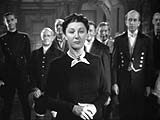
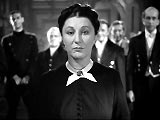
In Manderley's great front hall, the newlywed couple were greeted by an army of over fifteen servants standing as if posed for a picture. The young bride Mrs. de Winter (Joan Fontaine) met the unsmiling, severe, ominous, dark-haired, and slightly hostile housekeeper Mrs. Danvers (Judith Anderson) as she appeared from the left in front of the lineup:
They both stooped to pick up the young woman's dropped gloves. |
|
|||
|
Ball of Fire (1941)
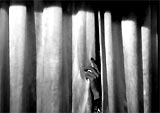
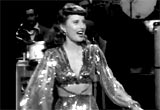
Gangster's moll and singer/burlesque dancer 'Sugarpuss' O'Shea (Barbara Stanwyck) made a stunning entrance into a nightclub, performing "Drum Boogie" (accompanied by Gene Krupa and his jazz band) - in this Howard Hawks screwball comedy. Her left hand grasped the curtain, as her index finger energetically tapped the beat, before she emerged from behind the curtain. The leggy Sugarpuss was revealed to be wearing a glittering, spangled, sequined outfit with a high-slit up the side. |
|
|||

|
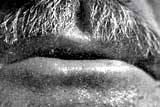
The film's famous, first murmured, echoed word was heard uttered by huge, mustached rubbery lips that filled the screen: "R-o-s-e-b-u-d!" The gigantic lips belonged to elderly Charles Foster Kane (Orson Welles), who had pronounced his last dying word as a snowstorm globe was released from his grip and rolled from his relaxed hand. The glass ball bounced down two carpeted steps and shattered into tiny pieces on the marble floor. |
|
|||
|
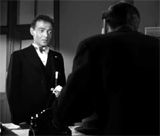
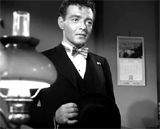
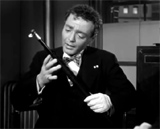
John Huston's film noir had one of the more memorable entrances of a homosexual character in a film, although it was highly suggestive - to bypass restrictions of the Hays Code. Detective Sam Spade's (Humphrey Bogart) secretary Effie Perine (Lee Patrick) alerted her boss to a sweet-smelling client who had just arrived in the outer office and presented her with a gardenia-perfumed business card. Spade sniffed the card, reacting with a bemused expression, as Effie noted: "Gardenia." Space urged his secretary to allow the client to speak to him: "Quick, darling, in with him." The strange, bug-eyed, shifty man - an effeminate, bow-tied Mr. Joel Cairo (Peter Lorre) with a cane, white gloves, and top hat, confronted Spade in his office.
|
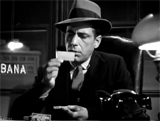 Smelling His Card 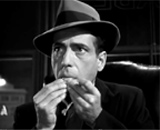 First View - Reaction Shot |
|||
|
|
Private detective Sam Spade (Humphrey Bogart) met Cairo's (Peter Lorre) partner, Kaspar Gutman or the 'Fat Man' (Sydney Greenstreet in his film debut at the age of 61), wearing a black penguin-like waistcoat. Gutman put both of his hands on Spade's right arm as he led him to a chair in his hotel room. In their first meeting together, a classic scene, Gutman was supremely interested in retrieving the Maltese Falcon/bird and outfoxing Spade, as he spoke in oratorical fashion and peppered his words with aphorisms. He admitted: "I'll tell you right out - I'm a man who likes talking to a man who likes to talk." Gutman's great bulk (enormous gut) was emphasized by low-angle shots in front of a curtained window, and his cultured talk with impeccable manners concealed his disregard for everything but the bird. |
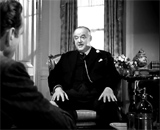 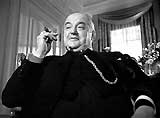 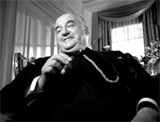
|
|||
|
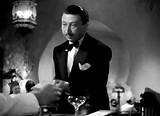
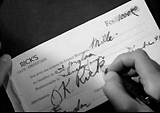
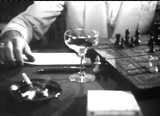
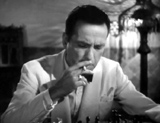
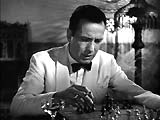
In the classic and much-loved romantic melodrama, cynical, disillusioned, embittered, self-centered, and exiled loner Richard "Rick" Blaine (Humphrey Bogart) made a delayed entrance, after a major build-up of suspense about his character. Already in the film's prologue, the importance of Rick's cafe in pro-Vichy Casablanca had been highlighted. For instance, an arriving plane flew over the rooftop sign of Rick's Cafe Americain as a crowd of refugees covetously watched it pass overhead. Among the many faces that turned skyward and yearned for freedom in the Americas were a Bulgarian couple, Jan Viereck (Helmut Dantine) and Annina Brandel (Joy Page), who hopefully wondered aloud: "Perhaps tomorrow, we'll be on the plane." It was actually the plane heralding the arrival of the new German Nazi/Gestapo commander Major Heinrich Strasser (Conrad Veidt), who was assured by sophisticated Capitaine Louis Renault (Claude Rains) that an arrest would be made that evening of a suspect with stolen letters of transit. It would occur at Rick's Cafe Americain - a gambling den and the center of everything that happened in Casablanca. In the cafe itself, Carl (S. Z. Sakall), the genial German headwaiter, told one of the affluent female customers that Rick, the uncaring and sole proprietor/owner of the cafe, didn't socialize or accept invitations to sit with the clients. Finally, with a foreground closeup, only Rick's hand was first viewed scrawling or scribbling a signature of authorization-approval across a check for an advance of 1,000 francs: "OK - Rick." Then, the camera revealed the objects in front of him - an ashtray with a smoldering cigarette, an empty glass, a chess board, and a pen. It slowly followed his arm up to his immaculate white tuxedo to his sober face as he dragged on his cigarette. Presiding over the gambling tables in the gaming room, Rick drank and sat by himself, playing a solitary game of chess. One of his main functions in the casino was to sign checks and vouchers and to occasionally break up fights. Expressionless, he had learned how to survive and be vigilant in the hostile environment. |
|
|||
|
Jane Eyre (1943)
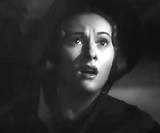
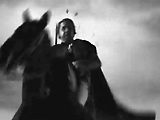
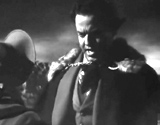
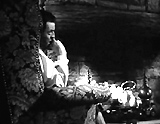
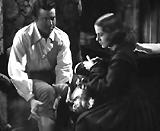
In this dark, moody and noirish adaptation of the Gothic 1847 classic romance novel by Charlotte Bronte, mousy and timid orphaned adult Jane Eyre (Joan Fontaine) had been hired by the homeowner of Thornfield Hall in Yorkshire - a mysterious and brooding Mr. Edward Rochester (Orson Welles). She was appointed as the new governess for Rochester's 'illegitimate' young French daughter-ward Adele (Margaret O'Brien). As the Thornfield housekeeper Mrs. Fairfax (Edith Barrett) showed Jane to her room, Jane was informed that the master and owner of the house had been away sometime, and that his visits were always "so unexpected and sudden." Later, about one half hour into the film (although there were many mentions of the absent Rochester), as Jane was walking about the moors, out of the fog came a cloaked horseman with a whip and his Great Dane Pilot, prefaced by horns and galloping sounds on Bernard Herrmann's soundtrack. Almost colliding with Jane, the rider was violently thrown to the ground. The ankle-injured rider did not identify himself, but was obviously annoyed by the near-collision and roared out toward the very apologetic Jane ("Apologies won't mend my ankle. Down Pilot!"). When Jane identified herself as the new governess from Mr. Rochester's place, he was astonished and asked: "Do you know Mr. Rochester?", and then strangely rode off into the fog ("Now kindly get out of the way") without introducing himself. He reappeared later in the evening, when Jane was surprised to discover him at Thornfield, emerging from behind a high-winged chair by a roaring fire, with his swollen and painful ankle in a bucket of hot water. He clicked his fingers at her to fetch more hot water. When he then bellowed, "Well, Miss Eyre, have you no tongue?" she properly and demurely responded: "I was waiting, sir, until I was spoken to." He then warned her: "Next time you see a man on a horse, don't run out into the middle of the road until he's passed." |
|
|||
|
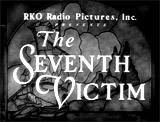
The Seventh Victim (1943) (aka The 7th Victim)
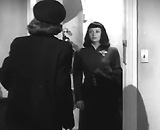
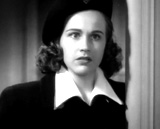
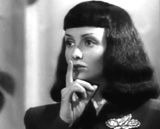
Director Mark Robson's (his directorial debut film) low-budget, noirish, creepy, doom-laden, psychological horror film and Gothic thriller (with the tagline: "SLAVE to SATAN") - was produced by RKO's Val Lewton, known for atmospheric suspense. The enigmatic Satanic-tinged story was a precursor to Roman Polanski's Rosemary's Baby (1968). The main character was naive, innocent, orphaned young private school student Mary Gibson (Kim Hunter in her film debut), who learned from convent nuns in her upstate NY Catholic school, Miss Highcliff's, that her older sister Jacqueline Gibson (Jean Brooks), the owner of La Sagesse - a successful cosmetics factory, had been missing for a number of months (and was not paying Mary's tuition). The search was on for the missing Jacqueline in New York's Greenwich Village, where Mary located errant Jacqueline's NYC apartment (a bare room with a chair and hangman's noose) above Dante's, an Italian restaurant. Mary learned that Jacqueline had, allegedly, suicidal tendencies and had become obsessed with death and despair. Jacqueline's first entrance into the film was stunning, coming about 30 minutes after the film's start. The first appearance of the missing Jacqueline (with distinctive black bangs) came after there was a knock on a door, and when opened, she stood quietly, and looked straight at her astonished sister Mary. She placed a shussing finger to her lips, but then after becoming fearful about something off-screen, she shut the door and seemingly evaporated. The film's main plot was that there was a conspiratorial, underground coven of witches - a deadly cult of diabolic Satanic worshippers called The Palladists. Shockingly, Jackie had given up her business and her soul to the possessed devil cultists, but she found herself kidnapped and in their imprisoning grip, and condemned to die if she left the group. They wished to keep her from revealing her association with them by encouraging her to commit suicide (as the 7th departing victim!) by drinking poison, or by assassinating her. Fearing for her life, Jacqueline had gone into hiding - the reason for her disappearance. |
|
|||
|
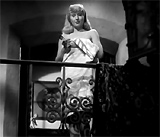
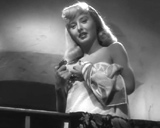
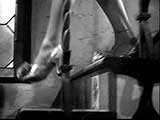
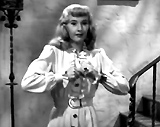
In the film's opening flashback, insurance salesman Walter Neff (Fred MacMurray) related how he became involved in a deadly relationship with Glendale, California housewife Phyllis Dietrichson (Barbara Stanwyck), a conniving, seductive, icy blonde bombshell. He first spotted her when he had stopped in a seemingly routine call at her family's California Spanish-style house to renew her husband's policy. The first image and appearance of Mrs. Dietrichson was bewitching as she asked:
She cooly emerged at the top of the stairs landing looking down, wearing only a bath towel on account of being interrupted while sunbathing - she said that she wasn't "fully covered." Taking her in lustfully, he slyly joked about the Dietrichsons' insurance "coverage." She said that she didn't mind talking about the policies: "If you'll wait till I put something on, I'll be right down." As Neff waited in the living room, he thought to himself: "I was thinking about that dame upstairs, and the way she had looked at me... and I wanted to see her again, close, without that silly staircase between us." After she dressed, Phyllis descended the stairs into the dark claustrophobic atmosphere (where she was figuratively and literally trapped). The camera focused on her legs (from Neff's point-of-view as he observed her) where she wore an engraved, gold ankle strap on her left ankle, flashing it at him as she came down the stairs. He also watched her exhibitionism as she finished buttoning up her blouse and put on her lipstick. |
|
|||
|
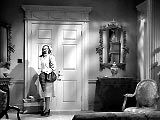
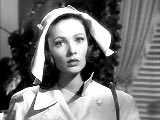
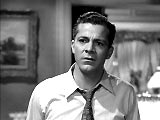
This dreamlike thriller by Otto Preminger presented the startling entrance scene of the "murdered" title character Laura Hunt (Gene Tierney) - her appearance for the first time - undoubtedly not dead. In the scene, New York detective Mark McPherson (Dana Andrews) was uncomfortably shocked when Laura was 'reincarnated' and walked in to her own apartment, awakening him from dozing. She turned on the light and found him half-sleeping in her armchair next to her portrait. He did a double-take and wiped his eyes, wondering if he was dreaming. She threatened to call the police: "What are you doing here?" She was unaware of the news of her own slaying, that she had been shot in the face in her apartment doorway - she didn't read the newspapers and radio broadcasts were unavailable to her while she was out in the country. Laura was horrified to realize that she was caught in the middle of a murder case, in which she was the victim! |
|
|||
(chronological, by film title) Introduction | 1920s-1935 | 1936-1939 | 1940-1945 | 1946-1949 | 1950-1955 | 1956-1959 | 1960-1965 | 1966-1969 1970-1975 | 1976-1979 | 1980-1985 | 1986-1989 | 1990-1995 | 1996-1999 | 2000-2005 | 2006-Present |




 Mrs.
Danvers
Mrs.
Danvers