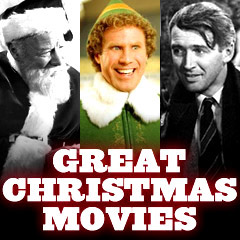
Christmas Movies

Great Christmas Movies

Classics


Great Christmas Movies
(chronological by film title)
Classics | Modern-Day


Great Christmas Movies: What are some of the best Christmas (or holiday) movies? The holidays are definitely about mandatory viewing of some of the best theatrically-released films that capture the spirit of the times - a regular pasttime in addition to other December traditions such as lighted trees, holly berries and mistletoe. They tell of good tidings, lessons to be learned about being generous rather than greedy, getting together with family members, showing love and cheer, and consuming great food.

It should also be noted that the holiday season hasn't always had the film industry's emphasis on increasing yearly grosses or the release of many Oscar-worthy (or prestige) titles - during what should now be termed the "award season." In the old days, classic Disney animated features were often re-released for the holidays, in addition to light-hearted comedies and musicals. The trend to release large-scale pictures during the holidays began in the mid-1970s, with the release of King Kong (1976), Superman: The Movie (1978), and Star Trek: The Motion Picture (1979). [Trivia Note: A few of the classic Christmas films, such as Holiday Inn (1942) and Miracle on 34th Street (1947), weren't even released during the holidays, but during the summer months!]

There are some bona-fide traditional classics here, lots of Christmas or holiday-themed films - and some dark comedies (although Gremlins (1984) and Die Hard (1988) - all tangential Christmas films - aren't included here). Many have wonderful nostalgic ingredients that make them perfect for viewing.


Great Christmas Movies: Classics
Film Title/Year/Director, Setting and Brief Description
Screenshots

A Christmas Carol (1938)

One of the earliest big screen adaptations of Dickens' classic tale--starring Reginald Owen as Ebenezer Scrooge.

Mid-Nineteenth Century London, England, at Christmas-time

This MGM production was one of the earliest (and best) screen adaptations of Dickens' novel A Christmas Carol - first published in 1843. [See also the entry for 1951.] Note: The earliest version of the tale was a crude, 11 minute silent film from Thomas A. Edison, titled A Christmas Carol (1910), with Marc McDermott as Scrooge, and Charles Ogle as Bob Cratchit.

In this 69-minute long Christmas family film, old miserly humbug Ebenezer Scrooge (Reginald Owen, rather than Lionel Barrymore who was the definitive hard-hearted Scrooge on the radio) exhibited his hatred of his penniless nephew Fred (Barry MacKay), when he rejected a dinner invitation. He also fired his underpaid, kind-hearted clerk-assistant Bob Cratchit (Gene Lockhart), after one of Bob's errant snowballs accidentally hit Scrooge. Cratchit remained upbeat, bought his family's Christmas feast, and cared for their crippled youngest child Tiny Tim (Terry Kilburn).

In his large empty mansion, tight-fisted Scrooge was visited later on Christmas Eve by the chained spirit of his former business partner Jacob Marley (Leo G. Carroll), who warned him to change his mean ways or suffer a cruel fate in chains in the afterlife. After dismissing the apparition's warning, he was haunted from 1-3 am by three ghosts:

  • the Spirit of Christmas Past (Ann Rutherford), a sweet-faced, angelic young woman, who showed him his lonely childhood
  • Christmas Present (Lionel Braham) revealed to Scrooge the joy of Fred and the Cratchits
  • Christmas Future (D'Arcy Corrigan) showed the stark contrast between Scrooge's own bleak death (without mourners) and that of Tiny Tim

Miraculously, Scrooge awakened a different man, and quickly distributed presents and gifts. He made Fred his partner, and at the Cratchit's home, he gave the family gifts and promised Bob a raise. He toasted: "To all of us, everywhere, a Merry Christmas to us all, my dears," while Tiny Tim added: "God bless us, everyone."


Scrooge
(Reginald Owen)


Jacob Marley
(Leo G. Carroll)

Holiday Inn (1942)

Screen legends Bing Crosby and Fred Astaire debut the quintessential holiday song, "White Christmas" in this Christmas musical.

In the 1940s, in New York City, also at the rustic "Holiday Inn" in Midville, Connecticut

The plot of this romantic musical film by director Mark Sandrich was spiced up with an Irving Berlin story and score (twelve songs), and it became the highest-grossing film musical to that time. It provided a spectacle of fifteen holidays throughout the year, all presented in song and dance routines - each represented by a calendar page.

The film opened on Christmas Eve in New York City at the Midnight Club, when the song-and-dance team of retiring crooner Jim Hardy (Bing Crosby) and ladies man/hoofer Ted Hanover (Fred Astaire) was breaking up. Hardy retired to his Connecticut farm alone when smooth-talking friend Hanover stole away his fiance, singer/dancer Lila Dixon (Virginia Dale).

Jim decided to turn his country house-inn into a nightclub, dubbed "Holiday Inn," that would only be open on national holidays. Jim hired wide-eyed, aspiring ingénue-singer/dancer Linda Mason (Marjorie Reynolds) as his leading lady to make his dream a success, of providing both dinner and entertainment.

This film was most famous for the debut of the quintessential holiday song, "White Christmas," sung as an unaccompanied ballad by Jim to Linda.

Unfortunately, Ted (after being dropped by Lila for "most wonderful millionaire in world" in Texas on New Year's Eve) was again partner-less (and obsessed about finding a replacement), and he arrived at the inn to drown his sorrows - and to capture Linda as his new dance partner. Of course, romantic shenanigans ensued between the two pairs, and it appeared that Ted and Linda were going to get married in Hollywood during the holidays.

By film's end, however, Ted was reunited with Lila, and Jim and Linda were also a couple. The two duos performed together on New Year's Eve at the Holiday Inn in the conclusion.


Jim Hardy (Bing Crosby),
Lila Dixon (Virginia Dale), and Ted Hanover (Fred Astaire)


Jim and Linda Mason (Marjorie Reynolds) singing
"White Christmas"


The Two Couples

Meet Me in St. Louis (1944)

This holiday musical starring Judy Garland features the debut of the classic song, "Have Yourself a Merry Little Christmas."

A Turn-of-the-Century Family in Suburban, Midwestern St. Louis of 1903, Who Lived in a Stylish Edwardian Home at 5135 Kensington Avenue

This film remains a delightful, classic, nostalgic, poignant, and romanticized musical film - and one of the greatest musicals ever made. Vincente Minnelli's gorgeous musical (his third film and his first in color) romanticized and idealized the turn of the century in the year 1904. It was the second highest-grossing film for MGM up to that time.

The film was structured as a series of coming-of-age vignettes (four in number). Different acts represented the seasons from summer 1903 to spring 1904 that concluded in the year of the St. Louis World's Fair/Exposition. Each segment marked changes and rites of passage - and was introduced by a filigreed tintype from the Smith family album - each static, initially sepia-toned image turned into color and came to life. Although the winter segment was one of the shortest vignettes, the film is still considered a favorite Christmas movie.

The opening image for winter was a nostalgic, Currier-and-Ives view of a horse-drawn sleigh, the sound of sleigh bells, and youngsters sledding down the lawns of Kensington Avenue in the winter sunshine. The city, and the well-to-do Smith family (with four beautiful daughters) living in the suburbs was on the verge of hosting (and celebrating) the arrival of the spectacular World's Fair. However, the family's head of the house was beckoned to New York due to a job promotion - an uprooting move that threatened to indelibly change the lives of the family members forever.

Judy Garland portrayed winsome daughter Esther Smith, who in this last part of the film had just returned home late at night after a Christmas Eve ball. She found her distressed sister 'Tootie' (Margaret O'Brien) worried and wondering about the prospect of moving from their beloved home:

Did he [Santa Claus] come yet? I've been waiting such a long time. And I haven't seen a thing....How will he know how to find us next year? He's so used to coming here.

Esther reassured her and placed her warming wrap around her shivering sister: "Oh, you can't fool him. He can find anybody he wants to find." Obviously upset, 'Tootie' sadly declared: "I'm taking all my dolls, the dead ones too. I'm taking everything." When Esther reminded her that she must leave behind her snow people she had built in their yard, there was a haunting view of their backyard lawn full of Christmas snowmen, seen from her bedroom window.

In one of the most memorable scenes of the film, Esther consoled her distraught sister 'Tootie' - compassionately and sweetly singing the wistful song "Have Yourself a Merry Little Christmas" while at the window. Her solemn voice was accompanied by the tinkling of 'Tootie's' antique monkey music box. Lovingly and tenderly photographed, Esther touchingly sang of hope:

Have yourself a Merry Little Christmas
Let your heart be light.
Next year all our troubles will be out of sight
Have yourself a Merry Little Christmas
Make the Yuletide gay
Next year all our troubles will be miles away
Once again, as in olden days, happy golden days of yore
Faithful friends who were dear to us, will be near to us once more
Someday soon, we all will be together, if the fates allow
Until then, we'll have to muddle through somehow
So have yourself a Merry Little Christmas now

Sobbing, 'Tootie' was most affected and traumatized by the thought of moving and abandoning her snow people - a group that represented her once-happy family. To show her emotional upset and misery after the song was finished, she ran in her nightgown from the house - and hysterically and maniacally decapitated the Christmas snowmen. She bludgeoned and destroyed them because they could not go to New York with the family: "Nobody's gonna have them. Not everybody's going to New York. I'd rather kill them if we can't take them with us." Esther vainly attempted to comfort her utterly despairing sister by kneeling and embracing her. 'Tootie' drowned out her words with her ceaseless crying:

"New York is a wonderful town. Everybody dreams about going there. But we're luckier than lots of families because we're really going. Wait until you see the fine home we're going to have and the loads and loads of friends we'll make. Wonderful friends. But the main thing Tootie is that we're all going to be together just like we've always been. That's what really counts. We could be happy anywhere as long as we're together."

Ultimately, Mr. Smith reconsidered the move, and decided to compromise with his family and stay in St. Louis after all, refusing his company's promotion regardless of the work prospects and other consequences.


Esther (Judy Garland)
with Tootie
(Margaret O'Brien)

Christmas in Connecticut (1945)

Elizabeth (Barbara Stanwyck) transforms from spinster Manhattanite to perfect housewife when her boss invites himself for Christmas.

Post-WWII Era, in NYC and at a Rural Connecticut Farmhouse, Around Christmas Eve

In this delightful, light-hearted screwball romantic comedy (remade poorly as a TV movie in 1992), a perennial Christmas favorite, Barbara Stanwyck portrayed Elizabeth Lane, a Martha Stewart-like food writer for Smart Housekeeping magazine who misled her readership. In her column "Diary of a Housewife," she wrote about her perfect life on a Connecticut farm with a husband and eight month-old son, great recipes and furnishings, etc. She was regarded as "the finest, most exemplary wife and mother." However, she was a spinster - there was no husband and no baby, she wasn't a gourmet cook (she got her recipes from her Hungarian Uncle Felix Bassenak's (S.Z. Sakall) restaurant), and she lived in a modest, high-rise apartment in Manhattan.

Elizabeth's corpulent mogul publisher Alexander Yardley (Sydney Greenstreet) and returning, wounded Navy war hero-sailor Jefferson Jones (Dennis Morgan) (who was hallucinating about fine dining!) invited themselves to her rural farm-home for an old-fashioned, traditional family Christmas Eve. The manipulative writer was worried that she might lose her job due to her charade. Exasperated, she was forced to spin a cover up of all of her deceitfulness, asking herself: "Arrange it? Are you crazy? Where am I gonna get a farm? I haven't even got a window box!"

She agreed to have snooty, humorless, unromantic, and infatuated architect John Sloan (Reginald Gardiner) stand in as her beau (and wedding arrangements were made). He had been dogging her for a proposal but she had always refused until now. She also asked restaurant chef Uncle Felix to cook for her, and 'borrowed' John's idyllic farm, who regretted helping her with the ploy: "I know I shall regret this for the rest of my life."

The marriage ceremony between Elizabeth and John was continually being interrupted and postponed. And John's instincts were accurate - Elizabeth fell in love with Jones during the festivities (especially during a flirtatious sleigh ride together), although Jones was being pursued for marriage by Navy nurse Mary Lee (Joyce Compton). The screwball plot intensified with multiple borrowed stand-in babies (a blonde boy, a dark-haired girl) brought in to impersonate the Lane family child.

When she eventually admitted the truth to Yardley that she wasn't married, she was fired and after a quarrel, she broke up with Sloan. Yardley soon reinstated her with a doubled salary raise (Uncle Felix convinced him that a rival publisher would hire her away). It appeared that Jones would marry Elizabeth after he proposed to her, although he was warned by Yardley that Elizabeth couldn't cook. The film ended with rotund Yardley's line: "What a Christmas! Ho, ho, what a Christmas!"


Elizabeth Lane
(Barbara Stanwyck) with
Uncle Felix (S.Z. Sakall)


With Jefferson Jones
(Dennis Morgan)


The Bishop's Wife (1947)

Guardian angel Dudley (Cary Grant) helps a smalltown bishop realize that "loving kindness and warm hearts" is what's important in life.

An Urban Setting, Post WWII, at Christmastime

This popular Christmas classic was poorly remade by director Penny Marshall as The Preacher's Wife (1996), with Denzel Washington as the angel who fell in love with co-star Whitney Houston. The original version, a romantic fantasy-comedy, told about an angel named Dudley (Cary Grant) who was sent to help ambitious Episcopal Bishop Henry Brougham (David Niven). The well-dressed, handsome, urbane guardian angel advised the troubled bishop about his failing project, after he had prayed for "guidance" regarding problems of fund-raising for the construction of a new church.

Dudley was not there to assist with the Bishop's building and funding of a new cathedral, but to show the busy Henry what he had been neglecting in life -- the poor and needy, the boys' choir, his parishioners and most noticeably, his lovely wife Julia (Loretta Young), who had the incredible gift, according to Dudley of "making heaven here on Earth." Unexpectedly, Dudley began to have romantic feelings for Julia.

Dudley rewrote Henry's Christmas sermon, dictating while the typewriter took down his words. When Henry finally publically announced the importance of Julia in his life to Dudley ("Julia means more to me than my life, I'm not going to lose her"), the angel promptly announced his departure. The angel told Henry that he and everyone else would have no memory of his visit or existence ("When I'm gone, you will never know that an angel visited your house").

At St. Timothy's Church, the Bishop delivered Dudley's sermon on Christmas Eve at midnight, while Julia beamed at him from the pews. From the street outside under a light falling snow, Dudley listened to the poignant and touching words, satisfied that his work was complete as he turned and slowly walked away - bringing the film to a heartfelt close:

Tonight I want to tell you the story of an empty stocking. Once upon a midnight clear, there was a child's cry. A blazing star hung over a stable, and wise men came with birthday gifts. We haven't forgotten that night down the centuries. We celebrate it with stars on Christmas trees with the sound of bells, and with gifts. But especially with gifts. You give me a book, I give you a tie. Aunt Martha has always wanted an orange squeezer and Uncle Henry could do with a new pipe. For we forget nobody, adult or child. All the stockings are filled, all that is, except one. And we have even forgotten to hang it up. The stocking for the child born in a manger. It's his birthday we're celebrating. Don't let us ever forget that. Let us ask ourselves what He would wish for most. And then, let each put in his share: loving kindness, warm hearts, and a stretched-out hand of tolerance - all the shining gifts that make peace on Earth.


It's A Wonderful Life (1947)

How does one person affect the lives of others? George Bailey (James Stewart) gets a glimpse on Christmas Eve.

Bedford Falls, NY (fictional town) on Christmas Eve

This moving, inspirational, much-loved perennial Christmas classic from director Frank Capra is one of the most popular and heartwarming films ever made. It was actually a box-office flop at the time of its release, and only became the Christmas movie classic in the 1970s due to repeated television showings at Christmas-time.

It was actually a dark, bittersweet post-war tale about the life (seen in flashback) of savings-and-loan manager George Bailey (James Stewart) who struggled in his small town against a greedy, rich and evil tycoon-banker Mr. Potter (Lionel Barrymore) and his own self-doubting nature. He began to suffer many hardships, sacrifices, mishaps and fateful trials, including compromised dreams of his youth to leave the town and seek fame and fortune.

Facing financial ruin and suicide, earnest down-on-his-luck do-gooder George became hysterical, melancholy and despairing. He was given encouragement and assistance by a whimsical, endearing, trainee guardian angel named Clarence Oddbody (Henry Travers). He was allowed to see what life in his town of Bedford Falls would have been like if he hadn't been born (a journey to Pottersville). It was a frightening, nightmarish, noirish view of the world (at Christmas-time) that brought him back from self-destruction. Only then did he recognize his life as wonderful and truly rich, even in its humdrum and bleak nature.

The tale of near-suicide and depression during the Christmas season came full circle with family and friends supporting him and his beleaguered family. He returned to the idyllic, small-town world that he had left, with renewed faith and confidence in life itself.


Miracle on 34th Street (1947)

Is Kris Kringle real or is he just plain crazy? This classic shows us that "Faith is believing when common sense tells you not to."

In New York City in 1947, Following the Thanksgiving Day Parade (Macy's), Through to Christmas Day

This wonderful holiday film has long been considered a cherished family tradition, with a strong faith-affirming religious theme. [The film's plot about the identity of "Kris Kringle" paralleled and retold the last year of the life of Jesus when he was tried before Pontius Pilate.] In fact, the theme of the film was capsulized in this quote: "Faith is believing when common sense tells you not to. Don't you see? It's not just Kris that's on trial, it's everything he stands for. It's kindness and joy and love and all the other intangibles."

Bearded Kris Kringle (Oscar-winning Edmund Gwenn, the only actor to win an Oscar for playing Santa Claus) was offered the job of Santa for the Macy's Department Store (on W 34th Street in NYC) by reluctant, feisty event director Doris Walker (Maureen O'Hara), when the Santa character for the Macy's Thanksgiving Day parade was reported to be drunk and unconscious. Disillusioned divorcee Doris' skeptical 6 year-old daughter Susan (Natalie Wood) didn't believe that the actual, warm-hearted, white-haired Kris Kringle was real, and pulled his beard to test him. Doris was dismayed that Santa was recommending that shoppers go elsewhere if they couldn't find toys that they wanted at Macy's.

Disbelieving cynics institutionalized him and declared him delusional and insane. In the meantime, good ol' Saint Nick created goodwill and peace between feuding store owners (of Macy's and Gimbels) and delighted customers. The white-bearded Santa, a resident of the Brook's Home for Old People, a retirement home on Long Island, also was instrumental in assisting the romantic relationship between Doris and her attorney/neighbor Fred Gailey (John Payne), with whom he was staying.

In the stirring finale and happy ending set in the NY Supreme Court on Christmas Eve, a battle between lawyers tried to determine Kris' sanity or lunacy. The climax came when the Postal Service delivered many bundles of letters. The bags of mail were regarded as official proof from the U.S. Government that Santa existed, and the judge dismissed the case.

Kringle eventually fulfilled Susan's Christmas wish for a beautiful dream house (for sale) with a swing in the backyard, and she was ecstatic ("This is my house, Mommy. The one I asked Mr. Kringle for...Mr. Kringle is Santa Claus!").

The film concluded as Fred kissed Doris and proposed to her in their future home, and then both of them noticed Kris's cane leaning against the wall by the fireplace. She doubted its ownership ("Oh no, it can't be. It must have been left here by the people that moved out"), while Fred added his own reflection about his successful defense of Kringle: "Maybe...Maybe I didn't do such a wonderful thing after all."


Holiday Affair (1949)

A love triangle and a final kiss on New Year's Eve wraps up this romance starring Robert Mitchum and Janet Leigh.

In New York City During the Christmas Season, in the Post-War 1940s

A Christmas season romance developed in this sentimental b/w romantic drama, even though the circumstances weren't promising at first. It was advertised with the tagline: "IT HAPPENS IN DECEMBER...BUT IT'S HOTTER THAN JULY!"

Department store clerk Steve Mason (Robert Mitchum), a drifter hired during the busy Christmas season by Crowley's in New York, assisted pretty young war widow Connie Ennis (Janet Leigh) whose husband was killed in the war. She had purchased an expensive model Red Rocket Express electric train set at the store for her 6 1/2 year-old son Timmy (Gordon Gebert). When the boy was disappointed that the gift wasn't intended for him, she returned it. Steve threatened to turn her in as a professional "comparative shopper" from a rival store. But he felt sorry for her that she would lose her job, and helped her by refunding her money for the purchase ("Now I write you a refund slip which I have a feeling I'm gonna live to regret") - and he was fired.

An almost-broke Steve became friends with Connie and the boy, and bought the train set as a Christmas gift for Timmy. Before long, an awkward love triangle developed between Connie, Steve, and Carl Davis (Wendell Corey), Connie's long-time stable admirer/boyfriend - a stuffy divorce lawyer whom she was planning to marry on New Year's Day. Meanwhile, Steve was concerned about Connie and lectured and reprimanded her for grieving over her dead husband. He advised her to let go of the past which was affecting her present love life:

"You were even gonna play it safe and settle for someone you didn't love so you wouldn't be unfaithful to your husband....All anybody wants is for you to live in the present and not be afraid of the future. You know, maybe it can happen again if you quit pretending that something that's dead is still alive...I want a girl that'll drop everything and run to me, no matter what the score is."

Realizing that Steve was destitute, Timmy had returned his train set to Crowley's for the refund of $79.50, where he successfully pleaded his case to the store owner Mr. Crowley (Henry O'Neill). When Steve received the refund money, he claimed to Connie: "I can shake myself loose from this penthouse and grab the first cheap train to California."

In the conclusion set on New Year's Eve, Connie decided to find love with Steve rather than Carl (who had decided to "divorce" their relationship and break up). Connie received a Western Union telegram that Steve was taking the "midnight special" - a westbound train to Balboa, California (where he planned to build sailboats with his friend). He promised: "WILL BE DRINKING TO YOU ABOARD THE MIDNIGHT SPECIAL. HAPPY NEW YEAR. STEVE." Timmy and Connie rushed through the partygoers on the moving train. She met up with Steve and embraced him between cars, as the camera pulled back. They were on one of the model train cars outside the Balboa, California station.


A Christmas Carol (1951) (aka Scrooge, UK)

17 minutes longer then the '38 version, this movie adds depth and more special effects -- starring Alastair Sim as Ebenezer Scrooge.

In London, England in the mid-1800s

This black and white classic from director Brian Desmond Hurst has been considered the most definitive and faithful film ever made about miserly Ebenezer Scrooge. It was 17 minutes longer, at 86 minutes than the 1938 version (at 69 minutes), with more depth and some crude special effects.

Scrooge (or A Christmas Carol) was based on writer Charles Dickens' 1843 novella, A Christmas Carol in Prose, Being a Ghost Story of Christmas (aka A Christmas Carol). The mean, white-haired London Scrooge, known for his trademark phrase: "Bah, humbug!" was authentically portrayed by Alastair Sim.

The film opened at the London business exchange, where on the outside steps, Scrooge rebuffed a debtor who asked for more time to repay a loan. The wealthy Scrooge also wouldn't give to charitable causes for the poor, unfortunate and needy, including his own underpaid, humble clerk Bob Cratchit (Mervyn Johns) with lame son Tiny Tim (Glyn Dearman). He begrudgingly allowed Cratchit to have Christmas day off. On his way home after work on Christmas Eve, miserly Scrooge stopped in for a meal at an inn, and when he asked the waiter for more bread, he changed his mind when the waiter claimed it would be an extra charge.

Once he returned alone to his empty mansion (with his door knocker reflecting the face of a ghost), Scrooge heard ringing from unmoving bells. He was visited by the ghost - his former partner Jacob Marley (Michael Hordern) who asked him: "Do you believe in me or not?" With heavy chains dragging him down, the suffering and tormented Marley claimed that he was "doomed to wander without rest or peace. Incessant torture and remorse." The shackled Marley warned that Scrooge still had a chance of escaping the same fate, with the visits of three ghosts that would begin at 1 am. Marley directed Scrooge to the window, where he saw other helpless, hopeless souls and phantoms like Marley.

Then a procession of three ghosts or spirits (seen with a double-exposure special effect) appeared. They all advised the embittered Scrooge to repent of his greedy ways, and redeem himself. Each of the ghosts showed Scrooge the parts of his life that he had forgotten or ignored, and urged him to discover and adopt the true spirit of Christmas:

  • the Spirit of Christmas Past (Michael J. Dolan), a white Grecian-robed, long gray-haired gentleman
  • the Spirit of Christmas Present (Francis de Wolff)
  • the Spirit of Christmas Yet to Come (C. Konarski), a black-garbed, horrific figure

With the ghost of Christmas past, Scrooge revisited his idealistic youth. He was heartbroken when he saw his beloved sister Fan (Carol Marsh) die while giving birth to his nephew Fred (Brian Worth) - someone Scrooge would resent. [Scrooge was likewise resented by his father when his mother gave birth to him and died.] The segment showed Scrooge's first signs of tyrannical greed that manifested itself as he was lured (and corrupted) by a rival - mentor Mr. Jorkin (Jack Warner) to leave his benevolent employer Mr. Fezziwig (Roddy Hughes), who was subsequently run out of business. He then partnered with Marley and took over control of the company (to avoid scandal) when Jorkin was accused of embezzlement. Scrooge had no pity when his partner Marley died, after-hours on Christmas Eve. He ignored Marley's last words of advice on his deathbed - that they had been wrong, and Scrooge should save himself.

During the second visitation, Scrooge looked in on the happy celebrations of his nephew and the Cratchits, and saw that his spurned ex-fiancee Alice (Rona Anderson) was now charitably caring for the sick and poor. The Spirit of Christmas Present also presented Scrooge with a grim view of two children at his feet, representing Ignorance and Want.

During the final visitation, Scrooge was most fearful of this last dark-shrouded spectre (looking like the Grim Reaper), although he still claimed: "Even in my fear, I must tell you I am too old! I cannot change! It's not that I'm inpenitent, it's just...Wouldn't it be better if I just went home to bed?" He was shown that Tiny Tim's death was deeply mourned and lamented, especially by Bob Cratchit. By contrast, Scrooge saw his possessions sold after his own death (and his funeral was inexpensive since no one came), and then he horrifically saw his own tombstone.

On Christmas morning after awakening from his frightful dreams, Scrooge repented and changed ("I'm not the man I was!"). Seemingly crazed, giddy and wild-haired, he tried to reassure his screaming and hysterical maid Mrs. Dilber (Kathleen Harrison): "No. Mrs. Dilber - I am not mad. Even if I look it!" He gave her a guinea coin as a Christmas present, raised her pay from two to ten shillings a week, and gave her the day off.

Feeling redeemed, Scrooge sent a boy (with the promise of a shilling) to purchase a turkey at the local butcher's shop, to be delivered to the Cratchits. (The family reacted in astonishment, thinking Scrooge had taken leave of his senses). Scrooge then called on his nephew Fred and asked for forgiveness for refusing to dine with him earlier. He also asked forgiveness from Fred's wife (Olga Edwardes): "Can you forgive the pig-headed old fool for having no eyes to see with, no ears to hear with - all these years?" And then he danced a lively polka with her.

The next day, Scrooge laughed uncontrollably as he happily raised Bob Cratchit's salary, and then he promised: "From now on, I want to try to help you to raise that family of yours, if you'll let me." Then he mumbled and cackled to himself: "I don't deserve to be so happy! I can't help it. I just can't help it." The narrator (Peter Bull, in voice-over) concluded the film with laudatory comments about Scrooge, as he ran to meet up with Tiny Tim - now running without crutches:

"Scrooge was better than his word. He became as good a friend, as good a master, and as good a man as the good old city knew, or any other good old city, town, or borough, in the good old world. And to Tiny Tim who lived and got well again, he became a second father. And it was always said that he knew how to keep Christmas well, if any man alive possessed the knowledge. May that be truly said of us, and all of us. And so, as Tiny Tim observed, 'God Bless Us - Everyone.'"


Scrooge
(Alastair Sim)


Jacob Marley
(Michael Hordern)


The Spirit of Christmas Past
(Michael J. Dolan)


The Spirit of Christmas Present (Francis de Wolff) with Scrooge

White Christmas (1954)

This holiday rom-com starring Bing Crosby and Danny Kaye was the highest grossing movie of 1954.

At a Guest Ski Lodge, the Pine Tree Inn, in Vermont in 1954

This heart-warming and sweet-natured romantic comedy musical from director Michael Curtiz was a loose remake of the earlier Holiday Inn (1942). (It had debuted "White Christmas" - also heard in this film and again performed, twice, by Bing Crosby). Irving Berlin's original song "Count Your Blessings Instead of Sheep" was the only one to receive an Oscar nomination. The title song had already won Berlin his only Academy Award in 1942. Also notable was that the film was Paramount's first VistaVision wide-screen production, and it was the highest-grossing picture of 1954.

The main characters were two Army GIs, buddies returning from WWII, paired or partnered with two blonde singing/dancing sisters:

  • serious and quiet Bob Wallace (Bing Crosby)
  • carefree, playboyish, marriage-shy Phil Davis (Danny Kaye)
  • older and more serious Betty Haynes (Rosemary Clooney)
  • leggy "younger" sister Judy Haynes (Vera Ellen)

During the war, Bob and Phil had performed for their fellow troops in Europe on Christmas Eve, 1944. Now ten years later, the twosome were producing and performing very popular shows, first in nightclubs, then on the radio, and finally, they scouted new talent as producers of Broadway revues - seen on TV as The Wallace and Davis Show.

A series of incidents found them traveling from Florida by train northward, in the company of the Haynes sisters (on the run from their landlord and an arrest warrant) to bring their Broadway-level Christmas show ("Playing Around") to a Vermont inn ski lodge. They were surprised to discover it was owned by their old Army superior, Major General Thomas F. Waverly (Dean Jagger). But because it hadn't snowed since Thanksgiving, the lodge was about to go bankrupt with warm temperatures and green grass. They hoped that their show, brought from New York before its Broadway debut, would revive the lodge. Typical of romantic musical comedies, there were the usual romantic pursuits and misunderstandings between the couples.

By Christmas Eve, after advertising the show and creating publicity on the Ed Harrison (Johnny Grant) variety show/program, the lodge was packed with customers (including a reunion with members of the 151st Division showing up to honor the retired General). After performing various numbers, including "What Can You Do With a General?", and "The Old Man," the show was coming to an end - and it began to snow just before the title song finale.

During the final number with Betty and Judy, Bob and Phil (and others) were dressed in Santa outfits. The film ended with kisses between Bob and Betty, and Phil and Judy, and the reprised singing of "White Christmas." Everything ended with the toast from the song: "May your days be merry and bright; and may all your Christmases be white."


The first singing of
"White Christmas"


Previous Page Next Page