Detective-Mystery Films are usually considered
a sub-type of crime/gangster films (or film noir), or suspense
or thriller films that focus on the unsolved crime (usually the murder
or disappearance of one or more of the characters, or a theft), and on the
central character - the hard-boiled detective-hero, as he/she meets various
adventures and challenges in the cold and methodical pursuit of the criminal
or the solution to the crime. The plot often centers on the deductive ability,
prowess, confidence, or diligence of the detective as he/she attempts to unravel
the crime or situation by piecing together clues and circumstances, seeking
evidence, interrogating witnesses, and tracking down a criminal. Detective-Mystery Films are usually considered
a sub-type of crime/gangster films (or film noir), or suspense
or thriller films that focus on the unsolved crime (usually the murder
or disappearance of one or more of the characters, or a theft), and on the
central character - the hard-boiled detective-hero, as he/she meets various
adventures and challenges in the cold and methodical pursuit of the criminal
or the solution to the crime. The plot often centers on the deductive ability,
prowess, confidence, or diligence of the detective as he/she attempts to unravel
the crime or situation by piecing together clues and circumstances, seeking
evidence, interrogating witnesses, and tracking down a criminal.
See also AFI's 10 Top 10 - The Top 10 Mystery Films and
Filmsite's related Greatest Plot Twists, Spoilers, and Surprise Endings.
Detective-mystery films emphasize the detective or person(s)
(an amateur, a plain-clothes policeman, or a PI - Private Investigator) solving
the crime through clues and exceptional rational powers. The detective studies
the intriguing reasons and events leading to the crime, and eventually determines
the identity of the villain (a murderer, a master spy, an arch fiend, an unseen
evil, or a malignant psychological force). The central character usually explores
the unsolved crime, unmasks the perpetrator, and puts an end to the effects
of the villainy.
Suspense is added as the protagonist struggles within the
puzzle-like narrative to gather evidence and testimony, to investigate all
motives, and to discover the one essential clue or fatal flaw/alibi that betrays
the identity of the culprit. The detective (or main protagonist) often succeeds in cleverly trapping
the killer or criminal where law-and-order officers and local police officials
do not. Intensity, anxiety, and suspense build to an exciting climax, often
with the detective (or protagonist) using his fists or gun to solve the crime.
This genre has ranged from early mystery tales, fictional
or literary detective stories, to classic Hitchcockian suspense-thrillers
to classic private detective films. A related film sub-genre is that of spy
films. If detection and the solution to a crime are not central to
a 'mystery' film, then it blends into other genre film types, such as horror
or suspense-thrillers.
The Earliest Mysteries:
Mysteries had their start in the early days of silent film.
The most primitive serials, such as
the well-known The Perils of Pauline (1914),
possessed a degree of mystery. This film type blossomed as a full film category
in the talking films of the 1930s, often borrowing from characters in popular
literature. Detective films were widely popular during the 1930s and 1940s
in B-series films.
Sherlock Holmes Films:
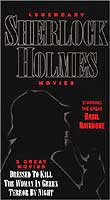 Sherlock
Holmes, the world's first private detective, was derived from Sir
Arthur Conan Doyle's works (his first SH novel was 1887's A Study
in Scarlet (1887), followed by three other novels and 56 short
stories). The Baker Street sleuth became the fictional character most frequently
recurring on the screen. He has appeared in over 200 films since
1900 and been played by well over 70 actors. Sherlock
Holmes, the world's first private detective, was derived from Sir
Arthur Conan Doyle's works (his first SH novel was 1887's A Study
in Scarlet (1887), followed by three other novels and 56 short
stories). The Baker Street sleuth became the fictional character most frequently
recurring on the screen. He has appeared in over 200 films since
1900 and been played by well over 70 actors.
Holmes
solved mysteries in hundreds of films with "elementary
deductions" and
with assistance from 221-B Baker Street sidekick assistant Dr. Watson.
Their setting in 19th century England was updated in 1942 to the World
War II era, with Holmes battling the Nazis. The only actor
to have played both Sherlock Holmes and his assistant Dr. Watson was
Reginald Owen (see below).
The immortal, prototypical detective first appeared
on the film screen in a 30-second, 1900 one-reeler (registered in
1903) from American Mutoscope and Biograph Company, titled Sherlock
Holmes Baffled (1900).
It was the first recorded detective film on record, made specifically
for one-person mutoscope viewing machines in amusement arcades.
Between 1921 and 1923, UK actor Eille Norwood played
the Sherlock Holmes character almost 50 times in short two-reelers,
and in two feature films (The Hound of the Baskervilles (1921,
UK),
and
The Sign of Four (1923, UK)). He was the most prolific actor
ever to portray Sherlock Holmes. Another of the earliest Holmes films
was Albert Parker's silent 9-reeler Sherlock
Holmes (1922) with
John Barrymore.
The first talkie
Sherlock Holmes film was The Return of Sherlock Holmes (1929) with
Clive Brook in the sleuthing lead role. The character was also popularly
portrayed by many actors in the 1930s, including:
- Raymond Massey (in The
Speckled Band (1931, UK), Massey's first talking picture)
- Robert Rendel (in The Hound of the Baskervilles
(1932, UK))
- Clive Brook (in Sherlock Holmes (1932))
- Reginald
Owen (in A Study in Scarlet (1933))
- The Hound of the Baskervilles (1937, Germ.) (aka
Der Hund von Baskerville), d. Carl Lamac, with Bruno Güttner
as Holmes
- Two Merry Adventurers (1937, Germ.) (aka The
Man Who Was Sherlock Holmes) - German actors Hans Albers & Heinz
Rühmann pretended to be the famous duo of Sherlock Holmes and
Dr. Watson
Arthur Wontner portrayed Holmes
in 5 films from 1931-1937:
- Sherlock Holmes' Fatal Hour (1931, UK) (aka The
Sleeping Cardinal), based on Doyle's two stories, The
Empty House and The Final Problem
- Sherlock Holmes and The Missing Rembrandt (1932,
UK),
based on Doyle's The Adventure of Charles Augustus Milverton
- The Sign of Four: Sherlock Holmes' Greatest Case
(1932, UK)
- The Triumph of Sherlock Holmes (1935, UK),
an adaptation of Doyle's The Valley of Fear
- Murder at the Baskervilles (1937, UK) (aka Silver
Blaze)
Basil Rathbone's 14 Sherlock Holmes Films
(1939-1946):
Its
most familiar, popular figure was the British actor Basil Rathbone
with an Inverness cape, deerslayer hat and curved-stem calabash
pipe (accompanied by dull-witted, pipe-smoking Nigel Bruce as Watson
- who wasn't so clumsy and buffoonish in the original writings),
who appeared during the war years in 14 pictures from 1939 to 1946:
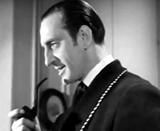
|
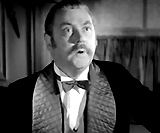
|
Sherlock Holmes
(Basil Rathbone)
|
Dr. Watson
(Nigel Bruce)
|
- The Hound of the Baskervilles (1939), 20th Century
Fox
- The Adventures of Sherlock Holmes (1939), 20th Century
Fox
Universal Studios created the next 12 entries:
- Sherlock Holmes and the Voice of Terror (1942),
in which Holmes was linked with the Allied war effort
- Sherlock Holmes and the Secret Weapon (1942),
Holmes fought the Nazis, adapted from Doyle's short story The
Adventure of the Dancing Men
- Sherlock Holmes in Washington (1943)
- Sherlock Holmes Faces Death (1943)
- The Spider Woman (1944)
- The Scarlet Claw (1944)
- The Pearl of Death (1944)
- The House of Fear (1945)
- The Woman in Green (1945)
- Pursuit to Algiers (1945)
- Terror by Night (1946)
- Dressed to Kill (1946)
Other Sherlock Holmes Variations Through the 1970s:
- The Adventure of the Speckled Band (1949) (TV
episode of NBC's "Your Show Time"), with Alan Napier as
Holmes
- Sherlock Holmes (1954-1955) (TV series) -
a half-hour TV series (of 39 half-hour episodes produced
in France with an all-British cast), with Ronald Howard
as Sherlock Holmes and Howard Marion-Crawford as Dr. Watson
- The Hound of the Baskervilles (1959, UK),
Hammer Films, d. Terence Fisher, with Peter Cushing as Holmes
- Sherlock Holmes and the Deadly Necklace (1962,
Germ.),
d. Terence Fisher, with Christopher Lee
- Sherlock Holmes (1964-1965, and 1968) (BBC-TV
series) - the series spanned two seasons
in the U.K.
The first batch was produced in 1964-65 and starred
Douglas Wilmer in the title role.
In the second season, 16 episodes
were originally produced, although only five stories remain (The
Hound of the Baskervilles, A Study in Scarlet, The Boscombe Valley
Mystery, The Sign of Four and The
Blue Carbuncle),
with Peter Cushing
- The Private Life of Sherlock Holmes (1970, UK/US),
directed by Billy Wilder, in colorful Panavision with Robert Stephens
as Holmes, and Christopher Lee as Sherlock's brother Mycroft
- They Might Be Giants (1971), Universal, with
George C. Scott (as Justin, who believed that he was Sherlock Holmes)
- The Hound of the Baskervilles (1972) (ABC-TV
movie), with Stewart Granger as Holmes
- The Adventure of Sherlock Holmes' Smarter Brother
(1975, US/UK), a comedy with actor/director/writer Gene Wilder
(his directorial debut film) as Holmes' younger brother Sigerson
Holmes (an alias used by Sherlock); Douglas Wilmer portrayed
Sherlock Holmes
- Sherlock Holmes in New York (1976) (NBC-TV
movie), with Roger Moore
- Silver Blaze (1977, UK/Can.) (25-minute TV
movie), with Christopher Plummer as Sherlock Holmes, d. John Davies
- The Hound of the Baskervilles (1978, UK),
d. Paul Morrissey, a comedy spoof with Peter Cook as Holmes
- Sherlock Holmes also appeared in various TV episodes:
in the cartoon series Teenage Mutant Ninja Turtles, in the
animated TV series Batman: The Brave and the Bold, and in
the TV drama series CSI:
Crime Scene Investigation.
- The TV-movie/pilot Sherlock (2002) starred
James D'Arcy as Sherlock and Roger Morlidge as Watson
- Another modern,
updated BBC-TV series composed of three feature-length episodes,
titled
Sherlock: Season One (2010), found
the sleuths (Benedict Cumberbatch and Martin Freeman) solving
crimes in present-day London
Curious Adaptations of Sherlock Holmes:
- Mr. Magoo's Sherlock Holmes (1965), an animated
short which aired in 1965 (as part of the mid-1960s TV series The
Famous Adventures of Mr. Magoo), with Paul Frees as the voice
of Sherlock Holmes
- A Study
in Terror (1965, UK),
and Murder
by Decree (1979, UK/Can.), in these two mystery-thrillers,
Sherlock Holmes (John Neville, Christopher Plummer) and Dr. Watson
(Donald Houston, James Mason) were in pursuit of Jack the Ripper
- The Seven-Per-Cent Solution (1976, UK/US),
Sherlock Holmes (Nicol Williamson) was treated for cocaine addiction
by Dr. Sigmund Freud (Alan Arkin) in Vienna; also with Robert Duvall
as Dr. Watson/Narrator
- Time After Time (1979), in the sci-fi time
travel film, H.G. Wells (Malcolm McDowell) claimed to be "Sherlock
Holmes"
- The Adventures of Sherlock Holmes (1984, UK) (TV
show series, 1984-1985), with Jeremy Brett as Sherlock Holmes in
13 episodes (in two seasons)
- Sherlock Hound (1984-, Jp.), animated TV
show from 1984-1985 (26 episodes), a canine version of the Holmes
story
- Young Sherlock Holmes (1985), directed by
Barry Levinson, with Nicholas Rowe as the teen version of Sherlock
Holmes, with a script by Chris Columbus; noted for ground-breaking
special effects - it was the first feature film to have a completely
CGI character: the stained-glass window
knight
- Without a Clue (1988, UK), a comedy in which
Dr. Watson (Ben Kingsley) claimed that Holmes was only his fictional
creation, allowing him to solve crimes incognito - actor Reginald
Kincaid (Michael Caine) was hired to impersonate "Holmes"
Most recently, the adventures of Sherlock Holmes have
been portrayed in a pair of director Guy Ritchie action films, starring
Robert Downey, Jr (as Holmes) and Jude Law (as Dr. Watson); unique
in that Holmes was a martial-arts specialist in Wing-Chun Kung Fu:
- Sherlock Holmes (2009)
- Sherlock Holmes: A Game of Shadows (2011),
a sequel
Also, there were these versions, on TV and the big
screen:
- Sherlock (2010-, UK), the continuing BBC's
Emmy-winning TV series about a "new sleuth for the 21st century,"
with Benedict Cumberbatch as Sherlock and Martin Freeman as Dr.
Watson
- Elementary (2012-), the continuing CBS-TV
series was set in NYC, starring drug-addicted Holmes (Jonny Lee
Miller) and his recovery sponsor Dr. Joan Watson (Lucy Liu)
- Mr. Holmes (2015, UK/US), by director Bill
Condon (based upon the novel A Slight Trick of the Mind),
with Ian McKellen as 93 year-old retired detective Holmes
Foreign Sleuths:
Charlie Chan -
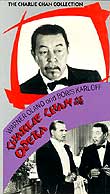 Short
who-dun-its in the 1930s and 40s featured the B-movie, Canton-born, Honolulu-based
Oriental sleuth Charlie Chan, derived from Earl Derr Biggers' works, and based
on real-life Hawaiian cop Chang Apana (very unlike the movie version). The
round-faced, meticulous sleuth was one of the screen's most prolific detectives,
with 46 Chan films and one serial from 1926 to 1949. [Charlie Chan was never played on the screen by a Chinese actor.] Short
who-dun-its in the 1930s and 40s featured the B-movie, Canton-born, Honolulu-based
Oriental sleuth Charlie Chan, derived from Earl Derr Biggers' works, and based
on real-life Hawaiian cop Chang Apana (very unlike the movie version). The
round-faced, meticulous sleuth was one of the screen's most prolific detectives,
with 46 Chan films and one serial from 1926 to 1949. [Charlie Chan was never played on the screen by a Chinese actor.]
Detective Charlie Chan was introduced in Pathe's 10-part serial The House Without a Key (1926) - portrayed by Japanese actor George
Kuwa. The second screen appearance was in Universal's and German director
Paul Leni's The Chinese Parrot (1927), with Japanese actor Kamiyama
Sojin in the lead role (the film was remade as Charlie Chan's Courage (1934)).
The first sound Charlie Chan film was Fox's Behind That Curtain
(1929), with Korean actor E.L. Park as the sleuth.
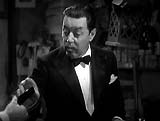 The
character was best played by Swedish actor Warner Oland (from 1931-1937
in 16 films), who portrayed Chan as a dapper fellow who was always
polite and unassertive but nevertheless was solving the crime using
physical evidence and logical deduction. The sly, composed Charlie
Chan would eloquently spout Confucius-type proverbs, aphorisms, and
wisdom in pidgin English, achieved by dropping definite articles
and verbs: ("difficult to catch fly with one
finger," "bad alibi like dead fish - can't stand test of time,"
"Joy in heart more desirable than bullet," "must not too soon
come to conclusion," "Perfect case like perfect doughnut - has hole"
and "silence is golden, except in police station," for example),
always with a courteous, paternalistic, and inquisitive manner. The
character was best played by Swedish actor Warner Oland (from 1931-1937
in 16 films), who portrayed Chan as a dapper fellow who was always
polite and unassertive but nevertheless was solving the crime using
physical evidence and logical deduction. The sly, composed Charlie
Chan would eloquently spout Confucius-type proverbs, aphorisms, and
wisdom in pidgin English, achieved by dropping definite articles
and verbs: ("difficult to catch fly with one
finger," "bad alibi like dead fish - can't stand test of time,"
"Joy in heart more desirable than bullet," "must not too soon
come to conclusion," "Perfect case like perfect doughnut - has hole"
and "silence is golden, except in police station," for example),
always with a courteous, paternalistic, and inquisitive manner.
The series continued, with less noteworthy quality, with American
actor Sidney Toler (1938-1947 in 22 appearances), and American film and TV
character actor Roland Winters (1947-1949 in 6 films) as the sixth and last
screen Chan. Fox was responsible for the Chan films from 1929-1942,
followed by Monogram (from 1944-1949). Charlie Chan also appeared on TV in
39 half-hour episodes, The New Adventures of Charlie Chan, during 1957-58:
- Behind That Curtain (1929), Fox's first film,
with E.L. Park as Chan; first sound film in series
With Warner Oland (1931-1937)
- Charlie Chan Carries On (1931) - lost film
- The Black Camel (1931)
- Charlie Chan's Chance (1932) - lost film
- Charlie Chan's Greatest Case (1933) - lost
film
- Charlie Chan's Courage (1934) - lost film
- Charlie Chan in London (1934)
- Charlie Chan in Paris (1935)
- Charlie Chan in Egypt (1935)
- Charlie Chan in Shanghai (1935)
- Charlie Chan's Secret (1936)
- Charlie Chan at the Circus (1936)
- Charlie Chan at the Race Track (1936)
- Charlie Chan at the Opera (1936) - one of the best
(in terms of script and direction)
- Charlie Chan at the Olympics (1937)
- Charlie Chan on Broadway (1937)
- Charlie Chan at Monte Carlo (1937)
With Sidney Toler (1938-1947)
- Charlie Chan in Honolulu (1938)
- Charlie Chan in Reno (1939)
- Charlie Chan at Treasure Island (1939) - possibly
the best in the series
- (Charlie Chan in) City in Darkness (1939)
- Charlie Chan in Panama (1940)
- Charlie Chan's Murder Cruise (1940)
- Charlie Chan at the Wax Museum (1940) - one of the
best
- Murder Over New York (1940)
- Dead Men Tell (1941)
- Charlie Chan in Rio (1941)
- Castle in the Desert (1942) - the final 20th Century
Fox film in the series
- Charlie Chan in the Secret Service (1944) - the
first at a new, low-budget studio, Monogram
- Charlie Chan in the Chinese Cat (1944)
- (Charlie Chan in) Black Magic (1944)
- (Charlie Chan in) The Jade Mask (1945)
- (Charlie Chan in) The Scarlet Clue (1945)
- (Charlie Chan in) The Shanghai Cobra (1945)
- (Charlie Chan in) The Red Dragon (1945)
- (Charlie Chan in) Dark Alibi (1946)
- (Charlie Chan in) Shadows Over Chinatown (1946)
- (Charlie Chan in) Dangerous Money (1946)
- (Charlie Chan in) The Trap (1947)
With Roland Winters (1947-1949)
- (Charlie Chan in) The Chinese Ring (1947)
- (Charlie Chan in) Docks of New Orleans (1948)
- (Charlie Chan in) Shanghai Chest (1948)
- (Charlie Chan in) The Golden Eye (1948)
- (Charlie Chan in) The Feathered Serpent (1948)
- (Charlie Chan in) The Sky Dragon (1949)
Foreign Sleuths:
Mr. Moto -
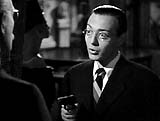 To
compete with Charlie Chan, another Far-Eastern sleuth - of Japanese descent,
derived from the I.A. Moto character in Pulitzer Prize-winning John P. Marquand's
novels (which first appeared as Saturday Evening Post serials), was
developed by 20th Century Fox, and named Mr. Moto. Hungarian-born German actor
Peter Lorre (in his 7th American film role) starred in the title role as the
enigmatic, quiet, self-effacing, unobtrusive, spectacle-wearing and brilliant
detective in the eight-film series (produced in less than three years from
1937-1939): To
compete with Charlie Chan, another Far-Eastern sleuth - of Japanese descent,
derived from the I.A. Moto character in Pulitzer Prize-winning John P. Marquand's
novels (which first appeared as Saturday Evening Post serials), was
developed by 20th Century Fox, and named Mr. Moto. Hungarian-born German actor
Peter Lorre (in his 7th American film role) starred in the title role as the
enigmatic, quiet, self-effacing, unobtrusive, spectacle-wearing and brilliant
detective in the eight-film series (produced in less than three years from
1937-1939):
- Think Fast, Mr. Moto (1937)
- Thank You, Mr. Moto (1937) - the best in the series
- Mr. Moto's Gamble (1938)
- Mr. Moto Takes a Chance (1938)
- The Mysterious Mr. Moto (1938) - another great one
- Mr. Moto's Last Warning (1939)
- Mr. Moto in Danger Island (1939)
- Mr. Moto Takes a Vacation (1939)
Mr. Moto was resurrected 26 years later, to compete with the
popular James Bond action series, with Caucasian actor Henry Silva
as the quizzical Moto, in The Return of Mr. Moto (1965).
Mr. Wong -
A fictional Chinese-American detective, named James
Lee Wong (simply Mr. Wong) created by Hugh Wiley (for a series of
stories in Colliers Magazine in the mid-1930s) was the lead character
in a series of six films from Monogram Pictures. In the first five
films, Boris Karloff took the lead role. In the sixth (and final)
film in the Mr. Wong series,
Phantom of Chinatown (1940), Chinese-American actor Keye Luke
took the role of the title character. This marked the first time
an American film featured an Asian character as a lead Asian detective.
- Mr. Wong Detective (1938)
- The Mystery of Mr. Wong (1939)
- Mr. Wong
in Chinatown (1939)
- The Fatal Hour (1940)
- Doomed to Die (1940)
- Phantom
of Chinatown (1940)
The Thin Man Series - (Nick and Nora Charles)
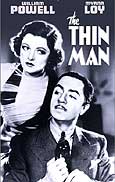 The
most popular film detectives of the 1930s were a delightful, high-society
sleuthing couple: the inebriated Nick Charles with his wife Nora (and dog
Asta). The characters in MGM's The Thin Man (1934) were derived from Dashiell Hammett's 1934 novel of the same title. The sophisticated,
wise-cracking, boozing couple (magnificently portrayed by William Powell and
Myrna Loy) managed to solve crimes and crack jokes in a long series of screwball-mystery
gems. After their first film in 1934, there were five more grade-A sequels
from 1936-1947 from MGM, although none were as good as their first effort.
The first four films were directed by W.S. Van Dyke: The
most popular film detectives of the 1930s were a delightful, high-society
sleuthing couple: the inebriated Nick Charles with his wife Nora (and dog
Asta). The characters in MGM's The Thin Man (1934) were derived from Dashiell Hammett's 1934 novel of the same title. The sophisticated,
wise-cracking, boozing couple (magnificently portrayed by William Powell and
Myrna Loy) managed to solve crimes and crack jokes in a long series of screwball-mystery
gems. After their first film in 1934, there were five more grade-A sequels
from 1936-1947 from MGM, although none were as good as their first effort.
The first four films were directed by W.S. Van Dyke:
- The Thin Man (1934)
- After the Thin Man (1936)
- Another Thin Man (1939)
- Shadow of the Thin Man (1941)
- The Thin Man Goes Home (1945), d. Richard Thorpe
- Song of the Thin Man (1947), d. Edward Buzzell
Peter Lawford and Phyllis Kirk portrayed the pair for
three seasons on NBC-TV in The Thin Man from 1957-1959, in
72 30-minute episodes.
Bulldog Drummond -
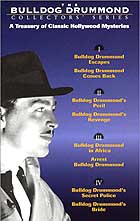 Another
literary figure from "Sapper's" (Herman Cyril McNeile) famed detective novels
- Captain Hugh "Bulldog" Drummond - became the featured suave,
gentleman-spy hero in many films mostly made between the silents through
to the late 40s. Drummond battled foreign agents, kidnappers, spies,
and other villains during his adventurous exploits. The detective was
portrayed by, among others: Another
literary figure from "Sapper's" (Herman Cyril McNeile) famed detective novels
- Captain Hugh "Bulldog" Drummond - became the featured suave,
gentleman-spy hero in many films mostly made between the silents through
to the late 40s. Drummond battled foreign agents, kidnappers, spies,
and other villains during his adventurous exploits. The detective was
portrayed by, among others:
- Ronald Colman in Bulldog Drummond (1929) -
Colman's talkie debut
- Ronald Colman in Bulldog Drummond Strikes
Back (1934)
- Ralph Richardson in The Return of Bulldog Drummond
(1934, UK) [Note: He portrayed the villain in Bulldog
Jack (1935)]
- Atholl Fleming in Bulldog Jack (1935, UK) (aka Alias
Bulldog Drummond)
- Ray Milland in Bulldog Drummond Escapes (1937)
- John Lodge in Bulldog Drummond at Bay (1937)
- John Howard in Bulldog Drummond's Revenge (1937), Bulldog
Drummond Comes Back (1937), Bulldog Drummond's Peril (1938), Bulldog
Drummond in Africa (1938), Arrest Bulldog Drummond (1939), Bulldog
Drummond's Bride (1939), and Bulldog Drummond's Secret
Police (1939)
- Ron Randell in Bulldog Drummond at Bay (1947) and Bulldog
Drummond Strikes Back (1947) - Columbia Pictures' ill-fated
attempt to revive the series
- Tom Conway in The Challenge (1948) and 13
Lead Soldiers (1948)
- Walter Pidgeon in Calling Bulldog Drummond (1951,
UK)
Bulldog Drummond was resurrected for a short
period of time in the mid-to-late 1960s as a resourceful British
agent, during the flurry of James Bond imitators:
- Richard Johnson in Deadlier Than the Male (1967,
UK)
- Richard Johnson in Some
Girls Do (1969, UK)
Boston Blackie -
Columbia Pictures presented fourteen low-budget installments
of another detective series (from 1941 to 1949) titled Boston
Blackie,
starring square-jawed Chester Morris in the lead role as a former jewel
thief/con artist and debonair tough guy who reformed himself and
turned detective. The series was based on the 1910 book by Jack Boyle,
and the wise-cracking character first appeared in various silent
era versions:
- Boston Blackie's Little Pal (1918), Metro, with
Bert Lytell as the safe-cracker
- Boston Blackie (1923), Fox, starring William Russell
- The Return of Boston Blackie (1927), Chadwick, with
Raymond Glenn (Bob Custer)
The 14 mass-produced Columbia Pictures films in the
1940s, often training grounds for a number of future prominent directors,
were:
- Meet Boston Blackie (1941), d. Robert Florey
- Confessions of Boston Blackie (1941), d.
Edward Dmytryk - one of the best in the series
- Alias Boston Blackie (1942), d. Lew Landers
- Boston Blackie Goes Hollywood (1942), d. Michael
Gordon
- After Midnight With Boston Blackie (1943), d. Lew
Landers
- The Chance of a Lifetime (1943), d. William
Castle (his debut film)
- One Mysterious Night (1944), d. Bud Boetticher,
Jr.
- Boston Blackie Booked on Suspicion (1945), d. Arthur
Dreifuss
- Boston Blackie's Rendezvous (1945), d. Arthur Dreifuss
- A Close Call for Boston Blackie (1946), d. Lew Landers
- The Phantom Thief (1946), d. D. Ross Lederman
- Boston Blackie and the Law (1946), d. D. Ross Lederman
- Trapped by Boston Blackie (1948), d. Seymour Friedman
- Boston Blackie's Chinese Venture (1949), d. Seymour
Friedman
On television, there were 58 half-hour episodes in a 1951 Boston Blackie series, with Kent Taylor as the sleuth.
The Shadow -
A crime-fighting vigilante, The
Shadow was based upon the Walter B. Gibson character created
in the early 1930s. He made
his first appearance on July 31, 1930, as the mysterious narrator
of a radio program titled The Detective Story Hour. In 1931 and
1932, Universal Pictures created a series of six film shorts based on
the popular Detective
Story Hour radio program, narrated by The Shadow.
A pulp series
detective magazine from Street & Smith was also dedicated exclusively
to The Shadow. The magazine was titled The
Shadow - A Detective Magazine, published in April of 1931, and
it featured The Shadow in his first literary pulp story, "The
Living Shadow." It was created and primarily written by the prolific
Walter B. Gibson, who had been hired by the publisher to create a
backstory. Author Gibson refashioned the sinister narrator of CBS Radio's The
Detective Story Hour into a dark super-hero - a super-sleuth who
often battled against super-criminals. Then, in September of 1937,
The Shadow radio drama premiered, and the first full-length
feature film about The Shadow was released
by Grand National Pictures.
His alter-ego was Lamont Cranston, an
amateur criminologist and detective, a wealthy crime-fighter who often
wore black, a trench coat, and a face-concealing mask. The words
that introduced The Shadow in the radio program (and the films) have
become immortalized: "Who
knows what evil lurks in the hearts of men? Only the Shadow knows!"
- The Shadow Strikes (1937),
Grand National Pictures, with Rod La Roque as Lamont Cranston/The
Shadow [Based upon the pulp adventure story "The Ghost of the Manor"
by Walter Gibson]
- International Crime (1938),
Grand National Pictures, with Rod La Roque as Lamont Cranston/The
Shadow
- The Shadow (1940), a 15-part serial from
Columbia Pictures, with Victor Jory as Lamont Cranston/The Shadow,
battling the villainous Black Tiger
- The Shadow Returns
(1946), Monogram Pictures, with Kane Richmond as Lamont Cranston/The
Shadow
- Behind the Mask (1946), Monogram Pictures,
with Kane Richmond as Lamont Cranston/The Shadow
- The Missing Lady (1946), Monogram Pictures,
with Kane Richmond as Lamont Cranston/The Shadow
- The Shadow (1954) (TV short, 25-minute pilot
episode), with Tom Helmore as Lamont Cranston/The Shadow
- Invisible Avenger (1958), with Richard
Derr as Lamont Cranston/The Shadow [A feature film composed of
two segments or episodes of Republic Pictures' TV pilot made in
1957] - re-released as Bourbon Street Shadows (1962), about
the investigation of the murder of a New Orleans jazz bandleader.
- The
Shadow (1994), with Alec Baldwin as The Shadow/Lamont Cranston
British Detectives:
The Saint (Simon Templar) -
One of the most popular, long-running mystery film series
of the late 1930s through the early 40s featured the Saint, a mysterious,
sophisticated, and debonair British detective named Simon Templar. The half-crooked
sleuth, a rogue-turned crusader for Scotland Yard, was derived from Leslie
Charteris' popular crime novels of the late 20s. Eight films (of the nine
films) in the 15-year long series were from RKO, with one entry from Republic
in 1943. In the first and last Saint films, Louis Hayward played the
role of Simon Templar. The other two actors were George Sanders and Hugh Sinclair:
- The Saint in New York (1938), RKO, with Louis
Hayward, the best in the series
- The Saint Strikes Back (1939), RKO, with
George Sanders
- The Saint in London (1939), RKO, with George
Sanders
- The Saint's Double Trouble (1940), RKO, with
George Sanders
- The Saint Takes Over (1940), RKO, with George
Sanders
- The Saint in Palm Springs (1941), RKO, with
George Sanders
- The Saint's Vacation (1941), RKO, with Hugh
Sinclair
- The Saint Meets the Tiger (1943), Republic, with
Hugh Sinclair
- The Saint's Girl Friday (1953), RKO, with
Louis Hayward
On television in the British-made series of hour-long shows
in the mid-1960s, Roger Moore portrayed the worldly traveler.
British Detectives:
The Falcon -
Another hardboiled detective, a suave and sophisticated sleuth
named the Falcon, was featured in another RKO series during the 1940s
- almost a carbon-copy of RKO's former Saint. The debonair and aristocratic
Falcon character was taken from Michael Arlen's detective stories. In six
years, there were 13 black and white films in the RKO series. Various actors
portrayed the Britisher (named Gay Falcon, Tom Falcon, and Mike Waring) in
the 16 Falcon pictures, including the former Saint George Sanders
(1941-1942) in the first four, and then Tom Conway (Sander's real-life brother)
in the next nine (from 1943-1946). After a two-year break, independent low-budget
Film Classics bought the rights to the Falcon, and produced three more
entires with John Calvert (1948-49):
- The Gay Falcon (1941)
- A Date with the Falcon (1941)
- The Falcon Takes Over (1942) - with most
of its plot borrowed from Raymond Chandler's Farewell, My Lovely,
and remade two years later as Murder, My Sweet (1944) with
Dick Powell
- The Falcon's Brother (1942) - Sanders and Conway
co-starred
- The Falcon Strikes Back (1943)
- The Falcon and the Co-Eds (1943)
- The Falcon in Danger (1943)
- The Falcon in Hollywood (1944)
- The Falcon in Mexico (1944)
- The Falcon Out West (1944)
- The Falcon in San Francisco (1945)
- The Falcon's Alibi (1946)
- The Falcon's Adventure (1946)
- The Devil's Cargo (1948), Film Classics
- Appointment with Murder (1948), Film Classics
- Search for Danger (1949), Film Classics
On TV during 1954-55, the Falcon (Mike Waring) was portrayed
by Charles McGraw in 39 30-minute episodes.
Agatha Christie's Adaptations:
The prodigious works of British mystery author Agatha
Christie (a total of 72 novels, 160 short stories, and 15 stage plays)
provided a great source for a number of classic detective film mysteries.
One was 20th Century Fox's atmospheric And Then
There Were None (1945) (aka Ten Little Niggers (UK)) from
director Rene Clair. It was often remade (for feature films or
TV movies) with Christie's original novel title Ten Little Indians
(or Ten Little Niggers):
- Ten Little Niggers (1949, UK) (TV) - lost
film
- Ten Little Indians (1959) (TV)
- Agatha Christie's 'Ten Little Indians' (1965,
UK) (aka Ten Little Indians)
- Ten Little Indians (1974, It./W.Germ./Fr./Sp./UK) -
the first English language color version
- Ten Little Indians (1989, UK)
[Christie's book was first published as Ten Little
Niggers in the UK in 1939, and then in 1940 as And Then
There Were None in the US (the offensive title was changed).
It was adapted in 1943 by the author and titled Ten Little Niggers in
the UK for its stage opening in 1943. It was retitled Ten Little
Indians for its US stage opening in 1944. In further film versions,
UK's Seven Arts Films moved the setting to a remote mountain top
castle in the Austrian Alps and released the film as Ten Little
Indians (1965, UK). Avco-Embassy, Inc., produced a third film
version titled Ten Little Indians (1974), with the setting
in a remote hotel in the Iranian desert. In its fourth incarnation
titled Ten Little Indians (1989, UK), Breton Films moved
the locale to an African safari.]
A four-character short story by Christie was made into
a London/Broadway stage hit and was filmed by famed director Billy
Wilder as Witness for the Prosecution (1957).
Agatha Christie's Master Sleuth:
Hercule Poirot -
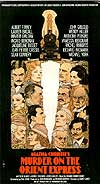 And
in the 1970s and 80s and afterwards (and even in the 1930s), there
were a few screen who-dun-its derived from the works of Agatha Christie
with all-star casts, featuring Christie's colorful, insufferable,
meticulous and fussy Belgian sleuth Hercule Poirot. The films (and
stars) included: And
in the 1970s and 80s and afterwards (and even in the 1930s), there
were a few screen who-dun-its derived from the works of Agatha Christie
with all-star casts, featuring Christie's colorful, insufferable,
meticulous and fussy Belgian sleuth Hercule Poirot. The films (and
stars) included:
- Alibi (1931, UK), Black Coffee (1931, UK), and Lord
Edgware Dies (1934, UK) - with Austin Trevor
- The Alphabet Murders (1965, UK) (aka The
ABC Murders) - with Tony Randall
- Murder on the Orient Express (1974, UK) -
with Albert Finney
- Death on the Nile (1978, UK) - with Sir Peter
Ustinov
- Evil Under the Sun (1982, UK) - with Peter
Ustinov
- Thirteen at Dinner (1985, UK/US) - TV movie
- with Peter Ustinov
- Dead Man's Folly (1986, UK/US) - TV movie
- with Peter Ustinov
- Murder in Three Acts (1986, UK/US) - TV movie
- with Peter Ustinov
- Murder by the Book (1986, UK/Can.) - TV movie
- with Ian Holm
- Appointment with Death (1988) - with Peter
Ustinov
- Agatha Christie's Poirot (1989-2013) - TV
series - with David Suchet
- Murder on the Orient Express (2001) - TV
movie - with Alfred Molina
Agatha Christie's Famous Female Detective:
Miss
Marple -
The character of Agatha Christie's Miss Jane Marple,
a gray-haired, wily, spinsterish detective, was also portrayed in
the movies and on TV over many years, beginning in the 1930s, and
prominent in the 1960s (with four films starring Margaret Rutherford)
and afterwards. The films (and stars) included:
- Murder She Said... (1961, UK) - (based on
Christie's 4:50 From Paddington) - with Margaret Rutherford
- Murder at the Gallop (1963, UK) - (based
on Christie's After the Funeral) - with Margaret Rutherford
- Murder Most Foul (1964, UK) - (based on Christie's Mrs.
McGinty's Dead) - with Margaret Rutherford
- Murder Ahoy (1964, UK) - (some plot borrowings
from Christie's They Do It With Mirrors) - with Margaret
Rutherford
- The Mirror Crack'd (1980) - with Angela Lansbury
- A Caribbean Mystery (1983) - TV movie - with
Helen Hayes
- Agatha Christie's Miss Marple: (approx. 1984-1992) -
BBC TV Mini-series and Masterpiece Mystery (many titles) and TV
movies - with Joan Hickson
- Murder with Mirrors (1985) - TV movie - with
Helen Hayes
- Agatha Christie's Marple (approx. 2004-2007) -
ITV series (12 episodes) - with Geraldine McEwan
- Agatha Christie's Marple (approx. 2008-2013) -
ITV/Acorn series (11 episodes) - with Julia McKenzie
Another of the best of the late 40s murder mysteries
from Britain was director Sidney Gilliat's film Green For Danger
(1947), featuring Alistair Sim as Scotland Yard Inspector Cockrill.
Other Fictional Crime Fighters:
Philo Vance -
The gentlemanly, artistocratic, independently-wealthy
New Yorker, amateur detective Philo Vance was introduced in the
works of Willard Huntington Wright (S.S. Van Dine), first in his
1926 novel The Benson
Murder Case. Thin Man star William Powell and others portrayed
Philo Vance from 1929 to 1947:
- The Canary Murder Case (1929), (in silent and sound
versions) Paramount, William Powell
- The Greene Murder Case (1929), Paramount, William
Powell
- The Bishop Murder Case (1930), MGM, Basil Rathbone
- The Benson Murder Case (1930), Paramount, William
Powell
- The Kennel Murder Case (1933), WB, William Powell
- The Dragon Murder Case (1934), WB, Warren William
- The Casino Murder Case (1935), MGM, Paul Lukas
- The Garden Murder Case (1936), MGM, Edmund Lowe
- The Scarab Murder Case (1936, UK), Paramount/British,
Wilfrid Hyde-White (lost film)
- Night of Mystery (1937), Paramount, Grant
Richards (rare or lost film)
- The Gracie Allen Murder Case (1939), Paramount,
Warren William
- Calling Philo Vance (1940), WB, James Stephenson
- Philo Vance Returns (1947), PRC (Producers Releasing
Corp.), William Wright
- Philo Vance's Gamble (1947), PRC, Alan Curtis
- Philo Vance's Secret Mission (1947), PRC, Alan Curtis
Other Fictional Crime Fighters:
The Lone Wolf -
During the silent era, Bert Lytell often played the
crime sleuth Michael Lanyard (The Lone Wolf), derived from the novels
by Louis Joseph Vance. The Lone Wolf invariably was an international
ex-jewel thief who also served on the side of the law after a change
of heart.
The Columbia series was capped
by nine performances from Warren William (from 1939-1943) as the upper-class
retired crook:
- The Lone Wolf Returns (1935), Columbia, Melvyn
Douglas (also made as a silent film in 1926 also by Columbia)
- The Lone Wolf in Paris (1938), Columbia, Francis
Lederer
- The Lone Wolf Spy Hunt (1939), Columbia, Warren
William
- The Lone Wolf Keeps a Date (1940 or 1941),
Columbia, Warren William
- The Lone Wolf Meets a Lady (1940), Columbia, Warren
William
- The Lone Wolf Strikes (1940), Columbia, Warren
William
- The Lone Wolf Takes a Chance (1941), Columbia, Warren
William
- Secrets of the Lone Wolf (1941), Columbia, Warren
William
- Counter-Espionage (1942) (aka The Lone Wolf
in Scotland Yard), Columbia,
Warren William
- One Dangerous Night (1943), Columbia, Warren William
- Passport to Suez (1943), Columbia, Warren William
- The Notorious Lone Wolf (1946), Columbia, Gerald
Mohr
- The Lone Wolf in Mexico (1947), Columbia,
Gerald Mohr
- The Lone Wolf in London (1947), Columbia, Gerald
Mohr
- The Lone Wolf and His Lady (1949), Columbia, Ron
Randell
On television, Louis Hayward portrayed the Lone Wolf in 1954's
39-part series (of half-hour shows) entitled Streets of Danger.
Other Fictional Crime Fighters or Sleuths:
Hildegarde Withers -
The 40ish, crime-solving, frumpy, spinsterish
schoolteacher in NYC, a version of Agatha Christie's Miss Marple,
was the fictional creation of Stuart Palmer. His second novel in
1931 with the character was titled The Penguin Pool Murder -
also the title of the first feature film. Edna
May Oliver, the definitive character, played the gaunt, thin Miss
Withers in the first three films from RKO Radio Pictures in the mid-1930s.
Her comic foil in all six of the murder mystery film series was Inspector
Oscar Piper (James Gleason).
- Penguin Pool Murder (1932) -
RKO, with Edna May Oliver
- Murder on the Blackboard
(1934) - RKO, with Edna May Oliver
- Murder on a Honeymoon (1935) - RKO, with
Edna May Oliver
- Murder on a Bridle Path (1936) - RKO, with
Helen Broderick
- The
Plot Thickens (1936) - RKO, with ZaSu Pitts
- Forty Naughty Girls (1937) (aka The Riddle of
the 40 Naughty Girls) -
RKO, with ZaSu Pitts
There was also A Very Missing Person (1972) (CBS-TV
movie) starring Eve Arden as Miss Withers.
Ellery Queen -
A smart, scholarly and analytical
crime-solver named Ellery Queen was a recurring who-dun-it detective-hero
derived from the late 1920s novels of cousins Frederic Dannay and
Manfred Bennington Lee (who used "Ellery
Queen" as
their joint pseudonym). Ellery Queen appeared for the first time
in the detective mystery novel The
Roman Hat Mystery (1929).
In the mid-30s, Republic was the first studio to release
low-budget films about Ellery Queen, a brilliant amateur detective.
These were followed by seven films from Columbia Pictures (from
1940-1942), with two actors, Ralph Bellamy (1940-1941) and William
Gargan (1942) in the lead role.
- The Spanish Cape Mystery (1935), Republic, Donald
Cook
- The Mandarin Mystery (1936), Republic, Eddie Quillan
- Ellery Queen, Master Detective (1940), Columbia,
Ralph Bellamy
- Ellery Queen's Penthouse Mystery (1941), Columbia,
Ralph Bellamy
- Ellery Queen and the Perfect Crime (1941), Columbia,
Ralph Bellamy
- Ellery Queen and the Murder Ring (1941), Columbia,
Ralph Bellamy
- A Close Call for Ellery Queen (1942), Columbia,
William Gargan
- A Desperate Chance for Ellery Queen (1942),
Columbia, William Gargan
- Enemy Agents Meet Ellery Queen (1942), Columbia,
William Gargan
There were other iterations of the character in many
TV shows-movies or series, beginning in 1950:
- The
Adventures of Ellery Queen was
a live ABC TV show from 1950-1952 with Richard Hart (and then Lee
Bowman) as Ellery Queen
- Hugh Marlowe starred in the 1954-1957 The
Adventures of Ellery Queen (TV series)
- George Nader
and Lee Philips starred in the 1958-1959 The Further
Adventures of Ellery Queen (TV series)
- Peter Lawford starred in the TV movie Ellery
Queen: Don't Look Behind You (1971) (TV)
- Following the TV show's cancellation in 1959 and
a 16-year delay, Ellery was revived and returned to TV for one-season,
with the title shortened to simply Ellery Queen. The made-for-TV
pilot film Ellery
Queen (1975) (aka Too Many Suspects) preceded Ellery
Queen (a 1975-1976 TV series for one
season on NBC, with 22 episodes) that
starred Jim Hutton as the great fictional detective.
|

 Detective-Mystery Films