|
Title Screen(s)
|
Film Misquote(s)
|
|
Gone With the Wind (1939)

Clue (1985)
The Mask (1994)
|
 Rhett
Butler's (Clark Gable) scandalous, swear-word farewell to Scarlett
(Vivien Leigh) in Gone With the Wind (1939) did
not include Scarlett's name. It was: Rhett
Butler's (Clark Gable) scandalous, swear-word farewell to Scarlett
(Vivien Leigh) in Gone With the Wind (1939) did
not include Scarlett's name. It was:
"Frankly, my dear, I don't give a damn."
Play clip from Gone
With the Wind (1939):  (short
version) (short
version)
Play clip from Gone With the Wind (1939): (long
version)
It was NOT:
"Frankly, Scarlett,
I don't give a damn."
The misquote was heard in Clue (1985), when
Miss Scarlet (Lesley Ann Warren) begged Wadsworth (Tim Curry) to forgive
her for trying to shoot him:
Scarlet: "Wadsworth. Don't hate me for trying to shoot
you."
Wadsworth: "Frankly,
Scarlet, I don't give a damn."
Play clip from Clue (1985):
And in The Mask (1994), the Mask/Stanley Ipkiss
(Jim Carrey) spoofed the line
after being shot:
"Tell Scarlett I do give a damn."
Play clip from The Mask (1994):
[Note: Contrary to popular opinion, Gone
With the Wind (1939) was not the first instance of the
use of the word 'damn' in a film. It reportedly was said a few
times in Glorifying
the American Girl (1929) and in Pygmalion (1938, UK).
Also, the phrase "March and sweat the whole damned day" appeared
on a dialogue card in the silent epic war film The
Big Parade (1925).] |
Only Angels Have Wings (1939)
|
In Only Angels
Have Wings (1939), Cary Grant said the name 'Judy' numerous
times to costar Rita Hayworth (playing a character named Judith
McPherson), such as: "Hello, Judy" -
but never repeated her name in rapid succession.
The phrase: "Judy...Judy...Judy" has often
been falsely attributed
to Cary Grant.
"Helly, Judy."
Play clip from Only Angels Have
Wings (1939):
[Note: Cary Grant vaguely recalled that at a party he
attended, someone introduced Judy Garland by saying, "Judy, Judy,
Judy" and
the phrase was attributed to him. A 1960 New Yorker ad for several
Judy Garland albums ("Judy! Judy! Judy!") reinforced the incorrect
quote.] |
|
The Wizard of Oz (1939)
Honey, I Shrunk the Kids (1989)
|
The
most beloved family film, The Wizard of Oz (1939) has
had many problems with one of its most famous lines spoken by Judy Garland
(as Dorothy Gale) to her dog Toto:
"Toto, I've a feeling we're
not in Kansas anymore."
Play clip from The Wizard of
Oz (1939):
It's generally misquoted as:
- "Toto,
I've got a feeling we're not in Kansas anymore."
or
- "I
don't think we're in Kansas anymore, Toto."
A misquote
was heard in Honey, I Shrunk the Kids (1989) when the two
Szalinski siblings, Amy (Amy O'Neill) and Nick (Robert Oliveri), realized
that they had been miniaturized and trapped in a plastic garbage bag in
their backyard:
Amy Szalinski: "I don't think we're in Kansas anymore, Toto."
Nick Szalinski: "I don't
think we're in the food chain anymore, Dorothy."
Play clip from Honey, I Shrunk the Kids (1989):
|
Knute Rockne: All American (1940)
|
Quite often, an actual quote has been
adapted or abbreviated. This is the original lengthy famous line in
the film
Knute
Rockne: All-American (1940), spoken by team coach Knute Rockne
(Pat O'Brien) as a pep-talk to his losing Notre Dame team during half-time:
"And
the last thing he said to me, 'Rock,' he said, 'sometime when the team
is up against it and the breaks are beating the boys, tell them to go
out there with all they got and win just one for the Gipper."
Play clip from Knute Rockne: All-American (1940):
It has often been stated simply as:
- "Win one for
the Gipper."
or
- "Win this one for the Gipper."
[Note: In the film, Knute Rockne
was recalling what his most famous player, George Gipp (portrayed by
Ronald Reagan), had said earlier: "Ask 'em to go in
there with all they've got, win just one for the Gipper." George
Gipp was a real-life football star who died young of pneumonia and provided
an inspiring anecdote to his coach.] |
The Maltese Falcon (1941)
|
The last line of the film noirish detective
story The Maltese Falcon (1941) was
a two-line conversation between Police Sergeant Tom Polhaus (Ward Bond)
and Sam Spade (Humphrey Bogart):
Polhaus: "It's heavy. What is it?"
Spade: "The
uh, stuff that dreams are made of."
Polhaus: "Huh?"
Play clip from The Maltese Falcon (1941):
Spade's unusual reference paraphrased Prospero's speech
in Act IV of Shakespeare's The Tempest, although it was a misquote of:
"We
are such stuff as dreams are made on." (NOT "made of").
The actual final word
of the film was the Sergeant's puzzled response: "Huh?" Many
forget the real last word and believe that "The uh, stuff that dreams
are made of" is the final line. |
|
Casablanca (1942)

Play It Again, Sam (1972)

Moonraker (1979)
Cut Off (2006)

I Want Candy (2007, UK)
|
"Play
it again, Sam" - was a line never spoken by either Ingrid
Bergman or Humphrey Bogart in Casablanca (1942) to
Sam (Dooley Wilson), the nightclub pianist and reluctant performer of
the sentimental song 'As Time Goes By' (written by Herman Hupfeld).
Variations on the line were spoken, however, by both
leads in the 1942 film:
- Ingrid Bergman (as Ilsa Lund) requested of Sam:
"Play it once, Sam, for old time's sake...Play it, Sam.
Play 'As Time Goes By'."
Play clip from Casablanca
(1942):
- The closest Humphrey Bogart (as Rick Blaine) came
to the phrase was his angry command to Sam:
"You played it for her, you can play it for me...If
she can stand it, I can. Play it!"
Play clip from Casablanca
(1942):
When "Play
It Again Sam"
became the title of a Woody Allen comedy Play
It Again, Sam (1972) that, in part, spoofed the classic 1942
film, the misquote was further reinforced.
The
misquote, "Play it again, Sam" was also heard in at least three
other films, including Moonraker (1979), Cut Off (2006), and I Want
Candy (2007, UK):
- During a well-choreographed
fight sequence, as Bond (Roger Moore) threw a would-be Kendo assassin
Chang (Toshiro Suga) through a gigantic ornate glass clock face and
into a piano on the piazza below, he quipped:
"Play it again, Sam."
Play clip from Moonraker
(1979):
- Cut Off (2006)
"Play it again, Sam."
- - "Well, play it again, Sam."
- "...That was a misquote from Casablanca, by
the way."
During an autobiographical book signing tour for her book Members
Only, semi-retired
adult porn star Candy Fiveways (Carmen Electra) was signing her DVD
for a fan, who told her that his name was 'Sam' and that he had watched
one of her films so many times that he had worn out the disk. She quipped
and urged him: "Well, play it again, Sam." His friend, next
in the book-signing line, told Candy that the previous customer had
just misquoted: "That was a misquote from Casablanca,
by the way." She claimed that she was a fellow film buff and knew the
misquote: "I knew it was a misquote, by the way."
Play clip from I Want Candy (2007): (excerpt)
[Note: However, contrary to popular belief, the Marx
Brothers' spoof A Night in Casablanca (1946) did NOT contain
the line.] |
Casablanca (1942)
|
In Casablanca (1942), Humphrey Bogart never said: "Drop
the gun, Louis."
However, he did give the following warning:
"Not so fast, Louis. Nobody is gonna be
arrested. Not for a while yet."
Play clip from Casablanca (1942):
|
Casablanca (1942)
|
The last line of Casablanca
(1942) is
also often misquoted (and the name Louis, pronounced 'Louie' (in French),
is often mis-spelled as Louie).
The correct line, spoken by Humphrey
Bogart, is:
"Louis, I think this is the beginning
of a beautiful friendship."
Play clip from Casablanca (1942):
It is often mis-stated as:
- "This
could be the beginning of a beautiful friendship."
or
- "I think
this is the start of a beautiful friendship."
|
|
The Treasure of the Sierra Madre (1948)
Blazing Saddles (1974)
The Ninth Configuration (1980)
Gotcha! (1985)
UHF (1989)

Troop Beverly Hills (1989)
|
One of the most oft-quoted lines in cinema
history was in director John Huston's The
Treasure of the Sierra Madre (1948):
"Badges?
We ain't got no badges. We don't need no badges. I don't have to show you
any stinkin' badges!"
Play clip from The Treasure of
the Sierra Madre (1948): (short) (long)
[Note: The line was derived from the 1935 novel by B.
Traven that consisted of the following similar dialogue, with some
Spanish obscenities added in:
"All right, "Curtain shouted back. "If
you are the police, where are your badges? Let's see them."
"Badges, to god-damned hell with badges! We have no badges. In
fact, we don't need badges. I don't have to show you any stinking badges,
you god-damned cabrón and ching' tu madre! Come out there from
that s--t-hole of yours. I have to speak to you." ]
It has often been misquoted or paraphrased, notably in
director Mel Brooks' Blazing Saddles (1974),
spoken by a Mexican bandit (Rick Garcia) as:
"Badges?
We don't need no stinkin' badges!"
Play clip from Blazing Saddles
(1974):
The line of dialogue has also
been misquoted in a number of films, including
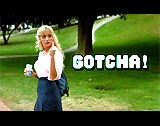
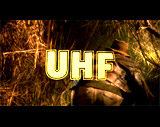
The Ninth Configuration (1980), Gotcha! (1985), "Weird
Al" Yankovic's UHF (1989), and Troop Beverly Hills (1989):
- - "Famous lines from famous movies."
- "Oh,
Frankie, your mother forgives me!"
-
"Victor McLaglen
in The Informer."
-
"We don't need no stinkin'
badges."
- "The Treasure of Sierra Madre."
Play clip from The Ninth Configuration (1980):
- Manolo (Nick Corri): "Don't show me your badges, we don't
know nothing about no stinking badges."
Gotcha! (1985)
- Animal Deliveryman (Cliff Stephens): "Well,
let's see. I got one aardvark, one flamingo, four porcupines, two
armadillos, three badgers..."
Raul Hernandez (Trinidad Silva): "Badgers??? Badgers???
We don't need no steenkin' badgers!"
Play clip from UHF (1989):
- Rosa the Maid (Shelley Morrison): "Patches? We
don't need no stinkin' patches."
(She was referring to the patches of the Wilderness Girls Troop)
Troop Beverly Hills (1989)
|
|
Fallen Angel (1945)
Beyond the Forest (1949)
Who's Afraid of Virginia Woolf? (1966)
|
The following popular catchphrase has
multiple origins, and probably goes way back. It was first heard in
the movies in Otto Preminger's film-noir Fallen Angel (1945).
Eric Stanton (Dana Andrews): "What a dump!"
June Mills (Alice Faye): "It isn't so bad."
Play clip from Fallen Angel (1945):
It was most famously uttered by Bette Davis
(as Rose Moline) in Beyond
the Forest (1949).
Rose Moline (Bette Davis): "What a
dump!"
Play clip from Beyond the Forest
(1949):
It was not popularized until heard in the opening scene
of the 1961 Edward Albee play, upon which the highly-acclaimed film Who's
Afraid of Virginia Woolf? (1966) was based. In
the film, the exact same line was uttered by actress Elizabeth Taylor
(as drunken and discontented 52 year-old wife Martha) as the opening
line of dialogue, upon entering their living room - she even parodied
Bette Davis' mannerisms, exclaiming:
"What a dump!"
She then
berated her professor-husband Richard Burton (as George) for
not remembering the film the line was from:
"...What's it from, for Christ's sake?...some
damn Bette Davis picture, some god-damned Warner Bros epic."
Play clip from Who's
Afraid of Virginia Woolf? (1966):
|
Knock on Any Door (1949)
|
Actor John Derek (Bo Derek's future husband)
in his first major film role (as young Italian hoodlum Nick Romano
in the Chicago slums, who was accused of murdering a cop) stated
the following line in the classic Humphrey Bogart film noir Knock
on Any Door (1949), directed by Nicholas Ray.
He told his girlfriend
Emma (Allene Roberts) that his motto or credo in life remained as:
"What I used to say still goes. Live
fast, die young and have a good-looking corpse!"
Play clip from Knock on Any Door (1949):
The last part of the phrase was fairly original (derived
from the text of the 1947 novel written by the African-American novelist
Willard Motley), while the phrase "live fast and die young"
dated back to the early 1900s.
[Note: The saying, although wrongly modified as “Live
fast, die young and leave a good-looking corpse!” has
often been wrongly attributed to actor James Dean - a quintessential
symbol of disenfranchised youth.] |
White Heat (1949)
|
In the classic gangster film White
Heat (1949),
James Cagney's triumphant shout atop a oil tank before blasting himself
into oblivion has often been erroneously quoted. The actual line was:
"Made
it, Ma. Top of the world!"
Play clip from White Heat (1949):
The line was not:
"Top of the world, Ma!"
|
All About Eve (1950)
|
Bette Davis' most famous film line as
aging, jealous stage actress Margo Channing in All
About Eve (1950) was delivered after she took another stiff
drink during a birthday party. She walked over to the staircase, turned,
and told everyone to buckle up their airplane seatbelts (cars
didn't have seatbelts in the 1950s!):
"Fasten
your seatbelts, it's going to be a bumpy night."
Play clip from All About Eve (1950):
The
line has often been misquoted, substituting the word "ride"
for "night."
"Fasten your seatbelts, it's going to be
a bumpy ride."
|
|
Sunset Boulevard (1950) (aka Sunset Blvd.)
Mrs. Doubtfire (1993)
|
In the closing of the classic film noir Sunset
Boulevard (1950), faded silent film star Norma
Desmond (Gloria Swanson) descended her marble staircase as she
warned famed movie director Cecil B. DeMille (as Himself) that
she was approaching the camera for a close-up:
"All right, Mr. DeMille, I'm ready for my
closeup."
Play clip from Sunset Boulevard (1950):
Many times, the line has been misquoted as:
"I'm ready for my closeup, Mr. DeMille."
The line was misquoted in Mrs. Doubtfire (1993) by
Daniel Hillard/Mrs. Doubtfire (Robin Williams), while speaking to Frank
(Harvey Fierstein) as he/she was made up:
- "I feel like Gloria Swanson."
- "You look like her mother."
- "I'm ready for my close-up, Mr. DeMille."
Play clip from Mrs. Doubtfire (1993):
|

Alice in Wonderland (1951)
|
In Disney's animated classic Alice
in Wonderland (1951), the Cheshire Cat (voice of Sterling Holloway)
has often been erroneously thought to have said:
"We're all mad here."
The
actual lines in the film were:
- "Of course, he's mad too."
- "But I don't want to go among mad people."
- "Oh, you can't help that. Most
everyone's mad here. You
may have noticed that I'm not all there myself."
Play clip from Alice in Wonderland (1951):
In Lewis Carroll's original novel, Alice's Adventures
in Wonderland published in 1865, however, the extended quote was:
"But I don't want to go among mad people," Alice
remarked. "Oh, you can't help that," said the Cat: "We're
all mad here. I'm mad. You're mad." "How do
you know I'm mad?" said Alice. "You must be," said
the Cat, "or you wouldn't have come here."
|
Son of Ali Baba (1952)
|
One of the more interesting misquotes was
attributed to actor Tony Curtis. In many tributes and obituaries when
he died in the year 2010, he was quoted as having said the following
line with a heavy New York accent:
"Yonder lies the
castle of my father."
OR
"Yonda (or yonda) lies da castle of my fodder (faddah, fodda, or fadda)."
Although many sources claimed that Curtis said the line
in The
Prince Who Was a Thief (1951) and/or The Black Shield of Falworth
(1954),
Curtis didn't utter the above quote in either film.
However,
a variation on the line was spoken by Curtis in Son of Ali Baba
(1952):
"This is my father’s
palace. And yonder lies the Valley of the Sun."
Play clip from Son of Ali Baba (1952):
|
Tea and Sympathy (1956)
|
Director Vincente Minnelli's melodramatic Tea
and Sympathy (1956) began as playwright Robert Anderson's stage play,
debuting in NYC in 1953.
The controversial film was about bullying and social
prejudice against "unmanly" prep school student
Tom Lee (John Kerr), who was shown understanding and friendship by
Laura Reynolds (Deborah Kerr) - the lonely, frustrated wife of Bill
(Leif Erickson), the school's coach.
The film's title came from his
description of his wife's role at the school, when she completed his
sentence:
- Bill: "All you're supposed
to do is once in a while give the boys a little tea..."
- Laura: "...tea and sympathy."
Play clip from Tea and Sympathy (1956):
The Rolling Stones 1969 song Let It Bleed, written
by Mick Jagger and Keith Richards (and performed by Mick Jagger), modified
the line in one of the verses:
She said, "My breasts, they will always be open
Baby, you can rest your weary head right on me
And
there will always be a space in my parking lot
When you need a little
coke and sympathy."
Play clip of Let It Bleed (1969):
[Note: The acclaimed film, bowdlerized and with a tacked-on
ending, should have ended with Laura's advice to Tom:
"Years
from now, when you talk about this, and you will, be kind."
Play clip from Tea and Sympathy (1956): ]
|
|
Goldfinger (1964, UK)
Dr. No (1962, UK/US)

You Only Live Twice (1967)
|
There were a few variations on the famous
James Bond 007 drink preference quote: "...shaken, not stirred," first
heard uttered by the Bond character (Sean Connery) himself in Goldfinger
(1964):
"...Just a drink. A martini, shaken, not
stirred."
Play clip from Goldfinger (1964):
Villain Dr. Julius No (Joseph Wiseman) offered the familiar drink to
Bond in the earlier first Bond film Dr.
No (1962) - with the words:
"A medium dry martini,
lemon peel. Shaken, not stirred."
Play clip from Dr. No (1962):
In You
Only Live Twice (1967),
the drink instructions were reversed, with Bond
politely agreeing with his host Henderson (Charles Gray) and accepting
the altered drink: "Perfect!"
"Oh, that's, uh,
stirred, not shaken. That was right, wasn't it?"
Play clip from You Only Live Twice
(1967):
|
|
Alfie (1966, UK)

Educating Rita (1983, UK)
|
In the UK film Alfie (1966, UK),
Michael Caine (as the title character) said a lot of phrases such as:
"(You) know what?"
"(You) Know what I mean?"
"(Do) you know..."
"I don't know..."
"...I don't want to (wanna) know."
However, Alfie never said: "(And)
not a lot of people know that" - although the catchphrase
(in many variations) was attributed to him for many decades.
Caine claimed that it was actually
Peter Sellers who had impersonated his voice with the phrase on his
telephone answering machine: ("This is Michael Caine, Peter Sellers
is out. Not many people know that"). Sellers repeated the humorous
phrase during an appearance and impersonation of Michael Caine on BBC-TV's The
Michael Parkinson Show in
1972.
"It takes a man in a tweed
suit five and a half seconds to fall from the top of Big Ben to the
ground. Now there's not many people know that!"
The phrase was also given to Caine (as the character
of Dr. Frank Bryant) as an in-joke in the film Educating Rita (1983,
UK), who drunkenly spoke:
"Did you know that Macbeth was a maggoty apple? Not many people know
that!"
[Note: Caine's first trivia book
published in 1986, Almanac
of Amazing Information, was sub-titled: "Not Many People
Know That." Proceeds from the book went to a charity: the National Playing Fields Association. Another
published in 1988 was sub-titled: "And Not Many People Know This
Either!"] |
Cool Hand Luke (1967)
|
The tagline from Cool
Hand Luke (1967) has often been modified from its original.
In its most famous utterance, the Captain (Strother Martin) said
to recalcitrant chain gang prisoner Luke (Paul Newman):
"What
we've got here is (pause) failure to communicate."
Play clip from Cool
Hand Luke (1967): (Captain's
line)
It was NOT:
"What we have here is a failure
to communicate."
However, the line with the word 'a' added was later
sarcastically repeated (by character Luke to the prison warden before
he was shot) -- as:
"What we got here is a failure to
communicate."
Play clip from Cool Hand Luke (1967): (Luke's
line)
|
|
The Graduate (1967)
The Ladies Man (2000)
(National Lampoon's) Van Wilder (2002) (aka Van Wilder: Party Liaison)
A Walk to Remember (2002)
|
In The
Graduate (1967), Benjamin Braddock (Dustin Hoffman) made a statement
and then asked a question of the Mrs. Robinson (Anne Bancroft) character.
As he naively asked his question, the camera shot under her upraised
leg, framing Ben underneath:
- Benjamin: "For God's sake, Mrs. Robinson, here
we are, you've got me into your house. You give me a drink. You put
on music, now you start opening up your personal life to me and tell
me your husband won't be home for hours... Mrs.
Robinson, you're trying to seduce me. Aren't you?"
Play clip from The Graduate
(1967): (short
version) (long
version)
He
did NOT ask either of these two questions:
- "Mrs. Robinson, are
you trying to seduce me?"
or
- "Are you trying to seduce
me, Mrs. Robinson?"
Shortly later upstairs in her home, Mrs. Robinson
went further and asked Benjamin:
"Would
you like me to seduce you?...Is that what you're trying to tell me?"
Play clip from The Graduate (1967):
The misquote (in a number of variations) was
heard in a few films, for example, The
Ladies Man (2000), Van Wilder (2002), and A Walk to Remember
(2002).
- Drunk and lying back on a waterbed, salacious radio-show
host Leon Phelps (Tim Meadows) asked loyal producer Julie Simmons
(Karyn Parsons) - who had accidentally fallen on top of him:
"Mrs. Robinson,
are you trying to seduce me?"
The
Ladies Man (2000)
- Ms. Doris Haver (Cynthia Fancher): "Mr. Wilder,
are you trying to seduce me?"
Van Wilder (Ryan Reynolds): "Who, me? No! Hey, hey..."
(National Lampoon's) Van
Wilder (2002)
Play clip from (National Lampoon's) Van Wilder (2002):
- Jamie Sullivan (Mandy Moore): "Are you trying
to seduce me?"
Landon Carter (Shane West): "Why?
Are you seducible?"
A Walk to Remember (2002)
Play clip from A Walk to Remember (2002):
|

Planet of the Apes (1968)
|
In Planet
of the Apes (1968), captured astronaut George Taylor (Charlton
Heston) screamed at one of the apes:
"Take your stinkin' paws off me,
you damn dirty ape!"
Play clip from Planet
of the Apes (1968):
He did NOT say:
"Get your stinkin' paws
off me, you damn dirty ape."
|
The Italian Job (1969, UK)
|
In the original British caper film The
Italian Job (1969, UK) about a gang stealing gold bullion from a bank
vault in Turin, Italy, this famous quote was heard from Cockney gangster
Charlie Croker (Michael Caine) as the film ended:
"Hang on a minute, lads, I’ve
got a great idea."
Play clip from The Italian Job (1969):
He did not say:
- "I've got an idea."
or
- "Hang on, lads.
I've got a great idea."
[Note: From the same film, the following line was
voted the favorite film one-liner in a 2003 poll of 1,000 British film
fans, reported in The
Telegraph.
"You were only supposed to blow the bloody doors
off!"
Play clip from The Italian Job (1969):
It demoted
the previous most favorite line down to the # 2 spot - Rhett Butler's
(Clark Gable) retort to Scarlett O'Hara (Vivien Leigh) in Gone
With the Wind (1939) - see earlier:]
"Frankly,
my dear, I don't give a damn!"
|
|
Dirty Harry (1971)

Short Circuit 2 (1988)

Scary Movie 2 (2001)
Showtime (2002)
|
Vigilante
SF cop 'Dirty' Harry Callahan (Clint Eastwood), while
holding his giant-sized .44 Magnum at a downed bank robber (Albert Popwell)
in the opening of Dirty Harry (1971), said:
"I know what you're thinkin'. 'Did he fire
six shots or only five?' Well, to tell you the truth, in all this
excitement, I've kinda lost track myself. But being as this is a
.44 Magnum, the most powerful handgun in the world, and would blow
your head clean off, you've got to ask yourself one question: 'Do
I feel lucky?' Well, do ya punk?"
Play clip from Dirty
Harry (1971): (beginning
of film)
He never said:
"Do
you feel lucky, punk?"
The same full quotation was ritualistically repeated
again almost verbatim at the film's conclusion, when Callahan confronted
the killer Scorpio (Andrew Robinson):
"I
know what you're thinkin', punk. You're thinkin': 'Did he fire six shots
or only five?' And to tell you the truth, I forgot myself in all this excitement.
But bein' this is a .44 Magnum, the most powerful handgun in the world,
and will blow your head clean off, you could ask yourself a question: 'Do
I feel lucky?' Well, do ya, punk?"
Play clip from Dirty
Harry (1971): (end
of film)
Misquotes of the same lines were
heard in a number of films, including Short
Circuit 2 (1988), Scary
Movie 2 (2001), and Showtime (2002):
- Robot Johnny Five imitated both Sylvester Stallone
and Clint Eastwood in one line:
"Yo,
come on, you bug-eyed geek! Do you feel lucky, punk?"
Play clip from Short Circuit 2 (1988):
- Dwight Hartman (David Cross) confronted the Hell
House Ghost (Richard Moll):
"I
know what you're thinkin'. Did I fire three shots or a hundred and
seventeen? Well, do you feel lucky, (pause) punk? Do you (pause) feel lucky? Do you feel
lucky, punk?"
Hell House
Ghost: "Shoot me, motherf--ker!"
Play clip from Scary Movie 2 (2001):
- In the "Confessional" Camera
Scene - Detective Mitch Preston (Robert De Niro) asked:
"Do you
feel lucky, punk? Who said that?"
Showtime (2002)
|






 Greatest
Film Mis-Quotes: Some of the most classic film lines or scenes
are really only legendary and/or apocryphal, or they are merely
movie misquotes, but after many years of repetition and being
misquoted in subsequent films, they have become part of the filmgoing
public's consciousness. Many of these examples are film quotes that
were either commonly attributed wrongly, or in fact were never actually
spoken.
Greatest
Film Mis-Quotes: Some of the most classic film lines or scenes
are really only legendary and/or apocryphal, or they are merely
movie misquotes, but after many years of repetition and being
misquoted in subsequent films, they have become part of the filmgoing
public's consciousness. Many of these examples are film quotes that
were either commonly attributed wrongly, or in fact were never actually
spoken.