|

| Film Title/ Director & Editor and Film Description | ||||||||||||||
|
d. William Friedkin
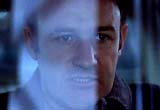
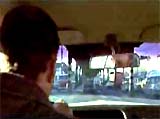
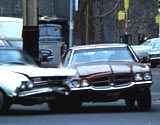
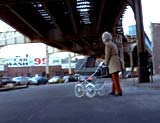
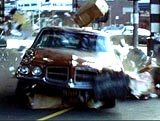
The film's most incredible scene was the hair-raising sequence of unbelievable car-chasing. New York City detective Jimmy "Popeye" Doyle (Best Actor-winning Gene Hackman) drove 90 mph in pursuit in a hijacked civilian car, a 1971 Pontiac Le Mans: ("Police emergency: I need your car") of a suspected smuggler-drug dealer's sniper-hitman Nicoli in a hijacked elevated subway train above him in Brooklyn (the BMT West End line). To keep pace, Doyle drove 90 mph and barely missed pedestrians and other vehicles on the narrow two-lane road beneath the elevated tracks; he half-collided with another white car at an intersection, was clipped or side-swiped by a delivery van/truck, dodged a mother and her baby carriage, and crashed into garbage, all the while furiously honking the car's horn and frantically switching from his brake to accelerator; he banged his fists on the steering wheel, angered at the delays and frustrations. During the chase, he - among other things - half-collided with another car, dodged a mother and her baby carriage, and side-swiped a delivery van, all the while furiously honking the car's horn and frantically switching from his brake to accelerator.
|
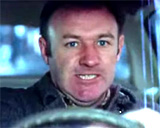  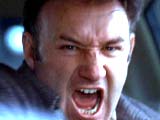 Crazed Jimmy "Popeye" Doyle Driving a Hijacked Civilian Car |
||||||||||||
|
d. Bob Fosse
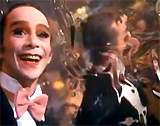
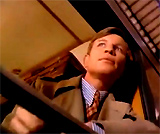
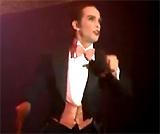
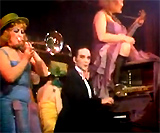
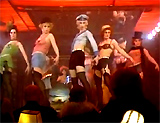
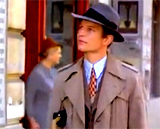
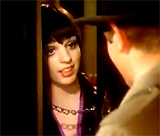
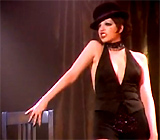
Director/choreographer Bob Fosse's defining, decadent, award-winning musical which popularized the phrase: "Life is a Cabaret" was only the director's second film, but won numerous accolades (and was a financial and artistic hit). From its ten Academy Award nominations, the vibrant film won eight Oscars. The sexually-charged, semi-controversial, kinky musical was the first one ever to be given an X rating (although later re-rated) with its numerous sexual flings and hedonistic club life. The film opened in Berlin, 1931, with sinister, androgynous, chalk white-faced, demonic Master of Ceremonies (Joel Grey) in the Kit Kat Club, a cabaret filled with frivolity and gaiety among its patrons. The MC host with painted lips and rouged cheeks, facing a warped mirror-wall, turned to the camera (and audience) to sing: "Willkommen" - a cheery greeting in German, French and English. The next segments were cleverly intercut with each other, to introduce the film's two other main characters. Simultaneously with the stage show, a railway train arrived at the Berlin station where a wide-eyed, smiling, blonde-haired passenger looked out the train window. Then, a female orchestra appeared on stage, and the host introduced six scantily-clad "cabaret girls" - "Heidi. Christine. Mausie. Helga. Betty... ...und lnge" - all with suggestive and exaggerated poses parodying sexiness. He also introduced a performer with a red dress - "the charming singer from America, Miss Sally Bowles!" (Liza Minnelli) but she wasn't emphasized yet as a main character. The rail passenger disembarked from the train and proceeded to a bohemian boarding house, where he spoke to false dark eyelash-wearing, American tenant Sally Bowles with a black helmet of hair. He explained he was looking for an inexpensive room to rent from Fraulein Schneider (Elisabeth Neumann-Viertel). Sally said she wasn't home and then begged: "Have you a cigarette, darling? l am desperate!" - and then showed off her painted green fingernails: "Divine decadence." He introduced himself as Brian Roberts (Michael York), an innocent, introverted and naive teacher hoping to pay his rent by offering English lessons. Eager to please, she toured him through the facilities, and showed him a small vacant room with only a bed. In her larger suite across the hall, she invited him to share the space and move right in, to offer his lessons there. Sally described how she had been there for three months, but worked nights: "l dash all day and l work late at the Cabaret." In the next scene, the free-spirited, over-the-top tawdry, and vampish singer/dancer Sally performed the show-stopping number "Mein Herr" at the seamy Club (with Brian in the audience) - made memorable with a black bowler, mascara, black stockings and garter, and low V-cut black outfit. |
|
||||||||||||
|
d. Francis Ford Coppola
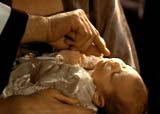
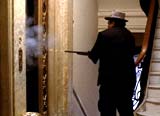
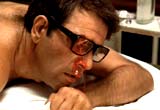
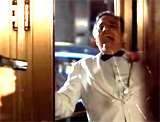
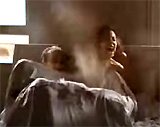
In the final extraordinary baptism scene, probably occurring in 1955, Michael Corleone (Al Pacino) acted as godfather at the christening of his sister Connie's (and Carlo's) child, his nephew and namesake. [The infant in the scene was director Coppola's daughter Sofia Coppola in an uncredited role.] The scene brilliantly crosscut back and forth from the church to locations throughout the city as gangland murders were orchestrated. With controlled intensity, Michael engineered a cold-blooded mass killing of Barzini, Tattaglia, Greene and all other rival gangleaders of the Five Families to settle the "Family business." While methodically committing the series of vicious and bloody counterattack gangland murders to confirm his position as the new godfather, he was at the church altar listening to holy recitations of the priest (Joseph Medaglia) during the baptism - in juxtaposed scenes. The killings took place in the following order:
|
|
||||||||||||
|
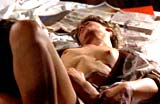
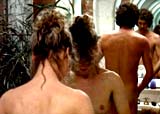
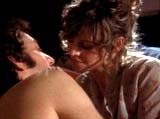
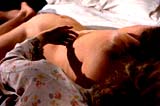
Don't Look Now (1973, UK/It.) d. Nicolas Roeg This intense mystery/drama told about a vacationing married couple Laura (Julie Christie) and John Baxter (Donald Sutherland). They were in Venice after the tragic accidental drowning demise of their daughter in England. The two had a three-minute explicit, honest, and frank love scene in their hotel room in which they reconnected emotionally. [Many questioned whether the sex was real or not.] The erotic sex scene was creatively edited - intercut and juxtaposed with their showering-bathing-dressing (in both the bathroom and bedroom) and last-minute preparations for going out to dinner afterwards. As they relaxed languorously together on the bed, she stated: "You've got toothpaste all over your mouth" to which he replied: "Eat if off" - she responded with a kiss, and a playful stroking of his naked backside as they both stretched out on a bed to make love. [Note: The scene was imitated in Steven Soderbergh's Out of Sight (1998) between George Clooney and Jennifer Lopez.]
Another deftly edited sequence was in the film's seven-minute opening with over 100 separate shots. It was composed of a series of intercut foreshadowing visual clues that were later elliptically inter-woven into the film, ominously portending further death. |
|
||||||||||||
|
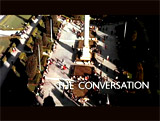
The
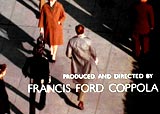
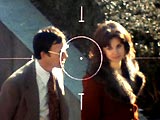
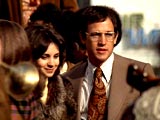
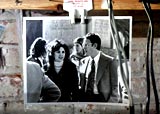
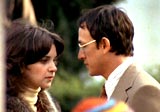
Conversation (1974) Francis Ford Coppola's timely, low-budget cinematic masterpiece of the 1970s was a slowly-gripping, bleak study of electronic surveillance and threat of new technologies. In its audacious opening scene (under the credits), the setting was surveyed with a bird's-eye view of Union Square in downtown San Francisco during a busy lunch time on a sunny day in December. Pedestrians, office workers on lunch break, and Christmas shoppers mingled together in the long view. Slowly, the camera zoomed closer and picked out a young, white-faced Mime (Robert Shields), dressed in a black-and-white drum major's costume, who imitated and parodied unsuspecting bypassers. The Mime selected a mid-40s aged, balding gentleman in the crowd who was sipping coffee and wearing a grayish, transparent rain slicker. The man - soon identified as the protagonist - was Harry Caul (Gene Hackman), a bespectacled, slightly balding, mustached, mid-forties leader of a professional team of snoopers-for-hire who were monitoring something in the park. Below a neon-lit sign for the CITY PARIS (on top of an image of the Eiffel Tower) high atop a building was a bundled-up individual wearing headphones holding an extended shot-gun microphone pointed into the square. It became increasingly clear that the target of surveillance, where the telescopic gunsight was aimed, was a young couple, later identified as:
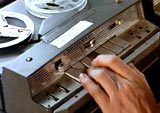
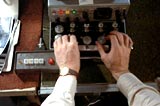
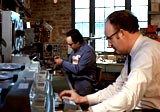
Innocuously, Harry stood close to the couple as they joined the group of spectators around the band. Another man named Paul (Michael Higgins), part of the eavesdropping team, with a hearing-aid wire and carrying a shopping bag with electronic recording devices inside a disguised gift package, also discreetly followed them to 'record' their conversation. Bits and pieces of their disjointed, fragmented talk were heard as it cut in and out while they were walking and talking. Later in the film, Harry methodically sorted through the materials from the previous day's work. In a mesmerizing scene, he threaded and synchronized three tape recorders with the tapes from the three locales (Unit A: shopping bag, Unit B: parabolic, Unit C: City of Paris). By playing all three recorders at the same time and varying their volumes on a mixer, Harry was able to construct, synthesize and splice together a fourth clearer recording onto another Ampex tape-recording machine. Painstakingly, he rewound and replayed fragments of dialogue - slowly piecing together Ann and Mark's audible conversation. Flashbacks cut back and forth to the footage from the previous afternoon. Eventually, as he listened and further interpreted, he revealed evidence of what he conjectured was a sinister plot regarding the 'personal problems' of his clients. At the same time in the scene, he argued with his assistant Stanley (John Cazale), who made annoying statements about their "stupid conversation" on the tape. But as Harry delved deeper and deeper into the recording, spinning and rewinding the final inaudible fragments of conversation, he finally deciphered the most devastating and crucial line of dialogue below the sound of the bongo drums:
|
|
||||||||||||
|
d. Steven Spielberg
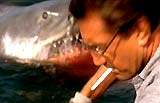
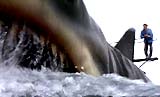
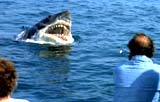
Spielberg's film was a huge summer box-office blockbuster in the mid-1970s, although the filming suffered many difficulties:
Much of the film was severely edited to avoid showing the shark for a long period of time (because of problems with the fake sharks), thereby actually enhancing the film's scare quotient. |
|
||||||||||||
|
d. John Avildsen
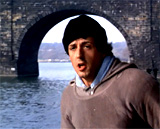
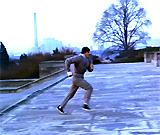
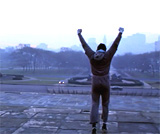
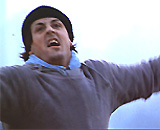
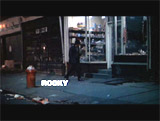
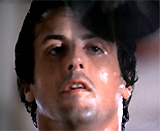
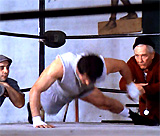
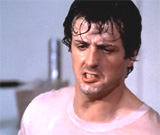
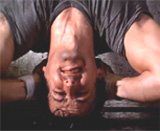
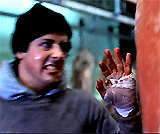
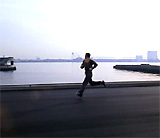
This phenomenally successful, uplifting, "sleeper" film was filmed in a record twenty-eight days with a paltry budget of about $1 million, and ultimately grossed well over $100 million. The action-packed, 'feel-good' crowd-pleasing story, shot mostly on location, told of the rise of a small-time, has-been, underdog Philadelphia boxer named Rocky Balboa (Sylvester Stallone) against insurmountable odds in a big-time bout. He was given emotional support by his shy, hesitant, loving girlfriend Adrian (Talia Shire). In the most memorable, well-edited sequence of the film, a montage accompanied by the rousing song "Gonna Fly Now " (by Bill Conti), Rocky underwent further grueling training and workouts in preparation for his Bicentennial fight against Apollo Creed (Carl Weathers). At dawn, he:
In the conclusion of the sequence, he turned and faced the panorama of the city, with his hands triumphantly raised in the air. Although his first run up the endless steps was overwhelmingly difficult, this run was effortless. |
|
||||||||||||
|
d. George Lucas
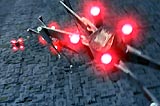
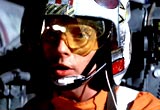
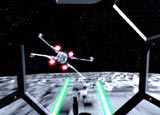
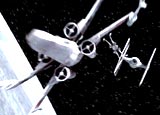
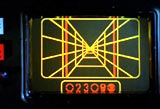
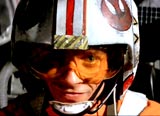
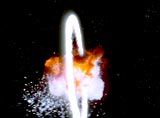
The Oscar-winning Death Star battle sequence was prefaced by a briefing session. Rebel Alliance pilots, including young Luke Skywalker (Mark Hamill), were told about the Death Star's one vulnerable Achilles' heel "weakness" - a long, narrow shaft at the center. If penetrated, entered by a small one-man fighter after a difficult approach, and struck in a direct hit with a proton torpedo, it would explode the entire leviathan in a lethal chain reaction. During the actual battle, as the Rebel fighters plunged toward the Death Star's surface to enter the trench and reach the target area, Luke heard Obi Wan Kenobi's/Ben's (Alec Guinness) advice inside his helmet: "Luke, trust your feeling." The engines of the Imperial fighters screeched into range as they entered into the impressively choreographed space battle/attack. The Rebel fighters of Luke's Red Group entered the Dogfight Alley trench, but one by one, all of the fighters were blown up as they attempted to fire torpedoes. Luke became the last hope of the Rebels when all the other wingmen were eliminated. Providing surprise backup support in their battered freighter, roguish Han Solo (Harrison Ford) and Chewbacca unexpectedly reappeared to defend Luke just as Darth Vader (voice of James Earl Jones) was preparing to destroy his Rebel fighter. Solo screamed: "Yahoo!" and blasted away at the Imperial fighters from behind. Vader's fighter craft was clipped by one of his own fighters, causing him to hurtle wildly out of control into deep space. Han assured Luke to continue: "You're all clear, kid. Now let's blow this thing and go home." In the exciting conclusion, Luke moved toward the target area and fired his two proton torpedoes at exactly the right instant with a well-placed shot into the shaft, without using his targeting computer. Han, Luke, and the remaining Rebel fighters swiftly flew away from the Death Star. Instead of the Rebel planet exploding, the Death Star flashed and exploded in a destructive shower of white, killing the evil forces. |
|
||||||||||||




 (Best Film Editing Winner: Gerald B. Greenberg)