|

| Film Title/ Director & Editor and Film Description | ||||||||

|
All That Jazz (1979) d. Bob Fosse
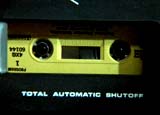
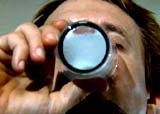
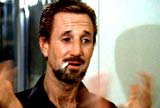
During the early morning ritual of hung-over choreographer-director Joe Gideon (Roy Scheider) in this semi-autobiographical American musical film, the film opened with the self-destructive, work-aholic showman in quick shots in his bathroom:
|
|
||||||
|
d. Francis Ford Coppola
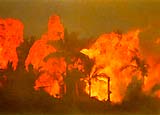
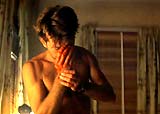
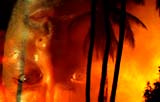
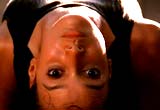
Producer/director Francis Ford Coppola's visually beautiful, ground-breaking masterpiece with surrealistic and symbolic sequences, detailed the confusion, violence, fear, and nightmarish madness of the Vietnam War. The war film told about a US Army assassin's mission, both a mental and physical journey, to 'terminate' a dangerously-lawless warlord and former Colonel who had gone AWOL, had become a self-appointed god, and ruled a band of native warriors in the jungle. The lyrical, slow-moving opening sequence was a dazzling, edited combination of cinematography, music and hallucinatory, super-imposed images from the brutal and destructive war in Vietnam. The sounds of the war chopper blades (chuk-chuk-chuk) were heard and flaming sights of war were seen at the edge of a green-canopied jungle of palm trees as explosive fiery napalm was dropped. The mind-altering, mournful words of the soundtrack from The End: "This is the end..." (sung by burned out 60s rock star Jim Morrison of the Doors) played over nightmarish memories of the war. Dust swirls and golden, billowing napalm flames filled the air. In 1968, debauched, moody, divorced Army Captain Benjamin Willard (Martin Sheen) of US Army Intelligence (505th Batallion, 173rd Airborne), was in a sleazy, dingy, sepia-toned Saigon hotel room, isolated, alienated, sweat-bathed and recovering from battle fatigue. At first, his inverted face was superimposed over the left half of the screen. There were panning shots of his dog tag, a pile of bills, his wallet, a woman's picture, an opened letter and envelope, cigarettes, a glass and Cordon Bleu bottle, and a gun lying next to his pillow. He was drinking and deliberately closed off from the outside world, haunted by his liquor-induced memories of the choppers, gunfire and the war. The sound of the helicopter blades was brought back by the whop-whop (or puck-puck) sound of an overhead ceiling fan. He realized his present state of disorientation and inactivity, having been in Saigon a week - and feared that he was beginning to go a little crazy. In a flat-voiced voice-over, as he looked out the slats of his venetian-blinded window and laid on his bed, he revealed that he was desperately "waiting for a mission" and praying to get back into the N. Vietnamese wilderness: "Saigon. S--t! I'm still only in Saigon." During a frenzied, spastic, half-nude karataka dance in the room, he self-destructively punched and broke the mirror (symbolically destroying his own image), bloodied his right fist and then wiped the bright red blood all over his face and nude body. |
|
||||||
|
d. Martin Scorsese
In the film's brutal, no-holds-barred look at the gladiatorial sport of boxing in documentary-style, B/W newsreel footage, Jake La Motta (Robert De Niro) unsparingly engaged other boxers in the ring in some of the most realistic, visceral, bloody, and brutal yet stylized boxing scenes ever filmed. Sweat and blood sprayed out of the ring, devastating blows were seen in close-up, and flashing - actually exploding - camera bulbs popped. Michael Chapman's stunning, crisp black-and-white cinematography (throughout the entire film except for the home video segments) and subjective camera used innovative techniques including slow-motion (varying camera speeds), 360 degree pans, and titled camera angles for various fight scenes. Although the eight fight scenes seemed to occupy much of the film, their screen time totaled only ten minutes, but they took about six weeks to film. Even more time was necessary to edit the dozens of shots that made up each boxing match. |
 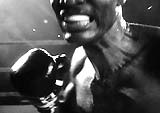 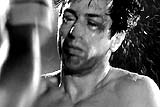 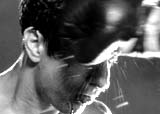
|
||||||

|
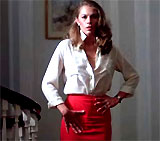
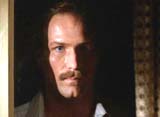
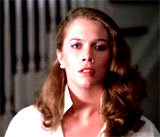
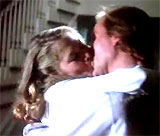
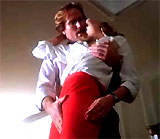
d. Lawrence Kasdan In this dramatic, modern day film noir, set in the hot atmosphere of Miranda Beach, Florida, alluring, crafty, and sultry femme fatale "Matty Walker" (Kathleen Turner) seduced corruptible, dim-witted, naive, and incompetent attorney Ned Racine (William Hurt), to convince him to kill her husband Edmund (Richard Crenna). Before the attempted murder, in one of the film's numerous, highly-charged, sweaty sex scenes with incredible sexual tension (due to its precise editing), Ned broke into her locked house through the windowed front door with a garden chair (to the sound of wind chimes) to kiss the awaiting, horny and receptive Matty.
She was standing waiting for him at the foot of her stairs. He made love to her on the floor, when she removed her bright red skirt and panties to accommodate him and begged:
|
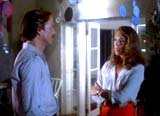 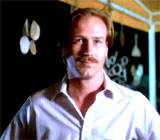 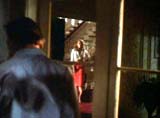 On the Balcony with Wind Chimes and Viewing Her Through The Windowed Front Door |
||||||
|
Raiders of the Lost Ark (1981) d. Steven Spielberg
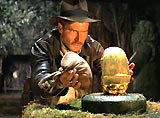
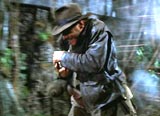
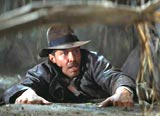
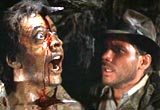
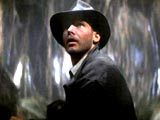
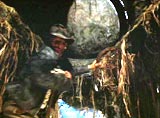
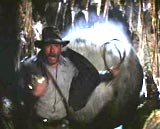
At the start of a memorable sequence in the film's exciting prologue, Indiana "Indy" Jones (Harrison Ford) had just snatched a fierce-looking but beautiful golden idol from an altar, located in a mid-1930s South American rainforest jungle cave setting. After a miscalculation, Indy set off a loud chain reaction of destruction. The entire sanctuary rumbled and shook and rocks fell loose from the collapsing walls, as Indy spun around and ran through the tiled floor area. He set off a noisy torrent of poisonous darts and arrows. After losing the idol and then regaining it from his traitorous Peruvian helper Satipo (Alfred Molina) who was bloodily spiked in the head, Indy suddenly turned toward a loud rumbling noise, and saw behind him a huge, thundering boulder. The giant bowling ball rock tumbled, roared and rolled in his direction - perfectly sized to fit the passageway. Indy dashed just ahead of the destructive, crushing boulder. He lept to safety outside the cave, just as the giant rock slammed into the entrance of the cave and sealed it perfectly. |
|
||||||

|
Flashdance (1983) d. Adrian Lyne
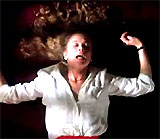
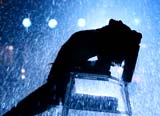
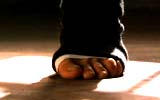
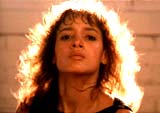
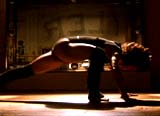
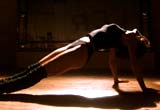
MTV, a cutting-edge music video channel on cable, was launched 24/7 in August, 1981. As a result, its style of fast-moving montage, circumventing conventional narratives with visual storytelling, was influential on many films that followed, such as Adrian Lyne's R-rated Flashdance (1983), and later on Tony Scott's music-infused Top Gun (1986) (particularly the sequence filmed to the tune of "Take My Breath Away") and Ridley Scott's Thelma & Louise (1991). Lyne had previously been a TV commercial director, so his style was characterized by fast-edited clips accompanied by 80s hit songs in some of the film's sequences, similar to the style of television advertisements. The filming style was derided by some critics as being only a "series of rock videos" and the entire film was viewed as a 95-minute, youth-oriented music video. Most filmgoers remember the film's early signature sequence in which 18 year-old blue-collar worker Alexandra (Alex) Owens (Jennifer Beals), a steel welder by day, erotically danced on stage in a Pittsburgh, Pennsylvania bar named Mawby's, and was drenched with water while reclining back on a chair. However, there was another stylishly-edited dance or workout sequence in which black leotarded Alex taped up her feet in preparation for an intense workout of running in place, twirling, and stretching (usually performed by body double Marine Jahan), to the tune of Michael Sembello's hit song (She's A) Maniac ("And she's dancing like she's never danced before"). There were lots of closeups, fast cuts and blurred action typical of the MTV style. In the film's climactic, infamous audition dance sequence, the quick-cut editing masked the fact that there were multiple dance doubles used, as well as a male breakdancer. |
|
||||||




 (Best Film Editing Winner: Alan Heim)