Background
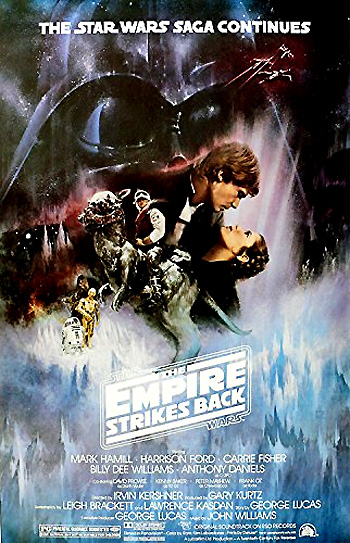  The
Empire Strikes Back (1980), (aka Star Wars: Episode V -
The Empire Strikes Back) is considered to be one of the most
appealing and powerful films in the Star Wars saga - with
a superior and more complex plotline (with two parallel storylines),
more developed characters (with a burgeoning romance between two
sparring leads) and better acting, increasingly-sophisticated special
effects, a consistently-even tone of darkness (i.e., Luke's near-death
on Hoth, the defeat and retreat of the Rebels, Luke's vision of
his own face in Vader's helmet and his aborted Jedi training, the
severing of Luke's hand, and Solo's frozen encasement in carbonite),
and a compelling and shocking conclusion that ended with an unresolved
cliff-hanger (Han's capture by bounty hunters, and the uncertain
nature of Luke's heritage). The
Empire Strikes Back (1980), (aka Star Wars: Episode V -
The Empire Strikes Back) is considered to be one of the most
appealing and powerful films in the Star Wars saga - with
a superior and more complex plotline (with two parallel storylines),
more developed characters (with a burgeoning romance between two
sparring leads) and better acting, increasingly-sophisticated special
effects, a consistently-even tone of darkness (i.e., Luke's near-death
on Hoth, the defeat and retreat of the Rebels, Luke's vision of
his own face in Vader's helmet and his aborted Jedi training, the
severing of Luke's hand, and Solo's frozen encasement in carbonite),
and a compelling and shocking conclusion that ended with an unresolved
cliff-hanger (Han's capture by bounty hunters, and the uncertain
nature of Luke's heritage).
The film was generally less beloved and less of a crowd-pleaser
than its predecessor for some of those very qualities. It took three
years for Lucas to develop this second film - another astounding
cult film about "A long time ago in a galaxy far, far away..." from
20th Century Fox, that opened first on May 21, 1980.
The film, shot on location in Norway (for the Hoth
planet scenes), and in studios in England, continued to advance special-effects
technology to a degree unseen before (i.e., the Imperial-Walkers,
the Cloud City, etc.). With the first Star Wars film, this
second entry in the saga ultimately helped to resurrect the financial
viability of the science-fiction genre, a category of films that
was considered frivolous and unprofitable, and it further enforced
the phrase "May the Force be with you" into common usage.
The budgeted production (of about $18 million) from the TCF/LucasFilm
production company, mostly made in Britain, was based upon Lucas'
recollections of Saturday afternoon matinees, serials, and comic
strips, usually with cliff-hanging endings.
The mythological tale of space-age heroism (fighting
Evil for the sake of Good) featured an assortment of both memorable
characters from the first film and new ones, including a benevolent
ex-Jedi Knight appearing in visions (Guinness) after a deadly duel
with the dark lord, an on-the-run Princess Leia (Fisher) of the peace-loving
Rebel Alliance, two comical robotic droids (R2-D2 and C-3PO), a self-interested
smuggler/mercenary space-pilot (Ford), his beastly creature - a co-pilot
named Chewbacca (a Wookiee), a traitorous but then helpful leader
of Bespin's Cloud City Lando Calrissian (Williams), an idealistic
young boy (Hamill) who becomes trained in the righteous, Zen-like
ways of the Force by wizened Jedi master Yoda (voice of Frank Oz)
in the swamps of Dagobah, and the dark forces of the Empire led by
evil Lord Darth Vader (voice of James Earl Jones/David Prowse).
The second blockbuster film was the second film in
the second trilogy, since Lucas had plans for another prequel trilogy
(three more films). In its Special Edition release in 1997, a few
segments in this film were enhanced or changed, including Luke's
encounter with a Wampa creature on Hoth, an altered version of the
appearance of the Emperor in a hologram, and the footage of the Falcon's arrival
at Cloud City, plus an enhanced soundtrack with digital surround-sound.
Two prequels in a second trilogy were released in 1999
and 2002, with a third in mid-2005. The prequels focused on how the
father of Luke Skywalker (Anakin Skywalker) succumbed to the dark
side of the Force and became the evil Darth Vader:
|
See Greatest
Film Series Franchises - The Star Wars Films
|
Star Wars Film Titles
(chronological order)
|
Director
|
Facts
|
| Star
Wars, Episode IV: A New Hope (1977)
Original Theatrical Version:
121 minutes |
George Lucas |
With a production budget of $11 million,
grossed $1.5 million in its limited opening weekend, and grossed
$307 million (domestic) and $775 million (worldwide), eventually
earning $461 million (lifetime domestic gross); nominated for
10 Academy Awards (including Best Picture, Best Director, Best
Original Screenplay, and Best Supporting Actor (Alec Guinness)),
winning six (in technical categories - Best Art Direction, Best
Costume Design, Best Film Editing, Best Score, Best Sound, Best
Visual Effects); and winner of a Special Achievement award for
Sound Effects; Star Wars: Special Edition (1997) earned
almost $36 million in its opening weekend, and soon topped E.T.:
The Extra-Terrestrial (1982) as the all-time domestic
box-office champ (for awhile). |
| Star
Wars, Episode V: The Empire Strikes Back (1980)
Original Theatrical Version:
124 minutes |
Irvin Kershner, George Lucas (exec-producer) |
With a production budget of $18 million,
grossed $4.9 million in its limited opening weekend and grossed
$209 million (domestic), $290.5 million (lifetime domestic gross),
and $538 million (worldwide); nominated for 3 Academy Awards
(Best Art Direction, Best Score), winning one (Best Sound); winner
of Special Achievement award for Visual Effects; famous for Darth
Vader's line: "No, I am your father" and the severing
of Luke's hand; set three years after the events in the 1977
film and considered by many to be a superior sequel to Episode
IV. It was the highest grossing (domestic)
film of 1980, besting comedy 9 To 5 (1980) in second place
at $103 million. |
Star
Wars, Episode VI: Return of the Jedi (1983)
(originally titled Revenge
of the Jedi)
Original Theatrical Version:
134 minutes |
Richard Marquand |
With a production budget of $32.5
million, grossed $23 million in its opening weekend, and overall
$252.6 million (domestic), $309.3 million (lifetime domestic
gross), and $475 million (worldwide); nominated for 4 Academy
Awards (Best Art Direction, Best Original Score, Best Sound,
Best Sound Effects Editing), winning none; winner of Special
Achievement Oscar for Visual Effects; set single and opening-day
box office records; the most under-rated of the segments of
the Star Wars saga. It was the highest-grossing (domestic)
film of 1983, besting second place Terms
of Endearment (1983) at $108 million.
Best scene: the speeder bike chase. |
Prequels
|
| Star
Wars: Episode I - The Phantom Menace (1999)
133 minutes |
George Lucas
(22 years after his original directorial effort) |
With a production budget of $115 million,
grossed $28.5 million in its first day of showings, and reached
the $100 million level in a record five days; grossed $64.8 million
in its opening weekend, and $431 million (domestic), $474 million
(lifetime domestic gross) and $1,022 million (worldwide); nominated
for 3 Academy Awards (Best Sound, Best Sound Effects Editing,
Best Visual Effects), winning none; set 32 years before the original Star
Wars films; introduced the young Darth Vader as 9 year old
boy Anakin Skywalker (Jake Lloyd), and his future love interest
- slightly older Queen Amidala (Natalie Portman); also introduced
CGI clumsy sidekick Jar Jar Binks (Ahmed Best). It was the highest-grossing
(domestic) film of 1999, besting second-place The Sixth Sense
(1999) at $293.5 million. It was the highest-grossing film
(unadjusted for inflation) of the entire Star Wars saga,
and the 4th highest-grossing (domestic) film of all-time (to
date).
Best scenes: the pod race through the Tatooine desert, and the
epic lightsaber duel. |
| Star
Wars: Episode II - Attack of the Clones (2002)
142 minutes |
George Lucas |
With a production budget of $115 million,
grossed $80 million in its opening weekend (May, 2002); opened
six months later in about 60 IMAX theatres; grossed $302.2 million
(domestic), eventually earning $310.7 million (domestic lifetime
gross), and $649.4 million (worldwide); nominated for only one
Academy Award (Best Visual Effects), without a win; shot on Digital
Video using a new 24-frame, High-Definition, Progressive scan
camera; the title Attack of the Clones is a misnomer -
the clones don't attack, but come to the defense of the Jedi;
set 10 years after Episode 1, with Anakin Skywalker (Hayden Christensen)
now a 19 year-old Padawan (apprentice Jedi knight) to Obi Wan
Kenobi (Ewan McGregor). It had stiff competition in 2002, against
# 1 highest-grossing (domestic) film Spider-Man
(2002) at $403.7 million, and # 2 film, The
Lord of the Rings: The Two Towers (2002) at $340 million.
Best scenes: the breathtaking aerial chase through the asteroid
field, and the light-saber duel between the good Yoda and the evil
Count Dooku (Christopher Lee). |
| Star
Wars: Episode III - Revenge of the Sith (2005)
140 minutes |
George Lucas |
With a production budget of $113 million,
grossed $108 million in its opening weekend (May, 2005); released
on the 28th anniversary of the release of Star Wars, and
the first of the films to receive a PG-13 rating; grossed
$380.3 million (domestic) and almost $849 million (worldwide);
nominated for only one Academy Award (Best Makeup), without a
win; showed how Luke Skywalker's father, Anakin (Christensen),
went from a Jedi apprentice to the galaxy-crushing villain Darth
Vader. The Sith was the evil sect that corrupted Anakin by drawing
him into the dark side of the Force - the cosmic power and living
energy field that balanced the universe. It was the # 1 highest-grossing
(domestic) film of 2005, besting second-place The
Chronicles of Narnia: The Lion, The Witch, and the Wardrobe (2005) at
$291.7 million. It was the # 2 highest-grossing (worldwide) film
of 2005, just behind Harry
Potter and the Goblet of Fire (2005) at almost $897 million.
Best scene: the opening space battle. |
|
Conversions
|
| Star Wars saga to be released on Blu-Ray,
box-set |
|
Fall of 2011 |
| All six Star Wars episodes
will be post-converted to 3-D |
|
Expected theatrical releases are one
per year, starting in 2012 with Episode I (in story-order).
(schedule variable, depending on its success). |
|
Other
|
| Hardware Wars (1977) |
Ernie Fosselius |
A 13-minute, low-budget short film (or faux trailer),
parodying the original Star Wars (1977), and one of the
pioneering fan films. It opened with kitchen appliances substituted
for spaceships (a steam iron fought against a toaster). It also
replaced the two robots with 4-Q-2 (similar to The Wizard
of Oz's Tin Man) and Arty-Deco (a vacuum cleaner), and Chewbacca
looked like the Sesame Street character Cookie Monster (now named "Chewchilla,
the Wookie Monster). The light-saber of Fluke Starbucker was
a flashlight. |
| Spaceballs (1987) |
Mel Brooks |
A satirical parody film of Star Wars, with
fractured names for the characters and locales: Planet Druidia,
Princess Vespa (Leia), Prince Valium, Dot Matrix (droid C3-PO),
Dark Helmet (Darth Vader), Pizza the Hutt (a mafia boss), Barf
(Chewbacca), Yoghurt (wise alien sage Yoda), the Spaceball One
flagship (the Death Star), and Schwartz (the Force). |
| Zack and Miri Make a Porno (2008) |
Kevin Smith |
A romantic comedy. Desperate to make money, Zack
Brown (Seth Rogen) proposed to film a pornographic version of Star
Wars, titled Star Whores, co-starring with his roommate
Miri (Elizabeth Banks). Light-up sex toys took the place of light-sabers. |
|
TV, and Animated
|
| The Star Wars Holiday Special (1978) |
Steve Binder, David Acomba (uncredited) |
One of the first official Star Wars spin-offs.
A notoriously bad, two-hour variety TV special for Thanksgiving
season that aired on CBS-TV on November 17, 1978 - it featured
the original cast members (Mark Hamill, Harrison Ford, Carrie
Fisher, C-3PO - Anthony Daniels, Chewbacca - Peter Mayhew) and
guest stars including Bea Arthur, Art Carney, Harvey Korman,
Diahann Carroll, and the rock group Jefferson Starship. The incomprehensible
plot involved Han Solo with his Millennium Falcon getting Chewbacca
home to his family for celebration of the Wookiee holiday - called "Life
Day." The first 15 minutes of the special were entirely
in Wookieese without subtitles! The rest of the film involved
long musical numbers and variety performances, including an animated
cartoon that introduced bounty hunter Boba Fett of The Empire
Strikes Back, and the end song - Fisher hideously singing
the "Life Day" song. Lucas reportedly ordered no further
airings and destruction of the master videos (so there would
be no video/DVD release), while the bootlegged, poorly-dubbed
video was circulated among fans for years. |
The Muppet Show
February 21, 1980 TV episode (4th season) |
|
In 1980 (February 21), an episode (# 89) of the
syndicated TV show in its fourth season (episode 16) featured
major cast members of Star Wars as guests. Mark Hamill
played both Luke Skywalker in space and his earth-bound 'cousin'
Mark Hamill, affectionately loved by Miss Piggy (portraying Princess
Leia). The Star Wars crew hijacked the Swine Trek,
and faced off against Dearth Nadir (Gonzo) holding Chewbacca
prisoner. |
Family Guy (2007-2011)
Three Trilogy Spoofs:
Blue Harvest (2007)
Something, Something, Something Dark Side
(2009)
It's a Trap (2011)
|
Seth MacFarlane |
Family Guy: Blue Harvest (2007) was the
(6th) season premiere show of the Fox-TV animated show Family
Guy which first aired on September 23, 2007. It was an hour-long
spoof authorized by Lucas (to celebrate Star Wars' 30th
anniversary) composed of CG-animating over previously-filmed
live action shots, with the show's characters appearing in Star
Wars (1977) roles, and the use of the musical score from
the film. Over the next four years (2007-2011), the show created
its own 'trilogy' of the original films with scene-by-scene make-overs
featuring the Family Guy cast as Star Wars characters. The
Empire Strikes Back (1980) was parodied in Family Guy:
Something, Something, Something Dark Side (2009), airing
first on December 22, 2009 as the season finale of the 8th season
of the show. Family Guy: It's a Trap (2011) was a spoof
of Return of the Jedi (1983), serving as the finale of
the 9th season of the show airing on May 22, 2011. |
| Star Wars: The Clone Wars (2008) |
Dave Filoni |
A feature-length, CGI-animated science-fiction
film that served as the official pilot episode, and as an introduction
to the TV series of the same name (see below) that premiered
only a few months later. It was the first animated theatrical
film for the Star Wars franchise. |
| Star Wars: The Clone Wars (2008- ) |
|
A half-hour, computer-animated TV series (each
season had 22 episodes) that premiered on the Cartoon Network
in the fall of 2008. It was expanded from the earlier 2-D animated
series of Clone Wars 3-minute shorts. Events took place
between the Attack of the Clones (2002) and Revenge
of the Sith (2005) films, and featured some of the original
characters (e.g., Anakin Skywalker, Obi-Wan Kenobi, Padme Amidala,
Mace Windu, Count Dooku) with new characters. Produced jointly
by Lucas's company LucasFilm, Warner Bros and Turner Broadcasting.
Plans were for five seasons. |
The first six "Star Wars" films grossed
about $2.2 billion (domestic) and about $4.26 billion (worldwide)
at the box office, while taking in at least double that amount from
merchandise sales.
The 20th Century Fox film set box-office records and
was a critical success (many reviewers considered it superior to
the original film) - it grossed $4.9 million in its limited opening
weekend and grossed $209 million (domestic) and $538 million (worldwide),
eventually earning $290.5 million (domestic lifetime gross). However,
all of the appealing Star Wars films were criticized for
encouraging a boom in spectacular (but sometimes drab) special-effects
laden blockbusters (with thin plot lines) for decades after. Prophetically,
a few years later, the Soviet Union became the 'Evil Empire' during
the Presidency of Ronald Reagan, and Reagan proposed a strategic
space-defense program (or SDI - Strategic Defense Initiative), dubbed "Star
Wars" in November 1985 by the media.
It was nominated for three Academy Awards (Best Art
Direction, Best Score), winning one (Best Sound). It was also the
winner of a Special Achievement award for Visual Effects. |