|

|
The
Great Train Robbery (1903) It contained prototypical elements that have been repeatedly copied by almost every western - a train holdup with six-shooters, a daring robbery accompanied by violence and death, a hastily-assembled posse's chase on horseback after the fleeing bandits, and the apprehension of the desperadoes after a showdown in the woods. |
|
|
The Birth of a Nation (1915) It was an intense, action-packed, stupendous, last-minute rescue finale, a thrilling climax - interweaving the siege on the cabin, the chaos in Piedmont, Elsie Stoneman's (Lillian Gish) fate at the hands of Silas Lynch (George Siegmann), and the onrushing rescue by the Klan. During the rescue, the most famous sequence in the film, excitement was heightened by shots of the Klan alternating with shots of the endangered Elsie - the film exhibited masterful parallel editing. |
|
|
Way
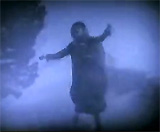
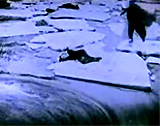
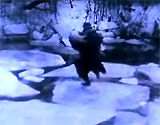
Down East (1920) As the ice thawed the next morning and broke apart ("the great ice-break"), her lifeless form was caught unconscious on moving ice-floes and was swept downstream toward a precipitous waterfall. David nimbly jumped from ice block to ice block to try to reach her before the ice jam gave way - rushing to the falls. As Anna regained consciousness from exhaustion, but started to sink into the frigid water at the edge of the falls, David scooped her up and saved her, running perilously upstream on unstable blocks of ice to reach the shore. |
   |
|
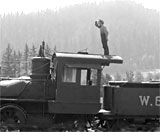
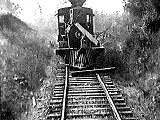
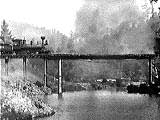
The General (1927) Each half of the film was predominantly composed of two train chases over the same territory. Each scene in the chase of the first half had a counterpart in the film's second half. In the first chase, Johnnie pursued his stolen locomotive taken to the North by the Union forces. In the second half, the Union spies chased Johnnie in his re-possessed General back to the South. The film concluded with a climactic battle at a river gorge, with the dramatic crash of the pursuit train into the Rock River in the film's most spectacular scene. |
|
|
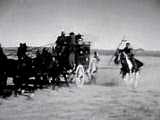
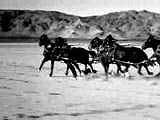
Stagecoach (1939) As he tried to grab the reins of the lead horse to control the stagecoach, Ringo (John Wayne) shot at him with his rifle from over Buck's shoulder. The Apache was struck and fell down among many sets of thundering hooves. He hung onto the rig's shaft or tongue (the projection on the bottom front of the wagon that connected the vehicle to the horses) while dragging along the ground. Then, after being shot a second time, the Apache warrior let go and slid between the wheels of the moving coach - the six horses and the stage's carriage rolled right over his prone body. The camera panned back to show that it wasn't a stunt dummy - the wounded Indian rolled aside and climbed slowly to his knees. |
|
|
The
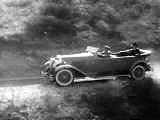
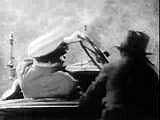
Bank Dick (1940) Following in three other chase cars through the city and country were the local police, the bank president, and a representative from the movie company. It was a superbly-timed chase - the cars zoomed and circled around, barely avoiding crashing into each other or other obstacles in the path. The getaway car careened through streets, over ditches (over the heads of ditchdiggers), around curves and up a mountainside, missing collisions at every turn with the pursuit vehicles. An unruffled Sousè gave non-chalant comments about the traffic and scenery. As his car started to fall apart, he joked: "The resale value of this car is going to be nil after you get over this trip." When asked by the thug in the back seat to give him the wheel, Egbert matter-of-factly pulled it off the steering column and gave it to him. When the rear tires started falling off, he calmly stated: "That's what I thought - going to be very dangerous." The robber was struck by the bough of a tree as he stood up and the car came to rest at the edge of a steep precipice. Sousè mumbled: "Have to take the boat from here on anyway." The unconscious thief was apprehended, and Sousè was a hero once again for thwarting another heist. |
|
|
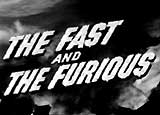
The Fast and the Furious (1955)
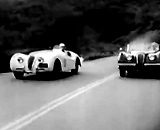
Some of the car chase footage was stock footage, since special effects were not very well developed in the 1950s. It advertised "WIDE-SCREEN THRILLS!" and tauted that it was "filmed at the Pebble Beach International Sports Car Races" - in Monterey, California, where some of the footage was borrowed from. Its tagline was:
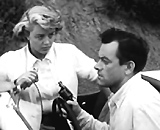
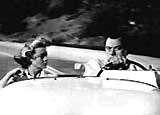
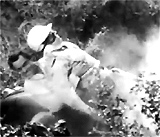
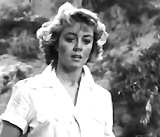
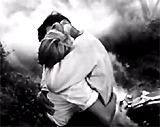
[Note: It was remade as The Chase (1994) starring Charlie Sheen as fugitive Jackson "Jack" Davis Hammond and Kristy Swanson as his kidnapped hostage and California heiress Natalie Voss. The title rights to this film were used for the 'remake' sequel - The Fast and the Furious (2001).] It starred John Ireland as an innocently-convicted, escaped murderer Frank Webster (originally a truck driver) who met and kidnapped attractive, independent-minded blonde society girl Connie Adair (Dorothy Malone) at a roadside diner. He also drove off with her in her late-model white Jaguar XK120 sports car for his flight to Mexico. As part of his escape plan, Frank participated in an international, across-the-border sports car rally from California to Mexico. In the final moments of the film, Frank led a police car on a wild chase. Police officer Faber's (Bruce Carlisle) car crashed, but Frank stopped and saved the man's life - and then Connie arrived (after breaking out of a shed where she had been locked up by Frank). She admitted that she had turned him into authorities, to help him get justice, as they heard police sirens coming closer:
|
|
|
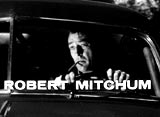
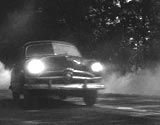
Thunder Road (1958)
As part of his vanity project, Mitchum also wrote the film's theme song Ballad of Thunder Road ("Thunder was his engine and white lightnin' was his load..."), and his real-life look-alike son James played a role as his younger mechanic-brother Robin.
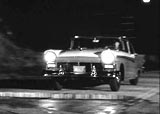
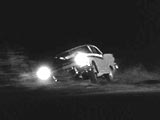
This definitive film (a cult drive-in favorite) was about transporting or running moonshine from the Appalachian Mountains area of backwoods rural North Carolina (Rillow Valley) and Harlan County (KY) while pursued by US Treasury (T-men) agents, including Troy Barrett (Gene Barry). Interference was also provided by ruthless crime syndicate city boss Carl Kogan (Jacques Aubuchon) from Memphis, Tennessee, who was threatening to consolidate all of the "action" of the local moonshine-bootleggers. Sleepy-eyed, cigarette-smoking, disillusioned tough-guy Mitchum played the romanticized but anti-hero role of a returning Korean War veteran named Lucas "Luke" Doolin, who resumed helping in his father Vernon's (Trevor Bardette) family business of bootlegging. He was a transporter ("those wild and reckless men") illegally carrying moonshine alcohol on the road to Memphis, in his souped-up 1950 gray stock-car Ford coupe with a modified 250 gallon tank in the trunk (carrying moonshine worth $1400), and an oil-slick device in the rear to waylay pursuers. He refused to bow to either the federal agents or to Kogan and quit his ways ("Why don't I quit breathin'?...I want to stop the clock, turn it back to another time in this valley that I knew before"). Bachelor Lucas was involved with two females (teenaged hillbilly Roxanna "Roxie" Ledbetter (Sandra Knight) and Memphis nightclub singer Francie Wymore (Keely Smith)) in the romantic subplots, but it was the few fast-driving road chases, usually at night, that were the highlight of this film. [Note: The bootleggers' cars were actually sourced from the local community.] Evading stakeouts and roadblocks, government treasury agents (revenuers) driving Chevys, other moonshine competitors and organized crime gangsters/racketeers, were only some of the challenges, as Lucas dared Barrett: "you've got to catch me - if you can." In one attempt after his 1950 Ford was car-bombed by Kogan's men, he blasted his new 1957 Ford (with Tennessee plates) at 90 mph through a Treasury inspection roadblock consisting of two vehicles. The film's inevitably-deadly and tragic conclusion found Luke in one final run into Memphis after an intense crack-down, in which the daring and head-strong transporter was pursued by one of Kogan's henchmen. Driving alongside, Luke flicked his cigarette at the driver through his open window, causing the thug to careen off the side of the road. But then his own car was sabotaged by a T-agent nail-strip, and his car overturned and crashed into a utility station - killing him. Barrett provided Doolin's epitaph as electrical sparking occurred: "Mountain people. Wild-blooded, death-foolish. Yeah, that was Doolin, alright. He was a real stampeder." In the film's closing scene without dialogue, Robin returned to Roxie and took her hand, as a long stream of car headlights signaled Luke's body being brought back to the valley (the "Whippoorwill" song was reprised on the soundtrack). |
|
|
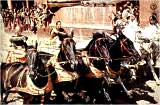
Ben-Hur
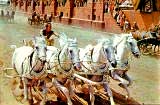
(1959) The climactic ending to the race occurred when the chariots of arch-rivals Messala and Ben-Hur (Charlton Heston), in hateful rivalry toward each other, ran neck-and-neck and slashed at each other. At one point, Ben-Hur's horses jumped over a crashed chariot, throwing the hero (stuntman Joe Canutt, son of famed stuntman Yakima Canutt) high into the air, yet he landed on his feet. Messala tried to destroy Ben-Hur's chariot by moving close with the blades, but as the wheels locked and he lost one of his wheels, Messala's chariot was splintered. He was dragged by his own team, then trampled, and run over by other teams of horses. Defeated, he was left bloody in the dirt, his body broken and horribly injured. |
|
|
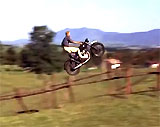
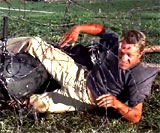
The Great Escape (1963) On his way toward neutral Switzerland, he came upon a German roadblock or checkpoint; he kicked a German officer and then made an exciting, daring cross-country escape across some farmland when cornered; he attempted to vault over the first of two six-foot barbed-wire/wooden fences at the German-Swiss border, but before he was able to jump the higher second-line fence, his motorcycle was shot from under him, and he become entangled and ensnared - and was captured. |
  |
|
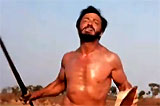
The Naked Prey (1966, S.Afr./US) The amazing race-for-his-life chase scene by the Man (a naked and unarmed safari tour leader/guide) (Cornel Wilde) as six tribe warriors give him a head start of 100 yards into the bush, in this adventure/chase film set in 19th century Africa co-directed by Cornel Wilde and Sven Persson. |
|




 This W.C. Fields film concluded with a memorable, zany slapstick, getaway
car chase scene, reminiscent of the silent Mack Sennett Keystone Kops
films. Egbert Sousè (Fields) was taken as hostage by a bank robber,
used as a shield, and forced to drive a getaway car.
This W.C. Fields film concluded with a memorable, zany slapstick, getaway
car chase scene, reminiscent of the silent Mack Sennett Keystone Kops
films. Egbert Sousè (Fields) was taken as hostage by a bank robber,
used as a shield, and forced to drive a getaway car.