|

|
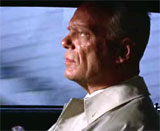
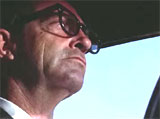
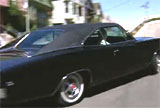
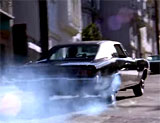
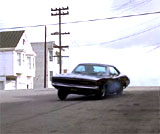
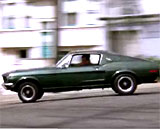
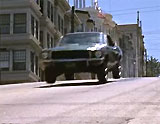
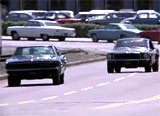
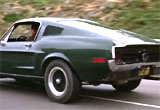
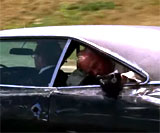
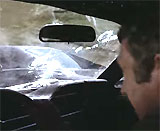
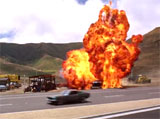
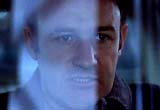
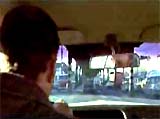
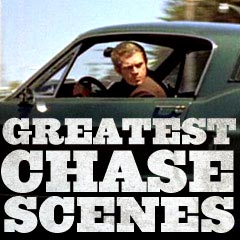
Bullitt (1968) Bullitt's car was a Highland Green, 1968 four-speed Ford Mustang Fastback GT (California yellow-on-black license JJZ 109) powered by a 390/4V big block engine, in pursuit of a black, 1968 four-speed Dodge Charger 440 R/T. The spectacular, high-speed, nine minute car pursuit-chase sequence was conducted up and down the narrow, hilly streets of San Francisco and through hazardous intersections, and then onto a winding 2-lane rural road near Brisbane in the north Bay, with multiple crashes and collisions - and airborne vehicles; right at the start of the scene, Bullitt reversed things and pursued the hitman's car; the classic chase ended when Bullitt side-swiped the hitmens' car and it lost control, veered off the road, and plowed into a gas station - with a fiery explosion.
|
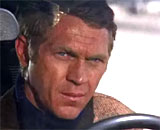 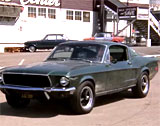 Bullitt's Car, Dark Green Ford Mustang, Before Chase  Bullitt Behind Hit-Man's Car, Viewed in Rear View Mirror 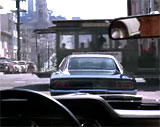 Bullitt Directly Behind Car in SF 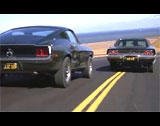 Out in the Country - (Bullitt's Car Still in Pursuit) |
||||||||||||
|
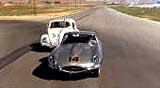
The Love Bug (1968) The famous car would star in four theatrical, chase-filled sequels in 1974, 1977, 1980 and 2005 (the last starred Lindsay Lohan in Herbie: Fully Loaded (2005)) and a TV series. |
|
||||||||||||
|
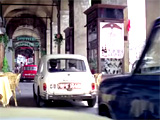
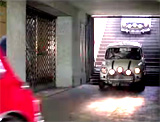
The Italian Job (1969, UK) It involved three Mini Cooper S's (patriotically painted red, white, and blue) laden with gold. The Italian police were in hot pursuit as the little Cooper S's drove up and down stair-steps, through a shopping plaza, via sewers and over the rooftops and a reservoir for their getaway. They even completed a lap on the Fiat's famous test track in Turin. Remade in 2003. |
|
||||||||||||

|
On
Her Majesty's Secret Service (1969, UK)
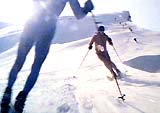
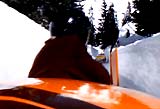
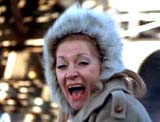
The pursuit continued into the small valley village, where Bond met up with love interest Tracy (Diana Rigg), and she rescued him driving her red Cougar, leading to an exciting car chase from there and onto the snowy race track of a stock-car race. After the demolition derby on the track, the pursuing car overturned and exploded, although everyone survived. The next morning, there was another downhill ski chase after Bond and Tracy. Blofeld caused an avalanche which engulfed and killed three of his own men and Tracy was also partially buried and taken prisoner. The final chase scene was Bond's pursuit of Blofeld downhill on racing bobsleds. Bond was blown off his bobsled by a thrown hand-grenade. They engaged in a brutal hand-to-hand fight when Bond jumped onto the back of Blofeld's bobsled - and the SPECTRE chief was severely injured when he became snared and entangled in the low-bough of a tree, breaking his neck in the V-shaped branch (Bond: "He's branched off") - but he survived! |
|
||||||||||||

|
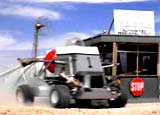
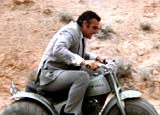
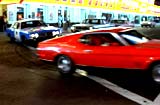
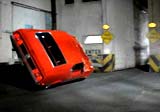
Diamonds Are Forever (1971) Bond eventually teamed up with co-conspiratorial diamond smuggler, seductive Tiffany Case (Jill St. John), when she finally realized that each link in the smuggling pipeline had been killed, and she was the next target. When they came upon a billionaire entrepreneur's remote Las Vegas desert facility, Willard Whyte's Tectronics factory involved in Blofeld's plot, Bond was discovered to be an intruder, and was forced to steal a Moon-buggy from a simulated moonscape used for testing. He crashed through the security gate and evaded pursuing cars through the rough desert terrain. He then stole one of the three-wheeled Dirt-bikes from Whyte's security guards following him, to return to the facility's entrance where Tiffany was awaiting him. After they drove back to Las Vegas that evening, they were pursued in Tiffany's red 1971 Ford Mustang Mach 1 by the alerted local police. After weaving through the neon-decorated fronts of the casinos on the Strip and causing multiple crashes/pileups in a parking lot, they eventually escaped when Bond steered Tiffany's car onto two-wheels down a narrow alleyway. |
|
||||||||||||
|
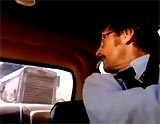
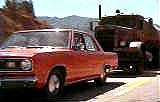
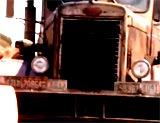
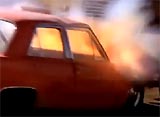
Duel (1971) Mild-mannered, distressed traveling salesman David Mann (Dennis Weaver), an LA electronics vendor, was driving in his red 1970 Plymouth Valiant, when he was relentlessly pursued on a rural California highway road by a demonic, killer diesel-engine truck (a 1955 Peterbilt 281 towing a tanker trailer). The greasy, grungy truck (with a FLAMMABLE warning) was driven by a hidden, faceless psychopathic driver (wearing cowboy boots) (stuntman and character actor Carey Loftin), although the truck itself personified a person (front window eyes, headlight pupils, front grill nose, front fender mouth, etc.). The driver exhibited stalking and many kinds of 'road rage' behaviors:
During Mann's last-stand confrontation with the monstrous homicidal truck, he gunned his overheated engine and proceeded to ram the truck - diving out at the last second. The explosive crash sent the truck (in slow-motion) over a cliff into rocks below. Mann stared at the burnt wreckage, as the credits rolled. |
|
||||||||||||
|
The
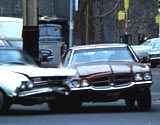
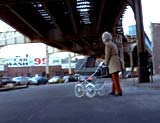
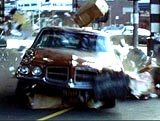
French Connection (1971) To keep pace, Doyle drove 90 mph and barely missed pedestrians and other vehicles on the narrow two-lane road beneath the elevated tracks; he half-collided with another white car at an intersection, was clipped or side-swiped by a delivery van/truck, dodged a mother and her baby carriage, and crashed into garbage, all the while furiously honking the car's horn and frantically switching from his brake to accelerator; he banged his fists on the steering wheel, angered at the delays and frustrations.
|
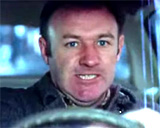 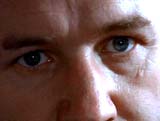 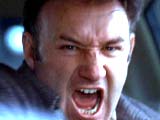 Crazed Jimmy "Popeye" Doyle Driving a Hijacked Civilian Car |
||||||||||||
|
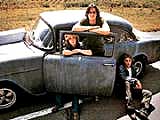
Two-Lane Blacktop (1971) The Driver (singer/composer James Taylor) and The Mechanic (Dennis Wilson of the Beach Boys) raced against middle-aged, glib "G.T.O." (Warren Oates), with The Girl (Laurie Bird) picked up as a sassy hitchhiker, at his side. |
|
||||||||||||
|
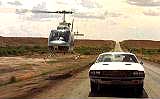
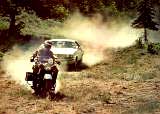
Vanishing Point (1971) Police chased the bennie-popping, ex-cop anti-hero in his souped-up, white 1970 2-door Dodge Challenger R/T (at 375 hp with a 440 cubic inch V8 Magnum) from Denver, Colorado, across Utah and Nevada's deserts, and toward his destination San Francisco, CA - accompanied by a rock-soul soundtrack and directions broadcast on the radio from blind disc jockey Super Soul (Cleavon Little). |
|
||||||||||||




 One
of the screen's all-time best car chase sequences (at up to 110 miles
per hour) was a tense sequence filmed with hand-held cameras on the
streets of San Francisco as police lieutenant Frank Bullitt (Steve
McQueen) chased after criminals in his car. The audio components of
the scene were the most compelling with the sounds
of squealing tires producing smoke from burning rubber, skidding
turns around sharp corners, and the continual roar of both car engines
One
of the screen's all-time best car chase sequences (at up to 110 miles
per hour) was a tense sequence filmed with hand-held cameras on the
streets of San Francisco as police lieutenant Frank Bullitt (Steve
McQueen) chased after criminals in his car. The audio components of
the scene were the most compelling with the sounds
of squealing tires producing smoke from burning rubber, skidding
turns around sharp corners, and the continual roar of both car engines