Hitchcock's Menaced Women:
Many of Hitchcock's earlier black-and-white works featured menaced
women:
- Rebecca (1940) - in this adaptation of a Daphne du Maurier tale, a naive, unnamed newlywed (Joan Fontaine) was
victimized by the tyrannical housekeeper (Judith Anderson) of her widower husband's
(Laurence Olivier) ex-wife Rebecca, in a Gothic noirish setting, until she fully discovered the strange events surrounding Rebecca's death
- Suspicion (1941) - a wealthy wife (Joan Fontaine
again) was suspicious of her fortune-hunting husband (Cary Grant) after
the murder of a friend (Nigel Bruce)
- Shadow of a Doubt (1943) - Joseph Cotten starred as a rich widow-killer who threatened his suspicious
favorite niece (Teresa Wright)
- Spellbound (1945) - Gregory Peck appeared as a young psychiatrist (actually a disturbed,
amnesia imposter) who was accused of murder and counseled by psychiatrist
Ingrid Bergman through dream analysis
- Notorious (1946) - Ingrid Bergman became the slowly-poisoned
wife of a Nazi spy (Claude Rains)
- Vertigo (1958), one of Hitchcock's greatest and most disturbing films, with James Stewart as retired police detective Scottie Ferguson who became obsessed with the disturbed enigmatic 'wife' Madeleine (Kim Novak) of an old friend, while suffering the effects of his fear of heights - and vertigo
- Psycho (1960) - this shocking and engrossing, most influential thriller-noir - a classic, low budget, manipulative, black and white film - included complex Oedipal themes and schizophrenia; it told about a loner - a mother-fixated motel owner and taxidermist (Anthony Perkins), who killed embezzling, blonde real estate office secretary Marion Crane (Janet Leigh) in the classic set piece (the 'shower scene'); the psychotic, disturbed cross-dressing transvestite "mother's boy" was dominated by his jealous 'mother', rumored to be in the Gothic house on the hillside behind the dilapidated, remote motel
 Imperiled
Children Noirs: Imperiled
Children Noirs:
- in Ted Tetzlaff's The Window (1949), a prone-to-lying
slum boy (Bobby Driscoll) wasn't believed when he vowed that he had witnessed
a New York murder in an adjoining apartment - and his life was threatened
by the killers
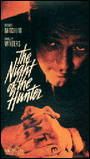
- in the masterwork The Night of the Hunter (1955), the only film ever directed by
actor Charles Laughton, Robert Mitchum starred as a psycho-crazed, creepy
preacher (with finger knuckles tattooed reading "L-O-V-E" and "H-A-T-E") desperately stalking
two children to learn their monetary secret
Corruption and Crime Noirs:
Crime and corruption were often the main focus of noir films, usually with tough
police detectives in pursuit:
- in Charles Brabin's gritty pre-noir The Beast of the
City (1932), gangsters were pursued by a serious police chief (Walter
Huston)
- in director Archie Mayo's The Petrified Forest (1936),
Humphrey Bogart (in an early role) took Bette Davis and Leslie Howard hostage
in a desert restaurant/service station
- in Raoul Walsh's gangster noir High Sierra (1941) based on W.R. Burnett's novel, Humphrey Bogart (in his first starring role) performed
as aging gangster Roy "Mad Dog" Earle with a heart of gold toward country girl Velma (Joan Leslie), who couldn't give up his life of crime and died while pursued in the Sierra Mountains
- in Stuart
Heisler's The Glass Key (1942), Alan Ladd starred as Ed Beaumont, a right-hand man and political aide who attempted to
save his politician employer (Brian Donlevy) from a murder rap, while Lake played
the seductive fiancee of the boss
- in Frank Tuttle's This Gun For Hire (1942), marking the first teaming of Alan Ladd and peekaboo blonde Veronica Lake, Ladd starred as "angel of death" hitman Raven, an unsmiling San Francisco professional hit-man who became embroiled in a double-cross and went on the run from police
- in Fritz Lang's suspenseful wartime espionage thriller Ministry of Fear (1944), based on Graham Greene's novel, Stephen
Neale (Ray Milland), in possession of microfilm won in a carnival cake raffle, found himself on the run
from both the Nazis and the authorities
- in Robert Siodmak's (and cinematographer Woody Bredell's)
expressionistic noir thriller Phantom Lady (1946), based upon Cornell
Woolrich's (pseudonym William Irish) pulp novel, an engineer (Alan Curtis)
accused of murdering his wife (and sentenced to the electric chair) had
an unbelievable alibi (involving a mysterious 'lady' with an ornate hat),
causing a police inspector to race against time to prove his innocence
- in Irving Reis' Crack-Up (1946), a middle-aged art
critic and forgery expert (Pat O'Brien) who blacks out must retrace his
recent past to circumvent an art forgery conspiracy at a New York museum
- in director Joseph H. Lewis' cult film noir So Dark
the Night (1946), a French investigating cop must solve murders committed
while on vacation
- director Roy William Neill's (known for a series of 1940s
'Sherlock Holmes' films) murder mystery Black Angel (1946), based
on the novel by Cornell Woolrich, was about an alcoholic piano player (Dan
Duryea cast against type) who attempted to solve the murder of his estranged
wife in Los Angeles when suspected of being the culprit; with a supporting
cast of Broderick Crawford and Peter Lorre
- director Robert Wise's nasty noir Born to Kill (1947),
based on James Gunn's novel Deadlier Than the Male, starred Lawrence
Tierney as a mean, cold-blooded double-murderer ("the coldest killer
a woman ever loved"), and Claire Trevor as his bad-girl mistress
- Edward Dmytryk's noirish political drama Crossfire (1947) told about the social issue of anti-semitism prejudice, in its flashback story regarding an investigation (by Robert Mitchum and Robert Young) into the mysterious murder of a Jew by a bigoted GI soldier (Robert Ryan)
 in
Henry Hathaway's violent docu-crime noir Kiss of Death (1947), Victor
Mature starred as paroled robber Nick Bianco opposite chilling, sadistic
gangster Tommy Udo (Richard Widmark in his stunning screen debut, noted
for the scene in which he giggled hysterically while pushing a wheelchair-bound
old woman down a flight of stairs); [remade as the western The Fiend
Who Walked the West (1958), and Kiss of Death (1995) with Nicolas
Cage] in
Henry Hathaway's violent docu-crime noir Kiss of Death (1947), Victor
Mature starred as paroled robber Nick Bianco opposite chilling, sadistic
gangster Tommy Udo (Richard Widmark in his stunning screen debut, noted
for the scene in which he giggled hysterically while pushing a wheelchair-bound
old woman down a flight of stairs); [remade as the western The Fiend
Who Walked the West (1958), and Kiss of Death (1995) with Nicolas
Cage]- in Edmund Goulding's Nightmare Alley (1947), Tyrone Power starred as traveling carnival con-man "The Great Stanton" who also claimed to be a spiritualist who could communicate with the dead - until exposed
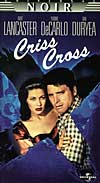
- Robert Siodmak's fatalistic Cry of the City (1948) and the doom-laden Criss Cross (1949) both featured unreliable characters,
tenuous relationships and twisting plots, with Yvonne DeCarlo in the latter
film as a femme fatale enticing a love-sick Burt Lancaster during
a heist gone wrong; [the film was remade by Steven Soderbergh as The
Underneath (1995)]
- Fred Zinnemann's Act of Violence (1948) starred Van Heflin as returning, ex-POW WWII veteran 'war hero' Frank Enley, who harbored the dark secret that he was a Nazi collaborator to survive, known only by vengeful sole-surviving ex-comrade Parkson (Robert Ryan)
- director John Farrow's suspenseful and complex thriller The Big
Clock (1948), with a giant corporate clock as the film's centerpiece,
told the flashback story of a media executive and Crimeways Magazine journalist George Stroud (Ray
Milland) in a race against time to solve the murder of his tyrannical boss Earl Janoth's (Charles
Laughton) mistress Pauline York (Rita Johnson) in 1940s New York - in an investigation that quickly showed himself as the framed prime suspect [the film was remade
as No Way Out (1987) with Kevin Costner and Gene Hackman]
- in John Huston's intelligent, exciting, theatrical,
but moody, downbeat crime drama/thriller (and melodramatic gangster-related
film noir) Key Largo (1948),
bullying, fugitive gangster Johnny Rocco (Edward G. Robinson),
on-the-run with fellow mobsters and his alcoholic lush moll and
ex-nightclub singer Gaye Dawn (Claire Trevor), found himself in
a Florida Keys hotel in the off-season during a violent, tropical
hurricane; he snarled while waiting for a counterfeit money deal
and held various residents hostage including returning war-scarred
veteran Frank McCloud (Humphrey Bogart), newly-widowed Nora Temple
(Lauren Bacall) and her wheelchair-bound father-in-law and hotel
manager James Temple (Lionel Barrymore)
- in director Robert Rossen's Best Picture-winning All
the King's Men (1949), Broderick Crawford portrayed a power-corrupted
politician based upon Louisiana's Huey Long
- in director Max Ophuls' domestic noirish melodrama The Reckless Moment (1949), upper middle-class housewife Lucia Harper (Joan Bennett) covered up for her daughter's manslaughter of her seedy, older lover, and then fell in love with blackmailing, infatuated small-time crook Martin Donnelly (James Mason)
- director Robert Wise's last film for RKO, The Set-Up
(1949) told of an aging boxer (Robert Ryan) betrayed by his trainers
- in director Nicholas Ray's first feature film They
Live By Night (1949), bank robber "Bowie" (Farley
Granger) was 'on-the-run' with eloped lover/wife "Keechie" (Cathy
O'Donnell)
- Raoul Walsh's film noirish gangster film White
Heat (1949) starred James Cagney as unstable, mother-fixated, sadistic
killer Cody Jarrett who blew himself up on an oil tank in the fiery climax, screaming:
"Made it, Ma! Top of the world!"
- maverick director Nicholas Ray's In a Lonely Place (1950), a mature, bleak and dramatic film noir, told about a world-weary, acerbic, self-destructive, hot-tempered, depression-plagued, laconic Hollywood screenwriter and anti-hero Dixon Steele (Humphrey Bogart) who became the prime suspect in a murder case of a night-club hat-check girl Mildred Atkinson (Martha Stewart); his romantic relationship with a lovely neighbor/would-be starlet Laurel Gray (Gloria Grahame) in his housing complex grew stronger when she confirmed his alibi, but she became increasingly suspicious
- in black-listed director Jules Dassin's grim Night and
the City (1950), Richard Widmark provided the lead performance as an
ambitious, scheming, and self-deceiving London hustler
- in John Huston's classic heist film The Asphalt Jungle
(1950) based on W.R. Burnett's novel, a group of criminals (including Sterling Hayden as Dix Handley)
gathered to execute one last, ill-fated jewel heist caper for criminal mastermind
Doc (Sam Jaffe) and crooked financial backer (Louis Calhern appearing with
his mistress Marilyn Monroe); the unsuccessful jewel robbery unraveled in the film's taut central scene -
with the film's final great sequence of Dix' death in a Kentucky horse pasture
[The film was remade three times as the western The Badlanders (1958) with Alan
Ladd, a jewel heist flick titled Cairo (1963), and Cool Breeze
(1972) with an all-black cast]
- in Otto Preminger's Where the Sidewalk Ends (1950) with a Ben Hecht script, raging, violent, and out-of-control NY cop Mark Dixon (Dana Andrews), whose father was a gangster, covered up the accidental death of a suspect by inadvertently framing local cab-driver Jiggs Taylor (Tom Tully), and became further entangled when he fell in love with the man's daughter Morgan Taylor-Paine (Gene Tierney)
- in Nicholas Ray's On Dangerous Ground (1951), embittered
cop Robert Ryan - investigating a murder of a young girl outside the city
- fell for the blind sister (Ida Lupino) of the prime murder suspect, her
mentally-ill brother
- in Phil Karlson's hard-edged, tough, low-budget
bank heist tale Kansas
City Confidential (1952), ex-con florist delivery man Joe
Rolfe (John Payne) was framed during a $1.2 million
armored car robbery job in Kansas City, committed by masked criminals
including Boyd Kane (Neville Brand), Pete Harris (Jack Elam),
and Tony Romano (Lee Van Cleef); after being cleared and released
(and losing his job and reputation), Rolfe pursued the criminal
gang to Mexico to the fictitious resort town of Borados where
he took payback revenge; Rolfe impersonated Pete Harris after
Harris was gunned down by police in Tijuana; complications arose
when he fell in love with the fresh-faced law student daughter
Helen "Punkin" Foster
(Coleen Gray) of the gang's double-crossing mastermind-boss 'Mr.
Big': bitter ex-cop Tim Foster (Preston Foster) who was posing
in Mexico as a vacationing fisherman
- in Fritz Lang's savage The Big Heat
(1953), bereaving, unrestrained cop Glenn Ford was on a one-man
crusade against corruption
- in writer/director Samuel Fuller's action-packed, raw thriller-noir Pickup on South Street (1953), Richard Widmark starred as tough-minded
ex-con pickpocket Skip McCoy embroiled in the plot with femme fatale prostitute Candy (Jean Peters) after unknowingly stealing microfilm (bound
for Communist spies) from her purse during a crowded subway ride
 in
Andre de Toth's B-film crime noir Crime Wave (1954), Sterling Hayden
starred as a confrontational, hard-nosed detective who despised a paroled
San Quentin convict struggling to redeem himself in
Andre de Toth's B-film crime noir Crime Wave (1954), Sterling Hayden
starred as a confrontational, hard-nosed detective who despised a paroled
San Quentin convict struggling to redeem himself- in director Joseph H. Lewis' thriller-film noir
The Big Combo (1955), sadistic and arrogant mobster hood-kingpin
Mr. Brown (Richard Conte) was able to lure weak-willed, abused,
and unwilling society blonde Susan Lowell (Jean Wallace) to himself;
she was eventually able to help half-crazed,
obsessed police detective Leonard Diamond (Cornel Wilde) break
Mr. Brown's syndicated crime organization
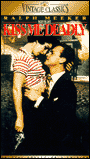
- Robert Aldrich's apocalyptic, jarring and violent Kiss
Me Deadly (1955) was an adaptation of Mickey Spillane's novel of
the same name; it told the quest tale of hardened and violent detective
Mike Hammer (Ralph Meeker) and sexy assistant Velda (Maxine Cooper) to learn
about the deadly contents of the "Great Whatsit" box [Later films
repeated the motif of the mysterious box, such as Repo Man (1984) and Pulp Fiction (1994)]
- Phil Karlson's documentary-styled The Phenix
City Story (1955) opened
with a 15 minute preface of interviews by real-life reporter
Clete Roberts of the actual principal characters in the muckracking
docu-drama, including a newsman, locals, and a widow; the focus
was Alabama's evil 'sin city' of Phenix City, centering on "The
Poppy Club" known
for corrupt card games, rigged gambling, murders, and other vices
catering to soldiers from nearby Fort Benning; it was
led by boss Rhett Tanner (Edward Andrews) and his brutish henchmen
(e.g., Clem Wilson (John Larch)); violence came to a climax after
some beatings of local opponents, the murders of Fred Gage (Biff
McGuire) and a black girl (with a threat pinned to her dress),
and the assassination of State Attorney General nominee Albert
Patterson (John McIntire), after which his veteran-son John Patterson
(Richard Kiley), a lawyer, took up the courageous torch of justice
- in Stanley Kubrick's The
Killing (1956), Sterling
Hayden starred as an ex-con involved in a doomed-to-fail
horse racetrack robbery, and Marie Windsor portrayed the duplicitous,
adulterous femme
fatale who plotted to run away with the money with gangster
Val (Vince Edwards) after betraying her husband (Elisha Cook,
Jr.), the inside-man at the track
- in Fritz Lang's underrated crime noir While the City Sleeps (1956), Dana Andrews starred as ambitious newspaper reporter and TV host Ed Mobley who used all competitive methods possible to hunt for and discover the identity of a serial sex killer - "The Lipstick Killer" (revealed to be teenaged Robert Manners (John Barrymore, Jr.)), in order to gain the newspaper's editorship - even resorting to using his girlfriend/fiancee Nancy Liggett (Sally Forrest) as bait; in the conclusion, the killer was captured in an exciting subway tunnel chase and confessed to four murders
- in Alexander MacKendrick's Sweet
Smell of Success (1957) from a script by Clifford Odets and Ernest
Lehman, Burt Lancaster starred as ruthless, all-powerful and evil NYC
gossip columnist J.J. Hunsecker (based on Walter Winchell) in league with his sleazy, hustling press
agent Sidney Falco (Tony Curtis) - both engaged in a nasty smear campaign to prevent
the columnist's young sister Susan's (Susan Harrison) marriage to a musician
- in one of the last true classic film noirs (and the first noir to include a black protagonist), Robert Wise's
crime drama Odds Against Tomorrow (1959), a trio of bank-robbers
(including Harry Belafonte as indebted nighclub entertainer Johnny Ingram) faced tensions (of racism and prejudice) within
their gang
Cross-Over Noirs:
The term film noir has also been more widely applied to other categories
of films. Some of the most interesting film noir derivatives were the film
noir westerns of the 1950s:
Non-genre dramatic films, such as Billy Wilder's drama about alcoholism titled The Lost Weekend
(1945), Wilder's Sunset Boulevard (1950), and Laurence Olivier's Hamlet (1948) could also be considered cross-over dramatic noirs. Surprisingly there was even a noir musical, Michael Curtiz' Young Man with a Horn (1950).
There are at least a few distinctive
'women's' film noirs: Laura (1944), Mildred Pierce (1945), Leave Her to Heaven (1945), Max Ophuls' domestic melodrama The Reckless Moment (1949) and Robert Siodmak's The File on Thelma Jordon (1950) with Barbara Stanwyck. |
 Film Noir