 |
|||||||||||||||||||
| Five Easy Pieces (1970) | |||||||||||||||||||
| Background
Its main iconoclastic character was a defining one for the era in which this American New Wave film was produced. In the late 1960s and early 1970s, the US political situation was very unstable and in upheaval, with Nixon's secret bombings of Cambodia and the uncertainty of the Vietnam War, the Kent State Massacre in the late spring, and Wall Street's hard-hat riots. He reflected the aimless, restless, dissatisfied middle-class spirit that was prevalent. Searching for his own identity, he had abandoned his upper-class bourgeois musical roots - first using his musical talent in cheap Las Vegas musical revues, and then forsaking music all-together as a Southern California oil field manual laborer, before finally heading into the unknown - possibly to Canada or Alaska. It had a few taglines:
The road-trip story from Columbia Pictures was about rough, red-neck California oil rigger Robert "Bobby" Eroica Dupea (Jack Nicholson in his first starring vehicle) who had turned his back on his well-to-do upbringing and his classical musical talent. [Note: He was named after "Eroica" - the title of Beethoven's Third Symphony.] His selfishness, lack of ambition and insecurity led him into a period of self-imposed exile, discontent, emotional emptiness and restlessness for twenty years as a blue-collar worker. Themes of masculinity, class, alienation and family were examined, as the disillusioned misfit was caught in the gulf between his intellectual upper-class family (where he had dashed their expectations) and his lower-class, part-time girlfriend (representing a lusty lifestyle of boozing, partying, bowling, and sex), and felt himself immobile to advance himself in life. His uncomfortable journey ended in an open-ended way, in the film's ambiguous ending, as he hitched a ride to nowhere. The film's title refers to a commonly-used elementary practice book of easy-to-play piano selections for beginning students - exercises on how to learn the art of mastering a piano. Metaphorically, the protagonist was also taking the 'beginners' approach to challenges that he faced in life. The lonely rebel would always take the "easy" route (usually denial, escape, or flight) from his discordant problems, various jobs and women, family responsibilities, the thought of settling down, fears and loved ones. The number five was also an important indicator in other ways:
The only time in the film that Bobby seriously played a classic musical work on the piano was a selection he dubbed "the easiest piece" he could remember. The opposition between the two lifestyles was reflected in the geography of the film - North (upper class), and South (lower class). He worked in the arid and dusty climate of Southern California, and was hiding out in the milieu of mobile homes and low-rent houses, while his family was from a colder, more remote, and rainy area (on an isolated island), and living a more cultured life of refinement. The physical struggles of the Dupea family in the North were clearly evident, however: he had a neurotic, love-starved, unkempt sister Partita (Lois Smith), a neck-braced brother Carl (Ralph Waite) whose fiddle playing was hampered (was he also impotent?), and a mute and stroke-immobilized father. Both of his two siblings had musically-derived names: (1) Partita - a synonym for a collection of musical pieces, or suite; and (2) Carl Fidelio - the name of Beethoven's only opera, a German piece with spoken dialogue in two acts. In a major turning point in the film, the misbehaving blue-collar worker with an adopted Southern accent returned to his estranged family's home in the North (Puget Sound) for a final reconciling visit when his father was on the verge of dying. There, he found love with sophisticated, musical protege and fiancee Catherine Van Oost (Susan Anspach) of his brother Carl. Meanwhile, he emotionally abused and turned his back on his vulgar but well-meaning, dim-witted and needy girlfriend Rayette (Karen Black), and then abandoned everything by taking flight even further northward. The two irreconciliable, contradictory worlds of his existence (his own existence and his parents' generation) were examined and contrasted:
The film was most famous for the classic scene of Nicholson's outburst while ordering a plain omelette with a side of toast (ultimately a chicken salad sandwich) in a roadside diner - symbolic of the 60s generation's rebellion and alienation during the Vietnam War Era. A second key scene was the one during traffic gridlock on a California freeway, when the oil-rigger left his vehicle, jumped up on a truck stalled in the line of cars ahead, and played a Chopin concerto on an upright piano located there. This was director Bob Rafelson's second film (and his best work) after he had directed the television pop band the Monkees in the mind-blowing Head (1968), a surrealistic and psychedelic film that was co-written with unemployed actor Jack Nicholson, the major star in this film, and emulated the European New Wave pictures of the era. Although the film has been criticized as misogynistic, its script was actually penned by Carole Eastman (pen-name Adrien Joyce), and co-written by Rafelson. The film was nominated in four categories without Oscars: Best Picture, Best Actor (Jack Nicholson) (lost to George C. Scott for Patton (1970)), Best Supporting Actress (Karen Black), and Best Story and Screenplay (Bob Rafelson and Adrien Joyce). Plot SynopsisThe road movie opens at an oil field where hard-hatted, blue-collar redneck Robert "Bobby" Eroica Dupea (Jack Nicholson) is revealed behind the bucket of a backhoe moving dirt. He is part of a team or crew working on oil derricks in the Southern California desert near Bakersfield. Under the title credits as the sun sets on the horizon, and the men are at quitting time, Tammy Wynette's "Stand By Your Man" plays in the background. He drives to a low-rent neighborhood and carries a six-pack of beer into a house he shares with his girlfriend, where a phonograph record player is spinning the tune. His ignorant, dim-witted, countrified, insecure but kind-hearted girlfriend Rayette Dipesto (Karen Black) is in the bathroom, barefooted and still wearing her orange diner waitress uniform. She has teased up hair, heavily made-up cat's eyes, and frosted lips. Obsessed with Tammy Wynette, the aspiring (and awful) country music singer insists on playing the record another time, although he protests: "You play that thing one more time and I'm gonna melt it down into hair spray." He explains: "It's a question of musical integrity" - he is unhappy with her common, low-life interests. She accuses him of being selfish:
He suggests that they go out and have a "good time" with their best friends: oil-rig co-worker friend Elton (Billy "Green" Bush) and his wife Stoney (Fannie Flagg). Seductively and pathetically, Rayette clings to Bobby, smothers him with love, and rightfully fears that he will leave her. She provides some alternatives for their evening together, including "I'll do anything that you'd like for me to do if you would tell me that you love me." He is not committed to her and doesn't feel at home or settled with her, evidenced in his response: "You can sing the song." She is annoyed and complains that he is never satisfied, and then quickly apologizes by rolling on top of him and kissing him. Rayette has reluctantly joined him to go bowling at the Black Gold Bowling Lanes with Elton and Stoney. During a competitive couples' match, Rayette keeps rolling gutter balls, and he is frustrated with her performance: "Just do what the hell I tell ya." At the end of the games when she finally throws a strike on her second ball, she is ecstatic, although Bobby sarcastically notes: "Great. You throw the big Z's for 19 frames and then you throw a strike on the last ball of a losin' game." Depressed by the outcome, he lingers at the alley as an aggravated Rayette retreats to her car. As they leave, Elton and Stoney invite them over to their mobile home to have "a good time." Bobby begins flirting and chatting with two friendly females in the adjoining banquette: bottle blonde Twinky (Marlena McGuire) and chubby-faced, busty, curly-haired brunette Betty (aka Shirley) (Sally Struthers, later of All in the Family fame). They mistake him for a TV car salesman and fawn over him. After he encourages them: "I wish I had more time to talk to you girls," he checks on attention-seeking Rayette who is pouting and sulking in the car in the parking lot, and has been upset by the evening. He warns: "I hope no one hits on you." He walks away to go to Elton's, but then returns and adds: "No one would want to hit on you. You look too pathetic." Hurt and teary-eyed by his uncaring treatment of her, she calls him "pathetic" and then defends herself:
He admits that he is "not too nice a guy," and she is a "real hell of a good person" because she puts up with him. The guileless female sputters for his sympathy as a victim: "Just find me dead one time. You'll just kill me...If you ever really get up and leave me, you'll read about it in the newsprint." He adamantly asserts that he will not leave her - and kisses her. When she pitifully asks: "Do you love me, Bobby?", he hesitates to directly answer and throws the question back at her: "What do you think?" After-work activities for Bobby include impromptu poker games with betting, and womanizing-drinking. Elton, Bobby, Twinky and Betty sit and party in their underwear in Twinky's apartment. Elton rides Twinky on his leg as both sing "Ride a Cockhorse To Banbury Cross." Betty describes her mother's explanation about how she acquired the dimple on her chin, and the traumatic impact it has on her feelings of self-worth:
The next morning, the drunken males with hangovers are refused work from their main rig supervisor, who claims they are "unfit." As Bobby (swigging from a bottle) drives away from work on the freeway, his "loaded" passenger Elton strums on a ukelele, singing "Raffle of a Dog":
Bobby is frustrated by the massive traffic jam: "What the hell are these people doing here?...I can't stand this goddamn freeway."
He gets out, yells back at a honking car, and then preaches: "Why don't we all line up like a goddamn bunch of ants in the most beautiful part of the day." He spots an open-bed truck several cars further up, with covered pieces of furniture, and climbs up onto the back end. He reveals an upright piano under a cover, sits down on a chair and plays the film's first piece - (1) Chopin's Fantasy in F Minor, Op. 49 concerto - blending the classical piece with the symphony of honking car horns. It is a perfect synthesis - bridging the high-culture world of his family and upbringing, and his chosen, vulgar and low-life existence - and the piano is out of tune. Elton exclaims: "Oh s--t, what's he doing?" but then applauds ("Play it!"). When the truck begins to move, an unnoticing Bobby continues to play the piece as the truck signals a right-turn and takes the off-ramp exit. He is finally able to jump off the back of the vehicle when it stops in front of the Top Hat Adult Theatre (featuring HOT CROSS BUNS and TNT SPECIAL, The Voyeur). He wanders aimlessly on the town's desolate sidewalks, by an adults-only theatre advertising the next attraction, Office Party. As the sun sets, he passes various cheap shops, including a Shoe Shine, a Loans company, a Palmist, and a Barber College (he waves to someone inside), and crosses the street to visit Rayette's diner - her place of work. As he waits for her, she basically ignores him and attends to a second male customer (with a crying child), while he is served coffee by another waitress. After her work, Rayette exits into the parking lot, where she maintains a suffering and hurt attitude for his unexplained absence the night before, calling him out: "You son of a bitch." She turns her head away as he kisses her neck, to reassure her. She quietly sobs as he hugs her. |
|||||||||||||||||||



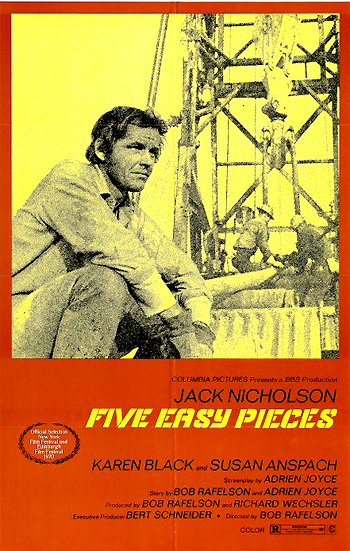
 Five
Easy Pieces (1970) is a moody, incisive, thoughtful character
study of an alienated, misfit drifter, outcast and non-committal
drop-out. The existential, off-beat road movie and thoughtful,
episodic and moody character study was awarded Best Picture honors
from the New York Film Critics Circle, and established Jack Nicholson,
soon after his success in
Five
Easy Pieces (1970) is a moody, incisive, thoughtful character
study of an alienated, misfit drifter, outcast and non-committal
drop-out. The existential, off-beat road movie and thoughtful,
episodic and moody character study was awarded Best Picture honors
from the New York Film Critics Circle, and established Jack Nicholson,
soon after his success in