
|
Bombs, Disasters and Film Flops: The Most Notable Examples Silents-1949 |

|
(chronologically, by film title) Intro | Summary Chart | Silents-1949 | 1950 -1966 | 1967-1969 | 1970-1974 | 1975-1977 | 1978-1979 1980 | 1981 | 1982 | 1983-1984 | 1985-1986 | 1987-1989 1990-1991 | 1992-1994 | 1995 - 1 | 1995 - 2 | 1996-1997 | 1998 | 1999 | 2000 | 2001 - 1 | 2001 - 2 2002 - 1 | 2002 - 2 | 2002 - 3 | 2003 | 2004 | 2005 | 2006 | 2007-2011 | 2012-2014 | 2015-2017 | 2018-2019 | 2020-2021 |
|
| Film Title, Director, Studio, Budget Information, Description | |
|
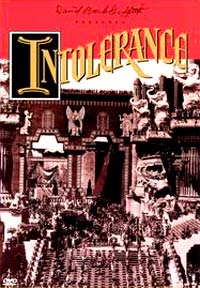
Intolerance (1916) Director D.W. Griffith's expensive, most ambitious silent epic film masterpiece overtook his earlier The Birth of a Nation (1915), which was the previous record-holder of "most expensive film" (at $110,000). Both films were milestones and landmarks in cinematic history - and regarded as two of the greatest films of the silent era. This film was financed using the profits of Griffith's earlier film. Unlike Birth, however, Intolerance - with an astronomical budget of almost $2 million, became the first multi-million dollar box-office 'bomb' in film history. Griffith's Triangle Studios suffered from poor box-office receipts, and went bankrupt, and Griffith himself was personally burdened by debts for almost two decades. The most costly elements of this early blockbuster were in the Babylonian segments which had the largest set ever constructed for a film. The excessive expense of 4,000 extras, and the orgy scene (priced at $200,000 alone) threatened to doom the film's production. It was also commercially unsuccessful in the US, partially due to the financial burden of having full orchestration accompany the film. The mammoth, melodramatic film was subtitled: "A Sun-Play of the Ages" and "Love's Struggle Throughout the Ages." All of the four widely separate, yet paralleled stories spanning several hundreds of years and cultures were held together by themes of intolerance, man's inhumanity to man, hypocrisy, bigotry, religious hatred, persecution, discrimination and injustice achieved in all eras by entrenched political, social and religious systems. The disparate storylines were:
In Griffith's radically non-linear, interwoven hybrid film, he simultaneously cross-cut (or "switchbacked") between the four segments over great gaps of space and time - there were over 50 transitions between the segments. As the film reached its suspenseful climax, the tension built as the transitions increased in tempo. This complex, sometimes baffling, unwieldy construction, and its three hour length partially contributed to its failure. One of the major reasons it bombed was because of timing - its pacifist themes (in its closing segment) helped to encourage its unpopular reception just prior to the US entrance into the Great War (World War I). |
|
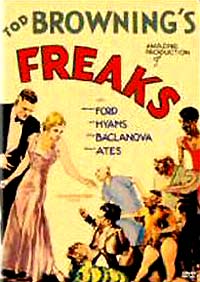
Freaks (1932) This disturbing and bizarre film was Tod Browning's follow-up to his horror smash hit Dracula (1931). Browning had run away to join the circus when he was 16 years old, influencing his work, and had directed two other circus-related films: The Show (1927) and The Unknown (1927). After this film, Browning's career would never be the same - he directed only a few more films through 1939 before retiring. This cult film redefined the concepts of beauty, love, and abnormality, but was so disturbingly ahead of its time that audiences stayed away in huge numbers, and it was even banned for 30 years in England. MGM was so embarrassed and horrified by the film's premise that it withdrew the film after its initial release, and sold off the film to exploitative, second-rate distributors who truncated it, toured it and renamed it Nature's Mistakes. To the studio's dismay, the film was both a financial disaster and a critical failure. Taglines and posters shamelessly promoted the film: "Can a full grown woman truly love a midget?" "Do Siamese twins make love?" "What sex is the half-man, half-woman?" The film avoided being exploitative by establishing itself as sympathetic towards the "freaks," explaining in the apologetic prologue that as otherwise normal people, they have through the ages been unfairly considered "an omen of ill luck or representative of evil," forcing them to adopt a code. Any crime committed against any one of them will be considered a crime against all of them. The morality play was about a circus sideshow and its odd clique of "freaks," comprised of real-life malformed people, such as dwarves, androgynous hermaphrodites, Siamese twins (Daisy and Violet Hilton), a "living torso" (Prince Randian, a man without limbs who slithered on the ground), a half-man (Johnny Eck with only the upper half of his body), a bearded lady, pinheads, and others. The film told a tale about a cold-hearted, full-sized, high-wire trapeze artist Cleopatra (Olga Baclanova) who seduced and married a circus sideshow midget named Hans (Harry Earles), hoping to inherit his wealth by poisoning him, and then running off with her boyfriend and circus strongman Hercules (Henry Victor). After the film's infamous and macabre "Wedding Feast" scene (with the unforgettable chant: "We accept her. We accept her. Googoo-goggle, Googoo-goggle. One of us, One of us."), she incurred the wrath of the tightly knit, loyal group of "nature's aberrations," including Hans' fiancee Frieda (Daisy Earles), who set out to avenge their compatriot in a truly horrifying climax that played itself out in a muddy rainstorm. |
|
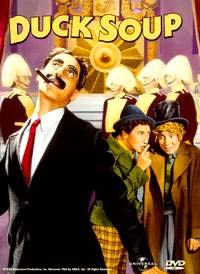
Duck Soup (1933) Although most critics have rated this absurdly funny film as one of the Marx Brothers' best comedies, it was also considered a very subversive political satire (and banned in Italy by Mussolini). Groucho headlined as Freedonia's prime minister Rufus T. Firefly who went to war because he was called an 'upstart' by the ambassador of the neighboring Sylvania. The film was filled with non-stop verbal humor, anarchic set-pieces and visual gags, without any of the solo musical routines that were found in their other features. At the time of its release, this short feature film was a commercial failure at the box-office, although actual statistics about its monetary take are unavailable. American audiences in the early 1930s were put off by the cynical and scathing attitudes toward war, politics and nationhood displayed in the film. As a result, it became the last of five films the Marx Brothers made with Paramount, when their contract wasn't renewed. However, they were picked up by MGM - and two years later, starred in the very successful MGM film A Night at the Opera (1935), with a more predictable and subdued plot. |
|
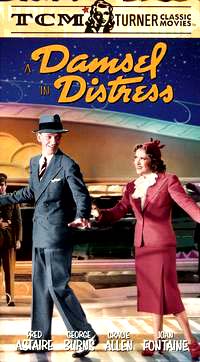
A Damsel in Distress (1937) This musical comedy (with music and lyrics by George and Ira Gershwin and based on a P.G. Wodehouse story) was best known as the first Fred Astaire/RKO film to not feature Ginger Rogers, after they had famously teamed up together in Flying Down to Rio (1933) and made their previous last joint appearance in RKO's Shall We Dance (1937). It was also the first Astaire film to be a box-office flop. In Ginger's place was an inept dancer/singer -- 19 year-old starlet Joan Fontaine (as Astaire's love interest Lady Alyce Marshmorton, the daughter of an English Earl), along with radio stars George Burns and Gracie Allen as themselves. Astaire played the role of dancer Jerry Halliday. Fontaine appeared in one song/walk routine with Astaire, called "Things Are Looking Up." The film received two Oscar nominations (including Best Art Direction) and won choreographer Hermes Pan an Academy Award Oscar for Best Dance Direction for the "Fun House" dance sequence titled "Stiff Upper Lip." To make up for their miscalculation, RKO quickly recast the celebrated dance team of Astaire and Rogers to reappear in the next year's Carefree (1938), followed by one more pairing in their final RKO film, The Story of Vernon and Irene Castle (1939). [Note: The pair ultimately made a total of nine RKO Radio Pictures from 1933-1939.] |