Exploitative Sex Hygiene -- Sex Education Films:
Even
in the late 20s and early 30s, before censorship officially took hold, independent
film producers such as S.S. "Steamship" Millard defied the Code
by producing tawdry films and anti-sex diatribes about the scourges of venereal
disease, white slavery and unwanted pregnancy -- such as Pitfalls of Passion
(1927) (advertised as "Sexsational" with the lobby card tagline:
"Is Sex Knowledge a Sin? See the Birth of Life Unfolded") and Is
Your Daughter Safe? (1927) - a "educational" melodrama that Variety said was "possibly the strongest and most daring of so-called
hygiene and sex warning pictures ever made." Edgar Ulmer also directed Damaged Lives (1933), a social drama about the horrors of venereal
disease for a married couple.
 Once the Hays Code was fully enforced, exhibitors attempted
to continue to cash in on the underground and road show film audiences' prurient
interest in sex hygiene films, by producing films such as: Once the Hays Code was fully enforced, exhibitors attempted
to continue to cash in on the underground and road show film audiences' prurient
interest in sex hygiene films, by producing films such as:
- High School Girl (1934) -
about teenage pregnancy, repackaged or remade for Kroger Babb's post-war Mom and Dad (1945) - see below
- Sex Madness (1937) - a propagandistic
film about the downfall of a teenaged 'good girl' named Millicent whose
behavior led to the social disease of syphilis and worse!
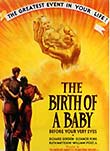
- The Birth of a Baby (1938) - a typical 'facts-of-life' maternity docudrama, with documentary footage
of an actual birth spliced into the last reel to make it "daring"
and "controversial" and cause some showings to be sex-separated
- No Greater Sin (1941) (aka The Lonesome Road) -
an expoitation film and serious melodrama about a young machinist who contracted
syphilis from a prostitute and then passed the disease onto his newlywed
'girl-next-door' wife and unborn child after consulting with a quack doctor;
the disclaimer was attached to the film: "Due to the adult subject
matter of this program, no one under 16 admitted!"
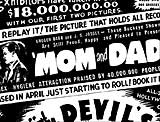 Mom
and Dad (1945) - producer/promoter Kroger Babb's (self-dubbed as "America's
Fearless Young Showman") low-budget, heavily-promoted film soon became
one of the most successful exploitation films of all time - it was the 3rd
highest grossing film during the 1940s; banners and ads cried out: "ONCE
IN A LIFETIME Comes A Presentation That TRULY PULLS NO PUNCHES! Now YOU
Can SEE The Motion Picture That DARES DISCUSS and EXPLAIN SEX AS NEVER BEFORE
SEEN and HEARD! THE ONE, THE ONLY, THE ORIGINAL...MOM AND DAD...Truly The
World's Most Amazing Attraction! NO ONE UNDER HIGH SCHOOL AGE Admitted
Unless Accompanied By Parents!! EVERYTHING SHOWN! EVERYTHING EXPLAINED!"
Besides being socially-significant as a sex-hygiene film (with facts about
sexual reproduction, pregnancy and the female anatomy), and tales about
the dangers of venereal disease and the disastrous results of premarital
sex, prints of this black and white feature drama were made and road-showed
for more than two decades, each print showing an innocent young girl deflowered
and becoming pregnant (without displaying nudity or sex of any kind), graphic
footage of a live birth, a C-section, and images of the ravages of venereal
disease Mom
and Dad (1945) - producer/promoter Kroger Babb's (self-dubbed as "America's
Fearless Young Showman") low-budget, heavily-promoted film soon became
one of the most successful exploitation films of all time - it was the 3rd
highest grossing film during the 1940s; banners and ads cried out: "ONCE
IN A LIFETIME Comes A Presentation That TRULY PULLS NO PUNCHES! Now YOU
Can SEE The Motion Picture That DARES DISCUSS and EXPLAIN SEX AS NEVER BEFORE
SEEN and HEARD! THE ONE, THE ONLY, THE ORIGINAL...MOM AND DAD...Truly The
World's Most Amazing Attraction! NO ONE UNDER HIGH SCHOOL AGE Admitted
Unless Accompanied By Parents!! EVERYTHING SHOWN! EVERYTHING EXPLAINED!"
Besides being socially-significant as a sex-hygiene film (with facts about
sexual reproduction, pregnancy and the female anatomy), and tales about
the dangers of venereal disease and the disastrous results of premarital
sex, prints of this black and white feature drama were made and road-showed
for more than two decades, each print showing an innocent young girl deflowered
and becoming pregnant (without displaying nudity or sex of any kind), graphic
footage of a live birth, a C-section, and images of the ravages of venereal
disease
Mae West's Racy Influence:
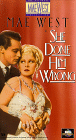 All
of the sultry comedies of bawdy, liberated and buxom Broadway star Mae West
were an affront to the Code, after Paramount brought her out West from New
York. West flaunted her sexuality and full-figured body, and irreverently
made sex into a comedy, first in Night After Night
(1932) in a small cameo role, and then in two of her most controversial
films: She Done Him Wrong (1933) (a film version
of West's popular Broadway play Diamond Lil) and I'm
No Angel (1933). All
of the sultry comedies of bawdy, liberated and buxom Broadway star Mae West
were an affront to the Code, after Paramount brought her out West from New
York. West flaunted her sexuality and full-figured body, and irreverently
made sex into a comedy, first in Night After Night
(1932) in a small cameo role, and then in two of her most controversial
films: She Done Him Wrong (1933) (a film version
of West's popular Broadway play Diamond Lil) and I'm
No Angel (1933).
Her sexual wiles and wisdom were obviously on display in one
film after another. The Production Code Administration also had severe problems
with the racy Belle of the Nineties (1934) (originally titled: It
Ain't No Sin), with West as notorious vaudeville star Ruby Carter. Some of her most famous lines of dialogue (from scripts often toned down and
replaced with double entendres) from the above-mentioned films include
the following:
- Hat-check girl: Goodness, what beautiful diamonds.
West: Goodness had nothing to do with it, dearie.
- Listen, when women go wrong, men go right after them.
- Come up. I'll tell your fortune...Ah, you can be had.
- You know it was a toss-up whether I go in for diamonds
or sing in the choir. The choir lost.
- Why, he'd be the kind a woman would have to marry to get
rid of.
- Don't worry. I ain't gonna hurt him. I only wanna feel
his muscles.
- Well, it's not the men in your life that counts, it's the
life in your men.
- When I'm good, I'm very good. But when I'm bad, I'm better.
- It's better to be looked over than overlooked.
- A man in the house is worth two in the street.
After July of 1934, films that were considered tawdry, cheap,
and offensive to the code were not allowed. In part, Mae West's popularity,
with her trademark sexual innuendos, declined precipitously as a result.
The Imposition of the Hays Code:
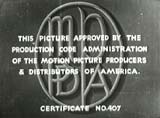 The film industry, represented by the MPPDA (Motion
Picture Producers and Distributors Association) that was formed in 1922 and
headed by former US postmaster Will Hays until the mid-1940s, created a series
of self-regulating agencies that led to the Production Code Administration in 1934. The Production Code was administrated by Joseph Breen. It required
producer-members of the MPPDA to submit script material and final film prints
for Production Code approval. The film industry, represented by the MPPDA (Motion
Picture Producers and Distributors Association) that was formed in 1922 and
headed by former US postmaster Will Hays until the mid-1940s, created a series
of self-regulating agencies that led to the Production Code Administration in 1934. The Production Code was administrated by Joseph Breen. It required
producer-members of the MPPDA to submit script material and final film prints
for Production Code approval.
Three factors forced Hays and the studios to become more restrictive:
- mounting
pressure from the Catholic Church aided by support from other
religious groups
- economic hardships during the Depression
- the threat of federal censorship
In 1934, the American
Catholic church announced the creation of the Legion of Decency,
which encouraged the production of moral films and promptly
condemned any film with an immoral message. The threat of movie
boycotts by the Catholic Legion of Decency led the industry's
trade association in mid-1934 to establish a stronger Production
Code Administration (PCA) Office, headed by appointee Joseph
Breen, to regulate films.
When the new, morally-strict Motion Picture Production
Code was imposed (actually strictly enforced) on the mainstream film industry
from 1934 on, certain words, gestures, and actions were forbidden, as well
as explicit violence and sexual innuendo. Films would be submitted for a "seal
of approval" - and if a film was denied a seal, it was not to be exhibited
in theaters. If a film was deliberately offensive and failed to meet the code's
requirements, it could face severe penalties or risk losing distribution rights.
Many films were either suppressed, or severely mutilated or censored to fit
the seal's requirements. A film that abided by the rules received a "Purity
Seal" - otherwise, a film was denied distribution or screening, and the
public was denied that viewing choice. A $25,000 fine was imposed on anyone
showing a film without the group's seal of approval.
The Code forbade the following, particularly anything
related to sex and crime (two of the biggest box-office draws): crimes
against the law, explicit treatments of adultery, excessive lust or
scenes of passion or rape, vulgarity, obscenity, profanity, complete
nudity, indecent exposure, white slavery, miscegenation, suggestive
dance, disrespect of religion (or clergy), homosexuality, childbirth,
and various repellent subjects (hanging, gruesome brutality, branding,
cruelty to children or animals, etc.). The Code enforced rigid compliance,
fearing corruption of morals otherwise.
Reaction to the Hays Code: Subliminal Sexuality
As a result, the Hays Code pushed earthy sexuality and
eroticism ('deviant' depictions of infidelity, homosexuality, etc.)
deeper into new levels of suggestiveness, repression, deviation, and
displacement. In some cases, films were actually improved by
appealing to the audience's imaginations. Writers often presented subjects
by metaphorical implication rather than literally, for example:
- the truncated bathing and overnight dalliance scene of
young soldiers with French farm girls in All Quiet on the Western Front (1930)
- the vampire's (Bela Lugosi) blood-sucking kisses in Dracula
(1931)
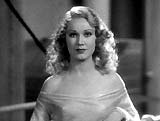 the
approximately three minutes of censored scenes (mostly for violence) in King Kong (1933), including one of the hairy Beast Kong peeling
some of the clothes away from Beauty Fay Wray (as Ann Darrow) and sniffing
them; this was the ultimate Beauty and the Beast monster film, with a strong
subtext about the introduction of the feminine into a man's world and into
uncharted territory, and the release of the primal male beast upon the civilized
world (NYC); the film was considered slightly scandalous for its inter-racial
'love story' of a giant black ape with a white blonde woman - their forbidden
love resulted in Kong's subsequent punishment - death; sexy screamer Fay
Wray was featured as the object of male affection and of the desires of
the giant hairy Beast -- and the Empire State Building was the ultimate
phallic symbol from which the beast was toppled; the white blonde woman
was regarded as a more valuable virginal substitute for Kong by the natives
of Skull Island who regularly sacrificed half-naked, garlanded black virgins
(white woman Ann was worth the equivalent of six native women, acc. to the
tribal chief); the film even contained sexual double entendres, as in the
scene when film-maker Denham (Robert Armstrong) told First Mate Jack Driscoll
(Bruce Cabot) that he feared his crewmember had been emasculated and gone
"soft" (or impotent) and "sappy" over Ann's Beauty, as the Beast would do
later: "It's the idea of my picture. The Beast was a tough guy too.
He could lick the world. But when he saw Beauty, she got him. He went soft.
He forgot his wisdom and the little fellas licked him"; in addition,
the film had a sexy sequence in which a braless Ann went to costume herself
for the screaming film-test with Denham, and soon returned wearing a revealing,
off-the-shoulder "Beauty and Beast costume" the
approximately three minutes of censored scenes (mostly for violence) in King Kong (1933), including one of the hairy Beast Kong peeling
some of the clothes away from Beauty Fay Wray (as Ann Darrow) and sniffing
them; this was the ultimate Beauty and the Beast monster film, with a strong
subtext about the introduction of the feminine into a man's world and into
uncharted territory, and the release of the primal male beast upon the civilized
world (NYC); the film was considered slightly scandalous for its inter-racial
'love story' of a giant black ape with a white blonde woman - their forbidden
love resulted in Kong's subsequent punishment - death; sexy screamer Fay
Wray was featured as the object of male affection and of the desires of
the giant hairy Beast -- and the Empire State Building was the ultimate
phallic symbol from which the beast was toppled; the white blonde woman
was regarded as a more valuable virginal substitute for Kong by the natives
of Skull Island who regularly sacrificed half-naked, garlanded black virgins
(white woman Ann was worth the equivalent of six native women, acc. to the
tribal chief); the film even contained sexual double entendres, as in the
scene when film-maker Denham (Robert Armstrong) told First Mate Jack Driscoll
(Bruce Cabot) that he feared his crewmember had been emasculated and gone
"soft" (or impotent) and "sappy" over Ann's Beauty, as the Beast would do
later: "It's the idea of my picture. The Beast was a tough guy too.
He could lick the world. But when he saw Beauty, she got him. He went soft.
He forgot his wisdom and the little fellas licked him"; in addition,
the film had a sexy sequence in which a braless Ann went to costume herself
for the screaming film-test with Denham, and soon returned wearing a revealing,
off-the-shoulder "Beauty and Beast costume"
 the
blanket ("wall of Jericho") suspended between the single beds of unemployed
reporter Clark Gable and runaway heiress Claudette Colbert in a shared bedroom;
and later a second scene with their beds separated by a blanket, and Colbert's
tearful, confessional request: "Take me with you, Peter. Take me to
your island. I want to do all those things you talked about....I love you.
Nothing else matters. We can run away. Everything will take care of itself.
Please, Peter, I can't let you out of my life now. I couldn't live without
you"; in the final scene, a trumpet's sounding and the fall of the 'wall
of Jericho' signaled the consummation of their love, in It Happened One Night (1934) the
blanket ("wall of Jericho") suspended between the single beds of unemployed
reporter Clark Gable and runaway heiress Claudette Colbert in a shared bedroom;
and later a second scene with their beds separated by a blanket, and Colbert's
tearful, confessional request: "Take me with you, Peter. Take me to
your island. I want to do all those things you talked about....I love you.
Nothing else matters. We can run away. Everything will take care of itself.
Please, Peter, I can't let you out of my life now. I couldn't live without
you"; in the final scene, a trumpet's sounding and the fall of the 'wall
of Jericho' signaled the consummation of their love, in It Happened One Night (1934)
- a man and woman (Robert Donat and Madeleine Carroll) were
handcuffed together through circumstances beyond their control, and forced
to share a bedroom in Hitchcock's The 39 Steps (1935)
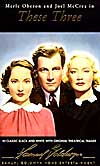
- William Wyler's retitled These Three (1936) (adapted
from Lillian Hellman's play The Children's Hour) ambigiously hinted
at the forbidden, objectionable theme of lesbianism
- Claire Trevor portrayed a streetwalker suffering from consumption
(tuberculosis) rather than syphilis, more common to her occupation in Dead
End (1937)
 Bette
Davis portrayed a 'nightclub hostess' (euphemism for prostitute) opposite
gangster Humphrey Bogart in Marked Woman (1937) Bette
Davis portrayed a 'nightclub hostess' (euphemism for prostitute) opposite
gangster Humphrey Bogart in Marked Woman (1937)
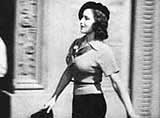
- teenaged Lana Turner's performing a tight-sweatered walk
in They Won't Forget (1937) - becoming "the Sweater Girl"
- Cary Grant's embarrassed exclamation while dressed in a
frilly woman's dressing gown, "...I just went gay all of a sudden,"
in Bringing Up Baby (1938)
- Judith Anderson portrayed a lesbian-leaning, obsessed housekeeper
to the dead Mrs. Rebecca de Winter in Hitchcock's Rebecca (1940)
- a homosexual, criminal trio consisted
of Sydney Greenstreet, Joel Cairo, and "gunsel" Elisha Cook, Jr.
in John Huston's The Maltese Falcon (1941)
- allegedly, the longest screen
kiss in film history in a commercial feature film, between Jane Wyman
and Regis Toomey in You're
In the Army Now (1941), lasted 3 minutes and 5 seconds. However,
that is an entirely false statement. It is only a legend or myth
that the kiss in
You're in the Army Now (1941) lasted 185 seconds. The kiss
in question was actually two kisses (broken up by cutaways) that
lasted a total of only 24 seconds. See http://www.filmsite.org/filmkisses6.html for
detailed proof.
- a cleaned-up Kings Row (1942) -
was released with little of the original novel's scandalous content
(including incest), and Cassie's (Betty Field) nymphomania affliction
was transformed to dementia
- the shared use of cigarettes served as a metaphor for the
sex act in Now, Voyager (1942)
- a suggestive fadeout occurred after Ilsa (Ingrid Bergman)
fell into Rick's (Humphrey Bogart) arms in his upstairs apartment, confessed
her love ("if you knew how much I loved you, how much I still love
you"), and offered a passionate kiss, in Casablanca (1942)
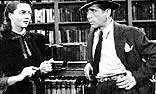 the
verbal come-on of a bold 19 year old Lauren Bacall (in her film debut) to
Humphrey Bogart upon rising from his lap after kissing: "You know you
don't have to act with me, Steve. You don't have to say anything and you
don't have to do anything. Not a thing. Oh, maybe just whistle. (She opens
his door and pauses.) You know how to whistle, don't you, Steve? You just
put your lips together - and blow," in To
Have and Have Not (1944) the
verbal come-on of a bold 19 year old Lauren Bacall (in her film debut) to
Humphrey Bogart upon rising from his lap after kissing: "You know you
don't have to act with me, Steve. You don't have to say anything and you
don't have to do anything. Not a thing. Oh, maybe just whistle. (She opens
his door and pauses.) You know how to whistle, don't you, Steve? You just
put your lips together - and blow," in To
Have and Have Not (1944)
- the interlude sex scene in Howard Hawks' The Big Sleep (1946) in which Bogart's Philip Marlowe convinced
an aggressive book salesgirl (Dorothy Malone) to share a drink of rye with
him during a wet and hard rainstorm! - she quickly lowered the shades, coyly
removed her eyeglasses and the barette from her hair, and conveniently brought
out two cups; after a fadeout, Bogart left the shop many minutes later (their
long dalliance was signaled by the end of the rain)
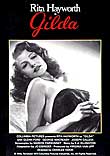 Rita
Hayworth's performance of a seductive, but minimal black glove "Put the
Blame on Mame" striptease in a black strapless gown in Gilda
(1946) Rita
Hayworth's performance of a seductive, but minimal black glove "Put the
Blame on Mame" striptease in a black strapless gown in Gilda
(1946)
- the marathon kiss on a balcony and throughout an apartment
between Cary Grant and Ingrid Bergman in Hitchcock's Notorious (1946)
- in Michael Powell's and Emeric Pressburger's tale
about a Himalayan nunnery in Black
Narcissus (1947, UK), one of the unstable and spurned British-Anglican
nuns Sister Ruth (Kathleen Byron) was driven mad by repressed sexuality
and jealousy; in the unnerving conclusion, she
renounced her vows, adorned herself in a bright red dress
(with matching red lipstick), and sought to lethally attack her
rival Sister Clodagh (Deborah Kerr)
- the disguised abortion doctor ('psychological consultant')
with whom Bette Davis visited with an unwanted pregnancy in Beyond
the Forest (1949) - a film that warned in its opening that it was
salutory to view this "story of evil" in order to be delivered
from it
Compensating Moral Value and Censorship:
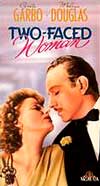 In
certain cases when "compensating moral value" tempered the immorality,
sin, and evil within a film, various prohibited actions would be allowed.
For example, in the romantic classic Camille (1936),
the affair between the dashing Robert Taylor and courtesan Greta Garbo could
exist as long as their dalliance would ultimately be prohibited by Taylor's
father Lionel Barrymore. In director George Cukor's Two-Faced Woman (1941),
Garbo's last film, the star played the part of her twin to seductively
lure philandering husband Melvyn Douglas away from his ex-mistress Constance
Bennett. The film's suggestive and immoral sexuality and Garbo's low-cut gowns
were condemned by the Legion of Decency. In
certain cases when "compensating moral value" tempered the immorality,
sin, and evil within a film, various prohibited actions would be allowed.
For example, in the romantic classic Camille (1936),
the affair between the dashing Robert Taylor and courtesan Greta Garbo could
exist as long as their dalliance would ultimately be prohibited by Taylor's
father Lionel Barrymore. In director George Cukor's Two-Faced Woman (1941),
Garbo's last film, the star played the part of her twin to seductively
lure philandering husband Melvyn Douglas away from his ex-mistress Constance
Bennett. The film's suggestive and immoral sexuality and Garbo's low-cut gowns
were condemned by the Legion of Decency.
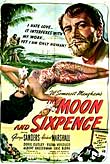 The
Production Code always ensured that criminals or 'bad' girls would
be punished in the end. In Billy Wilder's film noir Double
Indemnity (1944), the amoral, shrewd and sexy Barbara Stanwyck
and her male lover-accomplice Fred MacMurray end up shooting each
other (and dying) after committing a sexually-charged perfect murder.
And in the adaptation of Somerset Maugham's novel The Moon and
Sixpence (1943), a disillusioned,
rakish, sexually-adventurous, Paul Gauguin-like painter (George Sanders)
abandoned family and moved to Tahiti to engage in a hedonistic life
- where he was duly condemned by the film's narrator (provided by
Herbert Marshall). The
Production Code always ensured that criminals or 'bad' girls would
be punished in the end. In Billy Wilder's film noir Double
Indemnity (1944), the amoral, shrewd and sexy Barbara Stanwyck
and her male lover-accomplice Fred MacMurray end up shooting each
other (and dying) after committing a sexually-charged perfect murder.
And in the adaptation of Somerset Maugham's novel The Moon and
Sixpence (1943), a disillusioned,
rakish, sexually-adventurous, Paul Gauguin-like painter (George Sanders)
abandoned family and moved to Tahiti to engage in a hedonistic life
- where he was duly condemned by the film's narrator (provided by
Herbert Marshall).
Producer David O. Selznick's Gone With The Wind (1939) faced tough treatment by the Hollywood
Code, with the attractive but immoral character of prostitute Belle Watling,
Melanie's difficult labor and childbirth scene, the conjugal rape scene of
Clark Gable carrying his wife Vivien Leigh up the stairs (that ends with a
fade out), and Gable's scandalous parting words: "Frankly, my dear, I don't
give a damn" that broke the Production Code's language provisions; and
it is still widely-believed that the bold line of dialogue cost Selznick a
$5,000 fine. |

 Sexual-Erotic Films