
|

Greatest Films of the 1920s
1920 | 1921 | 1922 | 1923 | 1924 | 1925 | 1926 | 1927 | 1928 | 1929
Title Screen Film Genre(s), Title, Year, (Country), Length, Director, Description 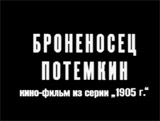


Battleship Potemkin (1925, Soviet Union) (aka Bronenosets Potyomkin, or Броненосец Потёмкин), 75 minutes, D: Sergei Eisenstein
The state commissioned legendary Russian auteur director Sergei Eisenstein to shoot this film to commemorate the 20th anniversary of the 1905 revolution. His classic landmark and visionary film was released in the US in 1926, advancing the art of cinematic storytelling with the technique of montage (or film editing). It was about the mutiny of sailors on the battleship Potemkin and the aftermath - a counter-attack by Czarist troops when civilians and rioters were ruthlessly massacred in the seaport of Odessa. Its most celebrated film scene, with superb editing combining wide, newsreel-like sequences inter-cut with close-ups of harrowing details (a woman with a bullet through her spectacles, troops in formation) - to increase tension, was the Odessa Steps episode. In the scene (with 155 separate shots in less than five minutes), the Czarist soldiers fired on the crowds thronging on the Odessa steps with the indelible, kinetic image of a baby carriage careening down the marble steps leading to the harbor (copied by De Palma's The Untouchables (1987)), and the symbolism of a stone lion coming awake.

Ben-Hur: A Tale of Christ (1925), 145 minutes, D: Fred Niblo
First filmed in 1907, this remake cost $2 million at the time, and is one of the most outstanding examples of silent film spectaculars. Set at the time of Christ, the film was the story of a Palestinian Jewish nobleman, Ben-Hur (Ramon Novarro), who was exiled to galley slavery by his Roman boyhood friend and centurion Messala (Francis X. Bushman), and later returned to seek vengeance. Included an exciting and spectacular chariot race sequence. Ben-Hur's mother and sister were healed of leprosy by Christ.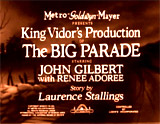


The Big Parade (1925), 141 minutes, D: King Vidor
The first realistic war drama which has served ever since as an archetypal model for all other war films. It was the first big box-office success of the newly-formed MGM Studios - and possibly the most profitable silent film of all time - it helped bring back the popularity of war films in the late 20s. At its time, it was the largest grossing silent film ever - with a combination of humor, romance, suspense, war-time action, and tragedy. Set in wartime, it was the story of an idealistic young man (John Gilbert) who enlisted to serve in World War I, and discovered the horrors of war. It was the first war film of its kind to tell its story from the viewpoint of the GI. Handsome matinee silent screen idol John Gilbert gave his greatest acting performance in a star-making role as one of three Americans who enlisted and was swept into the war in France. Along the way, he won the affection of beautiful French-speaking village girl Melisande (Renee Adoree). With extremely realistic battle scenes.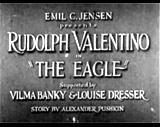
The Eagle (1925), 73 minutes, D: Clarence Brown
The sexually-appealing, charismatic Latin lover Rudolph Valentino (in one of his last films) starred as swashbuckling Russian cossack Lt. Vladimir Dubrovsky in this light, entertaining Zorro-like adventure film. In the plot, he portrayed an officer in the Czarina Catherine II's (Louise Dresser) horse guard who returned home to seek revenge. His deceased father had been dispossessed of his property by corrupt, scheming wealthy villain Kyrilla Troekouroff (James Marcus) and his partner - a corrupt district Judge (George Nichols). Dubrovsky masqueraded as two individuals - as a noble masked, Robin Hood-like bandit known as "The Black Eagle" and as a Frenchman hired to tutor the villain's beautiful daughter Mascha Troekouroff (Vilma Banky) in the language of the Russian court. In the schematic revenge-courtship story, Vladimir fell in love with Mascha.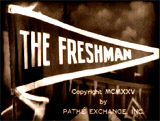


The Freshman (1925), 70 minutes, D: Fred C. Newmeyer, Sam Taylor
In this silent film satire of college life (aka College Days), bespectacled Harold Lloyd played the naive, awkward, nerdy Harold 'Speedy' Lamb who went off to Tate College, dressing and copying the behavior of the heroic football-star character in the movie The College Hero. With youthful optimism, he dreamt of becoming the most popular guy on campus and a major football star, but he lacked any apparent talent. After failing during football tryouts, the tough but pitying Coach (Pat Harmon) made him the tackle dummy and the team's water boy. Harold was under the mistaken impression that he was on the team, and ignorant that he was the butt of jokes by the entire campus. His love interest and dream-girl was a working girl named Peggy (Jobyna Ralston) in his boarding house and the Hotel Tate, and there was the stereotypical college cad or bully (Brooks Benedict). The most memorable scene in the film was the hilarious, climactic championship football game where Harold was finally able to play after every other substitute player had been injured and removed from the game.
The Gold Rush (1925), 72-82 minutes, D: Charles Chaplin
One of Chaplin's best films. The Tramp was an Alaskan prospector in the Klondike gold rush, who just about starved to death. Classic Tramp routines included his Thanksgiving Day Feast of a boiled edible boot, his romance with a dancehall girl, the dancing bread rolls, and the teetering house. A tremendous combination of pathos, sentimentality, and slapstick.

The Phantom of the Opera (1925), 93 minutes, D: Rupert Julian, Lon Chaney
One of the earliest horror films. Lon Chaney played the acid-scarred composer/phantom, who was somewhat crazed and scorned. He hid his deformity under a mask and lived in the catacombs under the Paris Opera House. He became infatuated by a young understudy, a beautiful soprano singer Christine (Mary Philbin) who he heard singing. He abducted her to his underground catacomb dwelling when she continued to see her fiance Raoul. In the secret dungeon, he planned to make her a star, training her to sing, in order to vindicate himself to those who had wronged him. She became intrigued by his mask and managed to impulsively unmask him in a shocking scene. With a two-color Technicolor Bal Masque sequence in which the Phantom suddenly made a Red Death appearance.
Seven Chances (1925), 56 minutes, D: Buster Keaton
The silly but entertaining story, filled with sight gags, was based upon the original Broadway production of "Seven Chances" by Roi Cooper Megrue and David Belasco. Remade in Hollywood as The Bachelor (1999). In the improbable plot, financial stock-broker Jimmie Shannon (Buster Keaton), a bachelor, was nearly bankrupt due to a bad deal. However, he was informed by lawyer (Snitz Edwards) that his grandfather's will left him an inheritance of $7 million - IF he married before 7 pm on his 27th birthday - that same day! He attempted to propose to seven eligible women, including his longtime but miffed girlfriend-next-door Mary Jones (Ruth Dwyer). He was thwarted by many obstacles and improbable matches at a country club, until an ad brought lots of prospective brides (in bridal gowns) to a church at 5 pm, but the angry females ended up pursuing the potential multi-millionaire through LA's streets - in a lengthy chase sequence. In another spectacular sequence, he dodged an avalanche of boulders, before he eventually discovered that Mary had changed her mind and they beat the 7 pm deadline.
Strike (1925, Soviet Union) (aka Stachka, or Стачка), 82 minutes, D: Sergei Eisenstein
This fictionalized propagandistic film (Eisenstein's directorial debut film) was set in pre-revolutionary Russia during Czarist rule, where a group of restless locomotive factory workers went on strike, to protest harsh working conditions and demand reforms (higher wages, a shorter work day, etc.). The strict capitalistic management brutally suppressed protest, resorted to spies and external agents (fire and police, and the army), and rejected all demands - and eventually decided to break the strike by any means necessary. The stunning film was a warm-up to Eisenstein's own Battleship Potemkin (1925), with many of the same audacious cinematographic techniques.