 |
The 1960s The End of the Hollywood Studio System and The Era of Independent, Underground Cinema Part 6 Film History of the 1960s Part 1, Part 2, Part 3, Part 4, Part 5, Part 6 Film History by Decade Index | Pre-1920s | 1920s | 1930s | 1940s | 1950s | 1960s 1970s | 1980s | 1990s | 2000s | 2010s |
|

|
Horror Films - During Alfred Hitchcock's Last Influential Decade:
Two other less effective Hitchcock films toward the end of the decade were routine Cold War espionage-spy thrillers:
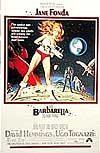
The science-fiction horror thriller Village of the Damned (1960) (remade in 1995 by John Carpenter), set in the British village of Midwich, told of the community's terrorizing by twelve children (all blonde, super-intelligent and with supernatural powers, fast-aging, and extra-terrestrial) - all born simultaneously. The UK's The Day of the Triffids (1963), based on John Wyndham's classic alien invasion sci-fi novel, told of a meteor shower that brought spores to Earth which germinated and grew into carnivorous plants. Another classic ghost-horror movie was Robert Wise's The Haunting (1963), based on Shirley Jackson's novel and starring Julie Harris and Claire Bloom. Two feuding legendary screen actresses Bette Davis and Joan Crawford had their careers re-vitalized by playing two aged, ex-movie star sisters (Davis portrayed a former child star and Crawford a handicapped former movie star) in Robert Aldrich's chilling, campy and macabre What Ever Happened to Baby Jane? (1962), setting a trend in horror films for years to come. George Romero's low-budget horror masterpiece was Night of the Living Dead (1968) about flesh-eating 'zombies' that possibly reanimated from their graves because of radiation from a fallen satellite. It was filmed on a miniscule budget of $114,000 and became an instant horror classic, even though it contained scenes of cannibalism and matricide, and featured a lead black actor (Duane Jones). It was one of the most successful independent features ever made at the time, earning some $12 million in box-office rentals worldwide. Changing Times in 60s Films: The Lucrative Youth-Cult Market: Director Roger Vadim's campy sexploitation science-fiction comedy-fantasy Barbarella (1968) also became a cult film due to Jane Fonda's revealing strip-tease in the film's opening credits. It also set a trend for vinyl knee-high boots, and shocked some with its kinky storyline (including a literal sex 'organ'). More and more young people were attracted - in huge numbers - to theaters in the years 1967-1969, due to the release of previously-mentioned films in the decade:
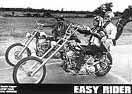
The pop singing group The Monkees starred in Bob Rafelson's self-indulgent, psychedelic, patch-work groundbreaking, surrealistic Head (1968), co-written by Jack Nicholson. Columbia's revolutionary, soundtrack-driven 'outlaw' biker road film Easy Rider (1969), a modern-day, youth-oriented tale made independently, cheaply, and informally, starred co-writer/director Dennis Hopper (as Billy) and second-generation star Peter Fonda (as Wyatt) on a surrealistic hippie odyssey that crossed paths with a boozy lawyer (Jack Nicholson). It was an unexpected monumental hit with countercultural crowds - the first blockbuster hit from a coming new wave of Hollywood directors.
As a result of Easy Rider's influence and success, this led to a flurry of equally self-indulgent, anti-Establishment themed films (generously green-lit by the big Hollywood studios) by inferior filmmakers, who overused some of the film's technical tricks, broke with a number of Hollywood conventions, and exploited the growing teen-aged market for easy profits. For example, Hopper's success with this film gave him the greenlight from Universal Pictures (and $850,000) for his next project The Last Movie (1971) which ended up being a colossal failure, due in part to reports of drug-induced orgies during filming, and its year-long editing process (delayed by alleged use of psychedelic drugs for 'inspiration'). However, a new wave of directors was looming on the horizon (Coppola, Bogdanovich, Altman, Scorsese, Spielberg, Lucas, De Palma, and Landis to name just a few) and led to an unusual eclectic set of offerings, including:
Daring Films in the 60s:
Another daring drama at the time was the glossy screen adaptation of John O'Hara's novel Butterfield 8 (1960) in which Elizabeth Taylor won her first Best Actress Award as an amoral, high-priced call girl in New York City. Italian director Federico Fellini's risque masterpiece La Dolce Vita (1960) (translated "The Sweet Life"), that marked the end of his Neo-Realistic period, starred Marcello Mastrioanni as a decadent society playboy and gossip columnist who pursued statuesque and busty film star Anita Ekberg to the Trevi Fountain.
To Kill a Mockingbird (1962) was a top-notch adaptation of Harper Lee's novel about a 1930s small-town, widowed southern lawyer (Oscar-winning Gregory Peck as Atticus Finch), with two children (Scout and Jem), who defended a falsely-accused black man against charges of the rape of a white woman - mixing two controversial topics (racism and rape). Two films in 1962 pushed for more explicit themes: Stanley Kubrick's Lolita (1962) dealt with the sensitive topic of pedophilia, and producer/director Otto Preminger's political-courtroom drama Advise & Consent (1962) involved homosexuality. Sidney Lumet's mainstream, socially-conscious melodrama about a Spanish Harlem Jewish shop owner - The Pawnbroker (1965) included a landmark scene of a woman undressing and baring her breasts - an integral component of the plot. The film was granted a Production Code seal, the first for a mainstream film containing nudity, beginning a trend toward nudity in other 60s American films. In 1967, a number of mainstream films helped spur the development of a ratings system, with their excessive amounts of explicit profanity and sexuality. (See Sexual and Erotic Films summary for more on challenges that led to the establishment of the ratings system). The First Films in 1966 That Challenged the System:
The title of the trashy melodramatic film Valley of the Dolls (1967), adapted from Jacqueline Susann's best-selling book and starring Barbara Perkins, Patty Duke, and Sharon Tate as three fame-seeking women, referred to 'uppers' and 'downers' - barbiturate pills. The first major (commercially-released) US studio film to include the word 'shit' in its dialogue was Richard Brooks' In Cold Blood (1967). It was also said a year later in Boom! (1968, UK) (spoken by actress Elizabeth Taylor as Flora 'Sissy' Goforth: "S--t on your mother!" Note: Taylor was the first actress to say 's--t' in a major motion picture). Two films claimed to be the first film to use the four-letter F word: director Joseph Strick's Ulysses (1967, UK/US) and Michael Winner's I'll Never Forget What's'isname (1967, UK) (i.e., "Get out of here, you f--king bastard!", spoken by actress Marianne Faithfull as Josie). The latter also included a scene that implied oral sex between Oliver Reed and Carol White, as did Albert Finney's first directorial attempt Charlie Bubbles (1967, UK) with a controversial oral sex scene. The New Ratings System: By the late 1940s, the organization known as the MPPDA (Motion Picture Producers and Distributors of America) to administer the motion picture Production Code then became known as the Motion Picture Association of America (MPAA). In 1966, the Production Code Administration (and its Motion Picture Production Code) that had set moral standards in films for almost 30 years since its establishment in the early 1930s, was curtailed. Due to pressures emerging against the archaic censorship body, its new president Jack Valenti (appointed in 1966) abolished the Hays Code in 1967. It had become very obvious that the code was outdated and unnecessarily restrictive. In November of 1968, a major revision in the ratings systems helped to encourage artistic freedom rather than censorship, and avoid the threat of government censorship. It let Hollywood film-makers compete against adult-oriented foreign film productions, and it lessened restraint toward questionable themes (sex and nudity, violence, obscenity, etc.) A new voluntary ratings code was announced to replace the decades-old Production Code, and it was to be administered by the Motion Picture Association of America (MPAA) (under the Classification and Rating Administration). Ratings were to be enforced by theaters, distributors and exhibitors. The four ratings beginning in 1968 (for only a few years) were:
Soon afterwards in 1969, the M rating was changed to GP (General Patronage) and then to PG (meaning 'Parental Guidance Suggested') in 1970, and the age restriction was raised to 17 from 16. Rather than a form of pre-censorship or a restriction against pornography, the new system mainly offered advisory classification to exclude under-16s from X-rated films (later changed to 17), and categorized films according to their appropriateness for young viewers. The threat of an X rating encouraged many filmmakers to re-edit their films to achieve an R rating. Most filmmakers would also subsequently try to avoid a G-rating (other than Disney's animations and true family fare) in order to raise their ratings to PG - and thereby increase their desirability by adult audiences. Many foreign film-makers chose to not submit their films to the ratings board, since their films didn't have widespread appeal anyway and would only play in arthouse venues. After the ratings system was implemented, a lot of films were made that probably couldn't have been made or released under the old Production Code guidelines. And a number of films were specifically geared to appeal to counter-cultural, youthful or arthouse audiences that had become tired of stale Hollywood offerings. The US/Canadian production of director Mark Rydell's originally R-rated debut film The Fox (1967, Can.) had been controversial for its depictions of nudity, masturbation and lesbianism - in a stark adaptation of D.H. Lawrence's 1923 novella of lesbian love. Brian De Palma's draft-dodger comedy Greetings (1968), (Robert De Niro's debut film) received an X rating by the MPAA for nudity and profanity (in its original release), although it was reduced to an R rating. The disturbing crime drama The Boston Strangler (1968) told the grisly story of violent, self-confessed mass murderer Anthony DeSalvo (Tony Curtis). The first film to receive an X rating was La Motocyclette (1968, UK/Fr.) (aka The Girl on a Motorcycle), about a leather-clad female cyclist (singer Marianne Faithfull) with numerous sexual fantasies.
The Best Picture Oscar for films made in 1969 went to English director John Schlesinger's X-rated Midnight Cowboy (1969) with the popular Harry Nilsson theme song Everybody's Talking. This archetypal "New Hollywood" 70s film, with nudity and profanity, told the story of the close relationship between a naive Texan stud-dishwasher (Jon Voight) and a grizzled derelict (Dustin Hoffman), two men forced to live in marginalized American society. Its themes resonated with the countercultural audiences of the time: sex, drugs, anti-authoritarianism, and the search for freedom. It was the first major, commercial studio-film so rated and the first X-rated film ever to win the Academy Award (although two years later, the ratings board re-classified it as R-rated).

Part 1 , Part 2, Part 3, Part 4, Part 5, Part 6 
 
|

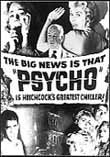
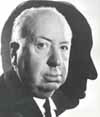 Alfred
Hitchcock opened the decade (his fifth-decade of film-making) with his
shocking, taut, blood-curdling
Alfred
Hitchcock opened the decade (his fifth-decade of film-making) with his
shocking, taut, blood-curdling 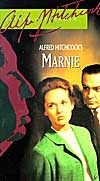 His
next film was the paranoic
His
next film was the paranoic 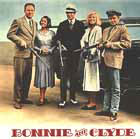 Traditional
genres, like the gangster, thriller, war, horror, and western film portrayed
more graphic violence and adult content. Films that exemplified these
trends included Arthur Penn's stylish, fictionalized account of two notorious,
anti-establishment 1930s folk-hero criminals
Traditional
genres, like the gangster, thriller, war, horror, and western film portrayed
more graphic violence and adult content. Films that exemplified these
trends included Arthur Penn's stylish, fictionalized account of two notorious,
anti-establishment 1930s folk-hero criminals 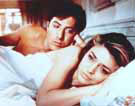 By
the end of the decade - a time of enormous social turbulence, anti-authoritarianism
and establishment questioning, political assassination, youth protest,
marches and demonstrations, permissive sexuality and nudity, and anti-Vietnam
War attitudes, baby boomers had become a major movie-attending presence.
Hollywood cautiously produced only a few films to answer these themes.
One of the most successful films to focus on youthful alienation and
'coming of age' was Mike Nichols' extremely popular but unsettling
sex comedy
By
the end of the decade - a time of enormous social turbulence, anti-authoritarianism
and establishment questioning, political assassination, youth protest,
marches and demonstrations, permissive sexuality and nudity, and anti-Vietnam
War attitudes, baby boomers had become a major movie-attending presence.
Hollywood cautiously produced only a few films to answer these themes.
One of the most successful films to focus on youthful alienation and
'coming of age' was Mike Nichols' extremely popular but unsettling
sex comedy
 Studios
capitalized on the expanding youth market by embodying the changing 60s
values, and by showcasing and reflecting the loss of innocence and the
onset of disillusionment in the waning decade's films.
Studios
capitalized on the expanding youth market by embodying the changing 60s
values, and by showcasing and reflecting the loss of innocence and the
onset of disillusionment in the waning decade's films.
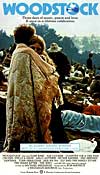 The
documentary-style grandfather of all rock-concert films, Michael Wadleigh's Woodstock
(1970), filmed on-location in upstate New York, chronicled the
counter-cultural "happening" at the now-legendary 1969 concert.
One little-known fact: it was edited by future film-maker Martin Scorsese.
[Note: David and Albert Maysles' disturbing, R-rated documentary Gimme
Shelter (1970) of the free 1969 Altamont (California) Rolling Stones
concert presented the violent underbelly of the youth culture and rock
concert phenomenon.] These films illustrated the influence of counter-cultural
younger audiences on changing tastes and reflected the strength of
the youth movement.
The
documentary-style grandfather of all rock-concert films, Michael Wadleigh's Woodstock
(1970), filmed on-location in upstate New York, chronicled the
counter-cultural "happening" at the now-legendary 1969 concert.
One little-known fact: it was edited by future film-maker Martin Scorsese.
[Note: David and Albert Maysles' disturbing, R-rated documentary Gimme
Shelter (1970) of the free 1969 Altamont (California) Rolling Stones
concert presented the violent underbelly of the youth culture and rock
concert phenomenon.] These films illustrated the influence of counter-cultural
younger audiences on changing tastes and reflected the strength of
the youth movement. 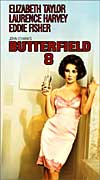 As
film censorship was slowly being abolished in the US, a new freedom of
language, subject matter and permissiveness was expressed in film, with
more explicit treatments of sex and violence. In 1960, the Best Film Oscar
went to Billy Wilder's
As
film censorship was slowly being abolished in the US, a new freedom of
language, subject matter and permissiveness was expressed in film, with
more explicit treatments of sex and violence. In 1960, the Best Film Oscar
went to Billy Wilder's  British
director Michael Powell's daring and controversial psychological thriller
about voyeurism, Peeping Tom (1960, UK), was criticized at
the time of its release for being creepy, sick, perverse, and obscene,
but since then has been re-evaluated and considered one of cinema's
masterpieces. Director Elia Kazan's
British
director Michael Powell's daring and controversial psychological thriller
about voyeurism, Peeping Tom (1960, UK), was criticized at
the time of its release for being creepy, sick, perverse, and obscene,
but since then has been re-evaluated and considered one of cinema's
masterpieces. Director Elia Kazan's  (1)
(1)  Cinematographer
Haskell Wexler directed his feature debut film - the cinema-verite
, non-exploitative adult film Medium Cool (1969), also
originally rated X due to full-frontal nudity and violence - about a
television news cameraman covering the violent 1968 Chicago Democratic
Convention. Another controversy erupted over the inter-racial love scene
between guerrilla leader Raquel Welch and deputy Jim Brown in 100
Rifles (1969) -
rated R. Both Robert Aldrich's lesbian film The Killing of Sister
George (1968), and first-time director Paul Mazursky's successful
sex comedy about swinging and group therapy, Bob & Carol &
Ted & Alice (1969), gave evidence that sexual permissiveness
and a new liberalism about sexual mores had emerged in Hollywood.Ken
Russell's version of D.H. Lawrence's Women in Love (1969, UK) (with
a Best Actress Oscar win for Glenda Jackson as Gudrun Brangwen), set
in a mining community in Nottinghamshire, was infamous for its nude wrestling
match between stars Oliver Reed and Alan Bates.
Cinematographer
Haskell Wexler directed his feature debut film - the cinema-verite
, non-exploitative adult film Medium Cool (1969), also
originally rated X due to full-frontal nudity and violence - about a
television news cameraman covering the violent 1968 Chicago Democratic
Convention. Another controversy erupted over the inter-racial love scene
between guerrilla leader Raquel Welch and deputy Jim Brown in 100
Rifles (1969) -
rated R. Both Robert Aldrich's lesbian film The Killing of Sister
George (1968), and first-time director Paul Mazursky's successful
sex comedy about swinging and group therapy, Bob & Carol &
Ted & Alice (1969), gave evidence that sexual permissiveness
and a new liberalism about sexual mores had emerged in Hollywood.Ken
Russell's version of D.H. Lawrence's Women in Love (1969, UK) (with
a Best Actress Oscar win for Glenda Jackson as Gudrun Brangwen), set
in a mining community in Nottinghamshire, was infamous for its nude wrestling
match between stars Oliver Reed and Alan Bates.