|
AIP's Rise to Prominence in the 60s:
American International Pictures
(AIP) with director-producer Roger Corman, were responsible for a large
wave of low-budget, B-film, black and white exploitative films designed
for the teen market, including genres as diverse as westerns, crime
thrillers, and sci-fi/horror. By 1960, however, their strategy of releasing
double-features was declining in success, and they began to release
bigger budgeted films (often in color). There were two series in the
60s that helped establish AIP as a leading studio:
- Edgar Allan Poe Tales - AIP released a
cycle of eight higher-budget, colorful widescreen films loosely based
on Poe's tales, often with big-name actor Vincent Price,
including
- The Fall of the House
of Usher (1960)
- The
Pit and the Pendulum (1961)
- The Premature Burial (1962)
- Tales
of Terror (1962)
- The Raven (1963)
- The Haunted Palace (1963)
- The
Masque of the Red Death (1964)
- The Tomb of Ligeia
(1964)
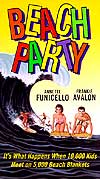 "Beach
Party" Films - released mostly to drive-in theatres, mostly sexless,
antiseptic, and well-groomed antics of beachgoers (on a perpetual
summer vacation), and starring popular 24 year-old singer Frankie
Avalon, and now-buxom 21 year-old ex-Disney Mickey Mouse Club Mousketeer
Annette Funicello (as Dolores or "Dee
Dee"
in later films). [Note: Ironically, both Avalon and Funicello
were from Philadelphia, not sandy-beached S. California!] William
Asher was the primary originator of the extremely popular and profitable
series and the director of most of these films. It consisted of a
four year run (1963-1966), with 7 official 'beach party' films in a
continuing series (see below). "Beach
Party" Films - released mostly to drive-in theatres, mostly sexless,
antiseptic, and well-groomed antics of beachgoers (on a perpetual
summer vacation), and starring popular 24 year-old singer Frankie
Avalon, and now-buxom 21 year-old ex-Disney Mickey Mouse Club Mousketeer
Annette Funicello (as Dolores or "Dee
Dee"
in later films). [Note: Ironically, both Avalon and Funicello
were from Philadelphia, not sandy-beached S. California!] William
Asher was the primary originator of the extremely popular and profitable
series and the director of most of these films. It consisted of a
four year run (1963-1966), with 7 official 'beach party' films in a
continuing series (see below).
These beach
movies were unique because they added pop music (almost presented as
rock videos) to the fantasy 'beach party' theme. AIP realized the lucrative
buying power of this new demographic group and advertised their first
fluffy film Beach
Party (1963) alluringly: "It's what
happens when 10,000 kids meet on 5,000 beach blankets." However,
wholesome star Annette Funicello - still under contract to Disney,
was legally forced to not appear in a bikini, and to express repressive
sexual attitudes, although she wore a non-revealing two-piece suit!
- the main films in the series included:
- (1) Beach Party (1963), a musical comedy
starring Avalon, Funicello, Robert Cummings, and Dorothy Malone
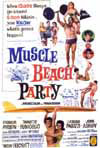
- (2) Muscle Beach Party (1964) - about a
'turf' clash between bodybuilders and beach surfers
 (3)
Bikini Beach (1964) - AIP's biggest grossing
film ever; included Boris Karloff in an uncredited cameo role;
advertised as: "It's where the girls are BARE-ING, the guys
are DAR-ING, and the surf's RARE-ING to GO-GO-GO" (3)
Bikini Beach (1964) - AIP's biggest grossing
film ever; included Boris Karloff in an uncredited cameo role;
advertised as: "It's where the girls are BARE-ING, the guys
are DAR-ING, and the surf's RARE-ING to GO-GO-GO"- (4) Pajama Party (1964) (aka The Maid and the
Martian),
d. Don Weis; with the action moved from the beach to an indoors
slumber party; with roles by old-time stars Buster Keaton, Dorothy
Lamour and Elsa Lanchester, and with Disney star Tommy Kirk (of The
Hardy Boys) as a poor substitute for Frankie Avalon
- (5) Beach
Blanket Bingo (1965) - the classic 'beach party' film, with
Avalon (now 26 years old!, and in his last and major starring role
in the 'Beach Party' films) who caused Funicello (as Dee Dee) to
try sky-diving when he went to rescue kidnapped pop singer Sugar
Kane (Linda Evans) from biker Eric Von Zipper's (Harvey Lembeck)
gang, and small roles by Hollywood icon Buster Keaton (as a lecherous
beachcomber) and Beach Boys singer Brian Wilson
- Ski Party (1965), d. Alan Rafkin, an aborted
attempt at a spin-off with new characters and locales, featuring
Frankie Avalon, Dwayne Hickman, Deborah Walley, and a cameo by
Annette Funicello
- (6) How to Stuff a Wild Bikini (1965) - with
a cast including Buster Keaton as witch doctor Bwana, Dwayne
Hickman (from TV's Dobie Gillis), Mickey Rooney, and a
cameo by Elizabeth Montgomery (from TV's Bewitched)
- Dr. Goldfoot and the Bikini Machine (1965),
d. Norman Taurog, a parody spy film (of two 60s James Bond films:
Dr. No and Goldfinger), starring Vincent Price
as mad scientist Dr. Goldfoot who created a group of bikinied
robots
- (7) Ghost in the Invisible Bikini (1966),
d. Don Weis, with Deborah Walley and Aron Kinkaid in the lead
roles, and Basil Rathbone and Boris Karloff in minor roles; the last
in the seven film AIP series
- Footnote: Back to the
Beach (1987) - released over 20 years later - a comedy
spoof-parody (and celebration) with Funicello and Avalon as
executive producers and stars as a married couple (Frankie,
the Big Kahuna and Annette) living in Ohio who head to California
for a visit; featured appearances by 1950s and 1960s TV stars
in bit parts (some uncredited) including Tony Dow, Jerry Mathers
and Barbara Billingsley (from Leave It to Beaver), Bob
Denver as a bartender (spoofing his title role in Gilligan's
Island) with various humorous lines, such as: "I was
on an island for years with a guy who could take two coconuts
and some string and make a nuclear reactor. But he couldn't
fix a three-foot hole in a boat") and Alan Hale Jr. from Gilligan's
Island as his buddy, Don Adams (from Get Smart) as
the Harbor Master, and Edd "Kookie" Byrnes (from 77
Sunset Strip) as a valet; Connie Stevens starred
as Miss Lip Gloss of 1962 and Pee-Wee Herman (Paul Reubens)
performed a virtuoso version of 'Surfin' Bird'
AIP 'Beach Party' Ripoffs:
The beach party films from AIP were cheaply
ripped off and imitated in the mid-60s by many of the major studios,
including director Maury Dexter's Surf
Party (1964) with heartthrob singer Bobby Vinton, Wild on
the Beach (1965) (aka Beach House Party) featuring an appearance
by Sonny and Cher (in their film debut), and by Paramount's and director
Lenni Weinrib's Beach Ball (1965). It had the tagline: "Those
surf ridin', skin divin', sky jumpin', drag racin', beach bashin' boys
and their bikini beauties... in a blast of a beach brawl!",
starred Ed "Kookie" Byrnes and featured an appearance by
Motown's Supremes. Another spy-comedy beach movie was Universal's Out
of Sight (1966).
Columbia's and director Don Taylor's Ride the Wild Surf (1964) starred
Fabian, Shelley Fabares, Barbara Eden and Tab Hunter in a Hawaiian
surf setting, and The Beach Boys singing group and pop star Lesley
Gore appeared in Paramount's and William Witney's The Girls on the
Beach (1965) set
in S. California. Many of the teen-related beach movies included performances
by pop bands of the time. Elvis Presley's Clambake (1967) was
advertised as a 'beach party' film.
Other "Clean Teen" Beach Films, Gidget,
and Tammy:
In the late 50s and 1960s, one of the major cinematic
trends was to appeal to the 'coming of age' baby boomers - an increasingly
well-groomed, youthful, middle-class film audience that wanted comic,
idyllic romantic escapades without heavy melodrama. [They were the
kind of clean white teens seen in TV shows such as Ozzie and Harriet and American
Bandstand.] Whimsical tales of carefree teens served as a counterpart
to the rebellious and mixed-up teen films with James Dean and Marlon
Brando, and counterbalanced the scary early 60's political and social
scene (evidenced by the Cold War, the Cuban Missile Crisis, the threat
of nuclear holocaust, the growing sexual revolution and Vietnam War,
etc.).
 Hollywood's first teen
'beach party' or high-profile surfing film, with numerous sequels and
imitators for the youth market, was the first in a series of
romantic comedy films from Columbia Pictures. They featured a petite,
teenaged girl, tomboyish surfer and A student named Francie Lawrence
(nicknamed Gidget or "girl midget"), first played by Sandra
Dee. The pert, squeaky-clean young blonde actress was one of the top
10 box office attractions from 1960 to 1961, and the 'Gidget' role
was the one she would become most identified with. [She was also referenced
in a song in the rock musical Grease (1978) -- "Look at
me, I'm Sandra Dee, Lousy with Virginity"]: Hollywood's first teen
'beach party' or high-profile surfing film, with numerous sequels and
imitators for the youth market, was the first in a series of
romantic comedy films from Columbia Pictures. They featured a petite,
teenaged girl, tomboyish surfer and A student named Francie Lawrence
(nicknamed Gidget or "girl midget"), first played by Sandra
Dee. The pert, squeaky-clean young blonde actress was one of the top
10 box office attractions from 1960 to 1961, and the 'Gidget' role
was the one she would become most identified with. [She was also referenced
in a song in the rock musical Grease (1978) -- "Look at
me, I'm Sandra Dee, Lousy with Virginity"]:
- Gidget (1959), with Sandra Dee as 'Gidget',
James Darren (as Moondoggie), and Cliff Robertson as Kahuna, Malibu's
resident surf bum
- Gidget Goes Hawaiian (1961) with Deborah Walley
as Gidget
- Gidget Goes to Rome (1963) with Cindy Carol
(as Gidget) and James Darren
- Gidget, a spin-off TV series, lasting one season
from 1965-66 with Sally Field
- Gidget Grows Up (1969), a made-for-TV movie,
with Karen Valentine as Gidget
- Gidget Gets Married (1972), a made-for-TV movie,
with Monie Ellis as Gidget
A similar series of four, surprise-hit, romantic comedies
debuted in the late 50s with a charming Debbie Reynolds (followed by
Sandra Dee again) as a young, backwoods country girl named Tammy Tarleton:
- Tammy and the Bachelor (1957) with the hit
song Tammy (Oscar-nominated as Best Song)
- Tammy, Tell Me True (1961) - with Sandra Dee
and John Gavin
- Tammy and the Doctor (1963) - with Sandra Dee
and Peter Fonda
- Tammy and the Millionaire (1967) - with Debbie
Watson
- Tammy, a spin-off TV series from 1965-66 with
Debbie Watson
Surfing Films:
The biggest surf film of the decade was director Bruce
Brown's The Endless Summer (1966), a semi-documentary about
the search for the
"perfect wave." Other surfing and youth-oriented films that
followed close behind during the decade were: Ride The Wild Surf (1964), The
Golden Breed (1968), UA's For Those Who Think Young (1964), Fantastic
Plastic Machine (1969), and Pacific Vibrations (1970) (promoted
as "Like Woodstock on a Wave"). The surfing craze was also
reflected in TV shows such as Surfside Six and Hawaiian Eye.
Literary-Based Films:
 During the early to mid 1960s, Hollywood looked to literary works and
the history books for many of its films. The studios were increasingly
willing to pay for film rights to various novels and literary works. Examples
of literary works translated to the screen in the 60s include: During the early to mid 1960s, Hollywood looked to literary works and
the history books for many of its films. The studios were increasingly
willing to pay for film rights to various novels and literary works. Examples
of literary works translated to the screen in the 60s include:
- Richard Brooks' absorbing adaptation of Sinclair Lewis'
novel Elmer Gantry (1960) - a tale of
a 1920's huckster, phony evangelist on the Midwest circuit of revival
meetings, a flamboyant role for which Burt Lancaster won a Best Actor
Award
- Otto Preminger's Exodus (1960) with Oscar-winning
music , based upon Leon Uris' novel about the establishment of the independent
state of Israel, with an unlikely blue-eyed Paul Newman as Jewish leader
Ari Ben Canaan
- a fictionalized dramatization of the actual Scopes
'monkey trial' courtroom battle about the teaching of evolution (between
the legendary Clarence Darrow and William Jennings Bryan), in the
film's adaptation between defense attorney Henry Drummond (Spencer
Tracy) and prosecutor Matthew Harrison Brady (Fredric March) - based
upon Jerome Lawrence's and Robert E. Lee's play Inherit
the Wind (1960)
- A
Raisin in the Sun (1961) - after its successful run as a Broadway
play, was a ground-breaking work on race-relations by Lorraine Hansberry,
during the early years of the civil rights movement, with Sidney Poitier
and Ruby Dee
- Elia Kazan's direction of an adaptation of William
Inge's psychosexual drama Splendor in the Grass
(1961) with Warren Beatty (in his debut film) and Natalie Wood
- a Depression-era Romeo and Juliet plot; it marked the first
screenplay of playwright Inge
 MGM's Mutiny on the Bounty (1935)
with Clark Gable and Charles Laughton, based on a true story of the
British navy in the 1700s, was remade as Mutiny on the Bounty (1962),
with odd-accented Marlon Brando as Fletcher Christian and Trevor Howard
as Captain Bligh MGM's Mutiny on the Bounty (1935)
with Clark Gable and Charles Laughton, based on a true story of the
British navy in the 1700s, was remade as Mutiny on the Bounty (1962),
with odd-accented Marlon Brando as Fletcher Christian and Trevor Howard
as Captain Bligh- Otto Preminger's The Cardinal (1963), adapted
from Henry Morton Robinson's best-selling novel, following the life
of a young Rome-educated American priest rising from a backwoods clergyman
to Cardinal [the film was the first film in Panavision 70, a film process
in which a 35 mm film was enlarged to 70 mm for wide-screen projection]
- writer-director Elia Kazan's own semi-autobiographical
America, America (1963) about his Turkish-Greek uncle's immigrant
experience
- John Huston's The Night of the Iguana (1964)
- based on a Tennessee Williams play about an alcoholic former clergyman
(Richard Burton) and Reflections in a Golden Eye (1967) based
on a Carson McCuller novel about a homosexual army officer (Marlon Brando)
in the South
- Harold
Robbin's steamy novel that was made into a garish saga of the career
of a Howard Hughes-like millionaire/industrialist in The Carpetbaggers
(1964) (actor Alan Ladd's last film)
- George Stevens' big-budget religious epic The Greatest
Story Ever Told (1965) was an adaptation of Fulton Oursler's best-selling
book, with Max Von Sydow in the role of Jesus, Telly Savalas as Pontius
Pilate, David McCallum as Judas, and many other stars in the roles of
additional New Testament characters
 the screen version of Robert Bolt's play in the superb,
Oscar-winning period piece by director Fred Zinnemann, A Man For
All Seasons (1966) - it portrayed the clash of ideals between the
honorable Sir Thomas More (Oscar-winning Paul Scofield reprised his
stage performance) and egocentric King Henry VIII (Robert Shaw) the screen version of Robert Bolt's play in the superb,
Oscar-winning period piece by director Fred Zinnemann, A Man For
All Seasons (1966) - it portrayed the clash of ideals between the
honorable Sir Thomas More (Oscar-winning Paul Scofield reprised his
stage performance) and egocentric King Henry VIII (Robert Shaw)- director/writer Richard Brooks' filming of Truman
Capote's adapted screenplay of a notorious 1959 Kansas mass murder of
the Clutter family in the stark black and white film In Cold Blood
(1967), starring Robert Blake as one of the two killers
- Charly (1968), a TV adaptation of Daniel Keyes'
story Flowers for Algernon (with a experimental lab mouse named
Algernon), brought the title character (Cliff Robertson) a Best Actor
Oscar for his role as someone with learning difficulties who temporarily
became a genius
- director Frank Perry's oddly-intriguing The Swimmer
(1968), an allegorical telling of a John Cheever short story (adapted
by Eleanor Perry) about a swimming trunks-clad man (Burt Lancaster)
who swims home through a suburban neighborhood
- James Goldman's literate screenplay for The Lion
in Winter (1968), about a medieval power struggle between Queen
Eleanor of Aquitaine (Oscar-winning Katharine Hepburn) and Henry II
of England (Peter O'Toole)
- Franco Zeffirelli's version of Shakespeare's Romeo
and Juliet (1968) starred two young teenaged actors (Olivia
Hussey and Leonard Whiting) in the lead roles as the tragic "star-crossed"
lovers of Verona
Two aging actors were both involved in Shakespearean roles in the mid-60s:
Laurence Olivier in the lead role of Othello (1965) and Orson Welles
in Chimes at Midnight (1966) (also known as Falstaff), a
seamless integration of five of Shakespeare's texts/plays. With French
production, Welles also directed a black, expressionistic, noirish version
of Franz Kafka's The Trial (1962) (or Le Proces).
War Films:
Sink the Bismarck! (1960) told the story of the deadly German
battleship that was sunk with a single shot by the British Royal Navy's
HMS Hood. In Judgment at Nuremberg (1961), Spencer Tracy
presided over Nazi war crime trials in Germany to bring justice to those
guilty of crimes against humanity during the war. The Longest Day (1962),
a tale about the events of June 6, 1944 told from both the Allied and
German points of view, featured nearly 50 international stars.
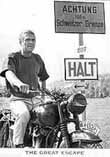 Cool, anti-hero 60s star Steve McQueen appeared in Don Siegel's WW II
action drama Hell Is For Heroes (1962) about a group of Americans
defending a foxhole. After his earlier work in 1960 with producer/director
John Sturges, Steve McQueen was re-teamed to make the critically-acclaimed
and box-office champ The Great Escape (1963), a classic WWII German
POW camp escape tale (based on a true story) with an all-star group of
Allied prisoners (American, Canadian, and British) - with McQueen's memorable
attempt at freedom on a soaring motorbike.
Cool, anti-hero 60s star Steve McQueen appeared in Don Siegel's WW II
action drama Hell Is For Heroes (1962) about a group of Americans
defending a foxhole. After his earlier work in 1960 with producer/director
John Sturges, Steve McQueen was re-teamed to make the critically-acclaimed
and box-office champ The Great Escape (1963), a classic WWII German
POW camp escape tale (based on a true story) with an all-star group of
Allied prisoners (American, Canadian, and British) - with McQueen's memorable
attempt at freedom on a soaring motorbike.
 During the years when the conflict in Vietnam was building up, McQueen
gave a compelling, Oscar-nominated performance as a sailor aboard a gunboat
(with young newcomer Candice Bergen) on the Yangtze River in China during
the 1920s in Robert Wise's The Sand Pebbles (1966), the director's
first film since his success with The Sound of
Music (1965). The action drama provided an interesting commentary
on American imperialism (and the concurrent US role in Vietnam). When
tragically dying in the film's climax, the heroic McQueen asked: "What
the hell happened?" - reflecting the era's confusion about its policies
(See more on Steve McQueen below.)
During the years when the conflict in Vietnam was building up, McQueen
gave a compelling, Oscar-nominated performance as a sailor aboard a gunboat
(with young newcomer Candice Bergen) on the Yangtze River in China during
the 1920s in Robert Wise's The Sand Pebbles (1966), the director's
first film since his success with The Sound of
Music (1965). The action drama provided an interesting commentary
on American imperialism (and the concurrent US role in Vietnam). When
tragically dying in the film's climax, the heroic McQueen asked: "What
the hell happened?" - reflecting the era's confusion about its policies
(See more on Steve McQueen below.)
The UK's historical war epic Zulu (1964) documented how the British
at Rorke's Drift were outnumbered by Zulu tribesmen in 1879 Africa. Frank
Sinatra (as Colonel 'Von' Ryan) led an escape of POWs held in WWII Italy
by seizing a German train in Von Ryan's Express (1965). A popular,
farcical Cold War movie The Russians Are Coming, The Russians Are Coming
(1966) provided a comical and satirical perspective, with its tale
of a stranded Soviet submarine on the coast of New England with a crew
led by Theodore Bikel and Alan Arkin.
 Robert Aldrich's nihilistic and macho-man The Dirty Dozen (1967)
was an enormously-successful hit in the 60s - a non-stop action World
War II thriller with the exciting tale of an impossible suicidal mission
against the Nazis by a group of death-row convicts (including John Cassavetes,
Telly Savalas as Maggot, Donald Sutherland, Charles Bronson, and ex-football
star Jim Brown) - all led by tough-talking Lee Marvin. And John Wayne's
portrayal as leader of elite US Army's Special Forces in the simplistic,
stereotyped The Green Berets (1968) [co-directed by Wayne], patriotically
bucked the era's anti-Vietnam war sentiments with heavy-handed propaganda
and pro-Vietnam views. It was the only big-budget Hollywood feature film
specifically about the Vietnam War that was made during the war - and
it was both hawkish and pro-intervention.
Robert Aldrich's nihilistic and macho-man The Dirty Dozen (1967)
was an enormously-successful hit in the 60s - a non-stop action World
War II thriller with the exciting tale of an impossible suicidal mission
against the Nazis by a group of death-row convicts (including John Cassavetes,
Telly Savalas as Maggot, Donald Sutherland, Charles Bronson, and ex-football
star Jim Brown) - all led by tough-talking Lee Marvin. And John Wayne's
portrayal as leader of elite US Army's Special Forces in the simplistic,
stereotyped The Green Berets (1968) [co-directed by Wayne], patriotically
bucked the era's anti-Vietnam war sentiments with heavy-handed propaganda
and pro-Vietnam views. It was the only big-budget Hollywood feature film
specifically about the Vietnam War that was made during the war - and
it was both hawkish and pro-intervention.
Landmark Films and Stars of the 60s:
 60s
movie star Paul Newman's most famous screen role was as anti-hero pool-player
Fast Eddie Felson in Robert Rossen's The Hustler
(1961), an adult drama and character study of an emotionally-empty
two-bit hustler who challenged legendary pool player Minnesota Fats (superbly
played by Jackie Gleason). Other memorable films during Newman's best
acting period included Martin Ritt's Texas-based drama Hud
(1963), Jack Smight's detective film Harper (1966), and
Stuart Rosenberg's Cool Hand Luke (1967),
with Newman as Lucas Jackson - a rebellious Southern chain-gang prisoner
and symbolic Christ-figure, noted for an egg-eating contest and the line
of dialogue: "What we have here is failure to communicate."
As many others stars would do, Newman took a stab at directing and cast
his wife Joanne Woodward as a spinsterish schoolteacher in his feature
film directorial debut Rachel, Rachel (1968). 60s
movie star Paul Newman's most famous screen role was as anti-hero pool-player
Fast Eddie Felson in Robert Rossen's The Hustler
(1961), an adult drama and character study of an emotionally-empty
two-bit hustler who challenged legendary pool player Minnesota Fats (superbly
played by Jackie Gleason). Other memorable films during Newman's best
acting period included Martin Ritt's Texas-based drama Hud
(1963), Jack Smight's detective film Harper (1966), and
Stuart Rosenberg's Cool Hand Luke (1967),
with Newman as Lucas Jackson - a rebellious Southern chain-gang prisoner
and symbolic Christ-figure, noted for an egg-eating contest and the line
of dialogue: "What we have here is failure to communicate."
As many others stars would do, Newman took a stab at directing and cast
his wife Joanne Woodward as a spinsterish schoolteacher in his feature
film directorial debut Rachel, Rachel (1968).
Robert Mitchum had one of his most menacing roles as vengeful ex-con
Max Cady, who terrorized the Bowden family led by prosecuting lawyer Gregory
Peck who had sent him to prison, in Cape Fear (1962). The noirish
thriller ended with a tense climax on a houseboat. (The film was remade
by Martin Scorsese as Cape Fear (1991), with Robert DeNiro in the
lead role as the threatening ex-criminal.)
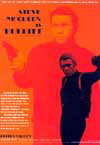 Anti-hero
Steve McQueen also exemplified the ultimate in "cool" - as a young poker
player in Norman Jewison's The Cincinnati Kid (1965), and as a
vengeful young half-breed in Henry Hathaway's Nevada Smith (1966).
Producer/director Norman Jewison's expensive, slick caper romance/thriller
The Thomas Crown Affair (1968) (remade in 1999) overdid the artsy
split-screen technique and other fancy photography (from Haskell Wexler),
but featured Steve McQueen in the charming title role. In addition, he
participated in one of the most exciting, extraordinary car chases in
film history (with McQueen driving a Shelby Mustang 350GT chasing a Dodge
Charger R/T through San Francisco) in Peter Yates' action-film Bullitt
(1968) with music by Lalo Schifrin. His role as an unorthodox police
lieutenant inspired other maverick cop-detective films. It was one of
the first Hollywood films shot entirely on location. Anti-hero
Steve McQueen also exemplified the ultimate in "cool" - as a young poker
player in Norman Jewison's The Cincinnati Kid (1965), and as a
vengeful young half-breed in Henry Hathaway's Nevada Smith (1966).
Producer/director Norman Jewison's expensive, slick caper romance/thriller
The Thomas Crown Affair (1968) (remade in 1999) overdid the artsy
split-screen technique and other fancy photography (from Haskell Wexler),
but featured Steve McQueen in the charming title role. In addition, he
participated in one of the most exciting, extraordinary car chases in
film history (with McQueen driving a Shelby Mustang 350GT chasing a Dodge
Charger R/T through San Francisco) in Peter Yates' action-film Bullitt
(1968) with music by Lalo Schifrin. His role as an unorthodox police
lieutenant inspired other maverick cop-detective films. It was one of
the first Hollywood films shot entirely on location.
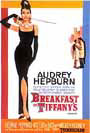 Another
big 60's star, Audrey Hepburn, starred in one of her best-loved, off-beat
roles as sophisticated Manhattan party girl Holly Golightly in the
stylish adaptation of Truman Capote's story Breakfast at Tiffany's
(1961)
with an Oscar-winning score (including the popular Oscar-winning "Moon
River") by Henry Mancini. In the Hitchcock-like murder-mystery
/ romantic-thriller Charade (1963),
the popular actress was pursued throughout Paris by bad guys and the
suave Cary Grant (assuming many aliases: Peter Joshua, Adam Canfield,
Alexander Dyle, while his real name was Brian Cruikshank) - plus there
were early appearances by Walter Matthau, George Kennedy and James Coburn.
And she played a blind girl terrorized by a psychopathic killer (Alan
Arkin) looking for heroin in the scary thriller Wait
Until Dark (1967). Another
big 60's star, Audrey Hepburn, starred in one of her best-loved, off-beat
roles as sophisticated Manhattan party girl Holly Golightly in the
stylish adaptation of Truman Capote's story Breakfast at Tiffany's
(1961)
with an Oscar-winning score (including the popular Oscar-winning "Moon
River") by Henry Mancini. In the Hitchcock-like murder-mystery
/ romantic-thriller Charade (1963),
the popular actress was pursued throughout Paris by bad guys and the
suave Cary Grant (assuming many aliases: Peter Joshua, Adam Canfield,
Alexander Dyle, while his real name was Brian Cruikshank) - plus there
were early appearances by Walter Matthau, George Kennedy and James Coburn.
And she played a blind girl terrorized by a psychopathic killer (Alan
Arkin) looking for heroin in the scary thriller Wait
Until Dark (1967).
 Esteemed
black actor Sidney Poitier was the first African-American to win
an Oscar for Best Actor for his role as a warm-hearted, unemployed construction
worker who helped nuns build a chapel in Lilies of the Field (1963).
A Patch of Blue (1965) boldly featured a kissing scene between
a compassionate, well-educated black man (Sidney Poitier) and a lower-class
blind white woman (Elizabeth Hartman). In just one momentous year - 1967
- the successful Poitier went on to make further hits, and appeared in
the few films of the decade that portrayed racial tensions: Esteemed
black actor Sidney Poitier was the first African-American to win
an Oscar for Best Actor for his role as a warm-hearted, unemployed construction
worker who helped nuns build a chapel in Lilies of the Field (1963).
A Patch of Blue (1965) boldly featured a kissing scene between
a compassionate, well-educated black man (Sidney Poitier) and a lower-class
blind white woman (Elizabeth Hartman). In just one momentous year - 1967
- the successful Poitier went on to make further hits, and appeared in
the few films of the decade that portrayed racial tensions:
- To Sir, With Love (1967), with Poitier as a
teacher in an inner-city school in London's tough East End; also with
the title hit song by Lulu
- director Norman Jewison's Best Picture winning detective-murder
mystery-drama In the Heat of the Night (1967),
with Poitier as a Philadelphia detective named Virgil Tibbs who
clashed with a bigoted Mississippi sheriff (Oscar-winning Rod Steiger)
in a prejudiced, Southern redneck town; noted for the line of dialogue: "They
call me Mister Tibbs!"
- Stanley Kramer's old fashioned, semi-contrived Hollywood
film Guess Who's Coming to Dinner (1967), about the controversial
subject of inter-racial romance between a black medical doctor (Poitier)
and his fiancee Katharine Houghton (the actual niece of Oscar-winning Katharine
Hepburn), the daughter of Hepburn and Tracy in the film; Hepburn was playing opposite Spencer Tracy (for the ninth
and final time)
Disaster film expert Irwin Allen directed the special effects-laden adventure
sci-fi Voyage to the Bottom of the Sea (1961), with Walter Pidgeon
as Captain Nelson commanding the submarine Seaview on a mission
to save the world. The film inspired an Irwin Allen executive-produced
spin-off ABC-TV series from 1964-1968, starring Richard Basehart. Richard
Fleischer's Fantastic Voyage (1966) used the interior of the human
body as the setting for a miniature government project in which surgeons
were shrunk to save a dying man - with Raquel Welch in a tight-fitting
wetsuit.
Light-Hearted Fare:
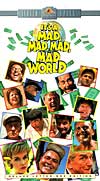 Cinerama's second hit in the 60s, before its demise, was Stanley Kramer's
exhausting It's a Mad, Mad, Mad, Mad World (1963) starring almost
every living Hollywood comedian (from the silent years to the present,
e.g., Buddy Hackett, Jimmy Durante, Mickey Rooney, Ethel Merman, Jonathan
Winters, Spencer Tracy, Milton Berle, Sid Caesar, Phil Silvers, Terry
Thomas, Buster Keaton, the Three Stooges, and Jerry Lewis) in a mad search
for buried treasure. According to Jimmy Durante, it was buried under a
big W. [The studio set a precedent by financing a Hollywood press junket
for reviewers to fly in.] Jerry Lewis also played a dual role as the ultra-smooth
Buddy Love and as a nerdy college teacher (Julius Kelp) in The Nutty
Professor (1963).
Cinerama's second hit in the 60s, before its demise, was Stanley Kramer's
exhausting It's a Mad, Mad, Mad, Mad World (1963) starring almost
every living Hollywood comedian (from the silent years to the present,
e.g., Buddy Hackett, Jimmy Durante, Mickey Rooney, Ethel Merman, Jonathan
Winters, Spencer Tracy, Milton Berle, Sid Caesar, Phil Silvers, Terry
Thomas, Buster Keaton, the Three Stooges, and Jerry Lewis) in a mad search
for buried treasure. According to Jimmy Durante, it was buried under a
big W. [The studio set a precedent by financing a Hollywood press junket
for reviewers to fly in.] Jerry Lewis also played a dual role as the ultra-smooth
Buddy Love and as a nerdy college teacher (Julius Kelp) in The Nutty
Professor (1963).
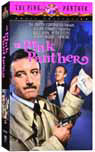 Three
continents were spanned in Blake Edwards' comedy The Great Race (1965)
with rivals Tony Curtis (as The Great Leslie) and Jack Lemmon (as mustached
Professor Fate). The first in a long, popular series of sleuth-caper
Pink Panther sequels was the original slapstick comedy The
Pink Panther (1963) with the incomparable, bumbling, inept French police
Inspector Jacques Clouseau (Peter Sellers in the first of five
films) trailing a glove-dropping jewel thief named the Phantom (David
Niven) in the Swiss Alps. Three
continents were spanned in Blake Edwards' comedy The Great Race (1965)
with rivals Tony Curtis (as The Great Leslie) and Jack Lemmon (as mustached
Professor Fate). The first in a long, popular series of sleuth-caper
Pink Panther sequels was the original slapstick comedy The
Pink Panther (1963) with the incomparable, bumbling, inept French police
Inspector Jacques Clouseau (Peter Sellers in the first of five
films) trailing a glove-dropping jewel thief named the Phantom (David
Niven) in the Swiss Alps.
The heartwarming children's/family nature film Born Free (1966)
- with an Oscar-winning title song, told of Elsa, a lion raised in Kenya
and eventually returned to the wild by game wardens Joy and George Adamson.
Mel Brooks' The Producers (1968) starred Zero Mostel as a con of
little old ladies, Gene Wilder as his timid accountant, and their attempts
to create a sure-fire flop called Springtime for Hitler. Zero Mostel
was also featured in the slapstick musical comedy A Funny Thing Happened
on the Way to the Forum (1966), with Stephen Sondheim songs. Jane
Fonda and Robert Redford starred as newlyweds, who lived on the fifth
floor of a Greenwich Village New York apartment in the romantic domestic
comedy Barefoot in the Park (1967), originally a successful Broadway
play from Neil Simon.
Cross-Over Singing Stars: Elvis Presley and Cliff Richard
Fox contracted with pelvic-thrusting Elvis "the
King" Presley, for his debut film, the Civil War drama Love
Me Tender (1956).
In the same year, Elvis made two appearances on NBC-TV's Milton
Berle Show (in April and June), an appearance on NBC-TV's The
Steve Allen Show (in July), and the first of three appearances
(from 1956-1957) on the competing CBS-TV variety show The Ed Sullivan
Show (in September), propelling the singer's rise to fame.
He continued making films, including Paramount's Loving
You (1957) (his first Technicolor film and first screen
kiss), MGM's Jailhouse
Rock (1957) and Paramount's King Creole (1958) (his
third and last B/W film, and Elvis' favorite film), although he was
soon inducted into the Army in 1958. In 1960, after serving a two-year
stint in the US Army, rock 'n' roller and movie star Elvis Presley
was honorably discharged and began filming Paramount's G.I.
Blues (1960) opposite Juliet Prowse, and singing the popular "Blue
Suede Shoes."
There were over a dozen Elvis Presley films released for youth
audiences by 1964, including:
- Loving You (1957)
- Jailhouse Rock (1957)
- King Creole (1958)
- G.I. Blues (1960)
- Flaming Star (1960)
- Wild in the Country (1961)
- Blue Hawaii (1961) - with Angela Lansbury as
Elvis' mother!, and the hit song: "Can't Help Falling in Love"
- Follow That Dream (1962)
- Kid Galahad (1962)
- Girls! Girls! Girls! (1962)
- It Happened at the World's Fair (1963)
- Fun in Acapulco (1963)
- Kissin' Cousins (1964)
- Viva Las Vegas (1964) - the King's biggest box-office hit, opposite Ann-Margret
- Roustabout (1964)
Singing star Cliff Richard (the UK counterpart to Elvis Presley) and
his music-filled films (sometimes with his band The Shadows) served the
same function, as in director Sidney J. Furie's Wonderful to Be Young
(1961) (aka The Young Ones), director Peter Yates' bus trip film Summer
Holiday (1963) - a combination of pop rock, roadie film, and romantic
comedy, Wonderful Life (1964), and Finders Keepers (1966).
Doris Day Returns in 60s Romantic Comedies:
For escapist entertainment by director Delbert Mann, Doris Day and Rock
Hudson were re-teamed as rival business adversaries, battling each other
on Madison Avenue as well as in a mating game in another appealing romantic
comedy called Lover Come Back (1961) - one of their best. Cary
Grant (as a suave and wealthy businessman) also starred with Doris Day
(as an unemployed secretary) in the next year's That Touch of Mink
(1962). In the year that Doris Day was the number one box-office star,
she starred in another romantic comedy, Move Over, Darling (1963),
a poor imitation of the 1940 classic My Favorite Wife (with Cary
Grant and Irene Dunne).
Other Popular Films:
John
Wayne starred as an zoo-animal hunter in producer/director Howard Hawks'
adventure film Hatari! (1962) (meaning danger in Swahili),
shot on location in East Africa. The first (and best of five) in a long
series of sequels of thought-provoking science-fiction films was Franklin
Schaffner's Planet of the Apes (1968), with its reversed man-ape
tale, and a surprise shock ending of a fragmented Statue of Liberty in
the Forbidden Zone.
The British comedy crime caper The League of Gentlemen (1960)
starred Jack Hawkins as the head of a hand-picked group of bank robbers.
L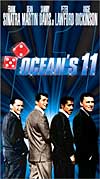 egendary
director Lewis Milestone's caper film Ocean's
11 (1960) (remade
in 2001) was the first movie featuring the so-called Rat Pack (Frank
Sinatra, Dean Martin, Sammy Davis, Jr., Peter Lawford, Joey Bishop,
also Norman Fell and Henry Silva) and sexy Angie Dickinson - a group
that called themselves "The Summit" or "The Clan." [Note: the Rat
Pack nickname was a misnomer. It was earlier used to identify a group
surrounding Humphrey Bogart.] The film was about the heist of five
Las Vegas casinos (the Sahara, the Riviera, Desert Inn, Sands and
The Flamingo) at midnight on New Year's Eve, by a group of 82nd Airborne
WWII veterans. By orchestrating a power outage, the group was able
to unlock the cashier cages and rob the casinos. In the tale's twist
ending, the money stashed in garbage bags - and hidden in the coffin
of one of the group members (Richard Conte) who suffered a surprise
heart attack after the job was completed - was accidentally incinerated
when his body was cremated. egendary
director Lewis Milestone's caper film Ocean's
11 (1960) (remade
in 2001) was the first movie featuring the so-called Rat Pack (Frank
Sinatra, Dean Martin, Sammy Davis, Jr., Peter Lawford, Joey Bishop,
also Norman Fell and Henry Silva) and sexy Angie Dickinson - a group
that called themselves "The Summit" or "The Clan." [Note: the Rat
Pack nickname was a misnomer. It was earlier used to identify a group
surrounding Humphrey Bogart.] The film was about the heist of five
Las Vegas casinos (the Sahara, the Riviera, Desert Inn, Sands and
The Flamingo) at midnight on New Year's Eve, by a group of 82nd Airborne
WWII veterans. By orchestrating a power outage, the group was able
to unlock the cashier cages and rob the casinos. In the tale's twist
ending, the money stashed in garbage bags - and hidden in the coffin
of one of the group members (Richard Conte) who suffered a surprise
heart attack after the job was completed - was accidentally incinerated
when his body was cremated.
The last 'Rat Pack' film was the semi-musical crime
comedy Robin
and the Seven Hoods (1964), a Robin Hood adventure story
take-off, now set in Chicago with Dean Martin as Little John, Peter
Falk as rival Guy Gisbourne, Sammy Davis, Jr. as Will, Frank Sinatra
as North Side boss Robbo, Bing Crosby as Allen Dale, and Barbara Rush
as Marian.
Producer/writer and director Billy Wilder supplemented his phenomenal
track record with the acidic tale of lawyers and insurance fraud entitled
The Fortune Cookie (1966), a marvelously-funny film with the first
teaming of stars Jack Lemmon (as an injured TV sports cameraman) and Best
Supporting Actor Oscar-winning Walter Matthau (as a shyster lawyer who
promotes the exaggeration of insurance claims). Later, the two reappeared
as ideally-cast opposites (Lemmon as fussy Felix Ungar and Matthau as
messy Oscar Madison) in the hilarious Neil Simon comedy The Odd Couple
(1968) - the film inspired numerous sequels and TV shows or series.
Cult Exploitation:
In only two days, producer/director Roger Corman, who began his career
in 1954 with ultra-cheap black-and-white exploitation movies, shot the
low-budget cult classic black comedy about a killer plant - The Little
Shop of Horrors (1961), with Jack Nicholson in one of his earliest
roles as a masochistic dental patient.
 By the mid-60s, American International Pictures (AIP) began to return
to its permissive, sexually-liberated roots with youth-oriented, counter-cultural
films such as Roger Corman's definitive biker film The Wild Angels
(1966) (co-written and edited by Peter Bogdanovich) with Peter Fonda
as Heavenly Blues, the leader of a violent leather-clad biker gang. Corman's quintessential LSD film The Trip (1967) (scripted by Jack Nicholson) told about the hallucinogenic, psychedelic tripping (visualized
with special effects) of a television commercial director (Peter Fonda)
in Los Angeles, and his drug dealer guide (Dennis Hopper) - the film was
a precursor to the classic hit Easy Rider (1969).
By the mid-60s, American International Pictures (AIP) began to return
to its permissive, sexually-liberated roots with youth-oriented, counter-cultural
films such as Roger Corman's definitive biker film The Wild Angels
(1966) (co-written and edited by Peter Bogdanovich) with Peter Fonda
as Heavenly Blues, the leader of a violent leather-clad biker gang. Corman's quintessential LSD film The Trip (1967) (scripted by Jack Nicholson) told about the hallucinogenic, psychedelic tripping (visualized
with special effects) of a television commercial director (Peter Fonda)
in Los Angeles, and his drug dealer guide (Dennis Hopper) - the film was
a precursor to the classic hit Easy Rider (1969).
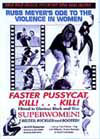
And sexploitation, soft-porn director Russ Meyer, known as "King
of the Nudies" and "King Leer," created one of his adult-cinema
classics that was considered hard-core for its day: Faster Pussycat!
Kill! Kill! (1962) - with action, violence, nudity, and humor. Later
in the decade, he directed the outrageous Vixen (1968). Meyer's
X-rated cult sexploitation film about a female rock group was Beyond
the Valley of the Dolls (1970) - a major studio release. It featured
a screenplay co-written by inexperienced screenwriter Roger Ebert (film
critic) and Meyer himself. In all, throughout the 60s and 70s, Meyer produced,
directed, financed, wrote, edited, and shot 23 of these 'semi-pornographic'
tantalizing 'skin-flicks' (with descriptive titles) featuring big-breasted
women.
 Film History of the 1960s
Part 1, Part 2, Part 3, Part 4, Part 5, Part 6

 
|