|

|
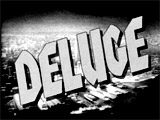
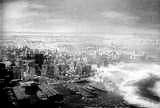
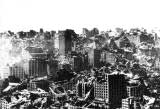
Deluge (1933) RKO's apocalyptic disaster film was about devastating earthquakes and resulting tidal waves (from tsunamis) that destroyed various California coastal cities and flooded New York City. It was loosely based upon S. Fowler Wright's 1928 novel about a global flood. Deluge was the first big-budget "talkie" disaster film with impressive visual effects. Most of the film dealt with the aftermath of the disasters, with rampant raping and pillaging of the survivors. |
|
|
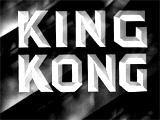
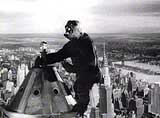
King Kong was the first "gigantic monster rampage" film - a classic adventure film from RKO about Beauty and the monstrous ape Beast. The colossal hairy creature, once returned to Manhattan Island, went on a rampage (attacking the elevated subway) and created havoc, before falling to his death from the 'Empire State Building' (the World Trade Center in a later version). It was remade in the 'disaster film' decade of the 70s as a modernized King Kong (1976) by producer Dino De Laurentiis, starring Jeff Bridges and Jessica Lange - and then an awful followup called King Kong Lives (1986) that added a Lady Kong, and another remake by The Lord of the Rings director Peter Jackson, as King Kong (2005), starring Adrien Brody, Jack Black and Naomi Watts - with a computer-generated ape. |
|
|
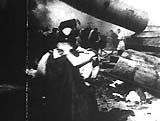
The Last Days of Pompeii (1935) Merian C. Cooper's and Ernest Schoedsack provided special-effects for this version of the Mt. Vesuvius eruption in 79 A.D - a holocaust of flowing lava over the Roman city of Pompeii. It was made earlier as an Italian silent in 1913 and in 1926 - and also later remade in 1959 (with Steve Reeves) and 1984 (as a TV mini-series). |
 1926 |
|
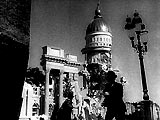
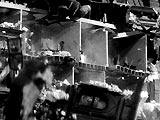
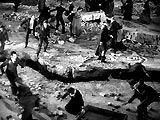
San Francisco (1936) This Best Picture-nominated film recreated the famous April 18th, 1906 earthquake in the City by the Bay at its conclusion (with the earth splitting apart and a subsequent devastating fire). The film was a big moneymaker for MGM, and out of its five Academy Awards nominations, it won for Best Sound. |
|
|
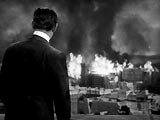
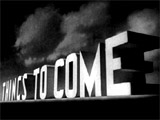
Things to Come (1936, UK) British producer Alexander Korda's cautionary and epic view of the future was directed by visual imagist William Cameron Menzies and starred Raymond Massey (as pacifist intellectual and messianic scientist John Cabal, and as his great grand-son Oswald Cabal). The imaginative, speculative and preachy English film was based on an adaptation of H.G. Wells' 1933 The Shape of Things to Come and was set during the years from 1940 to 2036 in 'Everytown' (a stand-in for London) - spanning a time of international warfare to a future time of television, jet planes, dictators, and a rocket to the Moon (a Giant Space Gun). The visionary anti-war film included a lengthy global world war (presaging WW II!), a despotic boss-tyrant named the Boss or Rudolph (Ralph Richardson) in a "dark ages" 1970s, a prophetic Brave New World-view, the dawn of the Space Age and exploration, and the attempt of social-engineering technocrats and scientists to defeat the warlords, save the war-ravaged world with superior technology, and make a new start for mankind. In the disease and war-free modern underground city of Everytown after the overthrow of the Boss, a societal Utopia had been developed and a new civilization had been established with advanced technological improvements, under the control of scientists and engineers. The new leader Oswald Cabal's (Raymond Massey) latest objective was to embark on a grand project to move humanity into deep space. He delivered the film's final words to his skeptical friend Raymond Passworthy (Edward Chapman), as he looked forward to more future conquests in a search for new knowledge and advances: "All the Universe or nothingness. Which shall it be, Passworthy? Which shall it be?" |
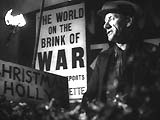 The Time of Endless Wars 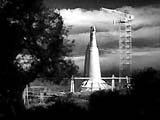 Manned Space Gun/Rocket |
|
The Good Earth (1937) This Best Picture-nominated film received five Academy Award nominations, including two wins for Best Actress and Best Cinematography. It featured a buzzing, marauding locust attack on the land recreated with special effects, accompanied by the frantic efforts of poverty-stricken farmers to save their lands. |

|
|
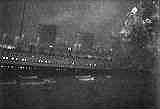
History is Made at Night (1937) Director Frank Borzage's suspense thriller featured a ship-and-iceberg subplot. It told about an insanely jealous shipping magnate (Colin Clive) who ordered his ship's captain to pilot his ship, The Princess Irene, into treacherous Northern waters in an attempt to kill his ex-lover Irene Vail (Jean Arthur) and her suitor Paul Dumond (Charles Boyer). |
|
|
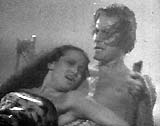
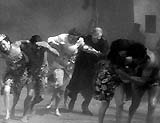
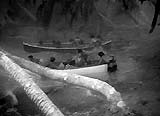
The Hurricane (1937) Samuel Goldwyn's film was considered the classic movie spectacle - with a monstrous, South Pacific tropical storm, massive tidal waves and battering gale-force winds - and major stars Dorothy Lamour and Raymond Massey. It received three Academy Award nominations, including Best Score, Best Sound, and Best Supporting Actor (Thomas Mitchell). It was remade in 1979 with Mia Farrow and Jason Robards. |
|
|
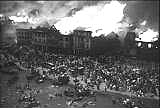
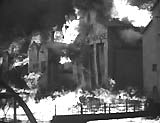
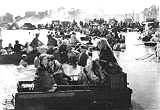
In Old Chicago (1937) Darryl Zanuck's production of director Henry King's disaster film was a Best Picture Oscar nominee. This film was 20th Century Fox's answer to MGM's hit San Francisco (1936). It received a total of six nominations and two wins: Best Supporting Actress (Alice Brady) and Best Assistant Director (Robert Webb). It had a spectacular 20-minute fire sequence in the film's climax (a dangerous sequence filmed on the studio's back lot with 1500 extras and a herd of cattle) - the burning down of Chicago by a great inferno in 1871. The fire was caused by Mrs. O'Leary's (Alice Brady) cow kicking over a lantern. |
|
|
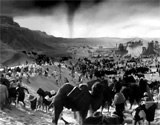
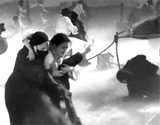
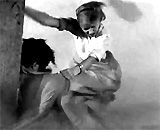
Suez (1938) Director Allan Dwan's romantic drama was nominated for three Academy Awards: Best Score, Best Sound, and Best Cinematography. The historical romance starred Tyrone Power as Ferdinand de Lesseps who directed the building of the Suez Canal in the Isthmus. However, its historical veracity was questioned as it was a mostly-fictionalized account of the monumental creation of the Suez Canal. Its most spectacular sequence was of a massive, tornado-like sandstorm, toppling tents, timbers, cranes and water storage tanks. De Lesseps was saved when knocked unconscious and his love interest Toni Pellerin (Annabella) lashed him to a post, although she was swept away in the wind and killed. |
|
|
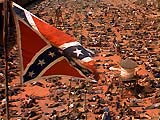
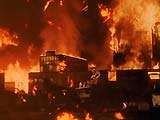
The Civil War epic was nominated for thirteen Academy Awards, with eight wins for Best Picture, Best Actress (Vivien Leigh), Best Director (Victor Fleming), Best Film Editing, Best Cinematography, Best Art Direction, Best Screenplay, and Best Supporting Actress (Hattie McDaniel). Producer David Selznick's dramatic historical romance had two major disaster scenes:
Its Best Visual Effects nomination was defeated by The Rains Came (1939), see below. |
|
|
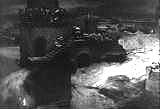
The Rains Came (1939) This was Darryl F. Zanuck's and 20th Century Fox's epic production - the biggest disaster epic of the decade. This film won the first-ever Visual Effects Academy Award, beating Gone With the Wind (1939) and five other films. A remake was made titled The Rains of Ranchipur (1955). It featured a spectacularly-staged major earthquake and epic catastrophic flood sequence (after a dam burst with a combination of miniatures and live-action footage) in the Indian city of Ranchipur were followed by a cholera plague. |
|
|
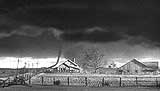
This beloved fantasy-adventure musical was nominated for five Academy Awards, and won two: Best Song and Best Score. It was notable for the cyclone sequence that carried the farmhouse along with Dorothy (Judy Garland) and her dog Toto to the colorful world of Oz. Its Visual Effects nomination was defeated by The Rains Came (1939) - see above. |
|