|

|
|
|
|||||||||||
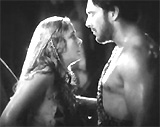
Saved From the Titanic (1912) This 1-reel, 10 minute film from the Eclair Film Co. (a lost film) depicted the sinking of the Titanic, told in flashback by the film's star and screenwriter Dorothy Gibson, who was an actual survivor of the tragedy. It took less than a week to film. The Titanic sinking has become the most used disaster film subject, with dozens of retellings. |
|
|||||||||||

|
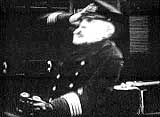
Night and Ice (1912, Ger.) (or Night Time in Ice) (aka In Nacht und Eis) One of the earliest disaster films, this rare and restored film was the first of many feature films about the doomed ship that sank in 1912 on its maiden voyage, after striking an iceberg. This film was made in studios in Berlin, and on an actual shipboard (the German liner Kaiser Auguste Victoria) and released a few months after the RMS Titanic's actual sinking! It was of epic length (35 minutes) in comparison to other films of the time. The filmmakers sunk a real boat to show realism. |
|
||||||||||

|
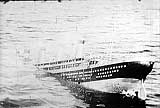
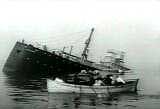
Atlantis (1913) One of the first full-length films ever made, with a 1 hour, 53 minute running time. It was also one of the most popular films of the 1910s, and a worldwide smash hit. It was a very realistic and naturalistic-looking Titanic film with a well-staged action scene of the ship's sinking. This version of the Titanic story, made only a year after the disaster, was from Denmark (but filmed off the coast of New Zealand) and made by director August Blom. It told about a doctor's voyage on an oceanliner that hit an obstruction and began to sink. |
|
||||||||||
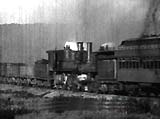
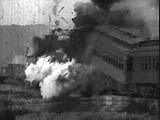
Beloved Adventurer (1914) This early silent film (a 15-episode serial of one-reel melodramas), from the Lubin Film Manufacturing Co., portrayed a small-scale disaster - the head-on collision of two locomotive trains facing each other on the same track. |
|
|||||||||||

|
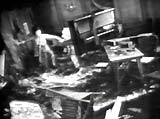
Male and Female (1919) In this Cecil B. De Mille film - star actress Gloria Swanson (as spoiled and rich Lady Mary Lasenby) was put into peril when the yacht she was traveling on was shipwrecked on rocks of a deserted island. The interior of the boat filled with water as she was trapped below and struggled amidst the floating pieces of furniture, although she was eventually able to emerge from a hole in the yacht's side and escape. |
|
||||||||||


|
This film climaxed with the spectacular flooding scenes of the underground city, with its tracking camera, when the children were led to safety from the rising waters. |
|
||||||||||
|
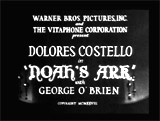
Noah's Ark (1928) Originally a silent film - and then made into an early 'talkie' a year later (with several stultifying scenes of Vitaphone sound-on-disk dialogue) -- this early romantic drama and disaster film was about the Biblical (Genesis) story of the 'Great Flood.' It was directed by Michael Curtiz, from a screenplay by Darryl Zanuck. In its original premiere form, it was about 135 minutes in length, although later shortened by about a half-hour. The surviving prints are about 108 minutes long. This was Warner Bros.' answer to Cecil B. De Mille's Biblical epics of the 20s (especially the silent film The Ten Commandments (1923)). It was Warners' most expensive film to date - costing over $1 million. The early religious epic about Biblical times and the sins of mankind was intercut with a parallel melodramatic romance story about soldiers in the Great War (WWI) - with moralizing about the hedonistic sins of the Jazz Age and Wall Street speculation.
The parallel intercutting in the film was reminiscent of D.W. Griffith's Intolerance (1916), with actors playing roles in both sections. Paul McAllister portrayed two roles: Noah and a Minister, who decried sin and worship of the pagan god Jaghuth. The two stars in a romantic relationship were:
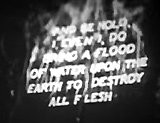
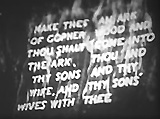
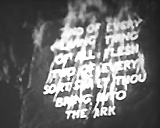
In a scene reminiscent of Cecil B. DeMille's earlier Biblical epic The Ten Commandments (1923), Noah (a Moses figure) went on a mountain trek where, in a dramatic scene, he experienced a Burning Bush and the creation of two giant stone tablets on a mountainside with flaming letters (written by lightning) warning of a giant flood and his commission by God to build an Ark to escape:
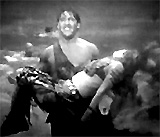
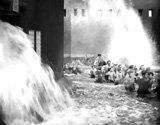
Just before the flood, virginal Miriam, Noah's handmaiden (betrothed to Noah's youngest son Japheth (George O'Brien)) was randomly chosen to be sacrificed by King Nephilim (Noah Beery) of Akkad to his God Jaghuth - as the high priest's archer drew back his bow and arrow to execute her high upon an altar, he was struck by lightning, and Miriam was saved from execution. Its major scene was of a climactic flood - that mixed miniatures, double-exposures, and the full-scale destruction of actual sets. Reportedly, when stored tanks of thousands of gallons of water were released for the sequence upon hundreds of unsuspecting extras, three of them died from drowning, and many others were severely injured. The imprisoned but now-freed (but blinded) Japheth heard Miriam's cries for help as she was threatened with being swept away in the currents. He rescued her from the water by picking her up to save her from drowning; with the water flowing down his face, his blindness was miraculously cured, as he brought her to the Ark on the outskirts of the city.
Those pagans that were still alive clamored to enter the Ark as it slowly floated away; King Nephilim's attempt failed when the door slammed onto his hand; all others were unsuccessful "and all living things - PERISHED!" |
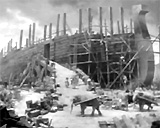 The Building of the Ark 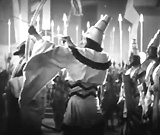 Executioner-Archer Struck by Lightning  Miriam Atop Altar 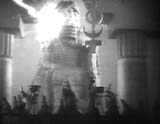 The Destruction of the Massive Temple  Miriam Rescued by Japheth From Flood Waters 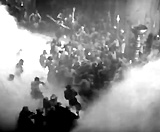 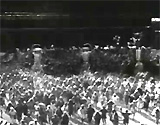 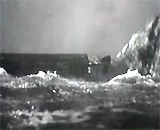 The Great Flood: Storms and Torrents of Water  King Nephilim's Vain Attempt to Enter Ark |
||||||||||
|
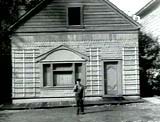
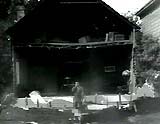
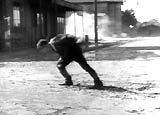
The final sequence of the film involved a terrifically destructive tornado/cyclone -- and one of the most suicidal and terrifying stunts and scenes in screen history. Steamboat Bill, Jr. (Buster Keaton), groggy and dizzy, stood up in front of the house that was about to be ripped apart from the forceful winds. As he paused there, the entire two-ton facade or front of the building fell forward and crashed down on top of him. All that saved him was a small window opening in the upper story, through which his body passed. He ran from the collapsed building on the ground and just avoided being flattened by another disintegrating house. When he turned to run away, he was propelled down the street - sliding, tumbling, and turning like other wind-blown objects. He struggled to run into the wind, bending forward at a significant angle but without making any progress. |
|
||||||||||
|
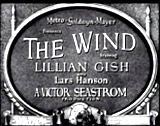
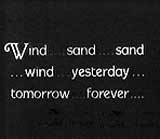
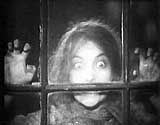
Victor Sjostrom (Seastrom) directed this late silent-era film, made in California's inhospitable Mojave Desert under temperatures of at least 100 degrees F, with sand projected by multiple airplane engine propellers and/or wind machines. It was about the relocation of delicate and impoverished Letty Mason (Lillian Gish) from Virginia to the windblown frontier ranch/farm of her male cousin, where she experienced jealousy, an unending desert prairie sandstorm, and ultimately madness in the face of misdirected passion and the relentless tempest. In the film's finale, she shot male assailant Wirt Roddy (Montagu Love), buried him in the shifting sands, and watched in horror as his corpse was uncovered. |
|
||||||||||
|
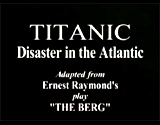
Titanic: Disaster in the Atlantic (1929, UK) (aka Atlantic) This mostly fictionalized, overacted, melodramatic tale was based on Ernest Raymond's play The Berg. It was another film inspired by the Titanic sinking - although the ship's name was Atlantic, not Titanic. [Note: The White Star Line had forbid the production company to use the name Titanic.] It was the first sound film about the doomed ship - a compilation of the best footage from both the German-language talkie version and the English-language version. |
|
||||||||||