|

|
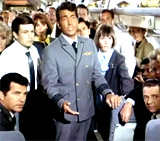
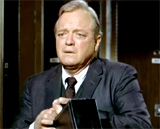
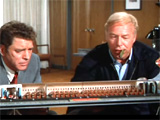
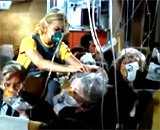
Airport (1970) This was the grandfather of them all - adapted from the 1968 novel by Arthur Hailey, and filmed on a large-scale with an all-star cast. The Universal film launched the 1970s-80s craze for many other Hollywood airplane disaster films. It was nominated for an astounding ten Academy Awards (including Best Picture), with one win for Best Supporting Actress (Helen Hayes) as an elderly stowaway Mrs. Ada Quonsett. The plot followed a series of emergency disasters occurring at a large Midwestern hub airport late one snowy, blizzardy night -- at Chicago's Lincoln International Airport (?). Control tower and airport personnel (Burt Lancaster and George Kennedy) negotiated how to land an ill-fated, badly-crippled TGA (Trans Global Airlines) Boeing 707 (piloted by Dean Martin as Capt. Vernon Demerest) that had departed on an evening flight to Rome during a blizzard, and had a bomb in an attache case explode onboard, set off in the rear lavatory by disturbed Guerrero (Van Heflin). It was followed by three sequels in 1974, 1977, and 1979 (a major flop) (see below):
There were also these spoofs: Airplane! (1980) and Skyjacked (1972). |
    |

|
The Andromeda Strain (1971) Versatile director/producer Robert Wise's suspenseful, intelligent, paranoid science-fiction techno-thriller and disaster-related story was adapted by Nelson Gidding from Michael Crichton's best-selling 1969 novel (it was his first novel with his own name). It was nominated for two Academy Awards: Best Art Direction and Best Film Editing. The film featured the early use of multiple or "split-screen" techniques (i.e., the display of corpses littering the town, views of two science team members and a technical diagram, the town's two survivors, etc.). Often, a horizontally-moving teletype news-like banner (white letters on a black strip) near the bottom of the frame indicated locations and times. The early 1970s sci-fi film captured the terror of a deadly, mysterious, alien extra-terrestrial organism from outer space that was intentionally brought back to Earth in a SCOOP VII satellite-probe. The satellite capsule crashed (after being struck by a meteor), and the virulent, highly-contagious organism inside the capsule almost entirely wiped out a small New Mexico village-town. Two investigators in white-protective suits entered Piedmont, New Mexico with a population of only 68. Possible clues to the cause of the problem were provided by the town's only two survivors: a cleaver-brandishing 69-year-old man (a sterno-ingesting alcoholic named Jackson) and a constantly-crying infant (later identified as Manuel Rios). Nicknamed the Andromeda Strain, the deadly micro-organism killed through nearly instantaneous blood clotting, causing the bloodstream to turn into red powder. A top-secret biological research project (known as SCOOP funded by the US government, and created by the US Army's Biological Research Division) was responsible for causing the emergency by exploitatively supporting the search to collect organisms in space for potential biological weapons. Racing against time, efforts were made by a team of four high-tech scientists, who were summoned, to save the world from deadly contamination and extermination by the lethal extra-terrestrial pathogen. They were assembled together in a top-secret, remote, advanced underground facility and lab in the southern Flatrock County in Nevada nicknamed Project Wildfire. The investigators in a team of scientists included:
They raced against time to diagnose, study, contain and destroy the microscopic space alien, named the Andromeda Strain, before it threatened to wipe out life on Earth. The facility was set to be nuclear-detonated within 5 minutes if the deadly alien virus escaped and threatened widespread contamination. After many close calls and worrisome findings, and the mutation of the Andromeda strain (that began to eat away at the synthetic rubber (Polychron) seals of the gaskets and door seals of the lab), the facility nearly self-destructed during a 5 minute countdown. Military jets seeded the clouds over Piedmont with silver iodine, stimulating rainfall that washed the deadly organism into the ocean, where it was destroyed by the heavy alkalinity of the salt water. |
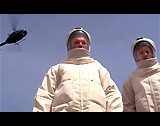 Dr. Stone and Dr. Hall Wearing White Protective Suits in the Decimated New Mexico Town 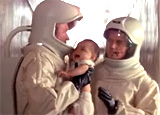 Discovery of a Surviving Crying Infant 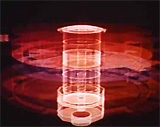 A Computer Simulation of the Five Levels of the Secret Underground Laboratory, known as Wildfire in S. Nevada 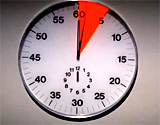 The Start of the 5 Minute Countdown to a Nuclear Detonation of the Wildfire Facility |
|
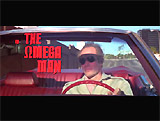
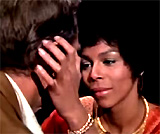
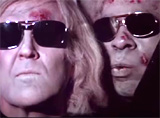
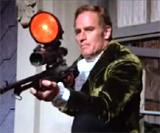
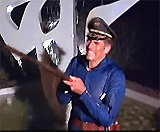
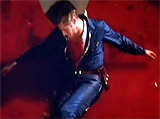
The Omega Man (1971) This sci-fi disaster film, set in the late 1970s, originated from the 1954 Richard Matheson novel I Am Legend - which was also the title for the blockbuster remake I Am Legend (2007) starring Will Smith. Richard Matheson also co-wrote the Italian-made adaptation The Last Man on Earth (1964, It./US), starring Vincent Price as sole surviving Dr. Robert Morgan. Charlton Heston starred as Dr. Robert Neville, a US Army Colonel who was apparently the sole survivor of biological germ warfare unleashed on Earth in the mid-1970s during a conflict between China and Russia. The tagline was: "The World Is Dead. One Survivor. Then The Others. Crawling In Darkness. The Strangest Sect Of All. Hunting The Last Man On Earth." In the film, a recorded TV broadcast reported the dire emergency:
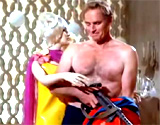
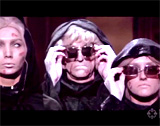
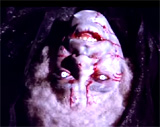
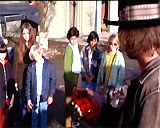
[Note: The tale was similar in plot to Heston's other sci-fi films, Planet of the Apes (1968) and the dystopian Soylent Green (1973).] After taking the antidote, Neville struggled to survive in the city of LA over-run by nocturnal, sinister, partially-blind, black-hooded, disease-altered, albinoid mutant scavengers (called "The Family") with sunglasses. [Note: "The Family" was reminiscent of the Charles Manson followers.] They were led by a charismatic, cult-leading, book-burning zealot named Jonathan Matthais (Anthony Zerbe), a former TV news-anchor, who viewed Neville as personifying the technological evil that destroyed the world. Matthais was aided by second-in-command Brother Zachary (Lincoln Kilpatrick). Every day, Neville survived by driving through deserted streets, watching the same movie over and over again (Woodstock (1970)), and machine-gunning mutant zombies, while taking refuge during dark nights in his fortified penthouse. Other survivors joined Neville (who wasn't actually the 'last man on earth'), including:
There were disagreements between the group over Neville's life-saving, experimental serum vaccine, and who should receive it. The film ended with various betrayals, deaths, and Christ-like religious symbolism and allusions. Neville sacrified himself, dying in a crucifix-pose in a pool of blood in a water fountain. He had been mortally wounded by Matthais who had hurled Brother Zachary's spear into the side of his chest. With Neville's bottle of serum in his hand to save everyone, Dutch told all the other young survivors: "Well, let's move kids, we've got a long way to go" (the film's final line). |
|
|
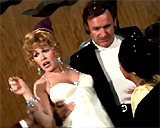
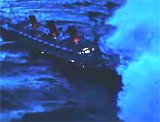
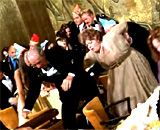
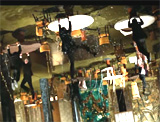
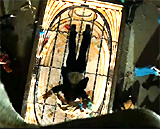
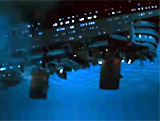
The Poseidon Adventure (1972) Noted as the quintessential disaster film by the "Master of Disaster" producer Irwin Allen, combined with a Grand Hotel (1932) cast of characters. On New Year's Eve during the SS Poseidon's last voyage from New York to Athens, it was turned over - trapping the travelers and destroying much of the ship, captained by Leslie Nielsen (as Captain Harrison). The highly-successful, big-budget film was nominated for eight Academy Awards, with one win for Best Original Song ("The Morning After"), popularly sung by Maureen McGovern, but performed in the film by Carol Lynley. It also was presented with a Special Achievement Honorary Award for Best Visual Effects. This first film was followed by a lesser sequel in 1979, Beyond the Poseidon Adventure (1979) (see below), a made-for-TV movie The Poseidon Adventure (2005), and a critically-panned remake Poseidon (2006) directed by Wolfgang Petersen. It included special effects of the ship capsizing due to a giant tidal wave just after midnight, and the overturned ballroom dining area (guests were left clinging to the ceiling before falling to their deaths). There was the creation of the upside-down world inside the ship as ten survivors of the submerged liner struggled to live and get to the 'top' (actually the bottom). Cast members included:
There were only six who ultimately survived the catastrophe (* marked above). |
|
|
Soylent Green (1973) Richard Fleischer's dystopic sci-fi detective thriller was an early cautionary 70s science-fiction film set in an overpopulated, impoverished and polluted dystopic world in the year 2022. Earth had experienced a climate crisis involving the greenhouse effect (blocked gases in the atmosphere, causing higher temperatures with humid conditions), causing dying oceans, limited fertility of the soil, food scarcity, and crowded living conditions. Society faced a depleted environment, unhealthy air, deforestation, limited housing, polluted water, and fewer natural resources. An early subtitle identified ground zero for environmental problems: "THE YEAR: 2022 THE PLACE: NEW YORK CITY THE POPULATION: 40,000,000; the crowded metropolitan area suffered many dire consequences; although some lived in luxury, the majority of the desperate 40 million people struggled to survive, with piled up trash, cramped and dilapidated tenement housing, lack of affordable food, homelessness (people sleeping on stairs everywhere), 50% unemployment, etc. It told about a dystopian future with massive ecological problems and food supply shortages, and simultaneously a murder investigation of a wealthy industrialist-lawyer associated with a rations and food-manufacturing company known as the Soylent Corporation. A member of the elite, the victim's suspicious death might have been part of a carefully-planned assassination plot, and also might elucidate the true meaning of the phrase "Soylent Green." New York City Detective Thorn (Charlton Heston) was assigned to investigate the murder of wealthy businessman William R. Simonson (Joseph Cotten), an influential board member of the financially-profitable Soylent Corporation that was manufacturing healthy, high-energy green wafers from ocean plankton. After witnessing the self-selected euthanasia of his best friend Sol Roth (Edward G. Robinson), Thorn entered a highly-secure waste-disposal center or plant, and was able to prove the horrifying, predictable discovery of the true composition of the Soylent Corporation's new artificial food product Soylent Green - it was not composed of ocean plankton - ruled an impossibility by The Exchange (a group of oceanographic researchers) due to barren ocean conditions. Instead, it was composed of the recycled bodies of the deceased inhabitants of the society's euthanasia centers. In the film's concluding sequence, Thorn made a desperate plea to his lieutenant partner, police chief Hatcher (Brock Peters) as he was dragged away to be treated for a serious gunshot wound:
|
 Crowded Stairway with People Sleeping  Crowded Streets with People and Broken-down Cars 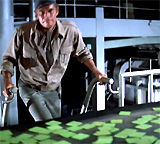 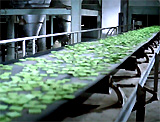 Conveyor Belt of Green Food |

|
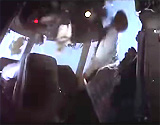
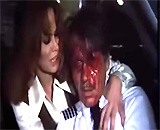
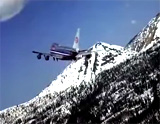
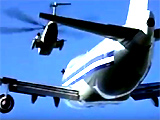
Airport 1975 (1974) The second of the Airport films (directed by Jack Smight), a sequel to the original Airport (1970). The plot was about the flight of a Columbia Boeing 747 on a flight (# 409) from Washington DC bound for L.A. that was rerouted to Salt Lake City due to foggy conditions. It then suffered an in-flight collision with a light private Beechcraft plane piloted by Scott Freeman (Dana Andrews), who had suffered a massive heart-attack. The 747 sustained heavy damages to the flight-deck cockpit area, leaving only Captain Stacy (Efrem Zimbalist, Jr.) alive - although blinded and soon unconscious. The plane, which had to dodge the snowy Wasatch Mountains, had to be flown by Chief-Stewardess Nancy Pryor (Karen Black), who was instructed how to set it on auto-pilot. An air-to-air rescue attempt was undertaken from a jet-powered helicopter, to lower a replacement pilot into the crippled plane. After the first attempt failed, former test pilot Captain Alan Murdock (Charlton Heston) (Pryor's boyfriend) was successfully able to be placed in the plane and perform a safe landing. The subplots featured singing nun Sister Ruth (Helen Reddy), Linda Blair as heart transplant patient Janice Abbott, and other passengers/stars that included Myrna Loy (as alcoholic Mrs. Devaney), Sid Caesar (as over-talkative Barney), George Kennedy (as airline official Joe Patroni) and Gloria Swanson (in her last film) (as Herself, a glamorous movie star). |
|
|
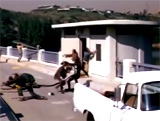
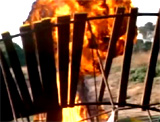
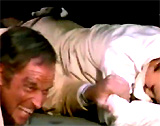
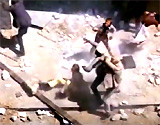
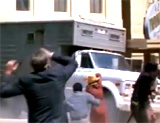
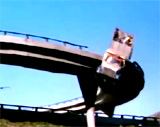
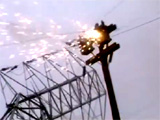
Earthquake (1974) Director Mark Robson's fantastic disaster film included scenes of the crumbling destruction of Los Angeles by a powerful earthquake. The rumblings were accompanied by the first use of low-frequency bass-vibrating Sensurround ("You'll FEEL it as well as see it!") (responsible for the film's only competitive Academy Award Oscar win: Best Sound) and quite impressive special effects, with stirring music by composer John Williams. It was also nominated for four Academy Awards, including Best Art Direction, Best Cinematography, and Best Film Editing. It won a Special Achievement Award for Visual Effects. The Universal film employed hundreds of stunt extras for the massive crowd scenes, and effectively used front projection, as well as matte drawings to depict the panoramic LA area suffering from a 9.9 level earthquake. It also included 'model' skyscrapers that collapsed, Styrofoam 'concrete,' and a 'miniature' to depict the crumbling Mulholland Dam. The earthquake was devastating: a collapsing dam, crashed cars and structures including power lines and towers, falling debris, faults opening in the ground, highway overpasses shaking and falling apart, a house tumbling down a hillside, a resultant flood, etc. The soap-opera styled film included an ensemble cast, with many cameos and vignettes from its stars, including:
|
|
|
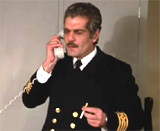
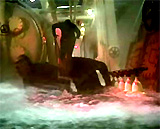
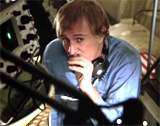
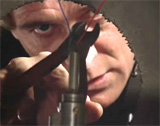
Juggernaut (1974, UK) Directed by Beatles' film-maker Richard Lester, this was an action 'race-against-time' crime thriller (based on a true-life event) about seven bombs planted on the SS Britannic. The film's title was the pseudonym for the blackmailing mad bomber (Freddie Jones as Sidney Buckland) himself. The ship was a luxury cruise liner (captained by Omar Sharif as Captain Alex Brunel) already halfway across the North Atlantic (with rough seas) carrying 1,200 passengers - that was due to be detonated by dawn, unless a large sum of money (£500,000) was paid by the British government in exchange for defusing instructions to dismantle the complex, highly-exposive amatol steel barrel bombs in seven locations. Richard Harris starred as Lieutenant Commander Anthony Fallon, the leader of the anti-bomb squad that was helicoptered to the ship to defuse the explosives. He was assisted by Charlie Braddock (David Hemmings), who tragically lost his life while defusing one bomb, causing a flood of water into the ship. Meanwhile, Scotland Yard's London official, Supt. McCleod (Anthony Hopkins), was supervising the entire operation. One by one, with some casualties and failures, the bombs on board were detonated, while the bomber was identified, located, and detained back in London. In the exciting nail-biting conclusion with only about two minutes until detonation, Fallon was able to outwit the "Juggernaut"/Sid (and his faulty directions about disarming the bomb, by cutting the red wire instead of the blue one as he was instructed - "Cut the blue wire"):
After cutting the red wire, Fallon successfully saved the ship and its passengers. |
|
|
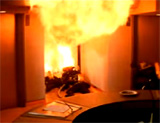
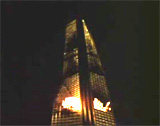
The Towering Inferno (1974) Producer Irwin Allen's most popular and spectacular life-and-death epic disaster film, co-directed by John Guillermin and co-produced by 20th Century Fox and Warners (a milestone venture), featured innovative stunts and a big-name ensemble cast trapped in a burning skyscraper ("The Glass Tower"), the world's tallest building at the time. The main stars, mostly involved in melodramatic subplots, included:
It garnered eight Oscar nominations, including oddly enough, Best Picture and a Best Supporting Actor nod for Fred Astaire, as well as Best Original Score (by John Williams). It won three Oscars - Best Cinematography, Best Film Editing and Best Original Song: "We May Never Love Like This Again." This classic disaster film had spectacular fire sequences that were filmed in an oversized, blazing "towering inferno" of 138 stories - a building with flawed electrical wiring. The all-star cast was mingling among 300 party guests situated near the top floor in the Promenade Room while a fire burned below them on the 81st floor. Two of the most exciting segments were the evacuation-descent of panicked guests in an outside elevator along the face of the burning building, and the attempt at a rooftop rescue. The eventual solution to douse the fire was to explode the million-gallon water tanks atop the building. |
|
|
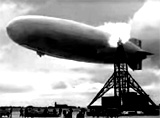
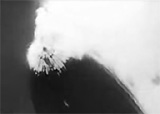
The Hindenburg (1975) Director/producer Robert Wise's docu-dramatization had lots of sub-plots and huge doses of melodrama. In the film's conclusion, in a lengthy montage, it mixed movie footage with the actual Universal B/W newsreel footage of the German airship's explosion and fire, sometimes in freeze-frame (recreating the unforgettable eye-witness 'you-are-there' account of the disaster by news reporter Herbert Morrison). The film followed the ill-fated ship's last voyage from Frankfurt, Germany to Lakehurst (New Jersey) Naval Air Station, where it crashed and burst into flames while landing in rough weather on May 6th, 1937. It told about the explosion of the famous pioneering, but ill-fated lighter-than-air passenger airship-zeppelin, and the events leading up to the disaster. The film won Special Achievement Oscars for its Sound and Visual Effects. George C. Scott starred as Nazi Luftwaffe Colonel Franz Ritter (George C. Scott), chief of security for the Hindenburg's flight, while Anne Bancroft co-starred as one of the Hindenburg's passengers, mysterious anti-Nazi German Countess Ursula von Reugen. The film speculated that there were various motivations and reasons for sabotaging the airship - one of the theories for the disaster. In the film, it appeared there were a number of suspects:
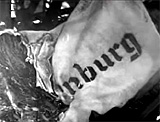
In the final moments of the film, a bomb was detonated when located and opened by Col. Ritter (who was killed), and the explosion appeared to cause the catastrophe, as the airship was docking (the sequence turned from Technicolor to black and white). The conflagration was massive, although many survived the blast and walked away from, although shaken and often suffering serious burn injuries. One of the film's last images was a view of a burnt piece of fabric in the wreckage, with the partial word "Hindenburg" on it. |
|
|
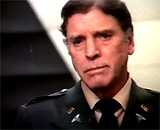
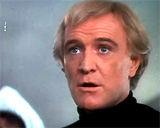
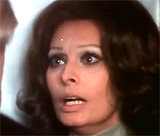
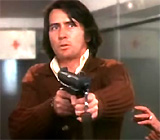
The Cassandra Crossing (1976, W.Germ./It./UK) This West German/Italian/UK co-produced disaster action-thriller, directed by George Pan Cosmatos, was about an imperiled train. Its formulaic premise was similar to so many other disaster films - a race-against-time with innocent lives in danger in an enclosed space. The tagline was: "The Fear is Spreading." It opened with an exciting sequence in which a terrorist attack on Geneva's International Health Organization (IHO) offices led to one of the terrorists being infected by a deadly virus and escaping onto a transcontinental passenger train. The virus-infected Swedish terrorist (Lou Castel) (harboring a deadly pneumonic plague virus) was aboard the Transcontinental Express train with 1,000 passengers, from Geneva enroute to Basel, Paris, Brussels, Amsterdam, Copenhagen, and eventually Stockholm. The melodramatic action fim featured a bevy of stars (mostly passengers on the train), including:
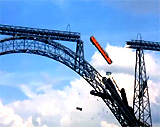
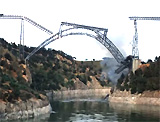
The strategy of US military Colonel Stephen Mackenzie (Burt Lancaster) was to cover up the fact that America was involved in germ warfare. His idea was to reroute the train to an abandoned ex-Nazi railway line leading to an "isolation facility" in Janov, Poland (the site of a WW II concentration camp). So as the plan was solidified, the train was quarantined, welded shut, and diverted to Poland via the old and condemned steel Kaslindrliv Bridge, or Cassandra Crossing. It was feared that the arched bridge was likely to collapse. The film concluded with an attempted helicopter rescue, deaths of a number of the passengers (Kaplan immolated himself in a gas-filled compartment, and Navarro was thrown off the train onto rocks), and at the bridge - the destruction of only the front part of the train with some of the infected passengers (the back part had been uncoupled and was saved, braking before crossing). |
|
|
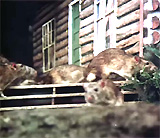
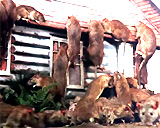
The Food of the Gods (1976) (aka H.G. Wells' The Food of the Gods) An infamously, cheaply-made silly B-movie sci-fiction thriller (nature vs. man) and creature film, and one of the last films by director/producer Bert I. Gordon. It was based upon H.G. Wells' 1904 novel "The Food of the Gods and How It Came to Earth." It told about a remote island (in Canada in the Pacific Northwest) where "food of the gods" (a mysterious, gooey toxic ambrosia labeled F.O.T.G.) had mysteriously oozed from the ground, and was consumed by some of the island's creatures. As a result, they became giant, bloodthirsty mutant animals - wasps, chickens (a giant rooster), grub worms, and rats. The two heroic figures who fought off the threat included:
Two other characters were Belinda Balaski as Rita - an imperiled expectant pregnant woman, and Ralph Meeker as Jack Bensington - a sleazy businessman who sold dog food and wanted to make money by patenting the miraculous "food." In the film's ominous ending, some of the remaining "food of the gods" was consumed by dairy cows - that produced milk drunk by schoolchildren. |
|
|
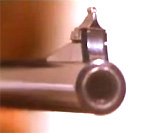
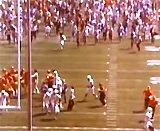
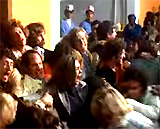
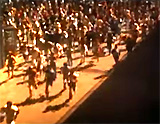
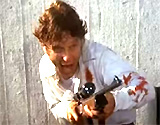
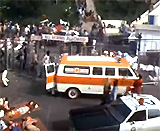
Two-Minute Warning (1976) Director Larry Peerce's crime thriller-disaster film told about a lone, homicidal sniper positioned to kill at a major-league football stadium (filmed at the LA Memorial Coliseum) during a championship "Super Bowl" game. The film was nominated for Best Film Editing. The cliffhanger, similar to Peter Bogdanovich's Targets (1968), starred the following stars (the lesser stars were attendees at the game):
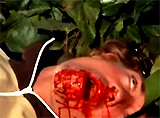
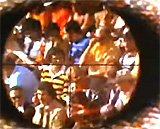
The film opened with a sniper in a circular high-rise hotel room next to the 405 (filmed at the Angeleno Hotel) shooting at an innocent couple bicycling in a neighborhood, and killing the male rider. He then disassembled his shotgun, checked out, and proceeded with his plan. The anonymous psychotic sniper perched himself on the top of the LA football stadium's scoreboard with a high-powered hunting rifle. The setting was a football arena filled with 91,000 fans during a championship game between Los Angeles and Baltimore. The film was titled Two-Minute Warning, referring to the time remaining in the game when referees halt play and advise the two teams. This also referred to the film's suspenseful finale when the sniper began wildly firing upon the crowd (and even the commentator's booth), causing mass panic (and many injuries and deaths as people jumped over walls, hung from railings, or were trampled) among the spectators as they stampeded in every direction. As sirens blared, and the wounded, bloodied and dead were everywhere, the sniper was cornered and secured - although he was mortally wounded and unable to answer questions before he died: ("Listen to me. You're dying....Where'd you get that gun? Who were you trying to get? Come on...You talk to me, you miserable son-of-a-bitch!"). His wallet revealed that he was Carl Cook (Warren Miller), a transient from out-of-state. Sgt. Button mentioned that in a few weeks time, more information would be revealed about the domestic terrorist-killer:
The final line of the nihilistic film was spoken by Capt. Holly to Sgt. Button about his wound: "Had a doctor look at that yet?...Don't be a hero, Sergeant. I'll drop you off at the hospital. Come on." |
|
|
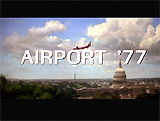
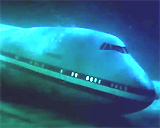
Airport '77 (1977) This third Airport film in the decade of the 1970s was directed by Jerry Jameson. The action thriller (and disaster film) promised, in its taglines:
There were two Academy Award nominations for the PG-rated film: Best Art Direction and Best Costume Design. The maiden flight of a privately-chartered Boeing 747 (Flight # 23) was on a course from Washington DC to Miami, Fl, and then to an estate in Palm Beach, Florida, owned by Philip Stevens (James Stewart), a philanthropist, art collector and owner of the plane. The plane was packed with expensive, priceless art-work and lots of VIP passengers (mostly big-name cast members), including:
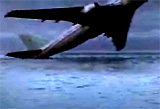
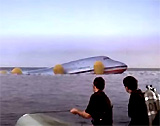
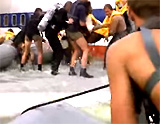
The ill-fated jet was targeted for a heist. It was hijacked, led by co-pilot Bob Chambers (Robert Foxworth), which caused the plane to crash into the Bermuda Triangle, far off its course. The stricken airliner then sank about one hundred feet underwater, and rested on a precarious ledge, leading to a momentous effort to salvage the plane, bring it to the surface, and save the occupants. Some of the passengers died when the cargo hold door was opened and the fuselage was flooded. As the film ended, a caption explained:
|
|
|
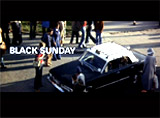
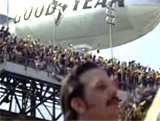
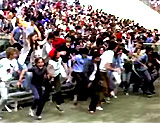
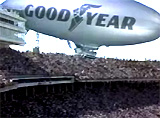
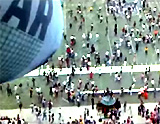
Black Sunday (1977) Director John Frankenheimer's prophetic action-thriller film (with a score by John Williams) was inspired by the terrorist attack at the 1972 Summer Olympics (in Munich), when the Black Terrorist Organization (of the PLO) kidnapped and murdered eleven Israeli athletes and officials. The film's tagline threatened: BLACK SUNDAY This nail-biting film was competing with the previously-released, not very-successful Two-Minute Warning (1976) (see above) with a very similar plot. The film told about a deranged, suicidal, former Vietnam vet POW for six years, Michael Lander (Bruce Dern), who was the pilot of the Goodyear Blimp, which often flew over stadiums during NFL games. He aligned himself with a terrorist group (the Black September movement), in particular, the cool and calculating Dahlia Iyad (Marthe Keller) and Fasil (Bekim Fehmiu). Their intent was to force the US to cease its pro-Israeli policies. Their plot was to kill thousands of people by loading a bomb onto the gondola on the underneath part of the Goodyear Blimp and exploding it over spectators during Miami's Super Bowl X - and also to unleash poisonous darts. Lander was gleeful when he ranted about his plan of mass destruction:
Those who raced to prevent the disastrous catastrophe included:
In the exciting epic finale to the film, the Major was able to kill the terrorists, and haul the Blimp away from the stadium by attaching it to a helicopter, to harmlessly blow up over the ocean. |
|
|
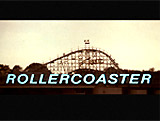
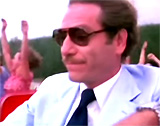
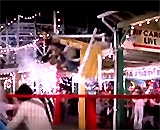
Rollercoaster (1977) Director James Goldstone's suspenseful 'disaster' film (more a mad-bomber thriller) was accompanied by the Sensurround effect - to shake the audience in their chairs (it was the third film ever to feature the technological innovation, following Earthquake (1974) and Midway (1976)). It effectively advertised its shaking effects:
With an exciting Lalo Schifrin Psycho-like score, it also featured an all-star cast:
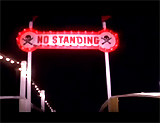
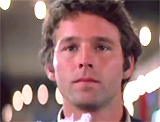
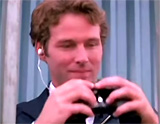
It told about a crazy, psychopathic, terrorizing, extortionist madman (Timothy Bottoms), identified only as Young Man, who threatened sabotage at various fairground ride attractions. The wily, cold-blooded killer was prepared to bomb additional amusement park rollercoasters in five other different locations around the country, if blackmailing demands for $1 million were not met. The locations that he targeted with rollercoasters in the film included:
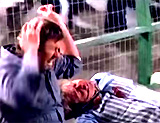
One of the more startling sequences was in the film's opening, when the mad bomber destroyed rollercoaster tracks at Ocean View with a bomb, that sent the derailed ride-cars careening into the fairgrounds, with lots of dead bodies. It concluded with a tense, cat-and-mouse chase finale at Magic Mountain near Los Angeles, between Calder and the Young Man. In the end, the terrorist was struck and killed by the very rollercoaster that he wanted to destroy. And only shortly after the tragedy, the park's rollercoaster ride re-opened again (to cheers), with the announcer's words:
The hang-dog inspector Harry Calder then bummed a cigarette (and a light) from one of the park guests, who annoyingly answered: "Keep 'em, OK?!" |
|
|
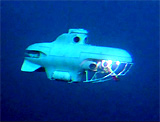
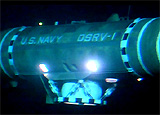
Gray Lady Down (1978) This surprisingly-dull submarine disaster film, about a daring undersea disaster/rescue, was based upon David Lavallee's novel "Event 1000," published in 1971. It was also very similar to Morning Departure (1950, UK) (aka Operation Disaster), another tale of a submarine trapped on the sea floor. The main stars, naval submarine officers - were:
It told about an American nuclear sub, the USS Neptune, that, on its way to the naval base port of Groton, CT, crashed into a wayward Norwegian freighter (during conditions of low visibility) just off the coast of Rhode Island. The vessel sank ("Gray Lady Down"), and found itself trapped on the floor of the ocean about 1,500 feet down, unstable and perched on a sea ledge, and precariously about to fall into deeper waters, as oxygen levels dwindled. [Note: Christopher Reeve had a bit part, in his feature film debut, as Phillips.] In conjunction with the two-man experimental Snark and the sacrifice of non-conformist Captain Gates' life, the distressed sub's occupants were retrieved in the Navy's conventional Deep Submergence Rescue Vehicle (DSRV) rescue submarine. |
|
|
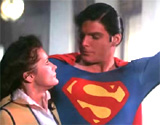
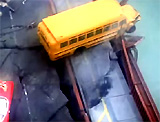
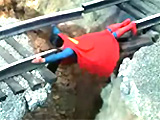
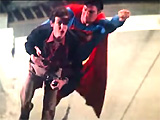
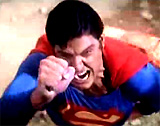
Director Richard Donner's classic superhero film about the 'Man of Steel' was nominated for three Academy Awards: Best Sound, Best Film Editing, and Best Original Score (John Williams), and received a Special Achievement Oscar for Visual Effects. Its title character Superman (Christopher Reeve) had arrived from the Planet Krypton as an infant named Kal-El. He was raised by a kindly Smallville, Kansas farm family - Jonathan and Martha Kent (Glenn Ford and Phyllis Thaxter) - and then took on an alter ego. He became a reporter in the city of Metropolis at the Daily Planet - a shy and mild-mannered Clark Kent. As Superman, wearing a red and blue costume bearing the S-shaped crest of the House Of El, he dealt with various catastrophes, such as:
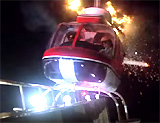
In the action-adventure's exciting conclusion, there was a cavalcade of disasters including:
Superman rolled a huge boulder and other rocks into place to save a nearby valley town from a cascade of water. He also resealed the San Andreas Fault by boring underground, pushing plates of land back together, and damming up and redirecting a flow of on-rushing lava. His failure to save Lois from a crevasse that swallowed her car during an aftershock, and suffocated her to death, resulted in him turning back time by circumnavigating the globe at lightspeed (preceded by a primal scream), to save her life - ignoring his father Jor-El's (Marlon Brando) cautionary warning about interfering with human history. |
|
|
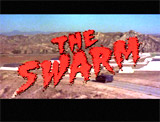
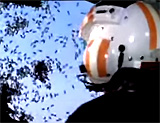
The Swarm (1978) A preposterous disaster-horror film by director/producer Irwin Allen (known as "The Master of Disaster") was about South American killer bees (originally from Africa) with potent venom that first invaded a secret American ICBM base. Then, they enveloped the small Texas town of Marysville and were beginning to infiltrate into a major Texan city - Houston. The catastrophe necessitated containment-suited individuals with flame-throwers to help contain or eradicate some of them. It received one unusual Academy Award nomination for Best Costume Design. As with many disaster films, aging, ill-used major stars filled various cast positions, such as:
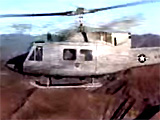
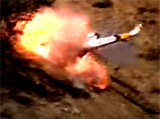
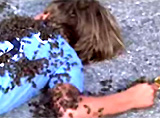
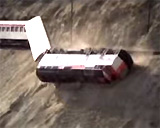
In a sequence of scenes during a race against time, a helicopter was downed by the insects and exploded, a passenger car driven by an attacked teen crashed into the small town square where people were preparing for their annual flower festival, schoolchildren were bitten and killed by a swarm, and then a passenger train evacuating citizens was attacked by the swarm, derailed and rolled down a hillside before it exploded. Eventually, the siege of a swarm of bees was curtailed by helicopters that lured the bees out to the water with special sound-emitting floats, where they were doused with oil and set ablaze. The last words of the film were voiced by Dr. Crane, who was asked by Helena: "Did we finally beat them, or is this just a temporary victory?":
The film contained a curious disclaimer in the end credits:
|
|
|
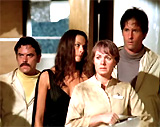
Beyond the Poseidon Adventure (1979) Director Irwin Allen's unnecessary sequel to the classic 1972 disaster film had the tagline:
The film was savagely criticized for lots of cheaply-shot, unrealistic footage, and inferior character development. Once again, the tale was a continuation of the S.S. Poseidon saga - the doomed ocean liner that was flipped over by a tidal wave (in the Mediterranean) in the previous film, with six survivors. The cruise ship was still afloat, although considered a "floating time bomb." There were two rival salvage teams of adventurers (good vs. evil) claiming salvage rights - both simultaneously searching for a billion dollar treasure of gold, and a deadly cargo of plutonium onboard. The opposing forces inside the ship - and trapped inside - were:
The two groups also came upon other additional survivors, three of whom were SS Poseidon crew members:
After various unsuccessful attempts to retrieve the treasures located onboard, there were only a few who survived, including Mike and Celeste who escaped on the tugboat. Mike was worried about the loss of his tug: "...the bank's gonna take the boat away as soon as we reach port." But then Celeste revealed that she was the lucky finder of a good-sized diamond chunk ("Maybe not"), and she asked: "Are you gonna kiss me now?" He replied: "I was gonna kiss you anyway" - the film's final line of dialogue as they happily chugged into the sunset. |
|
|
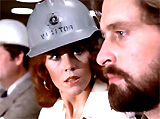
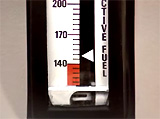
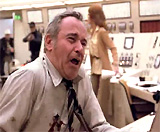
The China Syndrome (1979) James Bridges' cautionary political thriller-drama was an exciting, suspenseful doomsday film about the threat of a nuclear reactor accident, made all the more real by the actual Three Mile Island (Pennsylvania) incident about two weeks after the film's premiere. The film's title referred to a kind of reactor accident that would melt - theoretically - all the way through the earth to China. It was nominated for four Academy Awards, including Best Actor (Jack Lemmon), Best Actress (Jane Fonda), Best Art Direction, and Best Original Screenplay. The real tension began when long-time, conscientious, hard-working Ventana (California) nuclear power plant engineer/manager Jack Godell (Jack Lemmon) felt an unusual vibration or "shudder" signaled by his shaking coffee cup: ("I know the vibration was not normal"). There were also readings of high radiation on level 8 and faulty gauge readings, resulting in his impulsive decision to open up relief valves during an emergency shutdown (SCRAM) that caused extremely low and dangerous levels of coolant water in the reactor - all conditions that could have initiated a meltdown. Everything was caught on camera by ambitious Channel 3 TV reporter Kimberly Wells (Jane Fonda) and her cameraman Richard Adams (Michael Douglas), who were watching and secretly recording the developing crisis from the visitor's gallery. Jack made a frantic phone call to alert Operations about evacuating the plant, after realizing the inherent danger: ("We have a serious condition. You get everybody into safety areas and make sure that they stay there"). Soon, further conspiracies were brought to light regarding shoddy construction, corporate greed, media manipulation, numerous nuclear power plant violations, safety coverups and defects in the system. In the thrilling and suspenseful concluding sequence, Jack pulled out a gun, evacuated the control room, locked himself inside and demanded to speak on live TV to Kimberly after realizing that a lethal meltdown might be triggered by going to full power again: ("a sudden surge could kick that off again"). Jack was engaged in a conversation with reporter Kimberly Wells from inside the locked control room when a SWAT team suddenly cut the broadcast signal, entered the control room and shot Jack dead. In the aftermath, a plant official interpreted the situation to the media: "The public was never in any danger at any time... an emotionally-disturbed employee was humored just long enough to get the situation under control." However, a shaken Kimberly contradicted the official account and tried to summarize:
|
|
|
City on Fire (1979, Can./US) This badly-conceived, poorly-executed low-budget Canadian B-film from director Alvin Rakoff was one of the last cavalcade-of-stars disaster films of the 1970's. Its script was from American exploitation director Jack Hill. It was an inferior version of The Towering Inferno (1974) set on city streets. [Note: It was basically a recreation of a real-life accident that occurred in April of 1947 in the town of Texas City. It was a large non-nuclear industrial explosion at the port onboard one of the docked ships, resulting in further explosions and fires - and almost 600 deaths.] The advertised tagline warned with great exaggeration:
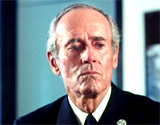
An opening title card also threatened: "What you are about to see could happen to any city, anywhere." It must be noted that Henry Fonda was again in this disaster film as soon-to-retire chief of the fire brigade, Chief Albert Risley - it was his fifth disaster film in just a few years - his previous 'disasters' were in Rollercoaster (1977), Tentacles (1977), The Swarm (1978), and Meteor (also 1979). Other American stars included:
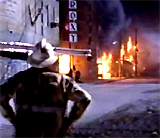
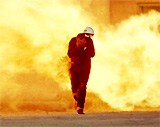
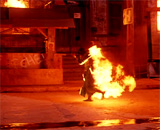
In the story, corrupt, unnamed Midwestern city mayor William Dudley (Leslie Nielsen), who was planning to run for governor, had a large chemical (or oil) refinery built right in the center of the town, next to main waterways. A vengeful and disgruntled maintenance employee Herman Stover (Jonathan Welsh), after an unexpected firing, sabotaged the plant. He released a flammable liquid into the nearby water flow, where welders downstream accidentally set it on fire. The fire raced back to the plant and caused an explosion at the refinery. This created a sweeping, chain-reaction series of fires through the entire area. Most of the fire's spread was conveyed by numerous people catching on fire and running madly. One of the film's major set-pieces was the evacuation of the hospital, threatened by the blaze. The film ended with the worried fire chief sermonizing with the very obvious statement: "All it takes is one man, could be anybody. Your neighbor, my neighbor, one man to destroy a city." |
|

|
The Concorde: Airport '79 (1979) This was last and absolutely worst of the long-running Airport series - a big-budget flop from director David Lowell Rich - and with an implausible script by Eric Roth. It served almost as a precursor to the next year's spoof Airplane! (1980).
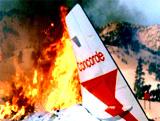
In this fourth installment, there was a conspiracy to shoot down the Concorde with a surface-to-air, heat-seeking missiles as it flew from Washington DC to Paris on the second leg of its maiden "Goodwill" flight - causing it to take evasive maneuvers (flying upside down, while the pilot Patroni depressured the cabin, and fired flares out of the cockpit window as a distraction) and then land disabled without brakes - by being caught in a safety net. In another segment of the film, the beleaguered Concorde continued onto the upcoming 1980 Moscow Olympics (in eight months), when rapid decompression after fuselage damage forced it to make a successful emergency landing in the snowy Alps - where it shortly later burst into flames. The film had many big-name stars, including:
|
|
 |
Mad Max (1979, Australia) Australian director George Miller's post-apocalyptic, nihilistic trilogy (from 1979 to 1985) contained both film noir and western genre elements in its sci-fi tales. The settings in the film, including collapsed civilizations, were typical of many other apocalyptic disaster films. The films were dark, desolate and grim in nature and set in a scorched-earth Australian wasteland with scarce supplies of water and gasoline. Non-renewable energy sources were almost entirely depleted. A global war was set in motion to acquire the few remaining resources. The trio of films included the original film and two sequels (and a third reboot later):
|
  Mad Max (1979) 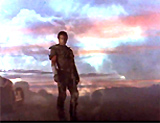 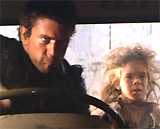 The Road Warrior (1982) |
|
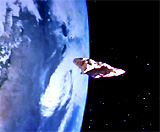
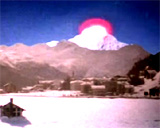
Meteor (1979) American International Pictures (AIP) partnered with director Ronald Neame (noted for The Poseidon Adventure (1972)) for this big-budget, sci-fi doomsday disaster film set during the Cold War. The end-of-the-world adventure had one Academy Award nomination for Best Sound. Its tagline was:
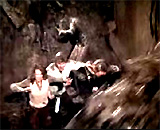
[Note: The premise of the film was later used for the plots of Armageddon (1998) and Deep Impact (1998).] It told about a number of meteor fragments (splintered chunks from the larger asteroid named Orpheus) that were due to strike Earth, causing worldwide earthquakes, destructive avalanches, tsunamis, and massive underground and surface flooding - in places worldwide (an avalanche in the Swiss Alps, a tsunami near Hong Kong, etc.). The most massive piece was a 5-mile wide meteorite fragment that descended upon New York City. It sailed past the Statue of Liberty, then destroyed the World Trade Center (albeit poorly done) - adding a disturbing subtext due to the 9/11 tragedy 22 years later. It also demolished the underground base (in Manhattan) where the Hercules operation was headquartered, and the East River soon flooded the nearby NYC subway system - the only escape route for muddied survivors. As with most big-budget disaster films, there were many stars:
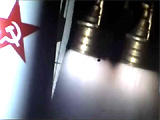
Launched US warheads from Hercules, coordinated with Soviet warheads (from a satellite named Peter the Great) eventually reached the meteor in outer space and destroyed it. |
|