 |
The Pre-1920s Early Cinematic Origins and the Infancy of Film Part 5 Film History of the Pre-1920s Part 1, Part 2, Part 3, Part 4, Part 5 Film History by Decade Index | Pre-1920s | 1920s | 1930s | 1940s | 1950s | 1960s 1970s | 1980s | 1990s | 2000s | 2010s |

| The Growth of the Industry: During the war years (1914-1917) before the US entered the Great War, the demand for films as escapist entertainment increased. Audiences clamored for more complicated plots, multi-reel films, and publicity information about the stars. Europe was so entrenched in warfare that the US was able to gain ascendancy in the film industry, with Hollywood, rather than New York, becoming synonymous with the American film industry. By the end of the European War when overseas film production had basically collapsed, Hollywood became the preeminent film producer and the center of world film production. 90% of all films shown in foreign countries were American. To keep up with the demand, it was necessary for the burgeoning US film industry to develop more sophisticated and organized methods of production - hence, the development of film studios with a factory/assembly line structure that cost-effectively could churn out more films. The predominant players who were to become future, competing studio film moguls, included:
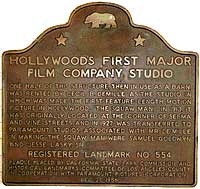
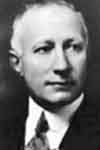
The Development of the Studios: Around 1912, Zukor established an independent film studio that he called the Famous Players Film Company, with distribution arranged with a new organization called Paramount. It included a number of famous performing personages, such as Sarah Bernhardt. Stage producer and early film executive Jesse Lasky also formed the Jesse L. Lasky Feature Play Company in partnership with his brother-in-law Samuel Goldfish (later renamed Goldwyn) and Cecil B. DeMille, to produce feature length motion picture versions of popular plays. [The yellow barn that the new company rented would become legendary - it became the birthplace of the first major film studio in Hollywood. The "Lasky Barn" was located in an orange grove on Selma Avenue and Vine Street. The structure was later moved in 1926 to the Paramount lot on Melrose Avenue, where it remained for 50 years.]
Afterwards, Zukor took control of both Lasky and Paramount Pictures Corporation (a distributing company). Zukor ultimately became the leader of the first Hollywood studio that evolved - Paramount Pictures - and the nation's largest movie company. Zukor forced theatre owners to accept "block booking" (the rental of groups or blocks of films) in order to assure that all of the studio's films would be distributed. [Zukor and Lasky were to rule Paramount from 1916 to 1932.] Other studios were soon following Paramount's lead. Already, Carl Laemmle had merged his studio with several others and formed Universal in 1912. By 1915, he had built a large studio north of Hollywood (and named it Universal City), as already described. The Beginnings of MGM:
The new owner, Marcus Loew, merged his Metro Pictures Corporation (with its recently-acquired Goldwyn Pictures Corporation), known as Metro-Goldwyn, with the Louis B. Mayer Pictures Company to form Metro-Goldwyn-Mayer in 1924. As part of the deal, Loew made Mayer head of the new Metro-Goldwyn-Mayer. MGM was destined to become the dominant studio of Hollywood's Golden Age during the 30s, under Louis B. Mayer's direction. He Who Gets Slapped (1924) was its first movie release, and the famous MGM lion roar in the studio's opening logo was first recorded and viewed in a film in 1928.
Mack Sennett's alluring 'Bathing Beauties' (including later stars Carol Lombard and Gloria Swanson) became soldiers' pin-up adornments. [Sennett's original bathing beauty in an early one-piece suit was Mabel Normand, and the very first example was found in The Water Nymph (1912).] Griffith's Landmark Epics:
The film's story was based on the Apocrypha and told about the title character - an attractive widow/martyr-heroine of ancient Bethulia who undertook to save her city under battle siege by seducing and killing the invading Assyrian general/conqueror. The film marked the transition point between shorter films and longer feature films, and demonstrated more of Griffith's cinematic techniques (e.g., cross-cutting of concurrent narratives). Soon afterwards due to conflict with the short-sighted Biograph over the expensive and lengthy film, Griffith left the studio in 1913 to make longer 'feature' films, and joined the independent Mutual/Reliance-Majestic studio in Hollywood, California. He brought along his talented cameraman G. W. "Billy" Bitzer and other actors, including Lillian and Dorothy Gish, Blanche Sweet, Mae Marsh, Henry B. Walthall, and Robert Harron. His most noted film in 1914 was the psychological thriller The Avenging Conscience (1914), an adaptation of Edgar Allan Poe's The Tell-Tale Heart. The Birth of a Nation (1915): Notorious, Contentious, and Sweeping
Intolerance (1916) -
The remarkable and ambitious historical pageant, with incredible cinematography by Billy Bitzer and the early use of a camera crane, interwove four stories in different historical eras (modern, medieval, Judean, and Babylonian) to chronicle intolerance, bigotry, and inhumanity throughout the ages. The story of Christ, the fall of Belshazzar's Babylon, the massacre of Huguenots by Catholics in 16th century France, and a modern story of reform and labor, were partially linked by titles and by a symbolic image. Griffith's favorite star, Lillian Gish, served as a unifying image in the film as a mother gently rocking a cradle. The film also ended with a cross-cutting finale. In reaction to Griffith's epic Intolerance (1916), Cecil B. DeMille (still at Famous Players-Lasky Corp., soon to be Paramount) went on to make his first large scale spectacle/epic film titled Joan the Woman (1916), one of the first epic biopics. It was DeMille's version of the Joan of Arc story starring opera star Geraldine Farrar and Wallace Reid. Its release coincided with the US entry into The Great War (and echoed the raging conflict), and the film served as propaganda for the Allies, with its framing story set in the English trenches of World War I. The film received critical acclaim and was greeted with modest box-office success. Oscar Micheaux: Notable African-American Filmmaker The independent African-American filmmaker Oscar Micheaux formed the Micheaux Film and Book Corporation in 1918 - he was one of the few black filmmakers, and the first African-American to produce a feature-length film. His first film was The Homesteader (1919) (a lost film), but his most famous feature film - and his earliest surviving directorial effort - was the 79-minute Within Our Gates (1920) with a primarily African-American cast. The themes of the landmark film were man's inhumanity to man (rape, lynching, murder) - mostly atrocious racist tendencies fostered by white-supremacist attitudes. It was considered an effective rebuttal to D.W. Griffith's The Birth of a Nation (1915). Included in the plot (often censored and edited) was the rape of mixed-race school-teacher Sylvia Landry (Evelyn Preer), its African-American protagonist, by a white man (her father!) - and a long flashback sequence that detailed the lynching of Sylvia's family. Later, Micheaux also became the first African-American filmmaker to direct a sound feature-length film, The Exile (1931), advertised as the first Black American 'talkie'. The Founding of United Artists:
Early Pioneering Female Hollywood Movie-Makers: Lois Weber Although women couldn't vote until 1920 (with the 19th Amendment to the Constitution), they were working in the burgeoning Hollywood in the early part of the century. They were in every major area of movie-making: writing, directing, acting, producing, and editing. One of the earliest and most successful female directors in the mid-teens to early 1920s was Lois Weber, an actress-turned director. By 1916, she was the highest-paid director at Universal Studios, and in the next year, she formed her own production company or studio, Lois Weber Productions. She was notable as the first woman to direct a feature film in the US - the Rex production of The Merchant of Venice (1914), in which she also played the role of Portia. She co-directed with her husband Phillips Smalley (who played the part of Shylock). One of Weber's most controversial films was the allegorical Hypocrites (1914) - it featured a reappearing naked woman dubbed "Miss Truth." She directed The Dumb Girl of Portici (1916) featuring the screen debuts for both Anna Pavlova and Boris Karloff. Her most successful and best-known film at Paramount was the social issue film The Blot (1921) about a poor but proud family that wouldn't accept charity. Her reformist principles and concerns for the social problems of women were reflected in her blunt social drama films with moral themes (about such provocative issues as abortion, birth control, capital punishment, promiscuity, racism, child labor, etc.). Where Are My Children? (1916) was against abortion or "race suicide," but advocated birth control. The preachiness and frankness of her directorial efforts often faced censorship hearings and fueled controversy, only adding to her fame and notoriety, until audiences in the 20s lost interest. Frances Marion One of Weber's young proteges was Frances Marion, who later, from the mid-20s through the late 1930s, became the highest paid screenwriter in the industry, especially when she worked at MGM. She wrote scripts for over 200 films, and won two Oscars for her original stories for The Big House (1929/30) and The Champ (1931/32). She was the first female to win an Academy Award for Best Original Screenplay, and the first woman to win an award for a non-acting achievement. She was also nominated (her third and last career nomination) for her screenplay for The Prizefighter and the Lady (1933). Marion was also responsible for creating a popular character for movie star Mary Pickford in The Poor Little Rich Girl (1917), Little Princess (1917), M'Liss (1918), and Pollyanna (1920). Frances also helped boost the film career of fading Marie Dressler in her film adaptation of Anna Christie (1929/30) (starring Greta Garbo), and wrote Min and Bill (1930/31) for Marie - helping her to win the Best Actress Oscar. She also was noted for writing some of the best scripts for actress Marion Davies, newspaper magnate William Randolph Hearst's romantic interest. Her work over the years was prolific - she also contributed to Victor Sjostrom's The Scarlet Letter (1926) and The Wind (1928), and also co-scripted the screenplays for Dinner at Eight (1933) and Camille (1936). The Birth of the Major Studios:
Cinematic Experimentation:
Early documentary film-maker Robert Flaherty made the landmark ethnographic study of the Inuit Eskimos - the low-budget film Nanook of the North (1922) that is considered the first documentary film. His work brought more life and realism to the screen than the earliest film documentaries that merely recorded historical events (i.e., the San Francisco Earthquake - 1906).
Major stars in the decade before and into the Roaring Twenties included Ramon Novarro, Rudolph Valentino, Francis X. Bushman, Broncho Billy Anderson, Mary Pickford, Clara Bow, John Gilbert, Charlie Chaplin, Colleen Moore, Alla Nazimova, Lillian Gish, King Baggot, Theda Bara, Douglas Fairbanks, Sr., Pearl White, German shepherd Rin Tin Tin, Louise Brooks, Bessie Love, Pola Negri, Tom Mix, Gloria Swanson, Norma Talmadge, Brigitte Helm, Emil Jannings, Marion Davies, and William S. Hart.

Part 1, Part 2, Part 3, Part 4, Part 5 
 
|

 Until
around 1912, producers and exhibitors insisted that audiences couldn't
sit through films longer than a single reel (about 15 minutes). But
with the arrival of longer films from Europe,
one-reel films soon gave way to two-reel and four-reel features. In 1912,
Zukor proved that there was an audience for a four-reel, 'feature-length'
French film Queen Elizabeth (1912), starring famous French stage
actress Sarah Bernhardt. (Her appearance in the film also increased respect
for motion picture acting.)
Until
around 1912, producers and exhibitors insisted that audiences couldn't
sit through films longer than a single reel (about 15 minutes). But
with the arrival of longer films from Europe,
one-reel films soon gave way to two-reel and four-reel features. In 1912,
Zukor proved that there was an audience for a four-reel, 'feature-length'
French film Queen Elizabeth (1912), starring famous French stage
actress Sarah Bernhardt. (Her appearance in the film also increased respect
for motion picture acting.)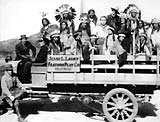 Young,
unknown and aspiring director Cecil B. DeMille came out to the West
Coast from New York, to become the new company's director-general of
all film production. In 1914, he made his debut film with Lasky and
co-producer/director Oscar Apfel, The Squaw
Man (1914). It was the first feature-length (6 reels @18 minutes/reel)
western movie made in Hollywood at the newly-acquired studio/barn or
stable on Vine Street, and the first film with screen credits.
It was also the first feature-length film for the Jesse L.
Lasky Feature Play Company.
The film was a great success due to the marketing efforts of the Company's
general manager Samuel Goldfish. [It cost about $45,000 to produce and
earned about a quarter million dollars at the box-office.] De Mille
became the first director to remake a picture and produce the
same film three times successfully. [Note: The Squaw Man was
filmed again in 1918 as a silent picture, and then in 1931 for MGM as
a sound picture.]
Young,
unknown and aspiring director Cecil B. DeMille came out to the West
Coast from New York, to become the new company's director-general of
all film production. In 1914, he made his debut film with Lasky and
co-producer/director Oscar Apfel, The Squaw
Man (1914). It was the first feature-length (6 reels @18 minutes/reel)
western movie made in Hollywood at the newly-acquired studio/barn or
stable on Vine Street, and the first film with screen credits.
It was also the first feature-length film for the Jesse L.
Lasky Feature Play Company.
The film was a great success due to the marketing efforts of the Company's
general manager Samuel Goldfish. [It cost about $45,000 to produce and
earned about a quarter million dollars at the box-office.] De Mille
became the first director to remake a picture and produce the
same film three times successfully. [Note: The Squaw Man was
filmed again in 1918 as a silent picture, and then in 1931 for MGM as
a sound picture.] After
its initial success, Jesse Lasky's Company merged in 1916 with its friendly
rival, Adolph Zukor's Famous Players Film Company and Frank Garbutt's Bosworth, Inc. . When
Zukor merged his studio with Jesse Lasky - the combined company was renamed Famous Players-Lasky Corporation and it migrated to Hollywood,
where it opened a studio in Hollywood on Sunset Boulevard. Edwin Porter
became director-general for the Famous Players-Lasky, the forerunner
of Paramount Pictures. Within months of the merger in 1916, Goldfish (Goldwyn)
resigned (or was promptly fired) and sold his $7,500 initial investment
for $900,000.
After
its initial success, Jesse Lasky's Company merged in 1916 with its friendly
rival, Adolph Zukor's Famous Players Film Company and Frank Garbutt's Bosworth, Inc. . When
Zukor merged his studio with Jesse Lasky - the combined company was renamed Famous Players-Lasky Corporation and it migrated to Hollywood,
where it opened a studio in Hollywood on Sunset Boulevard. Edwin Porter
became director-general for the Famous Players-Lasky, the forerunner
of Paramount Pictures. Within months of the merger in 1916, Goldfish (Goldwyn)
resigned (or was promptly fired) and sold his $7,500 initial investment
for $900,000. After
being forced out of the Famous Players-Lasky company in 1916, Samuel Goldfish
(Goldwyn) began a new studio in 1917 with partner Edgar Selwyn, naming
it Gold-wyn Pictures Corporation. [Goldfish legally acquired
the studio's name for his own in 1918 - Gold-wyn, taking its name from
the first syllable of Gold-fish's name and the last one of Sel-wyn's name.]
In 1918, Goldwyn Pictures purchased the old Triangle lot in Culver City where they set up their studios.
When Goldwyn experienced difficulties working within the studio system,
he sold his shares in Goldwyn Pictures Corporation to the Metro
Pictures Corporation (founded in 1916 by Richard A. Rowland and Louis
B. Mayer). In a few years, Mayer left this partnership to start up his
own production company in 1918, called the Louis B. Mayer Pictures
Company. In 1920, Metro Pictures Corporation was purchased
by early theater exhibitor Marcus Loew of Loew's Inc.
After
being forced out of the Famous Players-Lasky company in 1916, Samuel Goldfish
(Goldwyn) began a new studio in 1917 with partner Edgar Selwyn, naming
it Gold-wyn Pictures Corporation. [Goldfish legally acquired
the studio's name for his own in 1918 - Gold-wyn, taking its name from
the first syllable of Gold-fish's name and the last one of Sel-wyn's name.]
In 1918, Goldwyn Pictures purchased the old Triangle lot in Culver City where they set up their studios.
When Goldwyn experienced difficulties working within the studio system,
he sold his shares in Goldwyn Pictures Corporation to the Metro
Pictures Corporation (founded in 1916 by Richard A. Rowland and Louis
B. Mayer). In a few years, Mayer left this partnership to start up his
own production company in 1918, called the Louis B. Mayer Pictures
Company. In 1920, Metro Pictures Corporation was purchased
by early theater exhibitor Marcus Loew of Loew's Inc.  In the meantime, Goldwyn became an independent producer, forming Samuel
Goldwyn Pictures, Inc. in 1925. He started to release his films through United Artists. He would become one of the leading, influential,
independent film producers during Hollywood's Golden Era. By
1918, the cinema was one of America's leading industries, as more and
more independent producers set up their own studios. Hollywood films dominated
the European market, and Hollywood helped to inspire and support the war
effort.
In the meantime, Goldwyn became an independent producer, forming Samuel
Goldwyn Pictures, Inc. in 1925. He started to release his films through United Artists. He would become one of the leading, influential,
independent film producers during Hollywood's Golden Era. By
1918, the cinema was one of America's leading industries, as more and
more independent producers set up their own studios. Hollywood films dominated
the European market, and Hollywood helped to inspire and support the war
effort.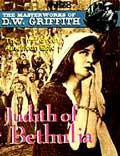 D.
W. Griffith also advanced cinema by experimenting with longer film
lengths, after the phenomenal success of the two-hour Italian epic Quo
Vadis? (1913, It. , directed in Europe by Enrico Guazzoni. Griffith's
response to the full-length features that were already coming over
from Europe was the first American four-reeler, Judith of
Bethulia (1913/14),
starring Blanche Sweet, Henry Walthall and the Gish sisters. It was the last film
he directed for Biograph. The early epic was made over-budget and secretly
produced in 1913, but not released until a year later due to concern
about its uncharacteristic length. The film was made on location in Chatsworth,
California.
D.
W. Griffith also advanced cinema by experimenting with longer film
lengths, after the phenomenal success of the two-hour Italian epic Quo
Vadis? (1913, It. , directed in Europe by Enrico Guazzoni. Griffith's
response to the full-length features that were already coming over
from Europe was the first American four-reeler, Judith of
Bethulia (1913/14),
starring Blanche Sweet, Henry Walthall and the Gish sisters. It was the last film
he directed for Biograph. The early epic was made over-budget and secretly
produced in 1913, but not released until a year later due to concern
about its uncharacteristic length. The film was made on location in Chatsworth,
California. 
 Griffith risked his own fortune of over $100,000 and created the first American
epic feature film, a twelve-reeler entitled
Griffith risked his own fortune of over $100,000 and created the first American
epic feature film, a twelve-reeler entitled  The
film premiered in Los Angeles at Grauman's Theatre on February 8,
1915, with a ticket price of $2 (higher admission prices could be
charged for feature-length movies), and on Broadway in New York, it
played to packed houses for almost a year. Although its investment
was $110,000 (estimated), it became one of the highest-grossing films
of all time ($10-14 million dollars, although some figures were probably
exaggerated). Griffith's masterpiece was also met with considerable
controversy and protest regarding its racist message, stereotyped
racial caricatures, white actors in black-face, and a sympathetic,
glorified portrayal of KKK members as heroes. Even though President
Wilson, following a special screening at the White House, reportedly
said: "It is like writing history
with Lightning. And my only regret is that it is all terribly true," the
film was strongly denounced by the NAACP, and racial disturbances erupted
in several cities (Atlanta, Boston, and Chicago), while the KKK experienced
a resurgence.
The
film premiered in Los Angeles at Grauman's Theatre on February 8,
1915, with a ticket price of $2 (higher admission prices could be
charged for feature-length movies), and on Broadway in New York, it
played to packed houses for almost a year. Although its investment
was $110,000 (estimated), it became one of the highest-grossing films
of all time ($10-14 million dollars, although some figures were probably
exaggerated). Griffith's masterpiece was also met with considerable
controversy and protest regarding its racist message, stereotyped
racial caricatures, white actors in black-face, and a sympathetic,
glorified portrayal of KKK members as heroes. Even though President
Wilson, following a special screening at the White House, reportedly
said: "It is like writing history
with Lightning. And my only regret is that it is all terribly true," the
film was strongly denounced by the NAACP, and racial disturbances erupted
in several cities (Atlanta, Boston, and Chicago), while the KKK experienced
a resurgence.  The next year after his smash hit The Birth of a Nation, Griffith
responded to criticisms that he incited racial prejudice with an over
three-hour long extravagant, follow-up masterpiece
The next year after his smash hit The Birth of a Nation, Griffith
responded to criticisms that he incited racial prejudice with an over
three-hour long extravagant, follow-up masterpiece 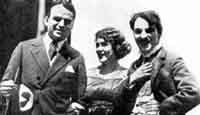 While at First National, the highest-paid film super-stars Charlie Chaplin
and Mary Pickford feared that their film company was soon to be merged
with giant Paramount, and hence they would lose autonomy over their careers.
To take control of their own work, in another precedent-setting move in
1919, Charlie Chaplin and Mary Pickford joined with director D. W. Griffith
and fellow actor Douglas Fairbanks, Sr. to form their own movie company
- United Artists Corporation. They built a studio on Formosa Avenue
at Santa Monica Boulevard [the present day site of the Warner's Hollywood
lot]. UA became a prestigious firm distributing only independently-produced
films. Their aim was to provide greater independence for distribution
of their films (and those of other stars including Buster Keaton, Rudolph
Valentino, and Gloria Swanson) and to thwart the efforts of the bigger
studios.
While at First National, the highest-paid film super-stars Charlie Chaplin
and Mary Pickford feared that their film company was soon to be merged
with giant Paramount, and hence they would lose autonomy over their careers.
To take control of their own work, in another precedent-setting move in
1919, Charlie Chaplin and Mary Pickford joined with director D. W. Griffith
and fellow actor Douglas Fairbanks, Sr. to form their own movie company
- United Artists Corporation. They built a studio on Formosa Avenue
at Santa Monica Boulevard [the present day site of the Warner's Hollywood
lot]. UA became a prestigious firm distributing only independently-produced
films. Their aim was to provide greater independence for distribution
of their films (and those of other stars including Buster Keaton, Rudolph
Valentino, and Gloria Swanson) and to thwart the efforts of the bigger
studios.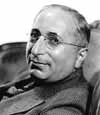 By
the end of the decade, studio producers, including Warner Bros. (the four brothers Harry,
Abe, Sam, and Jack), Adolph Zukor, Samuel Goldwyn, Carl Laemmle, William
Fox, Louis B. Mayer, Marcus Loew, and others were beginning to shape the
movie business. (See next section for other studio developments) Major
and minor studios, each with their own distinctive style and/or stars,
were soon formed from their efforts in only a few years during the next
decade:
By
the end of the decade, studio producers, including Warner Bros. (the four brothers Harry,
Abe, Sam, and Jack), Adolph Zukor, Samuel Goldwyn, Carl Laemmle, William
Fox, Louis B. Mayer, Marcus Loew, and others were beginning to shape the
movie business. (See next section for other studio developments) Major
and minor studios, each with their own distinctive style and/or stars,
were soon formed from their efforts in only a few years during the next
decade: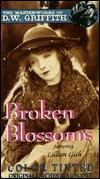 From
1911-1919, the number of feature-length films released each year increased
from 2 to 646, and grand movie palaces sprouted up in major metropolitan
areas. The first major, feature-length melodrama, D. W. Griffith's
From
1911-1919, the number of feature-length films released each year increased
from 2 to 646, and grand movie palaces sprouted up in major metropolitan
areas. The first major, feature-length melodrama, D. W. Griffith's
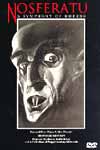 Robert
Wiene's expressionistic The Cabinet of Dr. Caligari (1920, Germ.) and
F. W. Murnau's vampire film Nosferatu: Eine Symphonie Des Grauens
(1922, Germ.),
with their angular distorted sets, unique compositions, expressionistic
shadowy images, visual story-telling, and stylized acting (especially
by Max Schreck as the title character) encouraged cinematographic
experimentation.
Robert
Wiene's expressionistic The Cabinet of Dr. Caligari (1920, Germ.) and
F. W. Murnau's vampire film Nosferatu: Eine Symphonie Des Grauens
(1922, Germ.),
with their angular distorted sets, unique compositions, expressionistic
shadowy images, visual story-telling, and stylized acting (especially
by Max Schreck as the title character) encouraged cinematographic
experimentation. 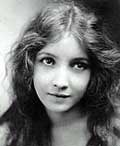 Stars
and Studios of the Era:
Stars
and Studios of the Era: