|
Greatest Scariest |

| Movie Title/Year and Brief Scene Description | ||||||||||||||||||||||||||

|
Bad Taste (1987, NZ) Co-writer/director/actor Peter Jackson's low-budget ($25,000) sci-fi/horror "splatter film" was notable as being Jackson's first feature film. The independent film - that became a well-known cult film favorite with gory special effects - performed very poorly at the box-office ($150,000), but it brought enough prominence to Jackson that enabled him to proceed with future film-making. There were always questions about the film's excessive gore and gratuitous violence, and it became notorious for its "BANNED IN QUEENSLAND" labeling. The heavily-edited and often-censored film was available on home video in a number of versions (of varying lengths), but only released theatrically thirteen years after its production in the year of 2000. Finally, in the year 2004, the film was released uncut on a DVD with a rating of R18+ (Medium Level Violence). The hyperactive, quasi-comedic alien invasion film began with New Zealand's Astro Investigation and Defence Service (AIDS) sending four para-military agents/assassins (known as "The Boys") to investigate the mysterious disappearance of all of the residents in the small fishing town of Kaihoro, on the North Island of New Zealand:
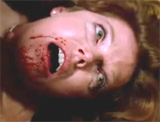
Derek and Barry were the first to enter the deserted town (on October 31st, Halloween), while Ozzy and Frank were slowly traveling on their way to the town as back up. Barry was immediately confronted and stalked by a blonde, axe-wielding stranger, and was forced to shoot the man in the head with his Magnum to stop his assault. Blood splattered onto Barry's face before the man fell dead at Barry's feet - with the top of his head blown away.
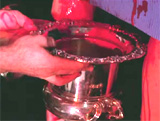
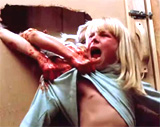
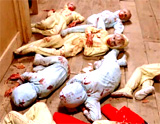
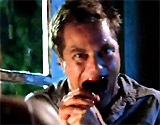
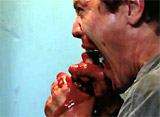
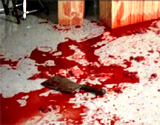
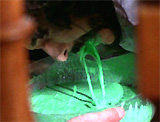
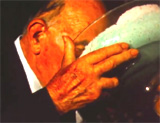
Derek radioed to Barry as he watched from afar and worried about the completely empty village: "I just hope we're in time to save the world." They assumed there had been an alien invasion: "There's no glowing fingers on these bastards. We've got a bunch of extra-terrestrial psychopaths on our hands. Like a visit from a planet full of Charlie Mansons." Suddenly, Barry was surprise-attacked from behind by another alien in a wooden shed. He escaped, and then was chased through town by a total of five blue-shirted aliens before he was able to elude them. While Derek was torturing another retarded alien named Robert (also Peter Jackson) on a cliffside, by pounding a metal blade into the sole of the man's shoe, his shrieking brought the aliens surrounding Barry to the rescue, wielding seldge-hammers. At one point, Derek fired his gun at an alien's stomach, then shoved his gun barrel through the alien's abdomen and kept firing. When two of the surviving aliens cornered Derek at the cliff's edge, he killed both of them (one was disarmed, the other was brain-injured), but he was presumed to have suffered a potentially-lethal fall off the cliff. His death was averted when he landed in a seagull's nest, revealed later. However, he noticed his own brain was oozing out of the back of his skull, and tried to stuff some of its contents back in. A continuing gag in the film was his efforts to keep his cerebrum in his cracked-open head - first with his hat, and then later with his waist-belt used as a headband. At the same time, an emergency relief-aid collector named Giles Copeland (Craig Smith) who had driven to town in a small blue Morris Minor (British car), was knocking on doors of empty homes. He came upon Robert who was eating the brains of one of the decapitated aliens with a fork. While Giles was being attacked by Robert, he gave him the finger. Although Giles escaped in his vehicle, later when he ran on foot to a large mansion, he was knocked out at the front door by another alien dressed as a chef. The captured-kidnapped Giles awoke marinating in a large metal drum in the house where he was being threatened with cannibalism (an apple was stuck in his mouth) - he would be the "main course" for the aliens' victory feast ("Tomorrow, we're having you for lunch. You're the exotic new taste sensation. Human flesh, is it?"). In an effort to rescue Giles, the other three agents (disguised as dark uniforms as commandos) entered the alien's mansion-headquarters after midnight and found bloody cardboard boxes and a meat cleaver, to be used to package human flesh as l alien fast-food. They discovered the film's nauseating twist - that the weapon-wielding, blue-shirted extraterrestrial humanoids (from the planet of Nalic Nod) were working to provide human food consumption samples for an intergalactic fast-food franchiser (Crumb's Crunchy Delights), in order to move on to the next step - the acquisition of a "mass slaughter permit" of the 4 billion Earthlings ("Within a year, the giant mincer will descend from the sky, the sun reflecting from its silver bits, and no army on Earth will be able to stop the noddy-burger machine!"). Their clear objective in invading Earth in UFOs was to harvest homo sapiens flesh for their food supply - they had already wiped out the small village. The aliens had a rushed timetable to complete their job, due to competition from a rival franchise (McYaballow's Fried Moonrat). In one of the most disgusting scenes set during the alien get-together, Robert vomited green puke into a ceremonial punch bowl and his regurgitated stomach contents were then consumed by the other aliens. Leader Lord Crumb (Doug Wren, voice of Peter Vere-Jones), disguised as an old gentleman, exclaimed after drinking: "Aren't I lucky? I got a chunky bit!" Disguised as one of the aliens (wearing a stolen blue-shirt from a decapitated alien), Frank was forced to partake in the disgusting meal of gruel when the bowl was passed around, as other aliens belched with enjoyment. Crumb extolled the coming of new flavors of fast food, before promising his minions that they would be feasting on Giles ("fresh local meat"):
The commandos/agents were able to rescue Giles. The next day, a prolonged gun battle, chainsaw pursuit by Derek, and Ozzy's rocket launcher attack ensued between the many alien followers and the agents in the house, throughout the grounds, and in an adjoining forest. There were multiple examples of the gory deaths of the aliens, sometimes accompanied by humorous asides: "I bet that cleared his sinuses."
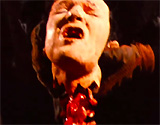
As the film concluded, after chainsawing an alien, Derek replaced the missing parts of his brain with the alien's brain, and then went "ape-s--t." Ozzy was shot in the leg by Lord Crumb, just before an errant launched rocket went through the house and struck a sheep grazing in a meadow. With Lord Crumb in the control seat, the alien's HQ transformed into a giant spaceship that launched itself into space toward the alien planet, with Derek caught onboard. Crumb phoned and bragged about his successful mission to Earth:
As the house-rocket proceeded away from Earth, Derek ambushed Lord Crumb by attacking him from above and sliced through him with his chainsaw - while yelling out: "Suck my spinning steel, s--t-head!" While he was snickering maniacally, Derek emerged or was birthed from inside Crumb - bloodied and ready to take on the entire alien race as a one-man force: "l'm born again!" He threatened through the phone: "l'm coming to get you bastards!" before donning Crumb's face and patting his chainsaw in his lap.
|
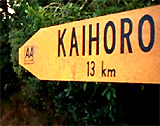 Besieged Town of Kaihoro 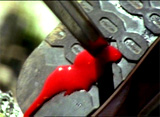 Derek Pounding a Blade Through Robert's Shoe Sole 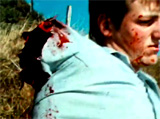 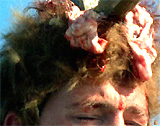 Dis-armed and Brain-Injured Aliens Attacking Derek on Cliff-Side 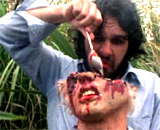 Robert Eating Brains of Decapitated Alien From Earlier 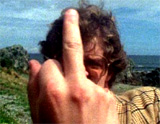 Giles Gesturing Toward Robert as He Was Being Attacked 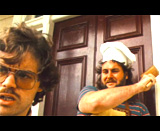 Giles Knocked Out by Chef at Alien HQ 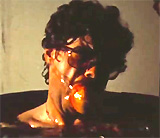 Giles Marinating in a Metal Drum 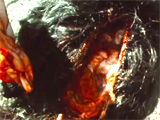 The Back of Derek's Opened Skull - Revealing His Oozing Brain 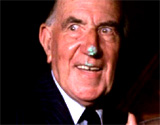 Lord Crumb (Doug Wren) - Disguised in "Human Form" 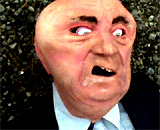 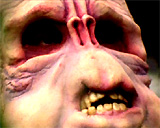 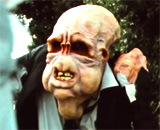 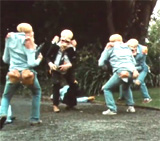 Lord Crumb and Other Aliens Losing Their Disguises 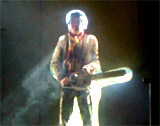 Derek with His Chainsaw 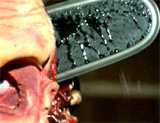 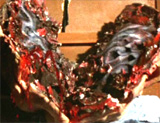 Derek's Massacre of the Aliens  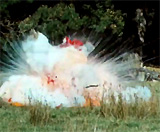 Errant Launched Rocket Struck a Sheep 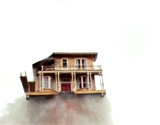 House Transformed into Spaceship |
||||||||||||||||||||||||

|
The traumatic and scary reality of death was introduced early to children in this Disney animated film. It was the memorable scene when hunter Man killed Bambi's mother (off-camera). She had sensed a human presence -- and warned: "Bambi. Quick! The thicket!" There were gunshots as they both raced away. She encouraged: "Faster! Faster, Bambi! Don't look back. Keep running! Keep running!" As Bambi ran and ducked behind a snowbank - and made it to the protective thicket, there was a fateful gunshot. Bambi turned and exclaimed while panting: "We made it! We made it, Mother! We...", but his Mother was nowhere in sight. Bambi emerged, asking and calling out: "Mother. Mother! Mother, where are you?!" He fruitlessly searched for her during a raging snowstorm, not knowing she had been killed by a human hunter. After not finding her and hearing no response, the young fawn began to sob, and then gasped at the imposing sight of his stag father, the Great Prince of the Forest, who stated:
A tear formed in Bambi's eye as he looked up, and was told: "Come. My son." He followed, but looked back one last time in the direction of where his mother had been. |
 Bambi's Mother: "Bambi. Quick! The Thicket!" 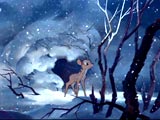  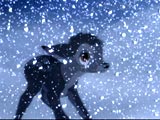 "Your mother can't be with you anymore." |
||||||||||||||||||||||||

|
Battleship Potemkin (1925, Soviet Union) (aka Броненосец Потёмкин) Director Sergei Eisenstein's propagandistic Russian silent film dramatized the 1905 mutiny of the crew of the Russian battleship Potemkin against their officers. Their uprising triggered a massive citizens' revolt in the city of Odessa against the Tsars. The most impressive and terrifying sequence was the Odessa Staircase episode (a fictionalized account of what actually happened on June 14, 1905), in which Tsarist military soldiers (Cossacks) blatantly opened fire on citizens (rioters and innocent folk alike) at the famed steps. During the massacre sequence, a mother pushing a baby carriage was shot and fell to the ground, leaving her young infant to careen down the steps in the buggy. It must have been a very scary scene for mid-1920s audiences. [Note: It was later reprised in a number of films as homage to the classic scene, including director Coppola's The Godfather (1972), Terry Gilliam's Brazil (1985), DePalma's The Untouchables (1987), and comically in Naked Gun 33 1/3: The Final Insult (1994).] |
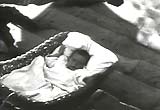 Baby Carriage on Steps 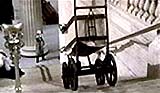 The Untouchables (1987) |
||||||||||||||||||||||||
|
The Beyond (1981, It.) (aka E Tu Vivrai Nel Terrore - L'Aldilà, or You Will Live in Terror or Seven Doors of Death) #60 Director Lucio Fulci's graphic horror film was the second in his trilogy of Gates of Hell films.
It was set beneath a dilapidated New Orleans hotel, the Seven Doors Hotel, with an underground entrance to the hellish underworld and its violent demonic forces. The scary supernatural film featured one of the more horrific eye-damage scenes of all time.
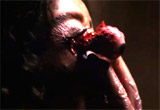
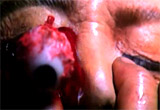
A grotesque zombie named Joe, the Plumber (Giovanni De Nava) rose from a dark substance in a bathtub, and grabbed Martha (Veronica Lazar) by the face. He backed her up to a wall, where the back of her skull was pushed into the blunt end of a nail. This caused her eyeball to entirely pop out of its socket. With an appropriately awful squishy sound-effect, the dislodged eye spewed blood, seen in closeup.
|
|||||||||||||||||||||||||
|
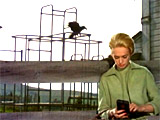
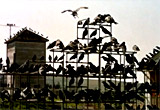
#96 Hitchcock's thriller/masterpiece, his first film with Universal Studios, was the apocalyptic story of a northern California coastal town filled with an onslaught of seemingly unexplained, arbitrary and chaotic attacks of ordinary birds. There were numerous scary scenes of crazed winged creatures attacking the inhabitants:
|
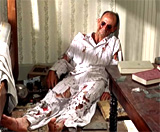 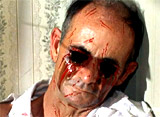 Bird Attack at Fawcett Farm House - Dan's Bloody Death 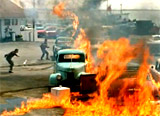 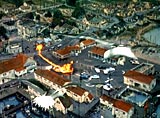 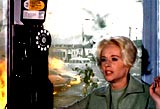 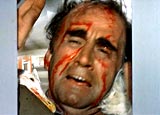 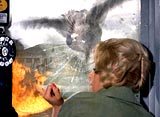 Amassing of Birds on Town: Trapped in Telephone Booth Sequence 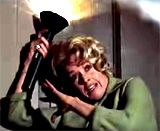 Attack in Brenner Attic   The Ominous Ending |
||||||||||||||||||||||||
|
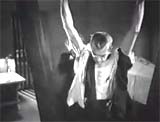
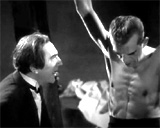
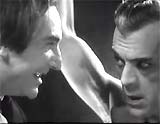
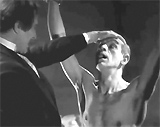
#68 This classic, enigmatically disturbing horror film from Universal Studios and expressionistic director Edgar G. Ulmer was Universal's top-grossing film of the year. The visually intriguing, austere, landmark horror film - a tale of European post-war anguish and death, portrayed the age-old struggle between good and evil science, diabolically personified by Bela Lugosi and Boris Karloff - the lead stars. In the end scene, Hjalmar Poelzig (Boris Karloff) was overpowered and then hung or suspended by his arms stretched upward, shackled to an embalming, torture rack where he was stripped of his robes and prepared for being skinned alive! At first, Dr. Vitus Werdegast (Bela Lugosi) sadistically ranted and raved with a mad, delirious gleam in his eyes, vengeful for earlier atrocities committed against him. He described what he was planning to do to the Satanist on Poelzig's own embalming rack:
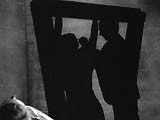
From a surgical table, Werdegast selected a scalpel for the operation. Slowly and bit by bit, the doctor sliced skin with a scalpel from Poelzig's face (the skinning was filmed as a dark shadow play in black images of manacled hands on the wall), asking sadistically:
|
 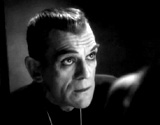 Werdegast vs. Poelzig 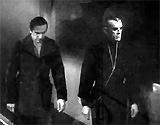 Poelzig to Werdegast: "Are we not both the living dead?" 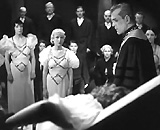 Devil Cult Worship - Poelzig Led Black Mass 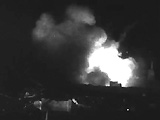 Ending: Destructive Explosion of Poelzig's Home |
||||||||||||||||||||||||

|
Black Christmas (1974, Canada) (aka Silent Night, Evil Night) #87 Not to be confused with the 2006 remake, this independent, low-budget Canadian horror film, an exploitative cult horror/slasher that predated the similar Halloween (1978) by four years, has been considered the forerunner of the modern slasher film. It was not cheap, but surprisingly well-made, and even included elements of humor and effective suspense. In the plot, an ill-fated houseful of sorority sisters from Pi Kappa Sig (at 6 Belmont Street) in the college campus town of Bedford were just about to leave for the Christmas holiday season. Some of the main female characters, with realistic and well-defined personalities in the sorority house, included:
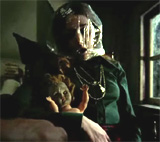
A fourth important character was Peter Smythe (Keir Dullea), an aspiring concert pianist, and Jess' boyfriend who had impregnated her and was opposed to her plans for an abortion; he became a prime murder suspect, but seemed unhinged and unstable mostly due to his concerns about his future with Jess. As the film opened during a Christmas party with carol singing, a heavily-breathing, deranged man (from his POV) was stalking around outside a sorority house before the individual climbed a trellis and entered into the sorority house's attic window. The shadowy man also descended through the attic's trap door and ladder to explore the upstairs 3rd floor area. He then proceeded to make a strange, and obscene phone call to the main phone in the sorority. The voice called them "Pigs" and threatened: "Let me lick it! Let me stick my tongue on it and lick it!...Let me lick your pretty piggy c---t...Suck on my juicy c--k!...I'll stick my tongue up your pretty p---y" and came to acquire the nickname "The Moaner." During the call, Barb took the phone and shouted back at the caller ("You f--king creep!"), and was told: "I'm going to kill you." [Note: Shortly later, Jessica addressed the caller as "Billy."] Actually things quickly did escalate to murder. One of the younger sorority sisters, Clare Harrison (Lynne Griffin), who became upset by the most recent call, decided to pack up early and leave the next morning for the holidays. In the scariest moment of the film, as she packed in her room, she was suffocated or asphyxiated with a plastic garment bag in her own room's closet, where the killer had been hiding. He then carried her corpse up into the attic and positioned it in a rocking chair by the window - keeping the plastic cleaning bag over her head. The killer sang: "Little baby Bunting, Daddy's gone a-huntin, Gone to fetch a rabbit skin, To wrap his baby Agnes in"; A baby doll was placed in Clare's lap and the psycho called her Agnes (the name of his sister?).
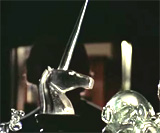
Another phone call came in, and Jessica answered it. She kept saying it was a wrong number, and addressed the caller as "Billy" when the man kept asking: "Where did you put the baby?...Where did you put Agnes, Billy?...What your mother and I must know is…" When Clare went missing the next day, a search was conducted that evening led by incompetent Sargeant Nash (Douglas McGrath) and Lieutenant Fuller (John Saxon), with some of the sorority girls and Clare's concerned father Mr. Harrison (James Edmond) participating, after pressure was put on the police at the station by Clare's insistent boyfriend Chris Hayden (Art Hindle). Chris believed that Clare's disappearance wasn't being taken seriously. During the search party for Clare, the next murder victim was the house mother Mrs. "Mac" MacHenry (Marian Waldman), a foul-mouth alcoholic (who hid bottles of alcohol everywhere in her apartment). After opening the attic door, the killer swung a curved crane hook into her neck. She was dragged up the trap door ladder into the attic by the impaling hook and killed (off-screen). Jessica received another disturbing phone call - the killer Billy was begging: "Oh, help me! Please, stop me! Oh, God, please! Help me!"; then the killer seemed to be reprimanded in a different voice: "Filthy Billy!...I know what you did, Blllyl Stupid Billy! Billy! Billy! Mad!"; Jessica hung up in disgust. After Jessica called and reported the obscene phone calls, she was able to get a response. Lieut. Fuller arrived with phone company lineman Graham at the sorority house on 6 Belmont Street to tap the sorority house's main phone line, and to station Officer Jennings (Julian Reed) in a squad car outside. However, Lt. Fuller unwisely chose not to tap the private phone line of Mrs. MacHenry, since obscene calls hadn't been received there. The third victim was Barb who was sleeping in her room, but suffering from an asthma attack (after having awakened from a nightmare of a stranger stalking her). She was bloodily stabbed numerous times with an ornamental glass unicorn figure (and its long spike) (while carolers were singing O Come All Ye Faithful at the front door and masking the noise). In slow-motion, she extended her bloody hand and knocked down other glass figurines by her bed.
There was another creepy call to the house, when the caller quoted something Peter had said to Jess ("Just like having a wart removed") - a reference to her abortion procedure (making Peter a possible suspect), but the caller wasn't on the line long enough to be traced. The fourth victim was Phyllis (murdered off-screen) after entering Barb's room and finding her body. At the same time, another call came in - dialed from Mrs. MacHenry's phone line - answered by Jessica. It was another obscene, disturbing, and confusing conversation mixed with screaming and the appearance of multiple voices: ("You fat pig! You pig! You bitch pig! Look at your little baby!...Billy! Billy! Where's the baby? Where's Agnes? You left Billy alone with Agnes!...Where's Agnes? Agnes! Give Mommy the baby! Baby's all right, Mommy!") This time, the phone call was traced, placing the Killer at the address of the sorority house - he was using Mrs. MacHenry's separate phone line. And then Officer Jennings outside in his squad car was found with his throat slit (off-screen). Jessica was instructed on the phone by Sgt. Nash that she must leave the house immediately ("Just put the phone back on the hook, walk to the front door, and leave the house") - and then against specific instructions by Lt. Fuller, Nash divulged that the killer was in the house - one of the most common horror film tropes:
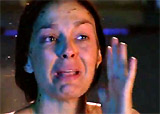
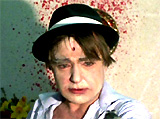
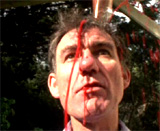
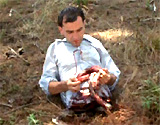
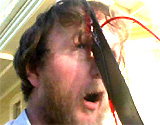
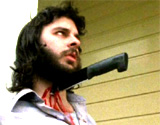
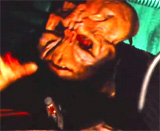
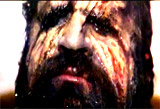
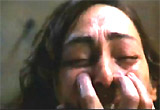
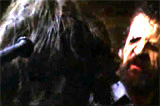
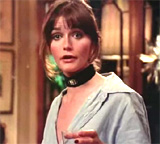
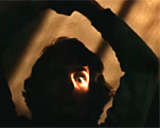
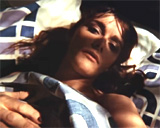
Sgt. Nash kept frantically ordering Jess to not go upstairs to check on her friends, and to leave the house immediately. Against his orders and to prepare herself, Jess grabbed the fireplace poker as a weapon, cautiously climbed the stairs, and entered Barb's room where she found the bloodied bodies of both Barb and Phyllis on display. Looking up, and from a crack in the door, Jess saw a wide-open eye watching her, and heard a whispering voice say: "Agnes, it's me, Billy! Agnes, Agnes, don't you tell what we did, Agnes." Jess presumed it was the killer. She slammed the door on the person and ran through the house. She was unable to open the jammed front door, so she raced into the basement (while being pursued by the killer), and locked the door behind her. When the killer was unable to break down the cellar door, his footsteps seemed to retreat. After a few moments of looking around, Jess saw the silhouette of a person at the basement window, who then moved to a second dirty window while calling out: "Jess, are you alright?" Fearing that Peter was going to kill her after busting out the window and climbing inside (and approaching her while repeatedly calling out her name), she bloodily bludgeoned him with her fireplace poker (off-screen), suspecting that he was the murderer (the film's 'red herring'). Police cars with sirens blaring arrived at the house and heard screaming. Lt. Fuller and other officers found Peter dead and cradled in Jess's lap.
Afterwards, police were pondering whether Peter was the killer ("Why would Peter start killing people?"), but Lt. Fuller presumed that Peter was indeed the killer. The officers were unable to question Jess who was sedated and would be unconscious for at least 4 hours. The bodies that had been discovered would be taken to the nearby Lincolnville morgue for autopsies and identification by the coroner and the parents of the deceased. Jess was left to sleep in her upstairs sorority house bedroom. The film's final twist was that the killer was still in the attic (where the bodies of Clare and Mrs. Mac had still been undiscovered) - the camera slowly panned from Jess' room over to the attic's ladder and trap door, where the killer was heard softly singing to the two corpses still stashed up there, and was also heard whispering: "Agnes, its me, Billy!" The camera slowly zoomed backwards and out through the attic window (where Clare was still seated), as the phone in the house began to ring during the scrolling final credits - a signal that the killer was still on the loose and another murder (of Jess?) was about to take place! |
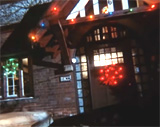 POV Exterior Stalking of Christmas-Decorated Sorority House 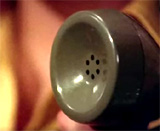 The "Moaner's" Obscene Phone Call 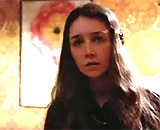  Scene of Attack on Clare (Lynne Griffin) in Her Room's Closet - Suffocated with a Plastic Garment Bag   Mrs. "Mac" House-Mother Hooked in Chin by Killer and Dragged Into Attic and Killed (Off-Screen)  Another Obscene Phone Answered by Jess  Mentally-Unstable Peter (Keir Dullea) Upset About Jess Seeking an Abortion 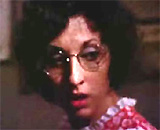 Phyl (Andrea Martin) Just Before Her Off-Screen Murder 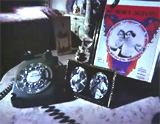 Killer Using Mrs. MacHenry's Private Phone Line For Calls 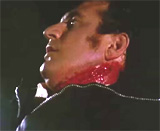 Officer Jennings With a Slit Throat in Squad Car Out Front 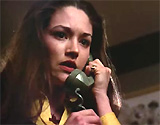 Jess Notified by Sgt. Nash to Vacate the House: "The Caller is in the House!" 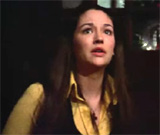 Jess' Tense Decision to Go Upstairs 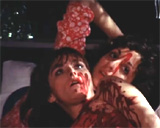 The Discovery of the Bloodied Bodies of Barb and Phyl Next to Each Other - Found by Jess in Barb's Room 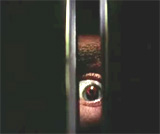 In the Hallway, a Spying Eye Whispering: "Agnes, it's me, Billy! Agnes, Agnes, don't you tell what we did, Agnes" 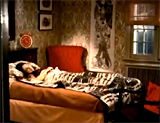
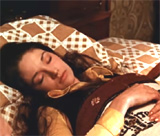 Alone and Unconscious, Jess Was Sedated in Her Sorority
House Bedroom
Alone and Unconscious, Jess Was Sedated in Her Sorority
House Bedroom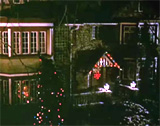 The Last Image: Outside of House |
||||||||||||||||||||||||
|
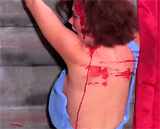
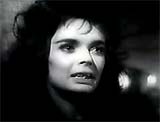
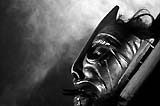
Black Sunday (1960, It.) (aka La Maschera Del Demonio, or The Mask of Satan, or The Mask of the Demon) #40 In the prologue of this Italian gothic horror film by Mario Bava (his credited directorial debut film), 17th century condemned witch Princess Asa Vajda (Barbara Steele) was first branded by her Grand Inquisition executioners with an S (The Mark of Satan) on her bare back. Then, she was condemned to be covered with the 'mask of the demon':
She responded to her accusers with a curse on her executioners (including her brother) and their progeny:
The executioner then sledge-hammered the mask down onto her face with a large wooden mallet, causing screams, blood-splattering and gushing blood through the eyeholes. The remainder of the film documented her revenge two centuries later when she returned resurrected from the dead to seek retribution on her brother's descendants. |
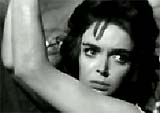   Mask Hammered Onto Princess Asa's Face |
||||||||||||||||||||||||
|
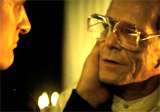
One of this popular science-fiction film's most unnerving scenes was the long-awaited encounter between a maker and his creation. It was the meeting between android NEXUS-6 replicant Roy Batty (Rutger Hauer) and creator Dr. Tyrell (Joe Turkel) - the confrontation was both pensive and violent. Demonstrating his intelligence to the insensitive corporation head, Roy confessed that he wanted his life to be extended beyond the built-in four year span - he desired more joie de vivre. Tyrell tried to calm and soothe his manufactured human with a technical explanation of the limitations, and that the Tyrell Corporation could not accomplish Roy's wish: "To make an alteration in the evolvement of an organic life-system is fatal. The coding sequence cannot be revised once it's been established...You were made as well as we could make you." Smugly, Tyrell thought Roy (compared to a light bulb) should be grateful for whatever life span he had been given: "The light that burns twice as bright burns half as long. And you have burned so very very brightly, Roy. Look at you. You're the prodigal son. You're quite a prize!" Roy then asked to be absolved for his sins: "I've done questionable things." Tyrell dismissed Roy's feelings of guilt, adding: "Also extraordinary things. Revel in your time!" Roy responded: "Nothing the god of biomechanics wouldn't let you in heaven for." Roy, the "prodigal son", reverently touched Tyrell's cheek with one hand. He also placed his strong hands on both sides of Tyrell's face and kissed his replicant God - his 'father' Tyrell, passionately on the lips. [This was a reference to the Jesus/Judas betrayal in the New Testament, with a kiss.] Then with his powerful bare hands and a look of utter contempt and pathos, Roy suddenly crushed and caved in his maker's skull with superhuman strength and gouged his eyes (!) out as Tyrell screamed - with blood oozing out of his eye sockets. Tyrell's corpse fell to the floor. |
 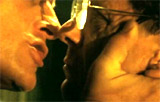 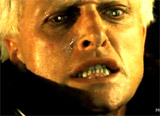 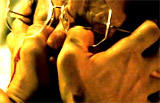 Roy Batty's Murder of Tyrell by Eye-Gouging |
||||||||||||||||||||||||

|
The Blair Witch Project (1999) #30 Two scenes were the scarefest's highlights in this coarsely-made, low-budget fake documentary about an urban legend (the Blair Witch). It told about three young documentary filmmakers in October of 1994 who disappeared in the woods near Burkittsville, Maryland:
A year later, their videotaped "found footage" was discovered in the woods, and compiled into the movie. Heather delivered a close-up, desperate, teary-eyed, video-taped confessional goodbye to her family and friends (fellow students Mike and Josh) in the dark Maryland backwoods, with snot dripping from her nostrils. Her face was lit by her flashlight shining from the side. She was now feeling totally vulnerable and in danger:
The closing scene involved a chase in the darkened woods by Heather and Michael for their missing friend Josh. They had found bits of his teeth and hair in fragments of Josh's blood-soaked shirt outside their tent. They proceeded through the seemingly-abandoned house - past kiddie-handprints on the wall (the Blair Witch myth told about children killed many years earlier), and then split up. It appeared that someone was screaming from the cellar. Mike got to the cellar first. When Heather (amidst screams and jerky hand-held camera shots) also approached, she saw Mike, in a final ambiguous shot, standing motionless and facing a wall in a corner of the basement. Was he drugged, semi-conscious, or propped up dead, in order to distract the next victim? The film's final ambiguous POV shot was accompanied by the sounds of "thwack", "thump", and "crash" as Heather's camcorder hit the ground (was she attacked and killed?). The camera was broken, but was still running -- before the end credits appeared. |
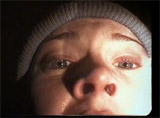 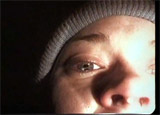 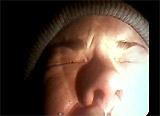 Heather's Teary-eyed Goodbye 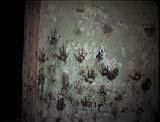 Handprints on Wall 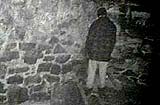 Mike Against Wall in Corner of Basement |
||||||||||||||||||||||||
|
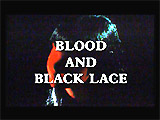
Blood and Black Lace (1964, It./Fr./Monaco) (aka Sei Donne per L'Assassino, or Six Women for the Murderer) #85 One of the best (and earliest) of the Italian Giallo films from director Mario Bava, with a stylistic dreamy feel, shadows, vivid colors, and lengthy stalking-killing sequences or set-pieces involving long buildups, brutal violence and often half-dressed females.
As a Giallo film, it was noted for its psychosexual themes, violence, blood and mystery. Its typical plot was that a masked killer who was stalking and killing (or slashing) beautiful models, but without the 'who-dun-it' angle emphasized. Interestingly, all of the murder victims in this film perished with their eyes wide open. A 'high fashion' (haute couture) salon outside Rome run by recently-widowed Countess Cristiana/Christina Cuomo (Eva Bartok) was set in a gated mansion in a woodsy area.
Red leather coat-wearing model Isabella (Francesca Ungaro) was stalked and strangled on her way to the fashion salon after a night's date by a homicidal maniac, wearing a black trench coat, fedora, and flesh-colored stocking mask. (Bravo emphasized the dark and suspenseful, atmospheric feeling of dread before the killing). Her body was found shortly later within a cabinet in the fashion studio by Cristiana, who screamed at the sight. During the investigation led by incompetent Police Inspector Sylvester (Thomas Reiner), Isabella's diary became the center of focus - with its potentially-damaging information contained within. Subsequent murders were linked to a desperate search for the revealing diary to cover up its secrets and what it would reveal. It allegedly contained a listing of all the various sordid crimes described by Isabella that were committed within the fashion salon, including cocaine drug-dealing and addiction, cheating, corruption, forced abortions, and blackmail. The next victims, seen in "bleeding color," included three more models who all died in a state of undress. They had each acquired the diary and passed it through their hands:
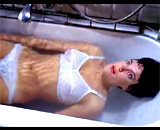
One of the main suspects was Cristiana's (married?) lover and greedy manager/assistant Massimo Morlacchi (Cameron Mitchell) (aka Max Marian), who admitted to killing Cristiana's former husband (in a suspicious car accident), so they could become lovers. Massimo had murdered the first victim - a model named Isabella - she knew of the crime and was blackmailing him. Massimo also murdered Nicole and Peggy in a frenzied search for Isabella's diary that revealed all. To further complicate things, Massimo's accomplice Cristiana (wearing the flesh-colored mask and black gloves) murdered the 4th victim Greta to give Massimo an alibi. She also murdered the 5th victim, Chinese model Tao-Li (Claude Dantes), by drowning her in a bathtub, and then slitting her wrist with a knife to make it look like a suicide, in order to frame her. Cristiana was the one to be revealed as the killer following Tao-Li's death. As Cristiana exited, she was climbing down a sabotaged drainpipe, fell from a second story window and was near-death from a serious head injury.
In the end scene, Cristiana revived enough to confront the treacherous Massimo, realizing that he had lured her into a trap (during the murder) and had sabotaged the drainpipe, because he wanted her fortune in jewels for himself. After a kiss of death, she vengefully shot him in the chest, and then briefly phoned the Inspector, but then collapsed atop him - and they presumably died together. |
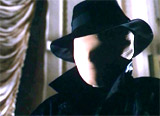 Homicidal Killer Wearing Featureless Mask 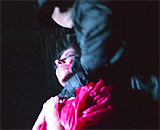 First Murder: Model Isabella Brutally Strangled in Woodsy Area Surrounding Salon 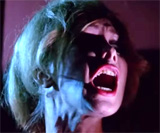 Next Victim: Nicole Killed with Medieval Spiked Gauntlet or Armored Glove 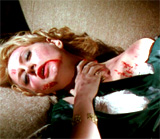 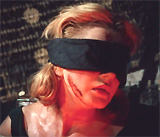  Third Victim Peggy Beaten Up, Blindfolded, Tied to a Chair, and Then Burned  Cristiana Unmasked as Killer Cristiana Unmasked as the Killer of Tai-Li 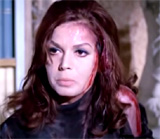 Cristiana - Mortally Wounded and Vengeful After Being Betrayed by Massimo 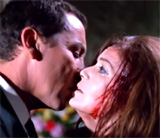 Kiss of Death Before Cristiana Shot Massimo In the Chest 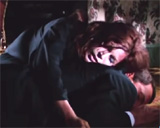 Dead Together |
||||||||||||||||||||||||
|
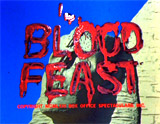
Blood Feast (1963) Sexploitation gore-fest director Herschell Gordon Lewis' career was launched with this low-budget cult film (starring June 1963 Playboy Playmate Connie Mason as Suzette Fremont). The 67-minute work was filmed in only 9 days (with a budget of about $25,000), and grossed $4 million. Lewis partnered with producer David Friedman, to branch off from their "nudie-cutie" sex films into the horror genre, in part to avoid conflict with censorship boards. The crude, ineptly-acted, and salacious Z-grade horror film is usually considered to be the first distinctive horror 'splatter' film for its excessive gore, blood, violence, and bodily mutilation. It was censored or outright-banned in many places, especially in the UK where it was considered a "video nasty."
The taglines on film posters described its unique depictions of horror:
The film debuted at a drive-in theater in Peoria, IL, in July of 1963 - a perfect venue, and then it widened its audiences in Florida, New York City, and Los Angeles. The film's producer David Friedman thought up two clever publicity stunts to garner attention: an injunction was issued against the film in Sarasota, FL, and some movie theaters were given "vomit bags" or plastic cups for patrons who became sickened. It went much further than its inspiration - Hitchcock's Psycho (1960), with graphic depictions of the gory results of bizarre ritualistic murders - filmed in rich bright color with exceptionally red blood. It paved the way for the existence of many blood-drenched, 'meat grinder-horror' films to follow, including George Romero's Night of the Living Dead (1968), Wes Craven's The Last House on the Left (1972), The Texas Chain Saw Massacre (1974), John Carpenter's Halloween (1978), the Friday the 13th films, and even Sam Peckinpah's The Wild Bunch (1969). The gore-fest was the first film in Lewis' "Blood Trilogy," composed of:
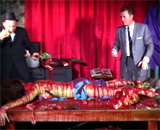
Lewis, dubbed "the godfather of gore," made a career out of similarly gory, low-budget drive-in films for the next decade (i.e., A Taste of Blood (1967), The Gruesome Twosome (1967), Something Weird (1967), The Wizard of Gore (1970) and The Gore Gore Girls (1972)). A sequel came much later: Blood Feast 2: All U Can Eat (2002). The film followed the infamous sacrificial intentions of a psychopathically-mad, homicidal, exotic food caterer named Fuad Ramses (Mal Arnold) who was murdering female victims in suburban Miami, FL in order to supplement his Exotic Catering service with meals composed of their organs and body parts. His ultimate objective was based upon his devotion to the dormant Egyptian goddess Ishtar ("The Mother of the Veiled Darkness"), to provide her with a ritualistic Egyptian blood feast in order to resurrect her. In the opening pre-titles murder scene, a blonde female named Pat Tracy (Sandra Sinclair) was hacked and mutilated to death by a crazed, grayish-haired, knife-wielding, wild-eyed maniac. She was struck in the eye, then whacked by a machete blade multiple times into her body and left knee before the killer stuffed some of her bloody remains (including her heart) into a bag. The letters in the film's title dripped reddish blood. A newspaper headline later described the murder: "LEGS CUT OFF!" The Miami Homicide Bureau's Police Captain Frank (Scott H. Hall) had assigned Detective Pete Thornton (William Kerwin) to investigate the rampaging serial killer who had committed seven killings (and mutilations) in two weeks without leaving any clues - the murders ("each killing more brutal than the other") had been reported on the radio (voice of Herschell Gordon Lewis, the director) in the last few days. There was a distinctive pattern left by each corpse - certain organs and body parts were removed from each victim. Meanwhile, at Fuad Ramses Exotic Catering services, wealthy socialite Dorothy Fremont (Lyn Bolton) hired catering for her daughter Suzette Fremont's (Connie Mason) upcoming party in two weeks on a Saturday night. It was arranged for the "unusual" occasion to feature a rare Egyptian feast unoffered for 5,000 years by a Pharaoh. Unbeknowst to the Fremonts, Ramses was preparing a special 6:30 pm dinner - a 'blood feast' in honor of a large golden statue of Egyptian goddess Ishtar, that he worshipped in the back of his store. The contents of a large vat (with various female body parts) would be served to facilitate the resurrection of the goddess. Soon, there were four more murders - all revealing the same clues: the removal of one part of the body, and the victims were members of a book club, reading the book "Ancient Weird Religious Rites" written by Fuad Ramses:
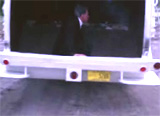
Suzette and her boyfriend Pete Thornton, the police detective involved in the investigation, were both attending a weekly lecture-class in Egyptian history and culture, where the lecturer Dr. Flanders (Al Golden) described the "Cult of Ishtar" that existed for 400 years until it was abolished. It involved a "bloodthirsty" devil-cult ritual after 7 days in which virginal priestesses laid on the altar of the temple were violently sacrificed to the evil Egyptian goddess Ishtar as a 'blood feast' offering to her. Pete surmised that all of the various clues in the murders pointed to Fuad Ramses as the homicidal killer, and found bloody remnants of Fuad's preparation for the feast of Ishtar in his back room, but he was unable to communicate his suspicions to Suzette in time. The dinner party at her home was already in session, where Fuad had cut the phone lines. Before the 'blood feast,' Suzette was summoned into the kitchen by Fuad to recline on the kitchen counter - an altar of sorts - and repeat a prayer to Ishtar ("O Ishtar, take me unto yourself") before he decapitated her with a machete. Suzette's mother Dorothy walked in and prevented Fuad from killing her daughter, as the police arrived (with Pete). Dorothy exclaimed humorously: "I guess we'll have to eat hamburgers for dinner tonight." The psychopath was chased into a nearby garbage dump. As Fuad attempted to climb into the back of a garbage truck to hide and be driven away, he was crushed and mangled to death by its sharp blades.
Captain Frank provided his assessment of the fiendish Fuad:
Pete also added: "Who knows if the spell of this monstrous goddess has possessed anyone else? Lust, murder, food for an ancient goddess who received life through the perverted death of others. Let's go home, Frank." The film's final image was of Fuad's golden statue of Ishtar crying bloody tears. |
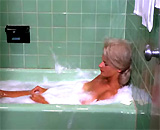  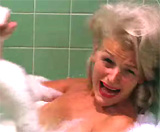 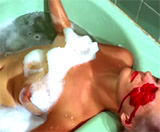 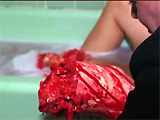 Pre-Title Credits Murder Sequence of Pat Tracy 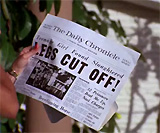 Headline About Teenage Girl's Murder: "Legs Cut Off!" 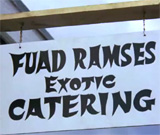 Catering Business Sign 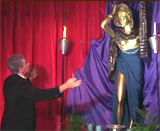  Fuad's Golden Statue of the Goddess Ishtar 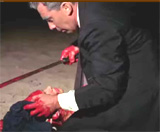 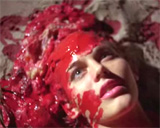 Murder of Marcy on Beach 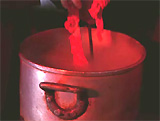 Body Parts of Victims Mixed in Large Pot  Suzette with Pete at Egyptian Lecture 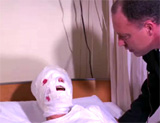 Dying Janet Blake in Hospital 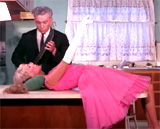  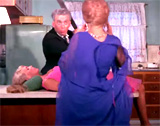 Preparations for Blood Feast (Machete Beheading of Suzette) Interrupted in Kitchen 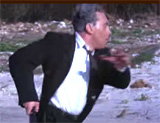 Fuad's Flight into Garbage Dump  The Film's Final Image: Bloody Tears From the Goddess Ishtar |
||||||||||||||||||||||||

|
Blood Simple (1984) #73 The Coen Brothers' complex neo-noir crime film featured an incredible set of excruciating-to-watch death scenes - the 15-minute cadaver disposal sequence, and the final stand-off in the film's conclusion. Bartender Ray (John Getz) had extraordinary difficulty getting rid of the dead body of a Texas bar-roadhouse owner - his cheating lover Abby's (Frances McDormand) husband Julian Marty (Dan Hedaya). Ray had wrongly assumed that Abby had killed her husband. To protectively hide the corpse, he drove Marty's dead body to a remote rural field in the middle of the night, but suddenly realized that Marty was still alive, when he was found crawling away from the car! He resisted bashing him over the head with a shovel, but then buried the struggling-to-live Marty in a hole that he dug in a dirt field. He was slowly able to cover him up with dirt before sunrise.
During the concluding pursuit scene, disaffected wife Abby slammed a window down on loathsome, duplicitous private detective Loren Visser's (M. Emmet Walsh) wrist, crushing it on the sill in the next room. She then pinned his hand to the sill with a knife. While Visser's hand was writhing in pain, he had to crash through the wall and blindly grope for the knife handle to remove it. She then shot Visser through a bathroom door as he continued to stalk her. She thought it was her husband Marty ("I'm not afraid of you, Marty," she said matter-of-factly). As Visser lay dying on the floor in the next room with a gunshot to the abdomen, he burst into laughter with the film's final line: "Well, ma'am, if I see him, I'll sure give him the message." He died with a view of the sink's dripping plumbing above him. |
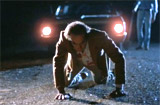 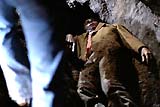 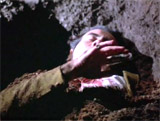 Ray's Live Burial of Abby's Husband Julian Marty |
||||||||||||||||||||||||

|
#84 Director David Lynch's bizarre and nightmarish film of the dark-side of life contained a pair of grotesque victim/voyeur/abuse scenes. Hiding in her apartment's closet, clean-cut, innocent, small-town college student Jeffrey Beaumont (Kyle MacLachlan) voyeuristically watched nightclub singer Dorothy Valens (Isabella Rossellini) as she disrobed to a black bra, black panties, and red high-heeled shoes. She stripped naked in the rear bathroom, and then reached for her blue velvet robe from the closet. He heard a drawer open in the kitchen as she reached for a large knife, and then suddenly flung open the closet door where he was caught hiding. She threatened him at knife-point into intimidation and forced him to get on his knees. She cut his face with the knife blade, turned the tables on him, made him her voyeuristic prey, and forced him to undress in front of her, all the way down to his underwear and socks.
She pulled down his underpants to his knees, then began touching, fondling, and kissing (and fellating?) him, and forced him to remain motionless. She asked: "Do you like that?" and then asked a question combining domination, pain, power, pleasure, and humiliation: "Don't touch me or I'll kill you? Do you like talk like that?" Responding with nervous ecstasy, arousal, but defenseless fear, he was led to the couch to lie down where she straddled him and kissed him. Three loud knocks at the door frightened Dorothy. Frantically fearing the man's arrival and with the knife gleaming above Jeffrey, she told him to head back into the closet. Jeffrey watched in horror, hiding behind a wardrobe closet door, as Dorothy was terrorized by her visitor - evil, psychotic, blackmailing, perverse and depraved villainous kidnapper Frank Booth (Dennis Hopper). He had cut off the ear of her tortured, kidnapped husband and was sexually blackmailing her. The following scene was a disturbing, cruel, sadomasochistic, kinky scene. Demanding and condescending to her, Frank quickly established an abusive master/victim relationship over Dorothy as she accommodated his depraved preferences. The 'dark' scene was intercut with a frightened Jeffrey surreptitiously viewing the shadowy, broken images between the slats of the distasteful ordeal from his hiding place in the closet:
Traumatized, Jeffrey watched Dorothy being tormented as foul-mouthed Frank's sexual slave/whore. He repeatedly demanded that she look away from him - denying her the sight of his 'dark' nature. [In a symbolic sense, Dorothy was "Mommy" and Frank was "Daddy" or "Baby."] The abusive scene was heightened when the leather black-dressed Frank reached for a portable, plastic gas-inhaling mechanism and mask on his belt. While he placed the mask over his mouth and nose, he snorted and inhaled (helium or nitrous oxide?) gas to heighten his sexual excitement, exhibiting infantile-regressive, animalistic/reproductive, and compulsive-addictive behavior. He debased her as a prostitute, mother figure, and copulatory partner in the natural world:
After another gasp of gas, Frank begged and whined menacingly:
Dorothy stuffed part of her blue robe into his mouth to satisfy his obsession with textured fabrics. As he began to feel her breasts, he sucked, chewed, and bit the velvet cloth. Then he seized her and threw her down to the floor, spewing vulgar words. Frank removed a pair of scissors, menacingly snipping with them in mid-air above her face and body:
And then after forcefully touching her genitals, he mounted her and started humping her with his unbuckled pants still on. He moved frenziedly faster and faster until climaxing in a brief and brutal f--k. After getting off of her, he slugged her again in the face, hideously threatening her again: "Don't you f--kin' look at me." Standing astride her on the floor before he left, he warned: "Stay alive baby. Do it for Van Gogh." Then he marched out of the apartment, shutting the door behind him and leaving her crumpled on the floor. |
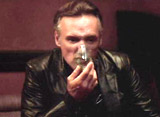 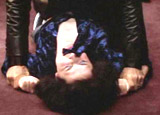 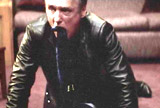 Gas-Inhaling Frank Booth - During Sexual Abuse of Dorothy |
||||||||||||||||||||||||
|
Bram Stoker's Dracula (1992) Writer/director/producer Francis Ford Coppola's eroticized, visually-opulent and lavish R-rated film was based on the novel by Bram Stoker. Dracula was at first portrayed as a pasty-faced, bouffant-coiffed, satin-robed nobleman. In one of its early scenes in Transylvania, young law-clerk/solicitor-agent Jonathan Harker (Keanu Reeves) was enticed and seduced by dark and brooding Dracula's (Gary Oldman) three surreal and alluring Brides of Dracula (Monica Bellucci, Michaela Bercu, and Florina Kendrick).
In Harker's bedroom as he was retiring for the night, one of the undead Brides emerged from under his bed (Bellucci) and proceeded to rise up (half-naked, bare-breasted) and stroke his inner thighs. When all the brides surfaced up through the mattress, he was surrounded by the ravenous creatures as they tore at his clothes, fed upon him (by licking him, and then biting down on his crotch with fanged teeth). They (called "devils of the pit") drained him of his blood to keep him weak. They were interrupted by the sudden appearance of Dracula himself, who jealously and strongly cautioned:
One of the Brides asked, "Are we to have nothing tonight?" Harker saw Dracula give his brides a young baby to feast upon, and as he screamed in horror, Dracula let out a hideous laugh. In the film's climactic ending scene, Mina was hypnotized and made a decoy to follow Dracula and finish him off. Dying, Dracula knew that his end was near: ("Where is my God? He has forsaken me. lt is finished"). Mina pledged her love and kissed him: ("Oh, my love, my love"). In voice-over, Mina spoke:
After his request: "Give me peace" (the film's final line of dialogue), she impaled Dracula in the heart with a sword, kissed him again, and then beheaded him to end his curse. |
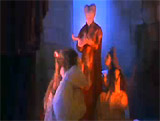 Dracula Offering His Three Brides an Infant    Mina's Sword-Impalement and Beheading of Dracula |
||||||||||||||||||||||||

|
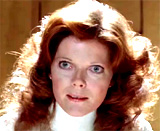
The Brood (1979, Canada) #78 Writer/director David Cronenberg's Canadian 'body horror' film - a repellent, repulsive, yet truly fascinating movie, was taglined: "The Ultimate Experience of Inner Terror." In the film, Cronenberg provided commentary on radical therapeutic solutions of the time period, including one termed psychoplasmics; some felt he went too far and the film's climactic scene suffered from censorship. The plot told about Somafree Institute of Psychoplasmics psychotherapist Dr. Hal Raglan's (Oliver Reed) self-obsessed, psychotic, and disturbed patient named Nola Carveth (Samantha Eggar). Nola had a history of psychological, verbal and physical abuse from her two alcoholic parents. Over a year and a half of time, she had autogenetically given birth to homicidal strange, sexless, dwarf-like mutated children, known as "The Brood," to physically express her own internal suppressed psychic rage (anger personified). The vengeful mutant dwarf-like children (the brood) - offspring of Nola Carveth - would murderously attack and psychically respond to Nola's anger. The children who were color-blind were also without genitalia, speech, teeth, and navels. In an early scene, two of the 'Brood' children murdered Institute teacher Ruth Mayer (Susan Hogan) in front of her class. In the final concluding sequence, Nola's upset ex-husband Frank Carveth (Art Hindle) arrived at the Institute to retrieve his endangered daughter Candice (Cindy Hinds). Before entering, Frank was confronted by Dr. Raglan and warned about Nola's homicidal Brood of children (living in the attic) who had already killed Ruth Mayer. Raglan held a gun on Frank - and cautioned him about just rushing in to take Candice. He explained how Nola's "Brood" of children were the result of her psychoplasmic sessions with the doctor, and a physical manifestation of her rage and how she felt about her own custody battle. Whenever Nola was in an angry mood, her Brood-children would carry out her bidding without her knowledge:
Raglan persuaded Frank about the "right way" to get Candice back. He was told to enter the hut and "persuade Nola that you want her back, that you want your family back. I want you to play the role of apologetic lover and husband....Because if you can keep Nola calm and happy, then the Brood's neutral. If she's mellow, then I can just walk into that attic, pick up Candy, tuck her under my arm and walk out....Frank, be nice to her." Frank followed Raglan's suggestions and visited with Nola in the downstairs wooden hut, who was found in a trance-like state. She was kneeling and wearing a white robe. As they conversed together, he attempted to reconcile and seek a rapprochement with her (as a trick to calm her), while Dr. Raglan entered the attic, waiting for the right time to snatch Candice away from the Brood:
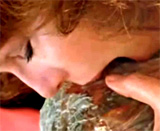
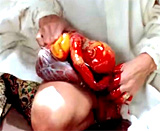
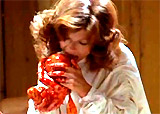
During the concluding 'birth' scene, both visceral and nauseating, Nola raised the two wings of her white robe - to reveal her external psycho-plasmically induced womb sitting on her lap. Then, in both a visceral and nauseating moment that shocked Frank ("Oh God, Nola!"), she leaned down and with her mouth, she ripped open her own uterus (baby or egg sac), and then licked the bloody afterbirth off of her own monstrous baby.
When Frank reacted with disgust, Nola realized Frank's real motivation for visiting her: "I disgust you. I sicken you. You hate me. You didn't come here because you love me. You came here to take our daughter away and give her to somebody else." Although Frank denied her accusations: "I wouldn't do that. I wouldn't do that to you," she called him a liar and became incensed at him ("I know you so well, and it won't work. I'd kill Candice before I let you take her away from me"), when gunshots rang out from upstairs in the attic. Meanwhile in the attic, the activated Brood (sensing Nola's anger) had attacked Dr. Raglan who was attempting to carry Candice out and not disturb them - he was armed and shot some of the Brood, but then was overwhelmed and beaten to death. Nola's pale, terrified and catatonic daughter Candice was able to run off and hide herself in a locked closet - although the pursuing Brood was able to break through the door behind her.
Back down in Nola's room, Frank threatened to kill Nola if she didn't call off the Brood upstairs: "Make them stop. They're doing what you want them to do. You want them to kill Candice. You make them stop, or I'll kill you." He was forced to strangle Nola during a struggle with his bare hands - when she urged: "Kill me!" With the death of their psychically-connected mother, the Brood died off and Candice was saved.
As Frank drove away with the traumatized Candice after the film's last lines of dialogue ("We're going home, Candy. We're going home"), the last ominous image of the film was a close-up sight of a raised, red sore (or wheal) growing on Candice's arm - she had undoubtedly inherited her mother's cursed abilities to manifest the pain inside of her. |
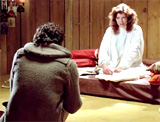 Ex-Husband Frank Reconciling With Nola 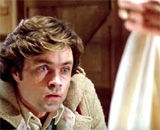 Nola Raising Her Robe For Frank to See 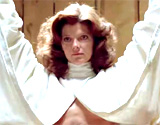 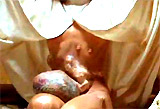 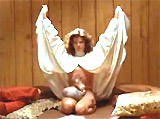 Nola's External 'Birth' Scene - Revealing Her External Womb 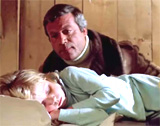 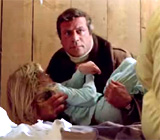 Dr. Raglan in Attic Attempting to Rescue Nola's and Frank's Daughter Candy From the Brood 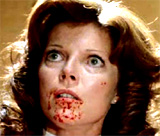 Nola's Reaction to Frank's Disgust 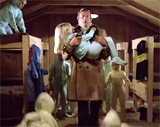 The Brood Surrounding Dr. Raglan With Candice In His Arms 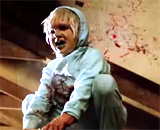 One of the Brood Children Shot Dead by Dr. Raglan 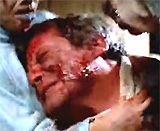 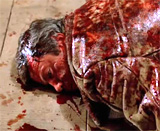 Dr. Raglan Beaten to Death 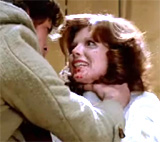 Strangulation of Nola with Frank's Bare Hands 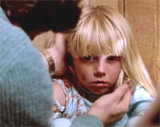 Candice Saved by Frank 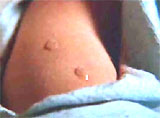
Shocking Last Image: Sores or Bumps (Wheals) on Candice's Arm |
||||||||||||||||||||||||
|
Bug (2006) #3 William Friedkin's intensely disturbing psychological thriller (some called it an extreme black comedy, or reminiscent of David Cronenberg's 'body horror' films) was very dark and bleak, although incredibly well-acted. It was based upon Tracy Letts's 2004 off-Broadway play, which basically starred two characters - very damaged individuals caught up in a love story. They were lost souls who became horrifically bonded, and eventually descended into utter madness in a rural motel apartment room:
Agnes had been married to swaggering, abusive ex-con husband Jerry Goss (Harry Connick Jr.) just released from prison, and was trying to keep her distance from him. Peter reassured Agnes after meeting her: "I'm not an axe murderer... You're really beautiful." He was also sexually attracted to her: "I haven't been to bed with a woman in a long time...But I think I could go to bed with you!" During Agnes' first love-making with Peter, the artsy cinematography lingered on the saliva-thread of a kiss, and provided a large closeup of her sweaty female breast. After they made love in her bed, he believed that he was becoming infested with bugs (he claimed there were "rogue aphids" in his bloodstream, and egg sacs under his skin). To rid the problem, he bought cans of bug spray and hung bug strips in the room.
Eventually, in one of the film's more horrific, self-mutilation scenes, he extracted what he thought were infested teeth from his mouth with a pair of pliers or wrench - he claimed the bugs were hiding behind his fillings. One of his other fantasies was that a helicopter was hovering over the room, although it was just the ceiling fan. She was also crazed by the thought of her missing 6 year-old son Lloyd, who was last seen in a grocery store shopping cart a few years earlier. Sharing their delusions, they both became violently paranoid and mad in a frenzy of delusional thinking, believing that Peter was an experimental drone, and Agnes was the mother queen bug.
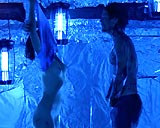
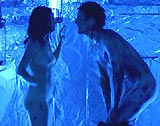
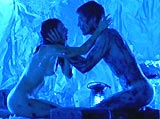
In the feverishly mad conclusion, they completely wrapped the blue-lit room (festooned with hanging ultraviolet bug-zapping lanterns) in tin-foil - Peter ranted about how he was part of a government/military conspiracy that had implanted every human born after 1982 with a computer chip - a microchip that would cause some of the test subjects to become killer zombies, like Timothy McVeigh. They decided to douse the entire room, and their naked bodies, with gasoline to prevent the spread of infection. In the erotic and violent climax, the two desperate souls reciprocally told each other: "I love you" and then struck a match to cause an engulfing inferno in the room. |
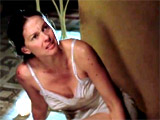 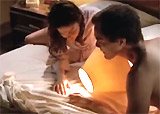 Agnes White (Ashley Judd) with Peter Evans (Michael Shannon) Finding Bugs in Bed - and Everywhere 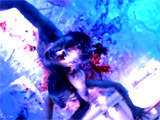 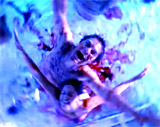 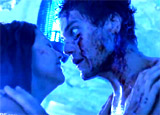 Swirling into Madness |
||||||||||||||||||||||||
(alphabetical by film title, illustrated) Intro | #s-A | B | C-1 | C-2 | D-1 | D-2 | E | F | G | H I-J | K-L | M | N-O | P | Q-R | S-1 | S-2 | S-3 | T | U-Z |





 Jess Terrorized and Traumatized in Basement by Peter