|
Greatest Scariest |

| Movie Title/Year and Brief Scene Description | |||||||||||||||||||

|
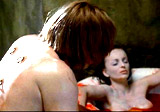
Cabin Fever (2002) #28 Eli Roth's debut feature film, mostly a gore-fest, told about five college graduates who rented a cabin in the woods in rural North Carolina and became infected by a contagious, flesh-eating disease/virus from drinking contaminated water. An infected homeless hermit (Arie Verveen), set on fire, had expired in the area's reservoir. The film's tagline was the catchy: "Catch It!" In the film's most infamous, cringe-inducing scene, diseased Marcy (Cerina Vincent) - unaware that the rash she had on her back had become diseased, bubbly and blistered with oozing sores, attempted to shave her soap-lathered, infected legs in the bathtub, causing bloody wounds, skin to come off, and reddish bathwater. When she emerged outside the cabin, Marcy was torn to pieces (off-screen) by a mad dog (named Dr. Mambo) in the woods - shot from the dog's POV. Her body parts were discovered scattered about, in the reddish-tinged scene. One of the scariest scenes was one in which blonde Karen (Jordan Ladd) was revealed to be the first one with the illness after drinking the bad water. As her would-be boyfriend Paul (Rider Strong) sexually touched her as she dozed feverish and unconscious, he removed his hand in horror - noticing that it was covered in goopy, infected blood. The skin on her thighs and groin area were rotting.
Later, after Karen was isolated in a shed outside the house, Paul found the mad dog (Dr. Mambo) feeding on her diseased body. He shot the dog, then put Karen out of her misery by beating her to death with a shovel. |
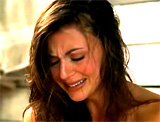 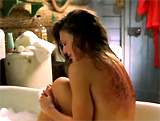 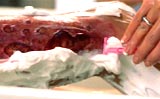 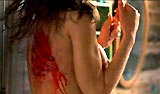 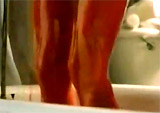 The Bathtub Shaving Scene |
|||||||||||||||||
|
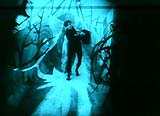
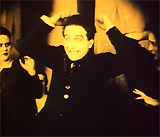
The Cabinet of Dr. Caligari (1920, Germ.) For its time, this German expressionistic, surrealistic fantasy/horror film was truly scary. It was also a landmark film that introduced many standard horror film conventions (some consider it the first true horror film), and one of the earliest examples of the 'twist ending.' The shadowy, disturbing, distorted, and dream-nightmarish quality of the macabre and stylistic 'Caligari,' with curving alleyways, lopsided doors, cramped rooms, overhanging buildings, and skewed cityscapes, was brought to Hollywood in the 1920s, and later influenced the classic period of horror films in the 1930s, and also film-noirs. The tale (the film's entire story) was told in flashback by Francis (Friedrich Feher) - it was a tale of the strange sufferings and horrible events that he had experienced. He told about a ghost-like, mad hypnotist-therapist in a local carnival named Dr. Caligari (Werner Krauss),. Caligari was a fortune-teller who performed a crowd-pleasing show with his pale-skinned, lanky, black leotard-wearing somnambulist named Cesare (Conrad Veidt). The main attraction for a group of fairgoers was to bring Cesare from a state of sleep in a box-shaped coffin. He also manipulated Cesare to conduct his evil desires, as a haunted murderer. In one of the more shocking sequences, the so-called "abduction scene," Francis' 'fiancee' Jane Olsen (Lil Dagover) was sleeping, when she was approached by the somnambulist with a long sharp knife who was threatening to stab her. Instead, he reached out to touch her and she was awakened. He grabbed her and dragged her from her bed to abduct her. A chase ensued by a mob across rooftops and down alleyways.
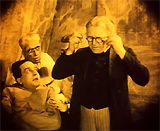
The film's major plot twist was that the story, the entire film (a framed story with a flashback) was made up from the mad ramblings and delusional nightmares of Francis, the mentally-ill, psychotic patient who was the narrator/story-teller of the film while he was seated in the asylum courtyard; the last scene was of Francis becoming crazed when he saw the asylum director Dr. Caligari - whom he insisted was the mad and sinister "Caligari" of his story. Francis thought that Dr. Caligari was the insane director of a mental institution, and that he was obsessed with imitating a 18th century mystic (of the same name) who sent out his somnambulist Cesare to commit murder; however Dr. Caligari was not a menacing figure, but Francis' benevolent, respected asylum doctor.
|
 Francis (Friedrich Feher) Telling His Tale, Seated in Courtyard 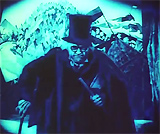 Dr. Caligari (Werner Krauss)  At Fair, Caligari Advertising Cesare 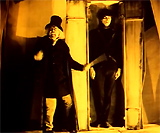 Opening of the Cabinet - With Somnambulist Cesare Inside 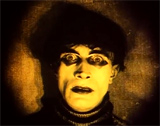 Cesare's Eyes Opening |
|||||||||||||||||
|
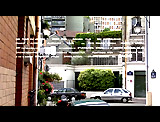
Caché (2005, Austria/It./Germ./Fr.) (aka Hidden) Austrian writer/director Michael Haneke's French film was a psychological thriller about an upper middle-class couple living in Paris in a townhouse:
Their lives were disrupted (actually terrorized) when they began to receive unmarked, mysterious videocassettes at their doorstep - intrusive surveillance tapes that showed how their home's exterior (and their comings and goings) was being surreptitiously observed from a camera positioned out on the street. In fact, the film's opening shot is a long-held, motionless view of the family's bourgeois home. In the film's most shocking (and very unexpected) sequence, Georges was invited to the apartment of an unhappy, middle-aged Algerian named Majid (Maurice Bénichou) - a childhood family member. After Majid claimed he had nothing to do with the videotapes, he suddenly suicidally slit his own throat - blood sprayed from his jugular vein onto the door and wall behind him, and Georges stood in stunned silence looking at Majid's body on the floor. The reason for Majid's suicide became clear later on. Georges admitted an earlier 'hidden' betrayal, secret or injustice - when he was only six years old and feeling threatened, he had fooled Majid into similarly beheading the family's rooster. Georges then claimed to his parents that Majid purposely did it to frighten him, and subsequently, Majid was sent away to an orphanage. |
 Opening Image    Majid's Stunning Suicide |
|||||||||||||||||
|
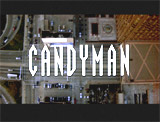
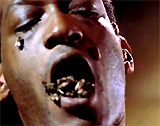
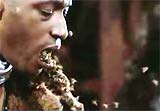
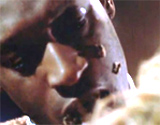
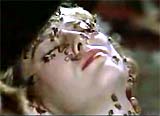
Candyman (1992) #75 Director Bernard Rose's creepy, supernatural horror film was the first of a trilogy of films, followed by: Candyman: Farewell to the Flesh (1995) and Candyman: Day of the Dead (1999). The story was based upon British author and filmmaker Clive Barker's short story novelette The Forbidden. All three films referenced the title-character known as 'Candyman' - a legendary figure from folklore during the Civil War. The prosperous son of a slave was tortured and murdered by hateful racists in the late 19th century for a romantic relationship with a white man's daughter, and acquired his nickname 'Candyman' from the nature of the torture inflicted upon him. Inquiries into many recent murders in a low-income Chicago neighborhood public housing project (Cabrini-Green) led to the discovery of the urban legend blamed for the deadly incidents. After the credits, the chilling film featured the title character's ominous voice-over heard over a massive honeycomb of swarming bees that were unleashed over the skies of Chicago -- clues to the frightening individual: "They will say that I have shed innocent blood. What's blood for if not for shedding? With my hook for a hand, I'll split you from your groin to your gullet. I came for you." "Candyman" was coming for his latest 'victim' - now introduced. Married Chicago anthropology graduate student Helen Lyle (Virginia Madsen) at the University of Illinois was researching superstitions, urban legends and mythic folklore with her friend Bernadette "Bernie" Walsh (Kasi Lemmons). Helen was unhappily married to cheating husband Trevor Lyle (Xander Berkeley), a university professor who was having an affair with one of his students. Helen's research included the "Candyman" - a one-armed, hook-wielding maniac haunting Chicago's Cabrini Green project, where dozens of murders had occurred.
During her studies, Helen had dinner with one of her senior professors, Professor Philip Purcell (Michael Culkin). He explained the historical development of the local legend - Candyman - a vengeful spirit who was summoned in a mirror. Historically, the "Candyman" was originally the son of a slave who was born in the late 1800s. The African-American named Daniel Robitaille prospered as a portrait painter who was raised in wealth and education in high society whose love (and impregnation) for a white woman (the daughter of one of his clients) led her enraged white father and others ("brutal hooligans" in a lynch mob to torture and murder him. His right hand had been amputated and replaced with a hook, and his body was smeared in honey (as the locals chanted 'Candyman' five times) and then he was stung to death by bees. His body was then set on fire in a pyre - on the site where the slum project now existed:
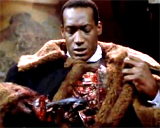
According to the legend, chanting the Candyman's name 5 times before a mirror would cause the Candyman to appear. In one of the film's scarier scenes, Helen playfully chanted the name "Candyman" five times in front of a mirror. Hence, the film's tagline: "We Dare You To Say His Name Five Times!" - her incantation brought a confrontation with the fearful 'Candyman' (Tony Todd) in a concrete parking garage. The tall black man possessed a hooked right hand and wore a fur-trimmed coat. He continually entreated her from a distance: "Helen. Helen." She asked the silhouetted figure as he approached closer: "Do I know you?" with his response:
He was implying that Helen's testimony about an attack by a copy-cat, hook-armed 'Candyman' assailant (Terrence Riggins), a local gang leader, had discredited and ruined his reputation. The suspect was subsequently arrested for the previous murders that had occurred in the local Chicago area, in a low-income housing project (Cabrini-Green), previously attributed to the legendary 'Candyman.' Now, 'Candyman' was worried that the locals were no longer attributing the deaths to him, and would endanger his own existence: ("Without these things, I am nothing"). He kept repeating the words to her: "Be my victim." He threatened to kill Helen, to again embolden his own reputation and legend. Helen fainted and lost consciousness. Soon after, Helen was suspected of the bloody decapitation-murder of the pet Rottweiler dog named Annie of one of the Cabrini-Green housing residents, a single mother named Anne-Marie McCoy (Vanessa Williams). She was also accused of wounding Anne-Marie with a meat cleaver, and kidnapping Anne-Marie's baby boy, Anthony - and subsequently arrested. Her husband Trevor bailed her out. And then, in Helen's apartment, she was also accused of murdering her friend "Bernie" - she was seen holding a knife over Bernie's mutilated corpse. However, she had been set up by the "Candyman" who was the actual murderer. He wanted to possess Helen if she would surrender to him, and become immortal. After a month of incarceration and heavy sedation in a psychiatric hospital, Helen dared to again repeat the name 'Candyman' five times in front of a mirror for doubtful psychiatrist Dr. Burke (Stanley DeSantis) (on her defense team), in order to prove her innocence ("I can prove it...I can call him"). Thereby, she again unleashed the incarnated spirit of the bloody, haunting and hook-wielding "Candyman" maniac with a deep gravely voice. The "Candyman" stabbed the unbelieving doctor at his desk from behind, and facilitated Helen's escape from the facility. By film's end, the 'Candyman' again found Helen in his company in his Cabrini-Green lair as she was searching for the kidnapped baby Anthony. The 'Candyman' seduced her: "You came to me...Surrender to me now and you shall be unharmed." As the room spun around, he picked her up in his arms and promised her immortality:
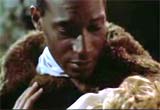
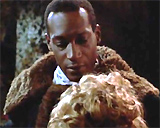
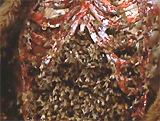
Helen appeared to be the reincarnation of Candyman's lover from his past. He offered her: "Come with me and be immortal." He then revealed buzzing bees swarming on his chest and pouring from his mouth before he transferred the bees from himself to her when he kissed her ("Bee-Kiss"). However, he reneged on his promises and attempted to burn to death both Helen and Anthony. By film's end in the shocking conclusion of the bloody film, both of them (Helen and the haunting, incarnated 'Candyman' maniac) were consumed in a bonfire set in Cabrini-Green. Helen tried to escape but was trapped under burning beams, suffered massive burns, and later died (although she was able to save an infant baby named Anthony). Still mourning the death of his wife Helen after her funeral, her husband Trevor Lyle was in his bathroom when he called out Helen's name five times in front of a mirror, not knowing that he was invoking her return as a spirit that had replaced Candyman - she appeared in a bluish pulsating light and asked him:
Because he had been sleeping with another woman named Stacey (Carolyn Lowery) (who was in the kitchen with a butcher knife preparing dinner), she took spectacular revenge against him - Helen killed Trevor by stabbing him in the stomach with the Candyman's large hook, ripping him open from his groin up to his neck - and leaving him a bloody corpse in the bathtub. Stacey found him and reacted in horror: "Trevor... My God, Trevor? Trevor? Trevor?" In Cabrini-Green, a painting of Helen with her hair ablaze on a wall was seen under the scrolling credits - she had entered the folklore of the legend. |
 The Skyline of Chicago, Bees, and Helen's Face 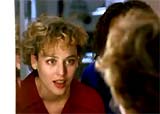 Helen Repeated "Candyman" Incantation 5 Times in Mirror 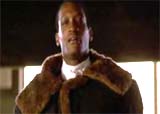 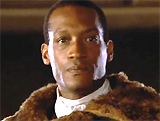 The Appearance of Candyman (Tony Todd) - Helen's Confrontation with "Candyman" in Garage 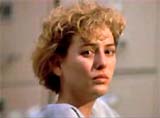 Helen Incarcerated For Suspected Murder of Her Friend "Bernie" 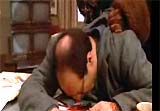 Helen's Psychiatrist Dr. Burke Stabbed in Back by the "Candyman"  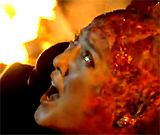 Bonfire Immolation Deaths of the Candyman and Helen in Cabrini-Green Housing Project  Helen's Cheating Husband Trevor Lyle (Xander Berkeley) After Helen's Death  Summoning the Spirit of Helen By Calling Her Name 5 Times  The Murder of Trevor  Stacey's Reaction to the Murder 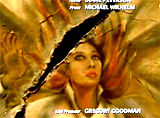 Wall Painting of Helen with Flaming Hair |
|||||||||||||||||
|
Cape Fear (1962) #36 This was a suspenseful and intense late b/w film noir from director J. Lee Thompson (James Webb's screenplay was based on John D. MacDonald's novel "The Executioners"), with moody music by Bernard Herrmann. The character of evil, intimidating, vengeful and insolent, cigar-smoking, Panama hat-wearing psychopath Max Cady (Robert Mitchum) was a convicted rapist. After being released from prison, he terrorized the family of well-regarded lawyer Sam Bowden (Gregory Peck), who had helped to imprison him for over eight years with his witness testimony. The legal system limited the Bowden family and its rights, as Cady voyeuristically stalked the family as a sexual predator. At a boat dock, Cady lewdly made a comment about young teenaged daughter Nancy Bowden (Lori Martin) to Sam:
Cady poisoned the family dog Marilyn with strychnine (mid-barking, the dog let out a long whine), and further menaced Nancy by first approaching her at her school. After Nancy's school let out one day, he lustfully stalked her into the school's basement, and terrorized her. When she ran outside the school, she unexpectedly ran into Cady's arms - screamed and ran into the street and was almost hit by a car. And then he threatened Sam by phone after the lawyer paid for three thugs to try and beat him up: "Speakin' about your wife and kid, I got a little caper planned for them...I got something planned for your wife and kid that they ain't never gonna forget." The scariest scenes were on a houseboat (on Cape Fear River), where Sam had lured Cady with the two females as 'bait.' The bare-chested ex-con threatened to force Sam's wife Peggy (Polly Bergen) to have consensual sex with him to save the rape of her daughter. He angrily squeezed a raw egg in his fist over her and rubbed the insides over her chest as he told her:
When she claimed he was using sexual blackmail on her, he held her against a wall, slapped her, and forced her to keep quiet: "All in all, I don't think you're gonna, you're gonna say too much about this, are you?" Then shortly after, in the climactic finale, Cady went after young Nancy. Although the young girl defended herself with a fireplace poker, she was no match against his powerful grip - he gagged her mouth and dragged her outside, and was about to rape her when she was saved by her father, who fought against Cady bare-fisted, overpowered him and held him at gunpoint. Cady taunted Sam to shoot him: "Go ahead. I just don't give a damn." But Sam decided not to kill him, in the last lines of the film:
Sam decided not to shoot him dead, but instead let him "rot" in a prison "cage" for the remainder of his life. |
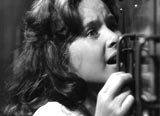 Menaced Daughter Nancy at School 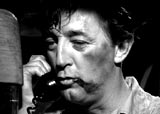 Psychopath Max Cady (Robert Mitchum) 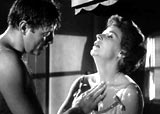 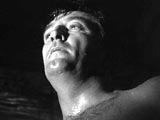 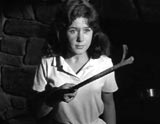 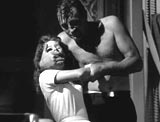 The Sexual Assaults on Peggy and Young Nancy 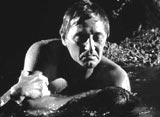 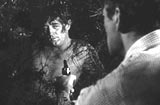 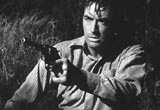 Face-Off Between Max and Sam |
|||||||||||||||||
|
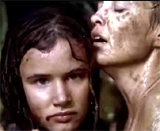
Cape Fear (1991) In this remake from director Martin Scorsese of the classic revenge story, vengeful psychotic Max Cady (Robert DeNiro) threatened public-defender lawyer Sam Bowden (Nick Nolte) and his wife Leigh (Jessica Lange) and family in the town of New Essex, North Carolina. He blamed Sam for helping to send him to prison in Atlanta fourteen years earlier for the rape and battery of a young woman. The character of the violent Max Cady was forecast in three unsettling scenes (two of which were very violent and brutal)
|
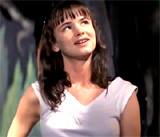 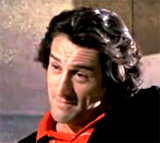 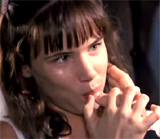 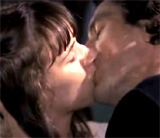
Cady's Seduction of Daughter Danielle or "Danny" (Juliette Lewis) 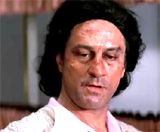 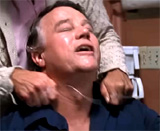 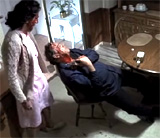 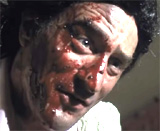 Cady's Murder of Bowden's PI Claude (Joe Don Baker) in the Kitchen 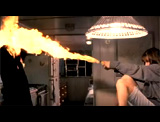 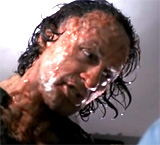 Cady Badly-Burned After Being Set Ablaze by Danny on the Houseboat 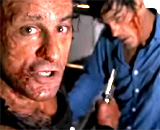 Cady Conducting Mock Trial of Sam For His Lawyering Offenses 14 Years Earlier |
|||||||||||||||||
|
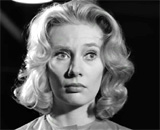
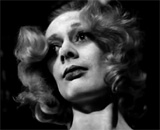
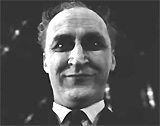
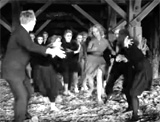
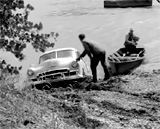
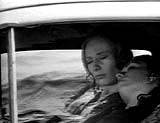
Carnival of Souls (1962) This low-budget independent horror film, a spooky and haunting cult zombie classic by producer/director Herk Harvey (his sole feature film), was notable for its many atmospheric and forboding scenes of stylistic terror. The plot was very similar to the episode of the Twilight Zone titled "The Hitch-Hiker." In the film's opening, a drag race resulted in one of the cars crashing off a bridge into a muddy river and landing upside down. Of the three females in the car's front seat, there was only one crash survivor (?) - passenger Mary Henry (Candace Hilligoss), a talented organist. As the story progressed after her near-fatal car accident, Mary moved to Utah to take a new job as a church organist. While driving there, she experienced one of many disturbing, creepy visions of ghostly figures of the recent dead. She was stalked by a weird vision of a ghoulish, Spectral Man (director Harvey) with darkened eye sockets, who first glared at her with an eerie stare through the windshield, and caused her to drive off the road. Mary also had moments when she became invisible and inaudible to others. She seemed to be caught between the real world and a dream-world. Her dreams, imagined visions and trances were due to her hallucinations during her death experience and entry into the spirit world. Later as the film drew to a close, she was drawn to an abandoned amusement park (and a Pavilion's dance hall) in the twilight hours, where she heard strange organ music. During a macabre party, she saw a surreal dance of death performed by zombie-like ghouls or souls (a "carnival of souls") who were twirling around as dance partners. The camera motion was sped up while the soundtrack was distorted with laughter. Mary realized that the ghoulish Spectral Man was dancing with a ghoulish version of herself !!
She screamed in fright and ran off - she was chased by many of the undead, dark-eyed dancing partners all around the pavilion and then to the beach, where she fell down during the pursuit - and was completely surrounded by the heads of the zombies staring down upon her.
In the revelatory final scene's plot twist, she had mysteriously disappeared. A search party surveyed the sand where Mary had fallen, with tracks of footprints leading up to where she had collapsed in the sand - with a large imprint of her body and a opened handprint. The Sheriff explained how Mary's car had been found at the Pavilion's gates nearby.
Back in Kansas, Mary's submerged car (with Mary's corpse inside) had been found - it was partially dredged out of the river. |
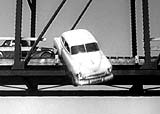 The Deadly Crash 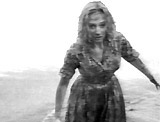 Mary's Survival of Crash (Spoiler: Imagined) 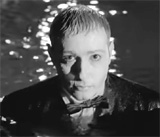 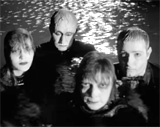 Mary's Visions of Ghouls/Souls 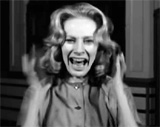 Mary Screaming in Horror at the Sight of the Undead Dancers 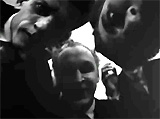 Mary Collapsing on Beach - Surrounded by Zombie Heads Staring Down on Her From Above |
|||||||||||||||||
|
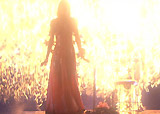
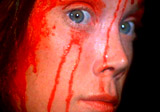
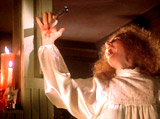
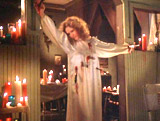
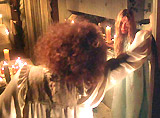
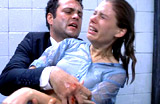
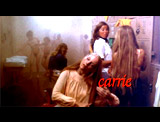
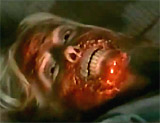
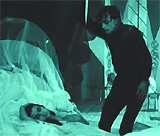
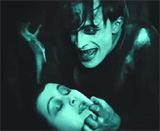
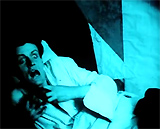
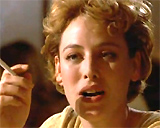
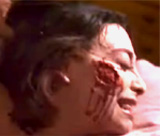
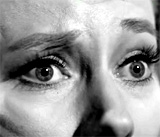
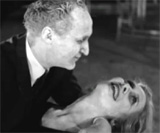
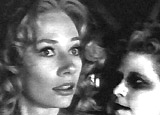
#8 In this effective Brian De Palma horror film, in the film's opening locker room scene, Carrie (Sissy Spacek) was cruelly taunted by schoolmates for having her first menstrual period. And soon after, in the film's centerpiece, the prom scene, she was doused and crowned with a bucket of pig's blood from above. In her mind, she heard tauntings: "They're gonna laugh at you," and "Plug it up!", and in her view (spinning around), she imagined the prom-goers laughing and jeering at her. Feeling humiliated, she sought psycho-kinetic, murderous revenge against the prom-goers (shown in split-screen). Seeking retribution, she caused the prom's exit doors to slam shut, and the lights to pop.
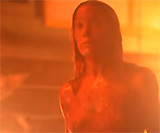
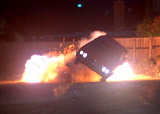
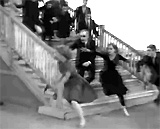
An emergency fire hose snaked into mid-air and doused the party-goers, causing chaos, confusion, and bodies careening around the dance floor. Some were electrocuted (Mr. Fromm (Sydney Lassick)), crushed by falling rafters (Miss Collins (Betty Buckley)), trampled, or burned to death in the resulting fire. Outside as Carrie walked home, she overturned a car attempting to hit her, driven by Billy Nolan (John Travolta) and Chris Hargensen (Nancy Allen), and she caused the flipped, rolled-over car to burst into flames. When she returned home, Carre's ultra-religious psychotic mother Margaret White (Piper Laurie) attempted to kill her after the ruinous prom experience. Carrie had removed her blood-stained clothes and bathed in a tub. Then, she wished for comfort from her mother (who appeared from behind the bathroom door). She asked to be hugged: "It was bad, Momma. They laughed at me...Hold me, Momma. Please hold me." Instead, as they knelt together, Mrs. White was self-critical about when she had conceived Carrie in a moment of sinful weakness and mistakenly carried her to term:
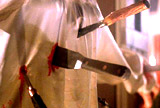
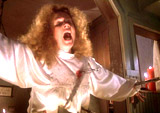
Suddenly, as she was reciting the Lord's Prayer, Mrs. White reached for a gleaming butcher knife and stabbed Carrie in the back as she was hugging her. The struggle traveled to the first floor, where Carrie had tumbled. Cornered in the locked kitchen, a fatal blow was about to be delivered by the raised knife. To stop the assault, Carrie used her telekinetic powers to send a projectile of another sharp knife to pin her mother's right hand against a wooden kitchen door pillar. Other kitchen objects (a peeler, another knife, and other cutlery and utensils) further pinned her mother's left hand (on the other side of the entryway) and also wounded her in the chest. One final knife spun into her mother's heart as the ultimate death blow. The image was of her suffering mother literally being crucified with her hands pinned to the sides. She gasped in almost religious pain and ecstasy, and then her head flopped to the side, with a slight martyred smile (as the camera slowly pulled back).
Carrie pulled her mother off the kitchen door-frame, causing the house to creak and crumble, and the two were in the prayer closet as the house burned down around them. It literally sank and was swallowed into the ground. The Jesus effigy image in the closet had arrows in its chest, duplicating the position of the sharp objects embedded in Mrs. White body. Both perished in the blaze. In the shock second ending - a dream sequence, surviving mourning classmate Sue Snell (Amy Irving) who was holding a bouquet of flowers, visited the defiled gravesite (with a graffiti-marked For Sale sign reading: "Carrie White Burns in Hell" and an arrow pointing downward) of dead psychic student Carrie White. As Sue went to put the flowers on the grave, Carrie's bloody hand burst out of the ground at her and grabbed her arm to pull her down into hell with her - the white-clad young girl screamed and suddenly woke up while recuperating in her bed at home, still screaming hysterically and being grabbed and held by her reassuring mother (Priscilla Pointer) ("It's all right, I'm here") as she experienced more nightmares. |
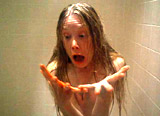 Shocking Menstruation in Girls' Locker Room 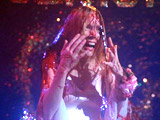 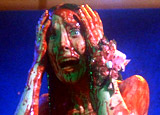 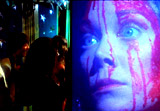 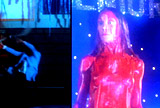 The Bucket of Pig's Blood Followed by Carrie's Psychic Revenge   Carrie Stabbed in the Back by Her Murderous Mother   Carrie In the Closet With a Jesus Effigy - Perishing in Blaze and Collapsing House 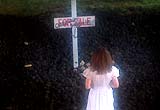  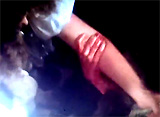 Carrie's Hand Bursting Out of Grave 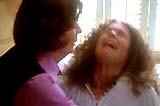 Sue Waking Hysterically From Nightmare |
|||||||||||||||||
|
Casino (1995) Director Martin Scorsese's gangster crime drama was replete with many brutal killings and murders. In a gratuitously violent torture scene of a rival mob member, Tony Dogs (Carl Ciarfalio) was subjected to intense interrogation for two days and nights to get him to talk. As he was being tortured and grilled, enforcer "Nicky" Santoro (Joe Pesci) threatened:
When his head was further squeezed in the vice after he swore at "Nicky," one of his eyes popped out. Tony eventually divulged the name after extensive torture, Charlie M. "Nicky" was flabbergasted by the information:
Offscreen, Dogs had his throat slit after divulging the name. In a later more violent sequence, Nicky and his brother Dominick (Philip Suriano) were savagely beaten (Dominick first, and then "Nicky") within inches of dying by their own thuggish gang members wielding metal-baseball bats, led by Frankie Marino (Frank Vincent). After being brutally beaten and stripped, they both suffered a barely-alive burial in a recently-dug ditch-grave hidden amongst the corn stalks. In voice-over, crime boss Sam "Ace" Rothstein (Robert DeNiro) explained the reason for the hit on "Nicky" - his hot-headedness:
|
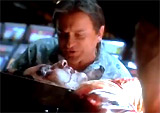 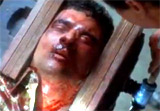 Tony's Head Crushing 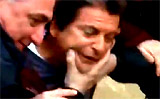      Beaten and Buried 'Almost Dead' |
|||||||||||||||||
|
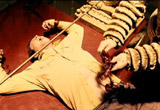
The 21st Bond film in the series was infamous for its sexual torture and interrogation scene. Villainous financier Le Chiffre (Mads Mikkelsen) strapped 007 agent James Bond (Daniel Craig) naked to an open-bottomed cane chair and swung a heavy, knotted rope to strike Bond's testicles, in order to extract a password code to a bank account to retrieve millions of funds after he had lost a high-stakes poker game ("I want the money"). Le Chiffre warned:
Bond defiantly taunted Le Chiffre while in excruciating pain as he was struck repeatedly:
Bond vowed he would not tell the password and Le Chiffre's enemies would eventually hunt him down and kill him. Le Chiffre promised if Bond divulged the password that fellow prisoner Vesper Lynd (Eva Green) would live. Bond refused, so Le Chiffre kicked over his chair and threatened to castrate him with a knife: "I'll feed you what you seem not to value." Bond was saved from death when Mr. White (Jesper Christensen) abruptly entered and shot Le Chiffre in the forehead. |
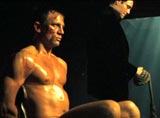 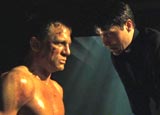 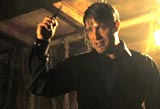 Bond's Naked Torture in a Chair by Whipping his Genitals with a Knotted Rope. |
|||||||||||||||||

|
#97 This Val Lewton-produced horror film from director Jacques Tourneur featured two frightening, feline-panther stalkings that produced fright without showing anything - they were two superb examples of suggestive horror:
|
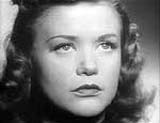 Irena Dubrovna (Simone Simon) 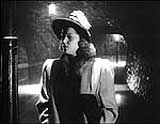 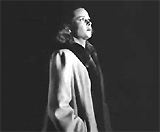 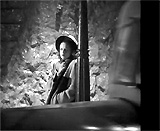 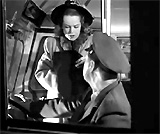 First Feline Stalking (Bus Driver: "You look as if you'd seen a ghost") 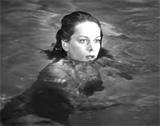 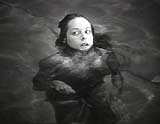 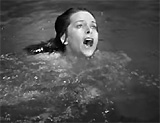 Second Feline Stalking |
|||||||||||||||||

|
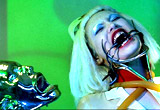
The Cell (2000) Director Tarsem Singh's stylish and innovative sci-fi thriller (his first feature film) was a combination of a typical police procedural (The Silence of the Lambs (1991) or Se7en (1995)) mixed with a virtual reality gimmick, as in The Lawnmower Man (1992). As one of the researchers said of the risky VR journey:
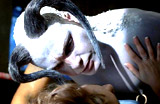
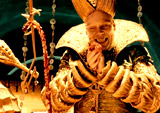
The opening scene demonstrated the capability of child psychotherapist Dr. Catherine Deane (Jennifer Lopez) to empathically enter into the mind of a comatose young boy named Edward Baines (Colton James) who nearly drowned on Seal Beach. Inside the Campbell Center lab aided by a 'brain-mapping device,' she was form-fitted as she lay prone with a deep-red, rubbery and ribbed, sensory catsuit-like VR device that was hung from ceiling wires. A serial killer in rural Southern California, identified as sadomasochistic Carl Rudolph Stargher (Vincent D'Onofrio), had built a glass-enclosed "cell' in an underground chamber near an abandoned tin-sheeted building (near Exit 10 off Highway 99) where he kept each captive kidnapped victim (grabbed randomly) to torment - seen in gratuitous detail. He would watch and record them on a set of four closed-circuit TV monitors as he meticulously fed and cared for them before slowly drowning them in the cell. With one recent victim, Anne Marie Vicksey (Catherine Sutherland), he gazed at her as she floated after drowning in the cell. In the basement of his small house, Stargher treated the most recent victim's body: bleaching it (turning it into a "doll"), then viewing it while suspended over the corpse, hung by 14 steel rings-hooks implanted into his back, and masturbating at his handiwork. Nearby, he displayed a grotesque collection of painted and pale plastic child's play 'dolls', some of which were modeled in absurd postures. Stargher had just suffered from an irreversible coma when he was apprehended by a SWAT team (he was tracked down by a hair from his rare albino German shepherd). Dr. Deane was called upon by the FBI, led by Agent Peter Novak (Vince Vaughn), to find Stargher's recently-kidnapped eighth victim, Julia Hickson (Tara Subkoff). Deane entered into Stargher's twisted, depraved and bizarre psyche and mental landscape to confront his dreams, represented by inventive, disturbing visuals. Her efforts were to discover information to locate and rescue the missing female kidnap victim from fateful drowning (automatically timed to occur within 40 hours) in the tank-cell. Inside of his mind, she found that one of his alter egos in his severe schizoid personality was a young abused boy. One image she witnessed was of a surrealistically-beautiful segmented horse - after being suddenly sliced into still pulsating pieces of anatomical slabs by falling panes of glass. In another scene, she saw a grotesque display of female victims in display cases attached to clockwork machinery that kept them continuously looping through poses. She saw the younger version of Stargher (Jake Thomas) relive how his abusive father had whipped him for playing with dolls ("I didn't raise no faggot"), burned him with an iron, river-baptized him (nearly drowning him) - with water representing both death and salvation, and broke three ribs and fractured his jaw when he was six years old. Others of Stargher's alter egos included an evil, demonic devil satyr with horns created out of human hair, and a Grand Guignol king with a purple cape on a throne. The visual highlight of the film was the twisted 'Anna and the King of Siam' fantasy.
The scariest scene was when agent Novak was also compelled to enter Stargher's mind to search for a trapped Catherine (taken captive by Stargher, and wearing a neck collar and chain). Both risked insanity and death if they remained too long. Novak found himself struggling, bound and prone, as Stargher plaintively sang "Mairzy Doats" and disemboweled him with a large pair of scissors. His intestines were slowly pulled out and wound onto a rotisserie spit. In the end, a clue from the logo of the steel torture slab (and hoist), manufactured by Carver Industrial Equipment in Bakersfield, California, led them to the location of Stargher's victim. Novak flew by helicopter, discovered the trap door leading to Julia's 'cell,' smashed the enclosure and rescued her just before she drowned - a very tense sequence. At the same time, without authorization, Deane reversed the feed and took Stargher into her own consciousness.
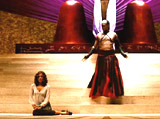
Representing a Catholic Virgin Mary (wearing red and white), she took young Stargher into her trust. He admitted that his pathology started when he drowned an injured bird as a mercy killing ("It was better for the bird. I saved him"), to save it from his father's torture. She then killed the murderous adult Stargher, by stabbing him in the heart with a sword, claiming: "My world, my rules." At the same time, she cradled the young Stargher in her arms as he also died and peacefully drowned in a baptism pool. As young Carl had saved the hurt bird, she also saved him from his beastly persona. In the denouement, she adopted Stargher's albino dog, and used the reverse process to successfully break through Edward's coma (symbolized by blooming trees, falling snow, and an unbroken toy boat). |
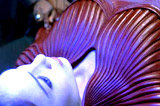 Dr. Catherine Deane (Jennifer Lopez) - 'Brain-Mapping' 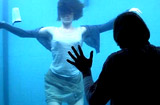 Dead Victim Anne Marie Vicksey (Catherine Sutherland) Watched by Psychopath Carl Stargher 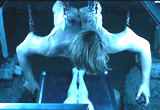 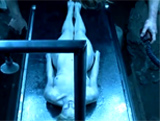 Sadomasochistic Serial Killer Carl Stargher Above Dead Nude Victim 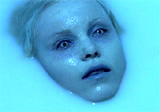 Milky Bleach Bath for Victim 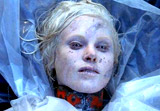  Play "Dolls" 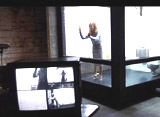 Recently-Kidnapped 8th Victim Julia About to Be Drowned in Tank-Cell 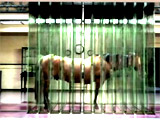 Vision of Segmented Horse  Stargher as Grand Guignol King With Purple Cape on Throne   Deane as Virgin Mary   The End of Murderous Adult Stargher |
|||||||||||||||||
(alphabetical by film title, illustrated) Intro | #s-A | B | C-1 | C-2 | D-1 | D-2 | E | F | G | H I-J | K-L | M | N-O | P | Q-R | S-1 | S-2 | S-3 | T | U-Z |








 Carrie (1976)