The Golden Age of Science Fiction Films:
 After
a dry period during the war years, science fiction films took off during what
has been dubbed "the Golden Age of Science Fiction Films," although many of
the 50s exploitative, second-rate sci-fi flicks had corny dialogue, poor screenplays,
bad acting, and amateurish production values. In response to a growing interest
in rocketry and space exploration, feature-length space travel films gained
popularity in the early 1950s, pioneered by two 1950 films: After
a dry period during the war years, science fiction films took off during what
has been dubbed "the Golden Age of Science Fiction Films," although many of
the 50s exploitative, second-rate sci-fi flicks had corny dialogue, poor screenplays,
bad acting, and amateurish production values. In response to a growing interest
in rocketry and space exploration, feature-length space travel films gained
popularity in the early 1950s, pioneered by two 1950 films:
- the low-budget space mission film Rocketship X-M (1950) (although the first manned space flight destined for the moon in the film
lands on Mars)
- Hungarian-born animator-producer George Pal's and director
Irving Pichel's fairly tepid and plain Destination Moon (1950), taken from famed sci-fi author/screenwriter Robert Heinlein's juvenile
novel Rocket Ship Galileo; this was Pal's first feature as a producer;
the technicolor science fiction film was historically important - it 'invented'
the realistic look of spacesuits, rocketships (skillfully-produced models),
and the lunar surface, and included a quasi-educational segment introduced
by cartoon character Woody Woodpecker; this film gave George Pal his first Academy Award; this Cold-War era film was also notable for its use of space
as a battleground with the USSR
 Suddenly,
science fiction films were viewed as financially profitable and audiences
flocked to the theatres and craved more. Quickly, there were many cheap, low-budget
imitators, such as Monogram's and director Lesley Selander's Flight to
Mars (1951) - about a manned space-flight in the year 2000 to the Red
Planet of Mars. The Mars sequences were filmed in washed-out two-color cinecolor
[this was the first science fiction film made with color]. Suddenly,
science fiction films were viewed as financially profitable and audiences
flocked to the theatres and craved more. Quickly, there were many cheap, low-budget
imitators, such as Monogram's and director Lesley Selander's Flight to
Mars (1951) - about a manned space-flight in the year 2000 to the Red
Planet of Mars. The Mars sequences were filmed in washed-out two-color cinecolor
[this was the first science fiction film made with color].
Alien Invader Films in the Cold War Era:
 Many
other sci-fi films of the 1950s portrayed the human race as victimized
and at the mercy of mysterious, hostile, and unfriendly forces.
Cold War politics undoubtedly contributed to suspicion, anxiety,
and paranoia of anything "other" - or "un-American." Allegorical
science fiction films reflected the collective unconscious and often
cynically commented upon political powers, threats and evils that
surrounded us (alien forces were often a metaphor for Communism),
and the dangers of aliens taking over our minds and territory. It
was a tale told to illustrate how scientists had foolishly meddled
with things that should have been left alone - and caused further
catastrophe. Many
other sci-fi films of the 1950s portrayed the human race as victimized
and at the mercy of mysterious, hostile, and unfriendly forces.
Cold War politics undoubtedly contributed to suspicion, anxiety,
and paranoia of anything "other" - or "un-American." Allegorical
science fiction films reflected the collective unconscious and often
cynically commented upon political powers, threats and evils that
surrounded us (alien forces were often a metaphor for Communism),
and the dangers of aliens taking over our minds and territory. It
was a tale told to illustrate how scientists had foolishly meddled
with things that should have been left alone - and caused further
catastrophe.
UFO
sightings and reports of flying saucers or strange visitors from outer
space found their way into Hollywood features as allegories of the
Cold War, such as in director Christian Nyby's and producer Howard
Hawks' sole science-fiction film The Thing
From Another World (1951). [It was remade by director
John Carpenter in 1982 with a faithful return to the original 1938
source, Who
Goes There? a novella by John W. Campbell, Jr.]. It told the story
of the discovery of a frozen block of ice encapsulating an alien life
form (a killer, chlorophyll-based humanoid vegetable), played by Gunsmoke's James
Arness, buried at a 'flying saucer' crash site near a remote Arctic
outpost. After the creature was accidentally thawed, its presence
was thrillingly announced by a beeping, flashing Geiger counter.
[This same technique was later copied by the Alien films, notably Alien
(1979).] When the monstrous
creature finally appeared, it was doused with kerosene and
set ablaze, and eventually destroyed by high-voltage electrocution.
The influential film's last line of dialogue, a reporter's radio
broadcast, warned : "Watch
the skies! Everywhere. Keep looking. Keep watching the skies!"
 More
US films about space invaders in the 50s included: More
US films about space invaders in the 50s included:
- director Robert Wise's classic The Day The Earth Stood
Still (1951), was a counter-revolutionary film about the madness of
Cold War politics; it had an anti-nuclear war message and ultimatum ("Klaatu
barada nikto") brought to Washington D.C. by a gentle, benevolent,
and philanthropic Christ-like alien/emissary named Klaatu (Michael Rennie),
backed up by a giant, eight-foot tall metallic robot named Gort (a prototypical Terminator character and similar to the Tin Woodsman in The Wizard
of Oz); the entire film was a precursor to Spielberg's Close
Encounters of the Third Kind (1977) and E.T.:
The Extra-Terrestrial (1982); it was remade in 2008 by director Scott Derrickson, starring Keanu Reeves as Klaatu
- director Edgar Ulmer's very low-budget
British film The Man from Planet X (1951), one of the earliest alien
invasion films, in which a mutant space traveler alien (with a bubble-head
and an expressionless, unmoving face) who landed in the damp and foggy Scottish
moors was treated with venal contempt
 Rudolph
Mate's When Worlds Collide (1951), adapted By Sydney Boehm from an
original novel by Philip Wylie and Edwin Balmer, told of a runaway planetoid
(Bellus) destructively approaching toward the doomed Earth (with primitive
but dazzling for-the-time Oscar-winning Special Effects by producer George
Pal), and the financing and building of a 'Noah's-Ark'-like spaceship to
evacuate a few chosen survivors to fly to Bellus' satellite Zyra (with Earth-like
climactic conditions) and colonize it Rudolph
Mate's When Worlds Collide (1951), adapted By Sydney Boehm from an
original novel by Philip Wylie and Edwin Balmer, told of a runaway planetoid
(Bellus) destructively approaching toward the doomed Earth (with primitive
but dazzling for-the-time Oscar-winning Special Effects by producer George
Pal), and the financing and building of a 'Noah's-Ark'-like spaceship to
evacuate a few chosen survivors to fly to Bellus' satellite Zyra (with Earth-like
climactic conditions) and colonize it- the film noirish science fiction classic, Universal's
3-D widescreen It Came From Outer Space (1953) with stereo
sound; director Jack Arnold's first sci-fi work adapted from
an original Ray Bradbury fantasy The Meteors; it was an
anti-conformist, anti-McCarthy message in its unique tale of
benign but monstrous one-eyed Cyclopian aliens that mistakenly
crash-landed on Earth in the Arizona desert near the small town
of Sand Rock. By the technique of shape-shifting, they cloned
the identities of nearby townspeople in order to repair their
spaceship; the film starred Richard Carlson (one of the most popular
sci-fi actors of the era) as a night amateur astronomer who witnessed
the fiery crash-landing of the 'meteorite'-spaceship (that no
one believed) and began to understand how people were being replaced
by unreal duplicates
 the
creepy, low-budget, cult classic film Invaders from Mars (1953) [remade
in 1986], was the last film of director William Cameron Menzies,
and one of the earliest films of its kind to be filmed in color;
it told the paranoid, foreboding story from the point of view
of young boy David MacLean (Jimmy Hunt) whose warnings went unheeded;
during a dream he witnessed a Martian flying saucer landing in
a nearby field; the menacing Martians, who took residence under
his house, were guided by a disembodied bulbous head in a glass
sphere; the film ended with the opening sequence of the dream
being repeated in reality; contrary
to popular belief, it was not shot in 3-D the
creepy, low-budget, cult classic film Invaders from Mars (1953) [remade
in 1986], was the last film of director William Cameron Menzies,
and one of the earliest films of its kind to be filmed in color;
it told the paranoid, foreboding story from the point of view
of young boy David MacLean (Jimmy Hunt) whose warnings went unheeded;
during a dream he witnessed a Martian flying saucer landing in
a nearby field; the menacing Martians, who took residence under
his house, were guided by a disembodied bulbous head in a glass
sphere; the film ended with the opening sequence of the dream
being repeated in reality; contrary
to popular belief, it was not shot in 3-D- the definitive Martian alien-invasion film, copied repeatedly
afterwards, was producer George Pal's and director Byron Haskin's film version
of H. G. Wells' 1898 story The War of the Worlds (1953) (again with
Oscar-winning Special Effects by George Pal), starring Gene Barry and Ann
Robinson; the aliens invaded in manta ray-like space ships with cobra-like
probes and zapped objects with green disintegration rays to destroy 1950s
Los Angeles, forestalled only by their demise from minute bacterial agents;
the film was overshadowed by Orson Welles' radio version in 1938; it was
remade as a spectacular Steven Spielberg-directed War of the Worlds (2005),
an updated version with disaster film elements, about sinister attacking
aliens from the perspective of divorced father Ray Ferrier (Tom Cruise)
with two children in the New York area -- with haunting recollections of
the 9/11 nightmare
 Universal's
thought-provoking science fiction adventure This Island Earth
(1955),
from director Joseph Newman, was based on the novel The Alien
Machine by
Raymond F. Jones. It told about nuclear physicist
Dr. Cal Meacham (Rex Reason) and his ex-love interest Dr. Ruth
Adams (Faith Domergue) who were recruited to a scientific world-peace
project in Georgia by white-haired Exeter (Jeff Morrow) and his
subversive right-hand man Brack (Lance Fuller); they were revealed
to be mysterious
humanoid aliens from the dying planet of Metaluna seeking
uranium and the knowledge of noted Earth scientists to save their
planet from destruction in their inter-planetary war against the
evil Zahgons; they were the disguised aliens
with odd-shaped skulls, distinguished by large heads with raised
foreheads; when the scientists were abducted to Metaluna, one
of the hideous Mutant servants with a large swollen, pulsating
cranium or exo-brains injured Exeter, although he successfully
pursued his mission to sacrifice himself to bring the two innocent
scientists Meacham and Ruth back to Earth; this classic sci-fi
film was targeted for heckling in Mystery
Science Theater 3000: The Movie (1996) Universal's
thought-provoking science fiction adventure This Island Earth
(1955),
from director Joseph Newman, was based on the novel The Alien
Machine by
Raymond F. Jones. It told about nuclear physicist
Dr. Cal Meacham (Rex Reason) and his ex-love interest Dr. Ruth
Adams (Faith Domergue) who were recruited to a scientific world-peace
project in Georgia by white-haired Exeter (Jeff Morrow) and his
subversive right-hand man Brack (Lance Fuller); they were revealed
to be mysterious
humanoid aliens from the dying planet of Metaluna seeking
uranium and the knowledge of noted Earth scientists to save their
planet from destruction in their inter-planetary war against the
evil Zahgons; they were the disguised aliens
with odd-shaped skulls, distinguished by large heads with raised
foreheads; when the scientists were abducted to Metaluna, one
of the hideous Mutant servants with a large swollen, pulsating
cranium or exo-brains injured Exeter, although he successfully
pursued his mission to sacrifice himself to bring the two innocent
scientists Meacham and Ruth back to Earth; this classic sci-fi
film was targeted for heckling in Mystery
Science Theater 3000: The Movie (1996)- director Byron Haskin's Conquest of Space (1955),
adapted from the book The Mars Project, with special effects by George
Pal, displayed a realistic takeoff to explore Mars, a circular earth-orbiting
space station, maneuverings during space flight and to avoid an asteroid,
and a landing on Mars, in a story about a maniacal spaceship commander
- Earth vs. the Flying Saucers (1956), noted for the
special effects of expert Ray Harryhausen; aliens lay waste to symbols of
democracy in Washington, D.C. in the film's climax (a precursor to Independence
Day (1996))
- director Roger Corman's second science-fiction film (following
his sci-fi disaster film The Day the World Ended (1956)) - the low-budget It Conquered the World (1956), featuring Peter Graves, Lee Van Cleef
and Beverly Garland - told about an alien from Venus subversively controlling
the minds of key personnel in a military base and its town using vampire-like,
pointy-headed cucumber-monster and bat creatures (this film was similar
in plot to Invaders from Mars (1953), The Day the Earth Stood
Still (1951), and Invasion of the Body
Snatchers (1956) of the same year) - it was remade as the cheapie,
alien invasion camp film Zontar - The Thing from Venus (1966)
- also, Corman's low-budget Not of This Earth (1957),
a sci-fi alien invasion film about a blood-seeking, extra-terrestrial invader;
originally released as part of a double-bill with Attack of the Crab
Monsters (1957)
 producer/director
Gene Fowler, Jr.'s effective vintage sci-fi thriller (with a ludicrous and
misleading title) I Married a Monster From Outer Space (1958), told
about a race of monster-like aliens from Andromeda Nebula, one of whom 'took
over' the body of a man (Tom Tryon) on his wedding night producer/director
Gene Fowler, Jr.'s effective vintage sci-fi thriller (with a ludicrous and
misleading title) I Married a Monster From Outer Space (1958), told
about a race of monster-like aliens from Andromeda Nebula, one of whom 'took
over' the body of a man (Tom Tryon) on his wedding night- in Village of the Damned (1960) from UK director
Wolf Rilla and based on John Wyndam's novel The Midwich Cuckoos,
a small English country village was suddenly cut off by a mysterious, alien
energy field force that caused many women of child-bearing age to become
pregnant; the twelve similar-looking, quiet, blonde, zombie-like children
(6 boys and 6 girls) of the mothers lacked human emotions but had awesome
mental powers, and were revealed to be hybrid aliens with human bodies;
this classic was followed by a semi-sequel titled Children of the Damned
(1964) with six other 'super-children' discovered in six different continents;
John Carpenter made a remake of the original film in 1995, with Christopher
Reeve in the lead role
Other Alien Invader Classics:
 In
more creature features, parasitic alien seed pods threatened to duplicate
and transplant themselves as emotion-less human clones in a hostile takeover
of the small California town of Santa Mira, in Don Siegel's suspenseful and
brilliant film Invasion of the Body Snatchers (1956) [remade in 1978 and in 1994]. It was a perfect post-McCarthy era film from
a story by sci-fi writer Jack Finney about the threat of Communist infiltration
and dehumanizing brainwashing. The metaphoric film effectively exploited the
Red paranoia of the 50s with chilling fright and warned about the dangers
of an automaton existence with numbing conformity and mindless apathy. In
more creature features, parasitic alien seed pods threatened to duplicate
and transplant themselves as emotion-less human clones in a hostile takeover
of the small California town of Santa Mira, in Don Siegel's suspenseful and
brilliant film Invasion of the Body Snatchers (1956) [remade in 1978 and in 1994]. It was a perfect post-McCarthy era film from
a story by sci-fi writer Jack Finney about the threat of Communist infiltration
and dehumanizing brainwashing. The metaphoric film effectively exploited the
Red paranoia of the 50s with chilling fright and warned about the dangers
of an automaton existence with numbing conformity and mindless apathy.
In They Came From Beyond Space (1967), formless alien
spacemen landed in Cornwall, England and began to take over the minds/bodies
of a group of scientists. The early 1970s sci-fi thriller film adapted from
Michael Crichton's novel, Robert Wise's The Andromeda Strain (1971),
captured the terror of a deadly, bacterial, crystalline organism from outer
space that was brought back to Earth in a satellite, and the efforts of assembled
high-tech scientists racing against time to save the world from extermination.
Disaster-Tinged Science-Fiction:
Stanley Kramer's masterpiece On the Beach (1959) dramatized
the realities of an apocalyptic world, with survivors waiting for their radioactive
doom in Australia, the last refuge on Earth in 1964. And disaster film expert
Irwin Allen offered up Voyage to the Bottom of the Sea (1961) about
the mission of an atomic submarine to destroy a deadly hot radiation belt.
Stanley Kubrick's Dr. Strangelove: Or How I Learned
to Stop Worrying and Love the Bomb (1964) black comedy irreverently
juxtaposed incongruous comedy and the prospect of atomic war. It featured
Peter Sellers in three prominent roles, including one of the title character
of Dr. Strangelove -- a bomb-loving, mad scientist type with a Nazi accent
and an artificial arm.
The Mutant Creatures/Monsters Cycle:
With the threat of destructive rockets and the Atom Bomb looming
in people's minds after World War II, mutant creature/monster films featured
beasts that were released or atomically created from nuclear experiments or
A-bomb accidents. The aberrant monsters were the direct result of man's interference
with nature. There were many examples of low-budget 50s films about the horrors
of the Atomic Age:
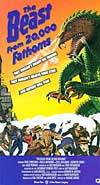 director
Eugene Lourie's The Beast From 20,000 Fathoms (1953), with spectacular
effects and stop-motion animation by FX expert Ray Harryhausen was based
on a Ray Bradbury short story of the same name; about a subterranean monster
(a fictitious crocodilian dinosaur called a Rhedosaurus, a cross between
an alligator and a T-Rex) thawed in the Arctic after atomic testing and
threatening to rampage New York City on its way to ancestral breeding grounds;
the attacking creature was cornered in an amusement park among various rides
and ferris wheels, where it was killed by a radio-active isotope fired into
a wound in its throat and burned in a roller-coaster bonfire; a precursor
to the 1954 Gojira or Godzilla monster director
Eugene Lourie's The Beast From 20,000 Fathoms (1953), with spectacular
effects and stop-motion animation by FX expert Ray Harryhausen was based
on a Ray Bradbury short story of the same name; about a subterranean monster
(a fictitious crocodilian dinosaur called a Rhedosaurus, a cross between
an alligator and a T-Rex) thawed in the Arctic after atomic testing and
threatening to rampage New York City on its way to ancestral breeding grounds;
the attacking creature was cornered in an amusement park among various rides
and ferris wheels, where it was killed by a radio-active isotope fired into
a wound in its throat and burned in a roller-coaster bonfire; a precursor
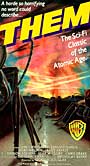
to the 1954 Gojira or Godzilla monster- Them! (1954) by director Gordon Douglas - a scary
film that launched the gigantic killer bug, B-movie sub-genre, was about
mutated, giant, radio-active, murderous ants hatched in the New Mexico desert
after an A-bomb test; a child stumbled out of the desert, screaming to announce:
"Them! Them! Them!"; a professional soldier (James Whitmore)
led the search for the monsters that traveled from the New Mexico desert
to storm drains; the giant ants were interpreted as Communists on-the-loose
[Starship Troopers (1997) paid homage to this classic film]
- Jack Arnold's Tarantula (1955), a film that imitated Them! (1954), about a rampaging, mutant spider; featured an early
bit role for Clint Eastwood as an Air Force pilot called in to bomb the
huge spider
 Kurt
Neumann's (director of the original The Fly) low-budget sci-fi thriller Kronos (1957), about a giant, electrical energy-sucking alien machine/robot
from outer space, with Jeff Morrow (of This Island Earth) Kurt
Neumann's (director of the original The Fly) low-budget sci-fi thriller Kronos (1957), about a giant, electrical energy-sucking alien machine/robot
from outer space, with Jeff Morrow (of This Island Earth)- the surreal, philosophical classic The Incredible Shrinking
Man (1957), by director Jack Arnold and author/scriptwriter Richard
Matheson; it was another of the atomic-era films billed as "a fascinating
adventure into the unknown," that featured amazing special effects
of a man (Grant Williams) miniaturized by glittery particles of radioactive
mist (atomic nuclear fallout), and then terrorized by an oversized cat and
giant black spider in a cellar
- producer/director Bert Gordon's incredulous The Amazing
Colossal Man (1957) questioned the damaging effects of technology, nuclear
energy, and radiation through the character of an Army officer (Glen Langan)
who grew to a height of 160 feet (and was bald) due to radioactive poisoning;
its sequel was War of the Colossal Beast (1958)
- Kurt Neumann's The Fly (1958), adapted from George
Langelaan's short story, about a matter-teleportation experiment gone awry
between a hapless scientist and a housefly; the film was followed by two
sequels (Return of the Fly (1959) and Curse of the Fly (1965))
and director David Cronenberg's great remake The Fly (1986) years
later, with Jeff Goldblum and Geena Davis
- The 30-Foot Bride of Candy Rock (1959)
- schlocky cult director Coleman Francis' drive-in classic The Beast of Yucca Flats (1961), noted for its lack of dialogue (and
its ridiculous narration), and ex-wrestler Tor Johnson as a defecting Russian
nuclear scientist who turns into a rampaging, mutant beast after exposure
to an H-bomb detonation
- in Allan Dwan's classic The Most Dangerous Man Alive
(1961), a gangster was turned into an automaton made of impervious steel
after an atomic blast
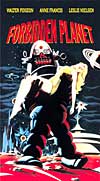 Hollywood
pursued the commercial success of these post-war SF films with many
more. One intelligent, lavishly-expensive science fiction film was
MGM's Forbidden
Planet (1956). The studio-bound film inspired
the look of many future films and works, notably TV's Star Trek by
Gene Roddenberry and Star Wars creator George Lucas, and it
was shot in CinemaScope and color. Its sole Academy Award nomination
was for its impressive Best Visual Effects, and it also featured an
all-electronic music score. Hollywood
pursued the commercial success of these post-war SF films with many
more. One intelligent, lavishly-expensive science fiction film was
MGM's Forbidden
Planet (1956). The studio-bound film inspired
the look of many future films and works, notably TV's Star Trek by
Gene Roddenberry and Star Wars creator George Lucas, and it
was shot in CinemaScope and color. Its sole Academy Award nomination
was for its impressive Best Visual Effects, and it also featured an
all-electronic music score.
It told
the story of a journey by astronauts of United Planets Cruiser C-57D
(led by commanding officer Leslie Nielsen in one of his earliest roles)
to a distant planet named Altair-IV. There, they investigated the fate
of a colony planted 20 years before. It re-worked
Shakespeare's The Tempest and
has been psychoanalyzed as a dramatization of repressed sexual desires.
The film has been best-remembered for Walter Pidgeon as Dr. Morbius
(the Prospero figure) on a tour of the ill-fated Krell laboratories,
and his pretty 19 year-old daughter Altaira (Anne Francis as the Miranda
character who had never seen men). The Tempest's Ariel was represented
by a language-fluent, lumbering Robby the Robot (its first appearance
in a film), and Caliban by an invisible Id-monster that attacked and
penetrated the electric force-field fence set up around the spaceship's
perimeter.
The popularity of Robby the Robot spawned another film, The
Invisible Boy (1957) with a supporting role for the 'good' computer robot.
Robby also served as the prototype for the robot in the Lost in Space TV series (1965-68). |

 Science Fiction Films