
|

(alphabetical and illustrated) Introduction | A - 1 | A - 2 | B - 1 | B - 2 | C - 1 | C - 2 | C - 3 | D | E | F G - H | I - J - K | L - M | N - O | P | Q - R | S - 1 | S - 2 | T | U - V - W - X - Y - Z |
|
|
|
|
| a revolutionary film, due to either its technical or performance artistry; those films recognized by the National Film Registry | Examples: The Jazz Singer (1927) (the first 'talkie'), Footlight Parade (1933) (choreographer Busby Berkeley's landmark musical), Citizen Kane (1941), Jaws (1975) (the first 'blockbuster') | |
| refers to a type of transition between two scenes - the first scene closes with a fade out, and a fade in brings up the next scene | ||
| a miniature type of microphone, usually omni-directional and wireless, and small enough to be taped or clipped to an actor, to record dialogue; aka lav, lapel or lap microphones | ||
| a digital film editing term, also known as a split edit, J-cut or delayed edit; it refers to a transitional edit in which the audio and video edit do not start at the same time; the audio starts before (or after) the picture cut | ||
| refers to the most important, main character in a film, often distinguished by gender; usually there is at least one male and female lead role; also usually known as protagonist; contrasted to supporting roles or characters. | 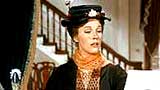 Example:
Julie Andrews in the lead role in Mary Poppins (1964) Example:
Julie Andrews in the lead role in Mary Poppins (1964) |
|
| a film that has 'legs' has strong and profitable box-office, stamina and audience drawing power far beyond the opening weekend; the term usually applies to films that last many months | Examples: Il Postino (1994), Titanic (1997), Hoop Dreams (1994), My Big Fat Greek Wedding (2002) | |
| an intentionally-repeated, recurring element or theme associated with a particular person, idea, milieu, or action; the element presents itself as a repeated sound, shot, bit of dialogue, piece of music, etc., that helps unify a film by reminding the viewer of its earlier appearance; sometimes presented along with a film's tag line on a film poster. | Examples: John Williams' ominous, chromatic scale music signifying that a shark attack is imminent in Jaws (1975); or in Fritz Lang's M (1931) - the M in the title sequence is associated with a fragment of Edward Grieg’s Peer Gynt - and thereafter connected with the whistled tune of the murderer; the many musical leitmotifs in Laura (1944); or the sounds of heavy breathing of killer Michael Myers in Halloween (1978) | |
| a piece of optical glass in a camera through which light passes and the image is focused before hitting the film stock inside; various types include wide-angle lens, telephoto lens, normal, etc.; to lense means to film a motion picture | ||
(or letterboxed) |
the technique of shrinking the film image just enough so that its entire width appears on TV screen, with black areas above and below the image; refers to the way that videos emulate the widescreen format on television screens; if a widescreen film is not in the letterbox format it is often in pan-and-scan format. | 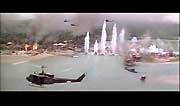 An
example of letterboxing, from Apocalypse Now
(1979). An
example of letterboxing, from Apocalypse Now
(1979). |
| a stock shot, often unimaginative or commonplace | ||
| refers to the illumination of a scene, and the manipulation of light and shadows by the cinematographer. | ||
| refers to the film producer who works on location and is responsible for daily operations and budget of a particular film shoot - to manage the day-to-day aspects involving all of the people and expenses | ||
| refers to the spoken dialogue belonging to a single performer; also refers to the full complement of spoken words in a film or stage script; also known simply as dialogue. | See this site's information on "Greatest Film Quotes and Movie Dialogues" | |
| a slang term that refers to Metro-Goldwyn Mayer (MGM) Studios -- with the legendary "Leo the Lion" logo | ||
| refers to synchronization between mouth movement and the words on the film's soundtrack | ||
(or on location) |
the properties or places (interior or exterior) used for filming away from the studio, set, or (back)lot, often to increase the authenticity and realism of the film's appearance; exteriors are abbreviated as ext., and interiors as int. | Example: To Kill a Mockingbird (1962) opens with the camera descending into the small town of Maycomb, Alabama, with the voice-over narration of the older Scout (uncredited Kim Stanley) describing the location: "Maycomb was a tired old town, even in 1932 when I first knew it..." |
| refers to recording background sound on location, to improve the film's realism; see also buzz track | ||
| refers to a camera shot in which the camera remains immobile and fixed, while something happens off-screen (e.g., an off-screen death) - usually employed as a technique to create suspense | ||
| a short, introductory summary of a film, usually found on the first page of the screenplay, to be read by executives, judges, agents, producers and script-readers; all screenwriters use loglines to sell their scripts; also known as premise; see also high concept hook | 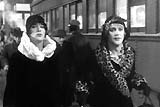 Example:
The logline of Some Like It Hot (1959) -
two broke male musicians who accidentally witness the St. Valentines'
Day massacre must elude the mobsters who pursue them; they dress in drag
and join an all-girl band traveling to Florida. Complications arise when
one of them falls for a sexy singer and poses as a rich playboy so he
can woo her; he convinces his partner to dodge the amorous advances of
the elderly millionaire he is impersonating. Love conquers all -- till
the mobsters show up at the same beachside resort for a convention. Example:
The logline of Some Like It Hot (1959) -
two broke male musicians who accidentally witness the St. Valentines'
Day massacre must elude the mobsters who pursue them; they dress in drag
and join an all-girl band traveling to Florida. Complications arise when
one of them falls for a sexy singer and poses as a rich playboy so he
can woo her; he convinces his partner to dodge the amorous advances of
the elderly millionaire he is impersonating. Love conquers all -- till
the mobsters show up at the same beachside resort for a convention. |
|
(LS) |
a camera view of an object or character from a considerable distance so that it appears relatively small in the frame, e.g., a person standing in a crowd of people or a horse in a vast landscape; variations are the medium long-shot (or mid-shot) (MS) and the extreme long-shot (ELS or XLS); also called a wide shot; a long shot often serves as an establishing shot; contrast to close-up (CU); a full-shot is a type of long shot that includes a subject's entire body (head to feet). | 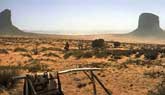 Example:
an extreme long-shot, Ethan Edwards (John Wayne) arriving on horseback,
in John Ford's The Searchers (1958) Example:
an extreme long-shot, Ethan Edwards (John Wayne) arriving on horseback,
in John Ford's The Searchers (1958) |
(or lengthy take) |
a shot of lengthy duration; see also mise-en-scene | Example: Hitchcock's Rope (1948), composed of a series of continuous, 8-minute takes; or the opening of Robert Altman's The Player (1992) |
| refers to the process in which dialogue is re-recorded by actors in the studio during post-production, matching the actor's voice to lip movements on screen; aka ADR (Automated Dialogue Replacement); contrast with dubbing; loop refers to a length of film joined from beginning to end for repeated continuous running | ||
| a shot in which the subject is filmed directly from below and the camera tilts up at the action or character, to make the subject appear larger than life, more formidable, taller and more menacing; contrast to a high-angle shot |
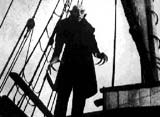 also the low-angle shot of the menacing vampirish Count Orlok (Max Schreck) in Nosferatu (1922, Germ.) |
|
| a fast-paced, wild, and reckless humorous work, usually with plenty of slapstick humor, goofy and farcical action, and crazy characters; also see screwball comedy | 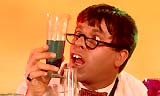 Examples: Cannonball
Run (1981), It's a Mad, Mad, Mad, Mad World (1963), Kentucky
Fried Movie (1977), The Nutty Professor (1963) (pictured), All
of Me (1985). Examples: Cannonball
Run (1981), It's a Mad, Mad, Mad, Mad World (1963), Kentucky
Fried Movie (1977), The Nutty Professor (1963) (pictured), All
of Me (1985). |
|
made for TV |
short for feature-length movies filmed or specifically made-for-television, often mid-way in style between a short drama and a cinematic release; aka telefilm or telepic | |
| the optimum time for filming romantic or magical scenes due to 'warm' and 'soft' lighting conditions, characterized by a golden-orange hue color and softened shadows; occurs for about 30 minutes around the time of sunset and sunrise; aka golden hour | Example: Nestor Almendros' cinematography in Terence Malick's Days of Heaven (1978); and Phil Alden Robinson's Field of Dreams (1989) | |
| a Hollywood-made film
with major stars, big budgets, and big hype; compare to independents;
its extreme opposite is termed counter-cinema (forms of alternative
cinema, such as avant-garde, art films, Third World
cinema, etc.) |
||
| refers to the major Hollywood motion picture producer/distributor studios at the present time (i.e., DreamWorks SKG, MGM/UA, Paramount Pictures, 20th Century Fox, Sony (Columbia/TriStar), Warner Bros, Universal, and Disney); contrast to the smaller, mini-major production-distribution companies (i.e., Miramax, New Line Cinema, and Polygram) that compete directly with the bigger studios |  20th Century Fox logo |
|
| refers to the materials that are used to prepare the performer for his/her respective role(s) before the camera, anywhere from facial pancake to elaborate costuming, latex masks, and other ghastly transformations; the makeup department is headed by a makeup artist | 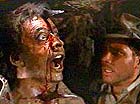 Example:
from Raiders of the Lost Ark (1981) Example:
from Raiders of the Lost Ark (1981) |
|
| a specialized documentary that focuses on the production of a specific film; most "making of..." documentaries are extended promotional advertisements before the release of the film, and almost all of them are shot while the film is in production; some specialized documentaries of classic films (called retrospectives), made years after the film was released, gather interviews and behind the scenes clips, etc. | 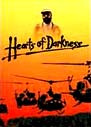 Examples: Hearts
of Darkness: A Filmmaker's Apocalypse (1991) used Francis Ford
Coppola's wife Eleanor's "home movie" footage shot during
the torturous 34 weeks shoot of Apocalypse Now
(1979) in the Philippines, and also included more recent interviews; Shadowing
the Third Man (2004) was an astounding retrospective of the making
of Carol Reed's The Third Man (1949) Examples: Hearts
of Darkness: A Filmmaker's Apocalypse (1991) used Francis Ford
Coppola's wife Eleanor's "home movie" footage shot during
the torturous 34 weeks shoot of Apocalypse Now
(1979) in the Philippines, and also included more recent interviews; Shadowing
the Third Man (2004) was an astounding retrospective of the making
of Carol Reed's The Third Man (1949) |
|
| (1) the name for the clapping of the sticks to sync up the sound and the picture; and (2) something on the ground (tape, a stick, chalk, etc.) that lets the talent know where they should be for the shot | ||
(or blackout) |
refers to covering up or blocking out a portion of the frame with blackness or opaqueness; most masks are black, but they could be white or some other color | 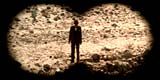 Example:
in Chinatown (1974), the scene in which
detective J.J. Gittes (Jack Nicholson) uses binoculars to trace the activities
of Hollis Mulwray (Darrell Zwerling); also used for the effect of looking
through a keyhole Example:
in Chinatown (1974), the scene in which
detective J.J. Gittes (Jack Nicholson) uses binoculars to trace the activities
of Hollis Mulwray (Darrell Zwerling); also used for the effect of looking
through a keyhole |
| a continuous shot or long take that shows the main action or setting of an entire scene (most scenes are shot with one or two master angles and then broken up into a series of smaller or tighter angles during editing (such as one-shots, two-shots, close-ups, and reaction shots)); a master refers to a positive print made especially for duplication purposes | ||
| a transitional technique that refers to a cut between two unrelated shots (outgoing and incoming) that are deliberately joined, matched, or linked by physical, visual, aural, or metaphorical parallelism or similarities, to establish continuity; there can be audio matches, segues (a segue refers to a smooth, uninterrupted transition), and visual match-cuts of various kinds; aka graphic match; see also audio bridge and bridging shot | 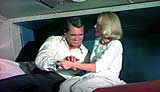 Examples: North
by Northwest (1959), Cary Grant pulls Eva Marie Saint up
the cliff of Mt. Rushmore -- then a match cut to Grant pulling
her up to a bunk in a train Examples: North
by Northwest (1959), Cary Grant pulls Eva Marie Saint up
the cliff of Mt. Rushmore -- then a match cut to Grant pulling
her up to a bunk in a train |
|
| the optical process of combining (or compositing) separately-photographed shots (usually actors in the foreground and the setting in the background) onto one print through a double exposure that does not meld two images on top of each other, but masks off (or makes opaque and blank) part of the frame area for one exposure and the opposite area for another exposure; the second image is printed in the masked-off area; it is a photographic technique whereby a matte painting or artwork from a matte artist - usually painted on glass - is combined with live action footage to provide a convincing setting for the action; also sometimes known as split-screen. | 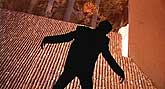 Example:
In Hitchcock's Vertigo (1958), this
complicated shot combined a real roof and a matted belfry in the background
with an added silhouette in the foreground. Also used to combine a
cartoon character with a human actor (e.g., Who
Framed Roger Rabbit? (1988)); the Emerald City in The
Wizard of Oz (1939) Example:
In Hitchcock's Vertigo (1958), this
complicated shot combined a real roof and a matted belfry in the background
with an added silhouette in the foreground. Also used to combine a
cartoon character with a human actor (e.g., Who
Framed Roger Rabbit? (1988)); the Emerald City in The
Wizard of Oz (1939) |
|
(or MacGuffin, or Maguffin) |
Alfred Hitchcock's term for the device or plot element (an item, object, goal, event, or piece of knowledge) that catches the viewer's attention or drives the logic or action of the plot and appears extremely important to the film characters, but often turns out to be insignificant or is to be ignored after it has served its purpose; its derivation is Scottish, meaning a "lion trap" for trapping lions in the lion-less Scottish Highlands (i.e., a trap that means nothing, since it is for an animal where there is no such animal). See detailed list of Hitchcock's MacGuffins. | 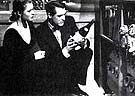 Examples:
'mistaken identity' at the beginning of North
by Northwest (1959) and the 'government secrets', the uranium
ore in champagne bottles in Notorious (1946) (seen
here), or the stolen money - $40,000 in Psycho
(1960), the 'Rosebud' sled in Citizen
Kane (1941), the treasure under the 'W' in It's a Mad, Mad,
Mad, Mad World (1963), the briefcase in Pulp
Fiction (1994), the Rabbit's Foot in Mission
Impossible III (2006); also the 'black bird' in The
Maltese Falcon (1941) served as a MacGuffin - before it was
termed Examples:
'mistaken identity' at the beginning of North
by Northwest (1959) and the 'government secrets', the uranium
ore in champagne bottles in Notorious (1946) (seen
here), or the stolen money - $40,000 in Psycho
(1960), the 'Rosebud' sled in Citizen
Kane (1941), the treasure under the 'W' in It's a Mad, Mad,
Mad, Mad World (1963), the briefcase in Pulp
Fiction (1994), the Rabbit's Foot in Mission
Impossible III (2006); also the 'black bird' in The
Maltese Falcon (1941) served as a MacGuffin - before it was
termed |
| refers to a conventional camera shot filmed from a medium distance; although it is difficult to precisely define, it usually refers to a human figure from the waist (or knees) up, to clearly see body language (but not facial expressions); between a close shot and a long shot; abbreviated as m.s. | 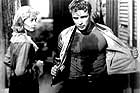 Example:
a medium shot of Vivien Leigh and Marlon Brando from A
Streetcar Named Desire (1951) Example:
a medium shot of Vivien Leigh and Marlon Brando from A
Streetcar Named Desire (1951) |
|
(multiplex) |
both refer to movie chains (i.e., Loews, AMC Theatres) with movie theatres that screen more than one film at a time, as opposed to single-screen theatres. A multiplex has from 2 up to 16 screens, a megaplex has 16 or more screens; plex is the abbreviation for a multiplex theatre. | 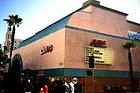 Example:
A typical AMC multiplex 7-screen theatre in the greater Los Angeles
area. Example:
A typical AMC multiplex 7-screen theatre in the greater Los Angeles
area. |
| originally referred to "a drama accompanied by music"; a film characterized by expressive plots with strong and intensified emotion, often with elements of pathos, illness and hardship; called 'women's films' or 'weepies' (tearjerkers) during the 1940s; aka meller; sometimes used disparagingly to describe films that are manipulative and crudely appeal to emotions; see also 'chick flicks' | 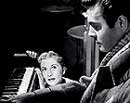 Examples:
prominent "weepies" include Letter
From an Unknown Woman (1948) (shown above) and Mildred
Pierce (1945), and any of director Douglas Sirk's lurid melodramas
of the 50s, such as Magnificent Obsession (1954), All That
Heaven Allows (1955), Imitation of Life (1959), and Written
on the Wind (1956). Examples:
prominent "weepies" include Letter
From an Unknown Woman (1948) (shown above) and Mildred
Pierce (1945), and any of director Douglas Sirk's lurid melodramas
of the 50s, such as Magnificent Obsession (1954), All That
Heaven Allows (1955), Imitation of Life (1959), and Written
on the Wind (1956). |
|
| a filmic device in which a scene, character, object, and/or action may be associated, identified, or interpreted as an implied representation of something else (that is unrelated) | 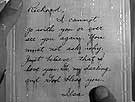 Example:
Hitchcock's use of the image of a train tunnel at the conclusion of North
by Northwest (1959) to metaphorically signify sex, or the rain-drenched
(like tears falling) sad farewell letter from Ilsa to Rick in Casablanca
(1942) Example:
Hitchcock's use of the image of a train tunnel at the conclusion of North
by Northwest (1959) to metaphorically signify sex, or the rain-drenched
(like tears falling) sad farewell letter from Ilsa to Rick in Casablanca
(1942) |
|
| a style of acting first expounded by Konstantine Stanislavsky in the early 1900s, and popularized by Lee Strasberg (1899-1982) in the US in his Actors Studio; refers to actors who gave realistic performances based upon and drawn from their own personal experiences and emotions; refers to not emoting in the traditional manner of stage conventions, but to speak and gesture in a manner used in private life. | 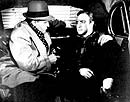 Example:
Marlon Brando was known as one of the main practitioners of method
acting, seen here in the famous taxicab scene in On
the Waterfront (1954); other proponents of method acting included
James Dean and Montgomery Clift. Example:
Marlon Brando was known as one of the main practitioners of method
acting, seen here in the famous taxicab scene in On
the Waterfront (1954); other proponents of method acting included
James Dean and Montgomery Clift. |
|
| offbeat, often independent (non-Hollywood) counter-cultural cult films exhibited at theatres for late-night shows - sometimes involving audience participation; appealed to various small segments of niche audiences with different tastes; these films (originally sexual thrillers, slasher flicks, etc.) were often box-office bombs upon initial release, but then gained a faithful following; the phenomenon began in the early 70s, then mostly disappeared in the 80s, but has recently been revived. | Examples: Freaks (1932), Reefer Madness (1936), Night of the Living Dead (1968), Mondo Trasho (1969), Beyond the Valley of the Dolls (1970), El Topo (1970, Mex.), Harold and Maude (1971), The Harder They Come (1972), Pink Flamingos (1972), The Texas Chainsaw Massacre (1974), the long-running The Rocky Horror Picture Show (1975), Eraserhead (1977), and recently The Adventures of Priscilla, Queen of the Desert (1994), Office Space (1999) and Donnie Darko (2001) |
|
(or pantomime) |
acting without words, emphasizing facial expressions, body movements, and gestures; common during the silent film era. | 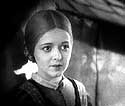 Example:
the films of Charlie Chaplin; or Janet Gaynor's Oscar-winning performance
in F.W. Murnau's classic Sunrise (1927) (shown
here). Example:
the films of Charlie Chaplin; or Janet Gaynor's Oscar-winning performance
in F.W. Murnau's classic Sunrise (1927) (shown
here). |
| small-scale models photographed to give the illusion that they are full-scale objects; also known as model or miniature shots. | 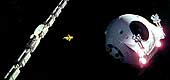 Examples: the space craft in Star Wars (1977) and 2001: A Space Odyssey (1968) |
|
| refers to an actor/actress who is completely wrong, untalented, or unbelievable for the role he or she has been cast in. | Examples: John Wayne as Temujin (Genghis Khan) in The Conqueror (1956), Barbra Steisand as Dolly Levi in Hello, Dolly! (1969) | |
a French term for "staging," or "putting into the scene or shot"; in film theory, it refers to the sum total of all the factors or elements placed (by the director) before the camera and within the frame of the film, in order to affect the artistic look and feel of the shot -- including their visual arrangement and composition; elements include settings, decor, props, actors, costumes, makeup, lighting, performances, and character movements and positioning; lengthy, un-cut, unedited and uninterrupted sequences shot in real-time are often cited as examples of mise-en-scene; contrast to montage |
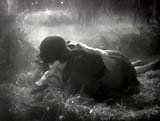 Examples:
the harsh lighting or expressionistic angles used in classic film noirs
(such as in Fritz Lang's work), in F.W. Murnau's Sunrise
(1927) with the striking contrast between the marsh, rural life
and the city; or in angular set designs of The Cabinet of
Dr. Caligari (1920, Germ.); Examples:
the harsh lighting or expressionistic angles used in classic film noirs
(such as in Fritz Lang's work), in F.W. Murnau's Sunrise
(1927) with the striking contrast between the marsh, rural life
and the city; or in angular set designs of The Cabinet of
Dr. Caligari (1920, Germ.); 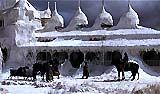 or
in the visual magnificence of the sets in David Lean's epic films, such
as the frozen dacha in Doctor Zhivago (1965) (pictured) or the
searing desert in Lawrence of Arabia (1962),
or in the claustrophobic feel on-board the Orca searching for the Great
White in Spielberg's Jaws (1975) or
in the visual magnificence of the sets in David Lean's epic films, such
as the frozen dacha in Doctor Zhivago (1965) (pictured) or the
searing desert in Lawrence of Arabia (1962),
or in the claustrophobic feel on-board the Orca searching for the Great
White in Spielberg's Jaws (1975) |
|
| the electrical combination of different sounds, dialogue, music, and sound effects from microphones, tape, and other sources onto the film's master soundtrack during post-production; dubbing (or re-recording) refers to the mixing of all soundtracks into a single composite track; the soundtrack is blended by a mixer (chief sound recording technician) | ||
|
|
a fictional, farcical film that has the style, 'look and feel' of a documentary, with irreverent humor, parody, or slapstick, that is deliberately designed to 'mock' the documentary or subject that it features; related to docudrama (a film that depicts real people and actual events in their lives) | 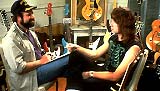 Examples:
This is Spinal Tap (1984) (pictured), Best in Show (2000),
Zelig (1983), Husbands and Wives (1992), Bob Roberts (1992),
Waiting for Guffman (1996), Drop Dead Gorgeous (1999) Examples:
This is Spinal Tap (1984) (pictured), Best in Show (2000),
Zelig (1983), Husbands and Wives (1992), Bob Roberts (1992),
Waiting for Guffman (1996), Drop Dead Gorgeous (1999) |
|
(or modern-day) classic |
a popular, critically-acclaimed film in recent years destined (possibly?) to ultimately become an all-time classic | Examples: Saving Private Ryan (1998), or Groundhog Day (1993) |
|
|
refers to a domineering, autocratic head of a major film studio; most commonly used when the studio system dominated film-making; now popularly called a studio chief | Example: Louis B. Mayer of MGM |
|
|
aka payoff shot; a term originally borrowed from the pornographic film industry; referring to a scene, image, revelation, or climactic moment that gives the audience "their money's worth," may have cost the most money to produce - and may be the key to the movie's success | 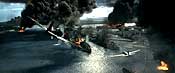 Examples:
the transformation scene in classic horror films in which the character
grows hair and fangs; Darth Vader cutting off Luke Skywalker's hand in The
Empire Strikes Back (1980), the attack and bomb 'POV' (point-of-view)
shot in Pearl Harbor (2001) (above), the first sight of Gilda in
Gilda (1946), or Halle Berry's toplessness
revealed behind a book in Swordfish (2001) Examples:
the transformation scene in classic horror films in which the character
grows hair and fangs; Darth Vader cutting off Luke Skywalker's hand in The
Empire Strikes Back (1980), the attack and bomb 'POV' (point-of-view)
shot in Pearl Harbor (2001) (above), the first sight of Gilda in
Gilda (1946), or Halle Berry's toplessness
revealed behind a book in Swordfish (2001) |
|
|
refers to a
small television screen hooked up to the camera and/or recording device
that allows crew other than the camera operator to check the quality of
a scene as it is being shot or to check and see if it needs to be reshot |
|
|
|
a scene or a portion of a script in which an actor gives a lengthy, unbroken speech without interruption by another character; see also soliloquy. See Best Film Speeches and Monologues |
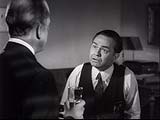 Example:
Keyes' (Edward G. Robinson) long speech about suicide statistics in Double
Indemnity (1944), or Romeo's last embrace and death scene in Romeo
and Juliet (1968) Example:
Keyes' (Edward G. Robinson) long speech about suicide statistics in Double
Indemnity (1944), or Romeo's last embrace and death scene in Romeo
and Juliet (1968) |
|
|
a French word literally meaning "editing", "putting together" or "assembling shots"; refers to a filming technique, editing style, or form of movie collage consisting of a series of short shots or images that are rapidly put together into a coherent sequence to create a composite picture; a montage usually suggests and conveys meaning or a larger idea or theme, or denotes the passage of time; in simple terms, it refers to the structure of editing within a film; a montage is usually not accompanied with dialogue; dissolves, cuts, fades, super-impositions, and wipes are often used to link the images in a montage sequence; an accelerated montage is composed of shots of increasingly-shorter lengths; contrast to mise-en-scene |
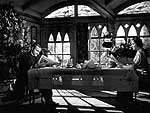 Examples:
the famous 'breakfast' montage scene in Citizen Kane (1941)
- that dramatized the deterioration of Kane's first marriage; the ambush
scene in Bonnie and Clyde (1967), the 45
second shower scene in Psycho (1960) -
with between 71-78 camera set-ups for the shooting of the scene and 50
splices (where two pieces of film are joined); or the 'Odessa Steps'
montage in Sergei Eisenstein's Battleship Potemkin (1925) including three
successive shots of stone lions in various positions - filmed to look
as though they were one lion rising to its feet and roaring in fury and
anger at the massacre Examples:
the famous 'breakfast' montage scene in Citizen Kane (1941)
- that dramatized the deterioration of Kane's first marriage; the ambush
scene in Bonnie and Clyde (1967), the 45
second shower scene in Psycho (1960) -
with between 71-78 camera set-ups for the shooting of the scene and 50
splices (where two pieces of film are joined); or the 'Odessa Steps'
montage in Sergei Eisenstein's Battleship Potemkin (1925) including three
successive shots of stone lions in various positions - filmed to look
as though they were one lion rising to its feet and roaring in fury and
anger at the massacre |
|
|
the term for a child, or pre-teen child actor | 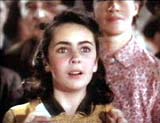 Examples:
Elizabeth Taylor in National Velvet (1944) (pictured), Shirley Temple,
or Mickey Rooney. Examples:
Elizabeth Taylor in National Velvet (1944) (pictured), Shirley Temple,
or Mickey Rooney. |
|
|
a literary term mostly, but used also to refer to a film (often heavy-handed and obvious in tone) that presents a judgment on the goodness/badness of human behavior and character, and emphasizes the struggle between good and evil | Examples: Intolerance (1916), Quiz Show (1994), The Lord of the Rings trilogy |
|
|
the transformation of one digital image into another with computer animation. |
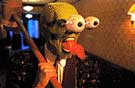 Examples:
The Mask (1994) (shown above), Terminator
2: Judgment Day (1991), Stargate (1994), and Interview
with the Vampire (1994). Examples:
The Mask (1994) (shown above), Terminator
2: Judgment Day (1991), Stargate (1994), and Interview
with the Vampire (1994). |
|
|
refers to a recurrent thematic element in a film that is repeated in a significant way or pattern; examples of motifs - a symbol, stylistic device, image, object, word, spoken phrase, line, or sentence within a film that points to a theme. |
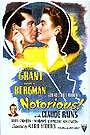 Examples: Keys in Hitchcock's Notorious (1946),
seen in the poster design for the film; the word 'Rosebud' in Citizen
Kane (1941); and the visual use of the X-symbol in the gangster
film Scarface (1932) signifying male violence
Examples: Keys in Hitchcock's Notorious (1946),
seen in the poster design for the film; the word 'Rosebud' in Citizen
Kane (1941); and the visual use of the X-symbol in the gangster
film Scarface (1932) signifying male violence |
|
(movies, pic(s), pix, or "moving pictures") |
a length of film (with or without sound) with a sequence of images that create an illusion of movement when projected; originally referred to the motion or movement (due to the principle of persistence of vision) perceived when a string of celluloid-recorded images were projected at a rate of 16 or more frames per second; an art form, and one of the most popular forms of entertainment, known archaically as a photoplay during the silent era. |
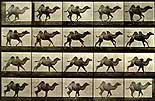 Example:
from Edweard Muybridge's 'animal animation' or 'persistence of vision'
experiments in the late 19th century. Example:
from Edweard Muybridge's 'animal animation' or 'persistence of vision'
experiments in the late 19th century. |
|
|
refers to lighting (or a light source) that is naturally existing in the real world, i.e., from a lamp post, table lamp, sunlight shining through a window, etc., that appears in a scene; for the lighting to appear natural in a film scene, it should seem to be coming from light sources that are visible or implied within the scene; the opposite effect is unmotivated lighting | 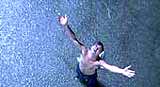 Example:
Andy's crucifixion victory stance in The Shawshank
Redemption (1994) was lit by unmotivated or inexplicable lighting Example:
Andy's crucifixion victory stance in The Shawshank
Redemption (1994) was lit by unmotivated or inexplicable lighting |
|
|
a slang term for the Walt Disney Co. or any division thereof -- refers to the company's most famous animated character: Mickey Mouse | |
|
|
acronym-initials meaning 'Motion Picture Association of America' - an organization that represents the interests of the major motion picture studios | |
| refers to the style of filming and editing first found on the MTV cable channel in the 1980s and its music videos, consisting of rapidly-cut shots, fast-paced action, jump-cuts, fast-edits, numerous camera angles | Example: first evidenced in the films of surrealists, and during the New Wave era; more recently in films such as Easy Rider (1969), Flashdance (1983), and Oliver Stone's Natural Born Killers (1994) | |
|
|
a major film genre category denoting a film that emphasizes segments of song and dance interspersed within the action and dialogue; known for its distinctive artists, stars, singers, and dancers; two major types are 'backstage' musicals and 'music-integrated' musicals. |  Examples:
42nd Street (1933), Singin'
in the Rain (1952), Seven Brides for Seven Brothers (1954),
An American in Paris (1951), West Side
Story (1961), The Music Man (1962), My
Fair Lady (1964), The Sound of Music (1965),
and Mary Poppins (1964) Examples:
42nd Street (1933), Singin'
in the Rain (1952), Seven Brides for Seven Brothers (1954),
An American in Paris (1951), West Side
Story (1961), The Music Man (1962), My
Fair Lady (1964), The Sound of Music (1965),
and Mary Poppins (1964) |
|
|
a print with only the picture image (minus the sound track) | |




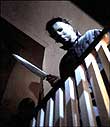 Examples:
a low-angle camera angle from John Carpenter's
Examples:
a low-angle camera angle from John Carpenter's