|

(alphabetical and illustrated) Introduction | A - 1 | A - 2 | B - 1 | B - 2 | C - 1 | C - 2 | C - 3 | D | E | F G - H | I - J - K | L - M | N - O | P | Q - R | S - 1 | S - 2 | T | U - V - W - X - Y - Z |
|
|
|
|
|
|
a clever phrase or short sentence to memorably characterize a film, and tease and attract potential viewers, or sell the movie; also creates a catchy 'soundbite' often repeated or presented in a trailer or on a film's poster, sometimes along with the film's leitmotif | 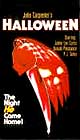 Examples:
"This is the weekend they didn't play golf" (Deliverance
(1972)), "The Night He Came Home!" (Halloween
(1978)), "Where were you in '62?" (American
Graffiti (1973)), "Small town. Big crime. Dead cold" (Fargo
(1996)), "This is Maggie the Cat..." (Cat
on a Hot Tin Roof (1958)), "It's Terrific!" (Citizen
Kane (1941)) Examples:
"This is the weekend they didn't play golf" (Deliverance
(1972)), "The Night He Came Home!" (Halloween
(1978)), "Where were you in '62?" (American
Graffiti (1973)), "Small town. Big crime. Dead cold" (Fargo
(1996)), "This is Maggie the Cat..." (Cat
on a Hot Tin Roof (1958)), "It's Terrific!" (Citizen
Kane (1941)) |
|
|
a single continuously-recorded performance, shot or version of a scene with a particular camera setup; often, multiple takes are made of the same shot during filming, before the director approves the shot; in box-office terms, take also refers to the money a film's release has made | |
|
|
a term applied to the actors, as a group, on a film set | |
|
|
the common term used for films with sound (beginning in 1927), although rarely used currently. The advent of talkies marked the dawning of the era of sound films, as opposed to silent films | 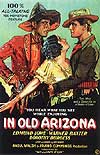 Example:
the landmark film In Old Arizona (1929), was advertised as "100%
All-Talking", and "You Hear What You See" on its poster,
because it was the first sound western from a major studio (Fox Pictures);
Singin' in the Rain (1952) took a look back
at the dawning of the talkies Example:
the landmark film In Old Arizona (1929), was advertised as "100%
All-Talking", and "You Hear What You See" on its poster,
because it was the first sound western from a major studio (Fox Pictures);
Singin' in the Rain (1952) took a look back
at the dawning of the talkies |
|
|
a medium shot of people conversing; used as a criticism - denoting an uninteresting image | |
|
|
a slang term, meaning to "pick", "select", "name", or "appoint" | |
|
|
an excessively-sentimental or emotional film, usually with suffering female protagonists, tragic circumstances, manipulative scenes, and dramatic musical scoring; aka melodramas or weepies; derogatively known as a 'woman's film' or 'chick flick'; contrast to feel-good film | 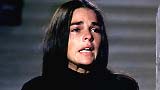 Examples:
Dark Victory (1939), Now,
Voyager (1942), Mildred Pierce (1945),
Letter From an Unknown Woman (1948),
Love Story (1970) (pictured), Beaches (1988), and Steel
Magnolias (1989) Examples:
Dark Victory (1939), Now,
Voyager (1942), Mildred Pierce (1945),
Letter From an Unknown Woman (1948),
Love Story (1970) (pictured), Beaches (1988), and Steel
Magnolias (1989) |
|
|
the trade name for the best known color film process; 3-strip color is often used as a synonymous term; also used generically as a term for rich, bright, vibrant, sometimes garish colors; Technicolor films were described as highly saturated (with pure and vivid colors); Technicolor (a 3-color dye transfer system) was introduced in the Disney short cartoon, Flowers and Trees (1932) | 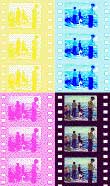 This
new process in the 1930s involved a camera that used prisms to split the
light coming through the lens onto three strips of black-and-white film,
one each for the primary colors (red, green, blue; with complementary color
dyes: cyan, magenta, yellow) This
new process in the 1930s involved a camera that used prisms to split the
light coming through the lens onto three strips of black-and-white film,
one each for the primary colors (red, green, blue; with complementary color
dyes: cyan, magenta, yellow) |
|
|
modern day (or post-modern) expressionistic film noirs set in the future, with dark, decaying societies | 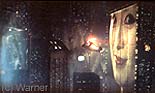 Examples:
Ridley Scott's Alien (1979) and Blade
Runner (1982) (pictured), Outland (1981), Nineteen Eighty-Four
(1984), The Terminator (1984), Robocop
(1987), Total Recall (1990), Kathryn Bigelow's Strange Days
(1995), Andrew Niccol's Gattaca (1997), Alex Proyas' Dark
City (1998), and David Cronenberg's eXistenZ (1999) Examples:
Ridley Scott's Alien (1979) and Blade
Runner (1982) (pictured), Outland (1981), Nineteen Eighty-Four
(1984), The Terminator (1984), Robocop
(1987), Total Recall (1990), Kathryn Bigelow's Strange Days
(1995), Andrew Niccol's Gattaca (1997), Alex Proyas' Dark
City (1998), and David Cronenberg's eXistenZ (1999) |
|
|
refers to a feature-length motion picture made for television; also known as telepic or telepix; see also made-for TV movie | |
|
(lens) |
refers to a camera lens with a very long focal length and narrow angle of view - the effect is to compress or condense depth in space, thereby bringing distant objects closer to the viewer (without moving the camera), but it also flattens the depth of the image; it has the opposite of the effect of a wide-angle lens |
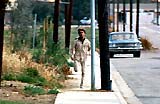 Example:
Mike Nichols' The Graduate (1967) and the
extreme telephoto shot of Benjamin (Dustin Hoffman) running towards the
church - and appearing to run in place; Example:
Mike Nichols' The Graduate (1967) and the
extreme telephoto shot of Benjamin (Dustin Hoffman) running towards the
church - and appearing to run in place; 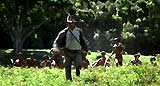 or the scene of Indy Jones (Harrison Ford) running from natives in the opening sequence of Raiders of the Lost Ark (1981) or the scene of Indy Jones (Harrison Ford) running from natives in the opening sequence of Raiders of the Lost Ark (1981) |
|
|
an industry slang or trendy buzzword term, meaning a film that is expected to serve as a primary support for a studio, i.e., to be a top-grossing blockbuster (usually during the summer season), to compensate for a studio's other flops; usually the film is the start of, or an installment in, a franchise | Example: Armageddon (1998) and other $100 million-plus films, such as Spider-Man (2002) or Shrek (2001) |
|
(film) |
the place for screening, presenting, or viewing a film or motion picture; aka cinema | |
|
|
a slang term referring to a feature-length motion picture | |
|
(film) |
the central characteristic, idea, concern or motif in a film | |
|
|
the opening or closing music of a motion picture, often containing the film's 'signature' or leitmotif tune/phrase that is associated with a character or situation within the film | Examples: 'Laura's theme' in Laura (1944), John Williams' shark music in Jaws (1975). |
| a film that has a three-dimensional, stereoscopic form or appearance, giving the life-like illusion of depth; often achieved by viewers donning special red/blue (or red/green) polarized lens glasses; when 3-D images are made interactive so that users feel involved with the scene, the experience is called virtual reality; 3-D experienced a heyday in the early 1950s; aka 3D, three-D, Stereoscopic 3D, Natural Vision 3D, or three-dimensional | Examples: the first major 3D feature film was Bwana Devil (1953) [the first was Power of Love (1922)], House of Wax (1953), Cat Women of the Moon (1953), the MGM musical Kiss Me Kate (1953), Warner's Hondo (1953), a version of Hitchcock's Dial M for Murder (1954) and Universal's Creature From the Black Lagoon (1954), Comin' At Ya! (1981), a segment of Freddy's Dead: The Final Nightmare (1991), Spy Kids 3D: Game Over (2003) |
|
|
|
refers to a medium shot that contains three people; compare to two-shot | |
|
|
refers to any commercial venture connected to a film | Examples: the simultaneous release of a novel and the film based upon it, or of model characters, such as the Harry Potter novels |
| a cinematography term that refers to a close-up camera shot of the subject, aka extreme closeup or tight framing | ||
|
(or oblique angle) |
a camera tilted up or down on a diagonal along a vertical axis; a vertical camera movement from a fixed position often used to suggest an imbalance, or strangeness, or to emphasize size, power or menace; also known as tilt pan, tilt up or tilt down (or reveal), or vertical pan, although not technically the same as "pan up" or "pan down", similar to a moving close-up; a dutch angle is filmed at an extreme diagonal tilt | |
|
|
a method of filming where frames are shot much slower than their normal rate, allowing action to take place between frames, and giving the appearance of the action taking place much faster in the finished product; often done for nature filming (the blooming of a flower, the movement of clouds, etc.), allowing the viewer to witness the event compressed from real time (hours or days) into a few seconds; (one frame shot every 30 seconds over 24 hours of real time would equal two minutes of film time); opposite of slow-motion | 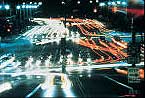 Example:
Koyaanisqatsi (1982) Example:
Koyaanisqatsi (1982) |
|
|
the use of color to physically tint film stock to achieve a desired mood, usually done selectively by hand; often used by silent black-and-white films before the widespread use of color film. See gel and sepia. | 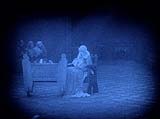 Example:
The Great Train Robbery (1903) was selectively
hand-tinted. D.W. Griffith's Intolerance (1916)
(pictured) tinted each of its four episodes (and its "cradle rocking"
interludes) in a different color: the "Modern" Story was tinted
amber, the "Judean" Story was tinted blue, the "French"
Story was tinted in sepia, and the "Babylonian" Story was tinted
grey-green. Gold tinting was also used to "color" the gold, brass
beds, gold teeth, gilt frames, and the canary cage in Greed
(1924). The 1984 re-release of Fritz Lang's Metropolis
(1927) also tinted various scenes Example:
The Great Train Robbery (1903) was selectively
hand-tinted. D.W. Griffith's Intolerance (1916)
(pictured) tinted each of its four episodes (and its "cradle rocking"
interludes) in a different color: the "Modern" Story was tinted
amber, the "Judean" Story was tinted blue, the "French"
Story was tinted in sepia, and the "Babylonian" Story was tinted
grey-green. Gold tinting was also used to "color" the gold, brass
beds, gold teeth, gilt frames, and the canary cage in Greed
(1924). The 1984 re-release of Fritz Lang's Metropolis
(1927) also tinted various scenes |
|
|
the lead part in a movie or other production for an actor or actress, that is named after the title of the film | 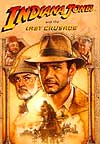 Example:
Harrison Ford in the title role in Indiana Jones and the Last Crusade
(1989), or Angelina Jolie in the title role of Lara Croft: Tomb Raider
(2001) Example:
Harrison Ford in the title role in Indiana Jones and the Last Crusade
(1989), or Angelina Jolie in the title role of Lara Croft: Tomb Raider
(2001) |
|
|
the words that appear on the
film screen and convey information; categories of titles include: credit
titles, main titles, end titles, insert titles,
and subtitles; a creeper title, also known as a roll-up
title, refers to a film title that appears to move solwly across
the screen - vertically or horizontally; in silent film, "titles"
(called title cards or intertitles) included the written
commentary and full screens of textual dialogue spliced within the action; title
design refers to the artistic manner in which the title of a film
is displayed on screen; the working title is the name by which
a film is known while it is being made (e.g., during the filming of Psycho
(1960), it was known as Production 9401); see Movie
Title Screens; see also credits |
|
|
|
abbreviation for tickets |
|
|
|
the mood or atmosphere of a film scene, often revealed by the director in the way a film is directed, e.g., serious, humorous, satiric, amusing, etc. | |
|
|
abbreviation for cartoon | |
|
|
to star; or to be billed above the title of a film; the topliner is the star of a particular film | 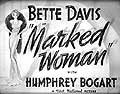 Example:
Bette Davis, top-billed or starring in the melodrama Marked Woman (1937),
with lesser billed and lesser-known actor Humphrey Bogart. Example:
Bette Davis, top-billed or starring in the melodrama Marked Woman (1937),
with lesser billed and lesser-known actor Humphrey Bogart. |
|
|
refers to the head of a company or organization | |
|
|
literally "forceful turn" (French); usually refers to a lead actor's performance that was incredibly skillful, brilliant, notable, masterful, reflecting a very high standard, and perfectly displaying the actor's ability; compare to 'stealing a scene' - the equivalent for a supporting actor role | 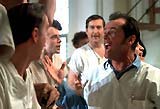 Examples:
Rosalind Russell in His Girl Friday (1940)
as Hildy Johnson, and Jack Nicholson in One Flew
Over the Cuckoo's Nest (1975) as Randle P. McMurphy (pictured). Examples:
Rosalind Russell in His Girl Friday (1940)
as Hildy Johnson, and Jack Nicholson in One Flew
Over the Cuckoo's Nest (1975) as Randle P. McMurphy (pictured). |
|
(or truck) |
a smooth shot in which the camera moves alongside ('tracking within') or follows the subject through space, usually with the camera mounted on a dolly (on a dolly track); often seen as a side-to-side motion (relative to the scene or the action); also known as following shot; sometimes used interchangeably with dolly shot, pull back shot (pull-out, push-out, widen-out or push-back), track back (moving away) or track in (or push-in) (moving forward), or zoom shot; see also Steadicam |
|
|
|
refers to a personal touch or embellishment of an actor, director, writer or producer within a film; aka signature, calling card. | Example: Hitchcock's 'cameos' in all of his films, or Stanley Kubrick's use of the in-joke CRM-114 (in 2001: A Space Odyssey (1969), the serial number on one of the pods was "CRM114"; in his A Clockwork Orange (1971), the central character Alex was injected with "serum 114" - CRM=serum; in Eyes Wide Shut (1999), the mortuary was located on Level/Wing C, Room 114) |
|
|
refers to the professional magazines and publications that report the daily or weekly entertainment news of the entertainment industry. | 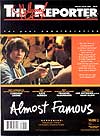 Examples:
Variety, and
the
Hollywood Reporter
(pictured here), and Boxoffice
Magazine. Examples:
Variety, and
the
Hollywood Reporter
(pictured here), and Boxoffice
Magazine. |
|
|
a short publicity film, preview, or advertisement composed of short excerpts and scenes from a forthcoming film or coming attraction, usually two-three minutes in length; often presented at the showing of another film. Historically, these advertisements were placed at the end of a newsreel or supporting feature and so "trailed" them, hence the name; also commonly known as preview(s); also, another name for the tail - a length of blank leader (strip of film) at the end of a reel; a teaser is basically a very short trailer (of 15-30 seconds in length) that only provides a few hints about the film (a Web address, a few bars of music, a quick sequence of images, specially-shot footage, etc.). |

|
|
(or transitional technique or device) |
one of several ways of moving from (or joining together) one shot or scene to the next one, including such transitional effects or shots as a cut, fade, dissolve, and wipe; a transition focus between two scenes means the current scene goes out of focus and the next scene comes into focus | 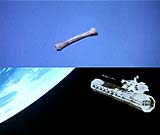 Example:
in 2001: A Space Odyssey
(1968), the bone-cut-to-satellite transition - one of the most famous
match cuts in cinematic history Example:
in 2001: A Space Odyssey
(1968), the bone-cut-to-satellite transition - one of the most famous
match cuts in cinematic history |
|
|
refers to second-run, low-budget films that are deliberately over-the-top, infantile, amateurish, sometimes excessively gory or raunchy which are intended to shock, disgust, and repel mainstream audiences, and appeal to non-traditional audiences. Sometimes described as a sub-category of exploitation and cult films, or called a 'turkey' film. Compare with sexploitation, B-films, and Z-films. | 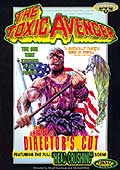 Examples:
Films distributed and produced by Troma Studios, the splatter films of Herschell
Gordon Lewis, Paul Morrissey's Trash (1970), John Waters' Pink
Flamingos (1972) and Female Trouble (1974), William Sach's The
Incredible Melting Man (1977), Meir Zarchi's Day of the Woman
(aka I Spit on Your Grave (1978)). Examples:
Films distributed and produced by Troma Studios, the splatter films of Herschell
Gordon Lewis, Paul Morrissey's Trash (1970), John Waters' Pink
Flamingos (1972) and Female Trouble (1974), William Sach's The
Incredible Melting Man (1977), Meir Zarchi's Day of the Woman
(aka I Spit on Your Grave (1978)). |
|
|
a film made for the purpose of showing scenes from foreign, exotic places | Example: Around the World in 80 Days (1956) |
|
|
a detailed literary summary or presentation of a film's story (and each major scene), with action and characters described in prose form, and sometimes including bits of dialogue; often used to market and/or sell a film project or script; usually it is an abridged script longer than a synopsis (a brief summation of a film); a completed treatment is a late stage in the development of a screenplay after several story conferences have incorporated changes into the script | |
| a group of three films that together compose a larger narrative and are related in subject or theme | 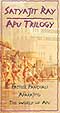 Examples:
Coppola's three Godfather films, the Terminator films trilogy,
Terry Gilliam's 'Age of Reason' trilogy, Satyajit Ray's Apu trilogy,
the Lord of the Rings trilogy,
Ingmar Bergman's trilogy, the Qatsi trilogy, Spielberg's original
trilogy of 'Indiana Jones' films,
the original Star Wars trilogy,
and Kieslowski's 'Three Colors' films Examples:
Coppola's three Godfather films, the Terminator films trilogy,
Terry Gilliam's 'Age of Reason' trilogy, Satyajit Ray's Apu trilogy,
the Lord of the Rings trilogy,
Ingmar Bergman's trilogy, the Qatsi trilogy, Spielberg's original
trilogy of 'Indiana Jones' films,
the original Star Wars trilogy,
and Kieslowski's 'Three Colors' films |
|
| refers to an actor or actress who can sing, dance and act skillfully and equally well on a consistent basis; usually applicable to performers in the musicals genre; it also could refer to a person who can act, direct, and screenwrite! | 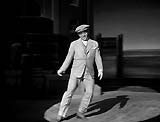 Examples:
Fred Astaire, Ginger Rogers, James Cagney (pictured, from Yankee
Doodle Dandy (1942)), Deborah Kerr; also Orson Welles, Charlie
Chaplin, Warren Beatty, Woody Allen, Robert Redford, etc. Examples:
Fred Astaire, Ginger Rogers, James Cagney (pictured, from Yankee
Doodle Dandy (1942)), Deborah Kerr; also Orson Welles, Charlie
Chaplin, Warren Beatty, Woody Allen, Robert Redford, etc. |
|
| a term that denotes to promote or draw attention to; usually conducted by publicists, advertisers, and agents; from the ancient show business custom of actors wandering the streets banging on tubs and drums to draw an audience together | ||
| refers to a film or project that has been abandoned by a studio and is no longer active (and now available for being shopped to another studio) | ||
| refers to the standard frame rate or film speed - the number of frames or images that are projected or displayed per second; in the silent era before a standard was set, many films were projected at 16 or 18 frames per second, but that rate proved to be too slow when attempting to record optical film sound tracks; aka 24fps or 24p | 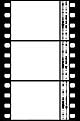 Example:
at 24 fps, 4 projected frames take 1/6 second to view Example:
at 24 fps, 4 projected frames take 1/6 second to view |
|
| a film that is marketed as having a surprise ending that shouldn't be revealed (as a spoiler) to those who haven't seen the picture | 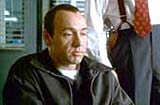 Examples: Citizen
Kane (1941), Psycho (1960), Planet
of the Apes (1968), Soylent Green (1973), The
Empire Strikes Back (1980), Angel Heart (1987), No Way
Out (1987), The Crying Game (1992), Se7en (1995), The
Usual Suspects (1995) (pictured), Primal Fear (1996), Arlington
Road (1999), The Sixth Sense (1999), Fight Club (1999),
The Others (2001), and Shrek (2001) Examples: Citizen
Kane (1941), Psycho (1960), Planet
of the Apes (1968), Soylent Green (1973), The
Empire Strikes Back (1980), Angel Heart (1987), No Way
Out (1987), The Crying Game (1992), Se7en (1995), The
Usual Suspects (1995) (pictured), Primal Fear (1996), Arlington
Road (1999), The Sixth Sense (1999), Fight Club (1999),
The Others (2001), and Shrek (2001) |
|
| slang for coupons that discount an film's admission price to "two for" the price of one | ||
| refers to a film with only two characters | Example: Sleuth (1972), with Michael Caine and Laurence Olivier | |
| in the silent era, this referred to a film lasting a little over 20 minutes | 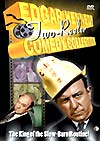 Example:
Silent era Edgar Kennedy's many two-reelers of comedy shorts (with Mack
Sennett and Hal Roach) Example:
Silent era Edgar Kennedy's many two-reelers of comedy shorts (with Mack
Sennett and Hal Roach) |
|
| a medium or close-up camera shot of two people (often in dialogue with each other), often framed from the chest up; often used to provide a contrast between the two characters; compare to three-shot |
| |
| when an actor or actress is commonly (but unfairly) identified, associated with, or 'stereotyped' by a particular character role; casting against type is the reverse of typecasting; typage refers to director Eisenstein's theory of casting that shunned professional actors in favor of 'types' or representative characters | 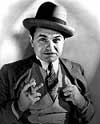 Example:
Edward G. Robinson - well-known as a 'tough guy', snarling gangster,
such as in Key Largo (1948) or Little
Caesar (1930); or 'good-girl' Deanna Durbin cast against type
in her first adult role as a sultry songstress-hostess (prostitute) in
the film noirish
Christmas Holiday (1944) Example:
Edward G. Robinson - well-known as a 'tough guy', snarling gangster,
such as in Key Largo (1948) or Little
Caesar (1930); or 'good-girl' Deanna Durbin cast against type
in her first adult role as a sultry songstress-hostess (prostitute) in
the film noirish
Christmas Holiday (1944) |
|





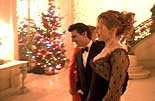 Examples:
from
Examples:
from 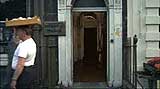 also
the famous track-back shot from upstairs to the outside of an apartment
in Frenzy (1972) (pictured); the 8 minute shot in Jean-Luc Godard's Weekend (1967) viewing surrealistic and nightmarishly apocalyptic images of the roads littered with traffic jams, car wrecks and accidents, bloody casualties, and burning cars; the opening shot in Boogie Nights (1997) that tracked into the 70s disco; also the 3-minute entrance of Ray Liotta and Lorraine Bracco into the Copacabana club in Scorsese's
also
the famous track-back shot from upstairs to the outside of an apartment
in Frenzy (1972) (pictured); the 8 minute shot in Jean-Luc Godard's Weekend (1967) viewing surrealistic and nightmarishly apocalyptic images of the roads littered with traffic jams, car wrecks and accidents, bloody casualties, and burning cars; the opening shot in Boogie Nights (1997) that tracked into the 70s disco; also the 3-minute entrance of Ray Liotta and Lorraine Bracco into the Copacabana club in Scorsese's 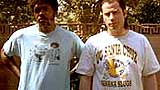 Examples
of a medium closeup (two-shot)
Examples
of a medium closeup (two-shot)