|
Greatest War Movies 1930s |

| Film Title/Year/Director, War-time Setting and Brief Description | ||
|
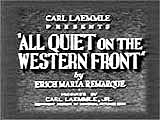
All
Quiet on the Western Front (1930)
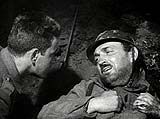
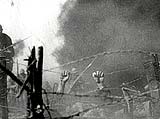
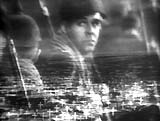
This stirring, impassioned film, the first sound film to win the Best Picture Academy Award, is possibly the greatest anti-war film ever made. It was based upon the 1929 novel by Erich Maria Remarque that viewed the Great War from the German point of view. All of the young idealistic German youths who went to the front to voluntarily serve the Fatherland became disillusioned and ended up victims of the struggle. It portrayed soldiers as human beings who were ravaged by their experiences. The film documented their descent into war (and disillusionment) in graphic detail, from the everyday reality of trench warfare to starvation and butchery. The film tracked the boys in training, battle, and eventually their senseless, untimely deaths. The film ended simplistically on the day of Armistice -- young soldier Paul's (Lew Ayres) death to the sound of the whine of a French sniper's bullet as his hand reached out to touch a beautiful butterfly from the shell-hole trench. The film's final images were composed of ghostly soldiers marching away, while superimposed over a dark, battle-scarred hillside covered with a sea of white crosses. |
|
|
Hell's
Angels (1930)
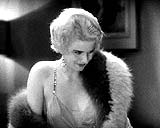
Millionaire playboy director/producer Howard Hughes' expensive film featured more impressive WWI aerial battle sequences and special effects than any film before. It also highlighted the debut of platinum blonde sex symbol Jean Harlow (speaking the famous saucy line: "Would you be shocked if I put on something more comfortable?") in love with two English brothers, Monte and Roy Rutledge (Ben Lyon and James Hall) who were British Royal Flying Corps pilots. |
|
|
Duck
Soup (1933)
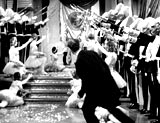
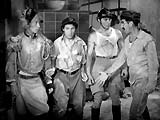
This Hal Roach studio short comedy was The Marx Brothers' greatest and funniest masterpiece. It was a brilliant satire and lampooning of blundering dictatorial leaders, Fascism and authoritarian government. Groucho played Rufus T. Firefly, the incompetent king of Freedonia (with Chico as Chicolini and Harpo - as Pinky - as his incompetent spies) who wooed the dowager millionairess Mrs. Sara Teasdale (Margaret Dumont). Easily offended, he waged war on the neighboring country of Sylvania because of a slight insult. One of the Marx Brothers' funniest, most surreal, anarchic films with the famous battle scene at its finale. The outrageous film was both a critical and commercial failure at the time of its release - audiences were taken aback by such preposterous political disrespect, buffoonery and cynicism at a time of political and economic crisis, with Roosevelt's struggle against Depression in the US amidst the rising power of Hitler in Germany. |
|
|
The Informer (1935)
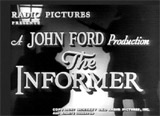
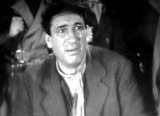
One of John Ford's greatest films, an Academy-Award winner based on the novel by Liam O'Flaherty. This profound expressionistic study of life in 1922 Dublin, Ireland was during the time of the violent Irish Sinn Fein civil rebellion. Gypo Nolan (Best Actor-winning Victor McLaglen), a big, slow-minded, hard-drinking Irish Dubliner, had been ejected from the IRA for refusing to shoot a deserter. Unemployed, he committed the ultimate traitorous act by revealing the identity and betraying his IRA leader and friend Frankie McPhillip (Wallace Ford) in order to collect a twenty pound reward from the hated British Black and Tans - money he hoped would pay for passage to America. Thereby, he began a downward spiral, especially after his friend died in custody. He was regretful, devastated and tormented by his decision and his conscience, drank away his reward money, and was put on trial (where he falsely accused Peter Mulligan (Donald Meek)) and became the object of revenge by the IRA. |
|
|
The Charge of the Light Brigade (1936)
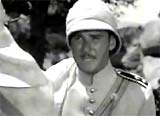
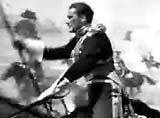
Michael Curtiz' historically-inaccurate film, a tale of 19th century imperialism, told about the memorable military engagement during the mid-19th century Crimean War. it also included a romantic pairing between Major Geoffrey Vickers (Errol Flynn) and Elsa Campbell (19 year old Olivia de Havilland). It included the climactic sequence of the famous light brigade charge of 600 soldiers during the Crimean War - an event which was in reality only 7 minutes long with only 30 seconds of intense gunfire. |
|
|
Scipione L'Africano
(1937, It.) (aka The Defeat of Hannibal)
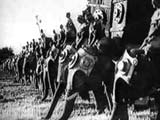
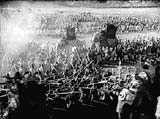
This propagandistic Italian film recreated part of Rome's Second Punic War (218-201 BC), the Battle of Zama in 202 BC, when the consul Publius Cornelius Scipio (Annibale Ninchi) invaded North Africa and defeated Rome's Carthaginian archenemy, Hannibal Barca (Camillo Pilotto) at Zama, with Hannibal's war elephants. The film was criticized for its inhumane treatment of animals in the battle scenes - some were maimed or killed for authenticity's sake. Scipio was later named Africanus for his triumph. The film's motto: "Victory or death" was appropriated by Fascist Italian dictator Benito Mussolini (Il Duce) to inspire his people, at the time of his invasion of Ethiopia. |
|
|
Grand Illusion
(1937, Fr.) (aka La Grande Illusion)
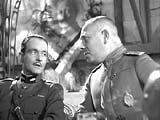
French director Jean Renoir's classic WWI POW drama idealistically expressed the 'grand illusion' and hypocrisy of men at war. The filmmaker attempted to signal a warning about warfare's 'grand illusions' with this classic anti-war film set in a WWI German prison camp in 1916. There, aristocratic French officer Capt. de Boeldieu (Pierre Fresnay) faced a dilemma regarding his escape with other POWs, including working class mechanic French officer/hero Lieut. Marechal (Jean Gabin) and wealthy middle-class Jew Lieut. Rosenthal (Marcel Dalio). They were imprisoned and under the watchful eye of German Captain von Rauffenstein (Eric von Stroheim). The film only implied that a war was occurring for the most part, and ended with Marechal and Rosenthal crossing the Alps to freedom in Switzerland, where a soldier spotted them and shouted: "Don't shoot! They are in Switzerland!". |
|

|
Alexander Nevsky (1938,
Soviet Union) (aka Aleksandr Nevskiy)
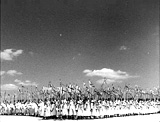
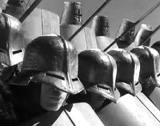
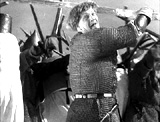
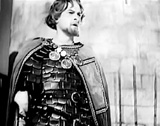
This nationalistic film presented the medieval story of the 13th century Russian prince Alexander Nevsky (Nikolai Cherkasov), enhanced with a superb score by Sergei Prokofiev. The set piece battle on the ice was parodied in Ken Russell's Billion Dollar Brain (1967). The film's most memorable and gripping sequence was the half-hour long battle scene on the blindingly-white ice at frozen Lake Chudskoye in 1242 on the boundary between Novgorod and Pskov. The conflict was between the invading barbaric Teutonic knights (wearing white capes and huge helmets) and the patriotic Russian army led by Prince Nevsky - both wielding spears and axes. In the battle's finale, as the defeated Germans fled, they were swallowed up when the ice started to crack and plunged them into the frigid water. In the film's ending, Nevsky delivered a stirring speech: "Go and tell all in alien lands that Russia (Rus) lives! Let all come and be our guests. But he who comes to us sword in hand, by the sword shall perish! On that our Russian land will forever take its stand! HE WHO COMES TO US SWORD IN HAND BY THE SWORD SHALL PERISH. ON THAT OUR RUSSIAN LAND WILL FOREVER TAKE ITS STAND." |
|
|
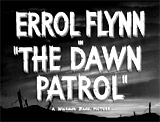
The Dawn Patrol (1938)
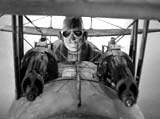
Errol Flynn took the lead role as insubordinate flight commander Captain Courtney and Basil Rathbone starred as the commander officer Major Brand forced to send amateur pilots of the 39th Squadron of the Royal Flying Corps into the air against ace German fliers. It was a remake of the 1930 film starring Douglas Fairbanks, Jr. and Richard Barthelmess as pilots, which told the story of the British Royal Flying Corps at a remote outpost in France during World War I. |
|
|
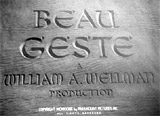
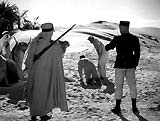
Beau Geste (1939)
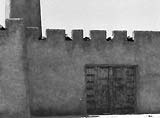
William Wellman's tale was a superb, high adventure set in the desert. The plot involved three Geste brothers (Gary Cooper, Robert Preston, and Ray Milland) who disappeared from England to avoid scandal and became members of the French Foreign Legion. The themes of the film included brotherly loyalty, patriotic honor, self-sacrifice, and treachery. The film opened with the enigmatic view of Fort Zinderneuf, later to be explained as the film progressed. |
|
|
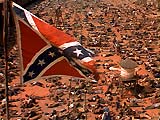
Gone With the Wind (1939)
The star-studded Civil War epic drama traced the South's tragic history during the war and the Reconstruction period. Set against this sweeping historical backdrop, the film followed a melodramatic romance between an indomitable, fiery Southern belle Scarlett O'Hara (Vivien Leigh) and a slyly-dashing war profiteer Rhett Butler (Clark Gable), tangled by her emotional love affair with a married Southern gentleman (Ashley Wilkes). She struggled to protect her family and her beloved plantation, Tara, from the ravages of the Civil War. |
|
(chronological by film title) Introduction | 1900s-1920s | 1930s | 1940s-1 | 1940s-2 | 1950s | 1960s-1 | 1960s-2 | 1970s | 1980s | 1990s | 2000s | 2010s |




 German
soldiers fighting on the front in WWI
German
soldiers fighting on the front in WWI