|
Greatest War Movies 1960s-2 |

| Film Title/Year/Director, War-time Setting and Brief Description | ||
|
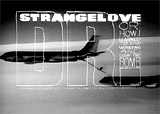
Dr. Strangelove, Or How I Learned to Stop Worrying and Love the Bomb (1964)
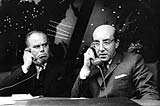
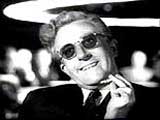
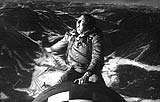
Kubrick's classic, nihilistic, cynical Cold War, satirical black comedy, had scathing humor and timeless performances, based on the novel Red Alert by Peter George and a script by Terry Southern. A crazed, psychotic US general Jack D. Ripper (Sterling Hayden), paranoid about his own potency and the Communists, sparked a nuclear crisis with a pre-emptive strike against "the Commies." The American President Muffley (Peter Sellers in one of three roles) must deal with gung ho military brass Gen. Buck Turgidson (George C. Scott), bureaucratic bumbling, a drunken Soviet Premier and a twisted, black-gloved German rocket scientist, Dr. Strangelove himself (Sellers again). Ended with the memorable bucking broncho image of Major Kong (Slim Pickens) riding the fatal bomb. |
|
|
The Train (1964)
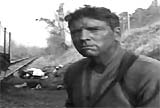
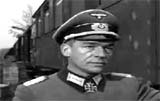
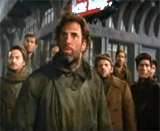
Frankenheimer's suspenseful war-adventure thriller, a fictionalization of history, told about Nazi art collector Colonel von Waldheim (Paul Scofield). His looted paintings ("Beauty belongs to the man who can appreciate it" he claimed) were on a train from Paris bound for Berlin, before the Allies arrived. French patriot and railway superintendent-inspector Paul Labiche (Burt Lancaster) was commissioned by the museum to stop the train and kill the German commander. The human death toll was staggering in the climax, with bodies everywhere surrounding the crated boxes of paintings. |
|
|
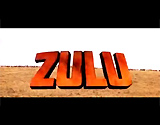
Zulu (1964, UK)
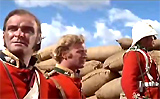
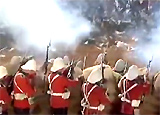
The UK's inspirational, historical epic captured and recreated a moment in British military history, with some historical inaccuracies - the 1879 Zulu warrior siege of Rorke's Drift, a South African outpost held by 139 outnumbered British-Welsh soldiers in Natal, Africa. The battle scenes in the film's non-stop second half showed 4,000 threatening Zulu warriors carrying shields fighting to a standstill with the British forces after 12 hours. |
|
|
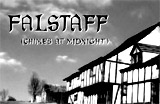
Chimes at Midnight (1965, UK) (aka Falstaff)
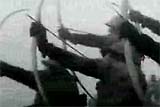
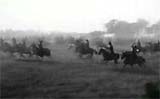
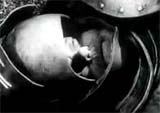
Considered a lost classic film by many, actor/director Orson Welles' low-budget film was a seamless integration and compilation of Shakespeare's two parts of Henry IV and other plays. It started with the end of Richard II to the beginning of Henry V with his onstage death. The film focused on the drunken, bawdy, cowardly, charismatic, corpulent thief / scoundrel / adventurer character ("huge hill of flesh") of Sir John (Jack) Falstaff (Welles) and his drinking companion relationship with young Prince Hal (Keith Baxter, who also later played Henry V). The 10 minute sequence of the Battle of Shrewsbury in this film has been considered the first great battle scene of the modern era, influential upon other films such as Braveheart (1995). In the foggy and muddy scene, inappropriately armored, helmeted Falstaff waded through the muddy battlefield and attempted to scurry away as other armored men were swinging heavy weapons. |
|
|
The Battle of
Algiers (1966, It.) (aka La Battaglia
Di Algeri, or La Bataille d'Alger (Fr.))
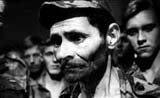
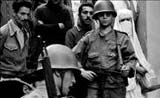
Shot in grainy, noirish documentary-style black and white and accompanied by an Ennio Morrocone orchestral score, this stylistic film told the story of the birth of Algerian independence from French colonial rule, the rise of the Algerian Front de Libération Nationale (FLN), and the French response, by Colonel Phillipe Mathieu (Jean Martin, the film's only professional actor), to the group’s terrorist, insurgency, and propaganda campaigns. The influential film was unflinching in displaying the atrocities committed by both sides - children shot soldiers point-blank, women planted bombs in cafés, and French soldiers tortured insurgents. Often considered one of the greatest war films of all-time for its cinema verite, its precise how-to manual for guerrilla terrorism, and its cautionary tale about warfare. [In the summer of 2003, it was screened by Pentagon officials, to provide insight into the challenges of the current US war in Iraq at the time.] |
|
|
The Dirty Dozen (1967)
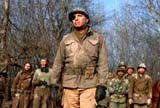
Robert Aldrich's highly-popular, gritty "guy's" action-filled (macho) war film was about a group of a dozen convicted, anti-social, death-row military prisoners. The nihilistic film's premise was built on the anti-Establishment premise that rapists, murderers, and sadistic misfits could be trained to become kill-crazy, "dirty" commandos for a suicidal mission behind enemy lines against the Nazis. It was released during the summer of '67 - coinciding with a series of race riots in numerous American cities, and increasing protests against the Vietnam War. Reviewers labeled the film as irresponsible, unrestrained, and revolting since it appeared to celebrate war and erase the line between "good guys" and "bad guys," particularly in the finale. The "dirty dozen" included Telly Savalas as religious madman Archer Maggott, Donald Sutherland as dim-witted Vernon Pinkley, football star Jim Brown as black Robert Jefferson, John Cassavetes as rebellious and outspoken Victor Franko, and Charles Bronson as Polish Joseph Wladsilaw. They were sent on a suicide mission and commanded by a tough Lee Marvin as Major John Reisman. They were to go behind Nazi enemy lines to destroy a French chateau and its German officers (with their mistresses). In the climactic mass death scene, an underground bunker filled with German generals and innocent civilians was blown up with a combination of live grenades and gasoline. |
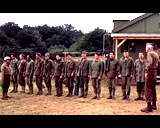 Twelve Insubordinate Men in a Line-Up 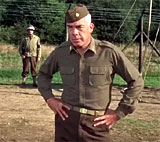 Major Reisman (Lee Marvin) 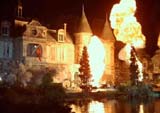 French Chateau Explosions |
|
War and Peace
(1968, USSR) (aka Война и мир, translated Voyna i mir)
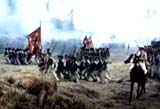
This seven hour (originally 8 hours in length), Soviet-produced adaptation of the famed novel by Leo Tolstoy was an elaborate, costly, and big-scale film, shot in 70 mm. It was the most expensive film ever made in the Soviet Union. The much-lauded epic won the Academy Award for Best Foreign Language Film. It was originally released in four parts during 1966 and 1967. Sections of the film's script quoted large sections of Tolstoy's dialogue. It was composed of staggering set-pieces, including a scene of the 1812 burning of Moscow, and an hour-long reenactment of the 1812 Battle of Borodino, requiring 120,000 Russian soldiers used as extras. Aerial shots using helicopters provided sweeping views of the bloody battlefield. |
|
|
Where Eagles Dare (1968, UK)
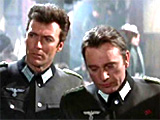
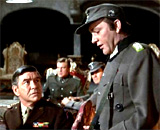
Alistair MacLean provided the story and script for this lengthy British war-time espionage action-drama, with a tagline that emphasized the dual nature of many of the characters: "They look like Nazis but..The Major is British...The Lieutenant is American...The Beautiful Frauleins are Allied Agents!" The film was most notable for its death-defying stunt atop a cable car ski lift in the Southern Bavarian Alps. The preface for the war adventure film was the capture of American Brig. Gen. George Carnaby (Robert Beatty), whose aircraft was shot down by Nazis. He was taken hostage and kept in the Schloss Adler, the heavily-fortified Eagle's Castle with guards, an electrified fence, doberman dogs, SS troops, and only accessible by cable car. It was also headquarters for the German Alpine Korps. Unbeknownst to the Nazis, the General had full knowledge of the upcoming Normandy Invasion (aka D-Day). A seven-man rescue team of Allied commandos (MI6 agents was assembled to rescue and liberate the American by Admiral Rolland (Michael Hordern) and second in command British officer Colonel Wyatt-Turner (Patrick Wymark) in England. The mission was led by British Major John Smith (Richard Burton) and U.S. Army Ranger Lieut. Morris Schaffer (Clint Eastwood), and five others (Donald Houston, Peter Barkworth, William Squire, Brook Williams and Neil McCarthy). There were also two UK undercover female operatives assisting the commandos: blonde Mary Ellison (Mary Ure) and Heidi Schmidt (Ingrid Pitt). The dangerous mission was plagued by the presence of double-agents (and many double- and triple-crosses), and by the fact that General Carnaby was actually American Corporal Cartwright Jones who was impersonating the General. In the conclusion, it was revealed that the real mission was to uncover the identity of German agents in England and among the 7 man team. The main villainous traitor, Germany's # 1 spy in Britain was revealed -- Colonel Turner, who was allowed by Smith to commit suicide (and avoid a trial for treason and inevitable execution) by jumping from their extraction airplane (a Lancaster bomber) without a parachute. |
|
|
Battle of Britain (1969, UK)
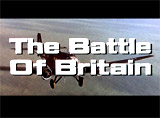
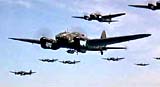
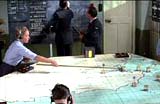
Guy Hamilton's moving and authentic big-budget film featured big-name stars portraying outnumbered RAF pilots flying Spitfires and Hurricanes. The pilots included Michael Caine as Squadron Leader Canfield, Christopher Plummer as fatalistic squadron leader Colin Harvey, and Robert Shaw as exhausted but inspiring Squadron Leader Skipper. It accurately captured how valiant the British, with only 650 aircraft, were 'under fire' during the many air battles and bombing raids of the German Luftwaffe (with almost 3,000 Messerschmitts, Junkers, Stukas and Heinkels) in the summer and autumn of 1940. 100 vintage aircraft were predominantly used in the filming of the reconstructed dogfights, rather than models or computer graphics. |
|
|
Castle Keep (1969)
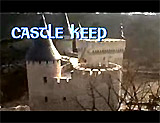
Young director Sydney Pollack's artsy, oddball, and surreal, allegorical war film was based on William Eastlake's novel. Some viewed it as commentary about the Vietnam War. It told a story about an American platoon of misfits, commanded by eye-patched Major Abraham Falconer (Burt Lancaster), that was held up in the Ardennes Forest during WWII, in the 10th century Belgian castle (named Maldoray) of mysterious, impotent Count Tixier (Jean-Pierre Aumont). The medieval castle was on the Belgian side of the French border. Army Captain Lionel Beckman (Patrick O'Neal), an art expert, was entranced by the Count's art collection, although Falconer believed that it would all be sacrificed during further conflict with the Germans. As the Germans advanced toward Bastogne, the Count promoted a romance between his own youthful Countess wife Therese (Astrid Heeren) and Falconer, to provide an heir for the line of Maldorais. In the film's final apocalyptic assault scene, invading Nazi tanks destroyed the castle, and only GI Private Allistair Piersall Benjamin (Al Freeman Jr.), a black aspiring novelist writing about their escapades (a novel called Castle Keep), escaped, taking Therese with him. |
|
(chronological by film title) Introduction | 1900s-1920s | 1930s | 1940s-1 | 1940s-2 | 1950s | 1960s-1 | 1960s-2 | 1970s | 1980s | 1990s | 2000s | 2010s |




 Strategic Air Command base, on-board B-52 bomber bound for Russia, and US War Room