|
|

|
Bad Boys (1995) Bad Boys was action film director Michael Bay's first feature film (it was produced by actioners Don Simpson and Jerry Bruckheimer) - laden with special effects, although he was already an accomplished video director. His directorial style was known for hyped scenes of fast car chases, blasting firearms, sex-jokes, profanity and noisy explosions especially attractive for hyper-active teenaged boys. The film's success and popularity resulted in two sequels: Bad Boys II (2004) and Bad Boys for Life (2020). The original 1995 film, a buddy-cop action crime drama, paired two black stars as Miami-Dade County narcotics cops, two Sergeant Detectives, who were forever quarreling with each other:
The buddy duo was entrusted with protecting informant Julie Mott (Tea Leoni) who witnessed the murder of her pretty best friend-prostitute Maxine "Max" Logan (Karen Alexander), as they were both posing as escorts for drug-using, crooked ex-cop Eddie Dominguez (Emmanuel Xuereb) in his hotel suite. Maxine - who was one of Mike's ex-girlfriends and a major informant, was doing a favor for Mike, but she and Eddie were killed by the film's leading suspect - a villainous French drug dealer and kingpin Fouchet (Tchéky Karyo), and his three henchmen Casper (Frank John Hughes), Ferguson (Vic Manni), and Noah Trafficante (Marc Macaulay) Fouchet had stolen $100 million dollars worth of impounded heroin from the police department's storage room. They only had a few days to recover the drugs before the Internal Affairs Division took over. When Julie contacted the police after Maxine's murder, she insisted on talking only to Mike, but she had never met him. Since Mike was unavailable at the time, Burnett was forced to impersonate Lowrey, and they had to maintain the major character switch and deception throughout the entire investigation. They even switched living situations and locations - Mike moved in with Burnett's wife Theresa (Theresa Randle) and family, while Marcus moved into Mike's apartment with Julie and her dogs. During the case, after the impersonation-deception was discovered by Theresa, Julie fled and was kidnapped by Fouchet and his gang. A shootout broke out between the cops and drug-dealers at an abandoned airfield, resulting in a massive explosion and a car chase after Fouchet, who was shot and killed by Mike to avenge Maxine's death.
Mike to Store Clerk - "Now back up, put the gun
down, and get me a pack of Tropical Fruit Bubblicious." "Damn! What are you weighin', 350? I bet you're a big Popeye chicken-eatin' motherf--ker, ain't you?" "You know, you drive almost slow enough to drive Miss Daisy." "You know I'm a better cop when I get some in the morning, I feel lighter on my feet."
The car hijacking scene when Mike and Marcus were stopped by a White and Black Carjacker (Kim Coates and Michael 'Bear' Taliferro), during an argument about french fries spilled on the floor of Mike's car. The brutal bathroom brawl in Club Hell (a hangout for drug-dealers) when Marcus was ambushed in the restroom by Fouchet's gang members, while Mike was being entertained and enticed by strippers in the noisy nightclub. The scene in a convenience store when the nervous and suspicious store clerk (Shaun Toub) held a gun on the two cops, who calmed the situation by asking for bubble gum and Skittles. The climactic shootout inside an airplane hangar during the rescue of Julie, including the explosive destruction of a 727 jet airplane. The dramatic car chase after Fouchet, ending in his death when he pulled a concealed weapon from his pocket, and was shot dead by Mike. |
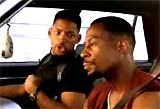 (l to r): Mike Lowrey (Will Smith) and Marcus Burnett (Martin Lawrence) 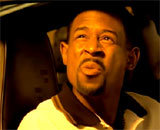 Marcus Burnett (Martin Lawrence): "What are you weighin', 350?" 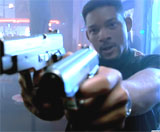 Mike Lowrey Confronting the Convenience Store Clerk 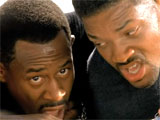 Mike to Marcus: "Don't Ever Say I Wasn't There For Ya" 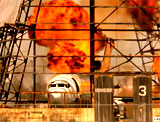 Airplane Hangar Plane Explosion 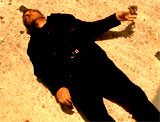 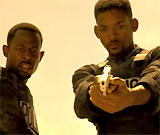 The Death of Fouchet |
||||||||
|
Braveheart (1995) Producer-director-actor Mel Gibson's 13th century melodramatic historical war epic was a major award winner, including Best Picture and Best Director. Although it was often historically inaccurate (faces weren't painted and kilts were not worn by the Scots), Gibson memorably portrayed the heroic Scottish freedom fighter William Wallace in this rousing, three hour film, who victoriously fought against the army of the oppressive and tyrannical King Edward I "Longshanks" (Patrick McGoohan) at Stirling Bridge in 1297. The central battle sequence was vividly portrayed and masterfully filmed to increase tension ("Hold...Hold...Hold"). He was spurred to revolt and righteous anger against the monarchy after his childhood sweetheart and secretly-wed wife Murron (Catherine McCormack) was raped and had her throat slit. Wallace delivered frequent, rousing, emotional and inspiring speeches to his loyal often outnumbered followers. Wallace was defeated at the Battle of Falkirk, captured and tried for high treason, and beheaded in a long and sadistic torture scene at the film's conclusion. The last lines of the film were William Wallace's voice-over - about the victorious Scots under the leadership of Robert the Bruce (Angus Macfadyen). "I AM William Wallace! And I see a whole army of my country men, here, in defiance of tyranny. You've come to fight as free men, and free men you are. What will you do with that freedom? Will you fight?...Aye, fight and you may die. Run, and you'll live - at least awhile. And dying in your beds, many years from now, would you be willing to trade ALL the days, from this day to that, for one chance, just one chance, to come back here and tell our enemies that they may take our lives, but they'll never take OUR FREEDOM!" "In the Year of our Lord 1314, patriots of Scotland - starving and outnumbered - charged the fields of Bannockburn. They fought like warrior poets; they fought like Scotsmen, and won their freedom."
During his long and brutal execution scene, he cried out: "Freedom!" Wallace was courageously tortured ("I'm not dead yet"). He was partially hung, racked, disemboweled, and beheaded (offscreen) - while reuniting with his already-murdered wife seen walking in the crowd as a ghost. |
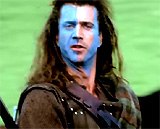 William Wallace: "Sons of Scotland!" 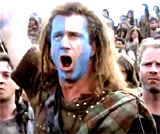 "Hold!" 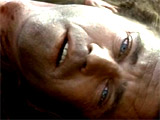 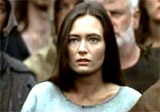 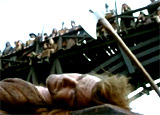
Wallace's Execution Sequence |
||||||||
|
Desperado (1995) Writer/director Robert Rodriguez' 'spaghetti-western' and Hong Kong-styled action film (a big-budget, English-language remake of his own cult classic El Mariachi (1992, Mex/US), his directorial debut feature film as writer and director), was great for action-hungry fans who wanted spectacularly cartoonish, balletic violence with lots of blood. It was part of a trilogy of films:
It featured attractive stars with sizzling eroticism between them:
In the neo-Western, El Mariachi (the man "dressed in black") sought to avenge the death of his previous lover. He had come to the Mexican border town Ciudad Acuna and was tracking down psychotic Mexican drug lord kingpin Bucho (Joachim de Almeida) and his gang, for killing his first love and for taking the use of his right hand in a gunfight. The film included shootouts in a seedy cantina and on rooftops, with two-fisted gunfighting and sailing bodies through the air.
"You drive around town, you see someone you don't know, you shoot them. How hard is that?" "Bless me, Father, for I have just killed quite a few men."
Early in the film, the blistering, massive gunfight in a Mexican bar (Tarasco), between El Mariachi and a drug lord's henchmen. The smoldering love scene between girlfriend Carolina and El Mariachi in a candle-lit room - shot with original camera angles and flash-cuts. The ending plot-twist revelation - that Bucho was El Mariachi's older brother, Cesar - before El Mariachi killed him. |
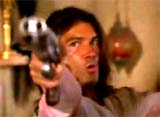 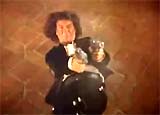 Vengeful Vigilante El Mariachi (Antonio Banderas) 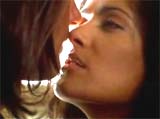 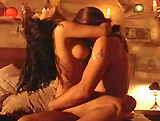
Love Scenes With Carolina (Salma Hayek) |
||||||||
|
Heat (1995) Writer/director Michael Mann's compelling, three-hour LA crime thriller/drama centered its tension-filled story around jaded and obsessed LA detective/cop Vincent Hanna's (Al Pacino) search for notoriously disciplined professional thief Neil McCauley (Robert De Niro). [It marked the first time the two powerhouse male actors appeared together on screen, although they co-starred in The Godfather, Part II (1974).] The crime film had its share of shoot-outs, violent deaths, chase scenes and action (especially an armored car robbery in downtown LA that went awry, and a second downtown shootout during a bank robbery), although it also emphasized the women in the men's lives: Hanna's third wife Justine (Diane Venora) in a fractured marriage, and McCauley's unknowing girlfriend and graphic artist Eady (Amy Brenneman).
- "I told you, when we hooked up, baby, that you
were gonna have to share me with all the bad people and all the ugly
events on this planet."
"A guy told me one time: 'Don't let yourself get attached to anything you are not willing to walk out on in 30 seconds flat if you feel the heat around the corner.'"
The opening sequence was a deadly heist by criminal mastermind Neil McCauley and a gang, taking possession of a Gage armored-van in Los Angeles, when the criminal bank robbers posing as paramedics wearing hockey-goalie masks stole $1.6 million in bearer bonds. The first wary, face-off and confrontational show-down meeting over a cup of coffee in a coffee-shop/diner was between the two similar aging professionals, who represented different sides of the law: LAPD top cop Lt. Vincent Hanna and crime boss Neil McCauley. They talked - "like a couple of regular fellows" - about their respective lives and duties. They both vowed to take the other down if necessary and without hesitation. In the film's climax, a botched heist of the downtown LA branch of the Far East National Bank led to a shootout on city streets, when two of the bank robbers, McCauley and his partner, wounded Chris Shiherlis (Val Kilmer), were able to hold off and escape from the authorities with expert gun-handling and duck-and-cover tactics. In the final night-time climax between Hanna and McCauley on an LAX airport tarmac, Hanna single-handedly pursued McCauley and mortally wounded him, after which he took McCauley's hand as he died. |
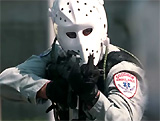 Opening Robbery of Armored Van in Los Angeles 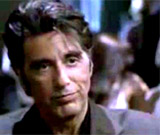 LAPD Lt. Vincent Hanna (Al Pacino) 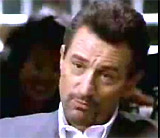
|
||||||||

|
Se7en (1995) This title of this grisly David Fincher crime thriller referred to ingenuously-displayed clues at the various murder scenes for each of the Seven Deadly Sins (gluttony, greed, sloth, lust, pride, envy and wrath), but none of the actual crimes were seen committed, except for the last one. In the film's opening, weary veteran Det. Lt. William Somerset (Morgan Freeman) was soon to retire after 32 years. He was meticulously going about his orderly and precise morning routine in his furnished bachelor apartment. The wise, perceptive and methodical homicide investigator was set in contrast to his headstrong replacement partner, young reckless rookie David Mills (Brad Pitt), in their pursuit of a diabolical serial killer named John Doe (an unbilled Kevin Spacey) who had staged murders. All of the killer's seven murders in the film were inspired by the legendary Seven Deadly Sins (Gluttony, Greed, Sloth, Lust, Pride, Envy, and Wrath).
The film's best acted sequence was a diner scene between Somerset and Mills' unhappy relocated wife Tracy (Gwyneth Paltrow) who had just moved to the city from upstate. She confided in him about her unrevealed pregnancy - he advised her that the city was no place for a family, and that if she aborted, she shouldn't ever tell her husband that she was pregnant. If she went ahead, however, he said: "You spoil that kid every chance you get." Sociopathic serial killer John Doe voluntarily turned himself in at the police station in a startling, last-reel revelation. He walked in, yelled out repeatedly to rookie Detective David Mills: "DETECTIVE!" and then admitted: "You're looking for me." Obviously he had just committed another crime because his shirt was spattered with blood. Shortly later after he had led the pair of detectives to another sick and gruesome crime scene, he admitted his grisly final misdeed to married detective Mills (see quote below). Doe confessed to the sin of Envy before killing Mills' wife Tracy and having "her pretty head" (a severed head, never shown), a souvenir, delivered in a bloody cardboard box to their location in the middle of the desert (although Mills was skeptical at first). It demonstrated the 6th Deadly Sin - Envy. Somerset knew that Mills was being set up to shoot and kill Doe (Doe: "Become vengeance, David...Become Wrath"). To demonstrate Wrath, anguished and angered Lt. Mills vengefully shot Doe in the head, and then emptied his gun of bullets into Doe's body, in exchange for his pregnant wife's beheading. Mills was taken into custody for the shooting and driven away. After declaring that he wouldn't be quitting after all, Det. Somerset delivered the film's final words (in voice-over) - see below.
"I wish I could have lived like you, David...Do you hear me, detective? I'm trying to tell you how much I admire you and your pretty wife...Tracy...It's disturbing how easily a member of the press can purchase information from the men in your precinct... I visited your home this morning after you'd left. I tried to play husband. I tried to taste the life of a simple man. It didn't work out. So I took a souvenir: Her pretty head...Because I envy your normal life, it seems that envy is my sin...She begged for her life, detectives...She begged for her life and for the life of the baby inside of her. Oh! (turning to Det. Somerset) He didn't know." (voice-over) "Ernest Hemingway once wrote, 'The world is a fine place and worth fighting for.' I agree with the second part."
The concluding head-in-a-box scene, demonstrating the last two of the deadly sins, Envy, and Wrath. |
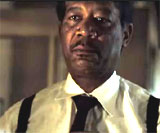 Detective Somerset's (Morgan Freeman) Early Morning Routine  Det. Somerset's Rookie Replacement - Det. David Mills (Brad Pitt) 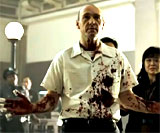 John Doe: "You're looking for me"  "Pretty Head" in a Box: Confession of Envy by John Doe  Mills Angrily Holding a Gun to Doe's Head, Calling Him a Liar  Mills Realizing That Doe Had Killed Both Tracy and Her Unborn Child That He Didn't Know About  Det. David Mill's WRATHful Vengeful Execution of Doe |
||||||||

|
Showgirls (1995) This 'guilty-pleasure' popular cult film was the second pairing of director Paul Verhoeven (known for RoboCop (1987) and Basic Instinct (1992)) and screenwriter Joe Eszterhas (also for Basic Instinct (1992)). It was a sleazy, big-budget 'adult-oriented' film with a soul-less, exploitative plot and mostly repugnant characters, that became a camp classic instead. The film was considered senseless, violent, and actually sexually boring or desensitizing, although it contained lots of gratuitous nudity. See full description of film here The outlandish, over-the-top film marked a milestone in film history - it was the first NC-17 rated film with a wide mainstream release. Although it was the first big-budget, adults-only film in many years (after Caligula (1979) and Philip Kaufman's Henry & June (1990)), it turned out to be both a critical and commercial failure, and grossed only $20 million (half of its budgeted cost). The film's star was introduced - 23 year-old aspiring actress Nomi Malone (newcomer Elizabeth Berkley of TV's Saved By the Bell) - who first found work as a stripper at the sleazy, low-class Cheetah Club where she performed pole and lap dances; higher-class hotel shows and headliner dancers aspired to work as showgirl-dancers at Las Vegas' Stardust. During a showgirl audition sequence, Tony Moss (Alan Rachins) introduced himself as the producer of the show, and made threatening and insulting comments to the contestants, including Nomi - about their "baby fat" or non-erect nipples. "Thrust It" coaching was administered by a crude dancing choreographer. To move up in the flashy world of show-biz, Nomi developed a love-hate attraction for the trashy diva star Cristal Connors (Gina Gershon), who headlined at the Stardust; Cristal showed her ambivalent affection for Nomi with kisses and offers of bisexual sex. Nomi eventually graduated to the Stardust's "Goddess" topless dance show (where she contributed her characteristically-jerky dance moves) with scores of half-naked dancers, and Cristal made her flashy entrance from an exploding volcano. Behind Cristal's back, leggy pole dancer Nomi and hotel entertainment director and impresario Zack Carey (Kyle Maclachlan), Cristal's boyfriend, participated in an overacted, over-the-top swimming pool scene with champagne and thrashing orgasmic activity - the scene was voted the # 1 'unsexiest' or worst sex scene in cinema history by Empire Magazine in 2005.
"Fifty bucks a pop, you take 'em in the back. Touch and go. They touch, they go. You can touch them. They cannot touch you...Now if they come, that's okay. If they take it out and come all over you, call the bouncer, unless he gives you a big tip. If he gives you a big tip, it's okay. You got that?...lf you want to last longer than a week, you give me a blow job. First l get you used to the money, then l make you swallow." "Okay, ladies. I'm Tony Moss. I produce this show. Some of you have probably heard that I'm a prick - I am a prick. I got one interest here, and that's the show. I don't care whether you live or die. I want to see ya dance and I want to see ya smile. I can't use you if you can't smile, I can't use you if you can't show, I can't use you if you can't sell." "Come back when you've f--ked some of this baby fat off. See ya." "I'm erect. Why aren't you erect?"
Nomi's pole-dancing at the Cheetah Club and her slithering, intercourse-simulating lapdance for Cristal's boyfriend Zack Carey (Kyle MacLachlan). The naturally-degrading topless dancer audition scene. The extravagant Stardust dance routines for the "Goddess" show. The seizure-like orgasmic nighttime sex scene (voted one of the least sexy scenes of all time) in an outdoor swimming pool decorated with neon palm trees. The offensive gang-rape scene. |
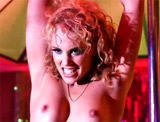  Nomi Malone (Elizabeth Berkley) At the Cheetah Club 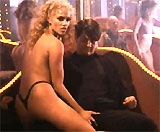 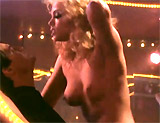 Lap Dancing for Zack 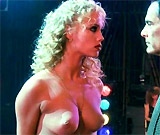 Tony Moss Insulting Nomi During Audition 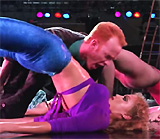 Intense Rehearsals with "Thrust It" Coaching 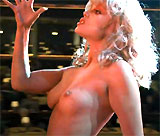 Nomi in the Vegas "Goddess" Dance Show 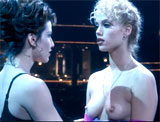 Cristal's Face-Off With Nomi 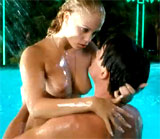 Nomi's Sexual Romp in Pool with Zack |
||||||||
|
The Usual Suspects (1995) Director Bryan Singer's clever, and hip, plot-twisting, film-noirish, mystery heist thriller (with a sharp script by Christopher McQuarrie) was (and continues to be) a popular cult favorite. Its tagline was: "In a world where nothing is what it seems you've got to look beyond...(THE USUAL SUSPECTS)." Much of the film was set in a police interrogation room, where a lengthy questioning was held between two men regarding a central mystery surrounding the enigmatic, greatly-feared, legendary existence and character of Hungarian mobster and kingpin known as Keyser Soze - a semi-mythical, cold-blooded "devil", and almost supernatural Hungarian crime lord and mastermind:
Kint told a convoluted story (in flashback) about criminal misconduct that stretched back to six weeks earlier. Much of Kint's story spoke about the mysterious, devilish crime lord Keyser Soze, his early life, and a description of the first time he ever heard of Soze, and his coldbloodness with Hungarian rivals followed by his disappearance: ("The greatest trick the devil ever pulled was convincing the world he didn't exist...and like that, he's gone. Underground....Nobody's ever seen him since. He becomes a myth, a spook story that criminals tell their kids at night"). According to Kint, a group of tough and savvy criminals (the ones on all the film's posters), were in an NYPD line-up, hauled in after a Queens, NY truck hijacking and gun parts shipment robbery -
As revenge for being 'falsely accused', they also pulled off a robbery of a protective escort service (New York's "finest taxi service" run by corrupt NYPD officers) that was escorting a jewel smuggler and they pulled off a $3 million robbery of emeralds. Following the lucrative heist, they traveled to Los Angeles to sell the loot through McManus' fence REDFOOT, and then failed a second jewel heist attempt (when the jewels turned out to be heroin). Afterwards, to compensate for his loss and pay him back, Turkish crime lord Soze (and his lawyer Kobayashi (Pete Postlethwaite)) coerced the five thieves to go on a suicide mission to San Pedro Bay (LA) harbor to commit a huge $91 million cocaine heist (and destruction) of a drug shipment on a docked ship -- an act of sabotage against Keyser Soze's own Argentinian drug-dealing competitors in the drug trade. The weaselly, limping Kint, one of only two survivors of the fiery explosion and fire-fight massacre at the harbor (the other survivor was badly-burned Hungarian mobster Arkosh Kovash) that resulted in 27 deaths, confessed truths, half-truths, double-crosses, and lies in the convoluted tale - claiming that he witnessed the botched raid (due to the fact that no cocaine was found on the ship - or it was mysteriously missing?); Kujan deduced: "Keaton was Keyser Soze" - the mastermind of everything, who had faked his death and deliberately left Verbal as a witness. However, Kint disagreed: "This is all bulls--t."
The concluding plot twist revealed and resolved the identity of Keyser Soze. After refusing to testify in court, the crippled Kint was released on bail and limped away from the police station (after receiving 'Keyser Soze's' gold watch and gold lighter -- another clue!), as his hand deformity and his limp suddenly disappeared from his stride. Kujan simultaneously realized - upon breaking his coffee mug (with the logo for Kobayashi Porcelain) and other trivial clues - that Kint was, in fact, the greatly-feared, legendary criminal mastermind and kingpin Keyser Soze of Kint's own extraordinarily-fabricated story. A police sketch artist's rending of Soze's face confirmed that Soze was Kint. To his stunned amazement, Kujan scanned the office's bulletin board and noticed that many of the elements of Kint's preposterous swindler story (about Kobayashi-Keyser Soze-Dean Keaton) were improvised from items behind Sgt. Rabin's desk in the borrowed office:
The "cripple" Kint was picked up in a black car by Kobayashi. The film's last line was Kint's voice-over, words that he had spoken earlier - (he blew on his fingers, as if to say 'Poof!'): "The greatest trick the Devil ever pulled was convincing the world he didn't exist. And like that, he's gone."
"The greatest trick the devil ever pulled was convincing the world he didn't exist."
The concluding scene in Special Agent Dave Kujan's borrowed office that revealed the identity of Keyser Soze. |
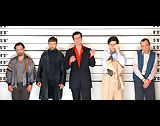 The NYPD Lineup of Five Crooks 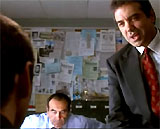 Questioning Kint in the LAPD Office 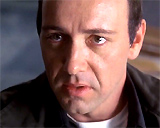 Roger "Verbal" Kint (Kevin Spacey) 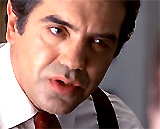 Dave Kujan (Chazz Palminteri) 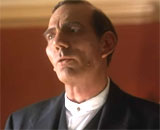 Lawyer Kobayshi's Coercion of the Gang to Commit the San Pedro Harbor Cocaine Heist 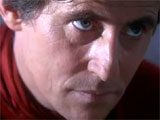 Kujan: "Keaton was Keyser Soze!" 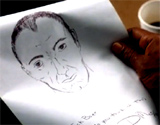 Arriving Too Late: A Police Sketch Artist Rendering of Soze's Face - Resembling Kint Himself 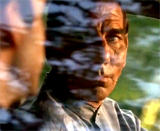 Kobayashi (Pete Postlethwaite) Picking Up Kint 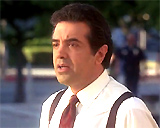 Dave Kujan: Tricked! 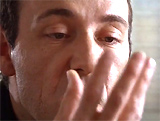 Kint: "The greatest trick..." |
||||||||