|
of All-Time 1970-1973 |

|
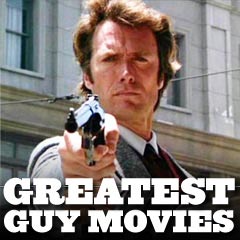
Director Don Siegel's sensational film was a seminal vigilante film of the decade, appealing especially to male audiences because of its overt violence, its tough-as-nails title character, and occasional glimpses of nudity. See Greatest Scenes: Dirty Harry for a more complete summary. The duelling combatants (the cop and the criminal) throughout the film - an individualistic, unconventional, neo-fascist, politically-incorrect super-hero police detective with a .44 Magnum weapon who threw away the rule book, and his complementary opposite - a pathological, malevolent and sadistic criminal named Scorpio (Andy Robinson) (based on the real Zodiac Killer) who demanded an extortionist ransom of $100,000, both shared traits of brutal violence and insanity. The 'mad' killer drew parallels with an actual gunman (the so-called Zodiac serial-killer) who terrorized the San Francisco Bay area in the late 1960s. Steely-eyed Clint Eastwood in a career-boosting role portrayed the title character, a maverick, renegade San Francisco cop named Inspector "Dirty" Harry Callahan ("Inspector 71") who was famous for sarcastic one-liners. This was the first of many hard-hitting, action-packed sequels starring the title character, from 1973 to 1988. Transferring his persona from his past appearance in 'spaghetti westerns' to the urban environment, Clint Eastwood (in his most famous role) played the part of an uncompromising, tough, unyielding, street-wise cop in a San Francisco overrun with crime and sexuality (e.g., the Columbus Street red-light district, and other deviant lifestyles displayed in the film). He followed his own unconventional philosophy of justice using "excessive force," ruthless methods, and "the end justifies the means" principle without much regard for the rules and legal regulations of his profession. Often, his methods were as vicious, taunting, sadistic and violent as the behavior of the criminals he opposed.
"I know what you're thinking. Did he fire six shots or only five? Well, to tell you the truth, in all this excitement, I've kinda lost track myself. But being as this is a .44 Magnum, the most powerful handgun in the world, and would blow your head clean off, you've got to ask yourself one question: Do I feel lucky? Well, do ya punk?" "No wonder they call him Dirty Harry. Always get the s--t-end of the stick."
Opening scene of a bank robbery with the taunt of Dirty Harry toward the the wounded bank robber (Albert Popwell) on the sidewalk. Also, the confrontation with Scorpio on the field in the middle of a football stadium. And the final hi-jacked school bus scene (with Harry riding on the top of the bus). The concluding quarry gun battle ending when the wounded killer heard another challenge with the same famous threatening lines of dialogue. |
 On a Rooftop, Sniper 'Scorpio' (Andy Robinson)  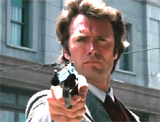 Dirty Harry to Robber: "Did he fire six shots or only five?" 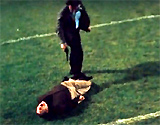 Kezar Stadium Confrontation Between Incensed Harry and Scorpio 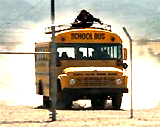 Hi-Jacked School Bus 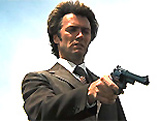 The Death of Scorpio |
|
And the sequel: French Connection II (1975) William Friedkin's film was a brilliant, fast-paced, brutally-realistic urban police/crime film - his commercial break-through film. The true-to-life film about the largest narcotics seizure of all time in 1962 was told with an innovative semi-documentary-style technique that conveyed the story with very few words. See Greatest Scenes: The French Connection for a more complete summary. It unsympathetically showed the untiring, violent and abusive counter tactics of two New York narcotics detectives fighting crime and an international narcotics smuggling ring located in France: the two were the vulgar, brutal, tireless, unlikable, maniacal and sadistic Jimmy "Popeye" Doyle (Gene Hackman) who toed the thin line between fighting crime and committing crimes himself, who passionately and obsessively pursued drug pushers with his partner Buddy "Cloudy" Russo (Roy Scheider). During the film's most famous sequence, "Popeye" pursued, at 90 mph, a suspected French drug smuggler-dealer Alain Charnier's (Fernando Rey) hitman-sniper Pierre Nicoli (Marcel Bozzufi) in a hijacked elevated, runaway subway train above him, after seizing a civilian car below: ("Police emergency: I need your car"); during the chase, he - among other things - half-collided with another car, dodged a mother and her baby carriage, and side- swiped a delivery van, all the while furiously honking the car's horn and frantically switching from his brake to accelerator. A climactic train crash occurred when the runaway train smashed into another train [photographed with the train moving away from the camera - and then reversed]; hijacker Nicoli escaped from the wreckage, believing that he was freed of Doyle; as he fled down the subway train station's stairs, he saw Doyle and immediately turned and reversed himself, but Doyle gunned him down at the top of the subway train station's stairs - the image became the famous iconic promotional still used to advertise the film on posters. The film concluded in a drug bust on Wards Island after the exchange of the extremely-pure heroin (hidden in the rocker panels of a French TV celebrity's Lincoln Continental) with loads of cash. A massive ambush and shoot-out in the underground warehouse ended with many dead, including Popeye's mistaken shooting of his own federal narcotics agent Mulderig (Bill Hickman) in a secondary building. Doyle ran off through the warehouse to further pursue his prey; a single shot was heard - off-screen - before the film abruptly ended with a black screen. Apparently, Charnier slipped away and was never caught.
"I've got a man in Poughkeepsie who wants to talk to you. You ever been to Poughkeepsie? Huh? Have you ever been to Poughkeepsie?" "All right, Popeye's here!" "The son of a bitch is here. I saw him. I'm gonna get him."
The overhead subway-car chase scene. The concluding gun-battle and shoot-out in an abandoned factory on Wards Island, with an ambiguous ending. |
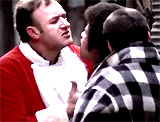 'Popeye' Disguised as Santa Claus with Partner Russo Confronting Drug Pusher 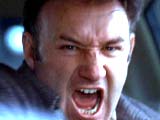 Exciting Chase Sequence 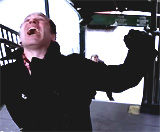 After Subway Chase, the Gunning Down of Nicoli by Doyle 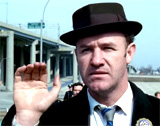 Doyle at Roadblock Confronting Drug Smugglers After Exchange of Heroin and Cash 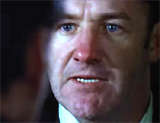 Doyle to Russo: "The son of a bitch is here. I saw him. I'm gonna get him" |
|
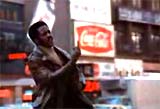
Shaft (1971) Esteemed black director Gordon Parks, a former photojournalist with Life Magazine, directed this break-through film - the first major, commercial crime film with a black hero. The colorful, action-packed, slightly tongue-in-cheek blaxploitation film starred Richard Roundtree as the ultra-hip, leather-clad, handsome police detective John Shaft (the black version of Clint Eastwood's "Dirty Harry" Callahan in Dirty Harry (1971)) who worked in Harlem against the Mafia. Shaft won an Oscar for Isaac Hayes' memorable theme song for the film (proclaiming that Shaft was 'a private dick' who's 'a sex machine to all the chicks').
"Don't let your mouth get your ass in trouble." "You're really great in the sack, but you're pretty s--ty afterwards." "Cut the crap, man, this is Shaft." |
|
|
British director John Boorman's gripping, absorbing, action-adventure film told about four suburban Atlanta businessmen-friends who encountered a disastrous rite-of-passage during a summer weekend's river-canoeing trip. The buddy group, composed of Ed Gentry (Jon Voight), ultra-macho Lewis Medlock (Burt Reynolds), fearful weakling Bobby Trippe (Ned Beatty), and Drew Ballinger (Ronny Cox) faced a nightmarish situation when they came upon the rapids and local hillbillies who degraded and terrorized them. The stark, uncompromising film was one of the first to deal with the theme of city-dwellers against the powerful, territorial forces of nature and the wilderness. The exciting box-office hit was most remembered for its banjo dueling and brutal, visceral action (and sexually-violent sodomy scene).
"I bet you can squeal like a pig."
The thrilling whitewater canoe trip down the rapids with numerous point-of-view shots of the river and rapids, preceded by the "Dueling Banjos" scene. And the grisly and shocking sexual molestation scene as a degenerate, redneck backwoods mountain man raped a pig-squealing and anguished Bobby (Ned Beatty) in his underwear. |
|
|
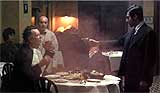
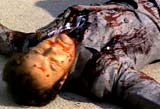
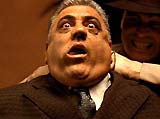
Also The Godfather Part 2 (1974) Francis Ford Coppola's operatic, violent drama was based on Mario Puzo's novel of the same name. It was a bravura, genre-defining, epic-length Mafia/gangster classic that evoked the mid and late 1940's period with powerful character development, lighting, costumes, and settings. The film followed the fortunes of the fictitious Corleones, a powerful Mafia family with its own family rituals and separate code of honor, revenge, justice, law and loyalty that transcended all other codes. When Godfather Don Corleone (Marlon Brando) was shot by rivals, his sons Sonny (James Caan), Fredo (John Cazale) and favorite young son Michael (Al Pacino) assumed control, with Michael ascending to a prominent position of power. The rich and enthralling film was characterized by flawless and superb acting and deep character studies, beautiful photography and choreography, authentic recreation of the period, a bittersweet romantic sub-plot, a rich and unforgettable score by Nino Rota, and superbly-staged portrayals and set-pieces of gangster violence. "I'm gonna make him an offer he can't refuse." "It means Luca Brasi sleeps with the fishes."
Any number of murder scenes, e.g., the murder of Sonny at a toll booth, or the grotesque severed horse-head in the bed scene. |
|
|
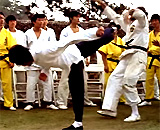
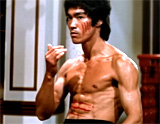
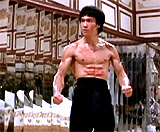
Enter the Dragon (1973) This fast-paced kung-fu action-thriller from director Robert Clouse, the big-budget version of the popular Chinese genre of martial arts, starred Bruce Lee in his first (and last) English-language (and Hollywood-produced) film. This legendary film is still considered the best "chopsocky" or "kickfest" (kung fu and martial arts) film ever made by an American studio (Warner Bros). It propelled Lee to major posthumous American stardom shortly after his tragic and mysterious death in July 1973 at the age of 32 - it was Lee's biggest US success and last fully-completed role. The film pitted a renegade, villainous Shaolin Temple monk named Han (Shih Kien) against a Jeet Kune Do master named Lee (Bruce Lee), who was recruited by the British to infiltrate Han's drug and prostitution operation under the guise of taking part in his annual, invitational competition on a mysterious island fortress near Hong Kong. Lee was also bent on revenge for the death of his sister Su Lin (Angela Mao Ying - the "female Bruce Lee") by one of Han's henchmen Oharra (Bob Wall). The martial-arts tournament between champions was sponsored by the crime boss Han - a one-handed, blood-thirsty mastermind who at one point supplemented his missing hand with a fearsome metal claw. The film featured a tremendous fight scene in the competition between Oharra and undercover agent Lee who displayed acrobatic fight skills, flip kicks and lightning fast punches. The action film concluded with an equally great fight scene (some in slo-mo) in an underground hall of mirrors between martial arts master Lee and crime/drug lord Han, who wore serrated knife blades in place of his detachable clawed iron hand.
"Through long years of rigorous training, sacrifice, denial, pain, we forge our bodies in the fire of our will." "You have offended my family, and you have offended a Shaolin temple." "Why doesn’t somebody pull out a .45 and, bang, settle it?"
The climactic confrontational fight-to-the-death kung-fu scene in an underground hall of mirrors between Lee and metal-clawed Han. |
|
|
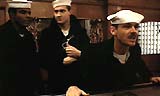
The Last Detail (1973) Director Hal Ashby's often humorous, military-related, anti-authoritarian buddy film was strewn with obscenities (mostly the F-word), out of the foul mouth of brash and rebellious Navy man Billy "Badass" Buddusky (Oscar-nominated Jack Nicholson in one of his most uninhibited roles). Buddusky was escorting naive 'grunt' sailor/prisoner Meadows (Oscar-nominated Randy Quaid) to prison (for an 8 year term) in Portsmouth, New Hampshire, for attempting to steal $40 (from a polio contribution box). Along the way from Virginia, he wanted to show 18 year-old Meadows a hedonistic "good time" -- by having first time sex with a prostitute (Carol Kane), drinking, fighting, and carousing.
"I knew a whore once in Wilmington. She had a glass eye... used to take it out and wink people off for a dollar." "Welcome to the wonderful world of pussy, kid."
The tense scene between Buddusky and a "redneck" bartender (Don McGovern) over a beer order for underaged Meadows - with the bartender threatening to summon the shore patrol, culminating with Billy's retort: "I am the motherf--king shore patrol, motherf--ker! I am the motherf--king shore patrol! Give this man a beer!" |
|