|
of All-Time 1974-1976 |


|
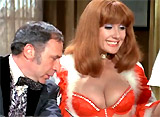
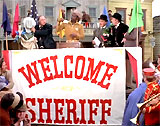
Director Mel Brooks' first in a series of satirizing parodies of classic movie genres (often as star, scripter and director) was this lewd, silly and raunchy western comedy, his first commercial hit. The iconoclastic, not-politically-correct slapstick tale told about the Waco Kid (Gene Wilder) and Black Bart (Cleavon Little) - the new black Rock Ridge Sheriff recruited to clean up a white frontier town. The crude, racist and sexist film with toilet humor and foul language included the main elements of any western - a dance-hall girl, a gunslinger, a sheriff, a town full of pure folk, and more, but it twisted them around. So they became a black sheriff, a racist town, a sex-obsessed Governor, and so forth. The near-sighted and dim-witted Governor Le Petomane (Mel Brooks) nuzzled into bosomy secretary Miss Stein's (Robyn Hilton) cleavage while being advised by villainous and scheming attorney general Hedley Lamarr (Harvey Korman). In another scene, Madeline Kahn (as saloon singer Lili Von Shtupp) exquisitely parodied Marlene Dietrich's saloon singer "Frenchy" (from Destry Rides Again (1939)) as the "Teutonic Titwillow" - and Lili's seduction scene of sheriff Black Bart ("Tell me, schatzie, is it, ah, twue what they say about the way you people are gifted?") - with her memorable phrase: "Oh, it's twue, it's twue" after unzipping his fly (with a loud zipper noise) and examining his endowment in the dark; and in the following scene, she asked in a whisper: "Well, then, how about a little...?" He was surprised: "Baby, please, I am not from Havana."
"Excuse me while I whip this out." "Mongo only pawn in Game of Life."
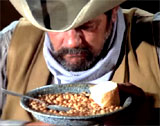
The infamous gas-passing, bean-eating scene around the campfire by flatulent cowboys. |
|
|
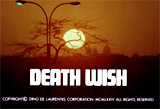
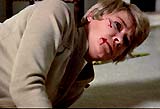
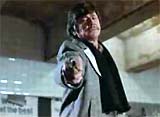
Death Wish (1974) And all of the sequels: Death Wish II (1982), Death Wish 3 (1985), Death Wish 4: The Crackdown (1987), and Death Wish V: The Face of Death (1994) Director Michael Winner's exploitative, urban crime and vigilante revenge thriller opened with the brutal lethal attack on wife Joanna (Hope Lange) and adult married daughter Carol Toby (Kathleen Tolan) in their NY apartment. Afterwards, soft-spoken and liberal architect-husband Paul Kersey (Charles Bronson) was determined to seek revenge for his wife's death, without hesitation, upon various thugs and muggers that preyed upon him and other city-dwellers. Kersey was judge, jury, and executioner in each instance of carnage and assassination - cooly and wordlessly dispatching his attackers with a .32 caliber revolver, and becoming a folk hero as a result when the NYPD appeared ineffectual.
"Goddamn rich c--t, I kill rich c--ts!" "Nothing to do but cut and run, huh? What else? What about the old American social custom of self-defense? If the police don't defend us, maybe we ought to do it ourselves." |
|
|
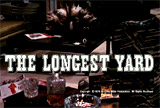
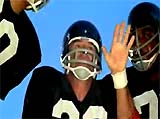
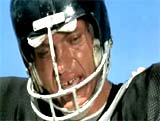
The Longest Yard (1974) (aka The Mean Machine) Robert Aldrich's crude, macho and tough football-in-prison film was one of the best sports films ever made. It told about how former NFL MVP pro football quarterback Paul Crewe (Burt Reynolds) aka ‘Wrecking Crewe,’ jailed for two to five years (for assault, theft, drinking while driving, and resisting arrest), was recruited by the hypocritical, iron-fisted, and sadistic prison warden Hazen (Eddie Albert). He was to assemble a group of prisoners into a football team (dubbed the "Mean Machine") to play an exhibition game against a team of brutal prison guards. It was revealed that anti-hero Crewe had been disgraced seven years earlier in a point-shaving scandal. The film's final game was a classic "losers-become-winners" (or misfit inmates vs. the system) battle. Its gritty realism was aided by its on-location shooting at Georgia State Penitentiary, with extras provided by actual guards and inmates, and actual former NFL pro players.
"All I'm saying is that you could've robbed banks, sold dope, or stole your grandmother's pension checks, and none of us would have minded. But shaving points off of a football game? Man, that's un-American." "I think I broke his f--kin' neck." "...you spend fourteen years in this tank, and you begin to understand that you've only got two things left they can't sweat out of you or beat out of you - your balls - and you better hang onto them because they're about the only thing you're gonna have when you get out of here."
The 45-minute long football game in the third-act finale. |
|
|
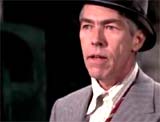
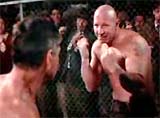
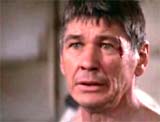
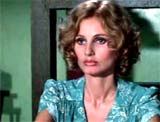
Hard Times (1975) (aka The Streetfighter) Machismo, weather-beaten-faced, stoic tough-guy Charles Bronson starred as broke drifter and bare-knuckle streetfighter Chaney with an unknown past in writer/director Walter Hill's brutal action drama (his directorial debut film). Set in Depression-era New Orleans, he partnered with gambling-addicted, fast-talking and ever-smiling boxing promoter and con-man Spencer 'Speed' Weed (James Coburn) and opium-addicted 'doctor' Poe (Strother Martin) in order to make a living by fighting in back-alleys. The only female character in the film was hard-hearted, part-time hooker Lucy Simpson (Jill Ireland, Bronson's real-life wife), hard-edged Chaney's long-suffering girlfriend.
"There's no reason about it. Just money." - "I suppose you've been down the long, hard road?"
The well-choreographed gritty bouts between formidable fighter Chaney and Jim "Skinhead" Henry (Robert Tessier), fought in a multi-storied metal-caged bullpen, and later, between Chaney and the gangsters' 'champion' from Chicago named Street (Nick Dimitri) in a warehouse. |
|
|
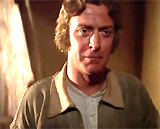
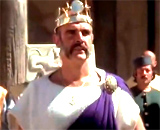
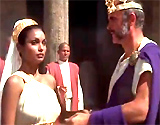
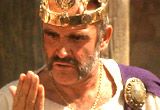
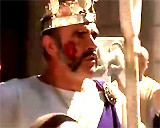
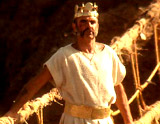
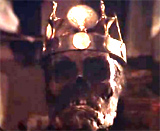
The Man Who Would Be King (1975, UK) This old-fashioned, rousing costume adventure film and morality tale from writer/director John Huston was told in flashback and based on Anglo-Indian novelist Rudyard Kipling's (Christopher Plummer) short story tale. It was set in 19th-century British India, and kingdom of Kafiristan (on Indian-Afghan border) It told about two roguish British soldiers-adventurers, Peachy Carnehan (Michael Caine) and Daniel "Danny" Dravot (Sean Connery) at the turn of the century who set out from Raj-ruled India. While serving as military officers in the remote city of Kafiristan in E. Afghanistan (a province now called Nuristan), the pair were mistaken for gods or kings by the people in the priest cult. During battle, Danny was struck by an arrow, but was unharmed (his bandolier, leather ammunition belt, under his clothing stopped the arrow). The natives believed Daniel was impervious to death, and a direct descendant of Alexander the Great. He himself began to arrogantly believe in his own divinity, and his right to take their rich royal treasures from the holy city of Sikandergul, with deadly consequences. He was disappointingly revealed to be human when beautiful marriage prospect and bride-to-be Roxanne (Shakira Caine), bit him on the cheek when he kissed her, in the ritualistic ceremony. Danny cried out: "The slut bit me." ("He's not god, not devil, but man"). Peachy realized the result with his negative assessment: "The jig's up." The two were pursued by an angry Kafiristan mob. Wearing his crown, Dravot was cornered, trapped and forced to walk on a rope bridge high above a canyon's gorge. The support ropes were hacked away, and he suffered a spectacular death. Peachy was crucified between two pine trees, but survived the ordeal and was cut down the next day. Daniel's decayed head was brought back (still crowned) by his surviving partner Carnehan to be viewed by Narrator/Rudyard Kipling (Christopher Plummer).
"Danny's only a man. But he break wind at both ends simultaneous - which is more, I reckon, than any god can do." "They're savages here, one and all. Leave 'em to go back to slaughterin' babes, and playin' stickball with each other's heads, and pissin' on their neighbors." "She bit me. The slut bit me!"
The marriage ceremony in which bride-to-be Roxanne,
superstitiously fearing that she would burst into flames if she consorted
with a god, bit Daniel on his cheek and drew blood. The final image of Daniel's severed head, still wearing the crown - presented by Carnehan to the Narrator. |
|

|
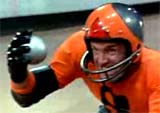
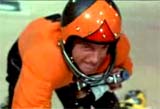
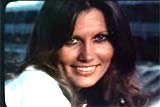
Rollerball (1975) Also Rollerball (2002) Director Norman Jewison's film's title referred to an ultra-violent, extreme sports game in the dystopic year 2018 - a gladitorial competition staged in a circular arena for blood-lusting mass audiences that was similar to rugby, basketball, wrestling, a gigantic pinball machine, roller-derby and motocross. The nasty brutality of the game was highlighted in many of the film's scenes, including its opening. James Caan starred as popular star Houston player Jonathan E., who rebelled against repressive elite corporate forces (led by sinister Energy Corporation executive Bartholomew (John Houseman)) when pressured to retire, and as rewarding compensation given beautiful Ella (Maud Adams). Although there was a individual vs. corporate rule parable in the sci-fi film, its emphasis was upon the aggressive competition found in the games.
"It's not a game a man is supposed to grow strong in, Jonathan." "They're afraid of you, Jonathan. All the way to the top, they are." "Corporate society takes care of everything. And all it asks of anyone, all it's ever asked of anyone ever, is not to interfere with management decisions." "No substitutions, no penalties, and no time limit."
The final World Championship game pitting Houston against New York, played to the death, with the crowd chanting for the last man standing: "Jonathan!" as he circled through the carnage in the arena. The film ended with a distorted freeze-frame shot of him skating toward the camera. |
|
|
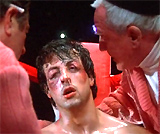
And all of the Rocky series sequels: Rocky II (1979), Rocky III (1982), Rocky IV (1985), Rocky V (1990), Rocky Balboa (2006), and Creed (2015) Screenwriter and major star Sylvester Stallone's phenomenally successful, uplifting, "sleeper" film told about a lowly, simple-minded, Philadelphia working-class Italian hero named Rocky Balboa, who was a good-natured individual that lacked basic intelligence, but displayed gutsy, optimistic perseverance while fighting for his dignity: "His whole life was a million-to-one shot." It told about the rise of a small-time, has-been, underdog Philadelphia boxer against insurmountable odds in a big-time bout, with the emotional support of a shy, hesitant, loving girlfriend named Adrian (Talia Shire). He boxed the heavyweight champion of the world Apollo Creed (Carl Weathers) and unbelievably went the distance under the direction of wily fight manager Mickey (Burgess Meredith). This most accessible, popular and identifiable of the many Rocky films was enhanced by Bill Conti's memorable, dynamically-triumphant fanfare (Rocky's Theme song: "Gonna Fly").
"All I wanna do is go the distance." "Yo, Adrian!"
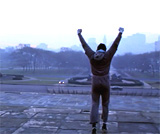
The film's montage of Rocky's grueling early morning workout and training accompanied by the rousing song "Gonna Fly" Rocky - at dawn, he sprinted beneath an overhead train, made another run through the City of Brotherly Love's streets and marketplaces, punched a bag, did one-armed pushups, took punches to his mid-section, executed endless situps, pounded more slabs of beef, and sprinted along the city's waterway. He dashed (and flew) up the endless steps of the Philadelphia Museum of Art, taking many steps with each leap. He turned and faced the panorama of the city, with his hands triumphantly raised in the air. |
|