|
Deaths Scenes 1939 |

|
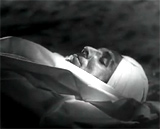
Young socialite and heiress Miss Judith Traherne (Bette Davis), with a brain tumor, died a quiet upstairs death. The death scene began at the foot of the stairs, where she told housekeeper Martha (Virginia Brissac): "I'm going up to lie down now." Feeling her way along, she started climbing the stairs - one last time - she stopped midway to embrace and say goodbye to her two dogs Daffy and Don. She haltingly climbed further toward her bedroom, knelt and offered a final prayer by her bedside. Martha had followed her and pulled the blind on the window, shutting out the rays of sunlight. Judith asked: "Is that you, Martha?" She eased herself onto her bed and lied down, telling her housekeeper to be dismissed, without hysterics:
Martha covered her with a comforter and then respectfully left the room and closed the door. Judith triumphantly and victoriously faced the end alone and died in a dignified manner. A camera framed a close-up of Judith's sightless, staring face and then slowly blurred out-of-focus, signifying the end of her vision - and death. A heavenly chorus of voices accompanied her entrance into the void. |
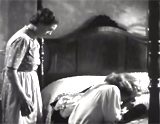 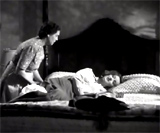 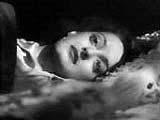
Judith's Last Words: "I don't want to be disturbed." |
||||||||||||
|
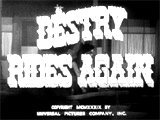
Bawdy saloon singer "Frenchy" (Marlene Dietrich) made a heroine's sacrifice for mild-mannered deputy Tom Destry (James Stewart), in the final scene. Frenchy was helping to defend Destry against unscrupulous Kent (Brian Donlevy) who stalked him from the Last Chance Saloon's second story balcony. She cried out to attempt to warn him about the ambush: "Look out, Tom!" She forced her way over to Destry and fearlessly lept into the line of fire to block the bullet meant for him. She was mortally wounded in the back as she threw her arms around him. Destry shot Kent, but Frenchy began to collapse and die in his arms. Before dying, she let him know that she loved him, gasping as she looked up at him:
Before their last kiss, she wiped away her lipstick with the back of her left hand - as he had suggested - as a final gesture. She expired and her head rolled away from Destry just as their lips touched (partially blocked from view by his hat). |
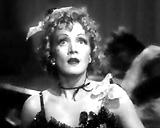 "Frenchy" Noting Danger 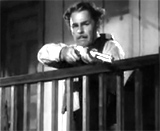 Ambush by Kent (Brian Donlevy) 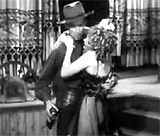 Frenchy Blocking Bullet Aimed at Destry 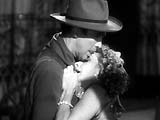 Final Goodbye Kiss |
||||||||||||
|
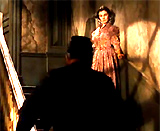
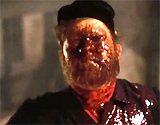
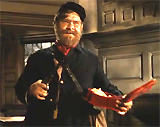
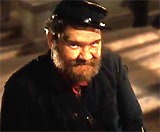
Scarlett O'Hara (Vivien Leigh) shot - at point blank range - a confrontational, armed Union deserter (Paul Hurst) on Tara's staircase. He was there to loot her mother's jewelry, and to menace and possibly rape-assault Scarlett. He responded to Scarlett's cold attitude about Yankee looters, with: "Regular little spitfire, ain't ya." As he approached her on the stairs, he asked: "Whaddya got hidden in your hand?" He was suddenly shot point-blank in the face with Rhett's pistol.
A close-up of Scarlett's face immediately after the killing showed her shocked and sullen face. She was only protecting the plantation household of Tara. Melanie Hamilton (Olivia de Havilland), who had dragged herself from a sickbed with her brother's sword to help defend Scarlett, saw the body at the foot of the stairs. She complimented Scarlett: "I'm glad you killed him." Melanie then suggested that they cover up the killing from other family members, and secretly bury the body to avoid repercussions from the North. Melanie gently asked Scarlett an unexpected question: "Do you think it would be dishonest if we went through his haversack?" Scarlett reluctantly admired her sister-in-law's suggestion: "I'm ashamed I didn't think of that myself." After finding gold pieces, Melanie removed her nightgown to wrap the bloody head of the dead soldier. In a discomforting sequence, Scarlett dragged and removed the body so that it could be buried. Scarlett postponed contemplating what she had done:
|
  Union Deserted: "Regular little spitfire..." 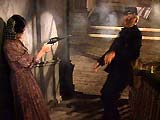 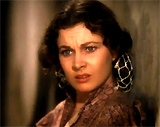 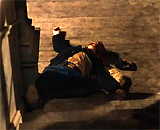 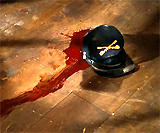 Shooting the Union Looter and Disposing of the Body |
||||||||||||
|
In the film's final nostalgic scene, elderly schoolmaster Mr. Charles Chipping (or "Mr. Chips") (Robert Donat) was ill on his deathbed and in his eighties. He overheard others talking over him about his lonely and sad life, with regrets because he never had children of his own. He stirred and refuted their remarks:
He closed his eyes while smiling, as the camera rose up when he passed on. He dreamily remembered many schoolboys filing past to repeat their names at call-over, while the music of the school song swelled in volume in the background. The final lad, the superimposed image of the last Peter Colley, appeared and spoke directly into the camera:
|
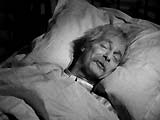 "I have...thousands of them...thousands of them...and all boys!"  Schoolboys Filing Past 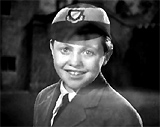 "Goodbye, Mr. Chips..." |
||||||||||||
|
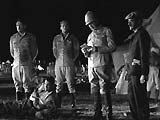
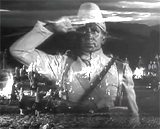
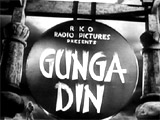
Gunga Din (1939) In RKO's quintessential adventure film, Indian water-bearer Gunga Din (Sam Jaffe) - although wounded with a bayonet, chose to sound the alert in colonial British India. He struggled to ascend to the top of the temple's gold dome, after taking a bugle from a dead Thugee cult member. With a last bit of effort, he sounded the alarm to warn approaching British forces that they were about to be ambushed. As he blew the bugle, he was shot dead, but his warning had been just in time, and the Thuggees were defeated. His sacrificial death warranted his induction into the British army as a corporal, during his funeral ceremony. Also, an excerpt from Rudyard Kipling's 1892 poem Gunga Din was read for his eulogy - as the film concluded:
The last image of the film was of the smiling spirit of Gunga Din in uniform and giving a posthumous salute - superimposed over the numerous funeral pyres. |
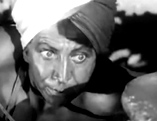  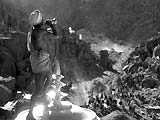 Gunga Din's Sacrificial Bugle Alert To Warn British Troops of an Ambush |
||||||||||||
|
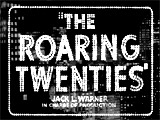
In this fatalistic story of rise and fall, rough gangster Eddie Bartlett (James Cagney) was bound to die a self-sacrificial, bloody death. In the memorable finale set on New Year's Eve, Eddie fled from rival gangsters into the snowy street, where he was shot in the back and mortally wounded. He found sanctuary outside a nearby church, where he stumbled, climbed, wobbled, and then tumbled down a flight of snow-covered steps. Weeping Panama Smith (Gladys George) came upon him and cradled his head in her arms as he expired on the steps of the church - the image evoked Michelangelo's Pieta. She answered a curious cop's inquiries about the deceased man's identity and laconically provided his epitaph and eulogy in the film's final poignant line, after which the camera pulled back:
|
 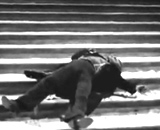 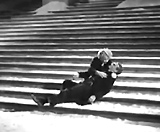 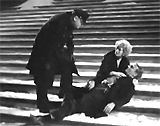 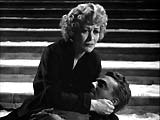 Panama: "He used to be a big shot." |
||||||||||||
|
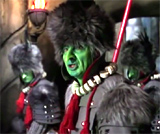
Without a way to escape from the mad pursuit, Dorothy (Judy Garland), the Lion (Bert Lahr), the Scarecrow (Ray Bolger), and the Tin Man (Jack Haley) were soon trapped, cornered and surrounded by the green-faced Wicked Witch of the West's (Margaret Hamilton) guards holding spears:
They were held at the evil Witch's mercy - her plan to do away with each of them had arrived:
First, the Witch set the Scarecrow's straw arm on fire by jabbing it with the lighted end of her broomstick: "How about a little fire, Scarecrow?" Dorothy tossed a nearby bucket of water on his arm to extinguish the flame, also accidentally splashing and drenching the Witch's face. She shrieked piteously in horror, her cries trailing off as she slowly dissolved, twisted, and melted in a memorable death scene. Her "wickedness" was reduced to a puddle of vaporous clothing in front of everyone by the application of a simple substance - water:
Toto and the Winged Monkey sniffed around her black cloak and hat, the only remaining parts of the Witch. Dorothy was confronted by the Captain of the Winkies Mitchell Lewis):
She meekly stammered an apology but was unexpectedly hailed and congratulated as the liberator from the evil forces of a witch:
Dorothy was presented with the defunct witch's broomstick after freeing herself and her friends - she turned excitedly to them: "Now we can go back to the Wizard and tell him the Wicked Witch is dead." |
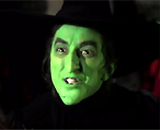 Green-Faced Wicked Witch of the West (Margaret Hamilton) 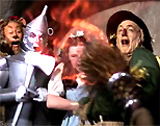 Scarecrow Set on Fire 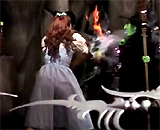 Dorothy Throwing Bucket of Water to Put Out Fire 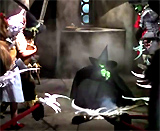 The Wicked Witch: "I'm melting, melting!" |
||||||||||||
|
|
Earlier, the Wicked Witch of the East died when she was crushed by Dorothy's (Judy Garland) farmhouse landing on her after a tornado. Only her feet (and the Ruby Slippers) protruded from under the structure. When her sister the Wicked Witch of the West (Margaret Hamilton) tried to procure the Ruby Slippers from her feet, the legs and feet shriveled up and withdrew under the house. The Witch was angered:
Glinda (Billie Burke) responded: "Too late. There they are, and there they'll stay." The magical Ruby Slippers had already appeared on Dorothy's feet. |
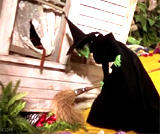 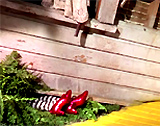  The Ruby Slippers |
||||||||||||
|
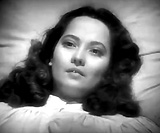
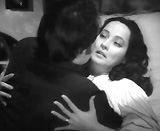
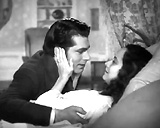
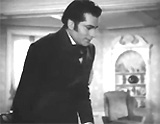
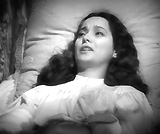
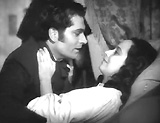
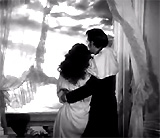
Director William Wyler's melodramatic romance was a brooding screen adaptation of Emily Bronte's 1847 romantic Victorian novel about a haunted love story and doomed lovers with inseparable spirits, set on the windy Yorkshire moors of pre-Victorian England. In a memorable, tragically-romantic deathbed scene in Cathy's bedroom, the long-hindered, passionate love affair of Cathy (Merle Oberon) and Heathcliff (Laurence Olivier) emerged in death; Heathcliff was reunited with the heartbroken and seriously-ill Cathy - she was possibly dying of a broken heart and suffering from an incurable disease. The two pledged their enduring, undying love and became reconciled after so many years of mutual unhappiness and bitterness. They passionately hugged and kissed each other, finally revealing their truest emotions to each other. Heathcliff argued as he stood up: "Oh Cathy, I never broke your heart. You broke it! Cathy! Cathy! You loved me! What right to throw love away for the poor fancy thing you felt for him, for a handful of worthiness. Misery and death and all the evils that God and man could have ever done would never have parted us. You'd be better alone. You wandered off like a wanton, greedy child to break your heart and mine." Cathy replied: "Heathcliff, forgive me. We've so little time." He vowed to stay with his dying love as her strength ebbed: "I'll never leave you again." He heard her claim that he was always the only man she ever loved: "When you went away that night in the rain, I told you I belonged to him, that he was my life, my being...It's true. It's true. I'm yours, Heathcliff. I've never been anyone else's." She requested to be picked up: "Take me to the window. Let me look at the moors with you once more, my darling. Once more." He carried her in his arms to her bedroom window for one last look out on the moors and Peniston Crag where they had played together as children.
Before slumping at his side after breathing her last breath and dying in his arms, they made a pact to be together for eternity. She promised to wait for him there in death until they were reunited again one day: "Heathcliff, can you see the Crag over there where our castle is? I'll wait for you 'til you come." Distraught by Cathy's death, Heathcliff gave an impassioned plea to his deceased beloved to haunt him for the rest of his days. He wished that he wouldn't have to suffer a long separation:
The film's flashback ended - the story of the tragic love between Heathcliff and Cathy Earnshaw had been told by Heathcliff's housekeeper Ellen Dean (Flora Robson) to a traveler named Mr. Lockwood (Miles Mander). Lockwood had been sleeping in Heathcliff's upstairs "bridal chamber" guest room, and called out to Heathcliff that he had heard a "phantom" woman calling out named Cathy. He also felt someone clutch his hand in an icy cold grasp at the window. Heathcliff flung open the window, and cried out for his long-lost love: "Cathy, Cathy, come in, Cathy come back to me...Oh my heart's darling. Cathy. My own, my, Cathy." Half-mad, Heathcliff ran downstairs and rushed out into the raging snowstorm. It was claimed by the family physician, Dr. Kenneth (Donald Crisp), who entered the room to find Ellen and Lockwood, that after desperately searching for Cathy's ghost in the snowy cold storm, he thought he saw Heathcliff walking with his arm around a woman, but then he was found frozen to death. Ellen informed the doctor that Heathcliff was not dead, but that his soul had joined his love in death at their favorite place forevermore: (Ellen: "No, not dead, Dr. Kenneth. And not alone. He's with her. They've only just begun to live"). In the final memorable image, the young, ghostly spirits of Cathy and Heathcliff were re-united for eternity (super-imposed as they walked over the snow) in death on the Peniston Crag moorlands, where they had spent many happy hours together in their childhood walking joyously across the heath. |
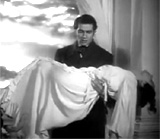 Cathy Dead in Heathcliff's Arms 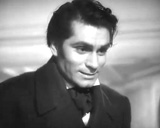 Heathcliff's Final Vow and Prayer: "Haunt me, then!" 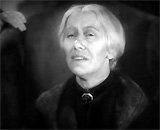 End of Flashback: Ellen's Final Words About Heathcliff and Cathy 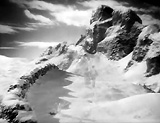 Last Image: Together Reunited on Peniston Crag |
||||||||||||
(chronological by film title) Intro | 1915-1929 | 1930-1933 | 1934-1938 | 1939 | 1940-1942 | 1943-1945 | 1946-1947 | 1948-1949 1950-1952 | 1953-1955 | 1956-1957 | 1958-1959 1960-1961 | 1962-1963 | 1964-1966 | 1967-1968 | 1969-1970 1971 | 1972 | 1973 | 1974 | 1975 | 1976 | 1977-1978 | 1979 1980 | 1981 | 1982 | 1983 | 1984 | 1985 | 1986 | 1987 | 1987 | 1988 | 1989 1990 | 1991 | 1992 | 1993 | 1994 | 1994 | 1995 | 1995 | 1996 | 1997 | 1998 | 1998 | 1999 2000-2001 | 2002 | 2003 | 2004 | 2005 | 2006 | 2007 | 2008 | 2009 | 2010 | 2011 |