|
Deaths Scenes 1948-1949 |

|
The Magic Mirror Maze funhouse hall-of-mirrors deadly shoot-out in this film's conclusion has become justly famous. It was between cruel pimp husband Arthur Bannister (Everett Sloane) and his blonde femme fatale wife Elsa (Rita Hayworth). They self-destructively drew their guns and shot at multiple likenesses of each other, as the screen erupted into a wild kaleidoscope of smashed glass, cracked and chipped pieces of mirror, and shattering bits of their false images. Their aim was confused by the contradictory mirror images that broke into splinters during the wild shooting as one fake image splintered and another replaced it. Witnessing the double murders as he stepped back and watched them destroy each other, Michael (Orson Welles) was horrified by the shattering of glass as the deceptive facades of their evil images were reflected and then blown away - and all that was left in the violent shoot-out was their guilt, greedy hunger, pain and misery. They finally were able to break through all their surfaces until they mortally wounded each other. At its climax after the panes had been blasted away, both Bannister and Elsa were dying and faced each other across a scene of shattered glass. Still in character, Bannister remarked with his last words: "You know, for a smart girl, you make a lot of mistakes. You should have let me live. You're gonna need a good lawyer." (See further below) |
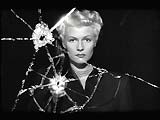 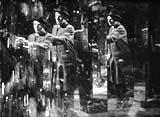 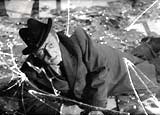
Death in the Magic Mirror Maze |
|||
|
|
As Bannister died after the shoot-out, Elsa (Rita Hayworth) stumbled with Michael (Orson Welles) into another room. The camera filmed at ground level down next to Elsa on the floor, as she agonized over her death. While she was dying, she had one last exchange with Michael. He recalled their conversation in the streets of Acapulco about the badness of the world, and his fishing tale about blood-thirsty sharks. After she admitted her own "original nature" that delved into corruptness and evil and surrendered to "badness," her pleading failed to gain his sympathy, even after an appeal to his sentimentality:
Unhooked from her charming and fatal attraction, Michael abandoned her to die alone. "I went to call the cops, but I knew she'd be dead before they got there and I'd be free. Bannister's note to the DA (would) fix it. I'd be innocent officially, but that's a big word - innocence. Stupid's more like it. Well, everybody is somebody's fool. The only way to stay out of trouble is to grow old, so I guess I'll concentrate on that. Maybe I'll live so long that I'll forget her. Maybe I'll die tryin'." |
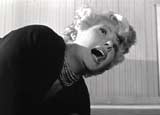 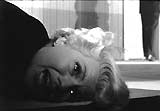 "I DON'T WANT TO DIE!" |
|||
|
The Red Shoes (1948, UK) Ballerina dancer Victoria (Vicky) Page (Moira Shearer) fell to her death just before an encore concert presentation of The Red Shoes ballet. The controlling red shoes willfully took her to a balcony overlook and forcefully pulled her off (into the path of an oncoming train below). Afterwards, there was a closeup of her bloody legs (and tights) and feet wearing the shoes. After she requested that Julian Craster (Marius Goring) remove her red ballet shoes, she died, in the melodramatic tragic death scene. |
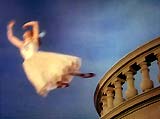 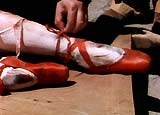 Red Shoes Caused Death |
|||
|
In the final memorable scene set at the state capital building, Willie Stark (Broderick Crawford) had just finished beating an impeachment rap, and he emerged to deliver a boisterous victory speech to the idolatrous crowd:
As he walked away, he was gunned down with two shots at close-range by an assassin - the embittered and vengeful young Dr. Adam Stanton (Shepperd Strudwick). He was the nephew of the reputable Judge Stanton (Raymond Greenleaf) who had recently committed suicide when Willie attempted to blackmail him into swaying votes in the Senate regarding Willie's impeachment trial. Mortally wounded and dying on the steps, a dismayed Stark delivered his final words to newspaperman Jack Burden (John Ireland), Sugar Boy (Walter Burke), political aide Sadie Burke (Mercedes McCambridge), and city boss Tiny Duffy (Ralph Dumke) - in close-up:
|
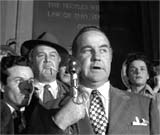 Willie Stark's Victory Speech After Beating Impeachment Charges 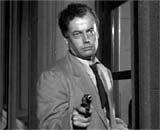 The Assassin - Enraged and Embittered Dr. Adam Stanton, Shooting Stark 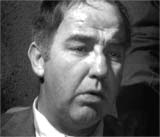 Last Words of Mortally-Wounded Willie Stark: "Could have been whole world - Willie Stark..." |
|||
|
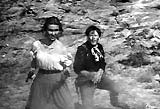
Colorado Territory (1949) In rocky mountain outcroppings, wounded, sought-after outlaw Wes McQueen (Joel McCrea) and mixed-race, El Paso dance-hall partner Colorado Carson (Virginia Mayo) faced last-stand deaths. In the exciting action scene, she heroically stood next to him with guns ablazing toward the authorities, but they were outnumbered and shot down. At the moment of their fateful deaths, they poignantly clasped their hands together. |
 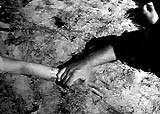 Clasped Hands |
|||
|
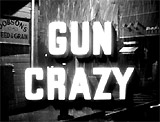
In this amour fou crime spree tale, the criminal, gun-wielding couple, Bart Tare (John Dall) and blonde sharpshooter/lover Annie Laurie Starr (Peggy Cummins), were hunted in the mountains and in a marshy and foggy swamp, where they were surrounded, with bloodhounds on their trail. In the moonlight, they came to the edge of a marshy swamp, with towering reeds and chirping crickets. Finding themselves pursued and at an impasse, they slowly turned their heads back towards their invisible trackers. After crossing another shallow pond, they collapsed into each other's arms on the ground to rest and await dawn. By morning, a thick, hellish, shroud of fog blanketed the area and trapped them in the swamp - anticipating a final showdown. With the camera firmly positioned on their apprehensive faces and trying to define their shapes through the mist, they heard - through the smoky clouds - ominous footsteps and the voices of Bart's boyhood pals Deputy Clyde (Harry Lewis) and Dave (Nedrick Young) announcing their approach. In their last few moments of life and knowing that they were surrounded, Bart faithfully declared his love for Laurie and gave her one final kiss. As the two came closer and Annie Laurie saw their figures in the fog, she vowed with an insane homicidal look on her face: "One more step and I'll kill you. I'll kill you. I'll kill you!" In a mercy killing, Bart was compelled to shoot his insane, aggressive lover - the only murder he committed in the entire film, in an act that adopted her own violent modus operandi. By killing her partly out of love, he silenced her lethal ability to kill any further, and protected the lives of his friends. Mistakenly believing that Bart had fired on them, a barrage of police gunfire abruptly cut Bart down. With poetic justice, he fell next to her. Their bodies lay united together - with Bart on his back and Laurie on her side. The film's sad theme song mournfully played one last time, as the two representatives of the law looked down at their fallen bodies in the heavenly shroud, and the camera pulled back and then up above their soggy, yet romantic grave. |
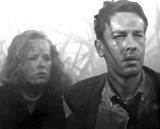 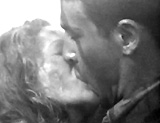 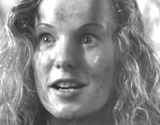 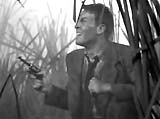 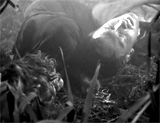 Dying Together |
|||
|
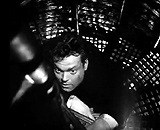
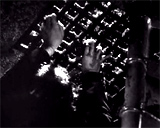
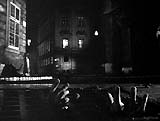
In the exciting breathtaking closing, there was a thrilling, extraordinary chase sequence, first through bomb-sites and down an open manhole, and then into the subterranean dark sewers and tunnels under Vienna that still linked all the occupied sections of the city. The climactic scenes were sharply edited for greater impact. The sewers were the dark, unobserved haunt of wounded black marketeer Harry Lime (Orson Welles) where his 'underground' evil-doings had permeated through the borders of the city's zones. In the manhunt by an international police force composed of police from all four nations, they climbed down into every available manhole. The filming captured the dark shadows on the ancient tunnel walls and the cobblestone surfaces. After a long pursuit sequence, Harry shot Sergeant Paine (Bernard Lee) dead with the gunshots echoing off the tunnel walls. Lime was shot and wounded by Major Calloway (Trevor Howard) as he scrambled away. As fugitive Harry made another break to escape, he was caught and cornered like a rat in the bowels of Vienna. He crawled up a circular iron stairway to reach a grill-covered man-hole - his fingers clutched, curled, strained and poked through the sewer grill grating (filmed from the street level) as he desperately and vainly tried to push it up, but he had been weakened by his wound and was unable to move the solidly-jammed grill cover and flee into the street.
His friend Holly Martins (Joseph Cotten) noticed Harry at the top of the iron stairway beneath the grating, and found his old friend struggling there, in great pain and fear. Calloway shouted out from a distance: "Be careful, Martins. Don't take any chances, if you see him, shoot." Harry looked down and saw Holly looking up at him. Harry wordlessly appealed to his friend, making a wink-like gesture or nod, to shoot. Ironically, it was left to Holly to kill his oldest friend. A gunshot sounded offscreen and Calloway halted. Holly's silhouette appeared at the end of the smoky tunnel - he had pulled the trigger and shot his friend dead - an ending typical of a Western tale. He had treacherously murdered and betrayed his oldest, closest and trusted friend. |
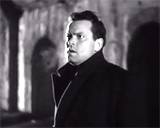 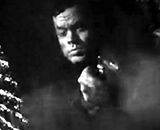 Harry Lime - On the Run and Firing Back 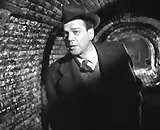 Holly Martins Joining in the Pursuit 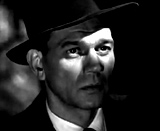 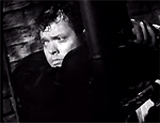 Looking Up at Harry Lime and Being Given Permission to Kill 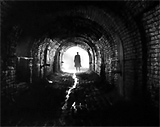 At the End of the Tunnel |
|||
|
White
Heat (1949) In the famous, climactic scene ending the film, mother-fixated gangster Arthur 'Cody' Jarrett (James Cagney) defiantly scrambled higher and higher around a holding tank with curving stairs circling the steel bulbous sides. At the top of the sphere, he gleefully fired upon the police, led by Hank Fallon (Edmond O'Brien). Cody was the only one left, cornered high atop one of the gas storage tanks at a dead end - he taunted the cops with a cocky retort: "Come and get me." Jarrett laughed maniacally as he was repeatedly wounded while standing astride the globe-like tank - or on top of the world itself - by Fallon's high-powered, scoped-rifle fire. As he recocked his gun, Fallon quizzically wondered about the mirth of the villain as he self-destructed: "What's holding him up?" Rather than giving in and submitting to the lawmen, a cackling, psychotically-mad Cody staggered around on the top of the platform as more bullets tore into him. Now out of his mind, he deliberately emptied his pistol into the giant gas-tanks of the chemical plant to ignite them and immolate himself. The men below ran from the flaming area, fearing for their lives. And then Cody hysterically lifted his face skyward, held out both arms, and memorably cried out to his dead mother that he had fulfilled her oft-repeated advice to him - immortality:
With defiance, he died in the tremendous 'white heat' explosion - a mushroom cloud, apocalyptic-style blast that shook the earth. Following Cody's suicidal, angry death, an emotionless, unsympathetic Fallon provided an additional epitaph as clouds of smoke billowed up and firelight flickered on his face:
|
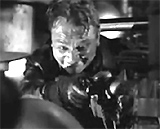 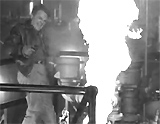 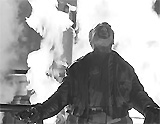 A Fiery Death: "Made it, Ma! Top of the world!" 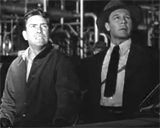 "...it blew right up in his face." |
|||
(chronological by film title) Intro | 1915-1929 | 1930-1933 | 1934-1938 | 1939 | 1940-1942 | 1943-1945 | 1946-1947 | 1948-1949 1950-1952 | 1953-1955 | 1956-1957 | 1958-1959 1960-1961 | 1962-1963 | 1964-1966 | 1967-1968 | 1969-1970 1971 | 1972 | 1973 | 1974 | 1975 | 1976 | 1977-1978 | 1979 1980 | 1981 | 1982 | 1983 | 1984 | 1985 | 1986 | 1987 | 1987 | 1988 | 1989 1990 | 1991 | 1992 | 1993 | 1994 | 1994 | 1995 | 1995 | 1996 | 1997 | 1998 | 1998 | 1999 2000-2001 | 2002 | 2003 | 2004 | 2005 | 2006 | 2007 | 2008 | 2009 | 2010 | 2011 |