![]() |
Best and Most Memorable Part 1 |
|
Note:
The films that are marked with a yellow star |
||
| (in chronological order by film title) Introduction | Part 1 | Part 2 | Part 3 | Part 4 | Part 5 | Part 6 | Part 7 | Part 8 | Part 9 | Part 10 |
||
| Film Title |
Description
of Kiss in Movie Scene |
|
| The Kiss (1896) (aka The May Irwin Kiss)
|
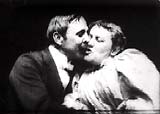
Although regarded as "disgusting" and scandalous and prompting demands for censorship, May Irwin and John Rice re-enacted a lingering kiss for Thomas Edison's film camera in this 20-second long short, from their 1895 Broadway stage play The Widow Jones; it was the first film ever made of a couple kissing in cinematic history, and became the most popular film produced that year by Edison's film company (it was filmed at Edison's Black Maria studio, in West Orange, NJ) | |
| A Fool There Was (1915)
|
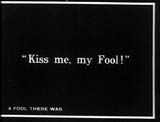
The original vamp and first movie sex goddess, the full-bosomed Theda Bara, starred in a number of early silents for the Fox Film Corporation - her first lurid, slinky vamp appearance (and first lead role) was in this Fox "psychological" melodrama, in which she portrayed a worldly, predatory woman who stole a wayward married man (Mr. Victor Benoit) from his wife and child by luring him with kisses ("Kiss me, my Fool!"); the catchphrase later became popularized as: "Kiss me, you fool!" | |
| Behind the Screen (1916)
|
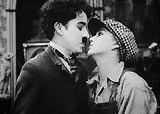
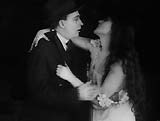
In this two-reeler's infamous 'gay' scene, hired film studio worker David (Charlie Chaplin) kissed a young girl (Edna Purviance) who was dressed in masculine clothing (as a masquerading way to find work), thereby upsetting his brutish and burly foreman Goliath (Eric Campbell) who believed they were homosexual and teased them mercilessly by acting 'prissy' to mock them | |
The Four Horsemen of the Apocalypse (1921)
|
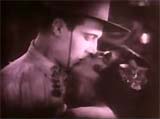
Argentinian Julio's (Rudolph Valentino) sexy (but forbidden) tango dance and kissing scene in a smoke-filled Argentinian cantina | |
|
|
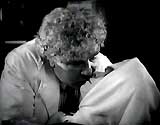
The scene in which self-taught quack dentist McTeague (Gibson Gowland) lustfully looks down at the unconscious, sedated face of his patient - ether-anesthetized, helpless Trina (ZaSu Pitts) in his dental chair; his eyes are fixed on her and he lustfully bends down toward her - but then he holds back and resists the strong temptation and impulse to molest her (inherited from his degenerate hereditary line). He takes out his drill to begin working, but still appears disturbed: "But below the fine fabric bred of his mother, ran the foul stream of hereditary evil...the taint of generations given through his father"; he smells her hair and her perfume, and eagerly leans over and cannot resist kissing her full on the mouth while she is under the influence of the ether. His agitated pet bird jumps and hops about in its cage in a corner of the office. At the conclusion of the shameful kiss, he pulls back, grabs his hair, and continues working. |
|
| Sherlock, Jr. (1924)
|
This classic silent comedy included a scene of lovelorn projectionist and flustered 'detective' Sherlock, Jr. (Buster Keaton) kissing his sweetheart/girlfriend (Kathryn McGuire) in the projection booth when he followed and imitated the cues of the leading-man screen actor kissing his girl |
|
|
|
In a marvelous, fully pantomimed, classic sequence - (one of the most famous scenes in silent film) - filmed in a single, uninterrupted take after they sat down on a bench beside her front steps, American soldier Jim Apperson (John Gilbert) introduced his French-speaking peasant girlfriend named Melisande (Renee Adoree) to American chewing gum with a lesson on how to stretch the gum out of one's mouth. To her surprise, she swallowed the stick of gum with one large gulp and then politely refused his offer of a second piece. With broken French, he boldly and awkwardly attempted to tell her of his love, and she reciprocated the attempt in broken English, and resisted his advances for a kiss. However, during their eight o'clock date that evening, when they both retreated to the wine cellar, in candlelight, he pointed out what he wanted to say to her about his love for her from his French primer. She beamed a smile back at him and they both shared a delicious, long kiss. When they rendezvoused later, their passion was released in a flood of kisses by the stream's edge | |
| Don Juan (1926)
|
In this film - the first Vitaphone feature film in which music and sound effects were synchronized and integrated into the film action, it was reported by Warner Bros' press agents that 42 year-old star John Barrymore (as a roguish Casanova swashbuckler named Don Juan de Marana) kissed his two leading ladies, Estelle Taylor (as jealous Lucretia Borgia) and 17 year old Mary Astor (as innocent and pious Adriana Della Varnese) 127 times in this film, plus smooches with other female companions that added up to a grand total of 191 kisses | |
Flesh and the Devil (1926/1927)
|
A luminous, torrid love affair between stars Greta Garbo (as amoral, insatiably sexual and sultry siren Felicitas von Kletzingk) and John Gilbert (as Leo von Sellenthin) occurred during the making of this Clarence Brown drama, filmed in 1926 but released in early 1927; their love/kissing scenes were beautifully photographed by William Daniels, using natural lighting (such as candle light), and the film reportedly had love scenes with the first-ever horizontal-position kiss in American film, and the first Hollywood film with an open-mouthed French kiss between the two stars - who were obviously in love in real-life |
|
| The Sea Beast (1926)
|
This romanticized silent screen film was loosely based on the Herman Melville tale of Moby Dick; John Barrymore starred as hard-loving, peg-legged roustabout seaman Captain Ahab Ceeley; in one infamous scene, four takes of the same kiss-embrace were spliced together to extend the male star's kiss with co-star Dolores Costello (as the lovely minister's daughter Esther Harper - and Barrymore's future real-life wife), who reportedly fainted afterwards | |
The Son of the Sheik (1926)
|
The decade's most popular, legendary male screen lover Rudolph Valentino (in his final film before his sudden death in August 1926 following his collapse at the film's NY premiere) starred in the title dual role as the now-older Sheik and his hot-blooded son Ahmed, who played opposite alluring, kidnapped bejeweled dancer, Yasmin (Vilma Banky); this was the superior follow-up silent adventure/melodramatic romance film to The Sheik (1921); it engendered criticism for being "morally objectionable" for its vengeful rape scene against Yasmin (only suggestively seen by a sequence of wide-eyed, soft-focus close-ups), as he forced himself upon her: "For once, your kisses are free!" as he approached her and the screen faded to black |
|
| Seventh Heaven (1927)
|
The ethereal and spiritual nature of romance was evidenced between Parisian sewer worker Chico (Charles Farrell) and street angel-waif Diane (Janet Gaynor) in his 7th floor bohemian loft (near the stars); when the two lovers were separated by war (she ended up as a munitions worker) and he was blinded, they still remained in telepathic communication with their hearts and minds each night at 11 - the film ended with the scene of their jubilant reconciliation following the war's end in a shaft of light | |
|
|
In this story of corruption and redemption, a rustic farmer - a fallen, married country Man (George O'Brien) living in a romanticized rural town fell prey to the seductive wiles of a city vamp and tempting mistress (Margaret Livingston) in an illicit affair. She summoned him with a soft, clandestine whistle at his window, and they rendezvoused together on the edge of the misty, moonlit marshes. The supernatural spell and erotic charm of the city woman seduced him and he pulled her into his arms for a passionate, fervent kiss - she stole his sanity and soul as she literally pulled him down into the swamp. While being kissed as they laid on the grass, the seductress tempted him, visualizing for him how to murder his wife and enjoy the allure of city life (seen in a kaleidoscope of images) | |
|
|
Later, after the country Man (George O'Brien) has reunited with his wife (Janet Gaynor) after threatening to kill her on their trip to the city, they were without fear and guilt - and seemingly invulnerable to the dangerous traffic they walked through. Magically, they appeared in a wooded country field with beautiful blooming flowers - their internal perceptions, visions, and feelings took on an objective reality. They walked into their fantasy world of the country and kissed - their love triumphed over chaotic evil in a commonly-shared dream. They suddenly reappeared super-imposed back within the congested city while still kissing and stopping traffic | |
| The farmer/husband (George O'Brien) and his presumed-drowned wife (Janet Gaynor) were reunited after she had been found alive but unconscious - he rushed to his wife's bedside in the farmhouse where they were joyously reunited; he attentively sat by his wife's bedside, where she slept with their infant until the dawn's light appeared - she opened her eyes and smiled at him with an angelic face and long-flowing hair after releasing her tight bun. She opened her eyes and turned her head on the pillow toward her husband. Their lips slowly drew together for a kiss, dissolving into the bright rays of an art-deco sun filling the screen. The word "Finis" floated upward to take the place of the sun as the music dramatically swelled | |
|
| Wings (1927)
|
This first Best Picture winner was also noted as portraying the first on-screen male-male kiss on the lips, when a handsome young soldier John "Jack" Powell (Charles "Buddy" Rogers) placed a lingering kiss on the mouth of his dying friend David Armstrong (Richard Arlen) | |
| The Wedding March (1928)
|
Under a shedding apple-blossom tree was a highly-romantic kiss between two lovers in a doomed relationship -- poor musician's daughter Mitzi Schrammell (Fay Wray) and young dissolute aristocrat Prince Nicki von Wildeliebe-Rauffenburg (director Erich von Stroheim), in pre-WWI Vienna | |
A Woman of Affairs (1928)
|
This MGM and Clarence Brown film with Greta Garbo (as Diana Merrick) and John Gilbert (as Neville Holderness) (in their third film together), was based upon Michael Arlen's erotic and controversial play The Green Hat, but sanitized for Hollywood, with its non-explicit melodramatic story of a carefree woman engaged in numerous illicit and amorous love affairs; in one of the most memorable scenes, Diana lounged seductively on a couch with a ring loosely dangling off her finger, mentioning coyly and temptingly to Neville: "I've been told I'm like this ring -- apt to fall...Neville, I have never said 'I love you' to any man - but you!.. " - as they passionately kissed and she stretched back horizontally under his embrace, the ring fell (in closeup) from her finger to the floor |
|
| Pandora's Box (1929, Ger.)
|
Insatiable, free-spirited, 18 year-old cabaret chorus girl and femme fatale Lulu (Louise Brooks), with a black bob (pageboy) haircut, was caught backstage in a wardrobe room scandalously kissing her obsessed and spell-bound patron - a wealthy newspaper owner named Dr. Ludwig Schon (Fritz Kortner) - by his more socially-acceptable fiancee Charlotte Marie Adelaide (Daisy d'Ora); Schon's marriage to his fiancee was immediately cancelled and he was compelled to marry Lulu instead, only to become jealously enraged (by her flirtations with his son Alwa (Franz Lederer)) and then he was accidentally murdered on his wedding night after struggling with a gun between them; her final kiss was on Christmas Eve in London's Soho during an erotic embrace when she was killed by gleaming-knifed Jack the Ripper (Gustav Diessl) (her hand went limp to indicate her death) |
|
| Morocco (1930)
|
In her Hollywood debut film (with Paramount and von Sternberg), Marlene Dietrich (as Amy Jolly) scandalously wore a sexually-ambiguous men's tuxedo and top hat as a performer in a North African cabaret club; in an early scene in which she exhibited smoky eroticism, she sang "Quand Lmour," took a flower from the hair of a young lady in the audience (asking: "May I have this?"), inhaled it suggestively, and then kissed the woman full on the mouth - one of the earliest (if not the first) female-to-female kiss; after wild applause, the bisexual (or androgynous) chanteuse tossed the flower to admiring foreign legionnaire Tom Brown (a young Gary Cooper) in the audience | |
Mädchen in Uniform (Germany, 1931) (aka Girls in Uniform)
|
This landmark lesbian film from Germany with an all-female cast was the first movie to portray forbidden lesbian love - it was based on the play by Christa Winsloe about a lesbian relationship in a Prussian girls boarding school; US censors banned the film for its depiction of lesbianism between student Manuela (Hertha Thiele) and teacher Fraulein Elizabeth von Bernbourg (Dorothea Wieck); during a bedtime ritual in the dormitory in which all the schoolgirls were kneeling at the end of their beds and anticipating a goodnight kiss, the teacher kissed all the girls on the forehead, except for Manuela who received an intimate lip-kiss |
|
| Bird of Paradise (1932)
|
In this King Vidor-directed exotic tale, beautiful Mexican actress Dolores Del Rio (as Luana - an alluring native princess) tempted love interest Joel McCrea to kiss her - repeatedly - and encouraged him by showing him where to put his lips; later after they had rehearsed many times, their kisses were more romantic and frequent | |
| A Farewell to Arms (1932)
|
The greeting kiss between World War I officer and ambulance driver Lt. Frederic Henry (Gary Cooper) and British nurse Catherine Barkley (Helen Hayes) was filmed with an impressive subjective camera close-up shot of her coming around his bed and kissing him after he first arrived in the hospital; he responded: "You're lovely" and "You're the loveliest thing I ever saw"; another dramatic kissing scene was in the film's dramatic conclusion when Catherine died in her hospital bed in a maternity ward in Switzerland after her baby died -- with Frederic by her side kissing her and professing his love: ("I'll never stop loving you"); in the scene, her prolonged tearjerking death ("Oh darling, I'm going to die. Don't let me die! Take me in your arms! Hold me tight! Don't let me go...In life and in death, we'll never be parted...I believe it and I'm not afraid") coincided with bells ringing to declare the Armistice; after she died, he carried her in his arms to the window and affirmed: "Peace, peace" - as white doves flew into the air and the screen faded to black | |
| Love Me Tonight (1932)
|
This innovative musical masterpiece from Paramount and director Rouben Mamoulian starred Maurice Chevalier (as a Parisian tailor) and Jeanette MacDonald (as a melancholy noblewoman) - as they came together for a kiss, Chevalier recommended: "The important thing is not to hurry" -- and then he aggressively kissed her | |
| Polly Tix in Washington (1932)
|
In this early, 15 minute child exploitation film, one of the Baby Burlesks shorts (with toddlers playing adult roles), four-year-old Shirley Temple (in only her second film role) was featured as Polly Tix - a high-priced call girl/prostitute (!) sent by corrupt officials to influence a backwoods politician | |
|
|
Sexy and unshaven Indochinese rubber plantation manager Dennis Carson (Clark Gable) was involved in a love triangle between sexy Saigon prostitute-on-the-run Vantine (Jean Harlow) and virginal (but married) upper-class adulteress Barbara "Babs" Willis (Mary Astor); during a torrential jungle rainstorm, Carson rescued Babs in his arms and "took" a kiss from her after reaching shelter; jealousies surfaced soon after and Babs - in a jilted rage - resorted to wounding Carson with a shotgun, leaving him by film's end to be happily treated by Vantine during his recuperation | |
Created in 1996-2008 © by Tim Dirks. All rights reserved.