
|
Film Kisses of All Time in Cinematic History 1937-1939 |

| Film Title/Year and Description of Kiss in Movie Scene | ||
|
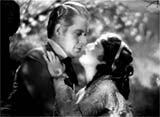
In the third of MGM's popular and profitable Jeanette MacDonald/Nelson Eddy films, this one an ornate production by director Robert Z. Leonard, the two unrequited lovers returned:
The two sang the film's magnificent Will You Remember (Sweetheart)?
They were on a path showered with flower blossoms. They kissed after he confessed:
|
|
|
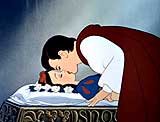
Snow White and the Seven Dwarfs (1937)
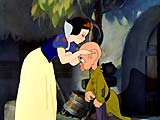
There were two memorable kisses in this delightful Disney animation - the first feature-length animated film:
Her endless sleep was induced by a bite of the Queen/Hag's poisonous apple. With great joy and cheering in the forest, an awakened Snow White went off with the Prince (voice of Harry Stockwell) on his horse - "and they lived happily ever after," but not before she kissed each of the dwarfs goodbye. |
|
|
The Adventures of Robin Hood (1938)
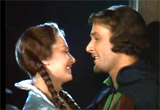
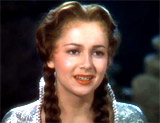
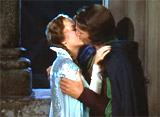
Director Michael Curtiz' rousing storybook adventure tale about the legendary Robin Hood was Warners studio's most expensive production up to that time (at $2 million). Tender romance accompanied the swashbuckler action scenes as the dashing outlaw won the hand of his lady love. The romance was between:
Robin climbed up the ivy on the steep Nottingham Castle wall to the chamber window of his beautiful love to express his gratitude for her daring part in his rescue. When he reached the top of the wall, he overheard Marian's thoughts on the subject of love as she spoke to her maid Bess (Una O'Connor). She was surprised when he entered through the chamber window, high in the castle wall, late at night. She was embarrassed to realize that he had overheard her confession of love to her maid Bess (Una O'Connor) about a "prickly feeling." Denying her feelings of love, she excused her thoughts as a "game." In an amorous conversation exhibiting one-upmanship, the two bantered and jested with each other as he talked about leaving and breaking his fall on enemy guards below. They shared a tender, innocent, storybook romantic scene on the open balcony as she called him back when he was about to retreat - they were equally in love with each other. When he questioned: "Then you do love me, don't you? Don't you?", she replied affirmatively: "You know I do." He responded positively: "Well, that's different," and boldly climbed back to the balcony. He took her into his arms for an embrace and kiss. Afterwards, she told him that he was "very impudent." When he spoke to her and praised her beauty, "You are the most beautiful...," she interrupted him, fearing for his safety: "And you're leaving here at once. Please darling! Every minute you're here, you're in danger." He dared to ask the captivatingly-beautiful heroine to join him in Sherwood: "I've nothing to offer you but a life of hardship and danger. But we'd be together." Marian replied: "Because I love you Robin, I'd come. Even the danger would mean nothing if you were with me," but then declined and decided to stay in Nottingham to provide intelligence on wicked Prince John's (Claude Rains) activities and watch for treachery in the castle. After gallantly courting her and encouraged by her love, Robin agreed to go back to his men without her. She bid him goodbye: "Go now quickly, dearest." They tenderly kissed a few times until Robin descended on the ivy down the castle wall. |
|
|
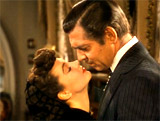
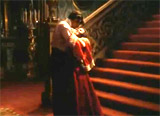
David O. Selznick's and MGM's epic Civil War-era masterpiece was essentially a love story about a contentious relationship between two sexually-charged characters:
They embraced and kissed a number of times in this film, but oftentimes, she would rebuff him. On one visit after she was made a widow early in the war, Rhett brought Scarlett a gift - a beautiful green hat from Paris, joking: "I thought it was about time to get you out of that fake mourning." Rhett had to show her how to wear it after she placed it on backwards: "The war stopped being a joke when a girl like you doesn't know how to wear the latest fashion." Scarlett thanked him for his generosity, but he declined to accept her graciousness. He said he expected something in return, but admitted: "I'm not a marrying man." Realizing that he was hinting at a kiss, she replied: "Well, I won't kiss you for it either," but in fact, she faced him, closed her eyes, and extended her lips. But then Rhett decided that he wouldn't kiss the receptive Scarlett:
He said he was waiting for "the right moment." She called him a "conceited, black-hearted varmint." |
 |
|
|
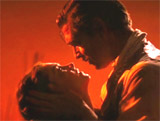
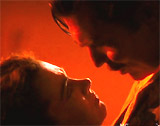
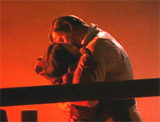
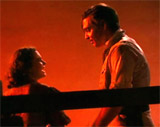
Later, on the road out of Atlanta against a fiery red sky, after they had evacuated the city, Rhett proposed leaving Scarlett, but then with his arms around her, long-time suitor Rhett realistically proposed that if she yielded to his love, he would stay and they would go off together:
He re-enacted the scene of a sweetheart kissing a soldier goodbye as he returned to the war:
But she misinterpreted his romantic fantasy and was furious at his vulgar and outrageous proposal - she violently slapped him in the face, and yelled at him: "You low-down, cowardly nasty thing you. They were right. Everybody was right. You, you aren't a gentleman." |
|
|
|
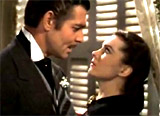
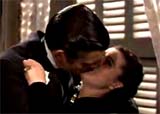
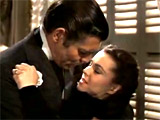
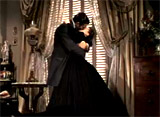
After the funeral of her second husband following the war, the virile Rhett antagonistically proposed to twice-widowed Scarlett with mock sincerity, and with a hint of sexual seductiveness. He suggested that she marry him to playfully try someone different:
He bullied her into kissing him. When she vowed she was fainting ("Don't, I shall faint"), he responded before kissing her again:
She then agreed to marry him without any real love for him - mostly for his money and for security. |
|
|
|
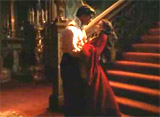
Later, at the foot of the stairs in the "Conjugal Rape" scene, a frustrated, lonely and angry husband Rhett appealed to Scarlett and threatened her. He suddenly and fiercely kissed her and asserted:
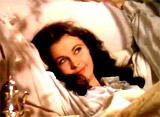
Rhett then carried her protestingly up a long flight of stairs to the bedroom, two steps at a time. The screen faded to black. The next scene opened with Scarlett's smiling, purring, happy face when she awakened the following morning. She betrayed her pleasure enjoyed during their previous night's sexual experience when he overcame her resistance. |
|
|
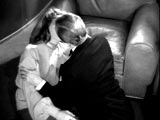
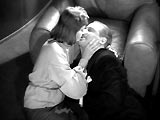
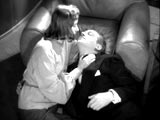
This charming romantic comedy by director Ernst Lubitsch about clashing ideologies (Soviet communism vs. capitalism) was star Greta Garbo's first comedy, advertised as: "Garbo Laughs." It told of a witty romance between a somber Russian emissary and an ardent Parisian playboy:
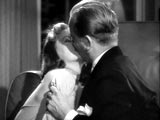
In his art-deco style apartment, Count Leon's persistence slowly and gradually began to melt, thaw and transform her Soviet rigidity, dogmatism, and literal coldness. He doused her with romantic talk, including a wonderful monologue about passion and love while expressing an overwhelming desire for her:
She pondered what he had said by looking intent and gazing into the faraway distance with a scientific attitude. With a side-long glance, she criticized his talkativeness: "You're very talkative." Unable to contain himself, he planted a kiss on her lips, asked: "Was that talkative?" - to which she replied with little feeling: "No, that was restful. Again." After being encouraged, Leon kissed her again. She replied: "Thank you," and leaned back on the leather chair, as he told her: "Oh, my barbaric Ninotchka. My impossible, unromantic, statistical..." She interrupted, took charge, and reciprocally kissed him back. He commanded her: "Again," but a telephone's ringing delayed any further kisses. |
|
|
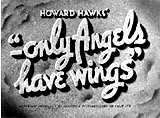
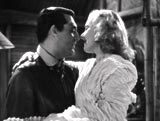
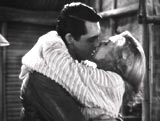
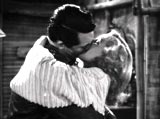
Director Howard Hawks' high-flying adventure story told about a group of pilots who risked their lives daily to fly over the South American Andes, and the arrival in their midst of a stranded female. Steely, embittered and misogynist Latin American pilots' boss Geoff Carter (Cary Grant), often in charge of dangerous missions, revealed to American showgirl Bonnie Lee (Jean Arthur) that his hard nature was due to a failed romance in his past to his ex-wife Judy (co-star Rita Hayworth), the seductive wife of pilot Bat MacPherson (Richard Barthelmess) with a troubled past. Later, after sticking around for another week to get better acquainted, Bonnie encountered Geoff in his quarters on the upstairs balcony, where she invited herself to take a bath. After he scooped her into his arms and called her a "queer duck," they kissed each other. She then confessed that she was in love and that she was no longer demanding and vulnerable about his risky profession. She affirmed that she was accepting of uncertainty, just like his friendship with older daredevil pilot Kid Dabb (Thomas Mitchell):
He replied: "The Kid?" and she responded: "Yes, he doesn't ask you for anything, or get in your way, or bother you, does he?" Surprisingly, he admitted differently: "Drives me nuts" - although he still kissed her. |
|
|
The Rules of the Game (1939, Fr.) (aka La Regle Du Jeu)
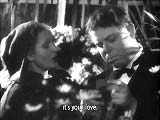
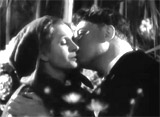
Jean Renoir's comedic psychological drama, often been considered one of the best films ever made, told about the romantic liaisons of rich and poor during a weekend retreat at a French country estate (La Coliniere) owned by the De La Chesnayes. In an idyllic scene in a dark and secluded greenhouse, upper-class married heiress Christine de la Chesnaye (Nora Gregor) comforted her close friend - the clownish, middle-aged, low-brow Mr. Octave (director Jean Renoir). She called him a "fine fellow" and told him "you need someone to take care of you. I'll take care of you." She then admitted her love for him:
When Octave gave her a warm peck on the cheek, Christine protested: "On the mouth, like a lover." Octave admitted his secret love (although he knew that she was unsuited for him in terms of class), and they kissed each other passionately, impulsively deciding to romantically run off together (taking a 3 am train). This was an impossibility when he was soon brought back to reality, but ended with a tragic misunderstanding and "accident" nonetheless. |
   |
(in chronological order by film title) Introduction | 1896-1925 | 1926-1927 | 1928-1932 | 1933-1936 | 1937-1939 | 1940-1941 1942-1943 | 1944-1946 | 1947-1951 | 1952-1954 | 1955 - 1 | 1955 - 2 | 1956-1958 | 1959-1961 1962-1965 | 1966-1968 | 1969-1971 | 1972-1976 | 1977-1981 | 1982 1983-1984 | 1985-1986 | 1987 | 1988 | 1989-1990 | 1991 | 1992-1993 | 1994 1995 | 1996 | 1997 | 1998 | 1999 | 2000 | 2001 | 2002 | 2003 | 2004 | 2005 | 2006-2007 | 2008 | 2009- |




 Unrequited
Love's Kiss
Unrequited
Love's Kiss