|
Film Kisses of All Time in Cinematic History 1942-1943 |

| Film Title/Year and Description of Kiss in Movie Scene | ||||||||
|
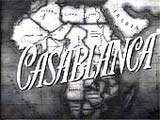
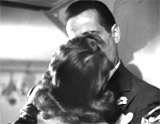
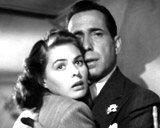
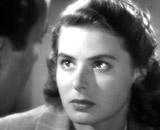
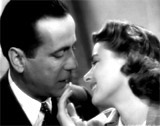
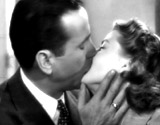
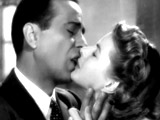
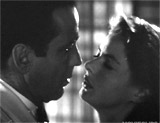
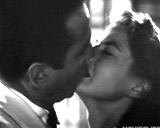
In this compelling romantic drama and Best Picture winner by director Michael Curtiz, a cynical ex-patriate American who was running a cafe in Casablanca happened to become reacquainted with a former lover from Paris. The couple were:
During a Parisian interlude scene - a bittersweet memory-flashback - at La Belle Aurore, piano player Sam (Dooley Wilson) played As Time Goes By ("a kiss is just a kiss") as Rick poured a glass of champagne for lover Ilsa and then offered his familiar toast:
As they embraced and kissed at the open window, artillery fire was heard off in the distance ("about 35 miles away") as the Germans approached, and Ilsa was startled and looked toward the street:
Because there was a "price" on Rick's head and his life was in danger, Ilsa pleaded with him to leave Paris. Rick suggested that they flee together on the 5 o'clock train from Paris to Marseilles ahead of the German invaders. She promised to meet him at the station. She was emotionally overwhelmed by his request to quickly marry her, and expressed her love for him in the midst of the "crazy world":
They express their passionate feelings in the flashback scene's climax. An emotionally-intoxicated Ilsa initiated the kiss, moving up to meet Rick's lips as they sit together, abandoning herself to him in a kiss - specially requested:
The camera moved down to reveal that Ilsa's fist in front of them had dropped and tipped over her champagne glass - symbolizing the strength of her anger at fate - and the end of her happy times with Rick. |
|
||||||
|
|
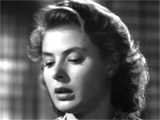
In a later scene, Rick and Ilsa encountered each other in the shadows of his dark, upstairs apartment, when she asked for exit visas and letters of transit, so that she and her husband Victor Laszlo could flee to America from the pursuing Nazis. She begged him for the visas he possessed for "any price" - documents that would enable them to fly to neutral Lisbon and then on to America. She accused him of being a self-pitying coward and scornfully told him:
But then when all else failed, she pulled a gun on him to demand the documents. Rick steadfastly refused to help, denying that he had ever aspired to the same Causes that "Victor Laszlo," the political institution and symbol, championed. When he was willing to give up his life ("Go ahead and shoot. You'll be doing me a favor"), she realized how much he was hurt by her abandonment. Ilsa's emotions crumbled and she could not shoot. She wavered and then dropped the threatening pretense - and lowered the gun.
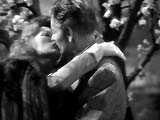
She turned away toward the window with tears in her eyes, and then fell into his arms. She suddenly realized how much she had always loved Rick and still loved him. He had triggered a rekindling of their old affection and she succumbed to his powerful, admirable love. She admitted that she was committed to him in Paris, and that she suffered immense pain when she had to leave him and separate. She ended her tender words with a passionate, authentic kiss:
|
|
||||||
|
Warners' ultimate tearjerker was a tale of the transformation of a moth to a butterfly, metaphorically. While on a cruise together, ugly-duckling turned, sexually-mature chic New Englander Charlotte Vale (Bette Davis) began a shipboard romance with kind fellow passenger Jerry (Paul Henreid). After a day trip of sight-seeing in Rio, Charlotte missed her boat's departure due to a car accident. The stranded couple sought overnight shelter in an abandoned cabin during a rainstorm. Before rejoining her ship, Charlotte spent five amorous days with Jerry in Rio - sight-seeing, eating in restaurants, and dancing. In one famous scene together, cigarette smoking became more and more a sensual, shared, intimate act as he first performed the trick with her - he lit both cigarettes and offered one to her. On a balcony as they talked about happiness and his growing feelings for her, he noticed: "My darling, you are crying." Charlotte buried her head in his chest and teary-eyed, said: "I'm such a fool, such an old fool. These are only tears of gratitude - an old maid's gratitude for the crumbs offered." When Jerry replied: "Don't talk like that" and took her chin in his hand, Charlotte admitted: "You see, no one ever called me 'darling' before." In close-up, they shared their first mutual kiss - a passionate but gentle one. Although she responded, "Let me go," they kissed again. Then, in the next famous scene at the Rio airport as Charlotte departed, Jerry brought her flowers. Both believed that they might never see each other again. She knew that Jerry was married and wouldn't desert his wife. He lit two more cigarettes and passed one to Charlotte:
They kissed one more time when she turned back. |
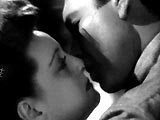 Balcony Scene 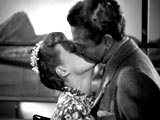 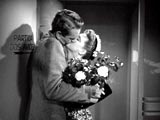 Rio Airport Goodbye |
||||||

|
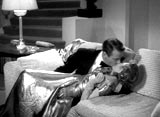
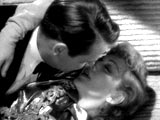
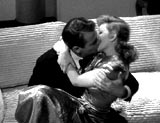
Preston Sturges' madcap marital comedy was an amusing look at life among billionaires in Palm Beach, Florida. It told of the threatened relationship between a couple, with the wife seeking divorce:
She walked out on her beleaguered husband after a five-year marriage to become an "adventuress." She theorized that she could make him happy by finding a new, wealthy husband (pre-approved and in his "good graces") who might help him realize his ambitions - or offer him a business partnership. She was confident that enamoured men would 'faint at her feet'. Upon their return home after dinner and a little tipsy, Gerry matter-of-factly stated:
When she was unable to unzip the back of her dress, he assisted and had her sit on his lap - and their love and fondness for each other was rekindled as he reminded her:
She shuddered under the spell of his passionate kisses on her back, but denied any effect: "It's nothing." However, she succumbed as he wrapped his arms around her, and pulled her to himself on the couch. When he asked: "That doesn't mean anything to you anymore, huh?", she breathlessly replied: "Almost nothing." (as her toes curled forward!) She allowed herself to be limply carried upstairs to their bedroom - their kissing was a prelude to lovemaking. |
|
||||||
|
Random Harvest (1942)
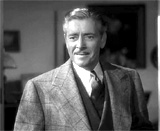
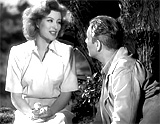
In this great romantic film adapted from James Hilton's novel, wealthy aristocrat Charles Rainier (Ronald Colman) sustained a shell-shocked head injury during WWI, and became an amnesiac who was named John Smith (or "Smithy"). He was institutionalized at the Melbridge County Asylum. He met music hall actress-entertainer stage-named Paula Ridgeway (Greer Garson) who took him to a countryside cottage in Devon to recuperate. Eventually he found the courage to ask her to marry him in an idyllic scene under a tree where they shared a picnic:
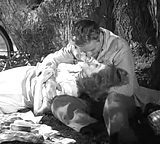
He relaxed back onto the ground with his arms outstretched: "Oh, oh, now, now, I can relax!", but she reminded him that they should properly seal their engagement with a kiss:
He took her in his arms: "Oh, my..." |
|
||||||
|
|
Random Harvest (1942)
After singer stage-named Paula Ridgeway (Greer Garson) was married to amnesiac John Smith (or "Smithy") (Ronald Colman), they lived together for about three years and had a baby son - until he was hit by a taxi in Liverpool when going there to apply for a newspaper job. He regained his memory of his real identity as wealthy aristocrat Charles Rainier, but lost all memory of his life as John Smith and his relationship with Paula. The still-devoted 'wife' tracked him down and became his devotedly faithful secretary named Margaret Hansen, just hoping for the day he would unlock his memory and remember her. In the film's conclusion, he approached their familiar-looking old cottage after going through the squeaky gate and blossoming bough - he used a long-treasured key to open the door. Behind him at the gate, Paula/Margaret (with tear-stained cheeks) softly called out to him:
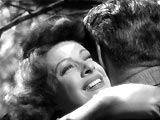
He recognized the voice - and remembered his former idyllic life with her. He turned around, softly responded "Paula!", and they came together to embrace and kiss as the music built to a crescendo.
A fade to black brought "The End" to the screen. |
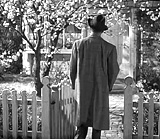 At the Front Gate 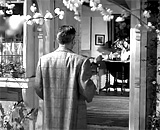 Opening Front Door with Latch-Key 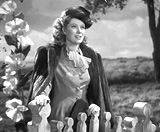 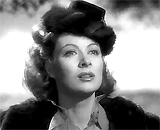 "Smithy? Oh, Smithy! Oh, Darling" - Paula Observing From Behind |
||||||
|
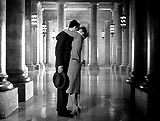
Although this Columbia Studios picture from George Stevens was a romantic comedy about a love triangle, it also was a serious look at the function of law in society. The studio originally shot two different conclusions to the film, not knowing who should win the affections of the girl - Jean Arthur (as schoolteacher Nora Shelley, the Professor's housekeeper). It would be either:
The film ended with both Dilg and Nora in Washington, to see Lightcap take his rightful place on the judicial bench. Although Nora winked at the judge, she raced after Dilg for a film-ending embrace in the hallway of the US Supreme Court building. |
|
||||||
|
Woman of the Year (1942)
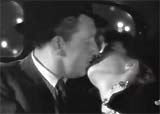
This was the first of nine films teaming Katharine Hepburn and Spencer Tracy together - an opposites-attract tale from director George Stevens. It told about successful New York Chronicle newspaper sportswriter Sam Craig (Spencer Tracy) who taught celebrated, sophisticated, no-nonsense, career-minded political columnist Tess Harding (Katharine Hepburn) (working for the same newspaper) about the simple pleasures of life. In a taxi-cab ride scene together, Sam confessed to Tess as she rested on his chest: "I love you." She was surprised: "You do?" and he replied: "Positive." She affirmed: "That's nice," but then asked: "Even when I'm sober?" to which he told her: "Even when you're brilliant." Their conversation was followed by a kiss which was soon interrupted by the nosy cab driver's untimely: "This is it!" In her dark apartment, they kissed again. She encouraged and invited him to kiss her a third time when he observed that her pretty portrait was "a little too high to reach" and she responded: "I'm not." Although he was a "bundle of nerves," she was "relaxed" and wanted to continue to kiss him (and presumably be more intimate), but he left hurriedly when she went to the kitchen for a glass of milk. In haste, he forgot his hat, which she sent to him in a box with a note asking: "What's the hurry?" |
|
||||||

|
For Whom the Bell Tolls (1943)
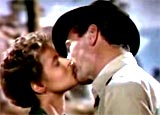
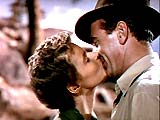
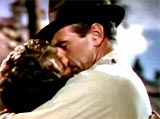
Director Sam Wood's film was a version of Ernest Hemingway's novel of the same name, set in Spain during its civil war in 1937. Before an ill-fated ending, the two main characters experienced a famous kissing scene between them:
After he cradled her head, she laughed as she told him:
To prove that she was kissing him correctly, he grabbed her for another kiss. |
|
||||||
|
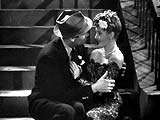
This wartime comedy film, another romantic comedy by director George Stevens, had a sexually-exciting, brownstone apartment front steps kissing scene on a balmy summer night in wartime Washington DC, during a housing shortage. The amorous smooching occurred between two of the three roommates who shared a single apartment:
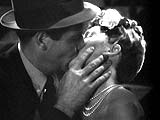
Walking home with him, she was provocatively dressed in an off-the-shoulder black lace evening dress, with a string of white pearls around her soft neck, and her hair was decorated with a white flower. On the way, she turned a streetcorner and nearly walked into one of many kissing couples on the sidewalk. As they talked about his family, he kept taking off and putting on her wrap, putting his hand on her bare shoulder, and taking her arm in his. When she asked about his girlfriends, they almost kissed in a shot framed between two small tree trunks, but then she resisted and pulled away, asking: "Are you afraid to get married or something?" As he embraced her, they collapsed on the front stoop of their shared apartment. She spoke about her plans for her own marriage and her future with her fiancee, an older man, forty-two year old ("a safe and sane age") government official. She was referring to her stuffed-shirt boss, Charles J. Pendergast (Richard Gaines): "I consider myself a very lucky little lady...being engaged to Mr. Pendergast." All the while, Joe was amorously embracing her, caressing her, and fondly touching her hands, arms, and shoulders - she vainly attempted to ignore his advances to make out. She fended off his nuzzling and roaming hands exploring her entire body (both in and out of view of the audience), and tried to conceal her growing desire by incessant talking. She held out her engagement ring for his approval and he responded by kissing her wrist. Connie became visibly distracted and her voice cracked when he admired and then nuzzled her bare neck. As she spoke, he interrupted her mid-sentence (with a passionate kiss on the lips):
When he released, she finished the sentence: "...viewpoint." She paused, looked away for a second, and then took the two sides of his face with her hands and boldly kissed him back - harder. But then, she realized that they were getting too involved. She stood and politely stated: "I've gotta go. Good night, Mr. Carter." He responded: "Good night, Miss Milligan." She ascended the stairs into the building and shut the door. He began walking away and then sheepishly remembered that he was leaving his own apartment: "I almost forgot where I lived." Connie held the door open for him. As they bedded down in adjacent rooms - shot from outside in a frame split by the wall between them, they discussed how uncomfortable and restless they were, and Joe finally admitted: "I love you Connie." She responded likewise: "I love you more than anything in the world." |
|
||||||
(in chronological order by film title) Introduction | 1896-1925 | 1926-1927 | 1928-1932 | 1933-1936 | 1937-1939 | 1940-1941 1942-1943 | 1944-1946 | 1947-1951 | 1952-1954 | 1955 - 1 | 1955 - 2 | 1956-1958 | 1959-1961 1962-1965 | 1966-1968 | 1969-1971 | 1972-1976 | 1977-1981 | 1982 1983-1984 | 1985-1986 | 1987 | 1988 | 1989-1990 | 1991 | 1992-1993 | 1994 1995 | 1996 | 1997 | 1998 | 1999 | 2000 | 2001 | 2002 | 2003 | 2004 | 2005 | 2006-2007 | 2008 | 2009- |




 "Kiss
Me As If It Were the Last Time"
"Kiss
Me As If It Were the Last Time"