| Tex Avery:
After working to help create the Oswald the Lucky
Rabbit cartoons
for the Walter Lantz studio in the early 30s, and then co-creating
some of the most notable cartoon characters of all time at Warners
in the late 30s and early 40s (for Leon Schlesinger), Tex Avery moved
to MGM Studios in 1942, where from 1942 to 1957, he accelerated the
pace and scope of animations and adopted new characters. At the end
of his time at MGM, Avery continued his work with the Walter Lantz
Studio (see further below).
Avery's first cartoon for MGM, the anti-German
propagandist short Blitz Wolf (1942), brought him his sole Oscar
nomination for Best Short Subject. It was a wartime semi-parody of
Disney's earlier Three Little Pigs (1933) with Adolf Wolf (a
thinly-disguised Hitler, portrayed as "one big stinker")
threatening to invade the state of Pigmania and the house of Sergeant
Pork (US).
Besides Tom & Jerry (see below), the other most popular
MGM cartoon characters, Tex Avery's most famous and long-lasting at
the studio, was the meek, slow-moving, sad, droopy-eyed, and slow-talking
basset hound known as Droopy Dog. The emotionless, deadpan-voiced,
yet stoic Droopy (known as "Happy Hound") made his nameless
debut in MGM's Dumb-Hounded (1943). His first line of dialogue
was: "Hello all you happy people...you know what? I'm the hero." He
finally received his proper name in his fifth cartoon, Senor Droopy
(1949). Drag-Along Droopy (1954) was one of the classic Droopy cartoons,
a spoof on range wars between sheepherders (Droopy) and ranchers (the
Wolf's "Bear Butte Ranch"), as was Dixieland Droopy (1954)
- the first Droopy cartoon in Cinemascope. One Droopy
Knight (1957) was nominated for an Academy Award for Best Short
Subject - the character's sole nomination (after Avery left
the studio).
Avery also
developed the character of wacky Screwy Squirrel, an angry anthropomorphic
furry squirrel for Screwball
Squirrel (1944) who appeared in only five cartoons from 1944 to
1946. Screwy's basic enemy was Meathead Dog. In addition, another short-lived
animation series consisted of only five cartoons from 1946 to 1948.
They starred a pair of mismatched bears named George and Junior (derived
from the characters in John Steinbeck's Of Mice and Men novel, George
and Lennie). The first George and Junior cartoon was Henpecked
Hoboes (1946), while the last was Lucky Ducky (1948).
|
Tex Avery's MGM Cartoons (1942-1957) - New Characters
|
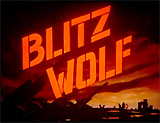
Blitz Wolf (1942)
|
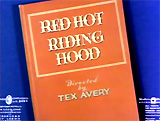
Red Hot Riding Hood (1943)
|
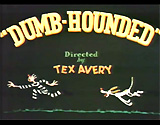
Dumb-Hounded (1943)
|
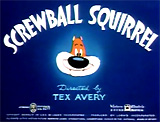
Screwball Squirrel (1944)
|
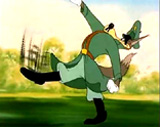
Adolf Wolf
|
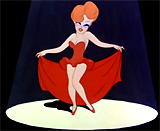
Red
|
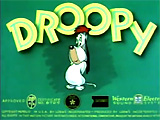
Droopy Dog
(first known as "Happy Hound")
|
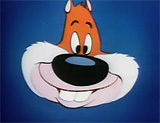
Screwy Squirrel
|
|
|
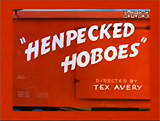
Henpecked Hoboes (1946)
|
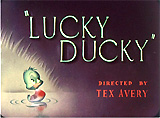
Lucky Ducky (1948)
|
|
|
|
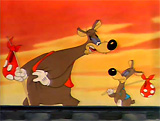
(l to r): Junior and George
|
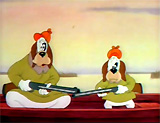
(l to r): Junior and George
|
|
Tex
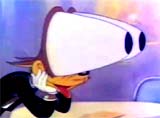
Avery's work was considered quite controversial when he created a sexy
version of the well-known fairy tale Red Hot Riding Hood (1943) with
a character known as Red, a sexy red-headed beauty.
[ Note: It heavily
influenced director Chuck Russell's The Mask (1994) featuring
Jim Carrey as mild-mannered bank clerk Stanley Ipkiss, who was obsessed
with cartoons. When Stanley donned a magical mask, he turned into an
alter ego composed of Tex Avery-like cartoon characters - the Wolf
(including a famous double-take with his eyes popping out of his head
and a wolf whistle), the Tasmanian Devil (whirling like a tornado),
and others. He even re-enacted portions of a classic Avery cartoon
that he earlier watched on his VCR, Red Hot Riding Hood (1943),
in the nightclub scene. All special effects were compliments of George
Lucas' Industrial Light and Magic.] Note: It heavily
influenced director Chuck Russell's The Mask (1994) featuring
Jim Carrey as mild-mannered bank clerk Stanley Ipkiss, who was obsessed
with cartoons. When Stanley donned a magical mask, he turned into an
alter ego composed of Tex Avery-like cartoon characters - the Wolf
(including a famous double-take with his eyes popping out of his head
and a wolf whistle), the Tasmanian Devil (whirling like a tornado),
and others. He even re-enacted portions of a classic Avery cartoon
that he earlier watched on his VCR, Red Hot Riding Hood (1943),
in the nightclub scene. All special effects were compliments of George
Lucas' Industrial Light and Magic.]
Walter Lantz Studios: Oswald the Lucky Rabbit, Woody Woodpecker,
and Chilly Willy
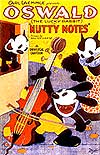 Walter
Lantz, an early animator, and Charles Mintz (representing Universal
and boss Carl Laemmle), took over the character Oswald the Lucky Rabbit
from Walt Disney in 1928 - it was the first animated character
for Universal Pictures. Mickey Rooney was the first to do the
character's voice. The resemblance of Oswald to its biggest competitor,
Disney's Mickey Mouse, was striking. Walter
Lantz, an early animator, and Charles Mintz (representing Universal
and boss Carl Laemmle), took over the character Oswald the Lucky Rabbit
from Walt Disney in 1928 - it was the first animated character
for Universal Pictures. Mickey Rooney was the first to do the
character's voice. The resemblance of Oswald to its biggest competitor,
Disney's Mickey Mouse, was striking.
Lantz made a series of black-and-white
cartoons from 1929 to 1935, featuring the rubber-limbed, long-eared
rabbit, including these early titles:
Ozzie of the Circus (1929), Stage Stunt (1929), Stripes
and Stars (1929), Wicked West (1929), Nuts and Bolts (1929), Ice Man's Luck
(1929), Junegle Jingles (1929), Weary Willies (1929), Saucy Sausages (1929),
Race Riot (1929), Oil's Well (1929), Permanent Wave (1929), Cold Turkey (1929),
Amature Nite (1929), Snow Use (1929), Hurdy Gurdy (1929), and Nutty
Notes (1929)
Lantz was noted for also making the first-ever
Technicolor cartoon - the opening animated sequence to the live-action The King of Jazz (1930).
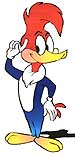 Another
of Lantz' legendary creations was a new character - the red-headed, blue-bodied, long yellow-beaked, trouble-making
Woody Woodpecker, with his distinctive trademarked laugh ("Ha-Ha-Ha-HA-Ha" by
Mel Blanc) and voice (by Mel Blanc for the first four cartoons, and then by
Ben "Bugs" Hardaway until 1948, and thereafter by Lantz' own wife
Grace Stafford). Woody (looking slightly deranged and not like his later persona) first appeared in Lantz' Andy Panda cartoon Knock, Knock (1940) distributed by Universal Studios, in which he bedeviled the panda. The next year, the popular Woody became a starring character as "Woody Woodpecker" in The Cracked Nut (1941), and began to replace the waning Oswald the
Rabbit. Another
of Lantz' legendary creations was a new character - the red-headed, blue-bodied, long yellow-beaked, trouble-making
Woody Woodpecker, with his distinctive trademarked laugh ("Ha-Ha-Ha-HA-Ha" by
Mel Blanc) and voice (by Mel Blanc for the first four cartoons, and then by
Ben "Bugs" Hardaway until 1948, and thereafter by Lantz' own wife
Grace Stafford). Woody (looking slightly deranged and not like his later persona) first appeared in Lantz' Andy Panda cartoon Knock, Knock (1940) distributed by Universal Studios, in which he bedeviled the panda. The next year, the popular Woody became a starring character as "Woody Woodpecker" in The Cracked Nut (1941), and began to replace the waning Oswald the
Rabbit.
Over the next three decades, Lantz made about 200 six-minute
Woody cartoons. Woody's appearance and demeanor was somewhat softened in The Barber
of Seville (1944), but he still maintained his usually aggressive and slightly
sadistic, manic personality. A long-time adversary of Woody's, Wally Walrus, was
introduced in The Beach Nut (1944), the same year. Two Woody shorts were Oscar-nominees:
- The Dizzy Acrobat (1943) - defeated by MGM's Tom & Jerry cartoon The Yankee Doodle Mouse
- Musical Moments From Chopin (1946) - defeated by MGM's Tom & Jerry cartoon The Cat Concerto
In 1948, the novelty
tune, The Woody Woodpecker Song (written by George Tibble, Ramey Idriess
and Danny Kaye) was released on record and became the #1 hit song (sung by
Kay Kyser). The song was put into the latest cartoon, Wet Blanket Policy
(1948) (with another new co-star arch-nemesis Buzz Buzzard) and was nominated
for an Oscar for Best Song (it lost to Buttons and Bows in The Paleface
(1948)). Young boys copied Woody's haircut, and fan clubs developed across
the country. In the late 50s, The Woody Woodpecker Show first appeared
on ABC-TV in 1957 , and led to further shows and syndication.
A less popular but distinctive Lantz cartoon character was
Chilly Willy - a penguin, who first appeared in 1953 in a cartoon titled appropriately, Chilly Willy (1953). Chilly's popularity soared when animator Tex Avery
joined the Lantz Studio the following year and directed Chilly's second and
third cartoons: I'm Cold (1954) and Academy Award-nominated The
Legend of Rock-a-bye Point (1955) for Best Short Subject Cartoon (it lost
to Speedy Gonzales (1935), a Warner Bros.' Merrie Melodies cartoon).
As with Woody, Chilly Willy cartoons appeared all the way until 1972 - the
last year of production.
Hanna-Barbera's Tom & Jerry:
 In
their first full teaming together after first meeting at MGM and serving
as co-directors in the studio's animation unit, William Hanna and Joseph
Barbera created the cat and mouse Tom & Jerry series (clearly
influenced by the frenetic action in Tex Avery's work at Warners).
It was composed of comic adventures about Tom - a gray mangy cat, and
Jerry - a wisely innocent mouse. In
their first full teaming together after first meeting at MGM and serving
as co-directors in the studio's animation unit, William Hanna and Joseph
Barbera created the cat and mouse Tom & Jerry series (clearly
influenced by the frenetic action in Tex Avery's work at Warners).
It was composed of comic adventures about Tom - a gray mangy cat, and
Jerry - a wisely innocent mouse.
When the cartoon series highlighting
the love-hate relationship between the two animals was first introduced
in 1940 with the 9-minute Technicolored pilot Puss
Gets the Boot (1940), Hanna and Barbera received their first Oscar
nomination. In this first appearance of the characters, both Tom and
Jerry were unidentified as such: Tom was called 'Jasper' and the mouse
had no name.
Hanna-Barbera's Tom & Jerry (1940-1957)
Introduced in a Pilot Episode
|
MGM Cartoon Title Screen
|
The Only Screen Credit -- Produced by Rudolf Ising,
(directed by William Hanna and Joseph Barbera)
|
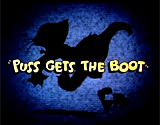
Puss Gets the Boot (1940)
|
Over 100 cartoons from 1940 to 1957 featured the two
cartoon characters, and Hanna and Barbera were able to break Disney's
Oscar monopoly for award-winning cartoons. They won more Academy
Awards than any other cartoon series in history, except for Disney's Silly
Symphonies that also won the same number. They
won seven Oscars for Best Short Subject: Cartoon for the following animated
cartoons, all in the Tom
& Jerry series:
- Yankee Doodle Mouse (1943) - the 11th Tom
& Jerry short, and the first cartoon to use their Tom
& Jerry red and yellow sunburst opening and closing title
cards
- Mouse Trouble (1944) - the 17th Tom & Jerry short
- Quiet, Please! (1945) - the 22nd Tom & Jerry short;
also one of the few cartoons in which Tom spoke
- The Cat Concerto (1947) - the
29th Tom & Jerry short, and the
fourth consecutive Oscar win in the category; the two studios
in competition for the award, MGM and Warners (with Friz Freleng's
Rhapsody Rabbit (1946) starring Bugs Bunny), accused each other of plagiarism
for similar plot lines
- The Little Orphan (1949)
- The Two Mouseketeers (1952)
- Johann Mouse (1953) - the
last and 7th film to win an Oscar; Jerry - the mouse, couldn't resist
waltzing when he heard music from the master of the house, Viennese
composer Johann Strauss. Tom, also a resident in the household of the
Maestro, took piano lessons to keep Jerry dancing and entranced - so
that he could snatch him.
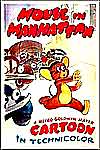 One of their most famous cartoons
was the 19th short, Mouse in Manhattan (1945) that featured
a score by Scott Bradley (made up mostly of Louis Alter's Manhattan
Serenade later used in The Godfather (1972) and
Arthur Freed and Nacio Herb Brown's "Broadway Rhythm") -
it told about Jerry's adventures in the big city. It was one of only
a few episodes where only one of the characters played a major
role.
One of their most famous cartoons
was the 19th short, Mouse in Manhattan (1945) that featured
a score by Scott Bradley (made up mostly of Louis Alter's Manhattan
Serenade later used in The Godfather (1972) and
Arthur Freed and Nacio Herb Brown's "Broadway Rhythm") -
it told about Jerry's adventures in the big city. It was one of only
a few episodes where only one of the characters played a major
role.
Later, in a few famous sequences, Jerry the mouse danced with
Gene Kelly in Anchors Aweigh (1945) - the first instance of
the combination of live action and animation in a feature film. Tom and Jerry
also performed an underwater fantasy dance with Esther Williams in Dangerous
When Wet (1953). Famed animator Chuck Jones was assigned to produce new
episodes for Tom and Jerry cartoons in the 70s at MGM - but they had
lost their spunk and spirit by that time - and were ultimately unsuccessful.
The First Full-Length Animated Film:
Walt Disney Animation Studio Feature Films (1937-present)
Decade of the 1930s
|
| No. |
Title Screen |
Title (Year) |
Notables |
|
1
|
|
Snow White and the Seven
Dwarfs (1937)
|
- based on the German fairy tale by the Brothers Grimm
- the first, full-length
cel-animated, hand-drawn featured film
- the earliest Disney Animated Feature Film
- derided by Disney's critics as "Disney's Folly"
- Academy Award nominated for Best Musical Score
- at the time of its release, it briefly held
the record for highest-grossing (domestic) sound film
- its unofficial sequel was Filmation's Happily
Ever After (1990)
|
 The
Golden Age of Hollywood cartoon comedy was in the late 1930s and 1940s. The
earliest animated films that most people remember seeing are the later,
more sophisticated Disney feature films that contain exquisite detail,
flowing movements, gorgeous and rich color, enchanting characters,
lovely musical songs and tunes, and stories drawn with magical or
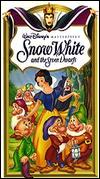
mythological plots. The first, full-length animated film was
Disney's classic Snow
White and the Seven Dwarfs (1937) released on December 21,
1937 (wide release on February 4, 1938), which took four years to
make and cost $1.5 million dollars. It was 1938's top moneymaker at
$8 million. The
Golden Age of Hollywood cartoon comedy was in the late 1930s and 1940s. The
earliest animated films that most people remember seeing are the later,
more sophisticated Disney feature films that contain exquisite detail,
flowing movements, gorgeous and rich color, enchanting characters,
lovely musical songs and tunes, and stories drawn with magical or
mythological plots. The first, full-length animated film was
Disney's classic Snow
White and the Seven Dwarfs (1937) released on December 21,
1937 (wide release on February 4, 1938), which took four years to
make and cost $1.5 million dollars. It was 1938's top moneymaker at
$8 million.
It was financed due in part to the success of Disney's earlier
animated short, The Three Little Pigs (1933). Although dubbed "Disney's
Folly" during the three-four year production of the musical animation, Disney
realized that he had to expand and alter the format of cartoons. He used a
multi-plane camera, first utilized in his animated, Oscar-winning Silly
Symphonies short, The Old Mill (1937) to create an illusion of
depth and movement. His version of the Grimm Brothers' fairy tale was the second of its
kind - the first was a five-minute Snow White (1933) starring Betty
Boop (with an appearance by Cab Calloway). Disney's risk-taking paid off when
the film became a financial and critical success.
[Note: It must be stated that another little-known but
pioneering, oldest-surviving feature-length animated film that can
be verified (with silhouette animation techniques and color tinting)
was released more than a decade earlier by German film-maker and avante-garde
artist Lotte Reiniger, The Adventures of Prince
Achmed (aka Die Abenteuer des Prinzen Achmed) (1926, Germ.), based
on the stories from the Arabian Nights.]
Disney's Golden Age of Hollywood Animations in the 40s:
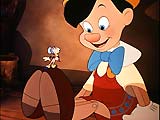 The critically-praised Pinocchio
(1940) released on February 7, 1940 and based on Carlo
Collodi's 1883 fable made a record $2.6 million and became the
highest-earning film of the year. This second Disney animated feature
also won two Oscars, for Best Musical Score and Best Original Song
(When You Wish Upon a Star). It was the rites of passage
story of a wooden puppet (with Tyrolean britches) that came alive.
The good-intentioned but naughty boy was accompanied by an ingenuous
narrator/carpetbagger named Jiminy Cricket who served as the boy's
conscience (and sounded like Benjamin Franklin). The ingenious
animation used the multi-plane camera technique to create an amazingly
life-like animation. The critically-praised Pinocchio
(1940) released on February 7, 1940 and based on Carlo
Collodi's 1883 fable made a record $2.6 million and became the
highest-earning film of the year. This second Disney animated feature
also won two Oscars, for Best Musical Score and Best Original Song
(When You Wish Upon a Star). It was the rites of passage
story of a wooden puppet (with Tyrolean britches) that came alive.
The good-intentioned but naughty boy was accompanied by an ingenuous
narrator/carpetbagger named Jiminy Cricket who served as the boy's
conscience (and sounded like Benjamin Franklin). The ingenious
animation used the multi-plane camera technique to create an amazingly
life-like animation.
Disney experimented with other milestone, ground-breaking
techniques that combined classical music and animation in seven separate
episodes in the film Fantasia
(1940), released on November 13, 1940, and January 29, 1941
(roadshow). The film, with a production cost of more than $2 million
(about four times more than an average live-action picture), featured
Mickey Mouse as the star of the picture in Dukas' The Sorcerer's
Apprentice, the mouse's only appearance in a feature cartoon. It
was the first film to be released in a multichannel stereo sound format
called Fantasound - decades ahead of its time - requiring a
special system devised for playback, although it was rarely shown that
way due to the expense (and the fact that only 6 theaters were equipped
to play Fantasound).
Fantasia was the fullest expression of Disney's
earlier work on Silly Symphonies. [Note A sequel of sorts was
released 60 years later, originally in the IMAX format, Fantasia/2000
(1999), with new interpretations of classical music (including
Beethoven's Symphony No. 5, Elgar's Pomp and Circumstance,
Stravinsky's Firebird, Shostakovich's Piano Concerto No.
2 - and Gershwin's Rhapsody in Blue), plus a replay of The
Sorcerer's Apprentice.]
Other great classic Disney tales, animated features,
and storybooks in the 40s included (see also below):
- Dumbo (1941) - the story of the baby elephant
with big flying ears, released on October 23, 1941
- Bambi (1942) - the
masterfully poetic tale of woodland creatures and a young fawn, with
the shattering scene of the killing of Bambi's mother; released on
April 16, 1942 [Note: although the second Disney animated
film to go into production, it ended up being the fifth release,
due to extensive time-consuming research conducted on animals to
make it appear exceedingly realistic]
- Saludos Amigos (1942),
released on August 24, 1942 (premiere in Mexico City); advertised
as "Walt Disney Goes South American"
with the introduction of Joe Carioca, the Brazilian Jitterbird
- The Three Caballeros (1944), released on December
21, 1944 (premiere in Mexico City) and February 3, 1945; in this
animated and live-action combined film, Donald Duck danced with "Brazilian
Girl" Aurora Miranda
- Make Mine Music (1946), released on April 20,
1946; a more modernized version of Fantasia
(1940) with popular music by Benny Goodman, the Andrews Sisters,
and Dinah Shore; the anthology included 10 film segments including
the classic tales Casey at the Bat, The Martins and the
Coys, and Peter and the Wolf; also Blue Bayou, All
the Cats Join In, Without You, Two Silhouettes, After You've
Gone, Johnny Fedora and Alice Bluebonnet, and The Whale Who
Wanted to Sing at the Met
- The Song of the South (1946), released on November
12, 1946, was Disney's first live-action feature film, but also contained
three major segments of animation; it was based upon Joel Chandler
Harris' Uncle Remus folk tales regarding Br'er Rabbit; due to extensive
protests (mostly by the NAACP) over the stereotypical representations
of blacks in the film and the romanticizing of slavery, the controversial
film was never released on home video for US audiences; the film's
hit song "Zip-a-Dee-Doo-Dah" won the Academy Awards Oscar
for Best Song
- Fun and Fancy Free (1947), released on September
27, 1947; a combination of live-action and animation; with two storylines,
including Bongo (hosted by Jiminy Cricket and narrated by
Dinah Shore) about a circus bear, and Mickey and the Beanstalk
- Melody Time (1948), released on May 27, 1948;
included seven animated shorts including two American folk heroes: Johnny
Appleseed and Pecos Bill; the 5th of Disney's large collections
of animated shorts
- So Dear to My Heart (1949), released on January
19, 1949; a live-action film with some animation, starring Burl Ives;
an Academy Award nominee for Best Song (Lavender Blue)
- The Adventures of Ichabod and Mr. Toad (1949),
released on October 5, 1949; the 6th and last of Disney's 'package'
films in the 1940s; included two segments: The Wind in the Willows (based
upon Scottish author Kenneth Grahame's 1908 novel) and Ichabod
Crane (based on Washington Irving's 1820 short story The Legend
of Sleepy Hollow)
Walt Disney Animation Studio Feature Films (1937-present)
Decade of the 1940s
|
| No. |
Title Screen |
Title (Year) |
Notables |
|
2
|
|
Pinocchio (1940)
|
- based on the Italian children's novel The Adventures
of Pinocchio by Carlo Collodi
- about a woodworker named Geppetto who created
a puppet that came alive after a wish was granted by the Blue
Fairy
- the highest-grossing (domestic) film of 1940
- it was the first animated feature to win a competitive
Academy Award -- two Oscars in fact, for Best Music Score and
Best Original Song (When You Wish Upon a Star), the future
theme song for Disney's parks
|
|
3
|
|
Fantasia (1940)
|
- composed of eight animated segments coordinated
and blended together with classical music conducted by Leopold
Stokowski
- the classical selections included Bach's Toccata
and Fugue in D Minor, Tchaikovsky's The Nutcracker Suite, Dukas'
The Sorcerer's Apprentice, Stravinsky's The Rite of
Spring, Beethoven's
Pastoral Symphony (# 6), Ponchielli's Dance of the
Hours, and
Mussorgsky's Night on Bald Mountain, concluding with Schubert's
Ave Maria
- it was a feature-length version of Disney's earlier
Silly Symphonies
- later Disney films, Make Mine Music (1946) and Melody
Time (1948), also combined music and animation
- a sequel followed almost 60 years later, Fantasia
2000 (1999)
- the first film to be released in a pioneering
multichannel stereo sound format called Fantasound
|
|
4
|
|
Dumbo (1941)
|
- one of the shortest animated feature films, hastily
created and cheaply made after the failure of Fantasia (1940)
- adapted from a short children's book about a flying circus elephant
- a Best
Song nominee (Baby
Mine)
and Academy Award-winner for Best Musical Score
- the most profitable Disney film of the decade
because of its low-budget production
|
|
5
|
|
Bambi (1942)
|
- based on Austrian writer Felix Salten's 1923 book, Bambi, a Life
in the Woods
- a three-time Academy Award nominee: Best Song
(Love
is a Song), Best Original Musical Score, Best Sound
|
|
6
|
|
Saludos Amigos (1942)
|
- the 1st package film
- translated: "Greetings (or Hello) Friends"
- composed of four animated shorts, set in Latin
America, interwoven with a live-action
documentary about the trip of Disney's artists to the area
- Disney's shortest animated
feature to date (42 minutes in length)
- the first appearance of José Carioca,
the Brazilian cigar-smoking parrot
- three-time Academy Award nominee: Best Sound Recording,
Best Musical Score, and Best Original Song (Saludos Amigos)
|
|
7
|
|
The Three Caballeros (1944)
|
- the 2nd package film
- a follow-up film to Saludos Amigos (1942), this
time concentrating on Mexico
- the animated
anthology film consists of seven segments, each connected by Donald
Duck receiving gifts on his birthday
- two-time Academy Award nominee: Best Sound and
Best Score
|
|
8
|
|
Make Mine Music (1946)
|
- the 3rd package film
- an anthology film, similar to Fantasia (1940),
with 10 separate film segments, including some classics, such
as The Martins and the Coys, Blue Bayou (unused for Fantasia),
Casey at the Bat, and Peter and the Wolf
|
|
9
|
|
Fun & Fancy Free (1947)
|
- the 4th package film
- a compilation of two shorts, Bongo (about
an escaped circus bear) and Mickey
and the Beanstalk (a version of 'Jack and the Beanstalk'
with Disney cartoon characters)
- the framework for the first story was
Jiminy Cricket from Pinocchio, and then for the second
story, Edgar Bergen and his puppets Charlie McCarthy and Mortimer
Snerd
|
|
10
|
|
Melody Time (1948)
|
- the 5th package film
- included seven film segments, another Fantasia-like
production combining animaton and music
- the last of Disney's large collections of animated
shorts
- the most popular segments included: the jazzy
Bumble Boogie (set to Rimsky-Korsakov's Flight of
the Bumblebee), The Legend of Johnny Appleseed, Little
Toot (about a tugboat), Blame It On the Samba, and
Pecos Bill (about the legendary cowboy, related in a campfire
story told by Roy Rogers)
|
|
11
|
|
The Adventures of Ichabod and Mr. Toad (1949)
|
- the 6th package film
- included the two shorts: The
Wind in the Willows (or The Adventures of Mr. Toad)
- narrated by Basil Rathbone, and The
Legend of Sleepy Hollow (or The Story of Ichabod Crane)
- narrated by Bing Crosby
|
The 1950s: Disney's Golden Age of Animation (continued)
In the 50s, Disney released more animated features, including
the following full-length classics:
- Cinderella (1950), released on February 15,
1950 [Note: Cinderella has been widely regarded as the most re-made
storyline ever]; its financial success helped to reverse Disney's
debt and declining fortunes
- Alice in Wonderland (1951), released on July
28, 1951; the Disney adaptation of Lewis Carroll classics; its failure
at the box-office offset the profits from the previous year's successful Cinderella
- Peter Pan (1953), released on February 5, 1953;
Disney's version of James M. Barrie's play
- Lady and the Tramp (1955),
released on June 16, 1955; Disney's first animated feature
in CinemaScope
- Sleeping Beauty (1959), released on January
29, 1959; also in widescreen format
Walt Disney Animation Studio Feature Films (1937-present)
Decade of the 1950s
|
| No. |
Title Screen |
Title (Year) |
Notables |
|
12
|
|
Cinderella (1950)
|
- based on Charles Perrault's fairy tale
- this animation marked a return to Disney's single-story
feature-length films
- three-time Academy Award nominee: Best Score,
Best Sound, Best Original Song ("Bibbidy-Bobbidi-Boo")
- with two direct-to-video sequels: Cinderella
II: Dreams Come True (2002), and Cinderella III: A Twist in Time
(2007)
|
|
13
|
|
Alice in Wonderland (1951)
|
- based on Lewis Carroll's Alice's Adventures
in Wonderland and
Through the Looking-Glass
- Academy Award nominee for Best Musical Score
- in 1974, it was re-released to theaters for the first time
- became popular in the 'psychedelic' drug culture
of the 1970s
- inspired the spinning teacups ride at Disneyland,
and Tim Burton's live-action Alice in Wonderland (2010) and
its sequel Alice Through the Looking Glass (2016)
|
|
14
|
|
Peter Pan (1953)
|
- based on the 1904 J.M. Barrie stage play Peter
Pan, or The Boy Who Wouldn't Grow Up
- criticized for its racist portrayal of "Indians"
(Native Americans)
- this was the first Peter Pan film in a franchise
that developed in the 2000s, including a direct-to-video sequel Peter Pan II: Return To Never Land (2002)
|
|
15
|

|
Lady and the Tramp (1955)
|
- the first animated feature-length movie, filmed
in the CinemaScope widescreen film process
- this was the first 'Lady and the Tramp' film in
a franchise that was followed by direct-to-video sequel Lady
and the Tramp II: Scamp's Adventure (2001)
|
|
16
|
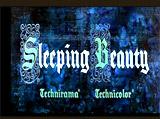
|
Sleeping Beauty (1959)
|
- based upon two fairy tales: Charles Perrault's
1697 French tale, and the German Brothers Grimm 1812 story
- the first animated film to be photographed in the Super Technirama
70 widescreen process
- Academy Award nominee: Best Musical Score
- this was the last Disney adaptation of
a fairy tale for 30 years (until The Little Mermaid (1989)),
due to poor box-office reception
|
In order, Lady and the Tramp (1955), Peter Pan (1953), and Cinderella (1950) were the top 3 grossing
films of the 50s. [Taking into account reissues and re-releases over the years
as well as the original releases, the order of these top-grossing animated
films of all time has been rearranged, placing Cinderella (1950) first,
followed by Lady and the Tramp (1955) and then Peter Pan (1953).]
Walt Disney achieved a milestone in the 1954 awards ceremony - as the individual
with the most Oscar wins (4) in a single year. He won the award in four
awards categories, including one film which was animated: Best Cartoon Short Subject: Toot, Whistle, Plunk and
Boom (1953).
UPA Productions - Columbia Studios:
Some who left Disney Studios around the time of the studio's
1941 strike later established United Productions of America (UPA),
a studio for cartoons distributed by Columbia. It was known for simplified,
stylized, more contemporary animated drawings of characters
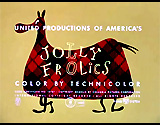
(with limited movement but boldly colored) in the Jolly
Frolics cartoon
series (38 theatrical cartoons released from 1948 to 1959). The two
main characters were:
- Gerald McBoing-Boing (first seen in the
cartoon Gerald
McBoing-Boing (1951)), a character developed by Dr. Seuss
- Mister (J. Quincy) Magoo (with voice by Jim Backus),
a near-sighted (myopic), short-statured, elderly gentleman, inspired
in part by famous comic W.C. Fields
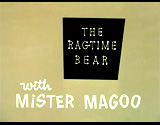
Mister Magoo's first appearance in a cartoon
was The
Ragtime Bear (1949) - found in the Jolly
Frolics series of cartoons.
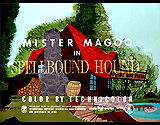
The second cartoon, at the start of a Mister Magoo series
of cartoons, was Spellbound Hound (1950). Over
the years from 1949 to 1959, the Mister Magoo cartoons (53 in total) were
honored with two Academy Awards (from five nominations) for Best Animated
Short Film: When Magoo Flew (1954) (it was the first UPA short filmed in CinemaScope),
and Magoo's Puddle Jumper (1956).
UPA also developed a popular animated TV series titled Mister
Magoo that aired from 1960-1962 (with 130 episodes).
|
The First Mister Magoo Theatrical Cartoons
|
TV Series
|
|
|
|
|
|
The Ragtime Bear (1949)
|
Spellbound Hound (1950)
|
Mister Magoo Show
(1960-1962)
|
Mister Magoo also starred
in UPA's first feature-length
cartoon film, the 76-minute 1001 Arabian Nights (1959), an
adaptation of the Aladdin folktale with Magoo as Aladdin's uncle.
The theatrical animation, released by Columbia Pictures, was the
studio's first animated feature. Walt Disney Pictures
also released a poorly-rated, live-action version of the character, Mr.
Magoo (1997) directed by Stanley Tong (his sole English language
film), with Leslie Nielsen as the title character.
Crusader Rabbit - The First US Animated TV Series:
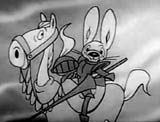 Animator Jay Ward, working with Alexander Anderson, Jr (whose idea was first turned down at Terrytoon Studios), created the immensely-popular animated, serialized NBC-TV show Crusader Rabbit, through their new company Television Arts Productions. It was the first American animated series produced especially for television. Animator Jay Ward, working with Alexander Anderson, Jr (whose idea was first turned down at Terrytoon Studios), created the immensely-popular animated, serialized NBC-TV show Crusader Rabbit, through their new company Television Arts Productions. It was the first American animated series produced especially for television.
The show originally aired from 1950 -1952 and also had
a color version in 1957, with both Lucille Bliss and GeGe Pearson providing
the voice of the Don Quixote-like title character. It told about knight-in-armor
Crusader Rabbit and his tiger companion Rags, combating nemesis Dudley
Nightshade, with episodes ending in a cliffhanger.
[Note: Ward went on to
produce more animated cartoon shows, such as The Rocky and Bullwinkle
Show -
composed of Rocky and His Friends (1959-1961) and The Bullwinkle
Show (1961-1964), Hoppity Hooper (1964-1967), George
of the Jungle (1967),
and The Dudley Do-Right Show (1969-1970) about a Canadian Mountie.
The only live-action TV comedy show that he produced was Fractured
Flickers (1963).]
Hanna and Barbera:
 In
the late 50s after their success with Tom and Jerry cartoons,
Hanna-Barbera formed their own company in 1957 (a division of Warner
Bros.' Animation). They were one of the earliest animation studios
to become successful producing animated cartoon TV shows for television,
but were often criticized for their crude, low-budget animations. In
the late 50s after their success with Tom and Jerry cartoons,
Hanna-Barbera formed their own company in 1957 (a division of Warner
Bros.' Animation). They were one of the earliest animation studios
to become successful producing animated cartoon TV shows for television,
but were often criticized for their crude, low-budget animations.
H-B Enterprises (the first name of the company)
became responsible for the following cartoon shows, and their related
spin-offs:
- The Ruff 'n' Ready Show (1957-1960) -H-B's
first TV show, for three seasons, with 50 episodes, about the adventures
of a dog (Reddy) and cat (Ruff)
- The Huckleberry Hound Show (1958-1962) - H-B's
first major hit about a blue anthropomorphic dog, with secondary
stars Yogi Bear and Boo Boo (who became the subjects of their own
spin-off series in 1961); it was the first animated TV program honored
with an Emmy Award (Outstanding Achievement in the Field of Children's
Programming), and the first H-B show to become syndicated
- The Quick Draw McGraw Show (1959-1961) - starring
an anthropomorphic western horse, for three seasons, with 45 episodes
- The Flintstones (1960-1966) - set in the Stone
Age, but loosely based upon the live-action sitcom The Honeymooners,
also ABC-TV's first series
to be televised in color, and the first animated series to be broadcast
in prime-time; it ran for six seasons (with 166 episodes) and at
the time, it became the longest-running animated prime-time show
in US TV history (a record it held for three decades until bypassed
by The
Simpsons)
- The Yogi Bear Show (1961-1962) - H-B's first
spin-off series (from The Huckleberry Hound Show), with 33 episodes
over a two-year period
- Top Cat (1961-1962) - H-B's series ran simultaneously
with The Yogi Bear Show, for two seasons, with 30 episodes
- The Jetsons (1962-1963) -
a Space-Age version of the popular The Flintstones; originally
for two seasons, with 24 episodes
- Jonny Quest (1964-1965) -
an action-adventure based series that ran for one
season, with 26 episodes
- The Magilla Gorilla Show (1964-1967) -
starring an anthropomorphic gorilla with a bow-tie, shorts and suspenders,
that ran for three seasons, with 31 episodes
- The Peter Potamus Show (1964-1967) -
for three seasons, with 27 episodes
- The Atom Ant/Secret Squirrel Show (1965-1967) -
with two characters: a superhero ant and a secret agent squirrel,
that ran for two seasons, with 52 episodes
- Wacky Races (1968-1969) -
with eleven competing race cars, that aired for one season, with
17 episodes
- Scooby Doo (1969-1970) -
originally for two seasons, with 25 episodes
Based upon some of these cartoon shows, they also produced
feature-length films, such as the animated musicals Hey There, It's
Yogi Bear! (1964) (H-B's first theatrical film) and The Man
Called Flintstone (1966) -
a James Bond spoof, the Star Trek-like Jetsons: The Movie
(1990), and the live-action Scooby-Doo (2002) (with a sequel
in 2004). In the 1980s, one of H-B's most popular animated TV series
was The
Smurfs (1981-1989), that ran on NBC-TV for
9 seasons, with 256 episodes.
Cold War Era Propagandistic Animations:
 One
of the most notorious propaganda films ever made, Duck and Cover (1951),
was aimed at school children. The 9-minute Civil Defense film used an animated
turtle named Bert to show children how to survive a nuclear explosion or atomic
attack by using a "duck and cover" technique under their desks.
Later, Bert became a cultural icon in the documentary The Atomic Cafe (1982),
and it was cleverly spoofed in Brad Bird's The Iron Giant (1999) with a cartoon
beaver. For its historical and cultural place within film history, it was
inducted into the National Film Registry in 2004. One
of the most notorious propaganda films ever made, Duck and Cover (1951),
was aimed at school children. The 9-minute Civil Defense film used an animated
turtle named Bert to show children how to survive a nuclear explosion or atomic
attack by using a "duck and cover" technique under their desks.
Later, Bert became a cultural icon in the documentary The Atomic Cafe (1982),
and it was cleverly spoofed in Brad Bird's The Iron Giant (1999) with a cartoon
beaver. For its historical and cultural place within film history, it was
inducted into the National Film Registry in 2004.
Advanced Animation Techniques in the 50s and 60s:
Ray Harryhausen and Others
In
1949, inspired by the stop-motion work of Willis O'Brien in King
Kong (1933), Ray Harryhausen animated the stop-motion gorilla in Mighty
Joe Young (1949), although the work was mostly credited to O'Brien. This
was Harryhausen's first feature film for which he created stop-motion animation. His own distinctive brand of stop-motion animation was termed DynaMation - a process involving split-screen rear projection to insert the stop-motion characters into background live-action plates.
Ray Harryhausen's films, such as his best known work Jason
and the Argonauts (1963) with its skeletal warriors set-piece,
perfected stop-motion animation. By the time the 61 year-old Harryhausen
had finished Clash of the Titans (1981), he had worked on
more than a dozen sci-fi and fantasy films with stop-motion animation. He created the fantastic images in 15 films between 1953
and 1981, including:
|
Title Screens
|
Harryhausen's Films
|
Descriptions
|
|
The Beast From 20,000 Fathoms (1953)
|
- Warner Bros.' prehistoric fantasy - a pre-Godzilla monster story with a rhedosaurus threatening New York City
|
|
It Came From Beneath The Sea (1955)
|
- about a giant radioactive squid-octopus (with only six arms instead of eight to save money) threatening San Francisco and the Golden Gate Bridge
|
|
Earth vs. The Flying Saucers (1956)
|
- with flying
saucers that destroyed the US capital in the spectacular finale
|
|
20 Million Miles to Earth (1957)
|
- with a threatening reptilian creature threatening
Italy
|
| |
|
Sinbad Trilogy:
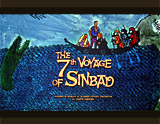
(1) The 7th Voyage of Sinbad
(1958)
|
- featuring Harryhausen's Dynamation process,
including the rescue of a miniature princess (Kathryn Grant)
by handsome prince Sinbad (Kerwin Mathews) on his seventh
voyage
- a young genie and many stop-motion animated
figures (a giant horned Cyclops who spit-roasted a sailor,
a dragon, a snake-woman, and a sword-battling skeleton - the
first of his skeletal warriors)
|
|
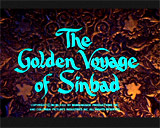
(2) The Golden Voyage of Sinbad (1974)
|
- featuring a 6-armed statue, a one-eyed centaur,
and a flying Griffin
|
|
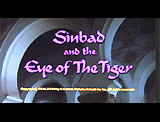
(3) Sinbad and the Eye of the Tiger (1977)
|
- with three zomboids, a giant saber-toothed
tiger, a horned prehistoric caveman named Troglodyte (Trog
for short), three banshees, and Minoton (similar to the legendary
Minotaur with a human body and bull's head) - among other
creatures
|
| |
|
|
|
The 3 Worlds of Gulliver (1960)
|
- adapted from Jonathan Swift's novel about an adventurer who encountered the worlds of Lilliput, Brobdignag, and England
|
|
Mysterious Island (1961)
|
- Jules Verne's oft-filmed tale about the ballooning journey of escaped convicts to an uncharted
island inhabited by a giant crab and a mysterious Captain Nemo of the Nautilus
|
|
Jason and the Argonauts (1963)
|
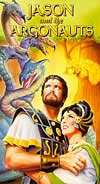 Harryhausen's best film, with screeching harpies, a giant metal warrior (a cross between the Colossus of Rhodes and a bronzed stone giant Talos man), a 7-headed hydra, and sword-wielding skeletons doing battle against Jason (Todd Armstrong) Harryhausen's best film, with screeching harpies, a giant metal warrior (a cross between the Colossus of Rhodes and a bronzed stone giant Talos man), a 7-headed hydra, and sword-wielding skeletons doing battle against Jason (Todd Armstrong) |
|
First Men in the Moon (1964)
|
- the H.G. Wells' adaptation about a space trip to the lunar surface
(with an alien civilization) and back
|
|
One Million Years BC (1966)
|
- Harryhausen's most celebrated film, with Raquel Welch as a fur bikini-clad cavewoman, and a menagerie of prehistoric creatures
|
|
The Valley of Gwangi (1969)
|
- about the unleashing of a giant, flesh-eating prehistoric monster unearthed by an archaeologist, that burns to death at a church altar in the fiery climax
|
|
Trog (1970)
|
- a horror-monster film, noted as the last film of Joan Crawford
|
|
Clash of the Titans (1981)
|
- a mythological fantasy, with a memorable snake-haired Gorgon-Medusa, a Cyclops,
and the winged horse Pegasus. this was Ray Harryhausen's swan song - his last film as Special Effects producer
|
Other Famed Animators in the 50s through 70s:
George Pal,
the father of screen science fiction fantasy
films, artistically combined live acting cinematography,
animation, puppets (e.g., Puppetoons produced for Paramount
in the 30s), and other visual effects in films such as Tom
Thumb (1958), the Cinerama-configured The Wonderful World
of the Brothers Grimm (1962), and 7 Faces of
Dr. Lao (1963).
Animator-geniuses of recent years have used pixillation,
the frame by frame animation of live subjects or objects and human beings
by filming them incrementally in various fixed poses. Mary Poppins (1964) was a more recent, semi-animated kids musical with both live-action and animated
characters.
The best-known work of the Halas & Batchelor (husband and wife) animation
studios was the adult-themed and serious Animal Farm (1954), the first animated
color feature film made in England. All of the character's voices were provided by actor Maurice Denham. The allegorical tale, based on George
Orwell's 1945 satirical political novel, told of animals at Manor Farm who
were led by fascist pigs Napoleon and Snowball to rebelliously overthrow oppressive
Farmer Jones, take over the farm, and form a free, egalitarian socialist utopia.
The new society was to be based upon seven principles:
- Whatever goes upon
two legs is an enemy.
- Whatever goes upon four legs, or has wings,
is a friend.
- No animal shall wear clothes.
- No animal shall sleep
in a bed.
- No animal shall drink alcohol.
- No animal shall
kill any other animal.
- All animals are equal. However, the animals
would learn that some animals were more equal than others.
[Note After
the success of the 'talking-animal' hit Babe (1995), the film
was later remade as the live-action TNT-TV production, Animal Farm
(1999).
It featured creations of Jim Henson's Creature Shop (where director
John Stephenson was a veteran supervisor), animatronics and computer
animation.]
A classic family animation with similar animal characters,
although a-political, was Charlotte's Web (1973), adapted from E.B.
White's beloved tale about an intelligent spider (Charlotte, voiced by Debbie
Reynolds), a rat (Templeton, voiced by Paul Lynde), and a bashful, ill-fated
barnyard pig (Wilbur, voiced by Henry Gibson). It was noted for Charlotte's
sacrificial saving of Wilbur with web-spinning creations ("Some Pig"),
Wilbur's caring for Charlotte's egg sac and spiderlings upon her death, and
memorable songs including "Mother Earth and Father Time."
The magical puppetry of Jim Henson's Muppet characters have also charmed audiences, first with The Muppet Movie (1979), then followed by more adventures with Kermit, Miss Piggy, and
other delightful characters. [See section on Children's Films.] |
 Animated Films