|
|
(chronological by film title) Introduction | Picture Guide | 1941 | 1944 | 1945 | 1946-1 | 1946-2 | 1947-1 | 1947-2 1948 | 1949 | 1950-1952 | 1953 | 1954-1956 | 1957-1959 |

|
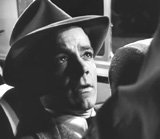
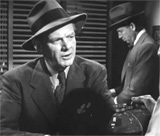
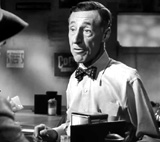
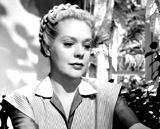
Detour (1945)
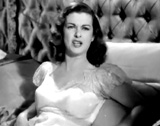
Edgar G. Ulmer's gritty, cheaply-made ("Poverty Row"), fatalistic, cultish B-crime film was about the bleak twists of fate. The nightmarish flashback story was cynically narrated with almost non-stop voice-over by a world-weary, fatalistic, self-pitying, down-and-out hitchhiker Al Roberts (Tom Neal), sitting in a tawdry diner in Reno, Nevada where he told about recent events and imagined his pending arrest. He told an existential story about how he had been haplessly involved in fateful events during a previous thumbing trek from NY to Los Angeles, and had ended up with a dangerous, blackmailing dame. Roberts had found himself as a hitchhiker picked up in Arizona (enroute to Hollywood) in the car of ex-bookie Charles Haskell, Jr. (Edmund MacDonald) from Florida, with suspicious deep scratches on his right hand. Haskell described them - a prophetic and fateful comment about the perpetrator:
Haskell suffered an ambiguous death - he passed out or had a heart attack and fell out of passenger side of the car (and his head struck a rock). When Roberts feared he would be blamed and arrested for murder, he dumped Haskell along the side of the Arizona road to hide it, and stole his identity (wallet, clothes, and car). Then in California, he picked up the same vulturous, nasty and despicable hitchhiker Vera (Ann Savage) at a gas station. He described her deceitful and unpredictable nature:
Suddenly, she sat up and began to suspect his true identity: ("Where did you leave his body? Where did you leave the owner of this car? You're not fooling anyone. This buggy belongs to a guy named Haskell. That's not you, Mister!") - she was the one who had hitchhiked with Haskell, all the way from Shreveport, Louisiana, had tussled with him and left her mark. Roberts expressed his fateful feelings about the blackmailing, castrating, sadomachochistic, vindictive and exploitative femme fatale con:
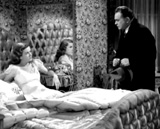
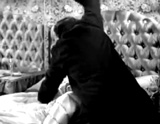
After accusing him of deliberately 'killing' Haskell ("What'd you do? Kiss him with a wrench?... You're a cheap crook and you killed him"), she held Roberts hostage to her wishes -- Vera's ultimate mercenary, unrealistic, and greedy plan was to sell Haskell's car (and abscond with the money) and also to claim a substantial inheritance from Haskell's dying father (he was suffering from bronchial pneumonia with only three weeks to live, described in a newspaper article), by having them pretend to be Mr. and Mrs. Haskell. During a vicious argument in their Hollywood hotel-apartment when the drunken Vera threatened to call the Hollywood police station and turn him in: "You won't be dreamin' when the law taps you on the shoulder. There's a cute little gas chamber waitin' for you, Roberts, and I hear extradition to Arizona's a cinch...I'm gonna get even with you!" After she had called him a "yellow stinker" and accused him of not being a "gentleman," she ordered him to open up the windows. It was a ploy - she grabbed the phone and raced into the adjoining room where she locked herself in. He pulled on the long phone cord extension through the closed bedroom door, which she had inexplicably wrapped around her neck. When Vera ignored his promise to do anything she asked for, he began yanking on the cord and pulled it as tightly as possibly (with a close-up of his straining fists). When he broke down the door, he found her sprawled (reflected in a mirror image) on her back and hanging off the bed. His voice-over continued: "The world is full of skeptics. I know. I'm one myself." This was a second disastrous twist of fate for Roberts - signified by the in-and-out of focus shots from his deranged mental state and POV as he looked around the incriminating bedroom. He realized he could be identified by many witnesses: the landlady, the car dealer, the waitress in the drive-in, the girl in the dress shop, the guy in the liquor store:
As he left the diner, his voice-over continued with the film's final lines of dialogue:
He imagined his arrest by the Highway Patrol outside the diner (to appease the Hays Code censors of the time). The film ended with Roberts being picked up by a patrol car for the murder of his 'wife' Vera. |
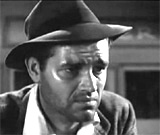 Al Roberts (Tom Neal) Explaining Fate in Flashback 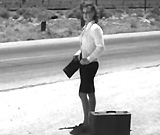 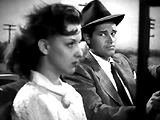 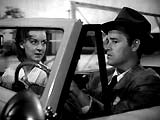 Al and Hitchhiker Vera (Ann Savage) 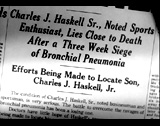 Newspaper Article - The Haskell Inheritance 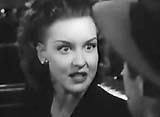 Vera's Greedy Plan to Claim Haskell's Inheritance From His Dying Father 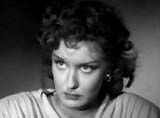 Drunken Argument and Vera Threatening to Call Police - Behind Locked Bedroom Door 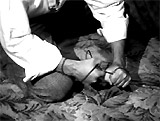 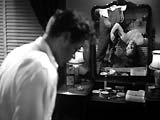 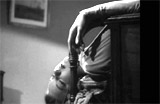 Vera's Accidental Telephone Cord Strangulation 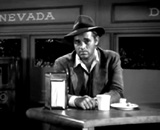 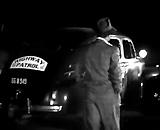 End of Flashback in the Reno, NV Diner - Where Roberts Imagined His Arrest |
||||||||||||||||||

|
Fallen Angel (1945)
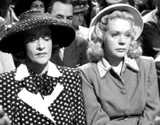
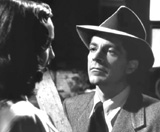
Director Otto Preminger's follow-up film noir to Laura (1944) was this taut, noirish crime drama and murder-mystery. It shared many plot similarities with the noir classic The Postman Always Rings Twice (1946). 20th Century Fox was trying to find a more diverse role for its bright musical star Alice Faye, who played a contrasting goody-two-shoes role within a love triangle, was the opposite to the film's dark femme fatale role portrayed by Linda Darnell. Told with impressive black/white cinematography, it was a tale of deceit, obsession, twisted passion, greed, lust, concealment and fake trickery, with almost all of the main characters both despicable and unappealing. In the film's opening, handsome, smooth-talking, down-and-out, cynical and amoral drifter and con man Eric Stanton (Dana Andrews), the film's anti-hero, had attempted to pretend he was asleep to fool the bus driver. He was ejected from his cross-country Greyhound Bus bound for San Francisco (150 miles to the north) for not having funds to pay the additional fare of $2.25 to get to the destination. He was dropped off in the small California sea-side town of Walton.
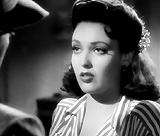
At the local beachside, greasy-spoon Pop's diner run by elderly Pop (Percy Kilbride), Stanton walked in after 10 pm and overheard the very anxious owner reporting to ex-NYC police detective Mark Judd (Charles Bickford), the local cop, that his favorite waitress Stella (21 year-old Linda Darnell) had been missing for three days. Suddenly and unexpectedly, the sexy, dark-haired, long-legged, tough-minded, brassy waitress Stella walked in the door. The destitute but opportunistic Stanton walked over to the Hotel Walton to rent a room where he noticed an advertising poster for a fellow con-artist named Professor Madley (John Carradine), a "Psychic Extraordinary" - a charlatan clairvoyant who was scheduled to appear at the hotel at 8pm on the next night, Saturday. The flyer promoted the grifter's ability to conduct seances and connect loved ones with their "dearly deceased" relatives. After speaking to the front desk clerk (Jimmy Conlin), Stanton conned his way into a free stay by sleeping in the room of Joe Ellis (Olin Howland), Madley's fraudster assistant. And then, due to his experience as an ex-NY press agent and familiarity with snake-oil pitches, Stanton maneuvered his way into acquiring a job as the promoter of the mentalist's show-performance. He proved his mettle by encouraging the town's rich, shy, blonde church organist June Mills (Alice Faye), the town's trusting, smart, pure-hearted, plain-Jane spinster, and her embittered, protective and wary older sister Clara (Anne Revere), the daughter of the former town mayor, to attend the evening's communion with the dead. (During the show, Professor Madley spoke about Clara's beau John Martin, who had swindled her out of her father Abraham Mills' inheritance, by encouraging her to sell all her bonds and orange groves.)
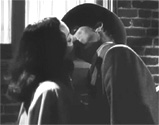
Stanton also became instantly entranced with earthy, bad-girl sexpot Stella, and realized they both shared like-minded roots from the wrong side of the tracks. He saw the manipulative, adept and slutty sexpot stealing money from the diner's till (by falsifying written receipts and stuffing money down her bra). After Professor Madley's show, Stella joined Stanton for dancing and drinks at a tavern, where she told him: "I like the way you talk." She verified for him that her mother ran a boarding house in San Diego, and her father was a drunk. During a second dance, they kissed.. On a nearby sandy beach, they kissed again in the moonlight. While bragging about his past exploits in a NYC publicity mill: ("I know all people and all places, like 21, The Stork Club. That's where you belong, smothered in mink. I can see you there"), he flattered her and encouraged her to run off to San Francisco with him the next day, but the disdainful and sulty conniver rebuffed him: ("You got the wrong girl...You got into town with one dollar in your pocket. You're a fake!"). In a show of her selfishness and uncompromising nature, she delivered an ultimatum to the unstable drifter - she would reciprocate his love with marriage ("a ring on my finger") and a home only if he showed evidence of financial stability and a steady income. Although he was planning to leave for SF, he decided to stay in town and convince Stella to marry him ("I can't get away without you, Stella, and I'm not going anywhere without you"), by promising the ambitious female that he would provide her with a $12,500 house - without telling her exactly how. He provided her with the deal: "You just sit tight and wait for me. That's the deal. You'll keep it." She answered: "Maybe I will." They shook hands - and kissed.
To curry seductress Stella's favor, the black-hearted and dishonest Stanton decided to date rich heiress June in order to eventually acquire her inheritance money, and then return to Stella. He asked June for a dinner-movie-and dancing date (during which he jealously saw Stella dancing with her old boyfriend Dave Atkins (Bruce Cabot) - a traveling juke-box repairman). After the date with June, Stanton waited around for Stella at her place until after 3 am, but she didn't show up. The next morning, he confronted Stella at the diner and noticed a brand-new expensive watch on her wrist that she had received from a secret admirer - presumably Atkins. Stanton pressured her to go out with no-one else for a couple of days. Stanton had a second beach cook-out date with June, and filled her head with seductive dreams of life in New York and San Francisco, to further her career as a musician. June decided to go with him by train to SF (with Clara accompanying them) to a mid-afternoon orchestral concert. After a visit to the sisters' SF bank deposit box, June secretly accompanied Stanton to acquire a Marriage Health Certificate in two hours, although June's very dubious sister Clara objected to the news: ("I'll have the whole thing annulled"). After the sham SF marriage to June (following only a few short dates), and on his wedding night back in Walton, Stanton left to be with Stella for a sexual rendezvous-liaison before running off with her. Stella was about to be driven away for a date with Dave Atkins, and rejected Stanton's offer to join her in SF during his honeymoon, to get the money: ("You're going to San Francisco tomorrow.... Tomorrow I'll have that money, all of it...It was the only way...I did it for you, to get you what you wanted"). After a loud argument, she stormed off and entered Atkins' awaiting car. (Potential sister-in-law Clara followed Stanton as he left the house and had watched their liaison from the shadows). Stanton had no choice but to return to a loyal and supportive June, who was told that he had gone to the diner but accepted him back anyway. The next morning, news came from hard-bitten cop Judd - who had been assigned to the case - that Stella had been mysteriously murdered earlier that morning in her 2nd floor apartment between 3 and 4 am by a blow to the head by a lead pipe. According to Judd, the downstairs tenant had found Stella's watch under the stairs - presumably dropped by the fleeing killer who she couldn't identify. There seemed to be many suspects each with their own motives. Judd briefly interrogated Stanton and revealed he knew of his unusual whereabouts: ("It's strange....that a man doesn't spend his wedding night at home"). He also brutally questioned and unnecessarily beat up Dave Atkins to force a confession, although the man's alibi checked out and he was innocent. June was determined to remain with Stanton: ("I can't let it end now. I must give us every chance. I hardly know him yet. We've said so little to each other, we're practically strangers. Together, maybe he'll change...at least I'll have tried, done everything I could"), even though Clara vehemently disagreed with her. June insisted on joining Stanton as he fled to SF: "You'll need me to get the money in San Francisco...You'll need it... I'm not giving it to you. It belongs to both of us." The newly-married Stanton couple left town for San Francisco (hitchhiking without luggage) and then resided in a cheap and seedy hotel. Although Stanton was restless and short with June, and ready to leave her for a life of continual drifting, her quiet demeanor and her true love for him persuaded him to redeem himself and establish an honest and open marital relationship with her. He admitted his life was basically a failure and "a complete washout at 30....Up in smoke, like everything in my life. My school, the publicity game. Easy come, easy go. I got everything by talking fast in a world that goes for talk, and end up with exactly nothing." She recited a poem to him to encourage them to stick together - with a reference to a "fallen angel":
The next morning, June was apprehended by SFPD officers outside the bank. Back in Walton, June was charged by Judd with being an accessory to Stella's murder thought to be committed by Stanton: ("Getting mixed up in this murder as an accessory after the fact"). Judd also suspected that Stanton's intent was to steal the Mills' sisters money from their safe deposit box, and then run off with Stella. However, the plan went awry according to Judd's theory - although he had no proof: "He made the mistake of coming back a married man and she didn't want to have anything to do with married men. They had an argument and he killed her." June counter-argued and defended Stanton's innocence:
Rather than continue running, Stanton was forced to return to Walton where June was being detained. He suspected that Judd's tactics were unethical, and uncharacteristically fervent since he supposedly had claimed ill health when he left the NY police force: ("You know, you weren't strong enough to keep on working on the New York force. Why are you working so hard on this case? Maybe you'd better slow down"). Stanton had investigated Judd's questionable work background for himself with the local DA, and found evidence that he had a pattern of brutality and unjust treatment of innocent suspects:
Stanton also had traced Stella's watch found at the crime scene. Knowing he was caught, Judd drew his gun on Stanton, and admitted his guilt. He had angrily grabbed the watch from Stella's wrist - a gift from Atkins - and then fled, but dropped it on the stairs: "Perhaps this might have been the perfect crime, if I hadn't dropped the watch, though I doubt it." He had become obsessed for Stella over two years time: "You know what she was like. You couldn't get away from her either. Two years, I came in here and drank coffee, just to get a look at her. Day after day, for two years." He had stalked on numerous nights when she was with other male dates, and when she rejected him and instead chose to marry Atkins, he sought revenge against Stella by striking her - and murdering her
Incensed by the confession, Pop grabbed Judd's gun to fire at him, but was blocked. Judd was arrested, and Stanton joined June outside who drove the two of them home. |
|
||||||||||||||||||

|
Leave Her to Heaven (1945)
This psychological, unsettling melodramatic, brilliantly-saturated Technicolored noir (told in flashback) was one of the few noirs shot in color. It highlighted a menacing, father-fixated, unstable, and deranged, darkly alluring femme fatale named Ellen Berent (Gene Tierney). In the opening sequence, author-writer Richard "Dick" Harland (Cornel Wilde) returned home after serving a two-year prison sentence to his lakeside lodge in Maine. He was greeted by his defense attorney, Glen Robie (Ray Collins). As Dick rowed away, Robie commented: "Well, of all the seven deadly sins, jealousy is the most deadly." At the start of the flashback, beautiful socialite Ellen Berent (Oscar-nominated Gene Tierney) met her captivated, soon-to-be future husband - 30 year-old bachelor and novelist Richard Harland, on a train in New Mexico. The strong intent of psycho-insanely-jealous, father-obsessed, neurotically-possessive, and heartless femme fatale Ellen to marry Richard - and her vow that she would stop at nothing to make the man she loved her exclusive possession:
Soon after when her behavior became more extreme, she apologized for her obsession in him, and to make him her exclusive possession. After her father's cremation and the scattering of ashes, she expressed her feelings: "Forgive me. I'm sorry. I can't help it. It's only because I love you so. I love you so, I can't bear to share you with anybody." The most dramatic and frightening scene was a murder orchestrated by Ellen. She was calmly watching from a nearby rowboat as her novelist husband Richard's younger paraplegic brother Danny (Darryl Hickman) (and her own brother-in-law) tired and drowned in the Maine lake directly in front of her, on a bright and sunny day. The scene began with her cheerfully assisting Danny in applying suntan lotion before he slipped into the water from the boat. He asked: "Can I swim all the way across today?" When she asked: "Do you think you can make it?", he assured: "Why sure? I made it three-quarters yesterday and I wasn't a bit tired." She followed in the rowboat, and promised he didn't have to worry about his direction: "I'll keep you on your course." She steered him into the middle of the lake and noted: "You're not making very much progress, Danny. Are you alright?" When he became winded and had a kink in his side, he admitted he was getting tired. She told him to "take it easy," but then pushed him further: "You don't want to give up when you've come so far." When he became exhausted and distressed in the water from severe stomach cramps (after eating a large lunch), Ellen passively watched as he called out: "Help me!" He submerged twice and then disappeared under the surface. She registered no reaction on her heartless face as he sank below the water and never reappeared. She pretended to assist him by diving in, but it was obviously too late.
Later when Ellen became pregnant, she detestfully looked at herself in a mirror: "Look at me. I hate the little beast. I wish it would die." She told her foster sister Ruth (Jeanne Crain): "Shocked, aren't you? If you were having the baby, you'd love it. Well, I never wanted it. Richard and I never needed anything else. And now this." Ruth replied: "How can you say such wicked things?" to which Ellen admitted: "Sometimes the truth is wicked. You're afraid of the truth, aren't you, Ruth?"
Ellen's plotted to rid herself of her problem (and her unborn child) - she changed into a longer blue robe and high-heeled blue slippers, emerged from her bedroom, and stood at the top of the long flight of stairs; she realized she could choreograph and fake a tripping fall by deliberately catching her left blue slipper under the loose rug - she flung herself forward with a scream to purposely abort her unwanted child by miscarriage. When her suspicious husband threatened to leave her, Ellen's final jealous scheme was to suicidally poison herself by mixing up, in her adoptive sister Ruth's bathroom, a deadly potion of powdered poison (arsenic), in order to frame and implicate Ruth Berent as her killer. On her deathbed, she breathlessly requested of Richard that he scatter her ashes with those of her father: ("I'm going to die...And you mustn't feeI sorry for me. I'm not afraid. Only, only, promise me one thing. I-I want to be cremated. Like my father, and my ashes scattered in the same place. Remember?....Richard! I'll never let you go, Richard. Never. Never. Never"). In the subsequent scene, a trial hearing was held regarding "cold, brutal premeditated murder." Recently elected Boston-area district attorney Russell Quinton (Vincent Price), Ellen's previous jilted and vengeful fiancee, was serving as the state's DA prosecutor in a case against the defendant Ruth Berent - "The State will prove that on the afternoon of September 5th at a picnic attended by Ellen Harland, her mother and her adopted sister, that Ellen met death as a result of poisoning. The State will prove that the sugar with which Ellen that day sweetened her coffee was mixed with poison and that she met death by reason of that poison. The State will prove that the defendant had both motive and opportunity to commit this dreadfuI crime. And the State will prove that the defendant, Ruth Berent deliberately and maliciously plotted and carried through the murder." Pretending to be a victim before her death, Ellen wrote a letter and sent it to Russell. It clearly stated her fears that Ruth was threatening to kill her. In a dramatic scene during the trial, Richard was forced to read it outloud:
During the trial - Ruth did confess to innocently loving Richard (but not with evil intentions toward Ellen). On the stand, Richard testified to the extreme depths of Ellen's insanity and her dual confession to two murders:
The result of the trial was that Richard was sentenced to two years in prison as an after-the-fact accessory for withholding evidence - because he had not reported the extent of Ellen's depraved crimes to authorities. |
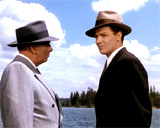 Opening Sequence - Ex-Con Richard with Lawyer  Introduction of Ellen Berent on Train in New Mexico 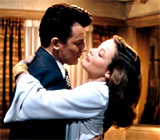 Ellen to Richard: "I'll never let you go. Never, never, never"  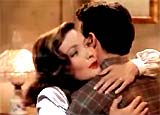 An Apology For Her Single-Minded Obsession: "It's only because I love you so" 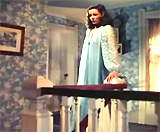  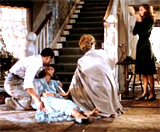 Plotting Her Own "Accidental" Miscarriage 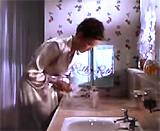 Ellen's Plot to Suicidally Poison Herself and Frame Ruth as Killer 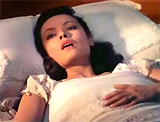 Ellen's Deathbed Scene: "I want to be cremated...I'll never let you go!" 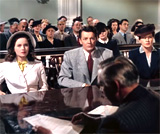 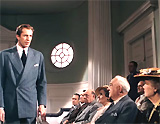 Ruth on Trial for Murdering Ellen - Prosecuted by Ellen's Ex-Fiancee Russell Quinton 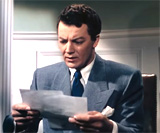 Richard Forced to Read Ellen's Incriminating Letter |
||||||||||||||||||
|
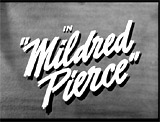
Mildred
Pierce (1945)
Director Michael Curtiz' classic melodramatic post-war film-noir (told in flashback) was a gritty tale of greed, mother-daughter love, and murder. Before filling in the backstory, the film opened in a beach house with the shooting murder of two-timing playboy Monte Baragon (Zachary Scott), Mildred Pierce's second husband, by an unidentified and unseen assailant. He uttered the film's first word: "Mildred!" In the following scene, suspected murderess Mildred Pierce-Beragon (Best Actress-winning Joan Crawford) walked on the Santa Monica pier. She was saved from suicide by a patrolling cop: ("You take a swim, I'd have to take a swim. Is that fair? Just because you feel like bumpin' yourself off, I gotta get pneumonia? Never thought about that, did ya? OK. Think about it. Go on, beat it now. Go on home before we both take a swim"). Possibly seen as the film's femme fatale, Mildred set up business associate Wally Fay (Jack Carson) to return to the crime scene where her husband had been murdered. In three flashbacked scenes set in the local police station, Mildred was brought in for questioning, where she falsely took the blame for Monte's murder. Divorcee Mildred was seen to have an obsessive mother-daughter love. She was a doting, long-suffering, sacrificial mother figure for her ungrateful, venemous, and spoiled-rotten 16 year-old femme fatale daughter Veda (Ann Blyth). She had contributed to her daughter's unappreciative and slutty behavior for a long time. Veda had been indulgently showered with gifts, nice clothes, and piano lessons, provided by Mildred's sacrificial baking of pies and cakes, although Veda was embarrassed by her mother's occupation and attempts to become independent. Veda expressed harsh words to her mother after Mildred admitted she was waiting tables in a downtown restaurant, in addition to baking pies: "My mother, a waitress!" Mildred defended herself: ("I took the only job I could get so you and your sister could eat and have a place to sleep and some clothes on your backs") although Veda was ungrateful: ("Aren't the pies bad enough? Did you have to degrade us?...l'm really not surprised. You've never spoken of your people, where you came from, so perhaps it's natural. Maybe that's why Father...") - Mildred slapped her daughter, but then apologized: ("l'd never have taken the job if l hadn't wanted to keep us all together. Besides, l wanted to learn the business the best way possible...the restaurant business"). Mildred's romance with scuzzy lounge lizard Monte began with a swim at his beach house. He at first admitted he was lazy and overindulgent: ("I do too much of everything. Too spoiled...I'm such a self-controlled and dignified young fellow...I loaf, in a decorative and highly charming manner...With me, loafing is a science") - and then they both spoke of their love in front of the fireplace before kisses and love-making. Eventually, Mildred was forced to deliver an ultimatum warning to Monte to stay away from her pretentious daughter Veda for good, to prevent him from poisoning her daughter's mind and lifestyle with luxuries: ("Stay away from Veda...And it isn't funny. She's only seventeen years old and spoiled rotten"). Mildred's concern was that she would lose her self-indulgent daughter to him:
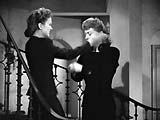
Then, the profligate Monte insulted Mildred for the 'smell of grease' surrounding her: "Yes, I take money from you, Mildred. But not enough to make me like kitchens or cooks. They smell of grease." She decided to personally dump the ungrateful Monte - and fire him with an added rebuttal: "I don't notice you shrinking away from a $50 dollar bill because it happens to smell of grease....There's no point in going on like this. You're interfering with my life and my business. And worst of all, you're interfering with my plans for Veda and I won't stand for it." Monte summarized their breakup: ("l always knew that someday we'd come to this particular moment in the scheme of things. You want Veda and your business and a nice, quiet life. And the price of all that is me. You can go back to making your pies now, Mildred. We're through"). To clear the books, Mildred wrote a substantial check to cover Monte's expenses (marked 'paid in full'). Meanwhile, the scheming and money-hungry Veda faked a pregnancy to extort money from her innocent boyfriend's wealthy family. She admitted to a fraudulent marriage (and baby) to receive a pay-off check of $10,000 after blackmailing a young, innocent boy that she didn't love - Ted Forrester (John Compton), the son of a wealthy family in Southern California. With the check in her possession, Veda revealed her true motivation, as expressed by Mildred: "Money - that's what you live for, isn't it? You'd do anything for money, wouldn't you?" During a second major confrontation, Veda delivered a brutal, humiliating and insulting tirade against her mother regarding her low-rent, lower-class birth: ("With this money, I can get away from you....From you and your chickens and your pies and your kitchens and everything that smells of grease. I can get away from this shack with its cheap furniture, and this town and its dollar days, and its women that wear uniforms and its men that wear overalls.... You think just because you've made a little money you can get a new hairdo and some expensive clothes and turn yourself into a lady. But you can't, because you'll never be anything but a common frump, whose father lived over a grocery store and whose mother took in washing. With this money, I can get away from every rotten, stinking thing that makes me think of this place or you!") When Mildred ripped up the pay-off check, Veda slapped Mildred across the face and knocked her down onto the stairs. Mildred rose and stood face to face in front of Veda and commanded: ("Get out, Veda. Get your things out of this house right now before I throw them into the street and you with them. Get out before I kill you").
Veda's outrageous behavior went much further, as she took a job as a singer/dancer in Wally's sleazy nightclub. Words of warning were issued by wise-cracking friend Ida (Eve Arden) about Mildred's beloved but spoiled, condescending and monstrous daughter Veda: ("Personally, Veda's convinced me that alligators have the right idea. They eat their young").
A final flashbacked replay of the opening scene revealed that promiscuous Veda was in the midst of a semi-incestuous affair with Monte. In the beach house, the miffed Veda bragged to Mildred: "Monte's going to divorce you and marry me, and there's nothing you can do about it." Although Mildred pulled a gun from her coat pocket, she dropped it to the floor when Monte grabbed her arm and cautioned her: ("Mildred, use your head"); then after Mildred fled outside to her car, Monte rebuffed, rejected and scorned Veda: ("Just where did you get the idea I'm going to marry you?... I'm not joking. If you think I'm going to marry you, you're very much mistaken.... Look. You don't really think I could be in love with a rotten little tramp like you, do you?"). To retaliate, Veda pulled Mildred's gun on Monte and shot him to death. Outside, Mildred heard six shots - and when she came back inside, she found her crazed, impassioned daughter standing over the dead body of Monte.
Veda desperately begged for her mother not to report Monte's murder to police: ("Think what will happen if they find me. Think what will happen...Give me another chance. It's your fault as much as mine. You've got to help me. Help me, Mother! Just this once. I'll change, I promise I will. I'll be different. Just give me another chance. It's your fault I'm the way I am. Help me"). In the final scene set in the present in the police station, Veda was booked for murder and led away (her last words to her mother were: "Don't worry about me, Mother. I'll get by"), as Inspector Peterson (Moroni Olsen) noted to Mildred, the film's final line: ("You know, Mrs. Beragon, there are times when I regret being a policeman"). Mildred was released to the outside dawn and greeted by her estranged husband Bert Pierce (Bruce Bennett). |
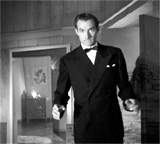 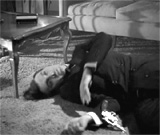 Opening Beach House Murder Scene of Mildred's Cad Playboy Husband Monte Beragon by an Unidentified Assailant 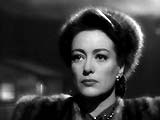 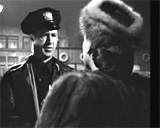 Mildred Saved From Suicide on Pier 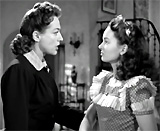 Veda's Insult to Her Mother: "My mother, a waitress!" 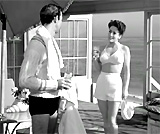 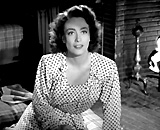 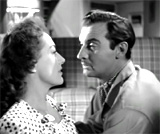 Mildred's Developing Romance with Monte 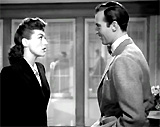 Mildred's Ultimatum to The Profligate Monte: "Stay away from Veda" 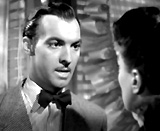 Monte's Response: "We're through" 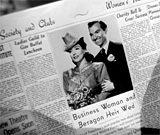 Mildred's Business Proposition to Lovelessly Marry Monte Beragon  After Monte's Murder - Veda to Her Mother: "I Told Him I'd Kill Him"  After the Murder, Veda Pleaded With Her Mother to Save Her  Veda Charged With The Crime: "OK, book her!"    Mildred's Reconciliation with Estranged Husband Bert Pierce (Bruce Bennett) |
||||||||||||||||||
|
Scarlet Street (1945)
Fritz Lang's steamy and fatalistic film was one of the moodiest, blackest thrillers ever made. Its three main actors, Edward G. Robinson, Joan Bennett and Dan Duryea, had all appeared together in Lang's earlier The Woman in the Window (1944). It told about a mild-mannered painter's unpunished and unsuspected murder of an amoral femme fatale after she had led him to commit embezzlement. She also impersonated him in order to sell his paintings, and had been deceitful and cruel to him - ultimately causing him in a fit of anger to murder her with an ice-pick. The meek, middle-aged clothing store cashier and unhappily-married, hen-pecked husband and amateur painter was Christopher "Chris" Cross (Edward G. Robinson). He unwittingly fell into a cruel trap set by cold-hearted, amoral femme fatale gold-digger and Greenwich Village streetwalker Katherine "Kitty" March (Joan Bennett) and her abusive, slick and mercenary boyfriend-pimp Johnny (Dan Duryea). Cross first met Kitty when she was being beaten up by Johnny on a rainy night (a set-up). He protected her by knocking Johnny unconscious with his umbrella, before the man recovered and fled. "Kitty" and Cross got to know each other in a bar for late-night drinks. He was immediately entranced by the clear plastic raincoat-wearing sexy and flirtatious dame, while she inaccurately believed that he was a wealthy painter. By feigned romantic interest in Cross, "Kitty" manipulatively controlled and led Cross to commit embezzlement (of his wife's and employer's funds) in order to rent an expensive apartment for her (to serve as an art studio). She also impersonated him in order to sell his paintings (along with Johnny) and make a profit, while being deceitful and cruel to him. In the middle of all the deceptive proceedings, there was an amazing and contrived plot twist -- the previous husband of Cross' shrewish wife Adele (Rosalind Ivan) - corrupt policeman Patch-eye Homer Higgins (Charles Kemper), suddenly appeared - he had been presumed drowned in the East River during the rescue of a suicidal woman. He had originally disappeared to cover up the fact that he had stolen $2,700 from the purse of the suicidal woman. Cross now assumed that his marriage to Adele was invalidated, and that he was free to marry Kitty. He was suspicious that "Kitty" and Johnny were romantically-involved, but still believed he had a chance to marry her. Cross pitifully and pathetically proposed to Kitty in her bedroom, explaining to her:
After he proposed, she told him her true feelings:
She caused him in a fit of jealous anger to commit murder. He stabbed her with an ice-pick through her bed covers as she hid from him.
The film ended with Johnny being accused of the crime, convicted and executed, while Cross was only fired from his job for embezzling funds from his employer. However, he suffered humiliating disgrace, haunting psychological torment and mental anguish due to his guilt (i.e., on the night of Johnny's execution, Cross attempted suicide by hanging and failed, and in abject homelessness, he wandered the streets). The final image was of Cross shuffling by a 5th Avenue gallery passing the 'self-portrait' he had drawn of Kitty. (After Kitty's death, she was immortalized as a great painter). Cross overheard its sale to an elderly matron for $10,000. The art dealer Mr. Dellarowe (Arthur Loft) commented: "Well, there goes her masterpiece. I really hate to part with it" - the buyer replied: "For $10,000 dollars, I shouldn't think you'd mind, Mr. Dellarowe." The last lines of dialogue were heard as the tormented and haunted Cross slowly ambled down the deserted street under a movie marquee - he thought of Kitty and Johnny together, with echoing words of love spoken (off-screen) between them:
|
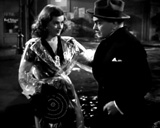 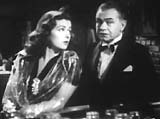 Rainy Night Meeting: Cross and "Kitty"  Femme Fatale "Kitty" 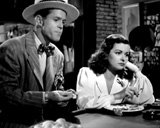 "Kitty's" Pimp Johnny (Dan Duryea) 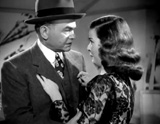 "Kitty" With Cross 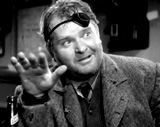 Patch-eyed Homer Higgins 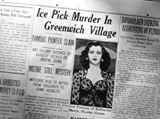 Newspaper Headline for "Kitty's" Ice-Pick Murder |
||||||||||||||||||