|
|
(chronological by film title) Introduction | Picture Guide | 1941 | 1944 | 1945 | 1946-1 | 1946-2 | 1947-1 | 1947-2 1948 | 1949 | 1950-1952 | 1953 | 1954-1956 | 1957-1959 |

|
Gilda (1946)
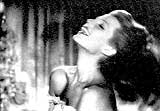
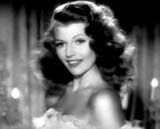
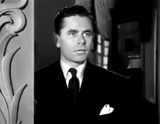
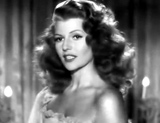
Charles Vidor's noirish romantic drama-mystery was suggestive with themes that included implied impotence, misogyny and homosexuality, although camouflaged by euphemisms and innuendo to bypass the Production Code. Its main theme was a strange, tawdry, aberrant romantic triangle (menage a trois) between the three main characters. Rita Hayworth was featured in this dark and complex noir (of a love triangle) with her sleek and sophisticated eroticism, lush hair and peaches and cream complexion. The gorgeous 'love goddess' portrayed the sexy, hedonistic, auburn-haired wife of South American casino owner Ballin Mundson (George Macready), who had recently hired gambling drifter Johnny Farrell (Glenn Ford) as his casino manager. In one of filmdom's best-known film entrances in her inner bedroom suite, Balin's new exuberantly healthy American wife was singing along to a phonograph recording of "Put the Blame on Mame." She was introduced by her mobster-husband Ballin Mundson to Johnny: (Mundson: "Gilda, are you decent?" Gilda: "Me?" - she gave a long, sensual look at Johnny and pulled up one side of her strapless dress as she added: "Sure, I'm decent"). As she spoke, she threw back her head and tossed her thick mane of hair in a blatantly sexual response. She was also the ex-wife of Johnny - who was entrusted as her bodyguard, to watch over her trampy behavior in the casino.
With her lingering love for Johnny, Gilda served herself up to be the object of a tension-filled, love-hate relationship between the two sexual rivals, as Johnny expressed his obsessive love for her:
To torture and inflame Johnny's jealous passions, two-timing Gilda danced and flirted with good-looking Latin male escort Gabe Evans (Robert Scott) - and when dragged from the casino dance floor by Johnny (who had warned her earlier: "Pardon me, but your husband is showing"), Gilda delivered her most famous one-liner:
She delivered two renditions of "Put the Blame on Mame" - the lyrics of the song, filled with double entendres, described a dangerous, threatening kind of woman who was often blamed - unfairly and illegitimately - by men:
In one scene, Gilda asked expectantly of Johnny: "Got a light?" - he turned and stood there with the lighter flame burning for her. In another, Gilda gave a passionate confession of love for Johnny:
In the film's twisting conclusion, when Mundson mysteriously disappeared and was presumed dead (in a suicidal airplane crash, possibly faked), Gilda and Farrell resumed their dangerous affair while Farrell assumed control over the casino business. Johnny replaced Mundson as Gilda's emotionally-abusive husband in a continuing love-hate relationship - he treated Gilda with increasing sadomasochism, vindictiveness and abuse after taking her as his wife. Police inspector Maurice Obregon (Joseph Calleia), who had been scrutinizing the South American casino's underlying criminal activities and trailing Ballin Mundson and Johnny Farrell throughout the entire film, spoke to Farrell about his assessment of his love-hate relationship with Gilda: "It's the most curious love-hate pattern I've ever had the privilege of witnessing. And as long as you're as sick in the head as you are about her, you're not able to think about anything clearly." But then Mundson vengefully returned after three months, and when he was just about to gun down both Farrell and Gilda, he was stabbed in the back (with his own cane) by Uncle Pio (Steven Geray), the aging, white-coated washroom attendant of the casino's nightclub - murder charges were dropped when the death was judged to be "justifiable homicide." In the upbeat finale to satisfy the Hays Code censors, Johnny admitted how wrong he was and they reconciled with each other after many months of an explosive relationship. The film's final line of dialogue was spoken by Gilda to Johnny: "Johnny, let's go home. Let's go home." |
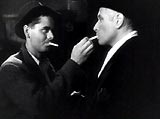 Johnny Farrell (Glenn Ford) and Ballin Mundson (George Macready) 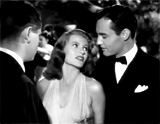 Gilda: "If I'd been a ranch, they would've named me the Bar Nothing" 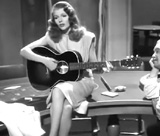 Gilda Strumming "Put the Blame on Mame" 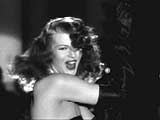 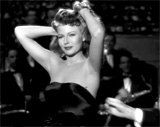 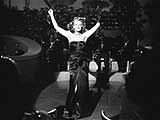
Gilda's Famous Strip-Tease 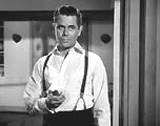 Gilda to Johnny: "Got a light?" 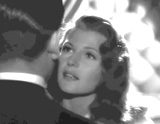 "I hate you too, Johnny" 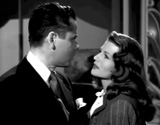 "Johnny, let's go home" |
|||||||||||||||||||||||||||
|
The Killers (1946)
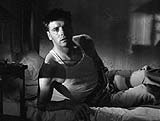
This classic, definitive film noir (a tale of robbery, unrequited love, and brutal betrayal in a twisting double-cross) - an adaptation of a 1927 short story by Ernest Hemingway, was told in eleven taut flashbacks after a bravura opening murder sequence. Two professional hit men cold-bloodedly murdered doomed ex-boxer Ole 'Swede' Andersen (Burt Lancaster, in his film debut) who had been hiding out in a New Jersey town under an alias for six years. He was warned in a nearby boardinghouse to flee, but was indifferent to their deadly approach and passively awaited his death on his bed. The Swede accepted his death stoically because, as he admitted fatefully: "I did something wrong once." He calmly sat up in bed when he heard the two cold-blooded gunman-executioners entering his downstairs boarding house door before climbing the stairs, entering his room, and blasting him with multiple gunshots.
The Swede's final words referred to the film's complex tale of crime and treacherous betrayal - all revolving around a beautifully-glamorous, mysterious, double-crossing, manipulative, vixenish femme fatale named Kitty Collins (Ava Gardner). Told in flashback, at a swanky hotel party scene, the Swede met and fell under the spell of gorgeous, alluring and treacherous femme fatale Kitty Collins (Ava Gardner) (wearing a sexy black dress and singing "The More I Know of Love"). She was the moll/girlfriend and "hostess" of imprisoned, sleazy racketeering king-pin boss Big Jim Colfax (Albert Dekker), who was absent and in jail at the time. The Swede first took a jail sentence rap in Kitty's place for stolen jewelry, and later, while planning a hat factory heist with Colfax, the Swede again fell under the allure of the treacherous Kitty. Kitty admitted that she knew of the Swede's obsessive love that she could cleverly manipulate on the eve of the heist:
Late one night just before the robbery, the unscrupulous Kitty lied to the Swede about the heist, and admitted her poisonous, duplicitous, and lethal nature, while promising the Swede that the money would allow her to get away from her hated boyfriend (another major lie). She told him that he was being set up by the betraying Colfax, and then confessed her love. After deceiving the Swede, she had him promise: ("Promise me one thing. You won't give me away. If Colfax ever found out what I did...You know why Colfax hates you? Because of me. He's no fool. He sees what's happened"). When the Swede asked: "Why did you ever go back to him, Kitty?", she responded with her most famous line:
She persuaded him to get revenge on Colfax by stealing the payroll. Trusting blindly in Kitty, the Swede double-crossed the gang and robbed them of the payroll at the farm house, but then Kitty double-crossed him by stealing the money and ditching him. The noir film ended when she was revealed all along to be Colfax's wife and partner in crime. She knelt by her husband's body as he was dying and again expressed how heartless and selfish she was. She repeatedly begged her dying husband to lie for her (as the Swede once did):
It would save herself from serving prison time, and to confirm her innocence about the hired killers. Colfax, her potential fall guy, expired after asking for a cigarette. His silence criminally implicated Kitty and condemned her. The film's final line was uttered by insurance investigator James Reardon (Edmond O'Brien), who wrapped up his own findings about Kitty's smoldering triple-cross: "The double-cross to end all double-crosses!" |
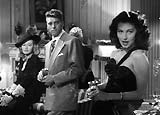 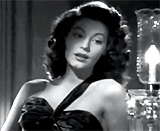 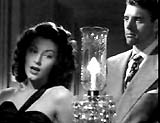 Femme Fatale Kitty in Swanky Hotel Party Scene 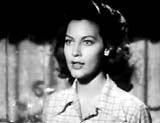 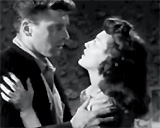 Kitty Took Advantage of the Swede's Obsessive Love 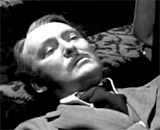 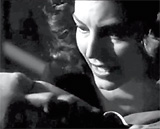 Lethal Wounding of Kitty's Boyfriend/Husband Colfax in Film's Conclusion |
|||||||||||||||||||||||||||
|
Night Editor (1946)
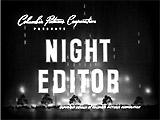
Columbia Pictures' and director Henry Levin teamed to create this short, hard-boiled, B-quality, noirish crime drama and police detective thriller with a prolonged flashbacked tale. It was the first (and only) film dramatized and based on a previous episode in the Night Editor radio series (broadcast weekly from 1934-1948). The low-budget noir was set up to be the account of a night newspaper editor's description of the 'inside scoop' on a current tawdry crime story. The cautionary story, accentuated by crisp b/w cinematography and moody dark lighting, involved murder, infidelity, lust, blackmail, double-crosses, the blending of sex and violence, a manipulative and icy cold, treacherous, psychopathic blonde femme fatale, and a last minute twist ending. The tagline was an apt description:
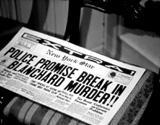
The film opened on a hot summer's night as late-for-work, troubled young reporter Johnny (Coulter Irwin) slowly ambled into the fictional New York Star building and climbed to the second floor. He was slightly drunk and sick-looking, and known to be lazy and neglectful of his family and domestic duties for the last few weeks. He found a graveyard-shift poker game in progress among his colleagues in the city newsroom. Mr. Crane Stewart (Charles D. Brown), the editor of the newspaper, led the gathering, and also greeted hot-shot, hard-working homicide detective 'Doc' Cochrane (Robert Stevens) who declined to join in the game, and instead was completing some research in the newspaper morgue. As he was playing poker with his friends, Stewart began to tell a cautionary Prohibition-Era story from the late 1920s or early 1930s in NYC, by prefacing it with a common human problem - similar to what Johnny was facing: "A guy will make a mistake, then he'll get in deeper and deeper, and the first thing you know, a mountain falls on him." At the start of the film's long flashback, he recalled the quick-and-dirty story of the homicide division's Police Lieutenant Tony Cochrane (William Gargan) from a generation earlier - a compromised, morally-conflicted police officer involved in a murder investigation. [Note: It was glossed over that the 'Tony' in the story was the father of 'Doc' Cochrane.] The tale began with a description of Tony Cochrane: a middle-class family man with a plain, unsophisticated yet devoted wife Martha ("Jeff"/Jean Donnell), and a young son named 'Doc' (Michael Chapin as young boy) that he doted on. But it soon became obvious that Tony was becoming more and more neglectful of his family. His son advised as he was put to sleep: "Keep your nose clean." Working nights, Tony's wife Martha suspected that he was cheating and faithless while away for long periods of time - she mentioned: "I love a cop. I'd like a husband too, for a change." The first view of Tony's fur-wrapped, wealthy, high-sclass paramour Jill Merrill (Janis Carter) as he pulled up outside her walk-up townhouse was a legs-only shot. She seemed sexually-voracious and immediately demanded a kiss. He postponed her by asking - with vampirish overtones: "What do you want, blood?" and she responded: "Yes, blood!" He cautioned: "Don't boil over the edge, Jill. It ain't time yet. We got a little talkin' to do."
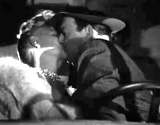
Tony entered the Homicide Squad Room and the inner office of his superior, Police Captain Lawrence (Harry Shannon), where they discussed how he was working overtime on his cases and was lacking sleep. It seemed obvious to most of his colleagues (and his family members) that Tony's job performance and demeanor had changed, and he was suffering from being engaged in something nefarious. Indeed, he was having an adulterous affair with Jill - a glamorous, big-league and sophisticated blonde out of his lower-tiered league (from the wrong side of the tracks), and he was ready to break off his sexual association with her after a year. Parked at a deserted beachfront location at Mitchell Beach - a popular lovers' lane spot for couples, he delivered an ultimatum to Jill. Her first reaction was that she suspected his wife had found out about their secretive and romantic entanglement, but he denied that was the case. Tony knew his time was up with her and that the woman was trouble, and he attempted to drop the haughty and rich socialite. But she was sexually irresistible to him and his resolve weakened:
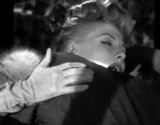
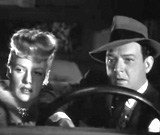
Suddenly mid-kisses, the duo were startled by the bright headlights of another car (an open convertible) that pulled up nearby, with another couple inside. Then, they heard a woman's scream, and witnessed the male driver standing outside the vehicle and brutally bludgeoning, pummeling and striking his female companion to death with a tire iron. In their switched on headlights, they caught a clear glimpse of the murderer. Tony's instincts immediately kicked in - he pulled out his gun and began a rapid pursuit after the fleeing killer making his getaway, but Jill yelled for him to stop: "Tony, please stop, there'll be a scandal. Your wife, she'll leave you. You'll lose the kid." Tony slowly responded and lowered his gun - realizing that he couldn't report the crime without revealing their scandalous and cheating affair - something that would ruin his life. He walked over to the open passenger door where the female victim's legs were extended, and saw her bloody corpse. Stunned by the sight, he walked back over to his car: (Tony to Jill: "He killed her. Beat her brains out with a tire iron. He got away"). Jill wanted them to keep their eye-witness experience to themselves, so that they wouldn't get involved: "You're not going to say anything, Tony. Let the cops find out for themselves." Tony felt he was neglecting his obligations as a cop to prevent the murder and stop the killer: ("I'm a cop. I didn't even try to stop him"). Then, the frenzied and perverse Jill became borderline orgasmic and sexually aroused with bizarre erotic excitement when she voyeuristically begged to see the bruised and battered body of the female victim: ("Tony, I wanna see her. I wanna see her, Tony! I wanna look at her!"). But Tony told her to shut up, denied her the crazed possibility, and drove away.
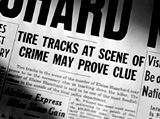
The next day, the now-compromised NYPD cop Cochrane was called to the beach crime scene, to investigate the killing with his partner Ole Strum (Paul E. Burns), but he was unable to reveal to anyone that he had been present and witnessed the crime. He heard a description of the girl's lethal injuries ("Skull crushed like an eggshell by repeated blows with a blunt instrument"). There were two pieces of evidence that seemed promising:
Captain Lawrence asked Tony to capture the extra set of balloon tire tracks at the murder site with a plaster impression. Robbery was a possible motive, but it seemed "too easy" an explanation - the victim (who had been drinking) had $200 in cash in her possession and was wearing about $12,000 dollars worth of jewelry. She might have picked up a hitchhiker or someone had seen her ostentatious jewelry and robbed her. Pawn shops were to be surveyed during the case. Conjectures were made that the victim had a "love angle" - maybe she was involved in a dangerous affair with a married man. Tony was instructed to review Elaine's bank statements (canceled checks). Strom mentioned to Tony that he was acting strangely - hinting that he sensed that Tony was somehow involved:
In addition, a list of the names of the dead victim's friends were compiled - and they included - to Tony's surprise - the names "Mr. and Mrs. Benjamin Merrill." He was reminded that his own mistress Jill was cheating on her elderly husband Benjamin Merrill (Roy Gordon). Tony phoned the Merrill residence, but was unable to reach Jill. Then he phoned his wife Martha and admitted that he had been a 'stranger' - causing her to perk up, but then after he encouraged her to leave the house, the call didn't end well.
Knowing that his wife would be out of the house between certain hours that evening, and to cover his own guilt and involvement (specifically, the tire track evidence that linked his car to the site), Tony began to switch out his tires in his garage. In the middle of the job, Martha returned home, and he snapped at her for showing concern and for inquiring about what he was doing. Tony visited the home of the Merrills as part of his investigation, since their names were on the victim's friends list. It was revealed that Tony had first met the couple (and Jill) a year earlier about a different case - presumably when he started his affair with her. After her husband left for the office, she admitted she had put on "an act" for him, and offered a reunion drink and her close company. He told her he had reconsidered their recent breakup: ("I'm just giving up struggling. I know when I'm hooked....Yeah, you got my number and I know it...I said to myself, 'What's the use of struggling. You go for her, and she goes for you'"), but then he came close for a kiss in order to confront her for information he knew that she had - her friendly association with the killer, but she wouldn't reveal the man's identity:
She begged as he held the upper hand over her: "Come back and see me, Tony." He sarcastically promised he would: "I'll come back and see you, baby. That's one thing you can be sure of. We're partners, ain't we?" Next, Tony visited the Hudson National Bank to review Elaine's cancelled bank checks. He was brought to the desk of the bank's VP, Douglas Loring - where he was shocked to recognize Loring as the man (having an affair with Elaine Blanchard) who fled from the car at the beach after killing her. The smooth-talking Loring claimed he had been family friends with the Blanchards for years, and regretted her death at so young an age. As Tony departed from the bank, he did a double-take when he heard a newspaper vendor exclaiming that the Blanchard killer had been arrested and that the beach murder mystery had been solved. A tramp named Phillips (Charles Wagenheim), a journeyman-carpenter, was seated in Captain Lawrence's office when Tony returned. Supposedly it was an "open and shut" case, because Phillips was found with some of Miss Blanchard's jewelry, and his prints were all over Elaine's purse. (Tony realized that the opportunistic tramp had only robbed the dead woman at the beach and stolen from her, but did not commit murder.) He worried that the convicted yet innocent man would soon face the death penalty (the electric chair). Tony met up with Jill on a sidewalk, and as they walked along, she spoke about recognizing the "murderer" sitting in the bank nearby: "Of all places, in a bank. Sitting there as calm as...In a bank. He doesn't look like a murderer. I think he's rather attractive." Tony quipped: "So's a snake." She invited Tony on a date - completely uncaring and unphased that the case was improperly concluded and that an innocent man was facing the death penalty ("They got the murderer, didn't they? Some thieving little tramp"). They spoke further a few minutes later in the public library between stacks. Jill continued to be uncooperative, intimidating, insensitive, and completely lacking a moral compass when she blamed the victim for her mishap: "Elaine was a nasty little brat. She probably had it coming to her..." She also added: "She probably deserved it." The cold-hearted Jill thought nothing of the innocent man who had been charged:
She refused to cooperate and confess the real truth to the authorities, and condemned Tony's white-knight search for the truth: "You're acting like a fool. Looking for more trouble?...Tony, dear, you're not the Galahad type. Do you want to mess up both our lives, lose your job, your wife, your child? What about his wife? If you feel so big-hearted, why don't you think about what it will do to her?" Tony had suspicions that the promiscuous and duplicitous Jill was also romantically involved with the married killer, and saw through her outer beauty into her inner rotten core:
When she claimed she loved Tony, he called her a venomous and lethal black-widow spider: "A fine kind of love, a female spider." He refused another request for a date with her. Through trickery, Tony was able to obtain Loring's fingerprints (by touching and identifying some of Elaine's jewelry, and then by signing a release form with a fountain pen), and matched them to his fingerprints in the car. Although Tony thought he had enough evidence to incriminate Loring, in the office of DA Bill Halloran (Jack Davis), Loring openly confessed that he was the last person to see Miss Blanchard alive on the afternoon of her death, and said she was in love with him. Because of their acquaintance, naturally his fingerprints would be the second set of fingerprints in the car. Loring then delivered a more stunning revelation - he claimed he was also romantically involved with Jill, and his alibi was that they were at a late movie together on the night of the murder - an outright lie - and she was conveniently there in the office to corroborate his whereabouts. Feeling completely stunned and betrayed, Tony went to get a drink at a bar and called Jill to meet him. He was flabbergasted by her duplicity: "What kind of a hot brick did you hand me down at the DA's office?" He insisted that she revise her alibi and admit her lies to the DA: ("You're gonna tell him you weren't with that ape, but with me that night"). She called him a "poor, dumb cop," and concurred that she really did have a "new boyfriend" (Loring) that was more her "type." She sneered: "You can go back to your Martha now." She refused to recant her deceptive lies, and claimed that by 10 o'clock the next morning (the time of Phillips' execution), it would all be over. Tony felt compelled to confess to his partner Ole that he was present at the beach site where Loring committed the crime ("I saw him do it"). He provided concrete "proof" or evidence of his involvement with femme fatale Jill ("a pretty bad one") - by showing Ole his switched-out, discarded tires in his garage with distinctive marking on the tire tracks. He briefly spoke to Martha about how he was mixed up in a major problem that he was resolving, so that he could return to her - but he hinted that he might lose his job. He realized that his confession would destroy his career and marriage, and inevitably result in jail time.
Tony (with Ole) went to arrest Jill at a party late that night in her home. Tony discovered her in her kitchen with Loring - in mid-kiss and embrace. When Loring left, Tony told her that he had revealed solid evidence of their involvement, and insisted on taking her to the DA's office: "Now we go down to headquarters and sing a duet. You're gonna tell them you lied about Loring." She falsely claimed that he had made her stronger so that she could confess - and asked for one final kiss: "Why I suppose we're through. You can give me one goodbye kiss. Come on. One farewell kiss. It won't hurt much" - and then like a venomous spider - after he called her "a screwy dame," she attempted to kill him by stabbing him in the back with an ice-pick. And then incredulously, she claimed that she didn't mean to kill him. Although shocked and seriously wounded, Tony (sweating profusely) was able to quietly lead Jill out of the house to the awaiting police. She told him: "I'll tell them, Tony, honest." He resigned (by handing over his detective's badge to Captain Lawrence). Ole reminded him of the consequences: "You lose your job, maybe Martha and Doc. You go to jail. It took a lot of guts. I'm proud of you, Tony." And then Tony collapsed onto the ground. Night editor Crane Stewart's flashbacked story ended - it immediately sobered up the young drunken and "mixed-up" reporter Johnny. In the film's last minute plot twist reveal, after hearing the story, Johnny had already left the office and walked into the lobby of the newspaper building. Realizing he was out of cigarettes, he asked to buy a pack from the familiar cigarette/cigar stand vendor - Tony. Suddenly it dawned on him that this 'Tony' was the main protagonist of the story - Tony Cochrane - the father of grown-up homicide detective 'Doc' Cochrane in the office. He was overjoyed to meet him, but then decided to hurry home to his wife in order to not repeat Tony's mistakes.
|
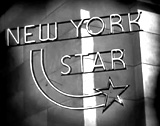 Opening Setting For Film: Newspaper Office 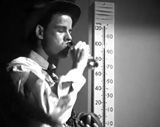 Drunken Reporter Johnny (Coulter Irwin) 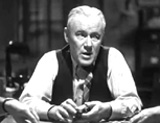 Editor Crane Stewart (Charles D. Brown) 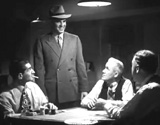 'Doc' Cochrane (Robert Stevens) 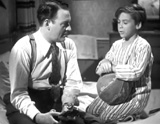 Flashback: Tony Cochrane (William Gargan) with His Young Son 'Doc' 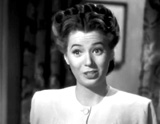 Tony's Plain Wife Martha ("Jeff"/Jean Donnell) The Bloody Murder Scene: 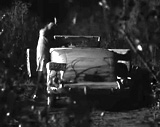 A Brutal Bludgeoning 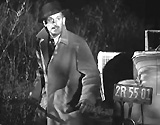 A Clear View of the Killer 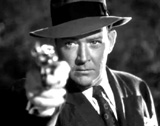 Tony's Pursuit with a Gun 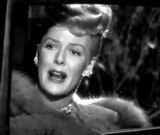 Jill's Efforts to Stop Tony, Threatening Scandal 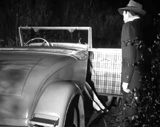 Tony's Viewing of the Dead Female Victim 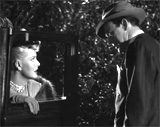 Tony and Jill Discussing the Murder 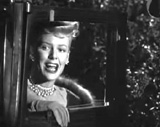 Jill's Perverse Desire to See the Bloody Body 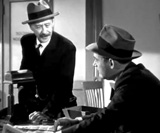 Tony with Partner Ole Strum  Ole Strum's Suspicions About Tony 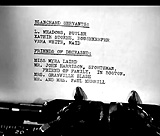 The Names of Friends of the Victim - Including Jill and Her Husband 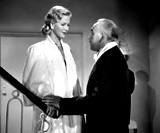 Jill with Her Elderly Husband Benjamin 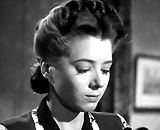 Tony on the Phone with His Wife Martha 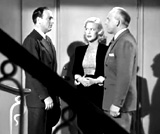 Tony Speaking With the Merrills 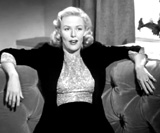 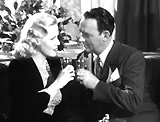 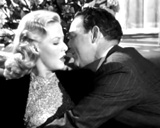 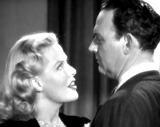 Private Time with Jill - To Confront Her About Her Knowledge of the Killer! 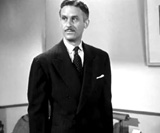 The Hudson National Bank VP: Douglas Loring (Frank Wilcox) - The Killer 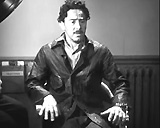 Falsely Arrested Murder Suspect - Phillips 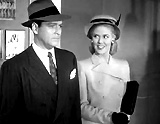 Mrs. Jill Merrill - Without a Conscience 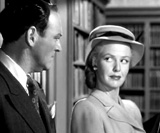 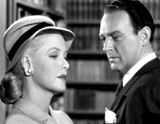 Jill - Uncaring and Insensitive About the Murdered Victim or the Innocent Suspect 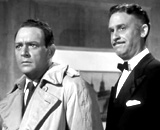 Loring's Confessions in the DA's Office - Stunning News to Tony 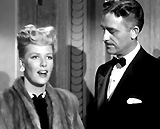 Jill Corroborating Loring's False Alibi 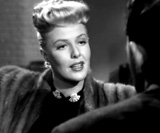 Jill Claiming To Tony That She Had a "New Boyfriend" (Loring) 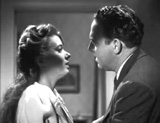 Tony Reconciling Himself With Martha 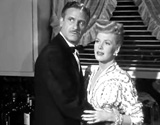 Tony Discovered Jill Kissing Loring in Her Kitchen During Party 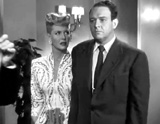 Wounded Tony Leading Jill Out of the House to Authorities 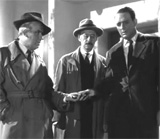 Tony Resigning From the Force By Turning In His Badge 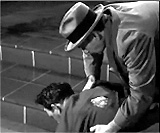 Tony Collapsing onto the Ground |
|||||||||||||||||||||||||||
|
The Postman Always Rings Twice (1946)
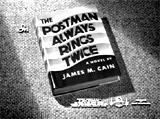
This stylish, sexually-charged, moody and fatalistic film about lust and murder (adapted from James M. Cain's 1934 novel) by director Tay Garnett was best known for one of the hottest portrayals of a sultry and seductive femme fatale - it was one of "sweater girl" Lana Turner's finest performances as a seductress. It was advertised in the tagline with: "Their Love was a Flame that Destroyed!"
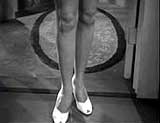
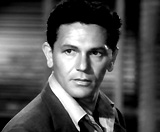
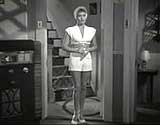
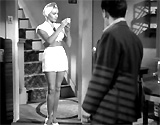
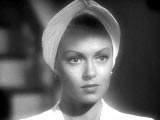
The film was advertised with posters that described the illicit passion between drifter Frank Chambers (John Garfield) and married, libidinous, restless and unsatisfied platinum-blonde waitress Cora Smith (Lana Turner) in a roadside cafe. Drifter handyman and mechanic Frank Chambers (John Garfield) was dropped off in front of the rural Twin Oaks Diner, owned by California roadside eatery proprietor Nick Smith (Cecil Kellaway). Soon after, he took his first look at hot-blooded, voluptuous Cora -- not knowing she was the cafe boss' wife. Her sexy entrance was prefaced by her lipstick case noisily rolling across the floor of the cafe toward him. The camera tracked back to her nude slim legs in the doorway. Frank looked at all of her - she was provocatively sexy and scantily clad in white shorts, white halter top, and white turban. He set his eyes on the whitish platinum-blonde woman, bent down and picked up her lipstick, and asked: "You dropped this?" She stood with her hand outstretched, waiting for him to bring it over to her. But he held onto her possession in the palm of his own hand and then leaned back on the counter.
She strutted over and took the case out of his hand. She walked back to the doorway, stood sideways, and applied lipstick to her lips before shutting the door. A little later, she and hired worker Frank officially met and spoke for the first time. She began bossing and sizing him up while he made suggestive advances towards the untouchable yet glamorous woman. Suddenly, Frank grabbed her and planted a kiss on her lips. She reacted with great poise - she pulled out her vanity mirror, cleaned up the smudged lipstick on her lips, and then reapplied the lipstick before leaving - without a word. There was terrific magnetism between the two Immediately smitten, Frank soon proposed to the voluptuous Cora to leave with the promise of adventure to escape her life of boredom and defeat, and her marriage of convenience. Cora placed an incriminating note into the cash register: "Nick - I'm going away with Frank - I love him. Cora" - when they planned to run away together. However, they changed their minds and returned in time to retrieve the note. They hatched a more daring plot to get rid of her good-hearted husband Nick, although Frank knew that Cora's smoldering sexuality was also a trap which pulled him further toward murder. The lovers planned to eliminate the woman's unloved husband - unfaithful and soul-less Cora planted the idea of murder into Frank's head so that they could be together. The evil and conniving Cora convinced Frank to murder her husband, because she was engaged in a loveless marriage with him: (Cora: "There's, there's one thing we could do that would fix everything for us" Frank: "What? Pray for something to happen to Nick?" Cora: "Something like that"). Meanwhile, there were many illicit, moonlit beach swimming scenes between Cora and Frank. Their second awkwardly-executed attempt to kill Nick was successful. It was a staged accident on the road to Malibu Lake (by getting him drunk, knocking him unconscious, and pushing the car (with him inside) off the side of the road down a cliff). (Their first attempt had failed (a bathtub accident)). As they both decided to climb down to the car: ("We gotta mess ourselves up so we can prove we've been in the accident too"), Frank was the only one who climbed down, and he became trapped in the car as it plummeted further down.
The relationship between the two lovers slowly deteriorated, orchestrated when Cora's lawyer had her plead 'guilty' to both counts: murder (against Nick Smith) and the attempted murder (of Frank). Both began to distrust and despise each other, resulting in Cora retaliating by testifying that Frank was implicated in Nick's murder: ("This will be a full and complete confession of how Frank Chambers and I deliberately planned and carried out the murder of my husband Nicholas Smith. Frank Chambers and I are equally guilty, although it was Frank who smashed Nick in the head before the car went over the cliff"). As a result of her lawyer's ploy, Cora plea-bargained, was acquitted and freed. They pledged to restore their love, although they remained tense toward each other. The efforts of the star-crossed lovers ultimately led to their mutual destruction in unexpected ways. In the finale's tragic accidental car crash scene, the now-reconciled couple drove along the highway and neared their home after mutual recriminations and reconciliation, when Frank asked for a long-awaited kiss. Cora was painting her lips with lipstick. Her last words before warning of an impending crash were:
He responded: "I hope I don't wait." She replied lovingly: "Darling," and then they kissed, but she soon cried out frantically: "Look out, Frank!" - (their final kiss was unfortunately a fatal one). Distracted during 'kisses that come from life' while he was driving, Frank ran off the road, killing Cora ('with a kiss that comes from death') in a fatal auto accident. With startling imagery - the car door opened after the crash, Cora's lifeless arm fell off the seat, and her tube of lipstick slowly dropped to the floor of the car and onto the ground. In a subsequent trial, Frank was convicted of murdering Cora (although it was truly an accident). The headlines read: "GRAND JURY INDICTS CHAMBERS AS SLAYER: Killed Wife In Bogus Auto Accident, Charged to Face Murder Trial - Sensational Cora Smith Case Has Aftermath in Action against Husband." Frank was sentenced to death (execution in the gas chamber): "This man, Frank Chambers, and the dead woman, first murdered her husband to get his estate. And then Chambers murdered her so that he would have it all to himself." In his last words to the priest Father McConnell (Tom Dillon) in his cell before execution, Frank accepted his fate. He would pay with his life for a crime he didn't commit (Cora's death), making up for getting away with the murder of Nick:
|
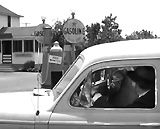 Hitchhiking Drifter Frank Chambers' (John Garfield) Arrival at The Twin Oaks Diner 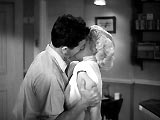 Frank Grabbing and Planting a Kiss on Cora's Lips 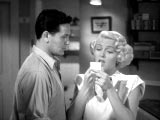 Cora Reapplying Her Lipstick 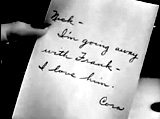 Incriminating Note - A Plan to Run Away Together - Shortly Later They Aborted the Plan 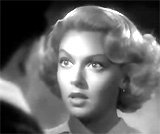 Conniving to Kill Cora's Husband Nick 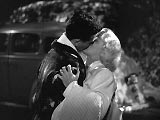 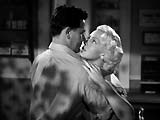 Furtive Kisses 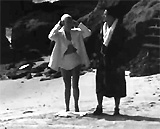 Moonlight Swimming 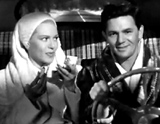 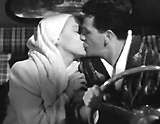 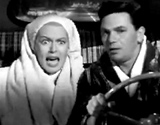  The Fatal Car Crash 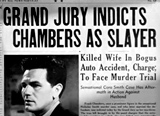 Frank Charged With Cora's Murder After Car Crash 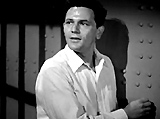 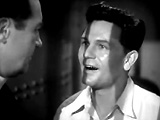 Frank's Final Words to the Prison Priest |
|||||||||||||||||||||||||||
|
The Strange Love of Martha
Ivers (1946)
This sordid, noirish, B/W melodrama told about three childhood friends who were brought together 18 years later for a climactic denouement regarding a murderous and guilty secret from the past, in the Pennsylvania town of Iverstown. The film opened in 1928 with young heiress Martha Ivers (Janis Wilson as a girl) bludgeoning (with a cane) her domineering, mean-spirited, tyrannical, wealthy Aunt Ivers (Judith Anderson) to death (on a flight of stairs, where afterwards, she tumbled to her death) during a raging thunderstorm - Martha sought revenge for her hard-hearted Aunt's caning to death of her beloved kitten named Bundles. At the time, Martha had repeatedly been planning to run away with her young, street-smart, independent-minded boyfriend Sam Masterson (Darryl Hickman as a boy). The murder was thought to have been witnessed by both Sam, who fled town (and joined a circus) and by young, prim, and bespectacled Walter O'Neil (Mickey Kuhn as boy) who was at Martha's side looking on. The weak-willed Walter was urged by Martha to lie about the killing to conceal her guilt. In exchange for their help in denying Martha's involvement, Walter's scheming father Mr. O'Neil (Roman Bohnen), Martha's greedy tutor, blackmailed Martha into marrying Walter (so that he could acquire her inherited wealth and influence), while a few years later, an innocent man was accused, condemned and executed for the murder of Martha's aunt. The love triangle clashed when they were brought together again years later in 1946. The three were:
Passing through Iverstown, Sam was forced to remain in the town after crashing his car into a signpost. Martha (and Walter) feared Sam's knowledge of the awful crime and would try to blackmail them, although at a crucial point in the film, he admitted that he did not witness Aunt Ivers' death ("I wasn't there. I left when your Aunt came into the hallway. I didn't want to stick around. I was in enough trouble as it was. I never saw what happened. I never knew until tonight about your Aunt or that man. The one they hung. The man that you and Walter killed").
Martha, who had never given up her love for Sam, decided to seduce him and then urged him to heartlessly kill her drunken husband after he fell down the ubiquitous staircase and was unconscious: ("Now, Sam. Do it now. Set me free. Set both of us free...Oh, Sam, it can be so easy"). Sam refused to comply with her: ("Now I'm sorry for ya....Martha, you're sick...You're so sick you don't even know the difference between right and wrong....I've never murdered"). After Sam declined to murder Walter and in fact helped him to revive, he prepared to walk out of the mansion. Martha threatened to shoot Sam as an intruder and sought assurances from Walter: ("We can't let him go, can we?...We'd be fools to let him go, knowing so much about us"); she thought she could use the legal argument of "self defense," but she couldn't pull the trigger on him and shoot him in the back. As he left, he told them: "I feel sorry for ya, both of ya." The shock double-suicide ending included Martha's death when she pulled the trigger on herself as her jealous and drunk husband Walter held a gun to her stomach during a deadly embrace - and then with her draped limply in his arms, Walter shot himself to death. Sam witnessed the two deaths through a window, as he stood outside the mansion, before he drove off westward with Toni - to get married (Sam to Toni: "Don't look back, baby. Don't ever look back. You know what happened to Lot's wife, don't ya?"). |
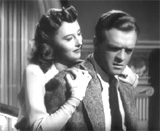 Martha Ivers (Barbara Stanwyck) with Sam Masterson (Van Heflin) - Urging Sam to Heartlessly Kill Her Unconscious Husband Walter 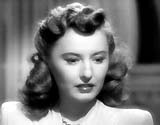 Martha Watching Sam Carry Walter Into the Study to Revive Him 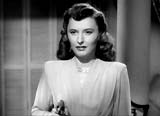 Threatening Martha Holding a Gun on Sam  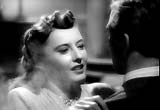 The Deadly Embrace Between Martha and Walter O'Neil (Kirk Douglas) 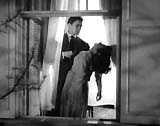
Double Suicide - Witnessed by Sam |
|||||||||||||||||||||||||||